
Places in this article: Samarkand · Bukhara · Khiva · Tashkent
Sights of Uzbekistan: the main places to see, city by city
Ask anyone in Tashkent what to see in Uzbekistan and you will get a list of towns, not of buildings. That is the right answer. In Samarkand, Bukhara and Khiva the great monuments stand a few minutes’ walk apart, so the real decisions are which places to put on your route and how many days to give each.
This is our list of the main sights of Uzbekistan, town by town and region by region, the way we plan them for our guests: what each place is, why it is worth your time and where to read more. At the end you will find how to see the essentials in 7, 10 or 14 days.
Eight places in Uzbekistan are on the UNESCO World Heritage List. Four are historic towns: Did you know? People still live inside Khiva's museum city Itchan Kala packs more than 50 historic monuments and about 250 old houses inside clay walls 8–10 m high and 5–6 m thick, and families still live and work in its lanes. Read more → in Khiva (1990), the centre of Bukhara (1993), Shahrisabz (2000) and Samarkand (2001). The others are the Did you know? Wild walnut and apple forests, now World Heritage Since 2016 the Western Tien-Shan, shared by Uzbekistan, Kazakhstan and Kyrgyzstan, has been a UNESCO World Heritage Site. Its lower slopes hold wild walnut and apple forests and the wild relatives of apricot, pear and cherry. Read more → mountains above Tashkent, a stretch of the A network of caravan routes between China and the Mediterranean. Samarkand, Bukhara and Khiva grew rich as stops along it. along the Zarafshan valley, the cold winter deserts of Turan in Karakalpakstan and, since 2026, ten modernist buildings of Tashkent, among them the Tashkent's old bazaar under a big blue-green dome, not far from Hazrati Imam. Bring cash in so'm. Read more → and a Did you know? A metro designed to ride out a magnitude-9 earthquake The three original lines of the Tashkent Metro were built to withstand an earthquake of magnitude 9.0, and the tunnels lie unusually shallow, only 8–25 m below the street. Read more → station. What each one looks like on the ground is in our guide to Uzbekistan’s UNESCO sites.
Samarkand: the Registan and Timur’s capital
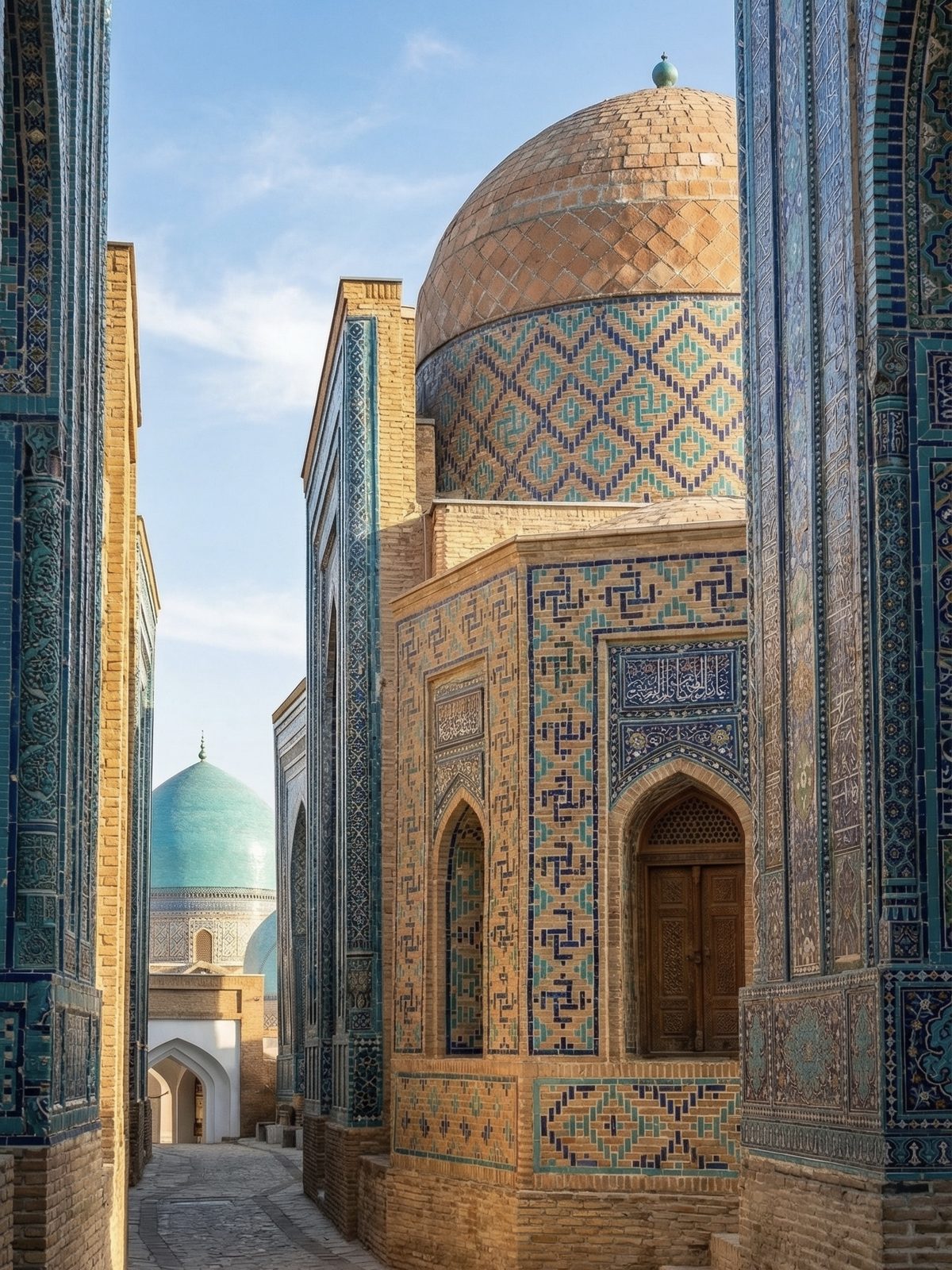
If you have time for only one city, make it Samarkand. Two full days cover the essentials; three let you add the Did you know? Paper polished with stone, made to last 400 years At the Meros mill in Konigil, founded in 1996 to revive a craft that had died out, a water wheel beats mulberry bark into pulp, and each sheet is polished for hours with agate, shell or horn. It is made to last some 400 years. Read more → and the Did you know? Ulugh Beg measured the year to within 25 seconds Working at his Samarkand observatory, Ulugh Beg put the tropical year at 365 days 5 h 49 min 15 s, about 25 seconds too long, closer than Copernicus a century later. Read more → without hurrying. Our plan for Samarkand in 1, 2 or 3 days puts everything in walking order, and tickets and hours are in Samarkand sights: tickets and opening hours.
The Registan
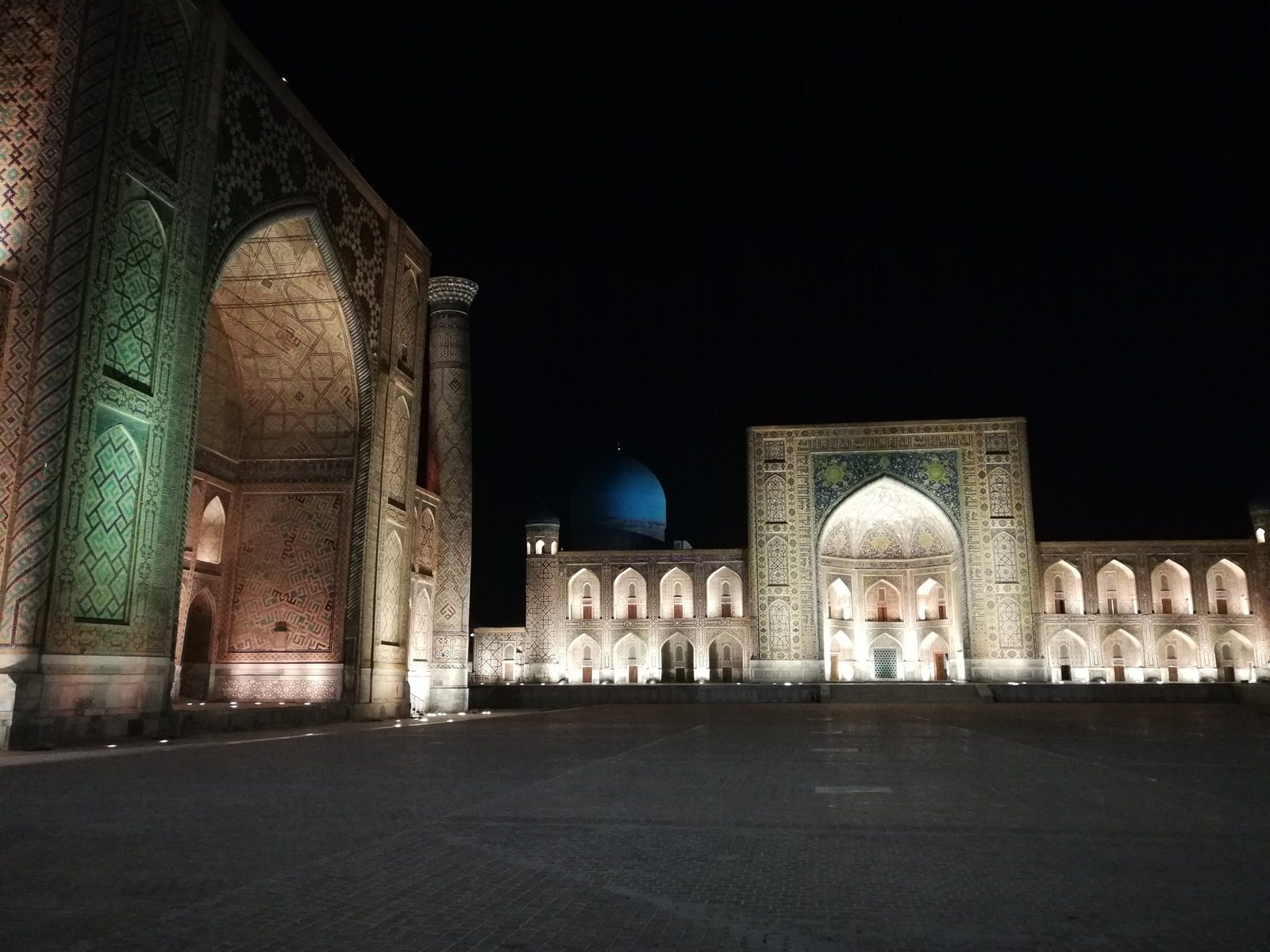
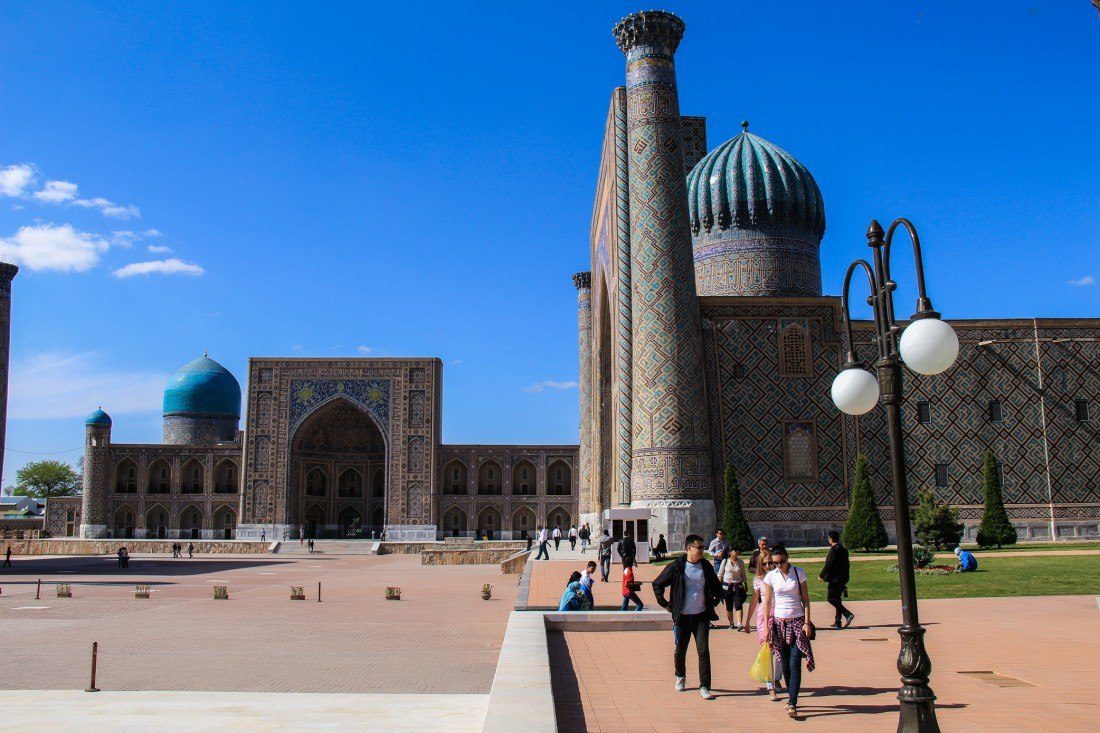
Three madrasahs face one square. Ulugh Beg built the first in 1417–1420 and taught astronomy in it; ,Did you know? The Registan's sun-carrying lion went on a banknote The Sher-Dor Madrasah (1619–1636) is named for the big cats with the sun on their backs on its portal. The image appeared on the reverse of Uzbekistan's 200-som note of 1997. Read more → two centuries younger, has tigers and human-faced suns over its gate; Did you know? The 'gilded' mosque of the Registan Tilla-Kari, built in 1646–1660, means 'gilded'. With Bibi-Khanym in ruins, it served as Samarkand's main Friday mosque until the 1920s. Its prayer hall glows with kundal, relief painting finished in gold leaf, restored in 1979. Read more → hides a gilded mosque behind a calm two-storey front. Come at opening time and again after dark. More: the Registan, its history and legends.
Gur-e-Amir
Amir Timur (Tamerlane, 1336–1405), founder of the Timurid empire, which had its capital in Samarkand. Born near Shahrisabz. began this tomb for his grandson and heir, ,Did you know? Timur's tomb was built for his grandson Gur-e-Amir was begun in 1404 for Muhammad Sultan, Timur's grandson and chosen heir. Timur had a crypt ready in his home town of Shahrisabz, but when he died in 1405 he was laid in Samarkand, in the tomb meant for the young prince. Read more → and a few months later was buried in it himself, in 1405, under a dark green stone. Ulugh Beg lies a few steps away, and the interior shines with gold. More: Gur-e-Amir, Timur’s tomb.
Bibi-Khanym Mosque and Siab Bazaar
Timur’s Friday mosque, begun in 1399 with the spoils of his Indian campaign, was meant to hold 10,000 people in its courtyard alone; its portal rises 35 metres. ,Samarkand's main bazaar, right next to Bibi-Khanym: Samarkand bread, dried fruit, nuts and halva. Read more → the city’s main bazaar, starts right beside it, so this is where we stop for lunch. More: Bibi-Khanym Mosque and the bazaars of Uzbekistan.
Shah-i-Zinda
A lane of tiled mausoleums climbing a hillside, barely wider than a corridor. Timur’s sister, niece and wife are buried here, and at the top is the shrine of Kusam ibn Abbas, the Living King of the legend. Come early, before the groups and the heat. More: Shah-i-Zinda, facts and legends.
Ulugh Beg Observatory
What survives is a trench in the rock with two marble-faced rails: part of a sextant with a radius of about 40 metres, the largest astronomical instrument of its age. Ulugh Beg’s star catalogue lists 1,018 stars. More: Ulugh Beg Observatory.
Around Samarkand
In ,A village near Samarkand where paper is made by hand from mulberry bark, the old way, at a working mill on the stream. 13 km from the city, the Meros mill still makes paper from mulberry bark with a water wheel. The Imam al-Bukhari complex in Khartang, 25 km away, reopened in March 2026 after a rebuilding on a far larger scale. More: Samarkand paper in Konigil and day trips around Samarkand.
Bukhara: an old town you can walk end to end
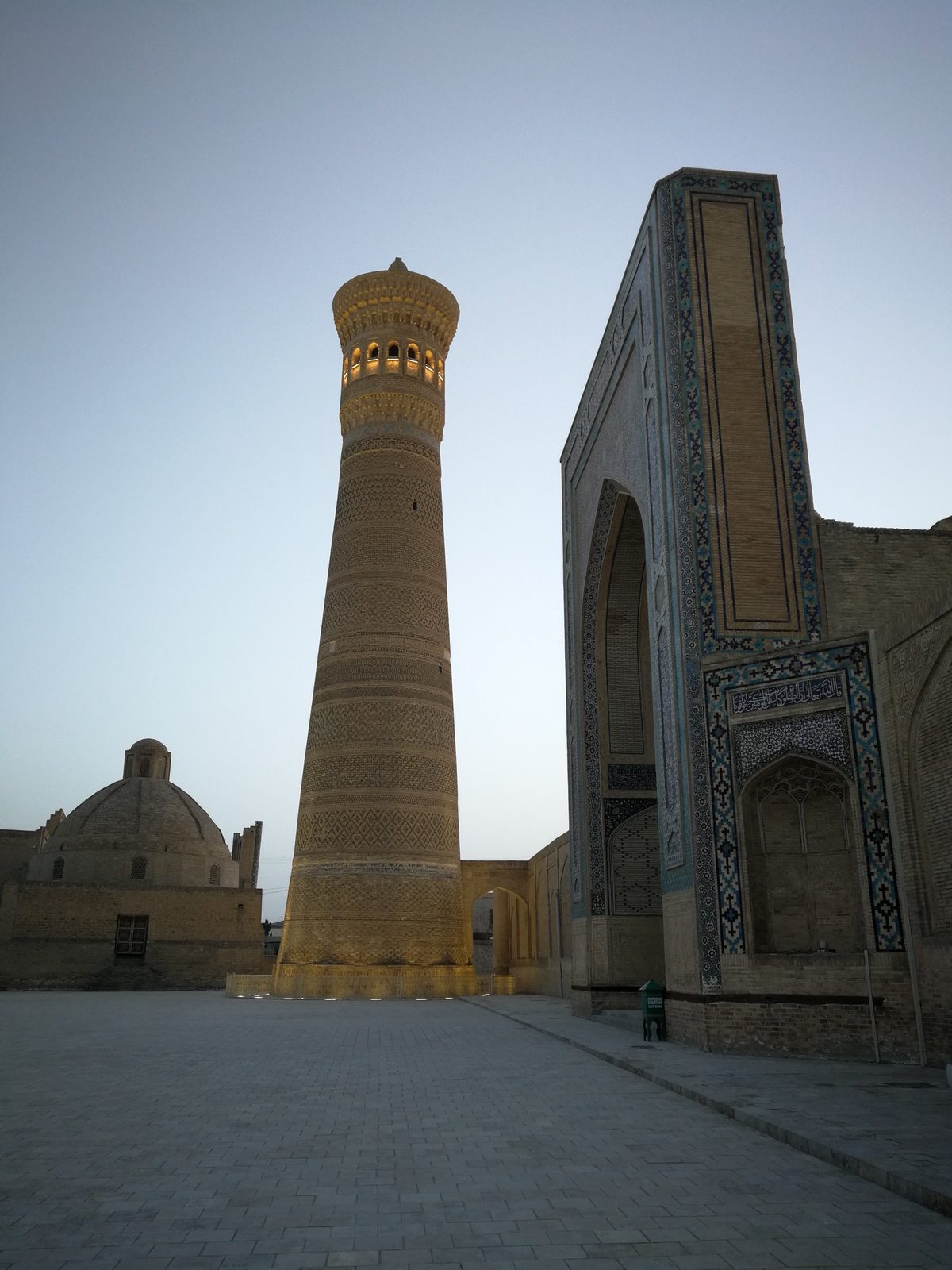
Almost everything in Bukhara lies on one short line, from Did you know? Bukhara's ponds were once its water supply Pools like Lyabi-Hauz, dug around 1620 and 46 × 36 m, were the city's main source of water. Most were filled in during the 1920s–30s because they spread disease; Lyabi-Hauz survived. Read more → in the east to the Samanid park in the west. Two days on foot cover the old town well; a third takes you by car to the emir’s palace and the shrines outside town. The day-by-day version is Bukhara in 1, 2 or 3 days.
The Ark
A fortress on a hill that people built up over more than two thousand years. Its walls rise 16 to 20 metres, and Bukhara’s rulers lived behind them until 1920. We start almost every Bukhara day here, at opening time. More: the Ark of Bukhara.
Poi-Kalyan
The ,Did you know? Diggers went 13 m down and never found its base The Kalyan Minaret of 1127 rises about 46 m, and an excavation reached 13 m without finding the bottom of its foundations. Genghis Khan reportedly ordered it spared. Read more → 46.5 metres of patterned brick built in 1127, was left standing when Genghis Khan burned the city in 1220. At its foot the Kalyan mosque and the Did you know? A madrasah still teaching after almost 500 years Mir-i-Arab, built in the 1530s opposite the Kalyan Mosque, was one of only three Islamic schools allowed to keep working in Soviet times, and it still trains students today. Read more → An Islamic college: student cells and classrooms around a courtyard behind a grand portal. In the old towns many now house museums and craft workshops. face each other across the paving. Come at sunset, then again after dark. More: Poi-Kalyan, facts and legends.
Lyabi-Hauz and Chor Minor
A pond of about 1620 with stone steps down to the water on every side, framed by a madrasah, a khanaka and teahouses: this is where Bukhara spends its evenings. Ten minutes away through residential lanes stands ,Did you know? Legend: four towers for four world religions? Chor Minor, a gatehouse of 1807, has four towers, each decorated differently. Guides say they stand for four world religions and look for a cross, a fish and a prayer wheel in the decor; others say four dynasties. All are interpretations. Read more → a gatehouse of 1807 with four blue-domed towers. More: Lyabi-Hauz and Chor Minor.
The Samanid Mausoleum and the trading domes
The Did you know? Buried in mud, this tomb escaped Genghis Khan The 10th-century Samanid Mausoleum, one of the oldest monuments of Islamic Central Asia, was covered by flood mud and sand before the Mongols came in 1220. Hidden for centuries, its brick lacework survived intact. Read more → is a 10th-century cube of patterned brick that survived the Mongols because floods had already buried it. On the way back into town, the 16th-century Did you know? Under Bukhara's domes merchants changed money and gold Four 16th-century trading domes still stand over old crossroads. Toki Sarrafon was the money changers' dome, where merchants from India and China swapped coins; Toki Zargaron held jewellers' workshops, Toki Telpak Furushon sold caps. Read more → give the best shade in the hottest hours.
Around Bukhara
,Did you know? Legend: the emir's palace site was chosen with meat Legend says that when Emir Nasrullah wanted a summer palace in the mid-19th century, sheep carcasses were hung in several places around Bukhara, and the spot where the meat spoiled last was chosen. Sitorai Mohi-Hosa there today dates from 1912–1918. Read more → the summer palace of the last emir, built in 1912–1918, has a White Hall of carved plaster laid over mirrors. Add the Did you know? A village renamed in honour of a Sufi master Bahauddin Naqshband (1318–1389), who gave his name to one of the largest Sufi orders, was born and buried near Bukhara in Qasr-i Hinduvan. The village was later renamed Qasr-i Arifan in his honour; the tomb over his grave dates from 1544. Read more → complex, the Did you know? A necropolis named after four men called Abu Bakr Chor-Bakr, 5 km from Bukhara, grew from 1559 around the grave of Abu Bakr Said, who died in 970 and was one of four Abu Bakrs, hence the name. Its 25 buildings joined UNESCO's list in 2023 in the Zarafshan-Karakum Corridor. Read more → necropolis and the potters of Gijduvan, and you have a full day by car. More: day trips around Bukhara.
Khiva: a whole town inside its walls
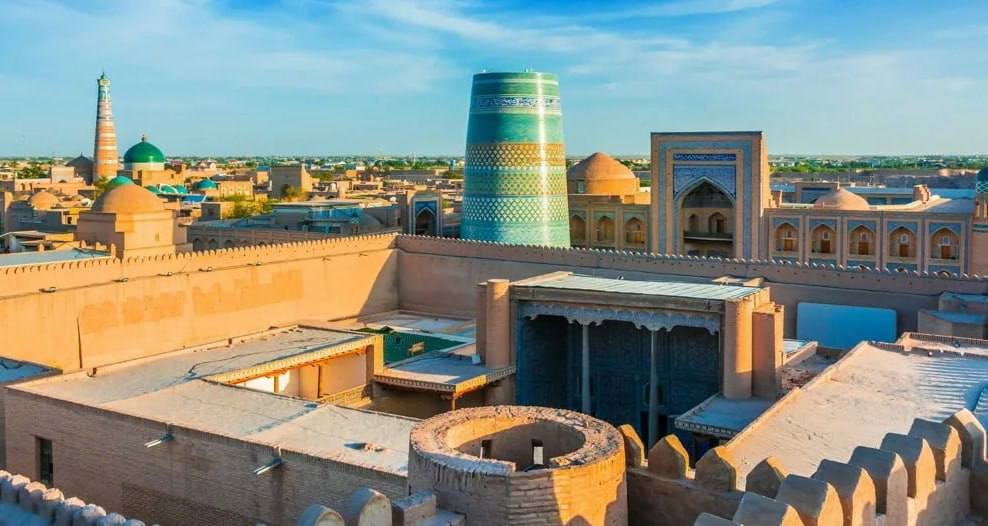
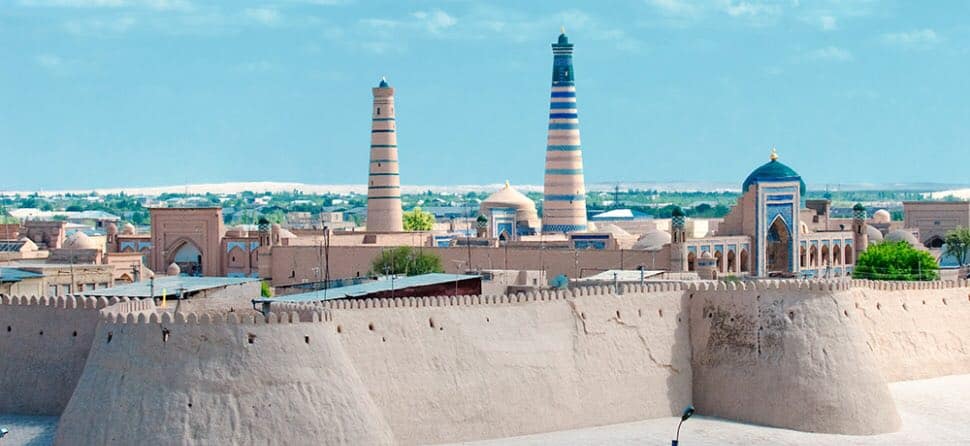
Itchan Kala, the walled inner town of Khiva, measures about 650 by 400 metres and holds more than 50 monuments, and people still live in its lanes. You can cross it in twenty minutes; we still give it a full day, because the light on the clay walls changes the place from hour to hour. The plan is in Khiva in 1 or 2 days.
Ichan-Kala and its walls
Clay walls 8 to 10 metres high run for about 2.2 km, with a gate on each side. Inside are the khans’ citadel, ,The old fortress-residence of the khans of Khiva, inside the walls of Itchan Kala. and the Did you know? In Tash-Hauli's harem each of four wives had her own loggia Allakuli Khan built the Tash-Hauli palace in 1830–1838 around three courtyards. In the harem four tall loggias belonged to the khan's four wives and a fifth, the largest, to the khan himself; behind each summer terrace lay a winter room. Read more → palace with its harem. Walking the lanes costs nothing; the monuments share one combined ticket sold at the West Gate. More: Ichan-Kala, history and legends.
Kalta-Minor and Islam Khoja
The short, wide Did you know? A 14-metre-wide base for a tower that stopped at 29 m Kalta Minor was begun in 1852 and meant to reach 70–80 m, but work halted in 1855 at about 29 m when its khan died. It is said to be the only minaret covered entirely in glazed tiles. Read more → was meant to be the tallest minaret in the region and stopped at 29 metres when the khan who ordered it was killed. The ,Did you know? Khiva's tallest minaret is barely a century old The Islam Khoja Minaret was begun in 1908, near the very end of the khans' era. At 56.6 m it is one of the tallest in Central Asia; a spiral stair of 175 steps leads up to its windowed top. Read more → finished in 1910, rises to 56.6 metres, and its 175 steps lead to the best view over the flat roofs. More: the two minarets of Khiva.
The Juma Mosque
A low hall held up by 212 carved wooden columns, rebuilt in 1788 with columns far older than the building. At midday the light falls through openings in the roof onto the forest of wood.
Tashkent: worth more than a transfer
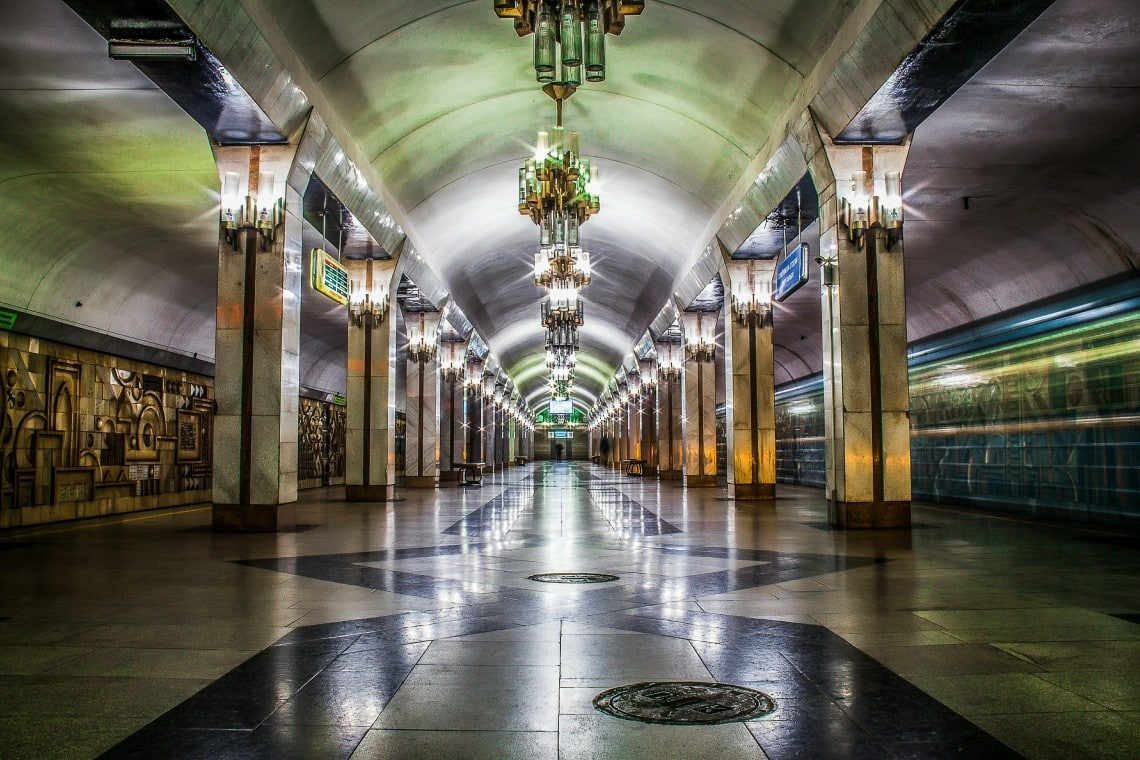
Most travellers treat the capital as an airport and a railway station. We live here and think it deserves a full day, two if you can spare them: see Tashkent in 1 or 2 days.
Hazrati Imam and the Center of Islamic Civilization
Next to the old mosques and madrasa of The religious heart of old Tashkent: madrasahs, a Friday mosque and mausoleums. Right next to it stands the new Center of Islamic Civilization, opened in 2026. Read more → rises a 65-metre dome: the Center of Islamic Civilization, opened in March 2026. In its Qur’an Hall lies the ,Did you know? Legend: Caliph Uthman's own Quran is kept in Tashkent Tradition holds that this huge parchment Quran is the personal copy of Caliph Uthman, and one story says Timur brought it to Samarkand. Radiocarbon dating gives 775–995, so it is more likely an early copy, yet still one of the oldest. Read more → a 7th-century Qur’an. Allow two to three hours. More: the Center of Islamic Civilization.
The metro
Opened in 1977, the first metro in Central Asia, with every station given its own theme and its own artists: crystal chandeliers, cosmonauts in ceramic, a poet’s love stories in turquoise relief. Photography has been allowed since 2018, and Did you know? A metro station where Ulugh Beg meets Gagarin Kosmonavtlar station, opened in 1984, has ceramic medallions of Ulugh Beg, Galileo, Icarus, Gagarin and Tereshkova, and glass stars in the ceiling that hint at the Milky Way. Read more → is now part of a World Heritage site. More: the Tashkent metro, station by station.
Chorsu Bazaar
The old city’s bazaar under a great blue dome, opened in 1990 and inscribed by UNESCO in 2026 with nine other modernist buildings. Come in the morning, when the bread arrives warm from the tandir. Evenings belong to the fountain parks and :Did you know? Legend: “Strength lies in justice” were Timur's own words The equestrian statue of Amir Timur in central Tashkent, unveiled in 1994, bears the motto “Strength lies in justice” in four languages. Tradition attributes the words to Timur himself, but historians cannot confirm he said them. Read more → see evening Tashkent.
Shahrisabz: Timur’s home town
About 90 km from Samarkand, over the Takhtakaracha pass at around 1,700 m, Shahrisabz makes an easy day trip. Its historic centre has been on the UNESCO list since 2000. Expect wide lawns between restored monuments rather than a maze of old lanes. More: Shahrisabz from Samarkand.
Ak-Saray
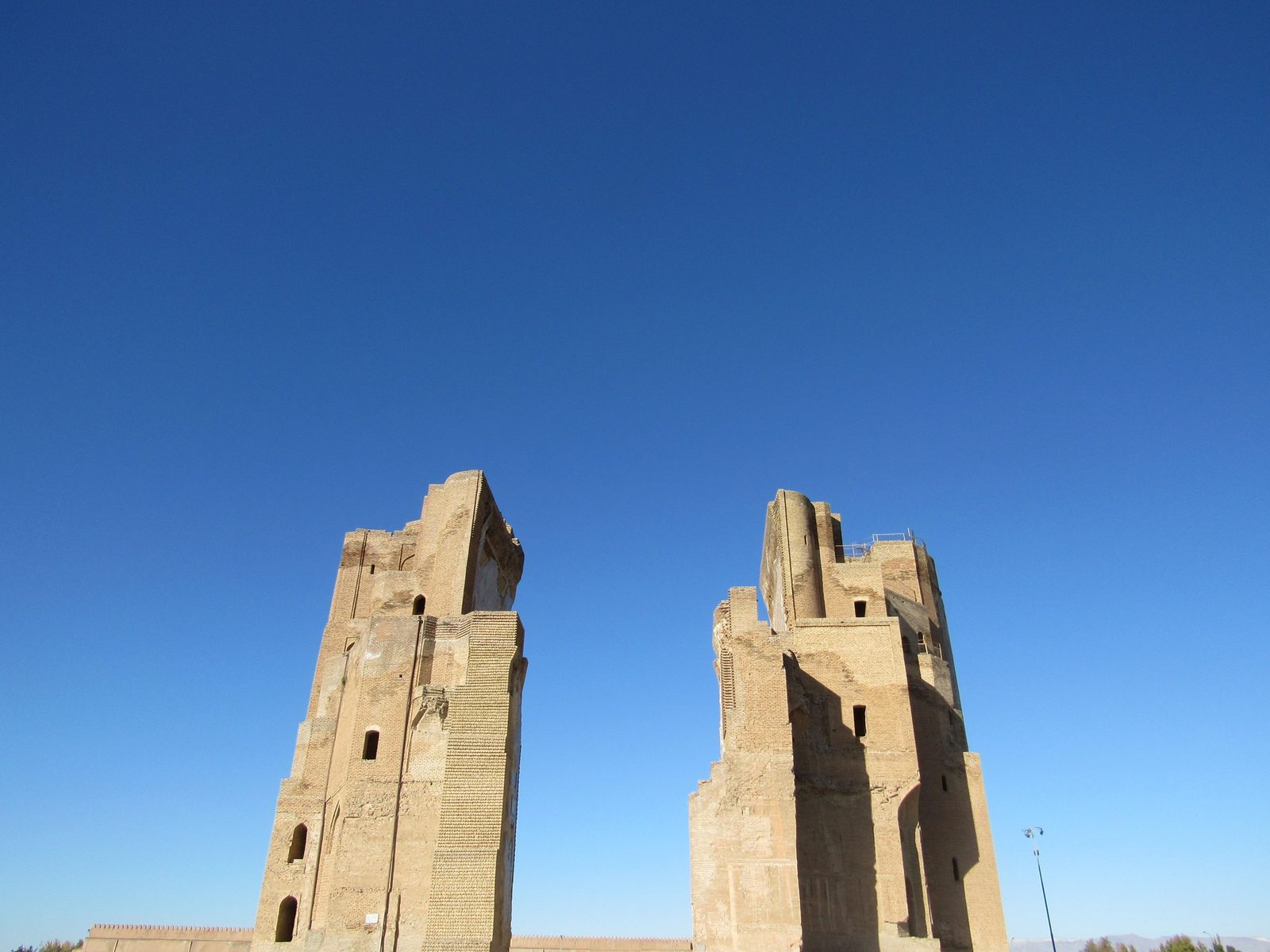
Only the broken towers of the gate of Timur’s White Palace survive, and they still rise about 38 metres, the height of a twelve-storey block. The 22-metre gap between them was once closed by a single arch. More: Ak-Saray, the ruined gate.
Kok Gumbaz, Dorus Siadat and Timur’s crypt
Ulugh Beg’s Friday mosque of 1437 under its blue dome; the memorial complex with the tomb of Jahangir, Timur’s eldest son; and an underground chamber where the stone casket Timur prepared for himself still stands empty.
The Fergana Valley: silk and ceramics
Since September 2026 a new electric train leaves Tashkent every day at 09:20 and reaches Did you know? Kokand's Friday mosque stands on 98 columns from India Muhammad Umar Khan built Kokand's Juma Mosque in 1812–1818. Its 100-metre iwan rests on 98 carved red-wood columns brought from India, and its minaret is 22 m tall. Inside is a small museum of applied arts. Read more → at 12:28 and Did you know? Legend says Margilan is named after chicken and bread Legend says locals greeted Alexander the Great with chicken and bread, 'murg' and 'non', and the dish gave the town its name. In fact Alexander never reached here; the name Margilan is recorded from the 10th century. Read more → at 13:00. Here you see Uzbek crafts being made, not just sold. Plan at least two days and one night: our Fergana Valley guide has the details.
Margilan: the Yodgorlik silk factory
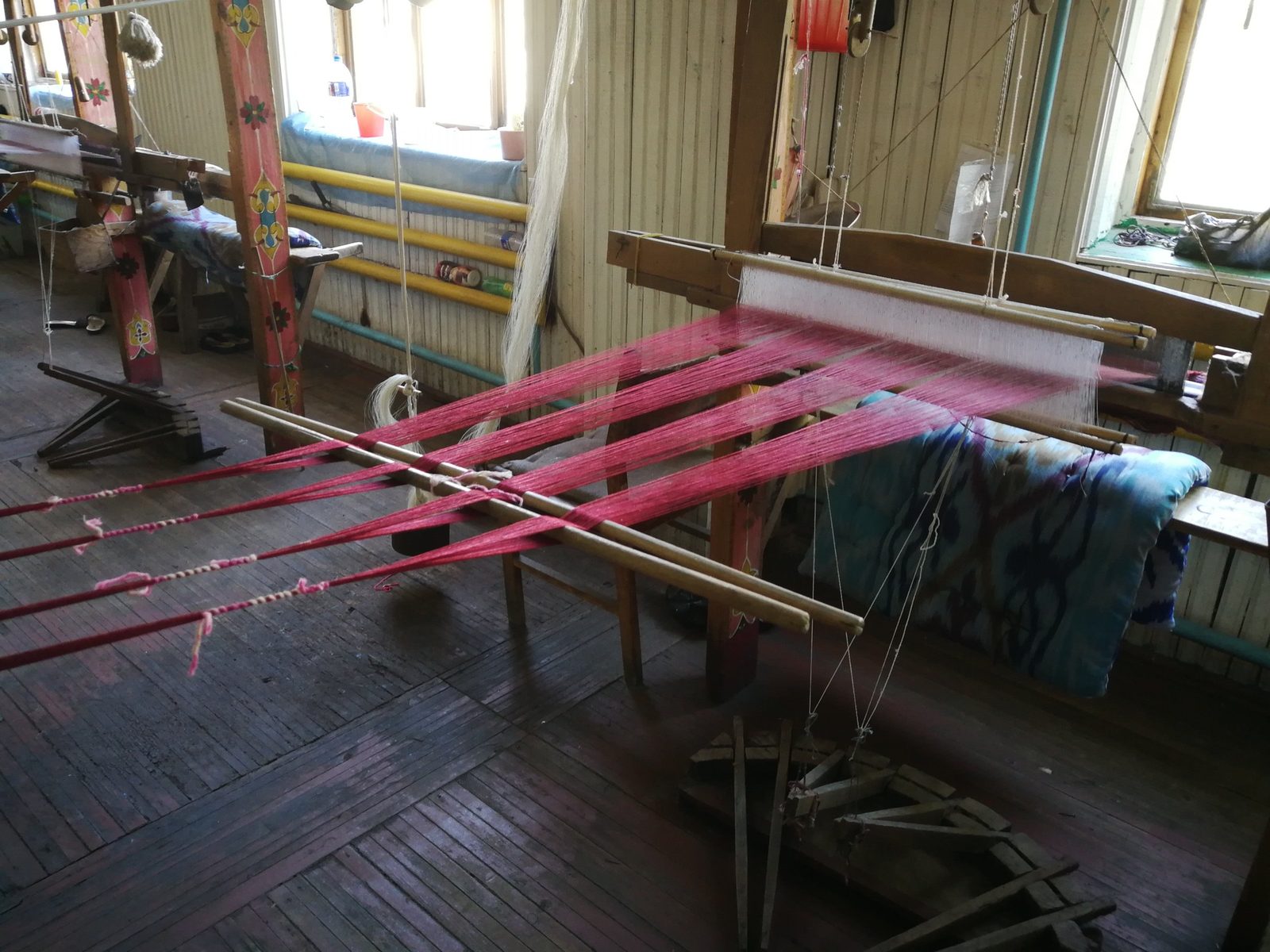
Watch the filament come off the cocoon in hot water, the warp tied and dyed for ikat, and Did you know? UNESCO holds up Margilan's silk weavers as a model In 2017 UNESCO added the Margilan Crafts Development Centre, which revives the hand-making of atlas and adras, to its Register of Good Safeguarding Practices. Atlas is pure silk; adras mixes silk and cotton. Read more → woven on hand looms, then buy the cloth where it was made. More: Margilan silk, from cocoon to ikat.
Rishtan ceramics
Red clay dug from under the town and ishkor, a glaze from turquoise to deep cobalt made from the ash of wild herbs. Most workshops sell straight from the shelves. More: Rishtan ceramics and how to buy them.
Kokand and Akhsikent
Did you know? Khudoyar Khan's palace once had seven courtyards Finished in the early 1870s, the 'Pearl of Kokand' had seven courtyards and some 114–119 rooms. Five courtyards and 19 rooms survive. The American diplomat Eugene Schuyler called it grander than any other palace in Central Asia. Read more →’s palace in Kokand, completed around 1870, still has its facade of glazed tiles. Near Namangan, ,Did you know? Akhsikent steel was prized as far away as Baghdad Akhsikath was not only a caravan stop on the road from Kashgar but a workshop town: crucible steel smelted here in kaolin-lined furnaces was famous as far as Baghdad and Damascus. Read more → the largest archaeological site in the valley, is the town Did you know? The founder of the Mughal Empire was born in Andijan Babur was born in Andijan on 14 February 1483 and, at twelve, took the throne of Fergana in its capital Akhsikath. Later he founded the Mughal Empire in India; his memoir, the Baburnama, still describes the valley's towns. Read more → called the strongest fort in Fergana. More: Akhsikent.
Termez: the Buddhist south
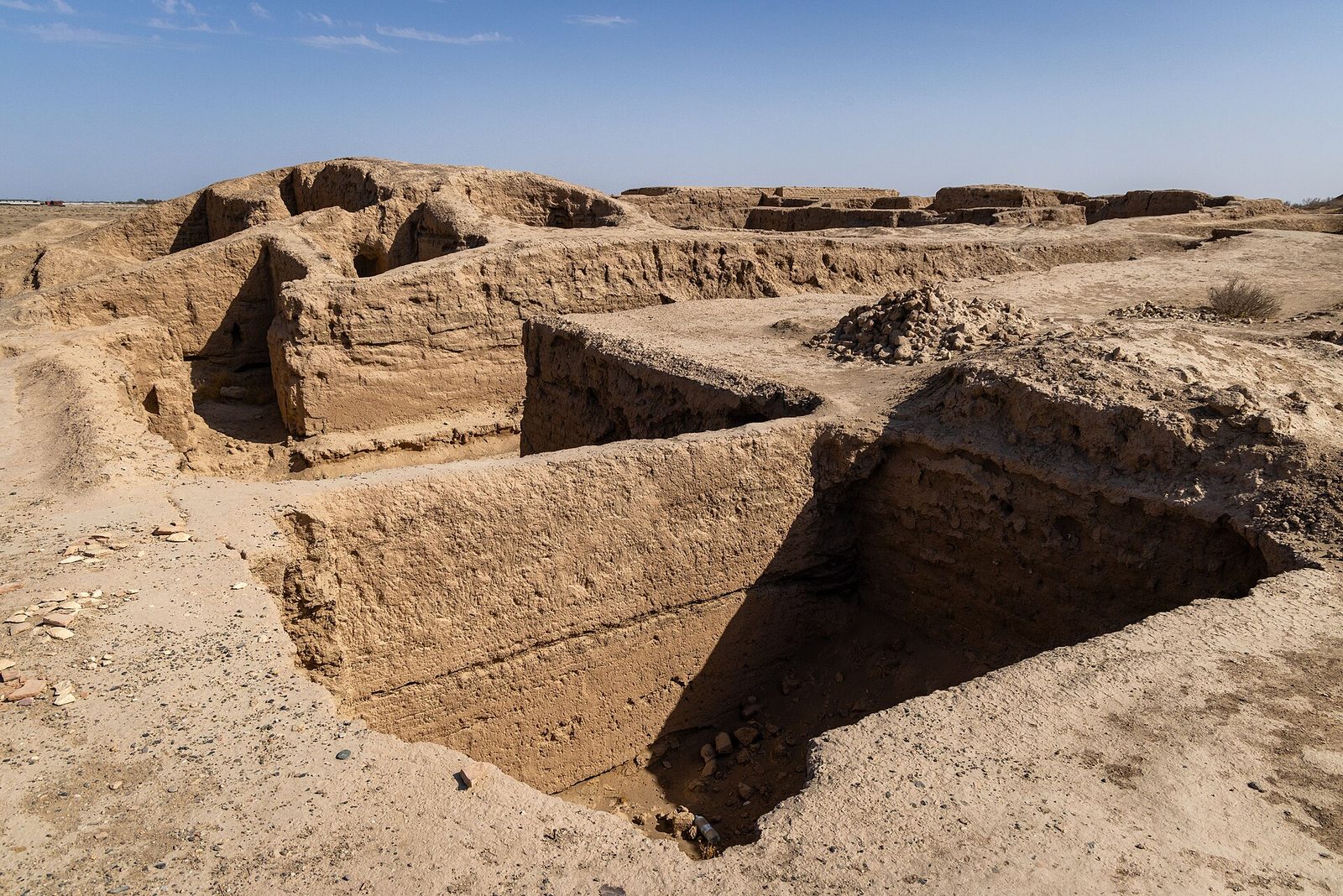
The far south of the country is the one place where Buddhist, Hellenistic and Islamic history stand side by side. We give it two days. More: Termez and Surkhandarya.
Fayaz Tepe, Kara Tepe and Zurmala
Kushan-era monasteries on the hills above the Amu Darya, one with its original stupa under a protective dome, and the Zurmala stupa, built from about 1.2 million mud bricks. Start with the Archaeological Museum, which holds some 27,000 finds: after it, the bare walls make sense.
Al-Hakim at-Termezi and Sultan Saodat
The most revered shrine of Termez, the tomb of a 9th-century Sufi writer, and the family necropolis of the Termez sayyids, which grew along one passage from the 10th to the 17th century.
Nukus and Karakalpakstan: art, fortresses and the Aral
The far west is a long way from everything else. Few visitors come, and those who do talk about it longest.
The Savitsky Museum
About 100,000 objects in the capital of Karakalpakstan: Russian avant-garde paintings that one collector brought to the desert, Did you know? Karakalpak means 'black hat' The Karakalpaks, who gave Karakalpakstan its name, call themselves Qaraqalpaq: qara means black and qalpaq a hat. About 770,000 of the world's 900,000 Karakalpaks live in the republic, whose capital is Nukus. Read more → jewellery and costume, and finds from ancient Khorezm. Allow at least half a day. More: the Savitsky Museum in Nukus.
Mizdakhan
About 20 km west of Nukus, a revered burial ground on three hills, with a half-underground tiled mausoleum and the "clock of the world": legend says time will end when its last brick falls.
Ayaz-Kala and Toprak-Kala
Clay fortresses above the ,The Kyzylkum, or Red Sands: the desert between the Amu Darya and Syr Darya rivers that the road and the railway cross on the way to Khiva. the oldest from the late 4th or early 3rd century BC. They are easiest as a half day by car from Khiva; come at sunset.
Muynak and the Aral Sea
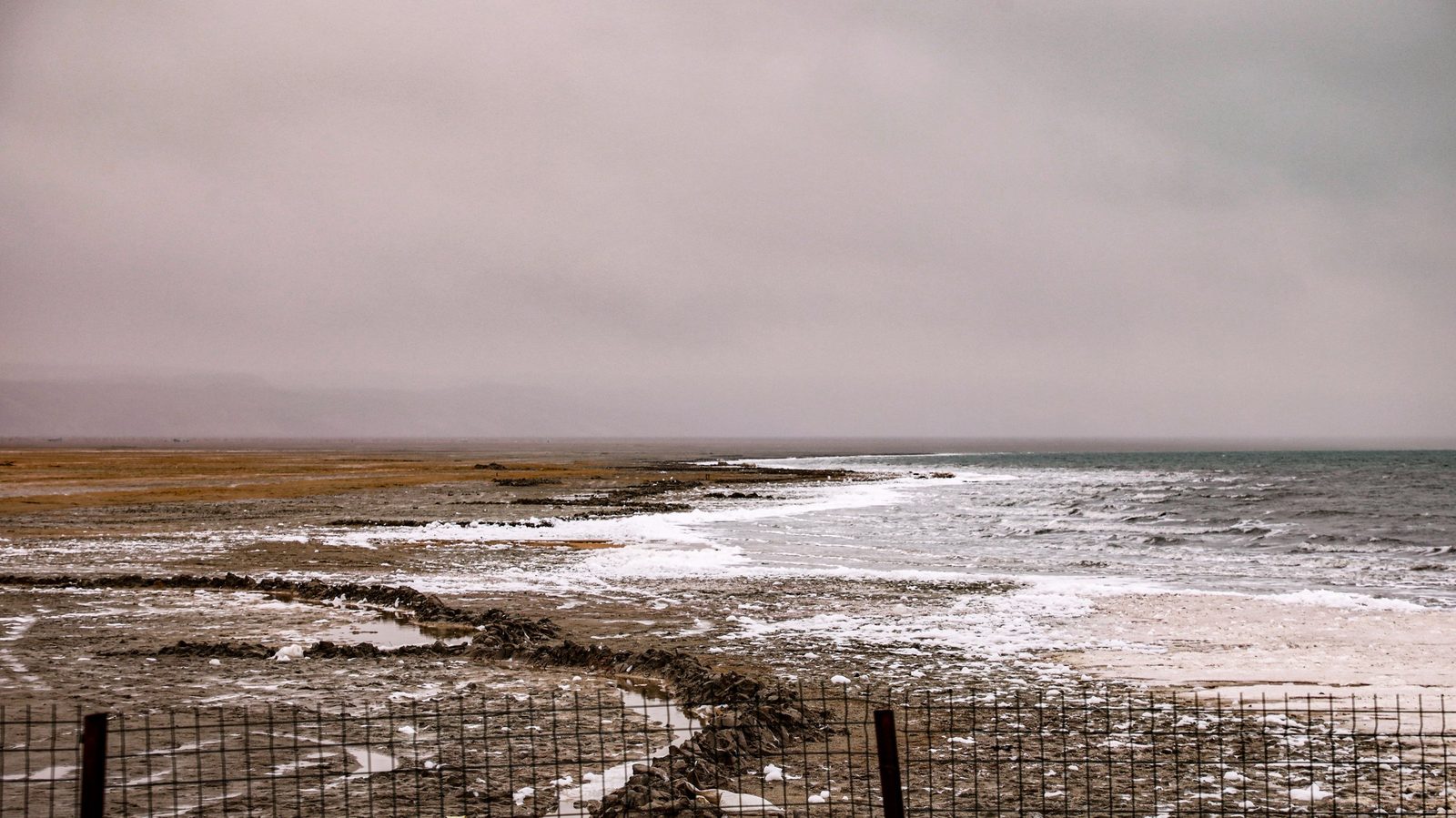
Once a fishing port, Did you know? A music festival is held among Moynaq's old fishing boats Since 2018 the Stihia festival of electronic music, art and science has gathered in Moynaq, once a port on the Aral Sea, right beside the ships left on the sand. It ends by burning a 10-metre installation of the word SEA. Read more → now has ships resting on sand where the harbour used to be. From there, 4×4 tracks cross the Ustyurt plateau to the water. More: the Aral Sea today.
Mountains, lakes and desert
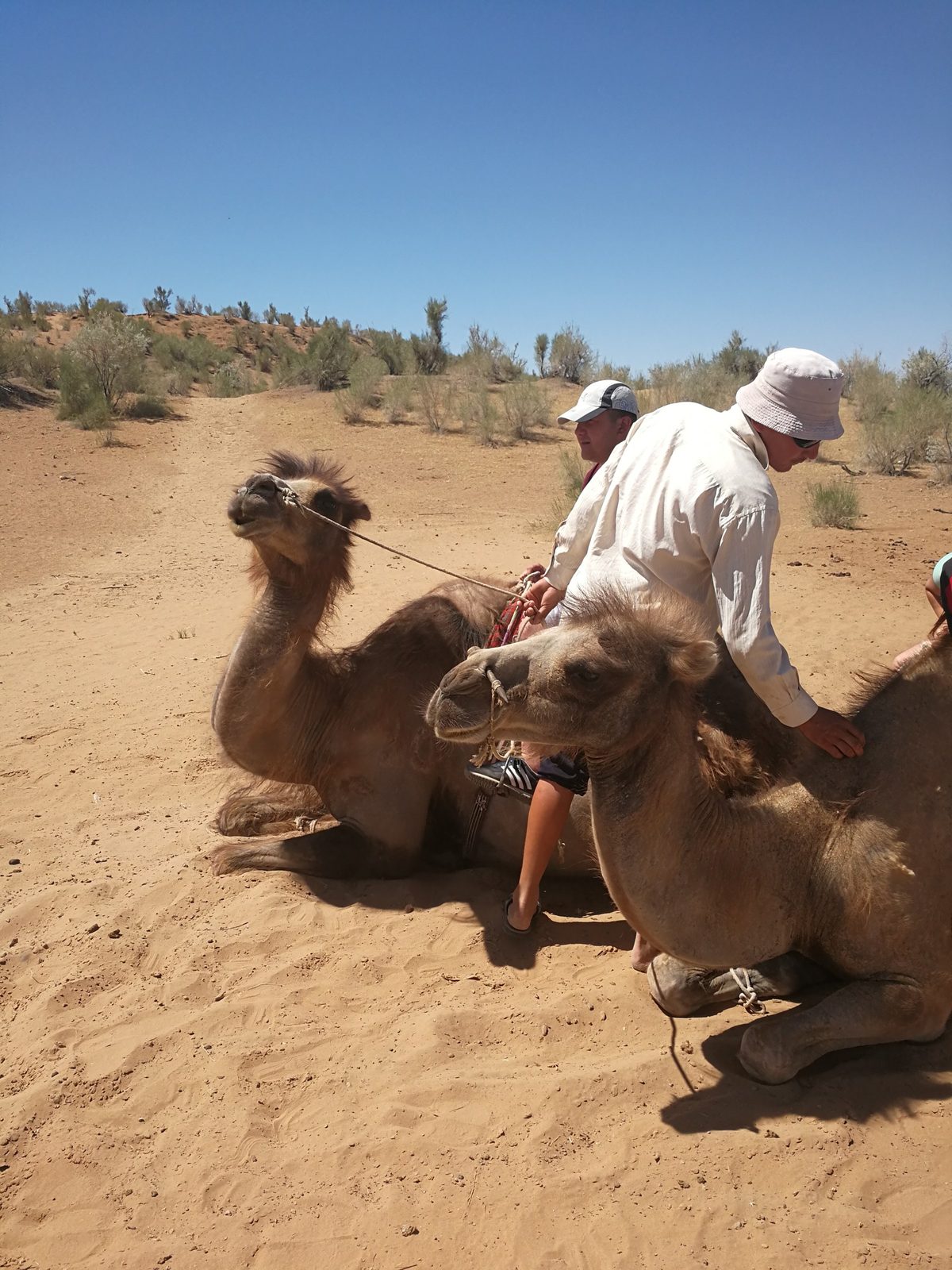
Uzbekistan is not only old towns. The mountains begin about an hour and a half from Tashkent, and a night in the desert fits between Samarkand and Bukhara.
Chimgan, Amirsoy and Lake Charvak
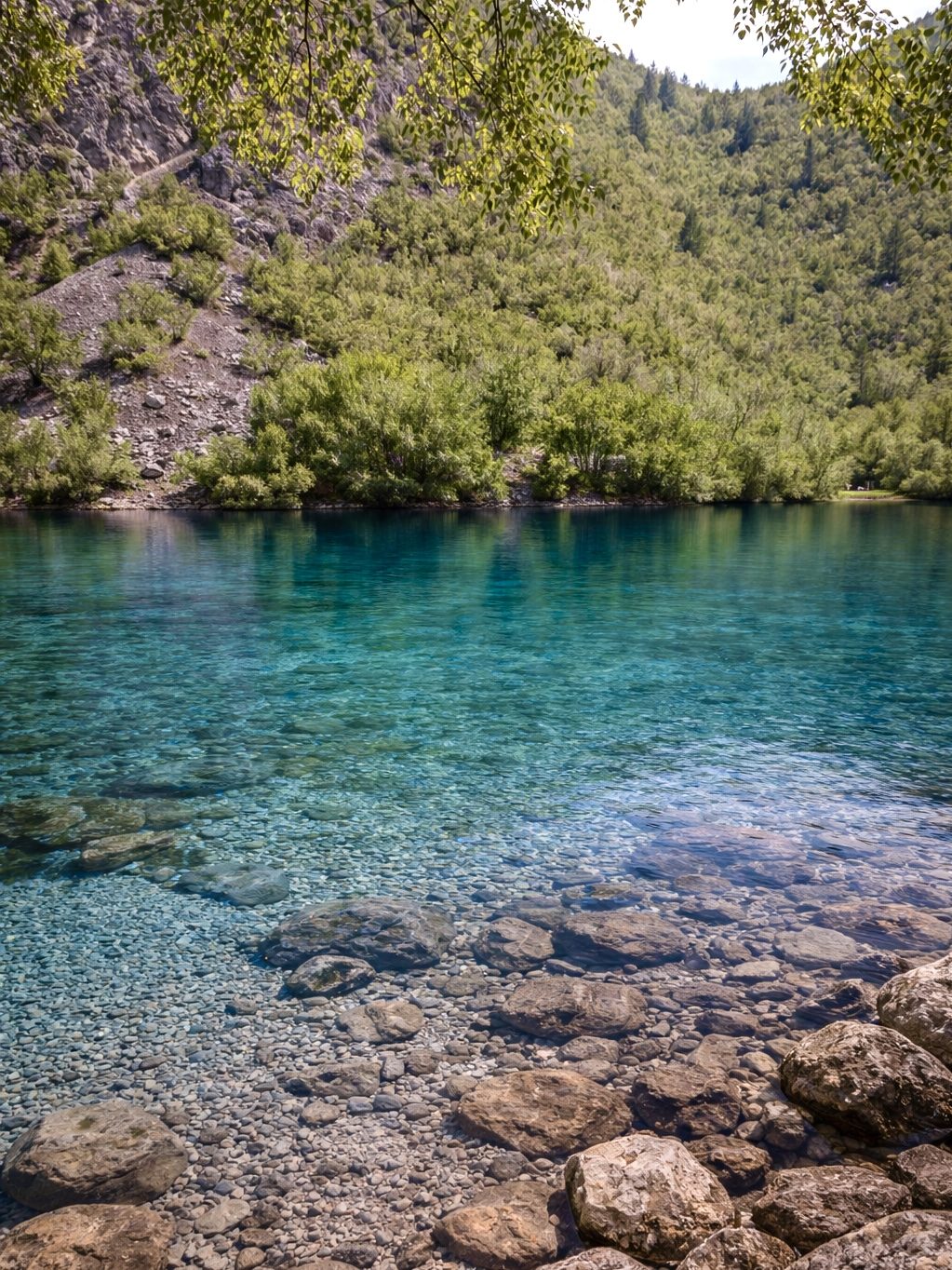
All three lie 65–85 km from the capital in the Western Tien Shan. On a July afternoon Mountains of the Western Tian Shan about 80 km from Tashkent: hiking in summer, skiing in winter, the Charvak reservoir nearby. Read more → is almost ten degrees cooler than Tashkent; the gondolas at Amirsoy run to 2,290 m in summer and winter; Did you know? The lake below Chimgan is held back by a 168-metre dam Charvak is a reservoir: a 168 m stone dam on the Chirchiq, built in 1964–1970, holds about 2 km³ of water from the Pskem, Koksu and Chatkal rivers. Its name is traced to the Persian chorbog, "four gardens". Read more → is a reservoir behind a 168-metre dam. More: the mountains near Tashkent, Chimgan and Charvak in a day and Amirsoy.
Aydarkul and a yurt camp
A lake that appeared in the Kyzylkum after a flood in 1969 and is now nearly 250 km long. We plan it as one night in a yurt on the way between Samarkand and Bukhara. More: Aydarkul and a night in a yurt camp.
Nurata and the Nuratau mountains
A holy spring that stays at about 20 °C all year, full of fish nobody catches, and a hill that tradition ties to Alexander the Great. Above the town, stone villages in the Did you know? The Nuratau ridge protects a rare wild sheep The Nurata Nature Reserve was set up on the Nuratau ridge in 1975 to protect wild walnut groves and Severtsov's argali, an endemic wild sheep on the Red List. Golden eagles and bearded vultures are protected here too. Read more → ridge take walkers in. More: Nurata and hiking in Uzbekistan.
How to see the main sights in 7, 10 or 14 days
7 days. Tashkent, Samarkand, Bukhara and Khiva by fast train. The train to Khiva leaves Tashkent every day except Sunday, and that one rule sets the order of your week: Uzbekistan in 7 days.
10 days. The same four cities at an easy pace, with two nights in Khiva, a day trip to Shahrisabz and an afternoon in Gijduvan: Uzbekistan in 10 days.
14 days. Add the Did you know? Legend says Fergana's 'heavenly horses' sweated blood Legend says the horses of Dayuan, as Chinese chronicles called Fergana, sweated blood, and around 102 BC Emperor Wu of Han sent an army to bring some home. The 'blood' was most likely a skin parasite that causes tiny bleeding spots. Read more → by the new daily train, the desert fortresses beyond Khiva and a day in the mountains: Uzbekistan in 14 days.
Ready-made routes are in our tour catalogue, and the tour finder suggests three that fit your dates and interests.
In short
- The core of any first trip is Samarkand, Bukhara and Khiva: give them two days each, Khiva at least one.
- Tashkent deserves a day for its metro, the Center of Islamic Civilization and Chorsu.
- For crafts, add the Fergana Valley; for Buddhist history, Termez; for art and the Aral, Nukus.
- Mountains are an hour and a half from Tashkent, and a yurt night at Did you know? Aydarkul is a wetland of international importance In 2008 the Aydar-Arnasay lake system, about 527,000 ha, became a Ramsar site. It lies where two great bird flyways cross and shelters Dalmatian pelicans and the rare white-headed duck. Read more → fits between Samarkand and Bukhara.
- Of the eight UNESCO World Heritage sites, from Khiva’s walls to Tashkent’s modernism, most lie on the routes above.
© Photos
- Kara Tepe Buddhist site, Termez — Marat Nadjibaev / Wikimedia Commons · CC BY-SA 4.0