
Places in this article: Bukhara
Around Bukhara: day trips to the emir’s palace, Bahauddin, Chor-Bakr, Gijduvan and Paykend
Four kilometres north of Bukhara's old town, an emir chose the site for his summer palace by hanging out sheep carcasses and waiting to see where the meat spoiled last. So the story goes. The palace he started is gone, but the one his successors built in its place still stands, and it is only the first of the places worth leaving the old town for.
Most visitors spend all their days inside the old town and miss what is around it. Here is what to see around Bukhara, as we plan it for our guests: the last emir's summer palace, the Did you know? A village renamed in honour of a Sufi master Bahauddin Naqshband (1318–1389), who gave his name to one of the largest Sufi orders, was born and buried near Bukhara in Qasr-i Hinduvan. The village was later renamed Qasr-i Arifan in his honour; the tomb over his grave dates from 1544. Read more → complex, the Did you know? A necropolis named after four men called Abu Bakr Chor-Bakr, 5 km from Bukhara, grew from 1559 around the grave of Abu Bakr Said, who died in 970 and was one of four Abu Bakrs, hence the name. Its 25 buildings joined UNESCO's list in 2023 in the Zarafshan-Karakum Corridor. Read more → necropolis, the potters of Gijduvan, and the excavated city of Paykend. For each place: what you will see, how far it is and how to fit several into one day.
Sitorai Mohi-Hosa, the last emir's summer palace
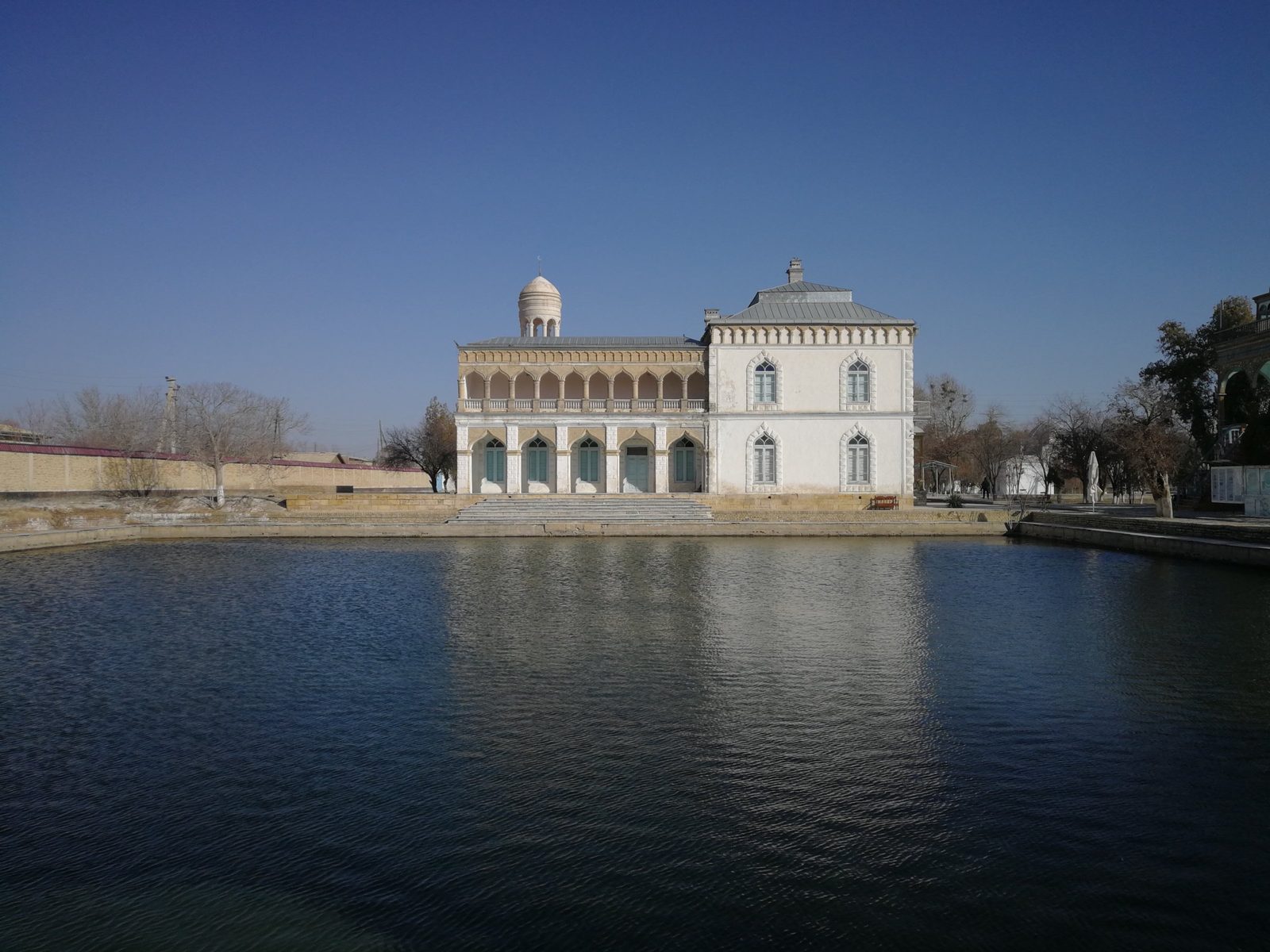
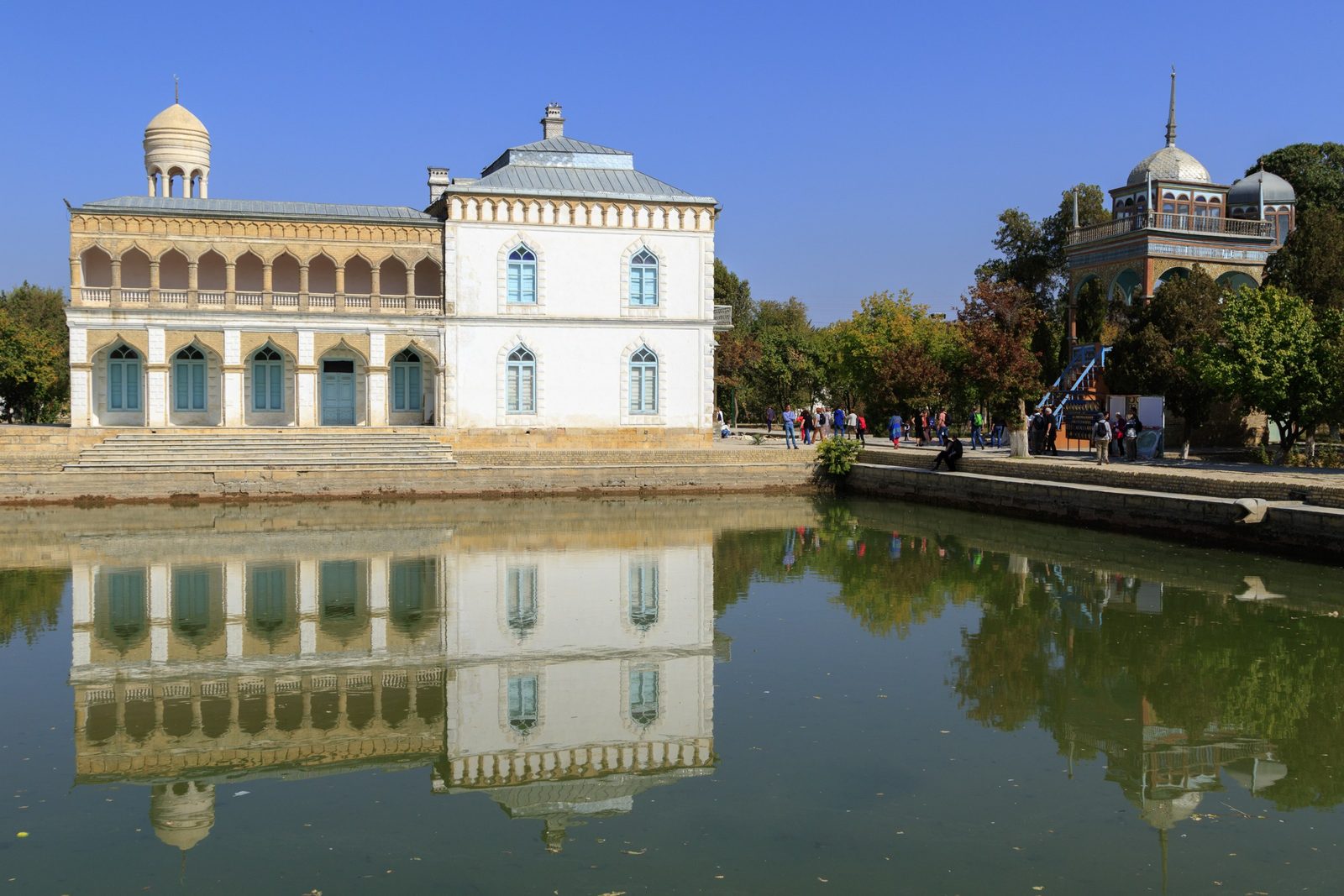
The name is Tajik for “a star like the moon”. The sheep legend belongs to the mid-19th century and Emir Nasrullah Khan, whose palace did not survive. The building you see was put up in 1912–1918 for Muhammad Alim Khan, the last emir of Bukhara, with Russian engineers working at his court alongside local craftsmen. Another legend says he dedicated it to his wife Sitora and named it after her.
From the outside it looks like a European villa. Inside it is Bukharan through and through. The palace is divided into men's and women's halves, and its showpiece is the White Hall: carved ganch plaster laid over mirrors by the master Shirin Muradov, with no pattern repeated. Since 1927 the palace has been a museum: Chinese and Japanese porcelain, Bukharan jewellery, suzani and gold-embroidered robes, and in a separate octagonal pavilion, the clothes of Bukharan townspeople from a century ago.
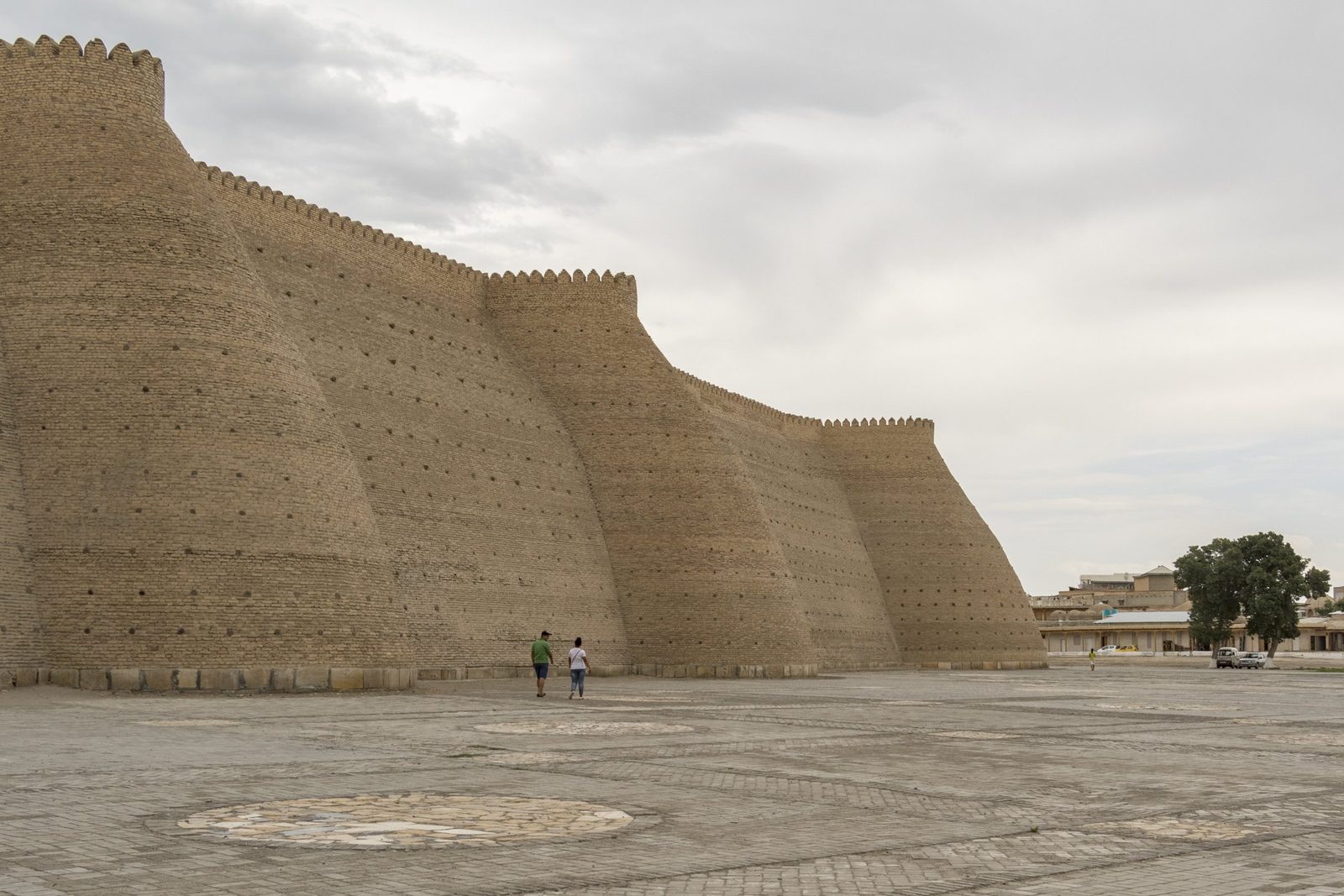
To see where the emirs lived the rest of the year, start in town at the Ark of Bukhara, the fortress they ruled from until 1920.
The Bahauddin Naqshband complex
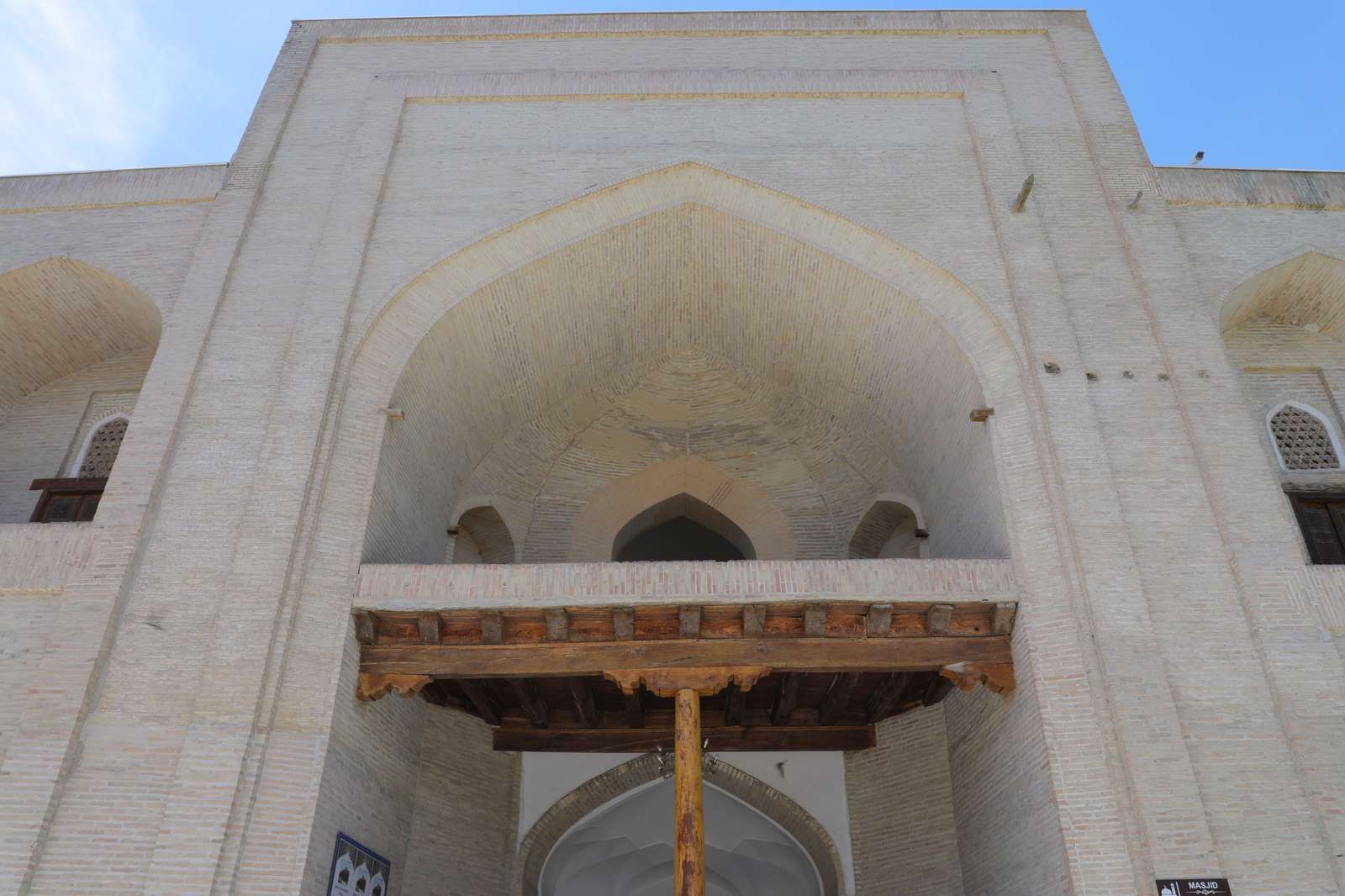
About 10 km north-east of the city, in Qasri Orifon, lies Bahauddin Naqshband (1318–1389), the Sufi master who gave his name to the Naqshbandi order. The complex grew around his grave for centuries. The largest building, the khanqah for Sufi gatherings, was built under Abdulaziz Khan in 1544–1545; the small brick minaret dates from 1885. Two mosques, a small An Islamic college: student cells and classrooms around a courtyard behind a grand portal. In the old towns many now house museums and craft workshops. and the Dahma-i-Shahon, the burial ground of Bukhara's rulers, complete it, and since 2004 a museum tells the story of the order.
Since 2023 the complex has been part of the UNESCO World Heritage property Silk Roads: Zarafshan-Karakum Corridor. It remains a place of reverence where families still come to pray, so cover shoulders and knees, and women bring a scarf. The story of how young Bahauddin found his teacher is in our legends of Bukhara, and the route of the seven Sufi masters buried around the oasis is in our guide to ziyarat in Uzbekistan.
Chor-Bakr, the necropolis of Sumitan
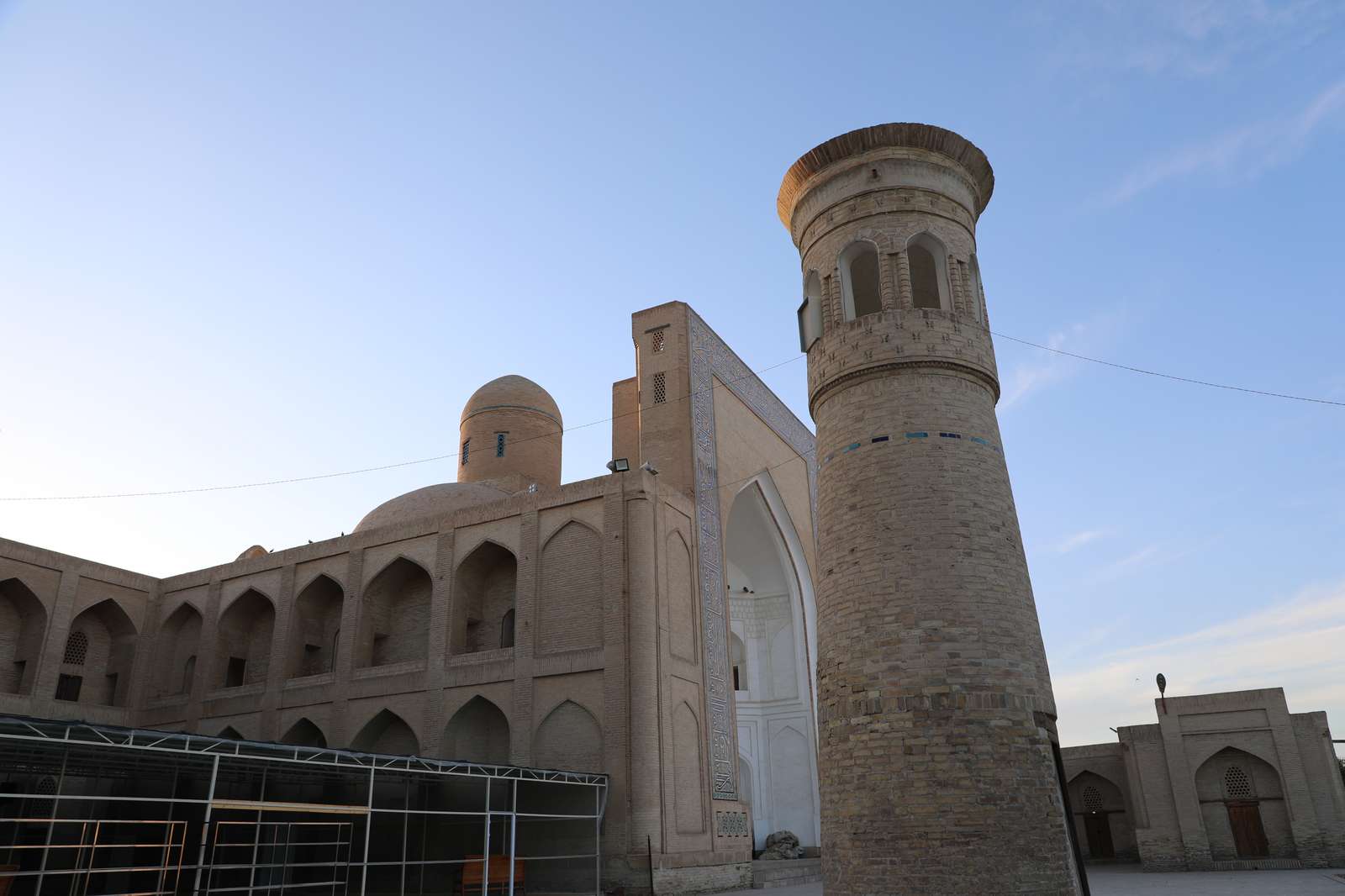
About 5 km west of Bukhara, in the village of Sumitan, Chor-Bakr looks like a small town where nobody lives. Instead of streets, there are walled courtyards. Each belonged to one family, and inside are their tombs, many under domes. Guides often call it the city of the dead.
It began with one grave. Abu-Bakr-Said, who died in 970–971, was one of four men named Abu Bakr, and chor means “four”. In 1559 the Shaybanid ruler Abdullah Khan II founded a memorial complex over his burial place: a mosque, a madrasa and a khanqah around a large courtyard. A minaret was added in 1890. Chor-Bakr joined the same UNESCO listing in 2023. It is quiet, shaded and rarely crowded, a contrast to Bahauddin a few kilometres away.
Gijduvan: a Timurid madrasa and the potters' town
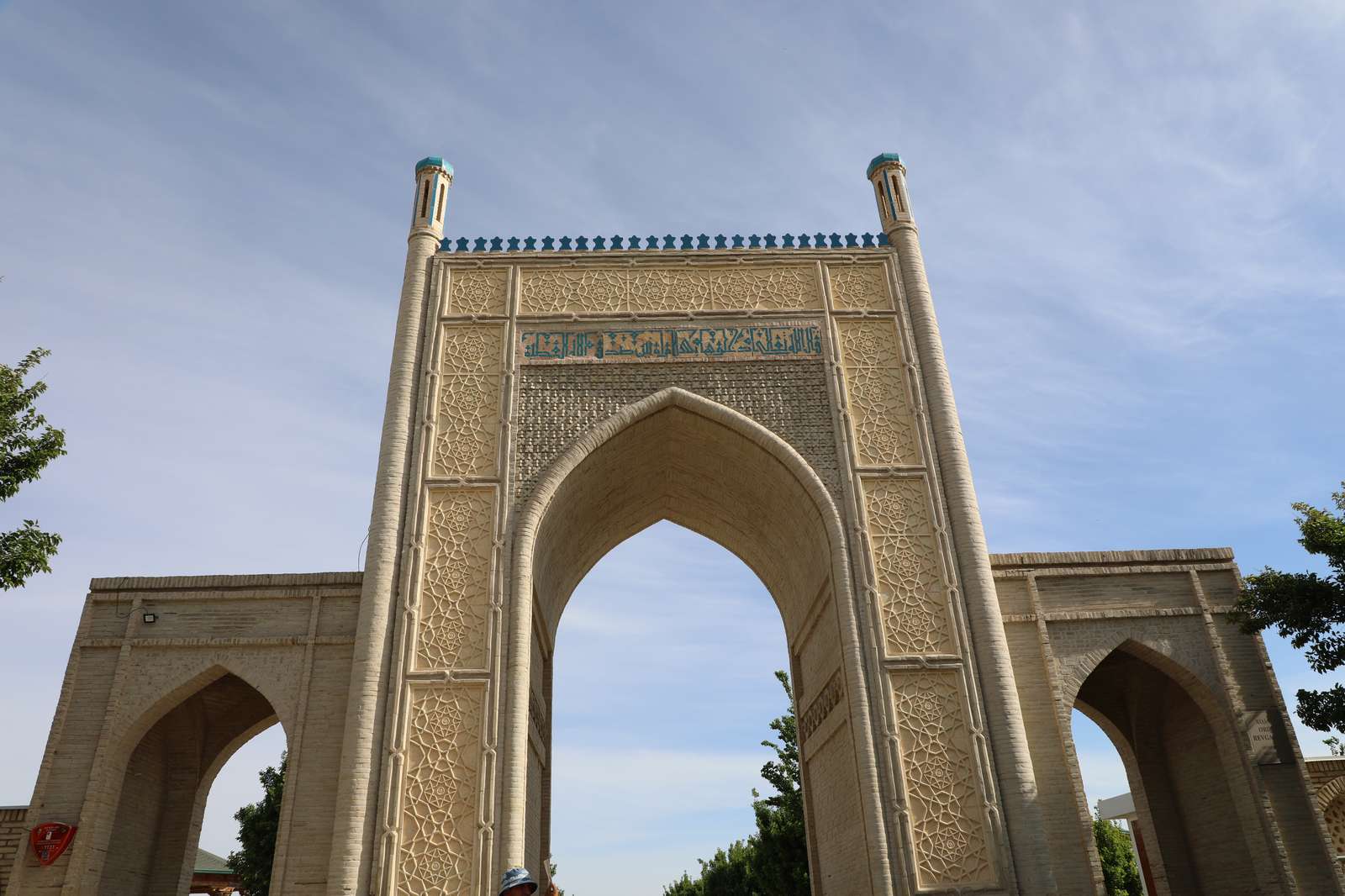
Gijduvan is about 40–45 km north-east of Bukhara, a working town rather than a museum. It has two reasons to come. The first is the complex of Abdulkhaliq Gijduvani, a 12th-century Sufi master regarded as the first of the seven pirs of Bukhara. Next to his tomb stands a madrasa built by Timur's grandson, ruler of Samarkand and an astronomer. He built a madrasah on the Registan and an observatory whose star catalogue was used for centuries. Read more → in 1433, the third and last of his madrasas after Samarkand and Bukhara, smaller and simpler than the other two, with blue and turquoise glazed brick on its facade.
The second is ceramics. Gijduvan has its own school of pottery, known for flower ornament combined with geometric patterns. In the town's best-known family workshop, the sixth generation of potters is at work, and their museum holds ceramics from many centres of Central Asia. You can watch the whole process, from clay to the kiln.
We run this as a separate outing from Bukhara, “Gijduvan: ceramics workshop and lunch”, with a car and a guide. Lunch is worth the drive: the town is known across the region for its fried fish and its shashlik. More on choosing ceramics is in our guide to what to buy in Uzbekistan.
Paykend and Varakhsha: for archaeology lovers
Paykend lies about 40 km south-west of Bukhara, in Karakul district. Arab writers called it the city of merchants: a Sogdian trading town that grew from a settlement of the last centuries BC. It was taken by Qutayba ibn Muslim in 706, flourished again under the Samanids and faded in the 11th century, when the water no longer reached it. Since 1981 a joint expedition of the Hermitage and the Institute of Archaeology of Uzbekistan has been digging here; by the 2010s about 15% of its 20 hectares had been excavated. On site you walk among the citadel, the town walls and the foundations of its mosque, and the museum next to the ruins shows the finds. Since 2023 Paykend has been part of the same UNESCO listing.
Varakhsha, about 39 km north-west of Bukhara, was the seat of the Bukhar Khudahs, the pre-Islamic kings of Bukhara. Its palace was painted in the eighth century with a king riding an elephant and fighting tigers and monstrous beasts. The ruins are earthen mounds in the desert, and the paintings left long ago for museums in Tashkent and the Hermitage. So we tell its story in town: the museum of Varakhsha and Bukhara ceramics is in the Did you know? A caravanserai that became a madrasah by a khan's word Nadir Divan-Begi built his 1622 building by Lyabi-Hauz as a caravanserai. At the opening Imam Quli Khan praised it as a fine madrasah, and a khan's word could not be taken back: a portal and cells were added, and a madrasah it became. Read more → khanaqah at .Did you know? Bukhara's ponds were once its water supply Pools like Lyabi-Hauz, dug around 1620 and 46 × 36 m, were the city's main source of water. Most were filled in during the 1920s–30s because they spread disease; Lyabi-Hauz survived. Read more →
How to combine them in one day
- The classic day: Did you know? Legend: the emir's palace site was chosen with meat Legend says that when Emir Nasrullah wanted a summer palace in the mid-19th century, sheep carcasses were hung in several places around Bukhara, and the spot where the meat spoiled last was chosen. Sitorai Mohi-Hosa there today dates from 1912–1918. Read more → at opening time, then Bahauddin Naqshband, then Chor-Bakr on the west side of the city. This is our Bukhara Discovery tour, a full day with a guide and car.
- The craft afternoon: the old town in the morning, Gijduvan after lunch. This is how we plan it in our 10-day itinerary.
- Two out-of-town days: the palace, Bahauddin and Chor-Bakr on one day; Gijduvan or Paykend on another. That fits a three-day stay, as in Bukhara in 1, 2 or 3 days.
Sitorai Mohi-Hosa, Bahauddin and Chor-Bakr are close to town, so they fit together in a morning or a relaxed full day. Gijduvan and Paykend lie in different directions, so we rarely put them on the same day.
Further out: Nurata and Aydarkul
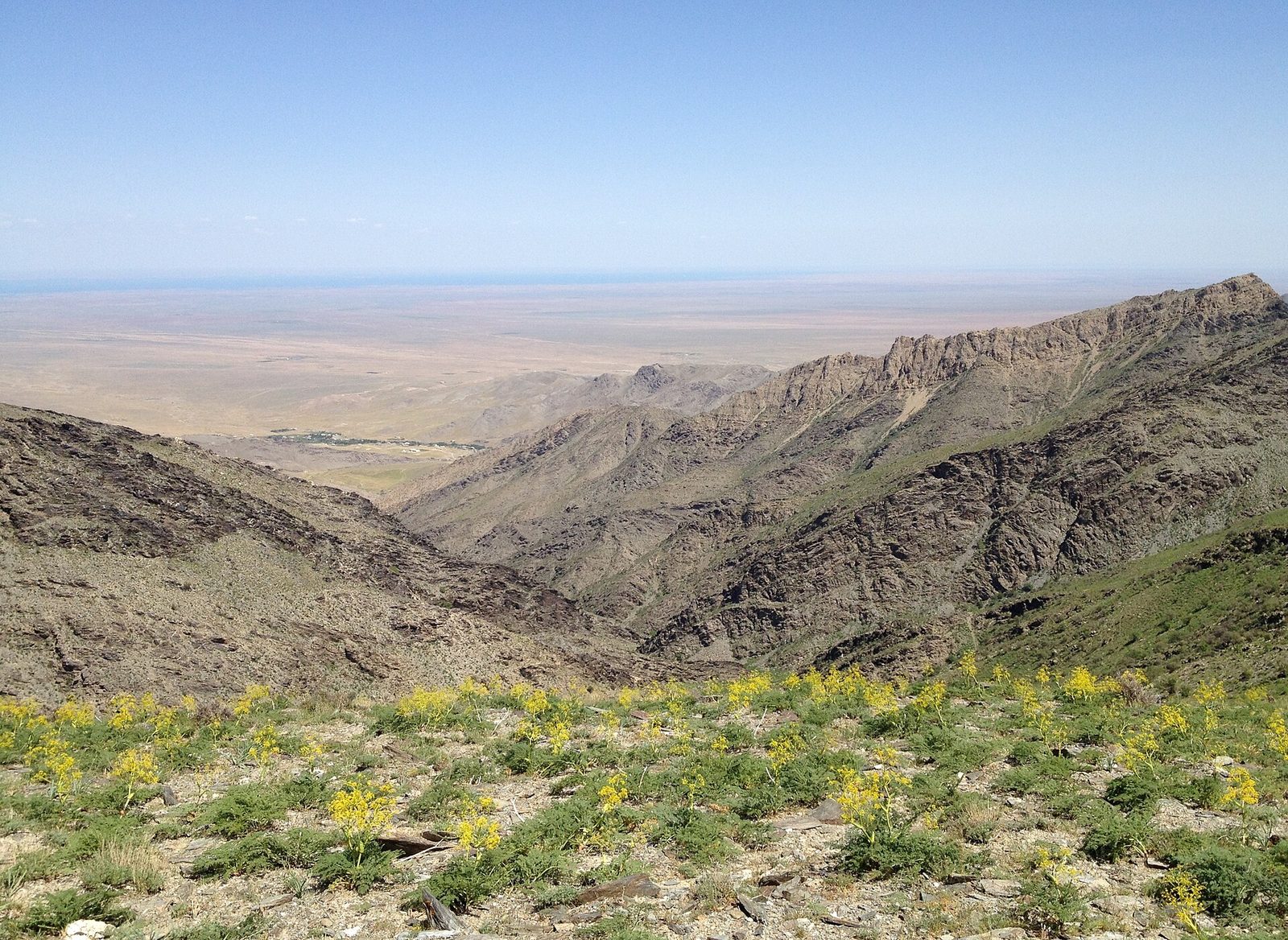
Did you know? Legend credits Alexander with Nurata's underground canals Legend says Alexander the Great founded Nur in 327 BC and laid its kariz, underground channels with wells dug a few metres apart for cleaning. Whoever built them, parts of the kariz near Nurata still carry water today. Read more → is about 175 km from Bukhara by road: too far for a day trip, but a natural stop on the way to Samarkand. It has a holy spring full of fish, a mosque under a 16-metre dome and a fortress tradition ties to Alexander the Great. About 60 km further north are the yurt camps by Lake .Did you know? Aydarkul is a wetland of international importance In 2008 the Aydar-Arnasay lake system, about 527,000 ha, became a Ramsar site. It lies where two great bird flyways cross and shelters Dalmatian pelicans and the rare white-headed duck. Read more → Read our Nurata guide and a night in a yurt at Aydarkul, or add a night with a family in the mountains with our Nuratau Mountains extension.
Getting there, tickets and time
- Transport: none of these places is in walking distance. Go by car with a driver; for Gijduvan and Paykend, plan for the drive back too.
- Distances from Bukhara: Sitorai Mohi-Hosa about 4 km north, Chor-Bakr about 5 km west, Bahauddin Naqshband about 10 km north-east, Gijduvan about 40–45 km north-east, Paykend about 40 km south-west.
- Tickets: Sitorai Mohi-Hosa costs 60,000 som for a foreign adult, the Paykend museum 20,000 som. Prices and hours for the rest are in Bukhara and Khiva sights, tickets and hours.
- Hours: the museums of Bukhara open at 9:00, with longer hours in the season.
- When: in summer, go out of town in the morning and keep the afternoon for shaded streets; spring and autumn suit a full day out.
- Time: about 1.5 hours at Sitorai Mohi-Hosa, 1–1.5 hours at Bahauddin Naqshband, an hour at Chor-Bakr, half a day for Gijduvan or Paykend with the drive.
- Dress: shoulders and knees covered at Bahauddin, Chor-Bakr and Gijduvan. More in what to wear in Uzbekistan.
All our routes are in Bukhara tours; the old town itself is covered by the Bukhara highlights tour and our Bukhara city guide.
In short
- Sitorai Mohi-Hosa, Bahauddin Naqshband and Chor-Bakr are 4–10 km from town and fit into one morning.
- The emir's palace is European outside and Bukharan inside; its White Hall has no repeated pattern.
- Bahauddin and Chor-Bakr are places of reverence: dress modestly and keep your voice down.
- Gijduvan gives you a Ulugh Beg madrasa of 1433, a potters' workshop and lunch in one half day.
- For archaeology, Paykend has ruins and a museum on site; Varakhsha is best seen in its museum at Lyabi-Hauz.
© Photos
- Aydarkul lake seen from the Nuratau ridge — Carpodacus / Wikimedia Commons · CC BY-SA 4.0