
Places in this article: Samarkand
Gur-e-Amir in Samarkand: Timur’s tomb, its history and legends
Amir Timur (Tamerlane, 1336–1405), founder of the Timurid empire, which had its capital in Samarkand. Born near Shahrisabz. ordered this tomb for someone else. In 1403 his grandson and chosen heir, Muhammad Sultan, died, and the old conqueror, back in Samarkand in the autumn of 1404, set his builders to work on a mausoleum for him. A few months later Timur himself was dead, and the building he had raised for the young man became his own grave.
Today ,Did you know? Timur's tombstone went to Persia and came back The dark-green jade slab on Timur's grave in Gur-e-Amir was carried off by Nader Shah in 1740. It broke, and on his advisers' urging he sent it back to Samarkand. Read more → Persian for “the tomb of the emir”, holds Timur, two of his sons, two of his grandsons and his spiritual teacher. We bring guests here at the end of almost every Samarkand day. Here is the mausoleum as our guides tell it: who lies where, the dark green stone over Timur, the ribbed dome, the gold inside, the opening of the tomb in 1941, and the legends, marked as legends.
A tomb built for a grandson
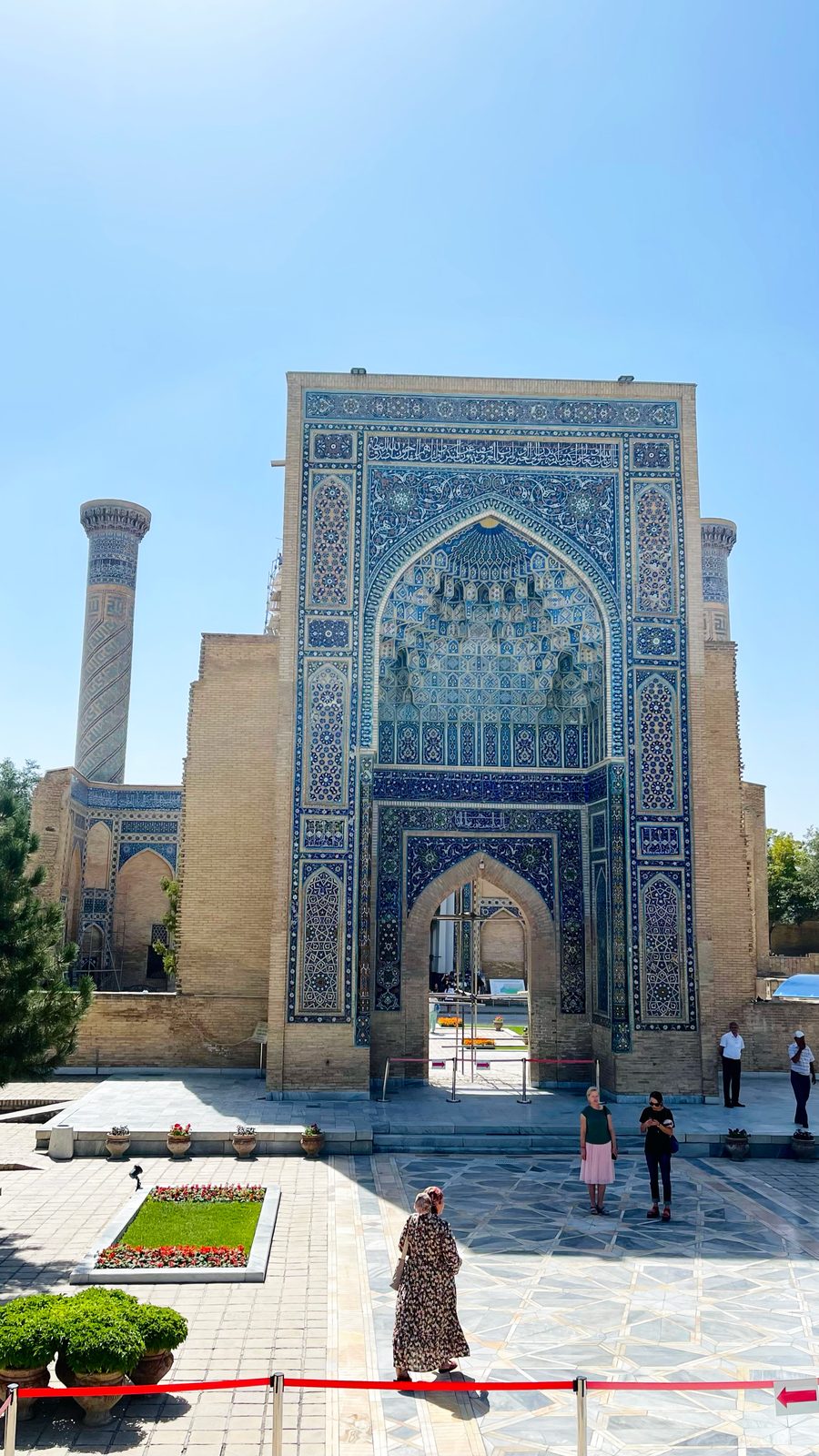
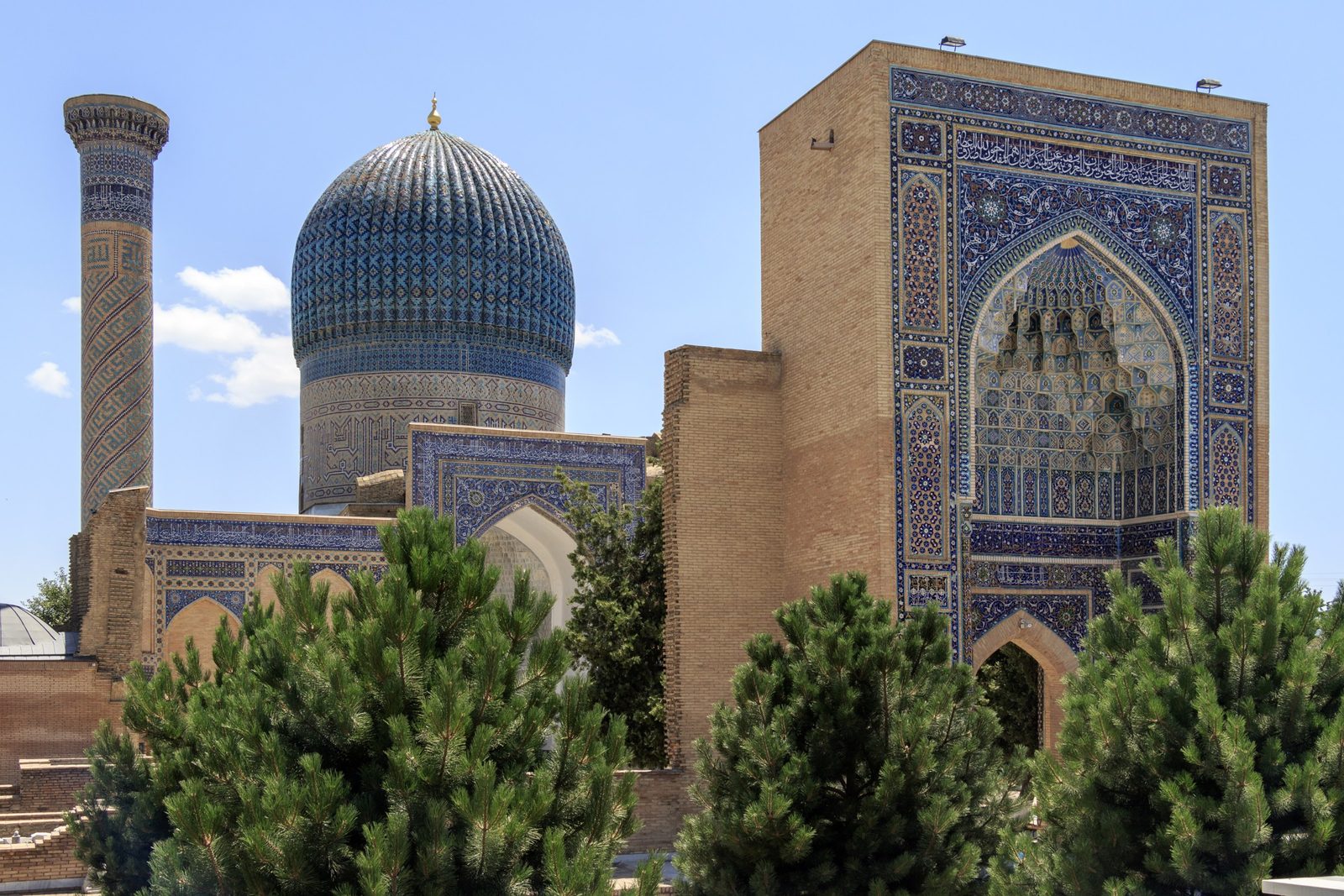
The site did not start as a cemetery. At the end of the 14th century Muhammad Sultan built a complex here: a two-storey An Islamic college: student cells and classrooms around a courtyard behind a grand portal. In the old towns many now house museums and craft workshops. on the east, a domed khanaka, a Sufi lodge, on the west, and a courtyard between them entered through a tall portal on the north. That portal still stands, and its mosaic carries the name of the builder, Muhammad ibn Mahmud of Isfahan.
After the prince’s death Timur added the mausoleum on the south side of the courtyard: an octagon crowned by a huge ribbed dome. He never saw it finished. Timur died in February 1405 at Otrar, on campaign. He had prepared a crypt for himself in Shahrisabz, his home town, but his body was brought to Samarkand and laid in his grandson’s tomb.
It was another grandson, ,Did you know? Ulugh Beg measured the year to within 25 seconds Working at his Samarkand observatory, Ulugh Beg put the tropical year at 365 days 5 h 49 min 15 s, about 25 seconds too long, closer than Copernicus a century later. Read more → the astronomer who built the first madrasah on the Registan, who completed the work. In 1425 he added a gallery on the east side, which is today’s main entrance.
Who lies in Gur-e-Amir
Inside, behind a carved marble screen, stand the cenotaphs. They are memorial stones only. The real graves lie in the crypt directly below, laid out in the same order, and the crypt is closed to visitors.
- Timur, buried in 1405, under the dark green stone in the centre.
- Muhammad Sultan, the grandson the tomb was built for.
- Miran Shah, Timur’s son, killed in 1408.
- Shah Rukh, Timur’s son, who died in Herat in 1447. His daughter brought his body to Samarkand the same year.
- Ulugh Beg, Timur’s grandson, killed in October 1449. His nephew Abdallah moved his remains here.
- Sayyid Baraka, Timur’s spiritual teacher.
Other members of the dynasty are buried here too. Walk around the screen slowly: from every side you see the same family in a different order.
The dark green stone over Timur
Timur’s cenotaph is the one everybody looks for: a block of dark green nephrite, a kind of jade, among pale marble. Ulugh Beg had it brought to Samarkand from a campaign of 1425 and set it over his grandfather’s grave.
The stone carries a long Arabic inscription. It names “the great sultan” Timur and traces his family line back through the generations to an ancestor he shared with Genghis Khan, and further, to Alan Qo’a, the legendary mother of the Mongol clans, who was said to have conceived from a ray of light. A second version of the same genealogy is carved on Timur’s marble tombstone in the crypt.
Look closely and you will see that the stone is in two pieces. In 1740 the Persian ruler Nader Shah had it carried off, and on the way it broke in two. The story goes that the break was taken as a bad omen, and his advisers urged him to send the stone back. It came home to Samarkand, cracked, and has stayed here ever since.
The ribbed dome
From the street the dome is what you notice first. It is about 15 metres across and 12.5 metres high, deeply fluted, with 64 ribs, and it swells out slightly over the cylindrical drum beneath it. The tiles are bright blue, with white and turquoise patterns running across the ribs.
Read the drum. Around it runs an inscription in letters several metres tall: “Eternity belongs to God”. Smaller letters above it say “Praise be to God”. On a tomb, the message is plain.
This shape travelled far. Timur’s descendants founded the Mughal dynasty in India, and historians trace the influence of Gur-e-Amir in their tombs: Babur’s garden in Kabul, Humayun’s Tomb in Delhi and the Taj Mahal in Agra.
Inside: onyx, blue and gold
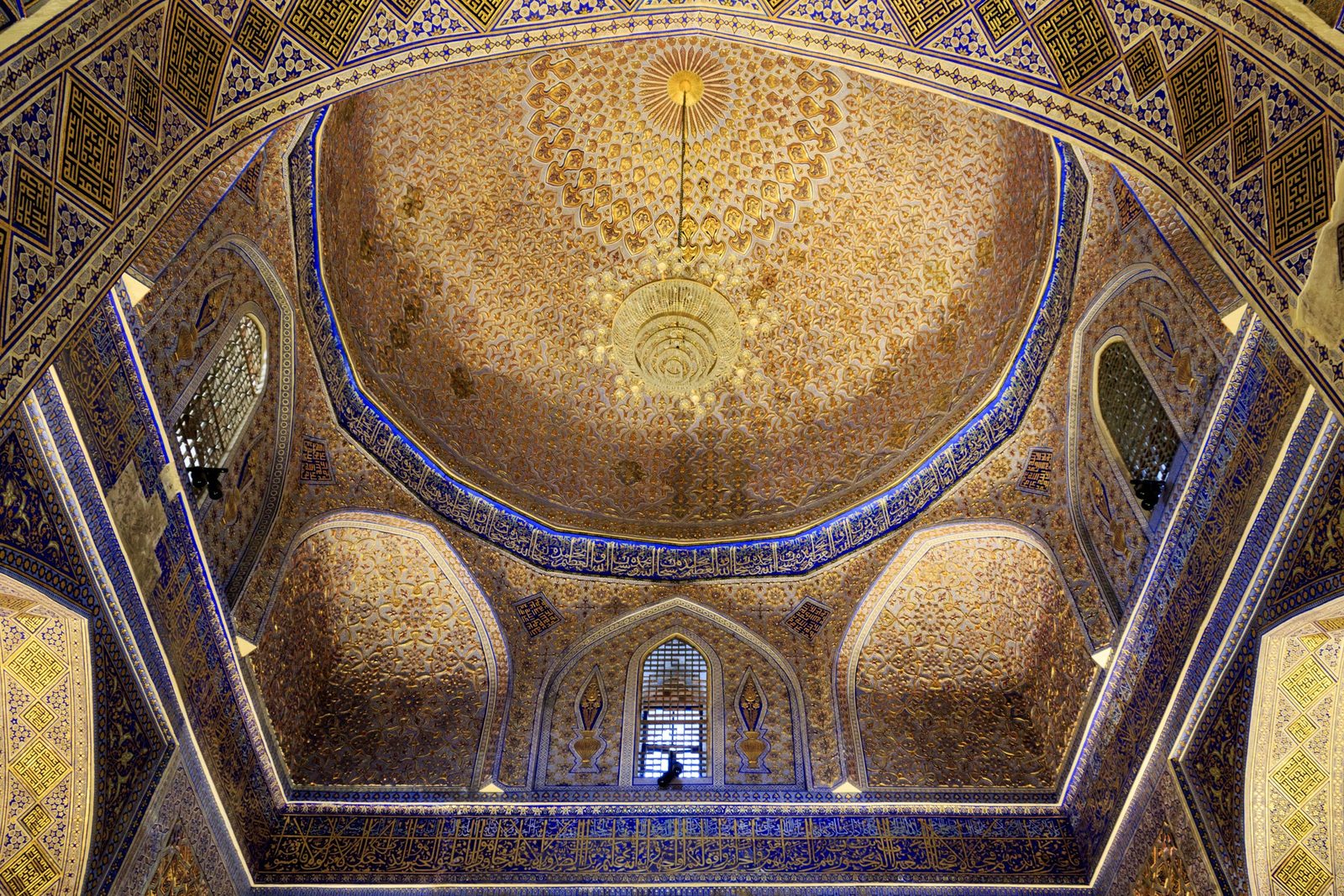
Step in and stop for a moment to let your eyes adjust. The lower walls are lined with panels of onyx, with a carved marble cornice of stalactite-like niches above them. Higher up, the walls and the inner dome are covered in relief ornament of papier-mâché, painted blue and gilded, so that the whole chamber seems to glow.
Much of what you see is the work of restorers. By the early 20th century the madrasah and the khanaka were reduced to foundations, and two of the four minarets of the courtyard had collapsed. The vault over the crypt was rebuilt in 1924–1926, the outer dome and its glaze in the 1950s, and the gilded interior was restored in the 1970s. In 1996, for Timur’s 660th anniversary, the minarets were rebuilt and the whole ensemble refurbished. In 2001 Gur-e-Amir joined the UNESCO World Heritage List as part of “Samarkand – Crossroad of Cultures”.
1941: the opening of the tomb
In June 1941 a Soviet scientific expedition opened the graves. The work began on 16 June; Timur’s coffin was opened on 19 June. The team included the writer Sadriddin Ayni, a cameraman and the anthropologist Mikhail Gerasimov, who could rebuild a face from a skull.
The bones confirmed what the chronicles said. Timur was about 172 centimetres tall, a big man for his time, broad in the chest. His right leg and right arm had been badly injured, and he walked with a pronounced limp. That limp gave him his Persian nickname, Timur-i Lang, “Timur the Lame”, which Europe turned into Tamerlane. Gerasimov modelled the faces of Timur and Ulugh Beg, and his reconstructions are still the portraits most people know.
At the end of 1942 Timur and his descendants were reburied in the crypt with full Islamic rites.
Legend: the warning on the tomb
This is a legend, not a record. People in Samarkand will tell you that a warning was carved on the tomb: “When I rise from the dead, the world shall tremble”, and that whoever disturbed the grave would bring disaster. They add that when the coffin was opened a strong scent of resins filled the crypt, and that this was the “spirit of Tamerlane”.
No such warning appears among the documented inscriptions: the words on the green stone are a genealogy. People close to Gerasimov called the story an invention. The legend lives on anyway, and our guides tell it standing beside the stone.
Did you know?
- A short walk from Gur-e-Amir, on the way to the ,Did you know? The Registan's sun-carrying lion went on a banknote The Sher-Dor Madrasah (1619–1636) is named for the big cats with the sun on their backs on its portal. The image appeared on the reverse of Uzbekistan's 200-som note of 1997. Read more → stands the small Rukhabad mausoleum, built in 1380 over the grave of the mystic Burhan al-Din Sagarji. By legend, a box with seven hairs from the Prophet’s beard is sealed in its dome.
- Timur’s empty crypt still waits for him in Shahrisabz, about 90 km from Samarkand over a mountain pass.
- Ulugh Beg, whose star catalogue lists 1,018 stars, lies a few steps from the grandfather who conquered half of Asia.
Visiting Gur-e-Amir: our tips
- Where: south-west of the old centre, about a kilometre from the Registan. It is an easy walk along the boulevard.
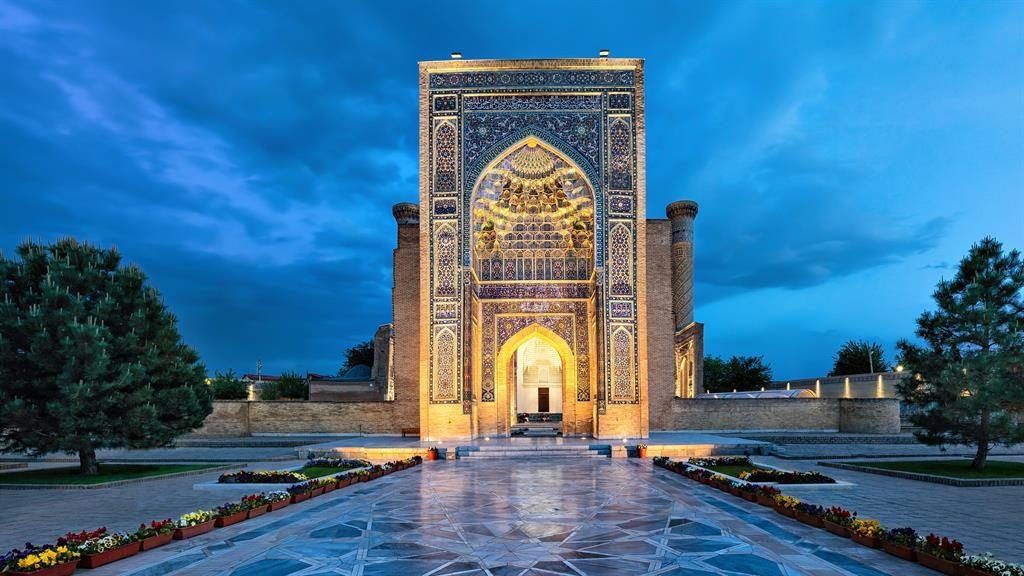
- When: late afternoon, as the last stop of the day. Inside, the gold is lit by lamps, so the hour does not matter; outside, stay until dusk, when the portal and the dome are floodlit.
- Time: 45 minutes to an hour.
- Ticket: sold at the desk at the gate; check the price there and carry some cash in som.
- Dress: this is a mausoleum and a place of pilgrimage. Cover shoulders and knees, women bring a scarf, and speak quietly inside. More in our guide to what to wear in Uzbekistan.
- Combine it: morning at the Registan, the walk north to Shah-i-Zinda, then Gur-e-Amir at the end of the day. Our Samarkand in 1, 2 or 3 days shows the whole loop, and Samarkand sights, tickets and hours has a card for every monument.
Samarkand is 2 hours 30 minutes from Tashkent on the Uzbekistan's high-speed train: Tashkent to Samarkand in 2 hours 30 minutes, Tashkent to Bukhara in about 4 hours. Tickets are tied to your passport. Read more → express: see Tashkent to Samarkand. With a guide, Gur-e-Amir is part of the Samarkand highlights tour and our other Samarkand tours; for the rest of the city, see our Samarkand city guide.
In short
- Timur began the tomb in 1404 for his grandson Muhammad Sultan and was buried in it himself in 1405.
- Timur, his sons Shah Rukh and Miran Shah, his grandsons Muhammad Sultan and Ulugh Beg and his teacher Sayyid Baraka lie in the crypt below the cenotaphs.
- The dark green stone over Timur came in 1425, broke in 1740 and carries his genealogy.
- The tomb was opened in June 1941; the warning “curse” is a legend.
- Come at the end of the day, cover up, and stay for the lights.