
Places in this article: Khiva · Bukhara
Ichan-Kala, Khiva: history, legends and how to see the walled town
The most famous minaret in Did you know? People still live inside Khiva's museum city Itchan Kala packs more than 50 historic monuments and about 250 old houses inside clay walls 8–10 m high and 5–6 m thick, and families still live and work in its lanes. Read more → is famous for being short. The Did you know? A 14-metre-wide base for a tower that stopped at 29 m Kalta Minor was begun in 1852 and meant to reach 70–80 m, but work halted in 1855 at about 29 m when its khan died. It is said to be the only minaret covered entirely in glazed tiles. Read more → was meant to be the tallest minaret in the world; it stopped at 29 metres when the khan who ordered it was killed. Half a century later, a few minutes’ walk away, a vizier finished the tallest minaret in Khiva, and he did not die in his bed either. Between the two stand a mosque held up by 212 wooden columns, a palace whose harem has five loggias and the tomb of a wrestler who became the city’s patron saint.
Ichan-Kala, also spelled Itchan Kala, is the walled inner town of Khiva, and people still live in it. We bring guests here every week, and this is the old town as our guides tell it: facts, legends (marked as such), the details most visitors walk past and how to plan your day.
What Ichan-Kala is
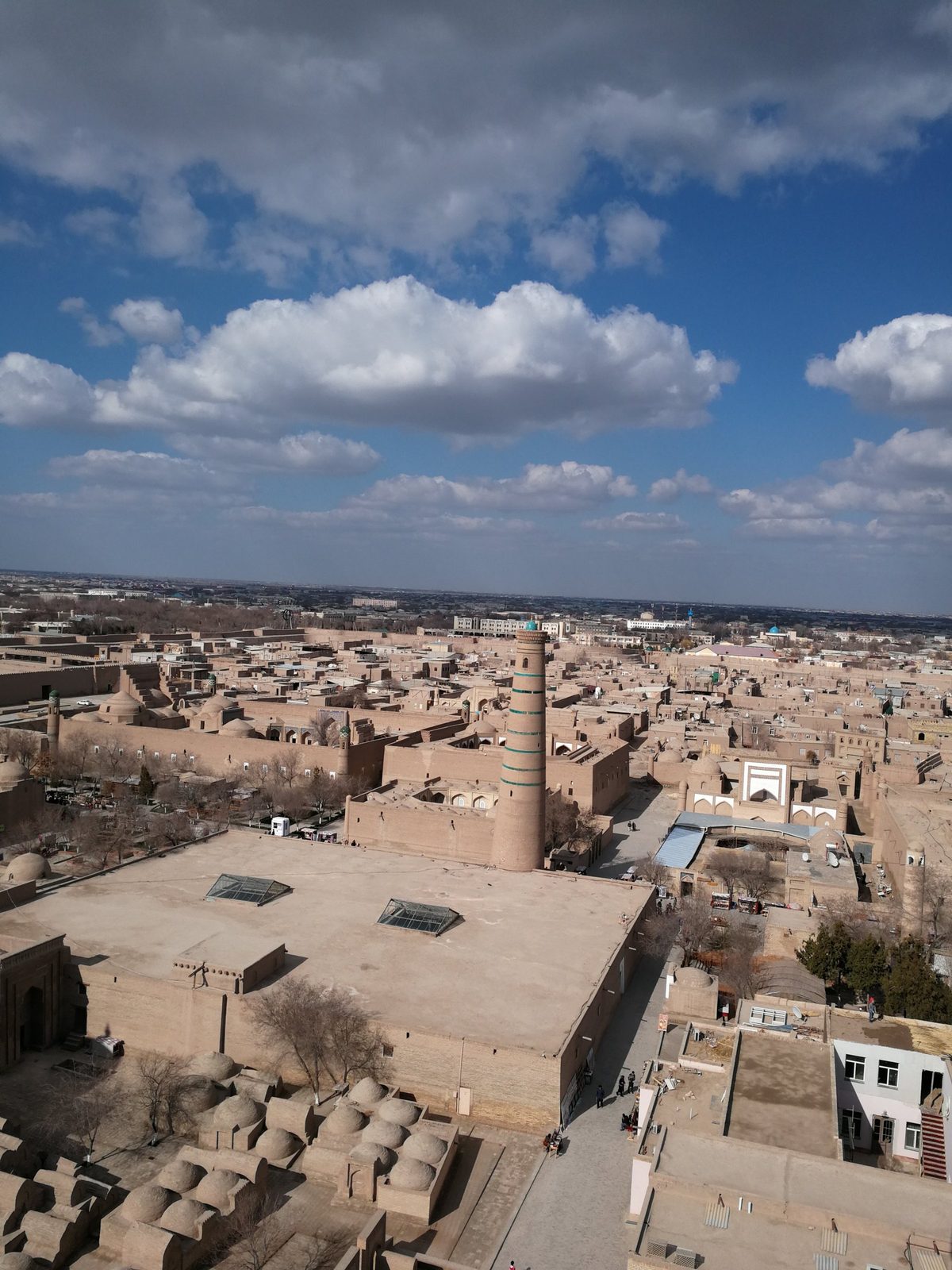
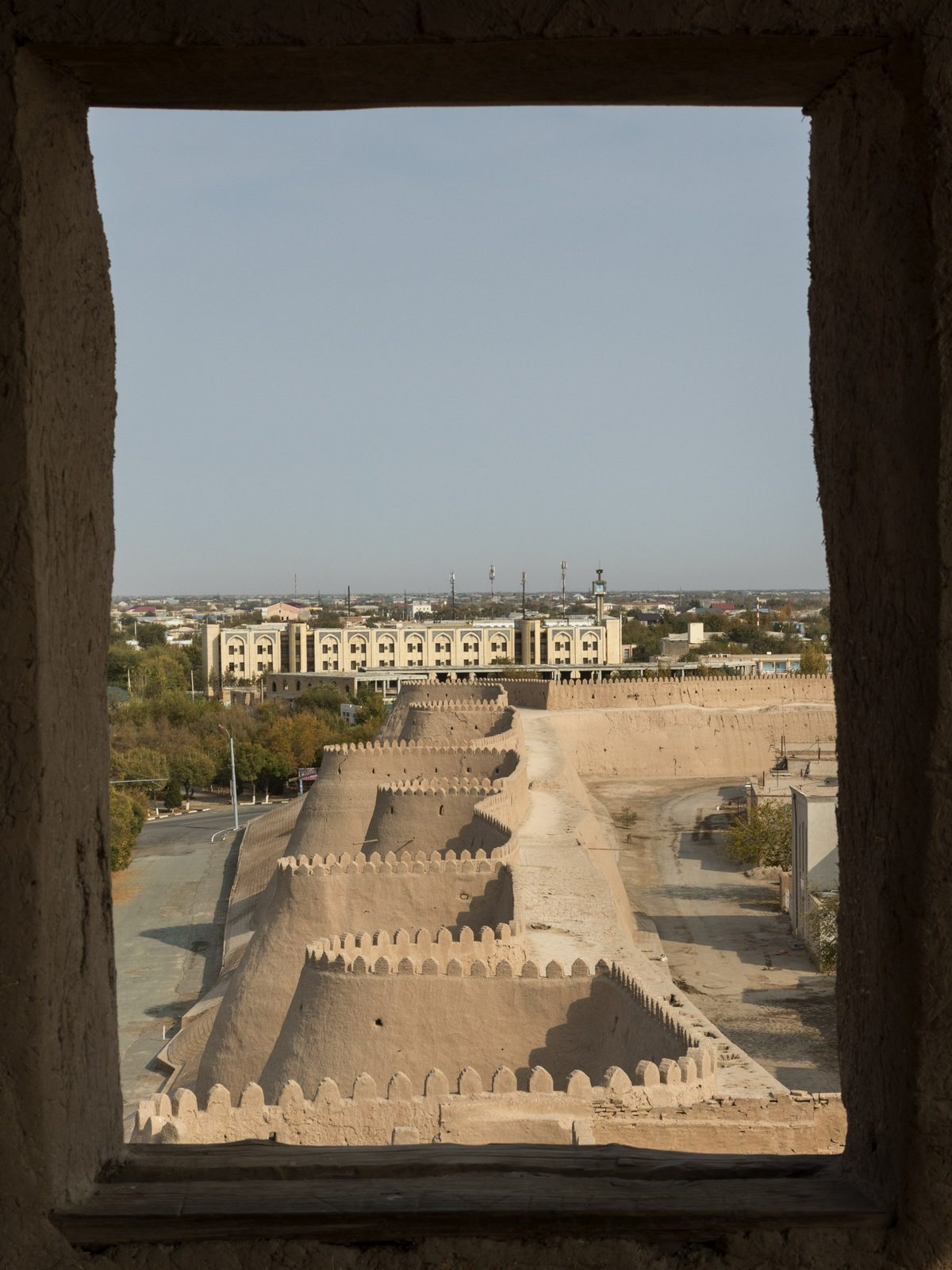
Khiva has two rings of walls. The outer town, Dishan-Kala, grew up around the inner one, Ichan-Kala, the “inner fortress”: a rectangle of about 650 by 400 metres, 26 hectares in all. You can walk across it in twenty minutes.
Inside are more than 50 historic monuments and about 250 old houses, most of them from the 18th and 19th centuries. Khiva became the capital of Khorezm in 1598, after the Amu Darya changed its course and left the old capital, Gurgench, without water. The khans who ruled from here for the next three centuries filled the inner town with mosques, madrasahs and palaces.
The walls and the four gates
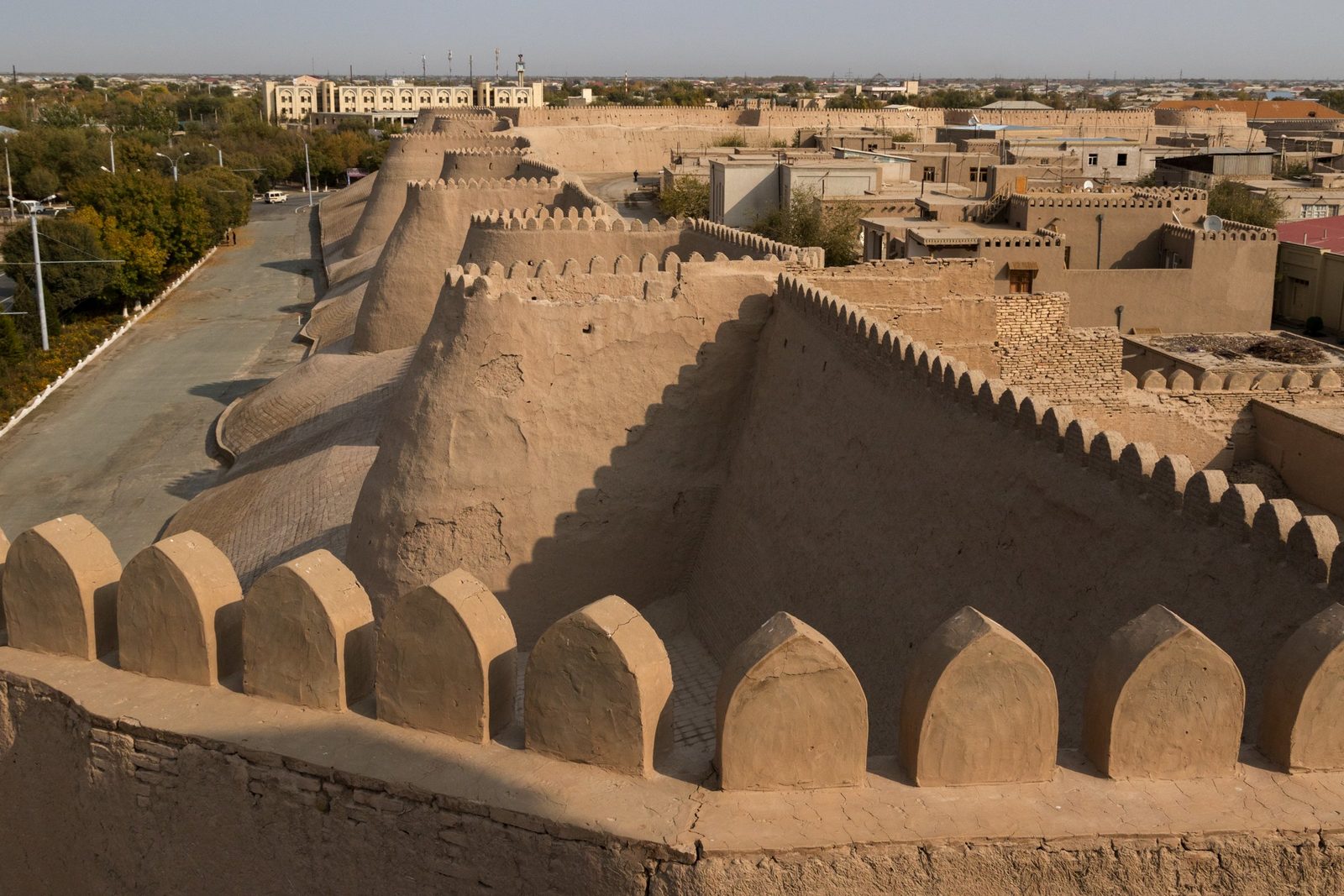
The walls are built of sun-dried clay brick, 8 to 10 metres high and 5 to 6 metres thick, and run for about 2.2 km. Round towers jut out roughly every 30 metres, and the top is crenellated like a row of teeth. A moat once ran along them; on the south side you can still trace it in the ground. The walls were repaired and rebuilt many times, but parts of their foundations are among the oldest things in Khiva.
Four gates face the four points of the compass:
- Ota-Darvoza, the West Gate, “Father Gate”: the main entrance, where most visitors come in and where the ticket office is.
- Bogcha-Darvoza, the North Gate, “Garden Gate”: the way out to the Nurullaboy palace.
- Polvon-Darvoza, the East Gate, “Strongman’s Gate”: Allakuli Khan’s caravanserai and covered market stand beside it.
- Tosh-Darvoza, the South Gate, “Stone Gate”.
Each gate had towers on both sides and a gallery above, and the longer passages were roofed with a row of domes.
Legend: Shem and the Kheivak well
This is a legend, not history. After the Flood, the story goes, Shem, son of Noah, known here as Sim, wandered the desert and fell asleep. He dreamt of 300 burning torches. When he woke, he laid out a town where the torches had stood, in the shape of his father’s ark, and dug a well. Its water tasted so good that people cried out “Khey vakh!”, roughly “What a delight!”, and the well, then the town, took its name from the cry. In another version it was A network of caravan routes between China and the Mediterranean. Samarkand, Bukhara and Khiva grew rich as stops along it. merchants who stopped to drink and said it.
The well, ,Did you know? A town said to have begun with a well dug by Noah's son Legend says Shem, son of Noah, founded Khiva after dreaming of 300 burning torches, and dug the Kheivak well, whose water had a surprising taste. The well can still be seen in Itchan Kala. Read more → is still there, in a small courtyard by the north-west wall. History is more modest: there was probably a settlement at the well by the 5th or 6th century, and linguists suspect the name Khiva comes from Khorezm, not from a thirsty traveller.
Kalta-Minor: the minaret that stopped at 29 metres
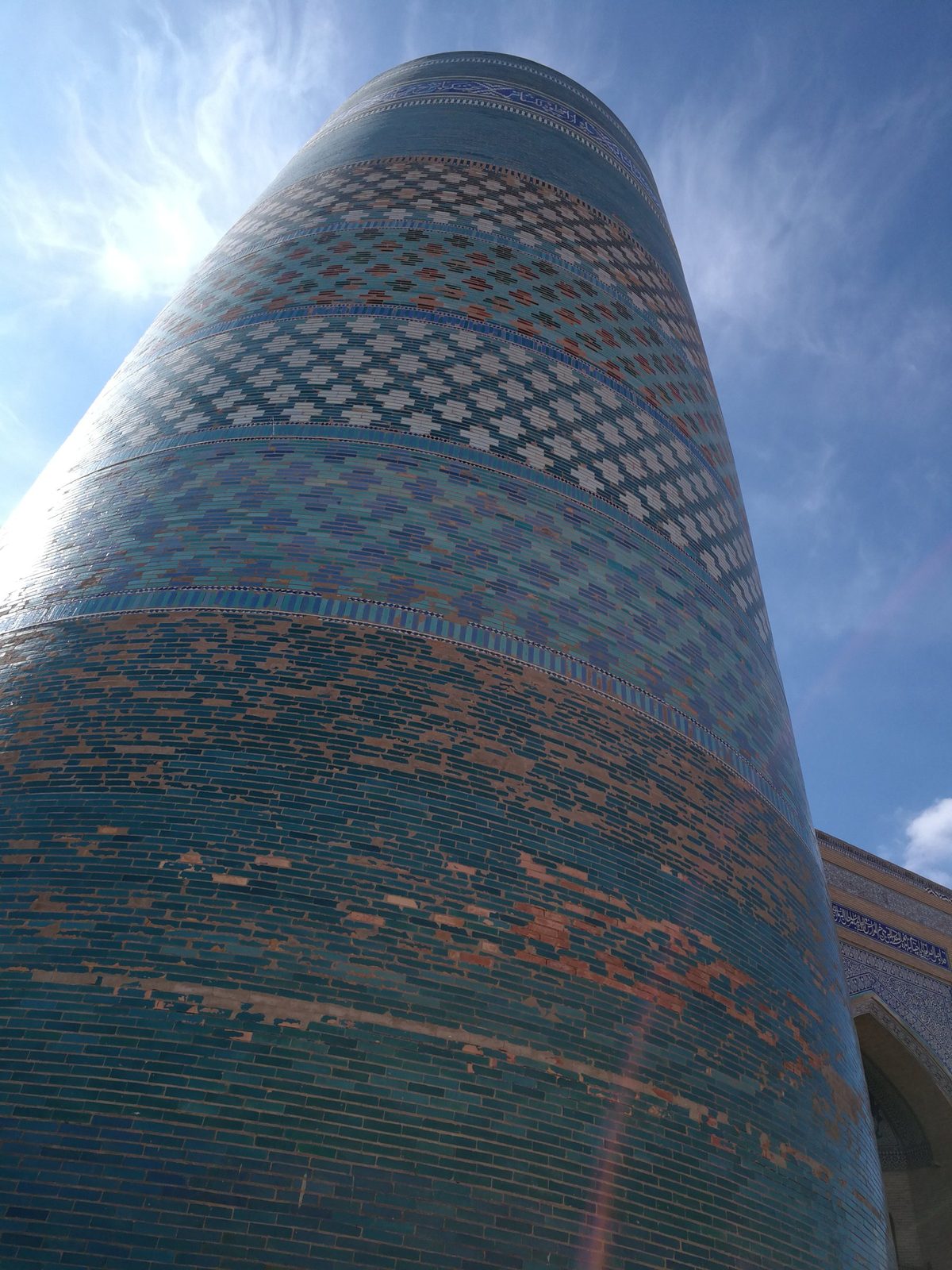
Walk in through the West Gate and it is the first thing you see: a wide turquoise drum, 14.2 metres across at the base, cut off at 29 metres as if with a knife. Muhammad Amin Khan began it in 1852 beside his ,An Islamic college: student cells and classrooms around a courtyard behind a grand portal. In the old towns many now house museums and craft workshops. the largest in Khiva, with 130 rooms on two floors for some 260 students.
The plan was 70 to 80 metres, and some accounts give even more; the khan wanted the tallest minaret in the world. That is why the base is so wide: the tower was to narrow sharply as it rose. It is the only minaret covered entirely in glazed tiles, in bands of turquoise, green and white, and its inscriptions carry verses by the Khivan poet Ogahi.
Why it was never finished: history and legends
The history is short. In 1855 Muhammad Amin Khan was killed on a campaign against the Turkmens near Sarakhs, and nobody carried on the work.
The legends are better stories. In the best-known one, the ruler of Bukhara heard about the giant minaret and secretly agreed with its architect that he would build an even taller one in Bukhara. The khan found out and ordered the architect thrown from the top of his own tower, and the work stopped. In another, the khan wanted to see Bukhara from the top, some 450 km away across the desert; the architect knew it was impossible and fled before he could be punished. Our guides tell both, then remind you that the chronicles give the khan’s death.
Kunya-Ark: the khans’ citadel
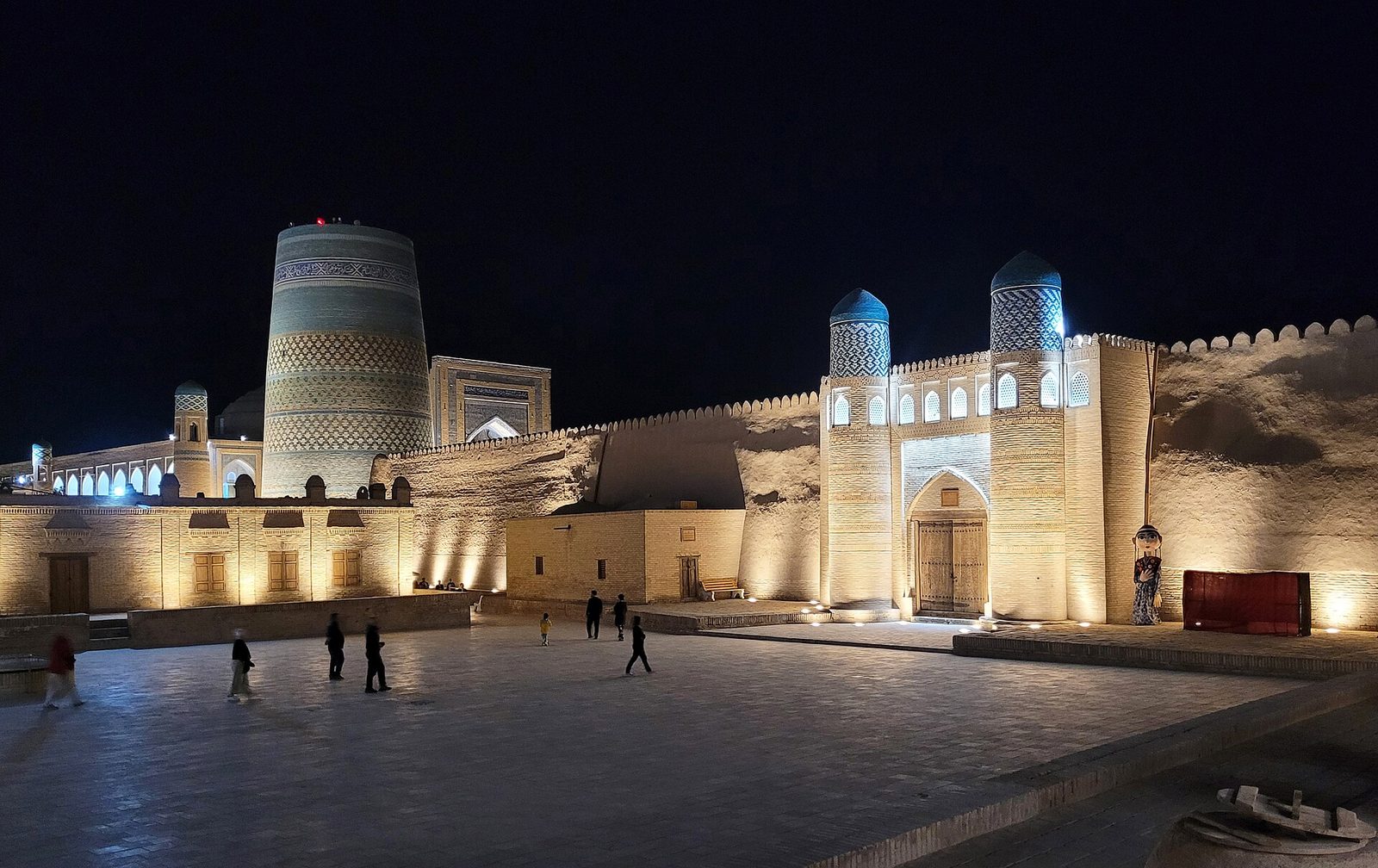
,The old fortress-residence of the khans of Khiva, inside the walls of Itchan Kala. the “old citadel”, stands just inside the West Gate: a fortress within the fortress, about 1.2 hectares, laid out at the end of the 17th century as the seat of the khans. Over the next hundred years it filled up with a mosque, a court, a mint, an arsenal, a powder works, stables, kitchens and a harem.
Its finest room is the Kurinish-khana, the reception hall, built in 1804–1806: an iwan lined with blue and white tiles, facing a courtyard where the khan’s summer yurt was pitched. The original throne, made in 1816 and covered in silver, was taken to Moscow in 1873 and is now in the Kremlin; the one you see is a copy. The summer mosque, decorated with tiles, was added by Allakuli Khan.
The highest point of the citadel is the Ak Sheikh Bobo watchtower. Keep it for the end of the day: more on that below.
Juma Mosque: a forest of 212 columns
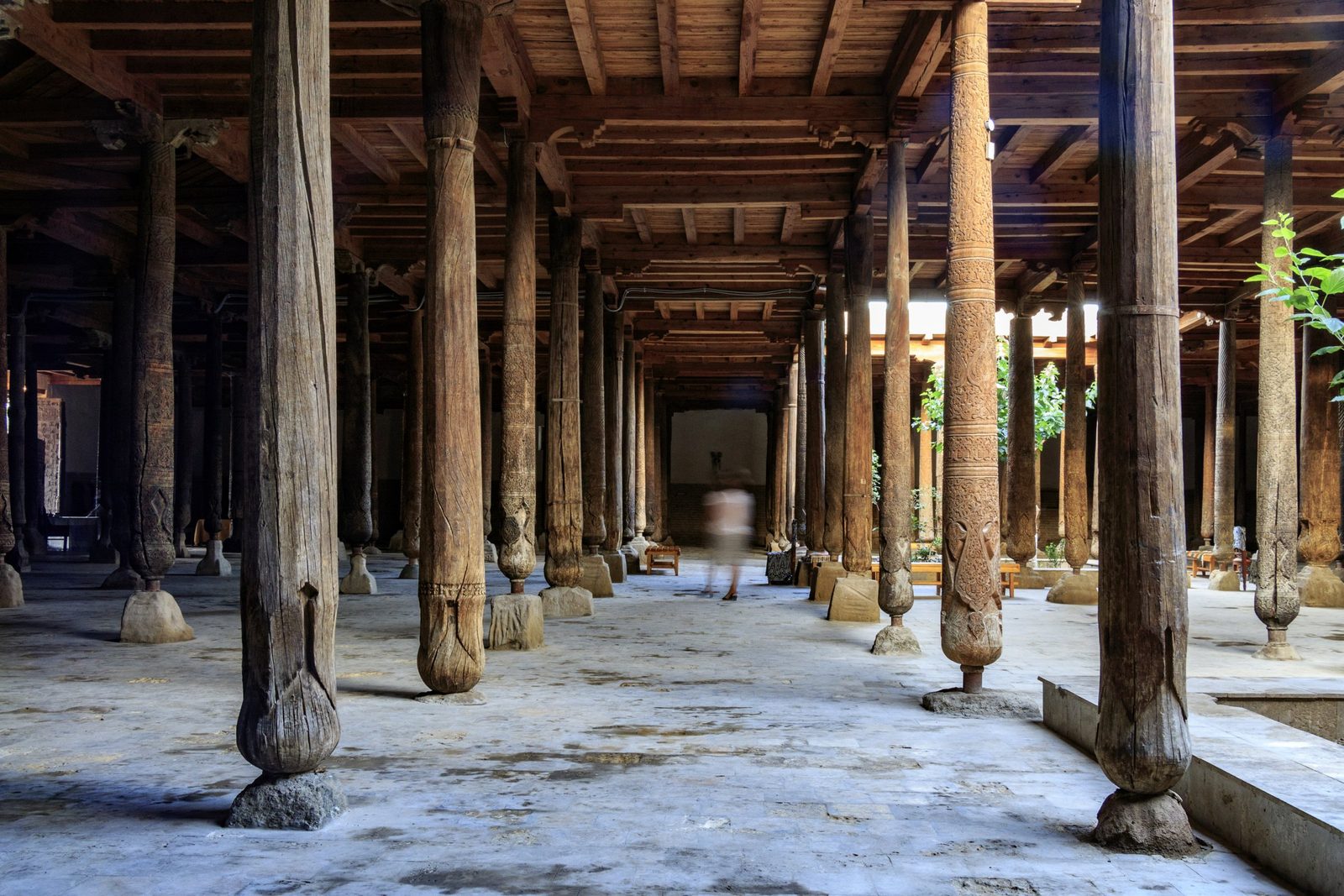
From the street it looks like nothing much: a low brick building with a flat roof, no portal, no dome and no courtyard. Inside is a single dim hall, about 55 by 46 metres, where 212 carved wooden columns in 17 rows hold up the roof; some counts give 213. Light comes only through openings in the ceiling, so the columns pass from shadow into sunlight as you walk.
The mosque is first mentioned in the 10th century by the Arab geographer al-Muqaddasi; the building you see dates from 1788–1789. Many columns are older than the walls around them. The oldest are thought to date from the 10th–11th centuries and were reused from earlier buildings, perhaps from Kath, an earlier capital of Khorezm. Carved dates on doors and columns run from 1316 to 1789. Look at the capitals and bases: no two are alike. The minaret beside the mosque is 42 metres high.
Allakuli Khan’s Khiva: Tash Hovli and its harem
Allakuli Khan, who ruled from 1825 to 1842, changed the face of Ichan-Kala. To make room, he had part of the wall by the East Gate taken down. In its place rose a caravanserai (1832–1833), a madrasah (1834–1835) and a covered market, the tim (1836–1838). Rent from the caravanserai and the market paid for the madrasah’s library. The madrasah now houses a crafts centre.
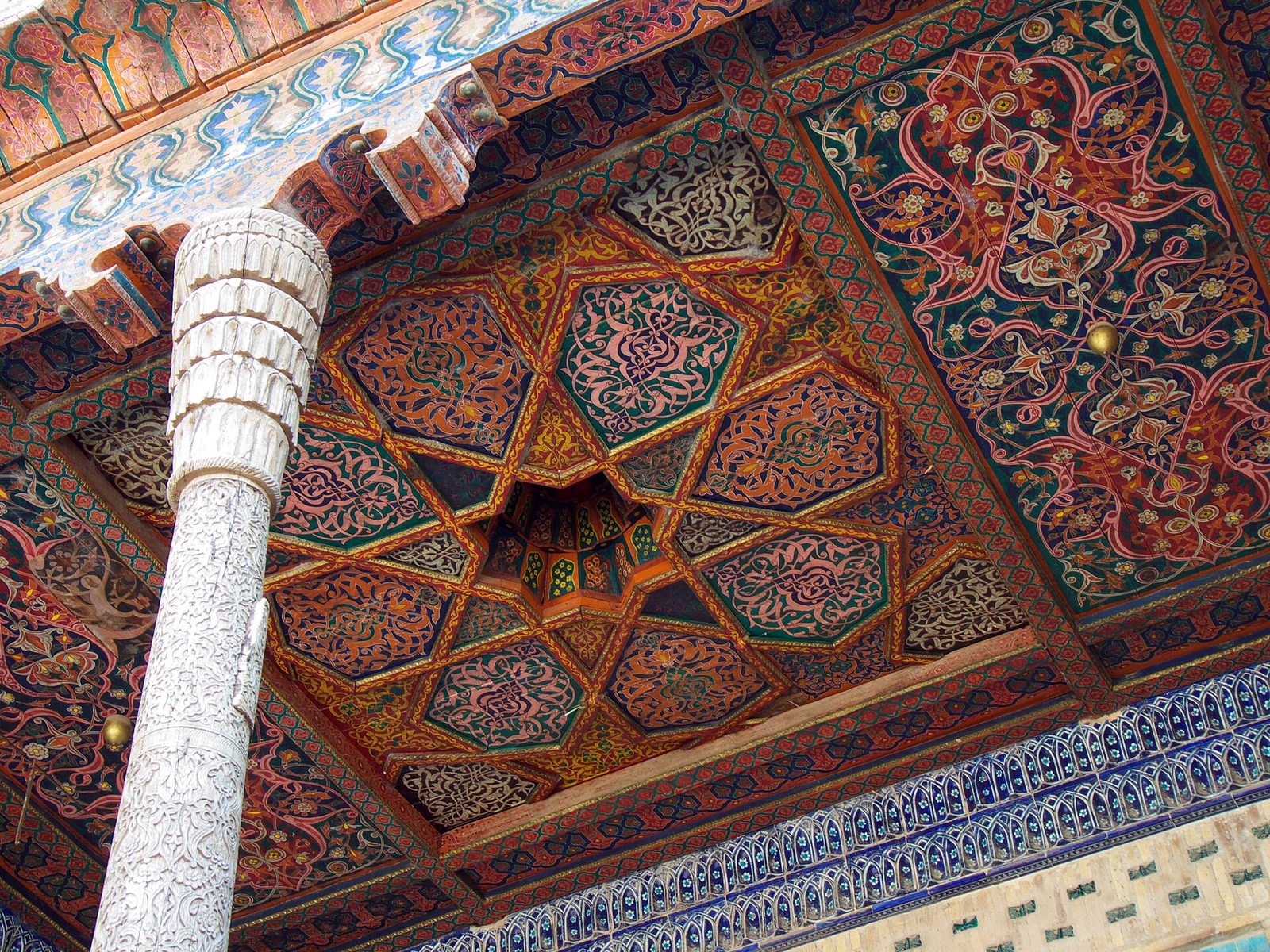
His palace, Tash Hovli, the “stone house”, went up in the 1830s: more than 260 rooms around three courtyards. The harem was built first. Along one side of its courtyard stand five loggias on carved wooden pillars: four for the khan’s four wives and the largest for the khan. In the reception courtyard, the Ishrat-hovli, guests could pitch their yurts on two round platforms; the third courtyard, the Arz-hovli, was the court of justice. The blue and white tiles are the work of the master Abdullah Jin, and the wooden ceilings are painted red and yellow.
Khiva also tells a grim story about the palace: the first architect, Usta Nur Muhammad, said it could not be finished in two years, and the khan had him executed. His successor took eight.
Pahlavan Mahmud: the poet-wrestler who became a saint
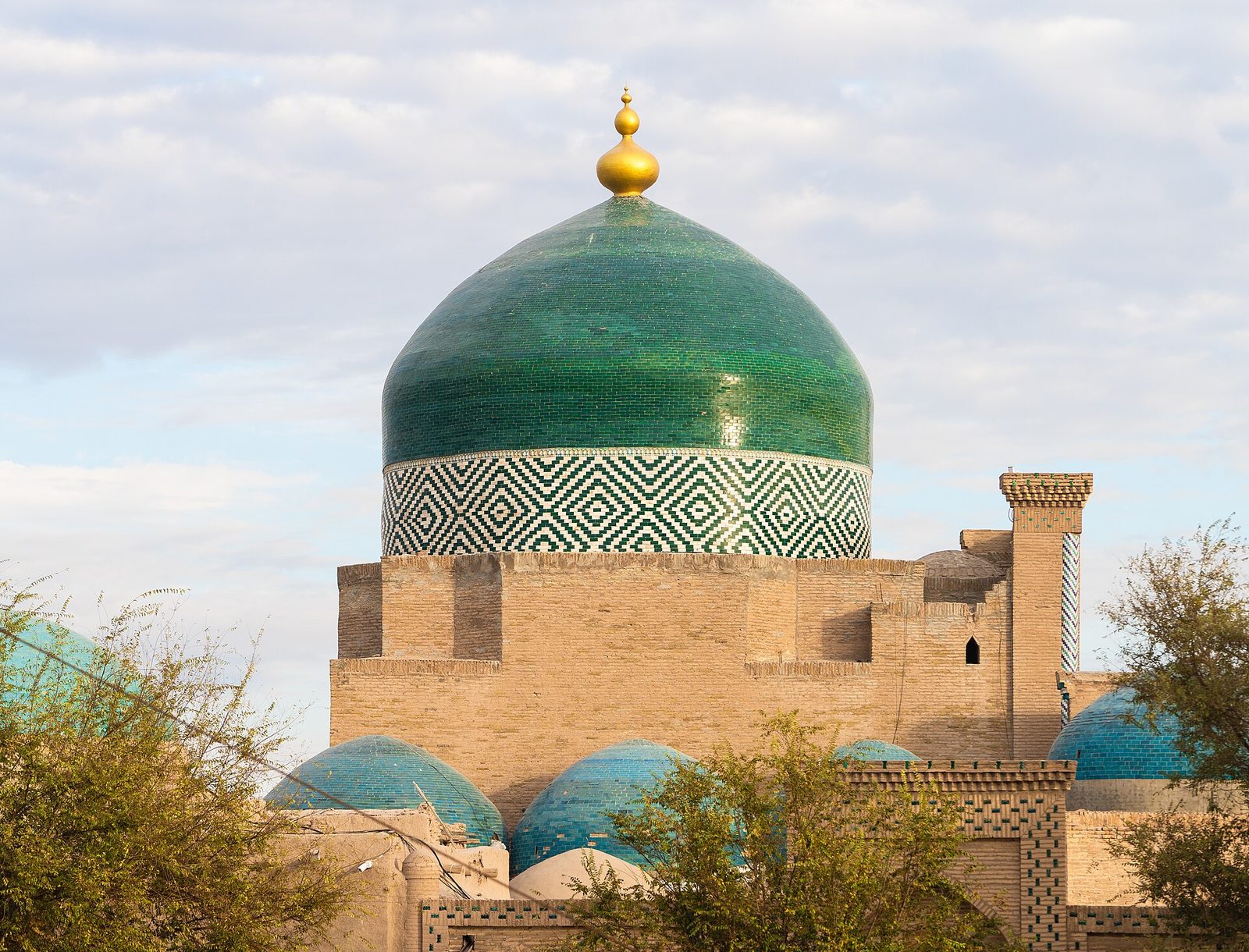
The mausoleum of Pahlavan Mahmud, a poet and wrestler revered as the patron saint of Khiva. lived in the 13th and 14th centuries; he died in the 1320s. He came from a family of craftsmen, worked with leather, wrote poetry and was remembered as an unbeaten wrestler and a healer. Today he is the patron saint of Khiva, and wrestlers in Iran still pray to him before a bout.
By his own wish he was buried in his workshop, and a shrine grew around the grave. The building you see was raised in 1810–1825 under Muhammad Rahim Khan I. Its double dome, the largest in Khiva, is covered in turquoise tiles and topped with gilding. Several khans are buried here, and inside, the tiles carry Persian verses attributed to Mahmud himself. It is still a place of pilgrimage: cover your shoulders and knees, bring a scarf if you are a woman, and keep your voice down.
Legend: the prisoners and the cowhide
This is a legend. Mahmud once defeated the champion of a foreign ruler, who offered him any reward he liked. Mahmud asked for the freedom of his fellow Khorezmians held captive there. “How many?” asked the ruler. “As many as fit inside a cowhide.” Mahmud cut the hide into a thin strip, tied it into one long cord and drew it around all the prisoners, and they went home with him.
Islam Khoja: the last madrasah and the tallest minaret
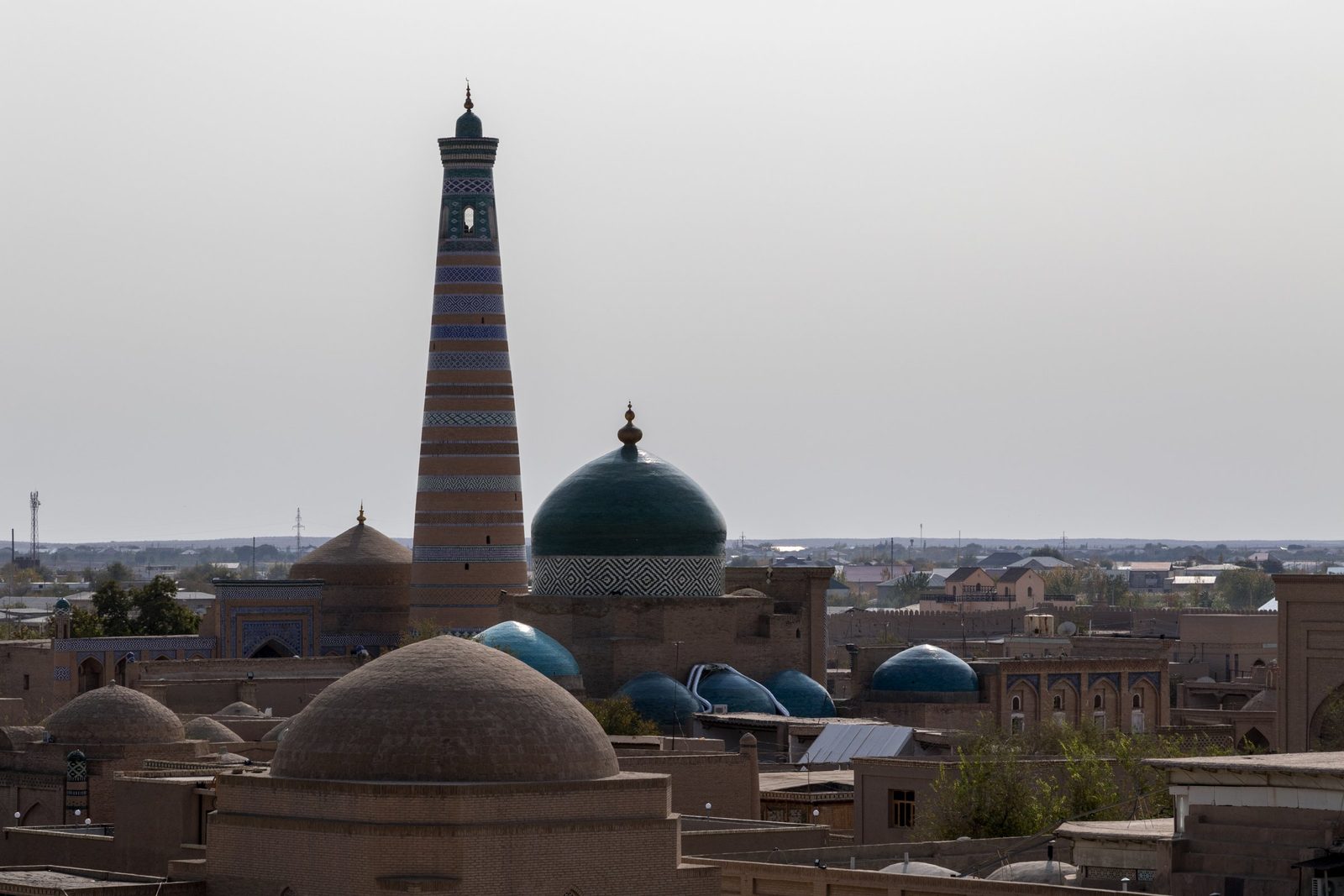
The youngest landmark of Ichan-Kala went up in 1908–1910. Did you know? Khiva's tallest minaret is barely a century old The Islam Khoja Minaret was begun in 1908, near the very end of the khans' era. At 56.6 m it is one of the tallest in Central Asia; a spiral stair of 175 steps leads up to its windowed top. Read more → was the first vizier of Khiva under Muhammad Rahim Khan II and his son Isfandiyar Khan, and a reformer: he paid for a hospital, a pharmacy, a post and telegraph office and secular schools.
His minaret is 56.6 metres tall, the tallest in Khiva, banded in blue, white and green tiles. The viewing platform at about 45 metres is the highest point in the old town. His madrasah is small, with 42 cells and a large domed hall, and now holds the museum of applied arts. In 1913 Islam Khoja was murdered; his reforms had made him powerful enemies at court.
Whether the minaret is open for climbing is decided on the day. The spiral staircase is narrow, dark and steep.
Museum-reserve since 1969, UNESCO since 1990
On 29 June 1969 the government of the Uzbek SSR made the whole of Ichan-Kala a state historical and architectural museum-reserve. The town became a museum without its people moving out, and the restorers moved in. Many of the tiles and carvings you see were renewed in those decades, and again for Khiva’s 2,500th anniversary in 1997.
On 12 December 1990 Ichan-Kala was inscribed on the UNESCO World Heritage List, the first place in Uzbekistan to be listed. Bukhara followed in 1993 and Samarkand in 2001. Today the museum-reserve runs 15 permanent exhibitions in the old madrasahs and palaces.
Life inside the walls
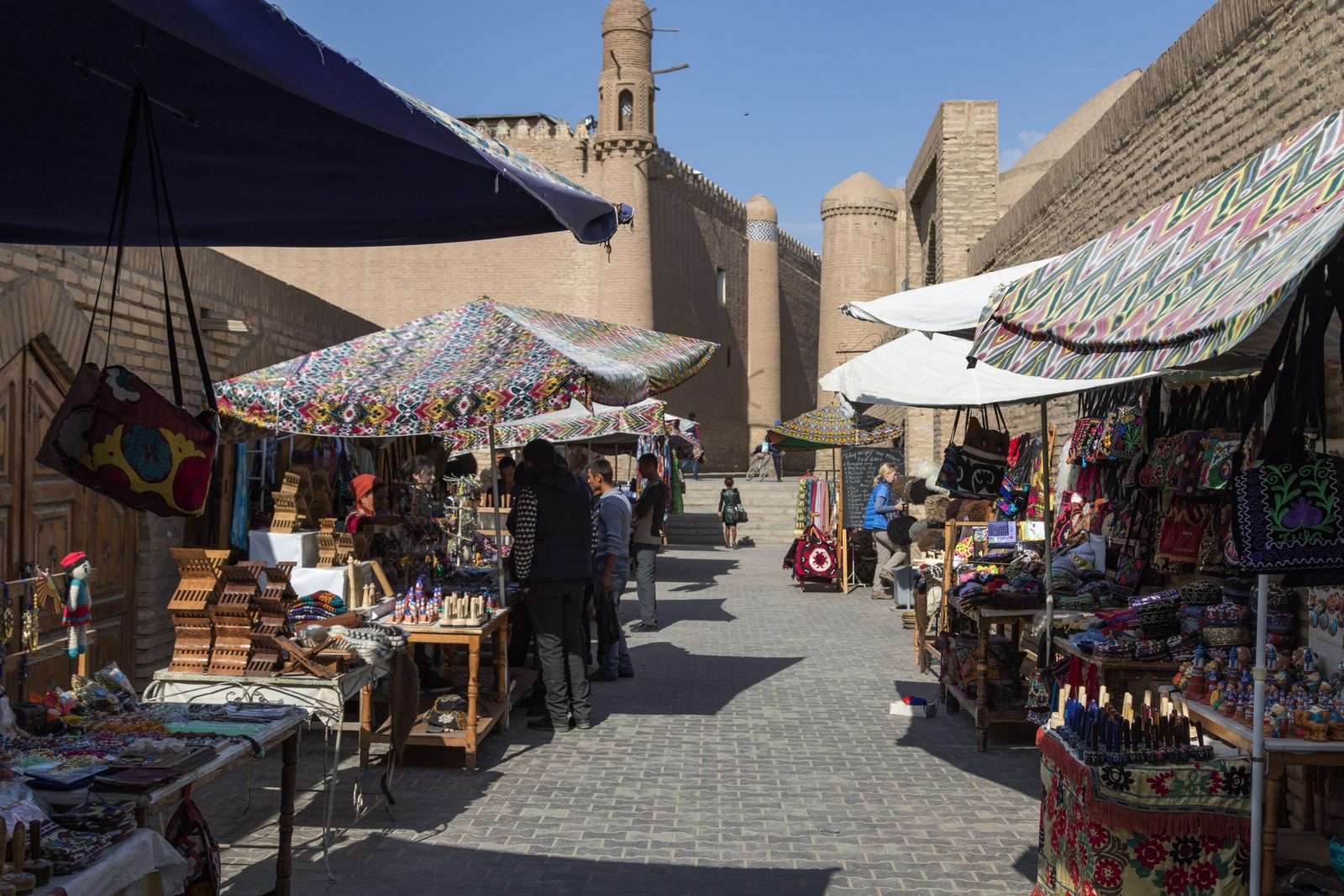
Ichan-Kala is not an empty open-air museum. Families still live in the old houses behind the monuments, and many make their living from crafts and visitors: guesthouses, cafés on the flat roofs, souvenir stalls, woodcarving and ceramics.
Early in the morning the lanes belong to them, and by evening, when the day groups have gone, they do again. Two rules: a house door is a private door, however photogenic, and ask before you photograph people.
Did you know?
- In 1970 Ichan-Kala played a frontier fortress in the Soviet adventure film The End of the Ataman.
- The Kunya-Ark had its own mint. More than 300 Khivan coins are kept in the Hermitage in St Petersburg.
- Some of the tile inscriptions on the Kalta-Minor were broken off in the Soviet years. After independence the master Rustam Tohirov restored the lettering.
- ,A new tourist complex on the shore of Lake Govuk, a short drive from Ichan-Kala, opened in May 2025: 17 hotels and guest houses, a 3,000-seat amphitheatre, restaurants, a bazaar under domes and a canal with gondolas. Read more → the new quarter by Lake Govuk, has its own copy of the Kalta-Minor, so you can compare the two on the same day.
Ichan-Kala in dates
| Year | What happened |
|---|---|
| 1598 | Khiva becomes the capital of Khorezm |
| Late 17th century | The Kunya-Ark is laid out as the khans’ citadel |
| 1788–1789 | The Khiva's Friday mosque: a single hall without a dome, held up by more than two hundred carved wooden columns of different ages. is rebuilt in its present form |
| 1804–1806 | The reception hall of the Kunya-Ark |
| 1810–1825 | The Pahlavan Mahmud mausoleum |
| 1830s | Tash Hovli palace |
| 1832–1838 | Allakuli Khan’s caravanserai, madrasah and covered market |
| 1852–1855 | Kalta-Minor, left unfinished |
| 1908–1910 | Islam Khoja madrasah and minaret |
| 1969 | Ichan-Kala becomes a museum-reserve |
| 1990 | UNESCO World Heritage List |
| 2025 | Arda Khiva opens outside the walls |
Visiting Ichan-Kala: ticket, hours and our tips
- Ticket: walking the lanes is free. The museums and monuments inside are covered by one combined ticket from the office by the West Gate. Its price, how long it is valid and what it includes are set there, so ask on the spot, including whether the minaret climbs cost extra.
- Hours: the lanes are a living town and never close. The museums keep daytime hours; check them at the ticket office.
- How long: one full day plus an evening. With a second day you can add Dishan-Kala and the desert fortresses: see Khiva in 1 or 2 days.
- Best light: sunrise for empty lanes and soft light on the walls; around noon in the Juma Mosque, when sunlight falls through the roof; the last hour of the day at the Kalta-Minor, when the tiles glow.
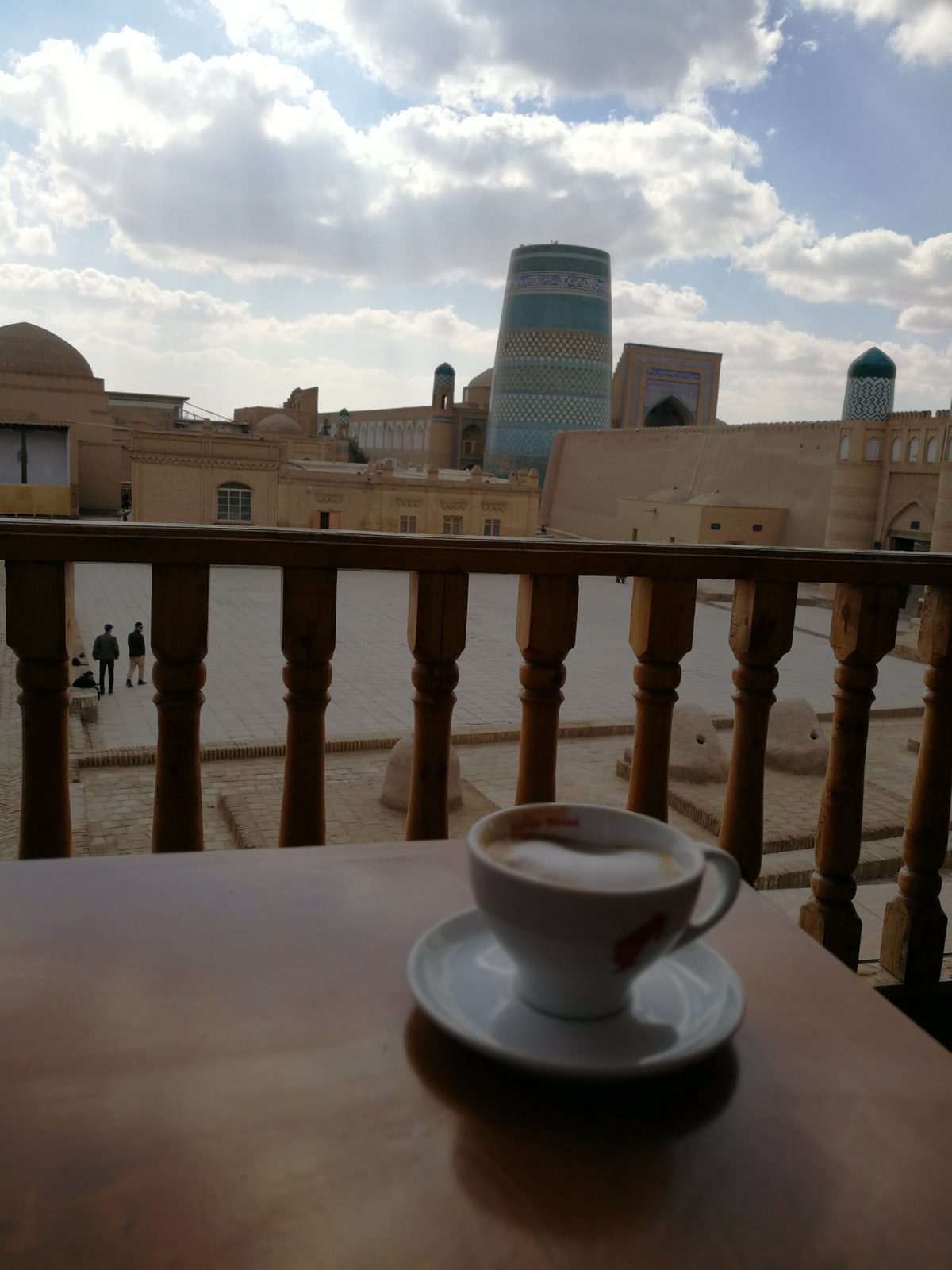
- Sunset: climb the Ak Sheikh Bobo watchtower of the Kunya-Ark: from the top, the domes, minarets and flat clay roofs come together into one picture. A café terrace on a roof is the relaxed alternative.
- Dress: shoulders and knees covered in the Juma Mosque and at Pahlavan Mahmud, and a scarf for women; elsewhere, ordinary summer clothes are fine.
- Where to sleep: inside the walls if you can. Small hotels and guesthouses in old houses give you the lanes before the groups arrive and after they leave. More in where to stay in Uzbekistan.
- Getting there: the fast Jaloliddin Manguberdi train leaves Tashkent at 07:00 every day except Sunday and reaches Khiva at about 14:30; the station is a half-hour walk from the walls. See trains in Uzbekistan and Khiva to Bukhara.
A card for each monument, with tickets and timings, is in our guide to Bukhara and Khiva sights. For the whole city, see our Khiva city guide. With one of our guides, Ichan-Kala is the Khiva walking tour, and it is part of Khiva in 3 days, the 8-day classic tour and our other Khiva tours.
Beyond the walls: Nurullaboy and Arda Khiva
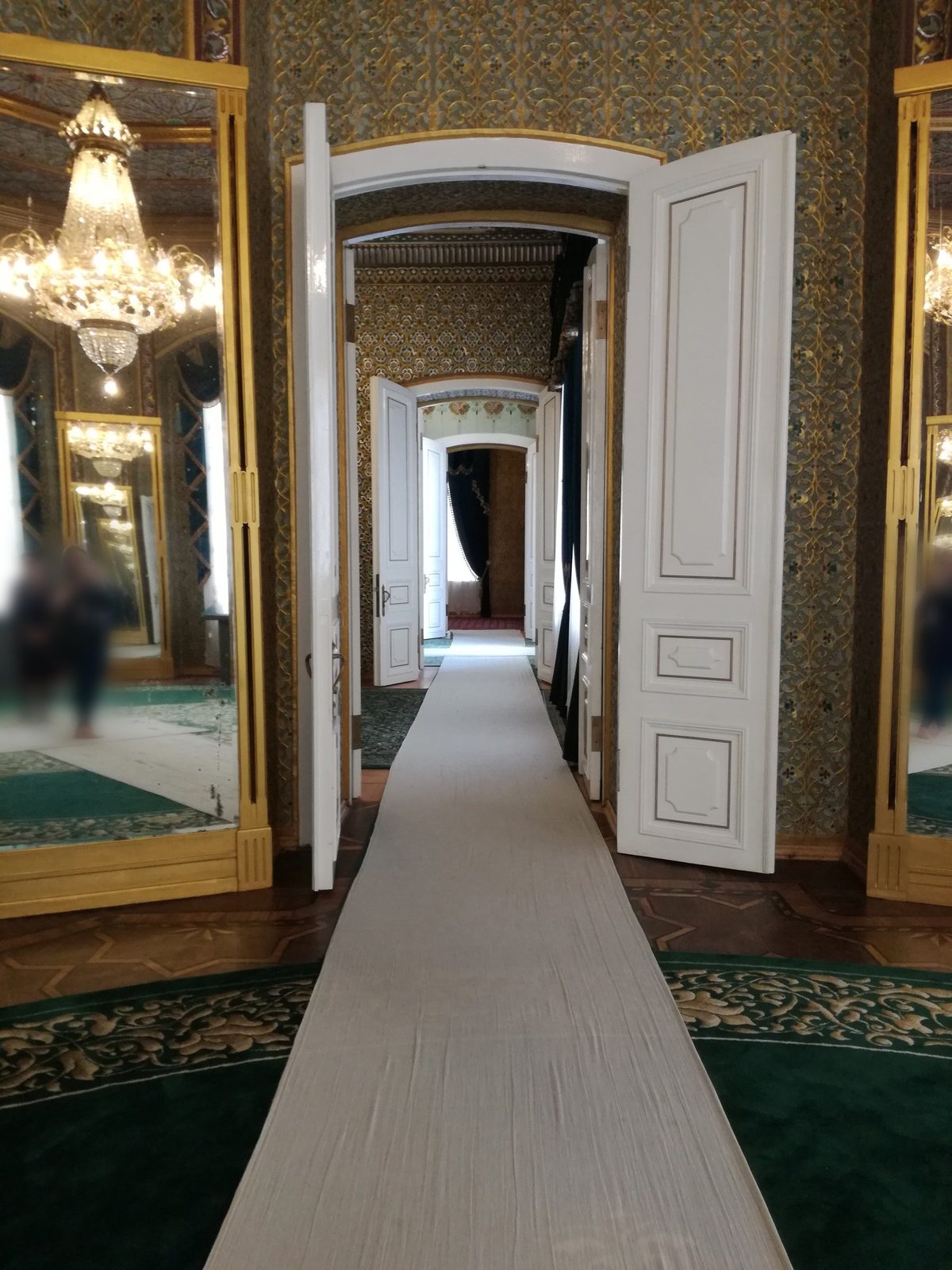
Walk out through the North Gate into Dishan-Kala and you reach the Nurullaboy palace, home of the last khans, with a reception hall finished in 1912: mirrors and chandeliers instead of tiles and carved wood.
For the evening, take a taxi to Arda Khiva, the new quarter on Lake Govuk, opened in May 2025: a promenade, a bazaar under domes, restaurants and a 3,000-seat amphitheatre by the water. After a day among the monuments, that is where we take our guests for dinner.
In short
- Ichan-Kala is Khiva’s walled inner town: about 650 by 400 metres, four gates, more than 50 monuments and about 250 old houses where people still live.
- Don’t miss the unfinished Kalta-Minor (1852–1855), the 212 columns of the Juma Mosque, the harem of Tash Hovli, the Pahlavan Mahmud mausoleum and the 56.6-metre Islam Khoja minaret.
- Shem and the well, the architect thrown from the minaret, the cowhide: enjoy the legends, but know which ones are legends.
- A museum-reserve since 1969 and the first UNESCO World Heritage site in Uzbekistan (1990).
- One combined ticket from the West Gate office, a full day plus an evening, sunset from the Ak Sheikh Bobo watchtower, and a night inside the walls if you can.
© Photos
- Tosh Hovli Palace, Khiva — Fulvio Spada from Torino, Italy / Wikimedia Commons · CC BY-SA 2.0
- Pahlavan Mahmud Mausoleum, Khiva — Panpanchik / Wikimedia Commons · CC BY-SA 4.0