
Places in this article: Bukhara
Lyabi-Hauz and Chor Minor: Bukhara’s pond square and the gatehouse with four towers
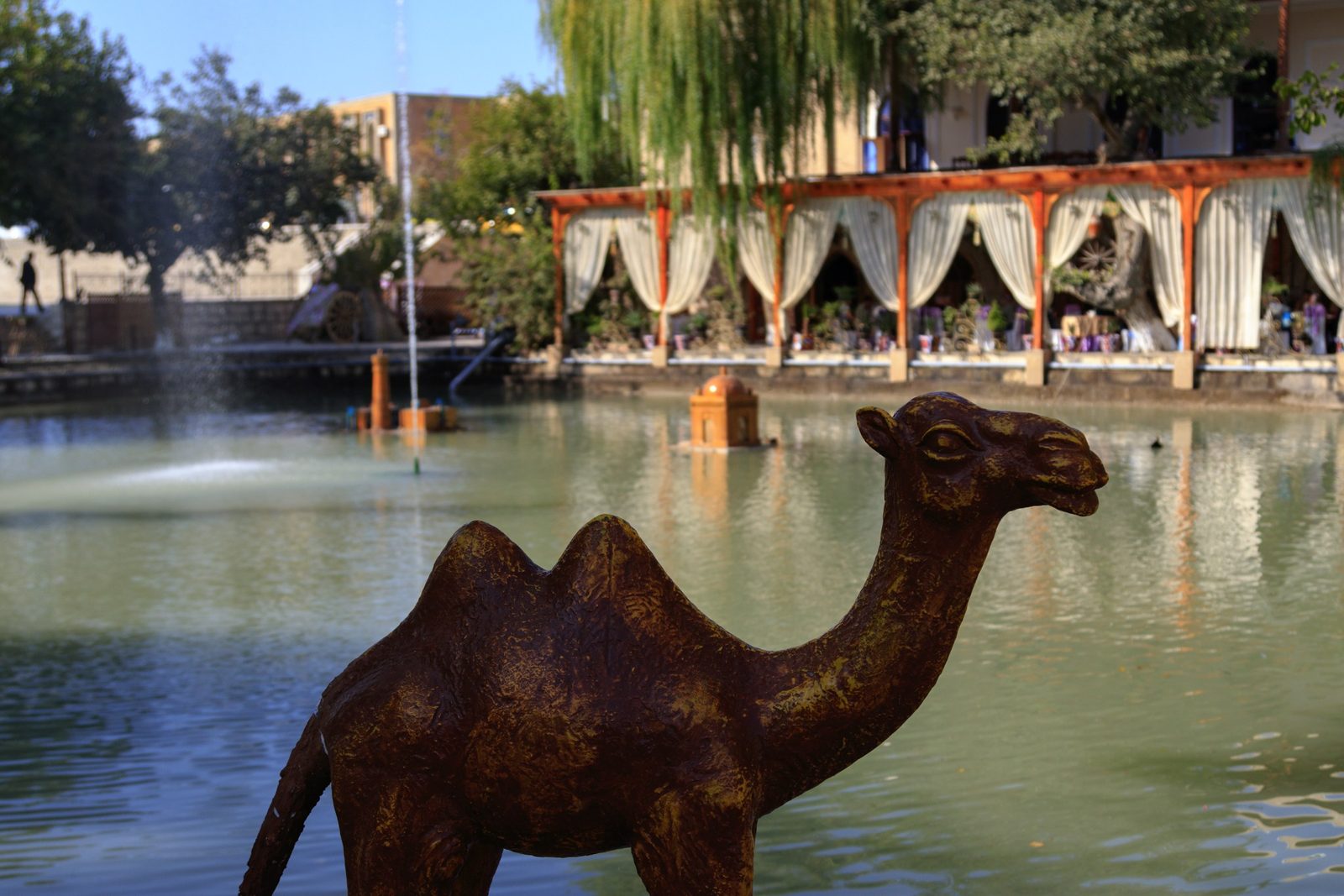
Stone steps run down into the water on every side of the pond, and in the evening every step has someone on it. Waiters carry pots of green tea between the tables, a bronze Did you know? Sit a child on Nasreddin's donkey for a happy life By Lyabi-Hauz stands a statue of Nasreddin, the trickster of tales told from Turkey to China, whom Uzbeks count as a Bukharan. Locals say a child placed on his donkey will have a life full of joy. Read more → waves from his donkey, and above the far bank two tiled birds fly towards a sun with a human face. ,Did you know? Bukhara's ponds were once its water supply Pools like Lyabi-Hauz, dug around 1620 and 46 × 36 m, were the city's main source of water. Most were filled in during the 1920s–30s because they spread disease; Lyabi-Hauz survived. Read more → “by the pond” in Persian, is where Bukhara spends its evenings, and where we finish almost every Bukhara day with our guests.
Here is the square as our guides tell it: the pond and the vizier who dug it, the three buildings around it, the folk hero on the donkey, the teahouses, and a ten-minute walk to ,Did you know? Legend: four towers for four world religions? Chor Minor, a gatehouse of 1807, has four towers, each decorated differently. Guides say they stand for four world religions and look for a cross, a fish and a prayer wheel in the decor; others say four dynasties. All are interpretations. Read more → the gatehouse with four towers. Legends are marked as legends.
A pond that outlived the others
A hauz is a stone-lined pond, and for centuries Bukhara lived on them. Dozens were scattered through the old town, filled from canals fed by the Zarafshan river, and they were the city’s main source of water. In the 1920s and 1930s most were drained and filled in. Lyabi-Hauz survived because of the buildings around it.
It was dug in about 1620 for ,Did you know? A caravanserai that became a madrasah by a khan's word Nadir Divan-Begi built his 1622 building by Lyabi-Hauz as a caravanserai. At the opening Imam Quli Khan praised it as a fine madrasah, and a khan's word could not be taken back: a portal and cells were added, and a madrasah it became. Read more → vizier and uncle of Imam Quli Khan, who ruled Bukhara from 1611 to 1642. The pond measures about 46 by 36 metres and is up to 5 metres deep. Its sides are steps of yellowish limestone that go down to the water. Water came in from the Shahrud canal, and there was no outlet.
Even this pond had a dry spell. In Soviet times it was emptied and used as a sports ground. Then, in the 1950s, a fire broke out in a grocery nearby and there was not enough water in the canal to fight it. The pond was filled again, and at the end of the decade a pipe and a simple fountain were laid around it.
The legend of the widow’s house
This is a legend. The plot Nadir wanted for his pond belonged to an old Jewish widow who would not sell. The muftis ruled that no one could take her land without her consent. So Nadir dug a channel past her house, the water soaked into her foundations, and in the end she agreed, on one condition: a plot elsewhere for a synagogue. Bukhara still calls the pond, half in jest, Hauz-i Bazur, “the pond made by force”.
Kukeldash: the largest madrasah in Bukhara
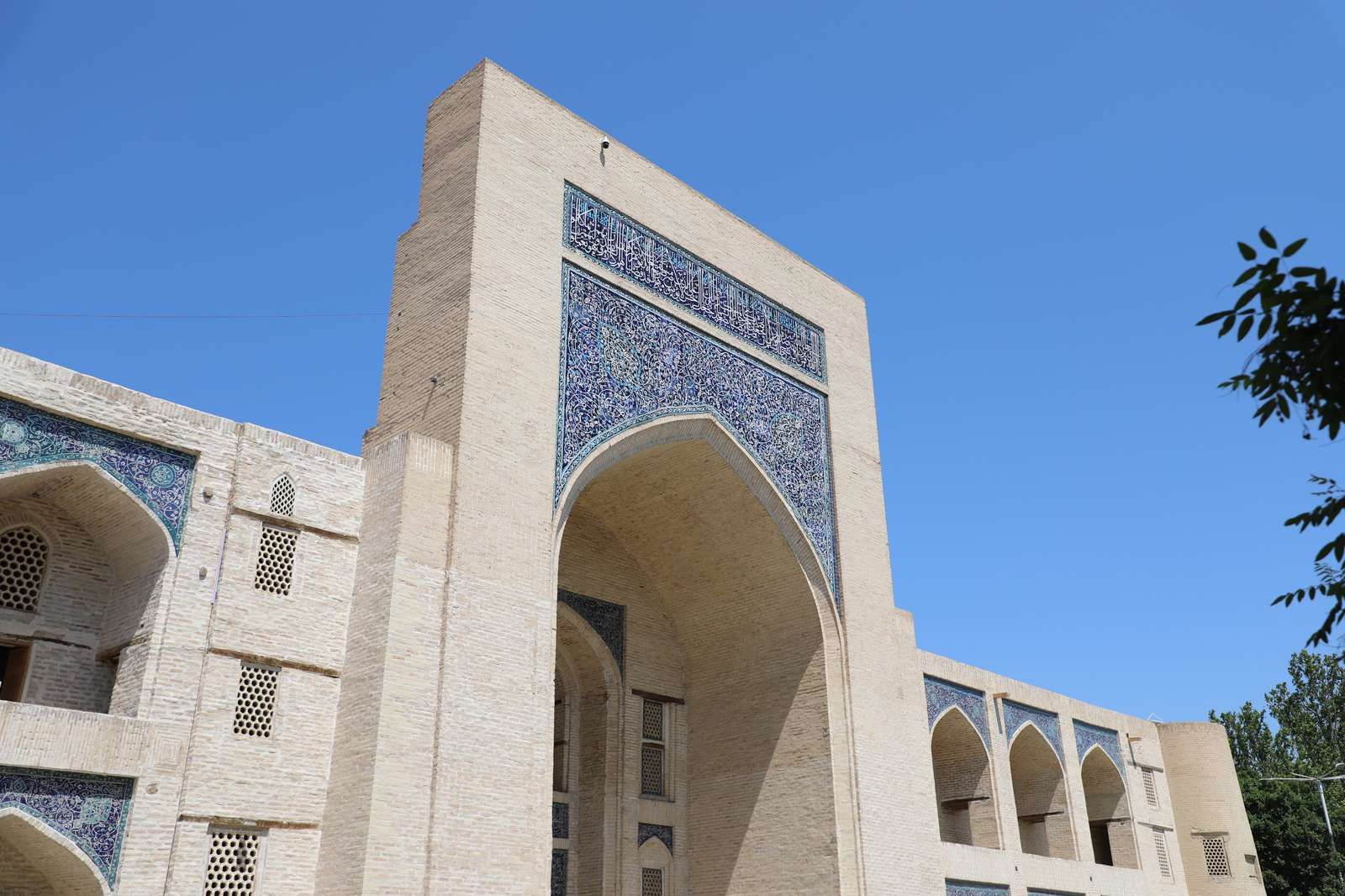
The north side of the square is one long brick building, half a century older than the pond. The Kukeldash madrasah was built in 1568–1569 under Abdullah Khan II, with money from Kulbaba Kukeldash, a dignitary of his court. It is the oldest building on the square and the largest An Islamic college: student cells and classrooms around a courtyard behind a grand portal. In the old towns many now house museums and craft workshops. in Bukhara: about 80 by 60 metres, with 160 cells for students on two floors around the courtyard.
Walk along the outside and look at the ground floor. The outer cells were let to the town’s shopkeepers, so the madrasah earned its keep while its students studied inside. Today part of the building belongs to the Bukhara State Museum-Reserve.
Nadir Divan-Begi: phoenixes on a madrasah
The two buildings that face each other across the water both carry the vizier’s name. On the west side is his khanaqah of 1619–1620, a domed lodge for Sufis. Its main hall, about 11 metres square, was built for dhikr, the Sufi chant, and its acoustics are still good.
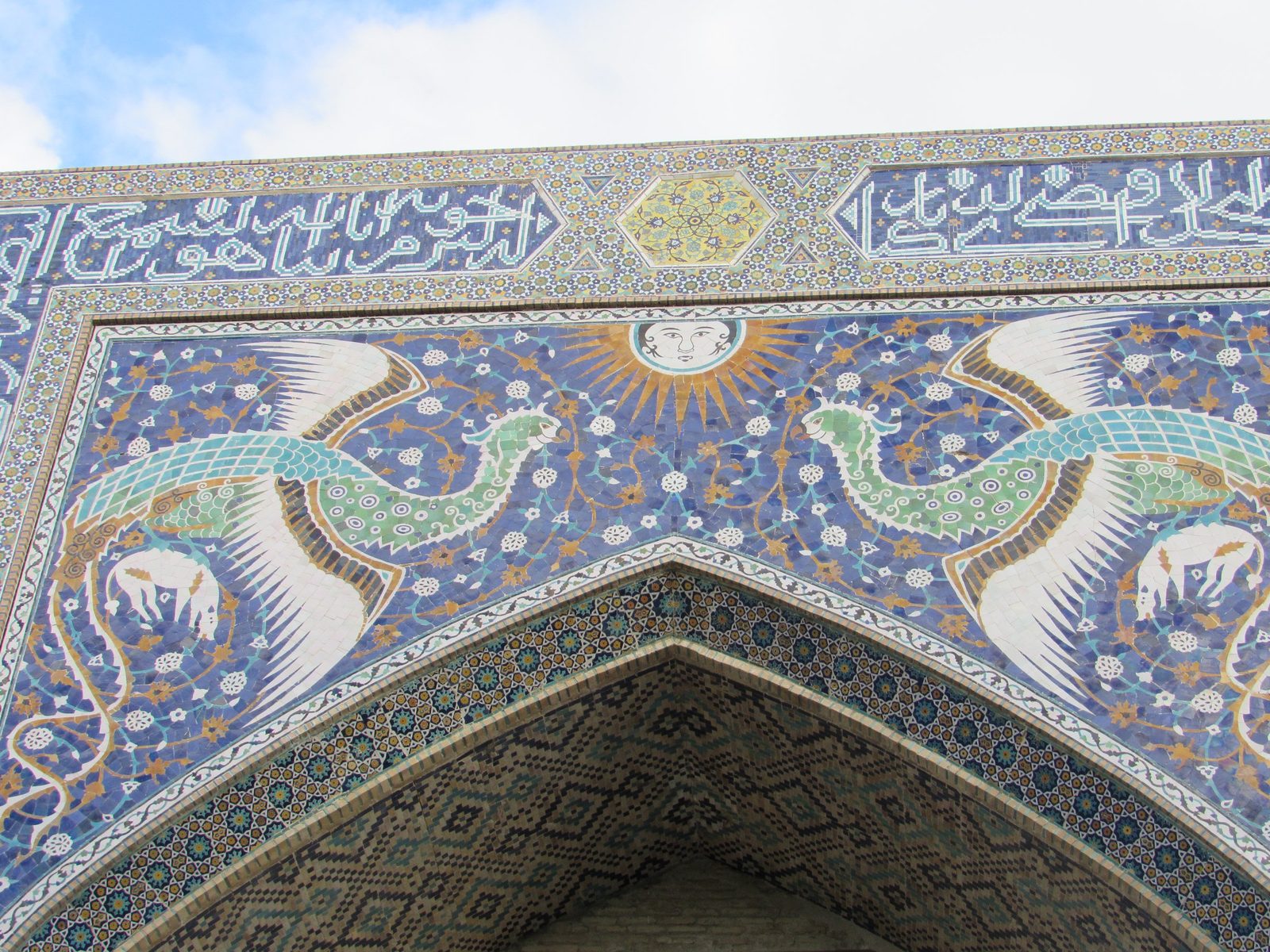
On the east side is the madrasah of 1622, which was meant to be a caravanserai. The story goes that at the opening Imam Quli Khan called it a fine madrasah, and a khan’s word could not be taken back. Nadir added a portal, corner towers and an extra floor of cells, and a madrasah it became.
Stand in front of that portal and look up. Two simurghs, the phoenix-like birds of Persian legend, fly towards a sun with a human face, each carrying a white deer in its claws. Living creatures are rare in the tilework of Central Asian madrasahs. In Samarkand the Sher-Dor madrasah, begun in 1619, shows tigers chasing deer under a sun with a face; see the Registan in Samarkand. Come back at sunset, when the low light falls on the portal.
Mulberries and Nasreddin on his donkey
Old mulberry trees shade the square, their trunks thick and twisted, and they are said to be about as old as the pond itself. In early summer the berries drop onto the paving, and townspeople have sat in their shade by the water for generations.
Between the trees and the khanaqah rides Khoja Nasreddin. The bronze statue went up in 1979: the trickster of a thousand anecdotes sits on his donkey, one hand raised in greeting. The stories about him are told from Türkiye to Kazakhstan, but Uzbeks consider him a Bukharan, born and raised here. In 2022 the telling of Nasreddin anecdotes was added to UNESCO’s list of the intangible cultural heritage of humanity, in a joint nomination by seven countries including Uzbekistan. Ask your guide for a story or two while you are here.
Evenings at the hauz
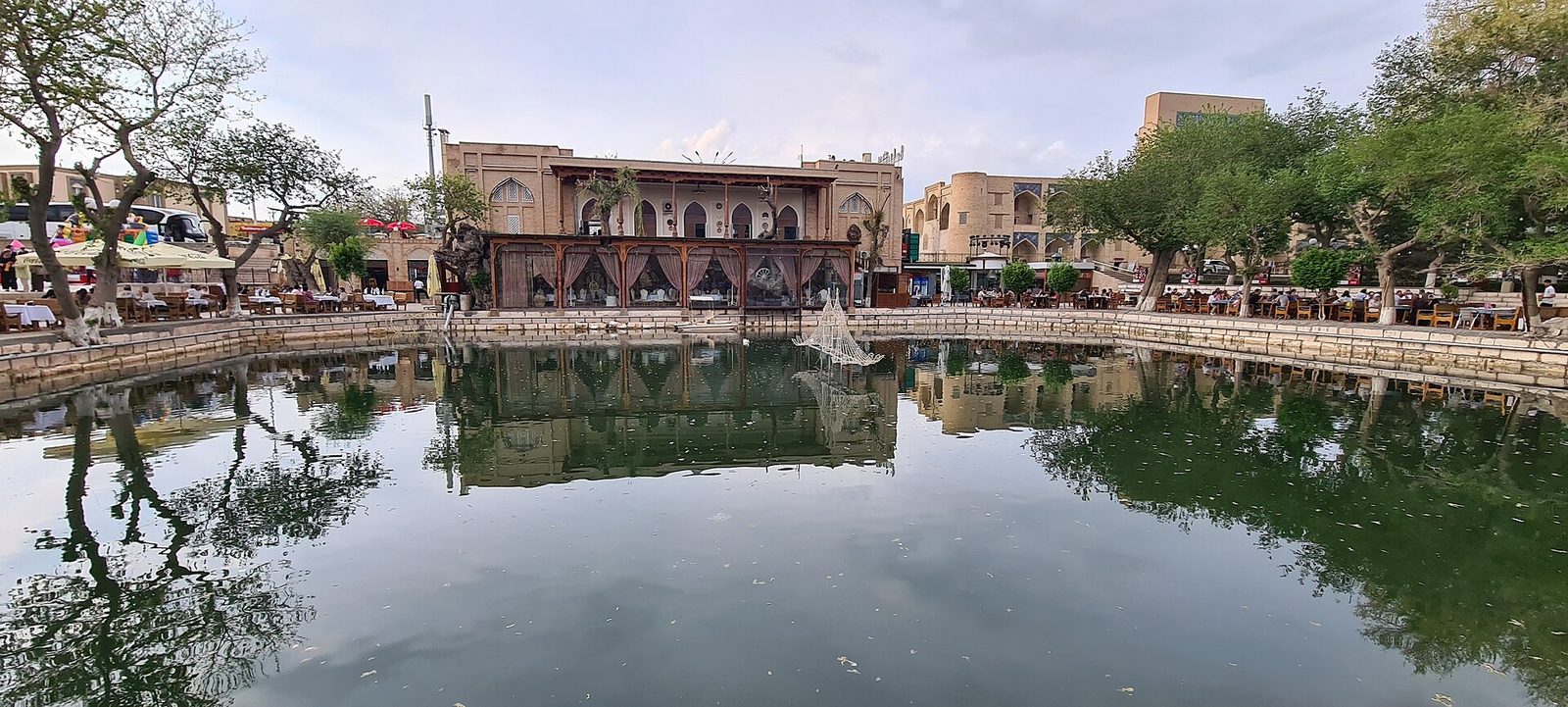
By day Lyabi-Hauz is a crossroads: the Did you know? Under Bukhara's domes merchants changed money and gold Four 16th-century trading domes still stand over old crossroads. Toki Sarrafon was the money changers' dome, where merchants from India and China swapped coins; Toki Zargaron held jewellers' workshops, Toki Telpak Furushon sold caps. Read more → start a few steps west, and the walk to Poi-Kalyan is about 500 metres. After dark it becomes the city’s living room. Teahouses and restaurants set their tables along the water, families come out for a walk, and the lights of the madrasahs are reflected in the pond.
Order green tea and ,Rice cooked in a kazan with carrots, onions and meat: the dish of every Uzbek celebration. Each region cooks it its own way. the Bukhara version, sweeter, with dried fruit. More on what to try and where to shop for it is in our guide to the bazaars of Uzbekistan; the domes of Bukhara are on that list.
A folklore show in the madrasah
In the season, from April to June and from August to October, the courtyard of the Nadir Divan-Begi madrasah hosts a folklore show of about an hour. Dancers from different regions of Uzbekistan perform to live music, and between the dances there is a fashion show of national costume. You can watch with dinner or without; we book places for our guests in advance.
Chor Minor: four towers in a quiet lane
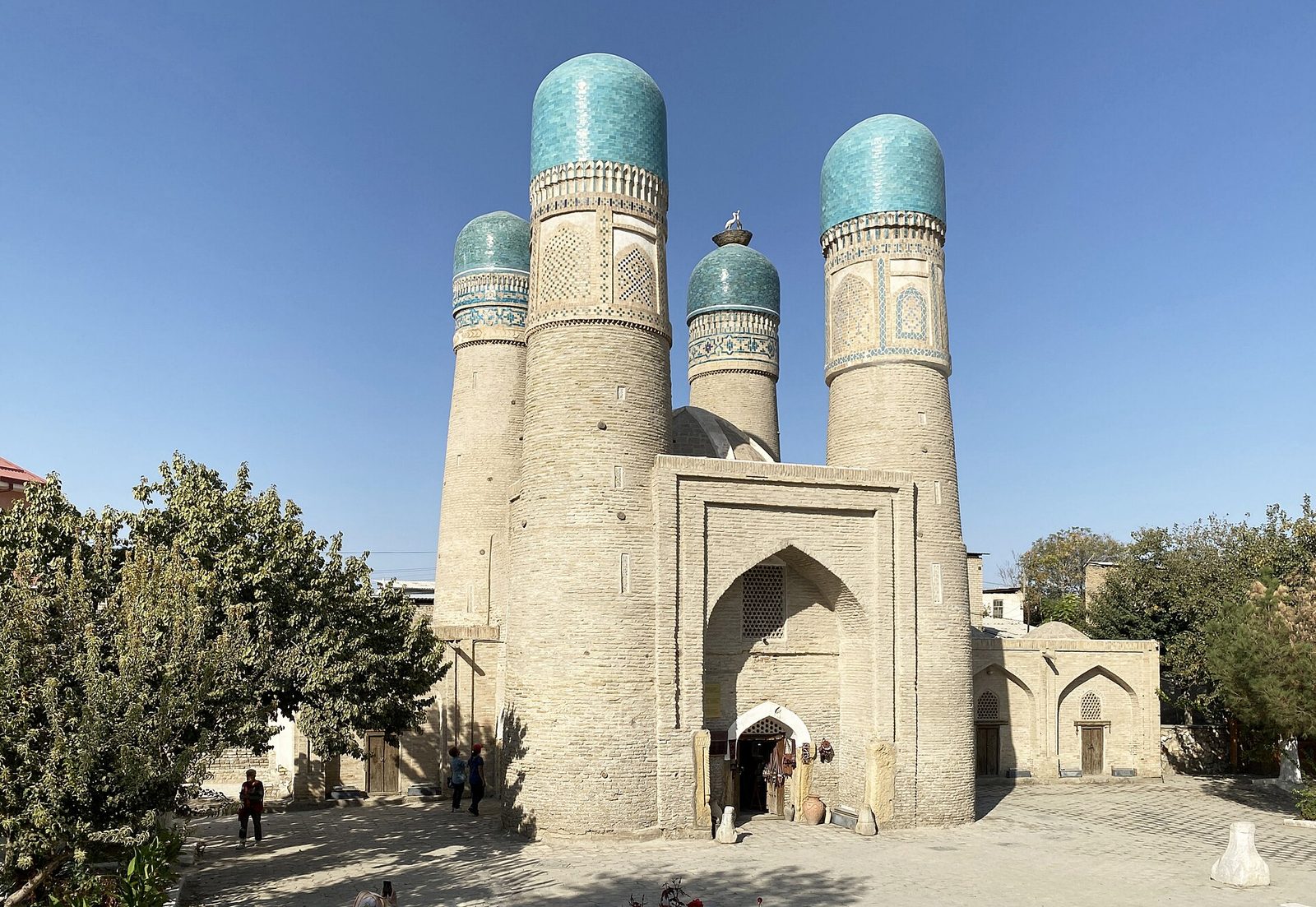
From Lyabi-Hauz, walk about ten minutes northeast through residential lanes; the lanes themselves are half the reason to go. Then one of them opens onto a small square, and there it is: a compact brick building with four towers, each crowned by a blue dome.
Chor Minor means “four minarets”, but the towers are not minarets: no one ever called to prayer from them. The building was completed in 1807 by Khalif Niyaz-kul, a wealthy Bukharan of Turkmen origin, as the gatehouse to his madrasah. The madrasah is gone; the gatehouse remains. Downstairs was the entrance hall and upstairs a library under a flat dome. One tower holds the staircase, and the other three were used as storerooms.
Why four towers, and why is each decorated differently? Nobody knows for sure, and each guide has a favourite version. One says the four towers stand for four world religions, and visitors look for a cross, a fish and a prayer wheel in the decoration. Another says they stand for four dynasties of Bukhara. A third says Niyaz-kul simply wanted to show that all people live under one sky. Many also see an echo of the Charminar in Hyderabad, India, with its four towers. All of these are interpretations, not history.
In 1995 the southeast tower collapsed, and in 1997 it was rebuilt with UNESCO’s support. Today a crafts and souvenir shop works inside, and for a small fee you can usually climb onto the roof and stand right beside the domes.
Visiting Lyabi-Hauz and Chor Minor: our tips
- Tickets: the square and the pond are free and open at any hour. The folklore show and the roof of Chor Minor are paid separately on the spot.
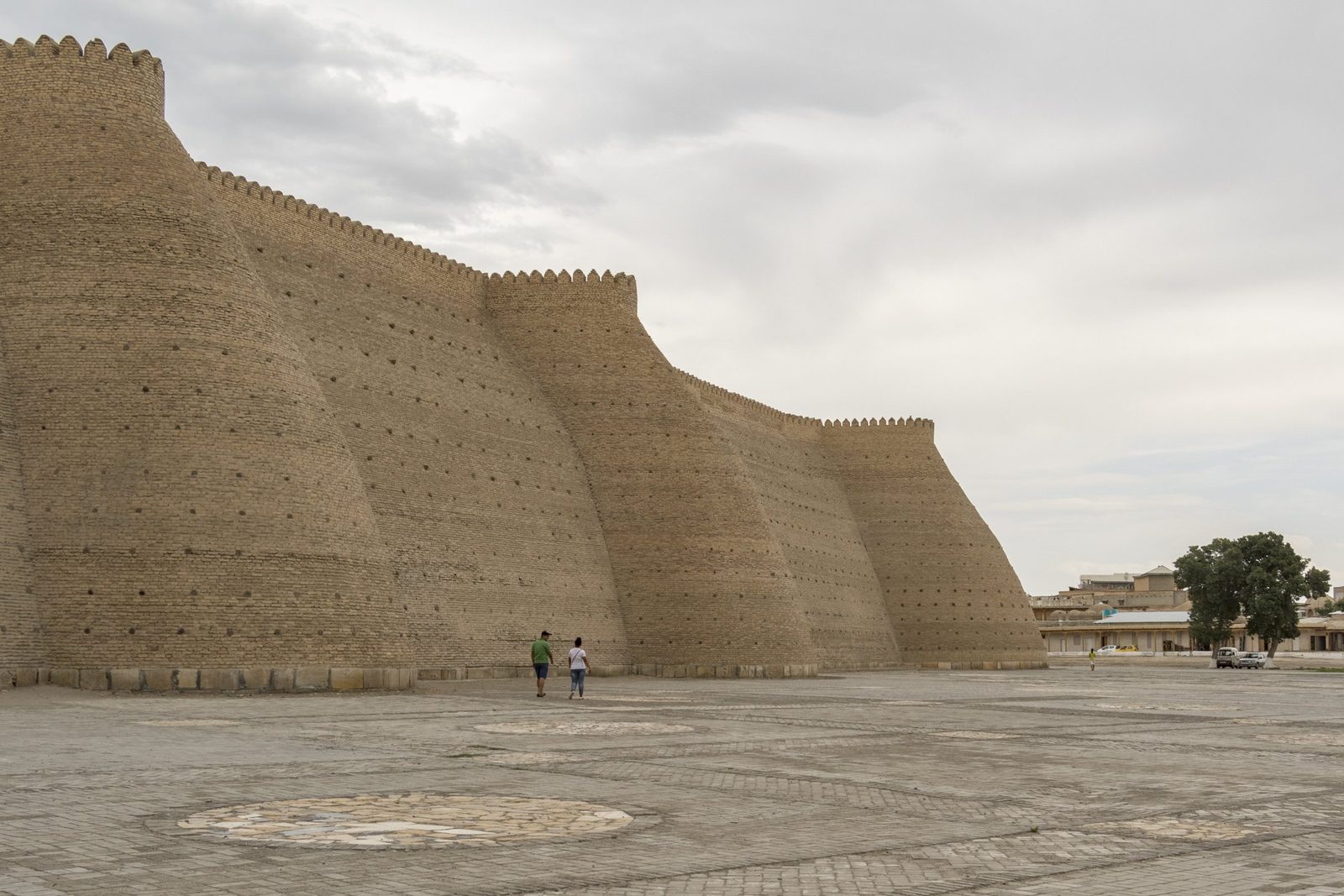
- Getting there: Lyabi-Hauz is the heart of the old town, about 500 metres from Did you know? Legend: the minaret's foundation was laid with camel milk Legend says master Bako laid the foundations of the Kalyan minaret with ganch plaster mixed with camel milk, then vanished for two years to let them harden, and only then built the tower. Locals still show a grave they say is his. Read more → and under a kilometre from .The fortress-residence of the rulers of Bukhara on a high artificial hill: the oldest structure in the city. Read more → Chor Minor is about ten minutes on foot northeast of the pond.
- When: after 5 pm, when the heat has gone and the teahouses fill up. Chor Minor is best in the morning or late afternoon, when the lanes are quiet.
- Time: half an hour for the square and its three buildings, an hour for the folklore show, and 30–40 minutes for the walk to Chor Minor and back.
- Dress: the khanaqah and the madrasahs are historic religious buildings; shoulders and knees covered is the respectful choice. See what to wear in Uzbekistan.
To fit Lyabi-Hauz into your days, see Bukhara in 1, 2 or 3 days, our table of Bukhara and Khiva sights, tickets and hours and the Bukhara city guide. The other two big stops on foot are the Ark and Poi-Kalyan and the Kalyan minaret. With a guide, the square is part of the Bukhara highlights tour, Bukhara in 2 days and our other Bukhara tours.
In short
- Lyabi-Hauz is one of the few hauz ponds left in Bukhara: dug in about 1620, about 46 by 36 metres, with stone steps down to the water.
- Around it stand the Kukeldash madrasah of 1568–1569 and the khanaqah and madrasah of Nadir Divan-Begi.
- Look up at the simurghs carrying white deer on the Nadir Divan-Begi portal, best at sunset.
- Nasreddin has ridden his bronze donkey here since 1979; the widow’s house is a legend.
- Chor Minor, the gatehouse of 1807, is ten minutes away; its four towers have many explanations, all of them versions.
© Photos
- Lyabi-Hauz pond, Bukhara — BeshevI / Wikimedia Commons · CC BY-SA 4.0