
Places in this article: Samarkand
Shah-i-Zinda in Samarkand: facts, legends and how to visit
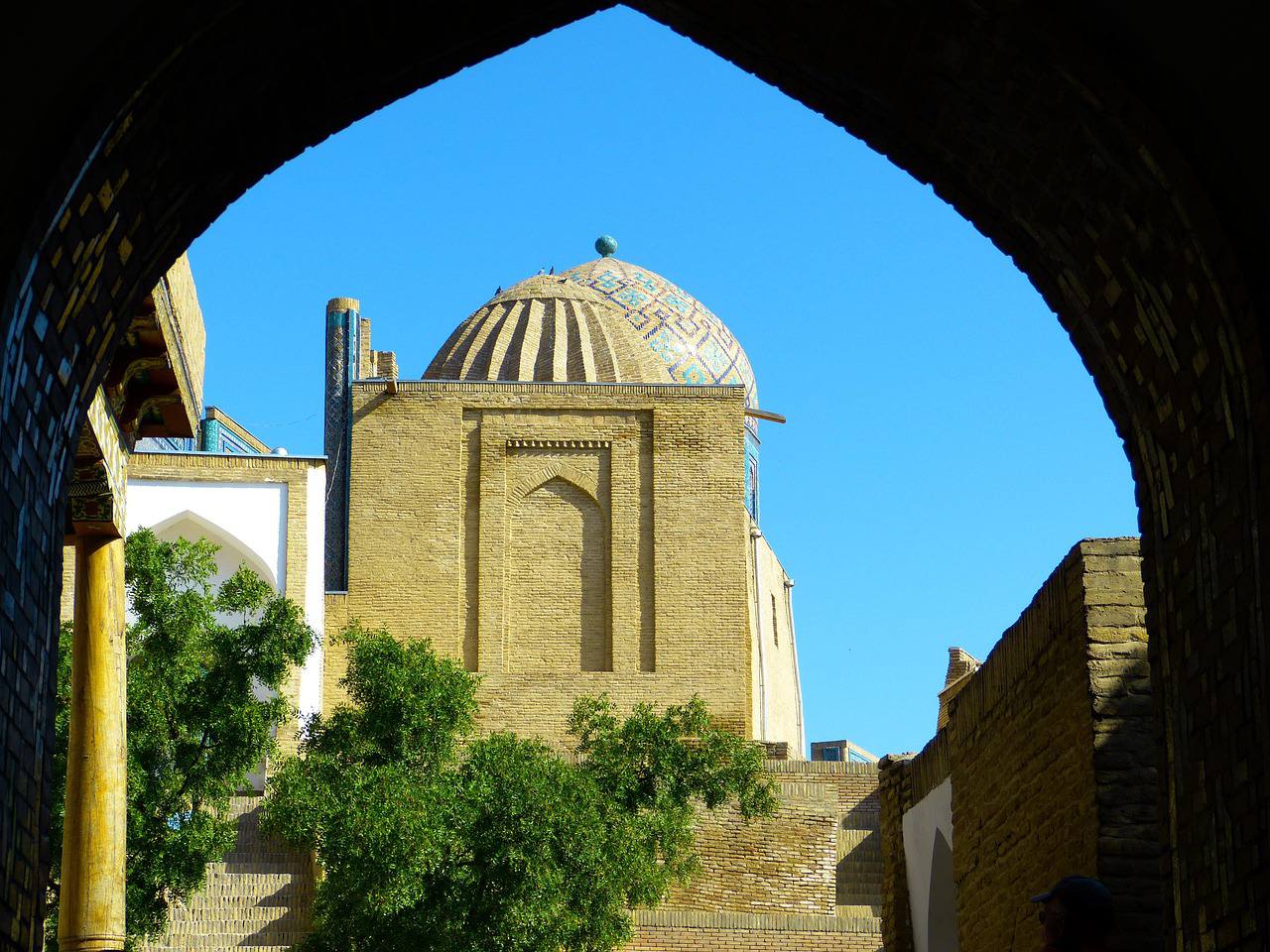
Walk through the gate, climb a steep flight of steps, and a lane opens up that is barely wider than a corridor. On both sides stand tombs faced in turquoise, cobalt and white: one for Amir Timur (Tamerlane, 1336–1405), founder of the Timurid empire, which had its capital in Samarkand. Born near Shahrisabz.’s sister, one for his niece, one for his wife, others for his generals. At the very top, behind a carved wooden screen, lies the man the whole street grew around. Samarkand calls him the Living King.
Our guides walk this lane with guests week after week, and we still slow down at the same places. Here is Did you know? Why Shah-i-Zinda means 'the Living King' The necropolis grew around the shrine of Qutham ibn Abbas, a cousin of the Prophet Muhammad. Legend says he did not die in battle but went down a deep well to a garden of paradise, where he lives on. Read more → as we tell it: who the Living King was, who is buried where, the legends (marked as such), how the tiles were made, what the restoration of 2005 changed, and how to plan your visit.
Who was the Living King? Kusam ibn Abbas
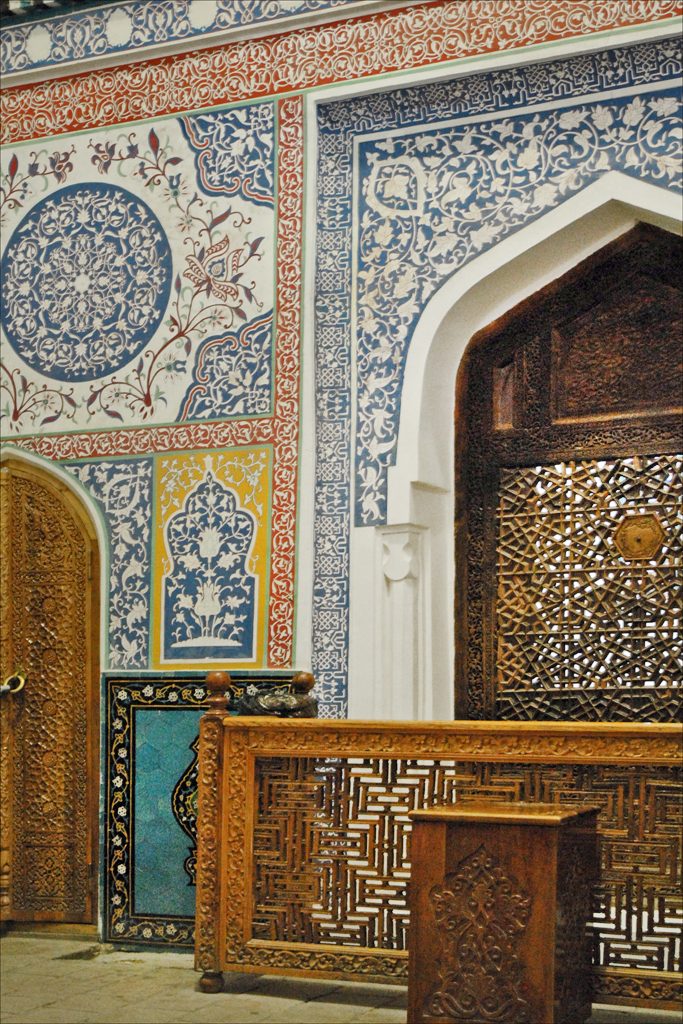
Kusam ibn Abbas, also spelled Qutham or Qusam, was a cousin of the Prophet Muhammad: his father Abbas was the Prophet’s uncle. Under the caliph Ali he governed Mecca. In 676 he joined the Arab campaign into the lands beyond the Amu Darya and stayed on in Samarkand, where he died around 677. Where and how exactly, historians still debate.
By the 11th century a mausoleum stood over the grave believed to be his, and the necropolis grew around it. Next to it are a room for pilgrims, the ziyaratkhana, and a small underground prayer room, the chillakhana, which still has its mihrab. Until the 16th century the place was simply called the Shrine of the Shah. Shah-i-Zinda, “the Living King”, came later.
Legend: the king who did not die
This is legend, not history, and Samarkand tells it in several versions. In the best known, enemies attacked the city during Friday prayers and cut off Kusam’s head. He picked it up and walked into a deep well, where he lives to this day. In another version he was struck by an arrow and crawled into the well to hide. In a third, Khizr, the wandering immortal of Islamic tradition, led him into passages under the hill.
The story is old. The Moroccan traveller Ibn Battuta, in Samarkand in the early 1330s, described this shrine alone among the city’s holy places. He wrote that the people of Samarkand came out to visit it every week at night, and that the Tatars, as he called the Mongols, brought rich offerings of cattle, sheep and silver and gold coins.
A street of tombs on the slope of Afrasiyab
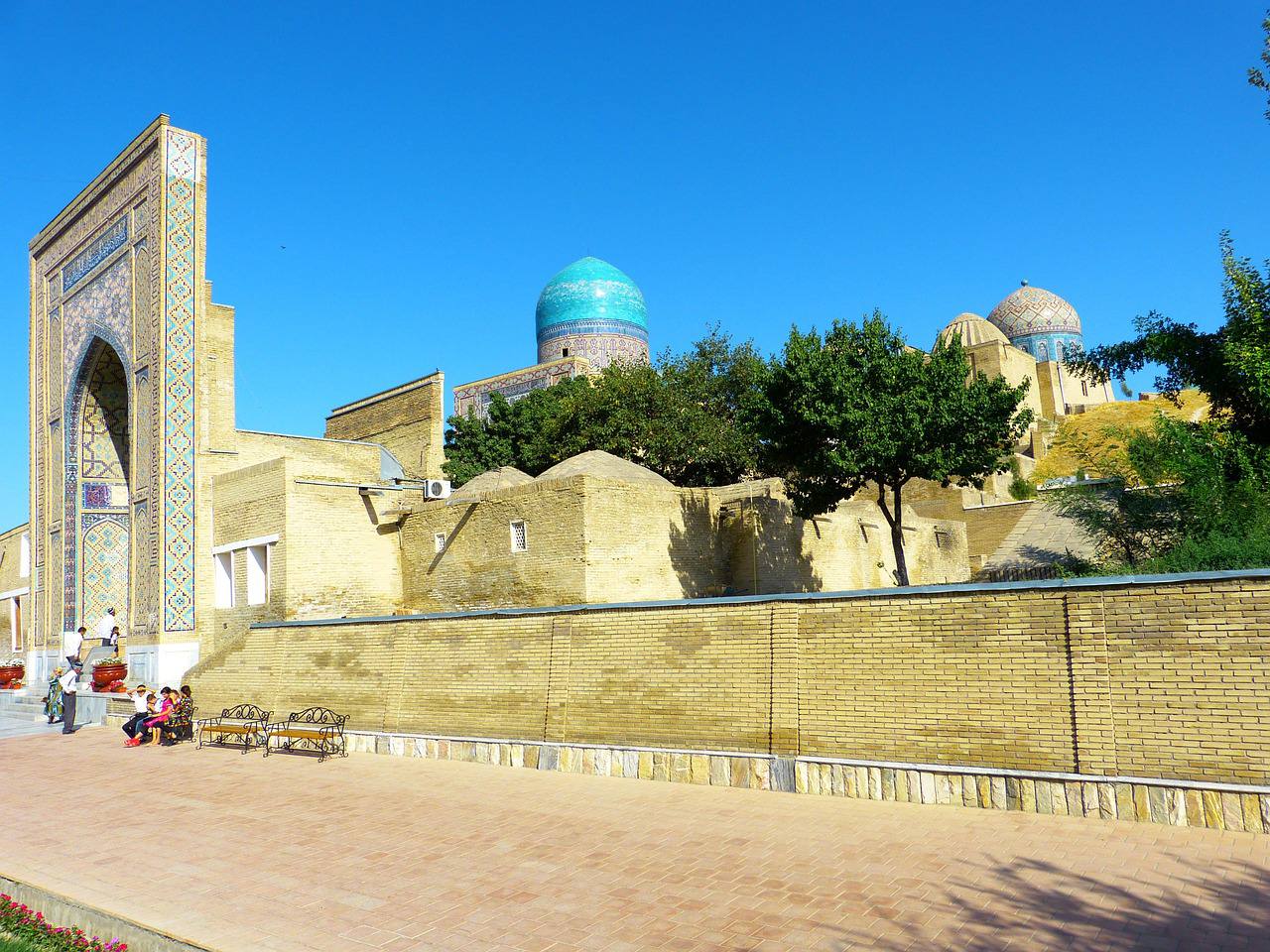
The necropolis climbs the southern slope of ,Did you know? A 7th-century mural shows envoys from Korea Uncovered by road builders in 1965, the Ambassadors' Painting at Afrasiyab shows delegations bearing gifts, Chinese with silk among them, and two men in feathered hats thought to be envoys from Korea's Goguryeo. Read more → the hill where Samarkand stood from about 500 BC until the Mongol invasion of 1220. The first buildings here, including mausoleums and a royal An Islamic college: student cells and classrooms around a courtyard behind a grand portal. In the old towns many now house museums and craft workshops. dated 1066, go back to the Qarakhanids, and excavations on the hill have found mausoleums of the 11th and 12th centuries.
The city later moved south, but the shrine stayed. From the 1350s Samarkand’s elite built their tombs as close to the saint as they could. Today there are more than twenty buildings from the 11th to the 15th and the 19th centuries, in three groups, lower, middle and upper, linked by chartaqs: domed passages on four arches. You enter at the bottom through the gate built in 1434–1435, in the reign of .Did you know? Ulugh Beg measured the year to within 25 seconds Working at his Samarkand observatory, Ulugh Beg put the tropical year at 365 days 5 h 49 min 15 s, about 25 seconds too long, closer than Copernicus a century later. Read more →
Who is buried where: Timur’s family and his amirs
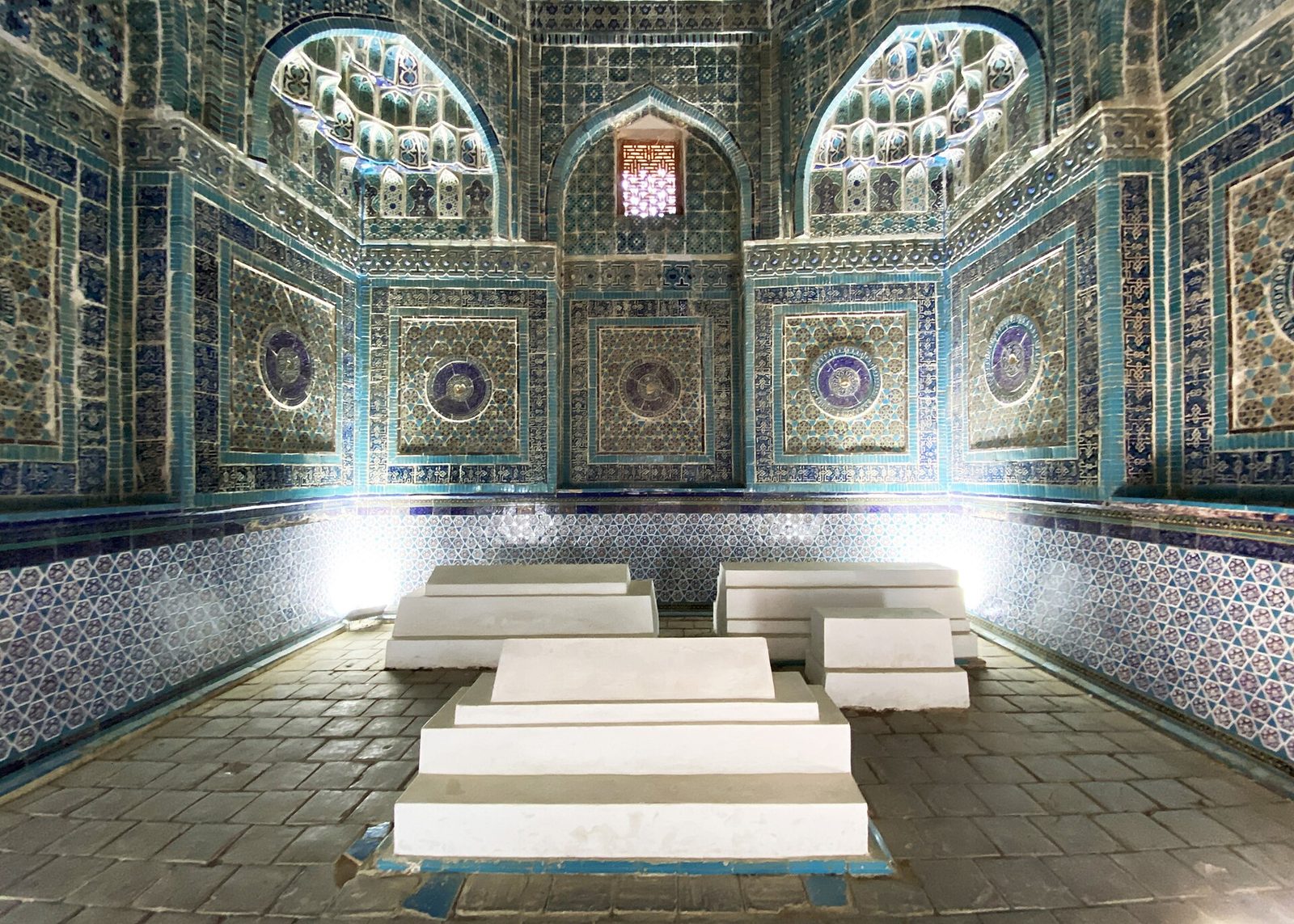
Most of the buildings are one-room mausoleums built after 1350, many for women of Timur’s family and for his amirs, the commanders of his army. These are the ones to look for.
Shadi Mulk Aka, 1372: a mother’s grief
Timur’s niece Shadi Mulk died in December 1371. Her mother, Timur’s elder sister Kutlug Turkan Aka, built this tomb for her, and it is the first building of Timur’s reign in Samarkand. Two burial chambers lie under the floor, matching the records that mother and daughter were both buried here. The verses around the entrance mourn a daughter who died young; one compares the tomb to a garden and the girl to a lost pearl.
The masters signed their work. Shams ad-Din and Barr ad-Din of Samarkand put their names in the portal niche, and the potter Zayn ad-Din of Bukhara signed the base of a carved column.
Shirin Bika Aka and the amirs
Opposite stands the mausoleum of Timur’s sister Shirin Bika Aka, built in 1385–1386. With Shadi Mulk Aka it is one of the two best preserved in the ensemble. Around them are the tomb known as Amir Zade (1386), the mausoleum of Amir Burunduq, one of Timur’s commanders (1380s), and the Octagon, an eight-sided mausoleum of the early 15th century. Further up, the mausoleum of Khoja Ahmad dates from the 1340s, before Timur’s time, and a tomb of 1360–1361 was built for a noblewoman whose name is lost.
Tuman Aka, 1405: landscapes on the walls
Near the top, the complex of Tuman Aka, one of Timur’s wives, joins a mausoleum and a small memorial mosque. Its portal is mosaic faience, with blue tiles patterned in gold. Inside, look for panels painted with streams, trees and birds. Whether Tuman Aka lies here nobody knows: the crypt was found filled with building rubble, and after Timur’s death she was sent away from Samarkand.
The twin-domed mausoleum: is the astronomer really here?
In the lower group stands a mausoleum with two domes, built in the first third of the 15th century, in Ulugh Beg’s time. Signs and guidebooks call it the tomb of Qadi Zada al-Rumi, the astronomer who taught at Ulugh Beg’s madrasah on the Registan. That name became standard in Soviet books from the 1940s, but it rests on tradition only.
Another tradition gives the tomb to Timur’s wet nurse and her daughter, Bibi Zaynab, though neither appears in sources of the time. Many scholars now simply call it the twin-domed mausoleum, and so do our guides.
Glazed terracotta, majolica, mosaic: how to read the tiles
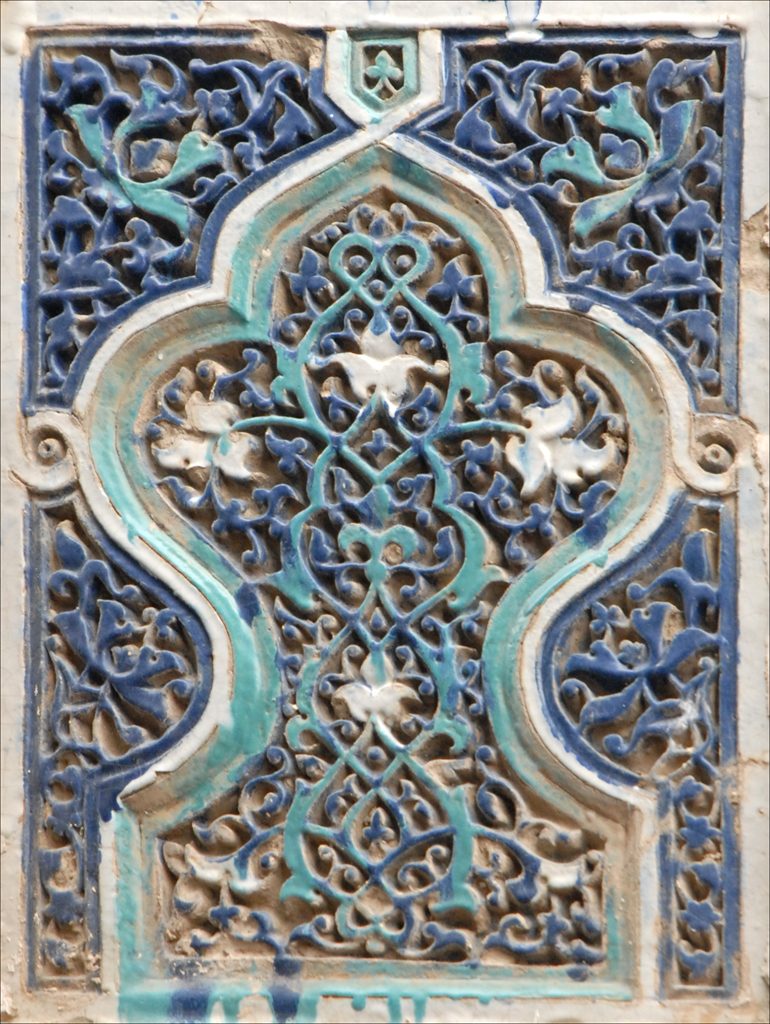
Shah-i-Zinda is a textbook of Timurid tilework. Along one short lane you will find carved and glazed terracotta, majolica, overglaze painting, single-colour glazed tiles and tile mosaic. The tiles were not only decoration: they protected the baked brick behind them from heat, frost, rain and dust.
- Carved glazed terracotta. The pattern is cut deep into clay panels, which are then glazed and fired, so light and shadow do half the work. The facade of Shadi Mulk Aka is the finest example: green and turquoise, with inscriptions in white on turquoise and dark blue.
- Majolica. Glazed tiles with painted designs. The inside of Shadi Mulk Aka is almost entirely majolica, with bright patterns on a deep blue ground.
- Mosaic faience. Tiles glazed in single colours are cut into small pieces and fitted together like a puzzle. Timurid craftsmen perfected it after the 1390s, and some of the finest examples are here. See the portal of Tuman Aka.
- Glazed brick. Glazed and plain bricks laid in geometric patterns, as on the Octagon.
Our tip: stand between Shadi Mulk Aka (1372) and Tuman Aka (1405). In 33 years Samarkand’s tile-makers moved from carving to cutting, and you can see the whole change in a few steps.
The staircase and the counting of steps
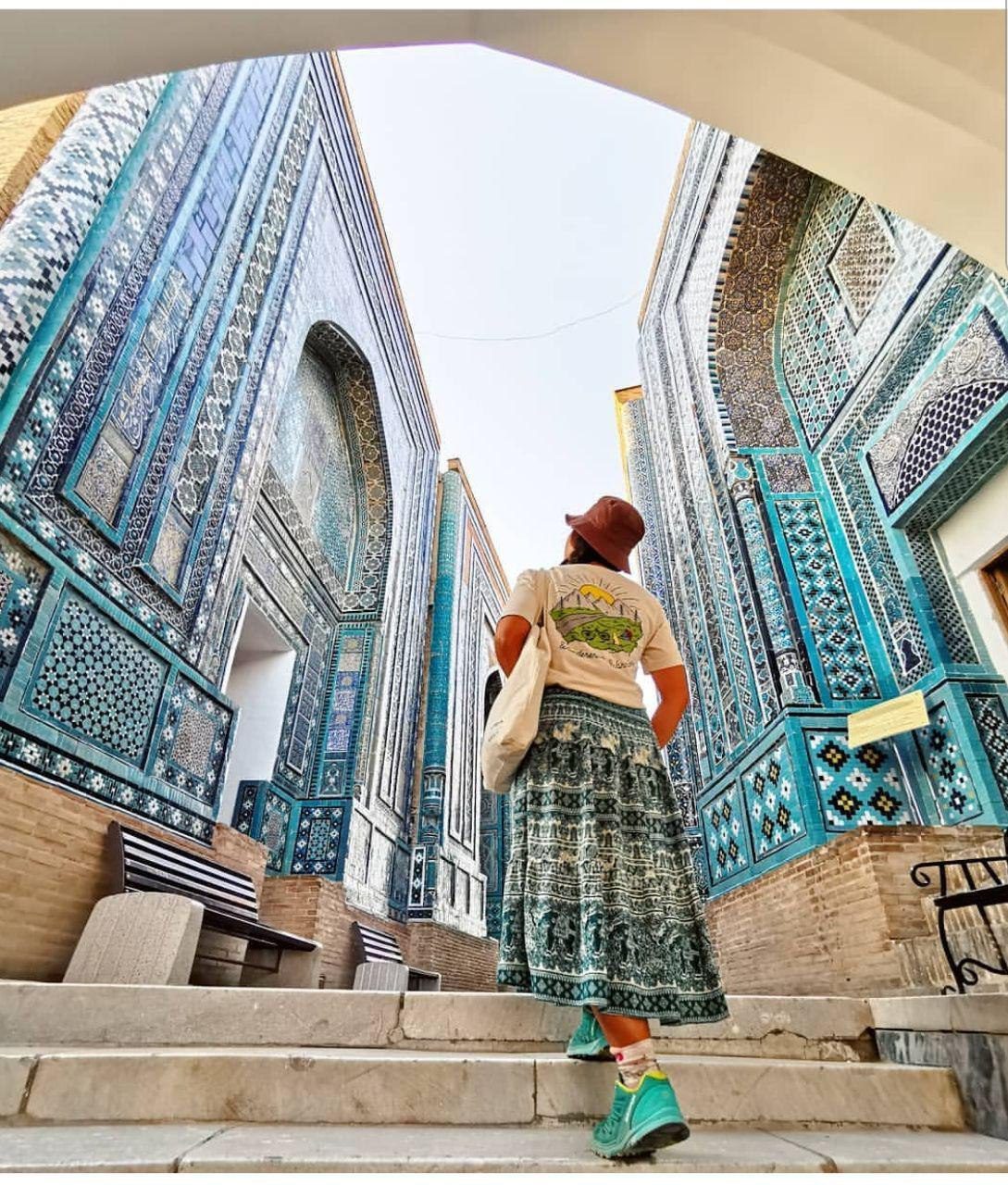
Past the gate, a steep staircase climbs the hill to the middle group. Sooner or later every visitor, pilgrim or tourist, starts counting the steps.
Folk belief: count them twice
This is folk belief, not history. Tradition says the staircase has forty steps, standing for the path of repentance and prayer. Count them on the way up and again on the way down. If the two numbers match, your sins are forgiven. Count for yourself: the number you get is part of the experience.
Another legend says pilgrims once climbed one step a day for forty days, praying on each. Bahauddin Naqshband, the Sufi master of Bukhara, is said to have done so. When he reached the top step, a rider on a white horse galloped at him, stopped just short, questioned him and vanished. The rider, the story goes, was Kusam ibn Abbas himself.
A place of pilgrimage today
Shah-i-Zinda is one of the most revered shrines in Central Asia, and for local families it is a place of prayer first and a monument second. The night from Thursday to Friday was traditionally the time for night prayers here. You will see people stop at the tomb of Kusam, read a prayer and move on quietly. More about the shrines of Uzbekistan in our guide to ziyarat and holy places.
Restoration: old tiles, new tiles and the debate of 2005
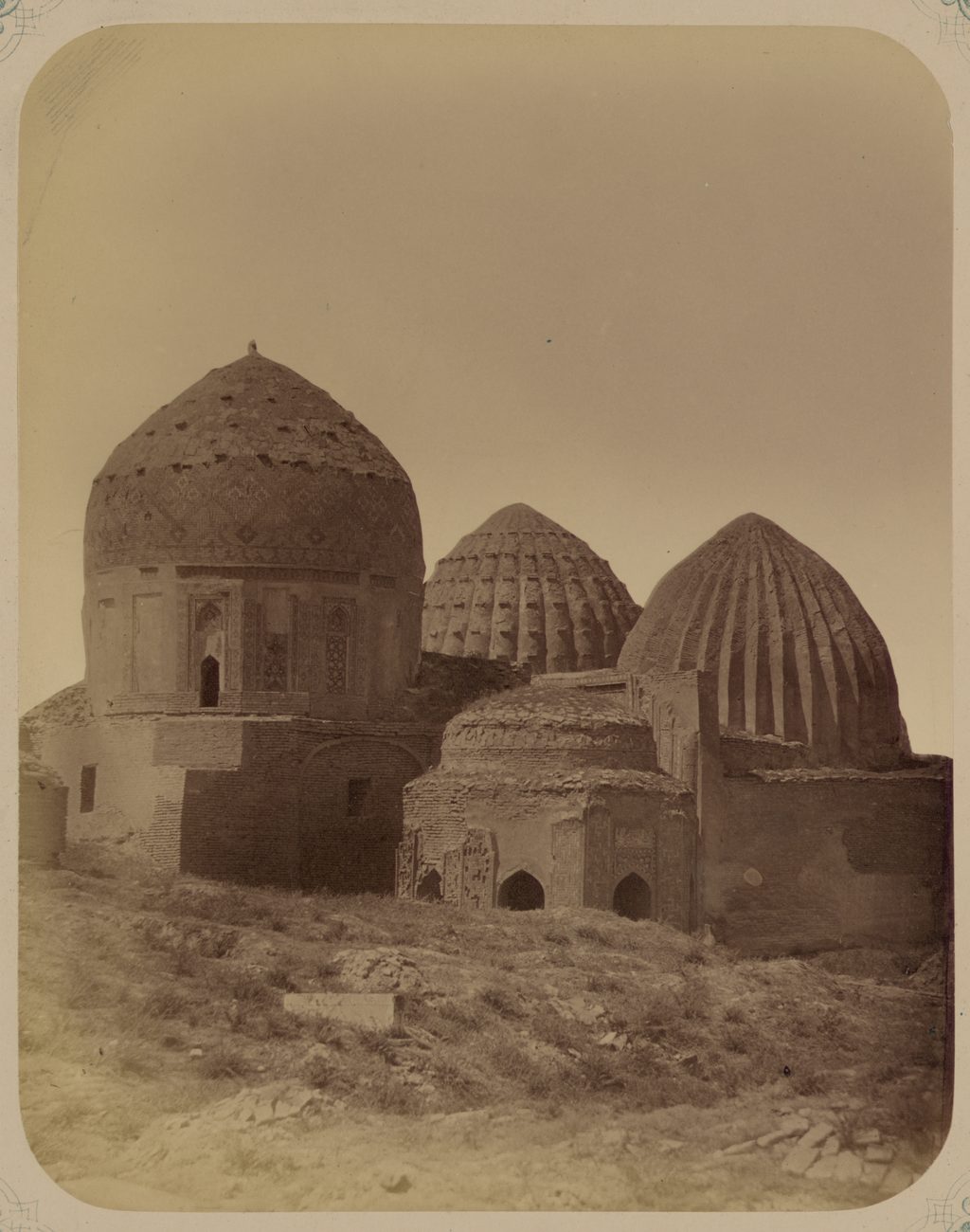
The earliest photographs of Shah-i-Zinda, taken for the Turkestan Album in the early 1870s, show bare domes and broken facades on an empty hillside. Excavations began in 1922. From 1957 the archaeologist Nina Nemtseva studied the necropolis systematically, and she worked here until 2001. That year Shah-i-Zinda joined the UNESCO World Heritage List as part of “Samarkand – Crossroad of Cultures”.
In 2004 a government decree launched a large restoration, finished in less than two years. The works uncovered the foundations of earlier buildings, among them a mosque and an 11th-century madrasah.
The speed drew criticism. In 2005 the World Heritage Committee expressed deep concern about the scale of the works, including the wide use of cement and reinforced concrete, and asked for them to stop. A year later it noted a partial loss of authenticity. Uzbekistan’s own report acknowledged that the haste had hurt the quality of some details. Much of the original Timurid tilework was replaced with new tiles.
Our tip: learn to tell them apart. Old tiles have softer colours, worn glaze and slightly uneven edges. New ones are brighter and perfectly even. Shadi Mulk Aka and Shirin Bika Aka are the best places to find the old ones.
Did you know?
- The carved wooden door of the Kusam ibn Abbas complex is dated 1404–1405 and was once inlaid with ivory.
- Verses from the Quran added to the entrance gate speak of those killed in God’s way as not dead but alive: the same idea as the name Shah-i-Zinda.
- Ibn Battuta saw the shrine in the early 1330s, four decades before the first Timurid tomb went up beside it.
Shah-i-Zinda in dates
| Year | What happened |
|---|---|
| 676–677 | Kusam ibn Abbas comes to Samarkand and dies there |
| 11th century | A mausoleum rises over the grave believed to be his |
| 1066 | A Qarakhanid royal madrasah |
| Early 1330s | Ibn Battuta describes the shrine |
| 1340s | Mausoleum of Khoja Ahmad |
| 1372 | Mausoleum of Shadi Mulk Aka |
| 1385–1386 | Mausoleum of Shirin Bika Aka |
| 1404–1405 | Tuman Aka complex; carved door of the Kusam complex |
| 1434–1435 | Entrance gate, in the reign of Ulugh Beg |
| Early 1870s | First photographs, for the Turkestan Album |
| 1922 | Excavations begin |
| 2001 | UNESCO World Heritage List |
| 2004–2005 | Large-scale restoration |
Visiting Shah-i-Zinda: tickets, hours and our tips
- Ticket: sold at the desk by the gate. Check the price at the ticket office and carry some cash in som; see our notes on cards and cash in Uzbekistan.
- Hours: check at the ticket office. We come at opening time.
- Time: 1 to 1.5 hours.
- Dress: this is a holy site. Shoulders and knees covered for everyone, a scarf for women, and quiet voices. More in our guide to what to wear in Uzbekistan.
- Light: come early. The lane is quiet, the light on the tiles is soft, and in summer the morning is the only cool part of the day.
- Photos: fine in the lane and on the stairs. Never photograph people at prayer.
- Getting there: about 800 m on foot past the The great mosque Amir Timur ordered after his Indian campaign of 1398–1399, one of the largest of its time. Read more → Mosque; the Afrasiyab museum is about a kilometre further.
- Our tip: walk to the top first, then come down slowly. The tilework reads better once you know the layout.
Samarkand is 2 hours 30 minutes from Tashkent on the Uzbekistan's high-speed train: Tashkent to Samarkand in 2 hours 30 minutes, Tashkent to Bukhara in about 4 hours. Tickets are tied to your passport. Read more → express: see Tashkent to Samarkand. To fit the necropolis into your days, read Samarkand in 1, 2 or 3 days, Samarkand sights, tickets and hours and our Samarkand city guide. With a guide, Shah-i-Zinda is part of the Samarkand highlights tour and our other Samarkand tours.
In short
- Shah-i-Zinda grew around the grave believed to be that of Kusam ibn Abbas, the Prophet’s cousin, who died in Samarkand around 677.
- The “Living King” is a legend: Kusam, it says, went into a well with his head in his hands and lives there still.
- Timur’s sister, niece and wife and his amirs are buried along one lane, in more than twenty buildings.
- Carved terracotta, majolica and mosaic stand side by side; the restoration of 2004–2005 replaced many old tiles with new ones.
- Come early, dress for a holy site, and count the steps both ways.