
Bukhara in 1, 2 or 3 days: a local plan
Places in this article: Bukhara · Samarkand · Khiva
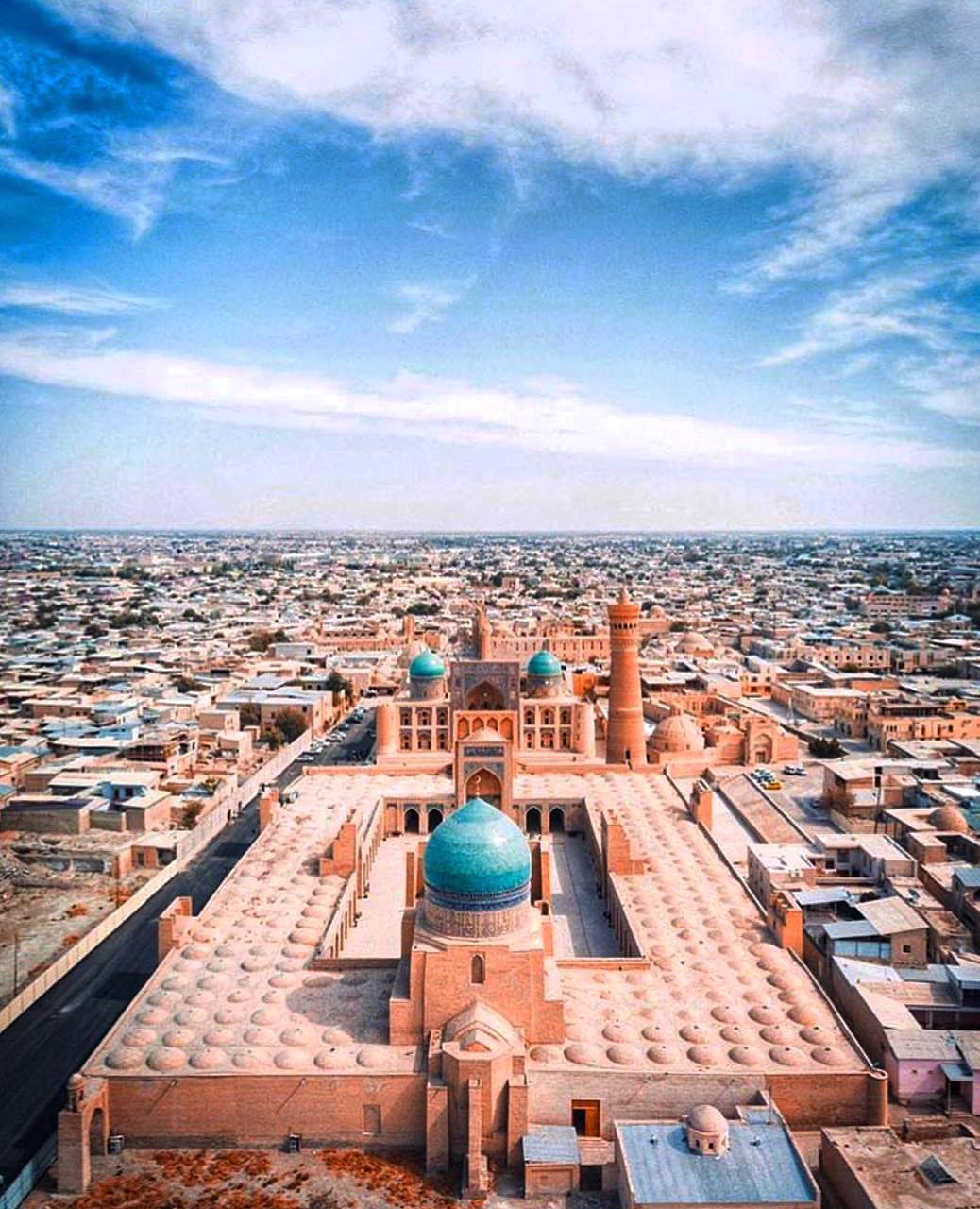
From Did you know? Bukhara's ponds were once its water supply Pools like Lyabi-Hauz, dug around 1620 and 46 × 36 m, were the city's main source of water. Most were filled in during the 1920s–30s because they spread disease; Lyabi-Hauz survived. Read more → to the Did you know? Diggers went 13 m down and never found its base The Kalyan Minaret of 1127 rises about 46 m, and an excavation reached 13 m without finding the bottom of its foundations. Genghis Khan reportedly ordered it spared. Read more → is about 500 metres. From the minaret to the gate of The fortress-residence of the rulers of Bukhara on a high artificial hill: the oldest structure in the city. Read more →, a few minutes more. Bukhara’s old town can be crossed on foot in half an hour, so the real question is not how far but when: the Ark in the morning, The heart of old Bukhara: the Kalyan Minaret of 1127, the Kalyan Mosque and the Mir-i-Arab Madrasah facing each other across one square. Read more → at sunset, Lyabi-Hauz after dark.
We take guests to Bukhara every week, and this is the order we walk it in, for one, two or three days. Tickets, hours and a short card for each sight are in our guide to Bukhara and Khiva sights; here we put them in order.
What is where
Almost everything lies on a short line from Lyabi-Hauz in the east to the Samanid park in the west. Only three sights need a car.
| Sight | What it is | From Lyabi-Hauz |
|---|---|---|
| Lyabi-Hauz | A square around a pond of about 1620, framed by madrasahs and teahouses | start |
| Trading domes and One of the oldest mosques in Central Asia, in the centre of Bukhara. It stands below today's street level: the city has grown up around it. | 16th-century covered markets; the old mosque stands below today’s street level | on the way west |
| Poi Kalyan | The Kalyan minaret of 1127, the Kalyan Mosque and the Did you know? A madrasah still teaching after almost 500 years Mir-i-Arab, built in the 1530s opposite the Kalyan Mosque, was one of only three Islamic schools allowed to keep working in Soviet times, and it still trains students today. Read more → An Islamic college: student cells and classrooms around a courtyard behind a grand portal. In the old towns many now house museums and craft workshops. | about 500 m |
| Ark and A mosque of 1712 opposite the Ark in Bukhara. Its twenty carved wooden columns reflect in the pond in front. | The emirs’ fortress on its hill, and the Bolo-Hauz mosque of 1712 opposite | under 1 km |
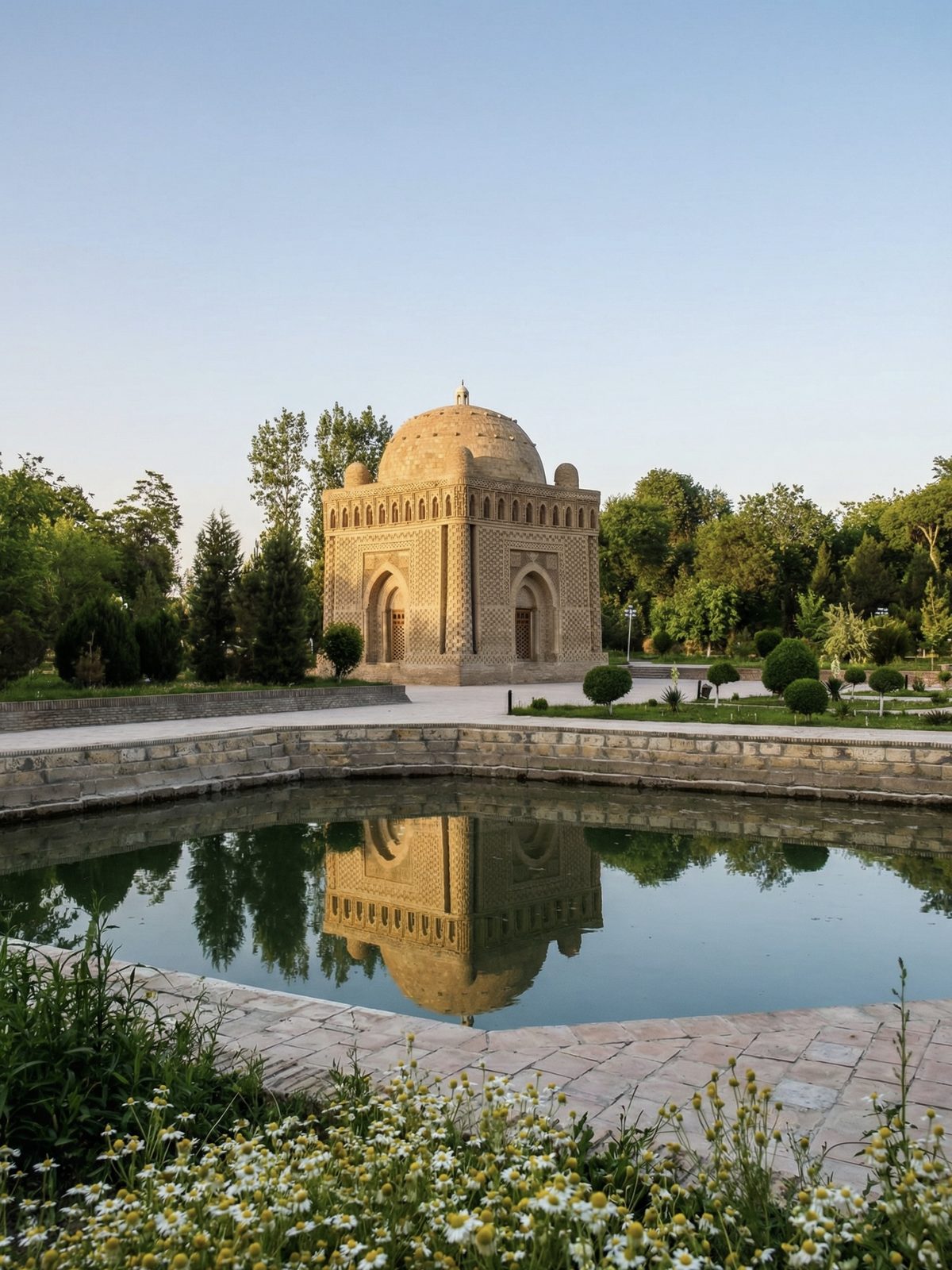
| A 9th–10th-century family tomb of the Samanid dynasty, one of the oldest surviving monuments of Islamic architecture in Central Asia, built entirely of patterned brick. Read more → and Did you know? A cone-shaped dome over Job's spring Chashma-Ayub, 'Job's Spring', has a conical dome in the Khorezm style, rare in Bukhara. Legend says Job struck the ground with his staff and water flowed; inside is a museum of Bukhara's water supply. Read more → | A 10th-century brick tomb in the park, and Job’s Spring nearby | under 2 km |
| A small gatehouse of 1807 in Bukhara with four towers topped by turquoise domes. | A gatehouse of 1807 with four turquoise-domed towers | about 700 m east |
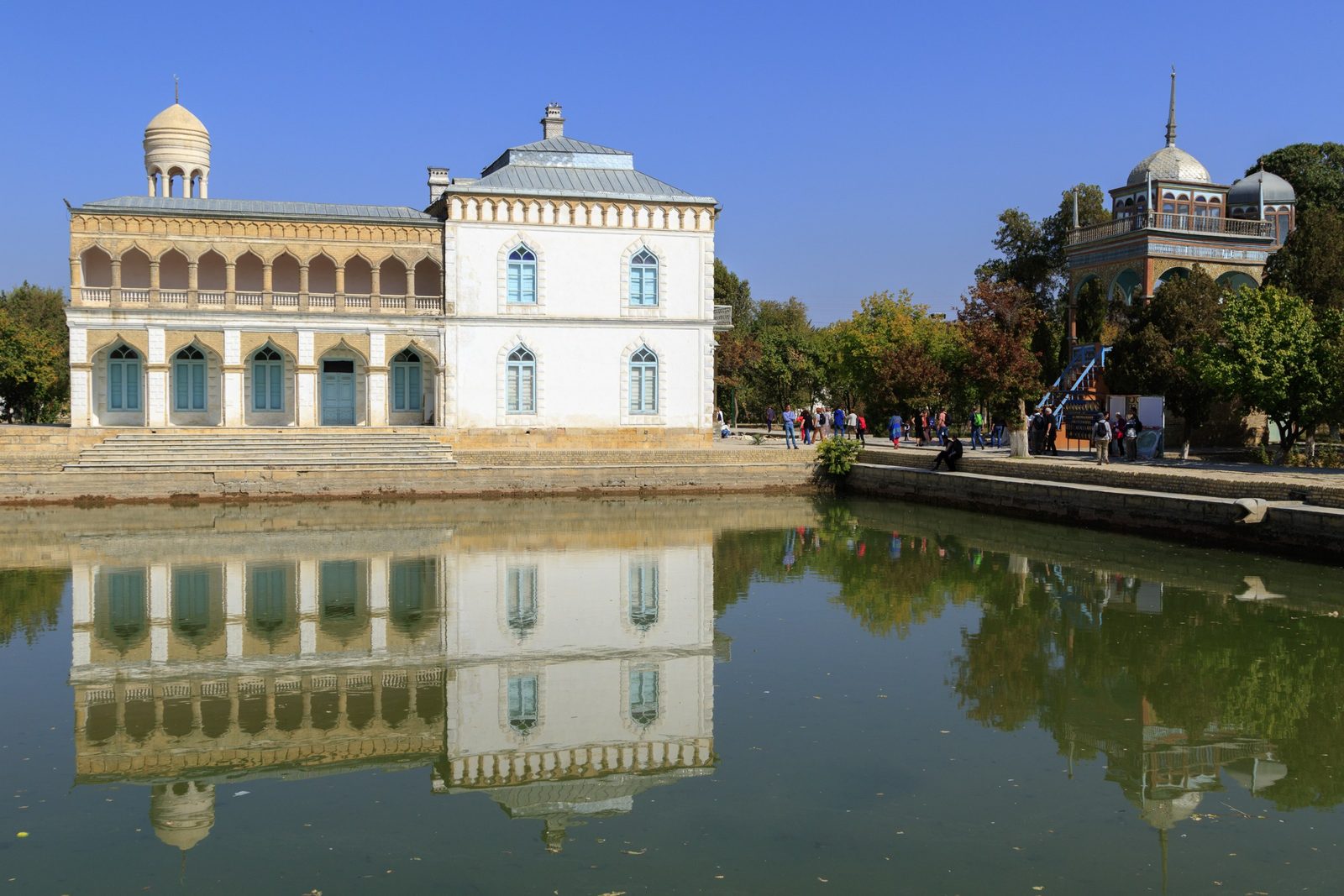
| The summer palace of the last emirs of Bukhara, built in the late 19th and early 20th century in a mix of European and Central Asian styles. | The last emir’s summer palace | about 5 km north, by car |
| Bahauddin Naqshband complex | The memorial complex of the Sufi master | about 10 km north-east, by car |
| Chor-Bakr | A necropolis founded in 1559 in the village of Sumitan | about 5 km west, by car |
The Ark and Sitorai Mohi-Hosa cost 60,000 som each for a foreign adult. Both are open daily from 9:00 to 18:00, and from 8:00 to 21:00 in season. Lyabi-Hauz and the trading domes cost nothing. Keep som in cash for the smaller ticket desks and the stalls under the domes: our notes on cards and cash explain the rest.
Arriving by train
Bukhara’s station is not in Bukhara. It is in Kagan, about 12 km south-east of the old town, so plan a taxi or a transfer at both ends. The morning fast trains from Tashkent arrive between about 10:00 and 12:30, a little over four hours after leaving; from Samarkand the ride takes under two hours. The overnight sleepers arrive before dawn. Trains back towards Samarkand and Tashkent leave between about 15:00 and 18:30.
If Khiva comes next, the Jaloliddin Manguberdi calls at Bukhara at about 11:00 and reaches Khiva at 14:31, every day except Sunday. Tickets open 60 days ahead on eticket.railway.uz. More in trains in Uzbekistan and Khiva to Bukhara.
One day: the old town on foot
Morning. Be at the Ark when it opens, before the heat settles on its open courtyards. Its walls rise 16 to 20 m, and a ramp takes you up through the gate to the throne room and the museums. Coming out, cross the square to the Bolo-Hauz mosque, whose twenty carved wooden columns are reflected in the pond. Then walk west into the park to the Samanid Mausoleum: a 10th-century cube of patterned brick that survived the Mongols in 1220 because floods had already buried it. The side light of the morning brings out the pattern. Chashma-Ayub, Job’s Spring, is a few steps away.
Midday. Walk back east to the trading domes. They were built over old crossroads, and their shade is the best place to be in the hottest hours. Lunch is Rice cooked in a kazan with carrots, onions and meat: the dish of every Uzbek celebration. Each region cooks it its own way., a midday dish here: Bukhara makes it sweeter, with dried fruit, and the teahouses around Lyabi-Hauz serve oshi sofi. More in our article on plov.
Late afternoon. Go to Poi Kalyan. The Kalyan minaret of 1127 rises about 46 m, and archaeologists dug 13 m down without reaching the bottom of its foundations. Opposite stands Mir-i-Arab, one of only three madrasahs allowed to keep teaching in Soviet times; it still trains students. Stay until the low sun turns the brick gold. This is a working religious complex, so cover shoulders and knees.
Evening. Walk the 500 m back to Lyabi-Hauz for green tea on the wide wooden beds by the water. Look up at the portal of the Nadir Divan-Begi madrasah: two simurgh birds carry white deer towards a sun with a human face.
Two days: the emir’s palace, the Sufi shrine and the quiet lanes
Morning, by car. The three sights outside the old town make one loop. Start at Sitorai Mohi-Hosa, the summer palace built in 1912–1918 for Emir Alim Khan: European outside, Bukharan inside, with suzani, porcelain and gold embroidery in its museum. Drive on to the Bahauddin Naqshband complex, the burial place of the founder of the Naqshbandi order, who died in 1389. It is a place of pilgrimage: shoulders and knees covered, a scarf for women; see what to wear. Finish at Chor-Bakr on the west side of the city, the necropolis Abdullah Khan II founded in 1559 around the grave of Abu-Bakr-Said. This is exactly the loop of our Bukhara discovery tour, with a guide and a car.
Afternoon. Back in the old town, walk from west to east. The Did you know? Engineers pulled a leaning minaret back upright By 1920 a minaret of the Ulugh Beg Madrasah on the Registan was tilting. In 1932 engineer Vladimir Shukhov straightened it; the second minaret was set upright in 1965. Read more → of 1417 is the oldest preserved in Central Asia; its carved door says that education is obligatory for every Muslim man and woman. Then the Magoki-Attori mosque, sunk below the street between the domes. From Lyabi-Hauz, take the residential lanes ten minutes east to Chor Minor: the lanes are half the reason to go.
Evening. See Poi Kalyan again after dinner, lit up and almost empty once the day groups have gone.
Three days: slow down, or move on
A third day in Bukhara is for doing rather than seeing. These are the options we offer our guests:
- Poi Kalyan at first light. Come back to the square in the quiet morning, before the shops open, and compare it with the sunset you saw on day one.
- Cook plov. On our culinary tour Taste of the Road the class in Bukhara is bakhsh, the green plov; on the Samarkand, Bukhara and Khiva group tour it is an evening in a family guesthouse. We can add a class to any trip.
- A night in the desert. Between Bukhara and Samarkand, Aydarkul lake and a yurt camp make a good stop: see Aydarkul and the Nuratau mountains.
- On to Khiva. Take the late-morning fast train (not on Sundays), arrive at 14:31 and have the sunset inside the walls. Our plan for Khiva in 1 or 2 days picks up from there.
Choosing the length of stay
One day covers the core if Bukhara sits between Samarkand and Khiva. Two days is what we plan for most guests, and three suit slow travellers and families. With a guide, day one is our Bukhara highlights tour and day two the discovery tour. From Tashkent there is Bukhara in 2 days by night train.
On longer routes, Bukhara is part of our 8-day classic tour and 11-day classic tour; the 8-day independent tour books hotels, trains and transfers and leaves the days to you. The page Bukhara shows how the city fits with Samarkand and Khiva, and the tour finder narrows tours by interest.
In short
- The station is in Kagan, 12 km out: book a taxi or a transfer before you arrive.
- One day: the Ark at opening time, the Samanid Mausoleum, the domes and plov at midday, Poi Kalyan at sunset, Lyabi-Hauz in the evening.
- Two days: Sitorai Mohi-Hosa, Bahauddin Naqshband and Chor-Bakr by car in the morning, the Ulugh Beg madrasah and Chor Minor in the afternoon.
- Three days: cook plov, spend a night in the desert or take the train to Khiva.
- The Ark and Sitorai Mohi-Hosa cost 60,000 som each for a foreign adult; cover shoulders and knees at Poi Kalyan and Bahauddin.