
Places in this article: Tashkent
The Tashkent metro: an underground museum, station by station
For forty-one years you could not take a single photograph down here. The Did you know? A metro designed to ride out a magnitude-9 earthquake The three original lines of the Tashkent Metro were built to withstand an earthquake of magnitude 9.0, and the tunnels lie unusually shallow, only 8–25 m below the street. Read more → was also a shelter, and guards could take your camera away. Since June 2018 you can photograph anything you like: crystal chandeliers, cosmonauts in ceramic, and a 15th-century poet’s love stories in turquoise relief, all for the price of one ride.
We ride it every day, and we still take guests down on purpose. Here is the metro as our guides show it: why a city shaken flat by an earthquake dug a metro, the stations worth getting off at, a self-guided route and how to pay in 2026.
Why Tashkent built a metro after the 1966 earthquake
On 26 April 1966 an earthquake destroyed much of old Tashkent. The rebuilt city got new avenues, a modernist centre and a metro. The decree to design and build it was signed on 26 September 1967, when Tashkent had just passed one million people.
It took persistence. Sharof Rashidov, then the head of the Uzbek republic, travelled to Moscow eighteen times to win permission, and Moscow asked for studies of the region’s earthquakes, groundwater and soil first. Work began in 1972 in Chilonzor, the most crowded district.
The earthquake is built into the walls. The structures are designed for shaking of up to 9 points on the MSK-64 intensity scale, in thick reinforced concrete. Most stations lie only about 8 metres down and were dug as open pits, because of the groundwater. Nearly all the materials came from Uzbekistan, from the white Nurata marble of the columns to local granite underfoot.
In November 1977 the first line opened with nine stations. It was the first metro in Central Asia and the seventh in the Soviet Union, and every station was given its own theme and its own artists.
Four lines and 50 stations: the metro in 2026
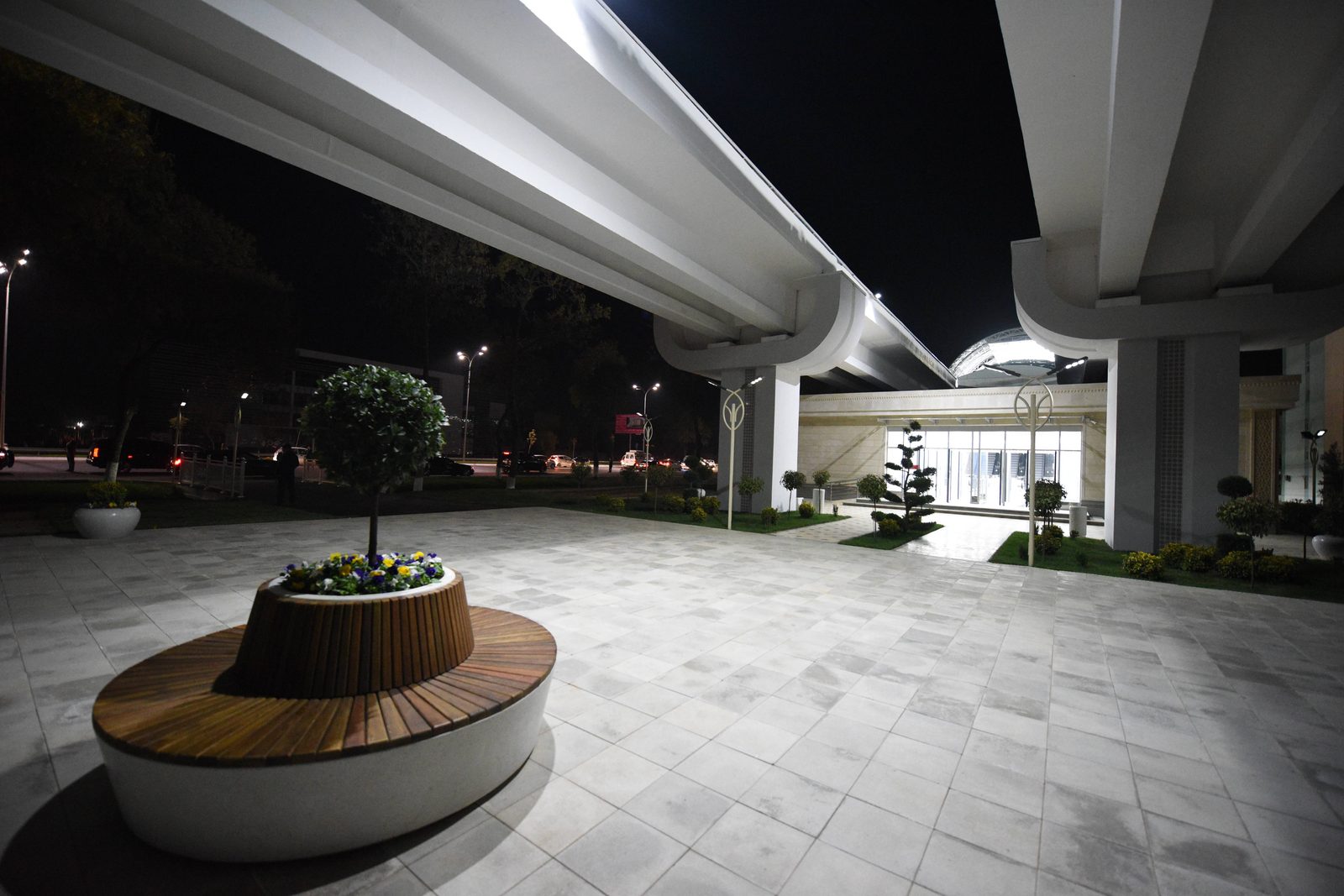
Today the metro has four lines and 50 stations.
| Line | Opened | Stations |
|---|---|---|
| Chilonzor (red) | 1977 | 17 |
| Uzbekistan (blue) | 1984 | 11 |
| Yunusobod (green) | 2001 | 8 |
| Circle Line (overground) | 2020 | 14 |
The three older lines run underground and hold the art. The Circle Line runs above the streets on a viaduct; it opened in 2020 and has grown in stages, most recently in 2025. Its stations are bright and modern; for chandeliers, stay underground.
In 2025 the metro carried 286.8 million passengers, about 785,000 a day. On 16 December 2024 it carried a million people in a single day for the first time.
Station by station: the underground museum
These are the stations we stop at with guests. Get off, let the train go and give each platform ten minutes.
Kosmonavtlar: space under the city
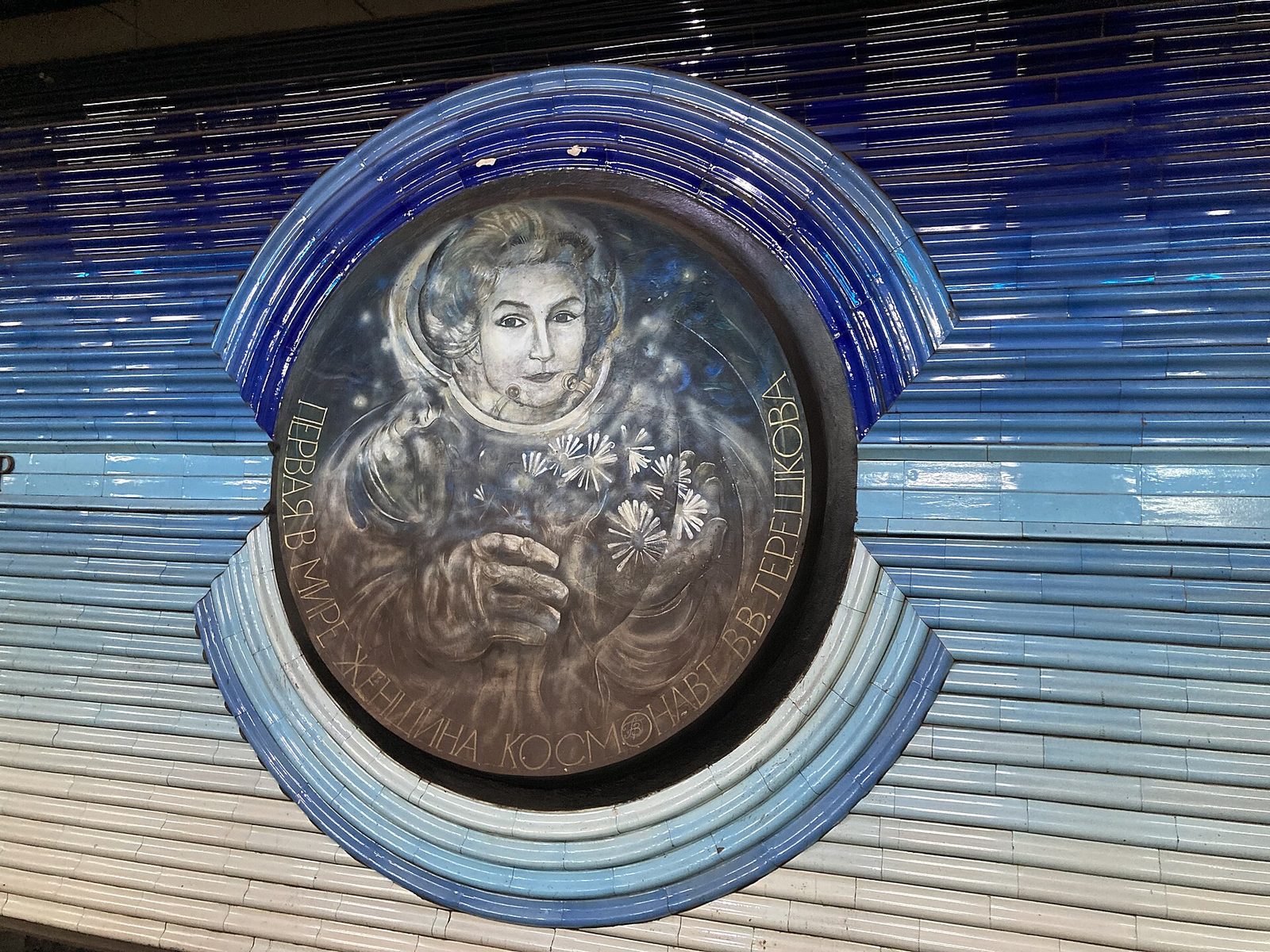
Opened on 8 December 1984, this is the station many call the most beautiful in the city. The architect was Sergo Sutyagin. The walls shift from turquoise at the floor to deep blue at the ceiling, like the sky seen on the way to orbit, the round columns are clad in glass, and glass stars run along the ceiling like the Milky Way.
Along the walls hang ceramic medallions: ,Timur's grandson, ruler of Samarkand and an astronomer. He built a madrasah on the Registan and an observatory whose star catalogue was used for centuries. Read more → the 15th-century astronomer-king of Samarkand, Icarus, Yuri Gagarin, Valentina Tereshkova, the first woman in space, and the cosmonauts Vladislav Volkov and Vladimir Dzhanibekov. The murals are by the monumental artist Arnold Gan.
In April 2024 Did you know? A metro station where Ulugh Beg meets Gagarin Kosmonavtlar station, opened in 1984, has ceramic medallions of Ulugh Beg, Galileo, Icarus, Gagarin and Tereshkova, and glass stars in the ceiling that hint at the Milky Way. Read more → joined Uzbekistan’s national heritage register, and in July 2026 it became part of the UNESCO World Heritage site “Tashkent Modernist Architecture”. It is the only metro station on the list. If Ulugh Beg’s medallion makes you curious, his An Islamic college: student cells and classrooms around a courtyard behind a grand portal. In the old towns many now house museums and craft workshops. is the first building on our Registan.
Alisher Navoi: domes and a poet’s love stories
The hall is a row of domes resting on tapered columns, and it feels more like a madrasah than a station. It is named after Alisher Navoi, the 15th-century poet who founded literature in the Uzbek language.
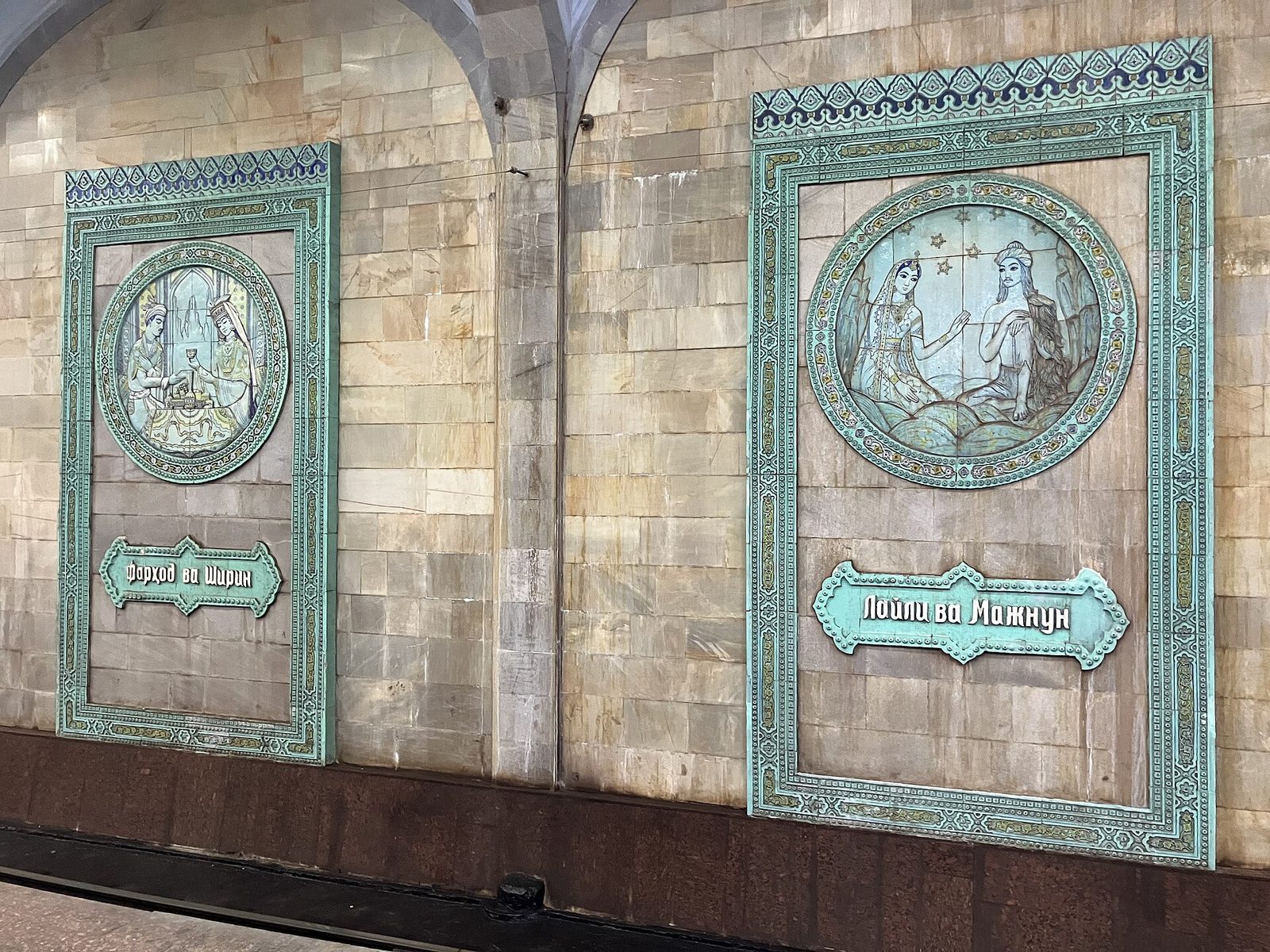
The turquoise ceramic reliefs on the walls illustrate his Khamsa, five long poems: look for Farhod and Shirin, Layli and Majnun, and Alexander the Great building his wall. The sculptor Ahmet Shaymuradov spent four years on them, working with the artist Chingiz Akhmarov. In August 2019 twelve young musicians from the Tashkent Philharmonic played Bach on this platform, the first concert in the history of the metro.
Pakhtakor: white gold
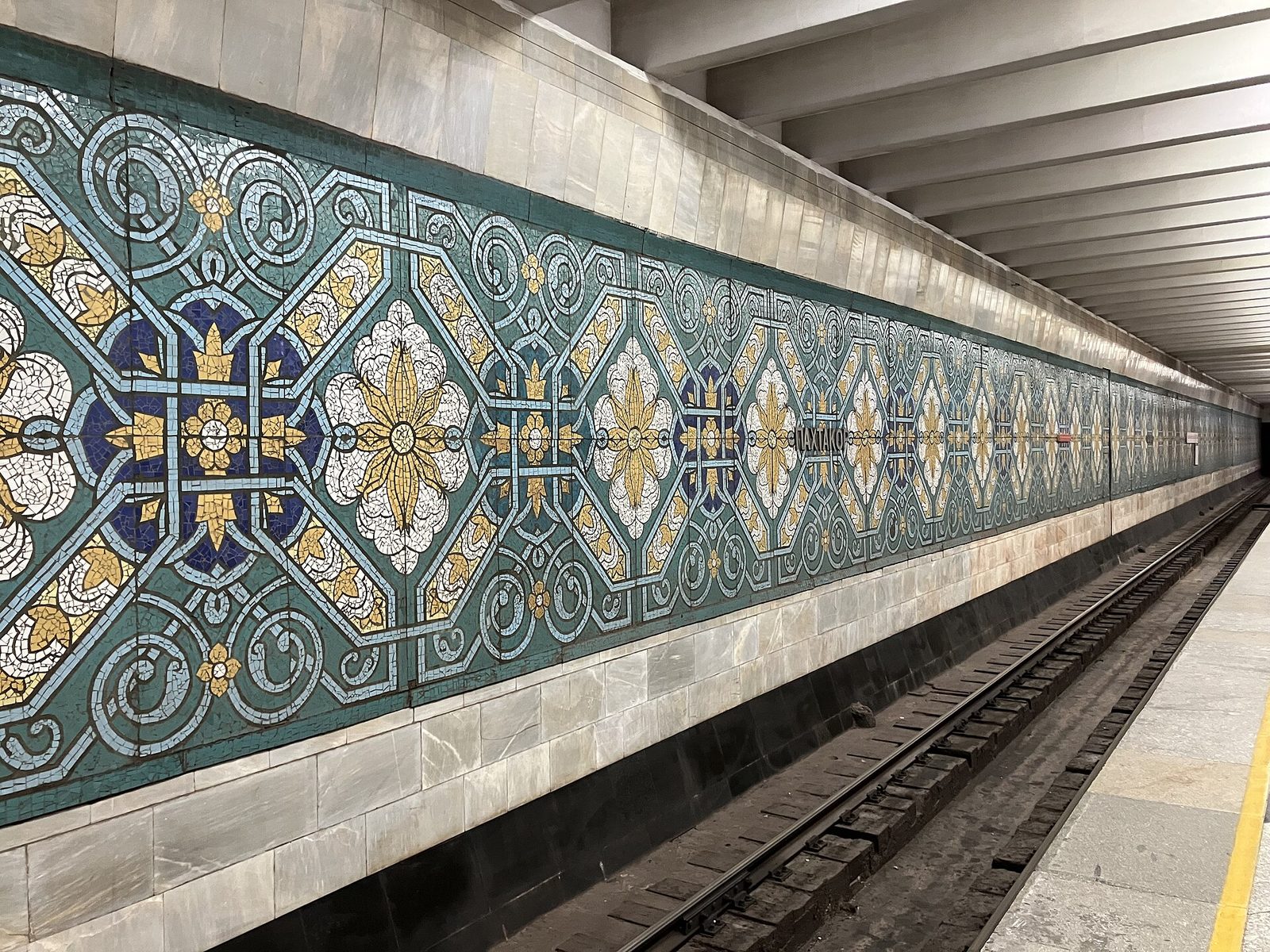
Alisher Navoi’s twin across a short passage, Pakhtakor opened with the first line in 1977. Its name means “cotton grower”. Above the entrance a copper relief shows cotton, the “white gold” of the republic, by Vladimir Burmakin, who also made the station’s mosaic panels. The columns are pale Gazgan marble, and their aluminium capitals are lit from inside.
Cotton comes back on the blue line: at Uzbekistan station the lamps of glass and metal are shaped like open cotton bolls, under a ceiling of carved ganch plaster. To see the real thing in a field, read our cotton season guide.
Mustaqillik Maydoni: crystal under the main square
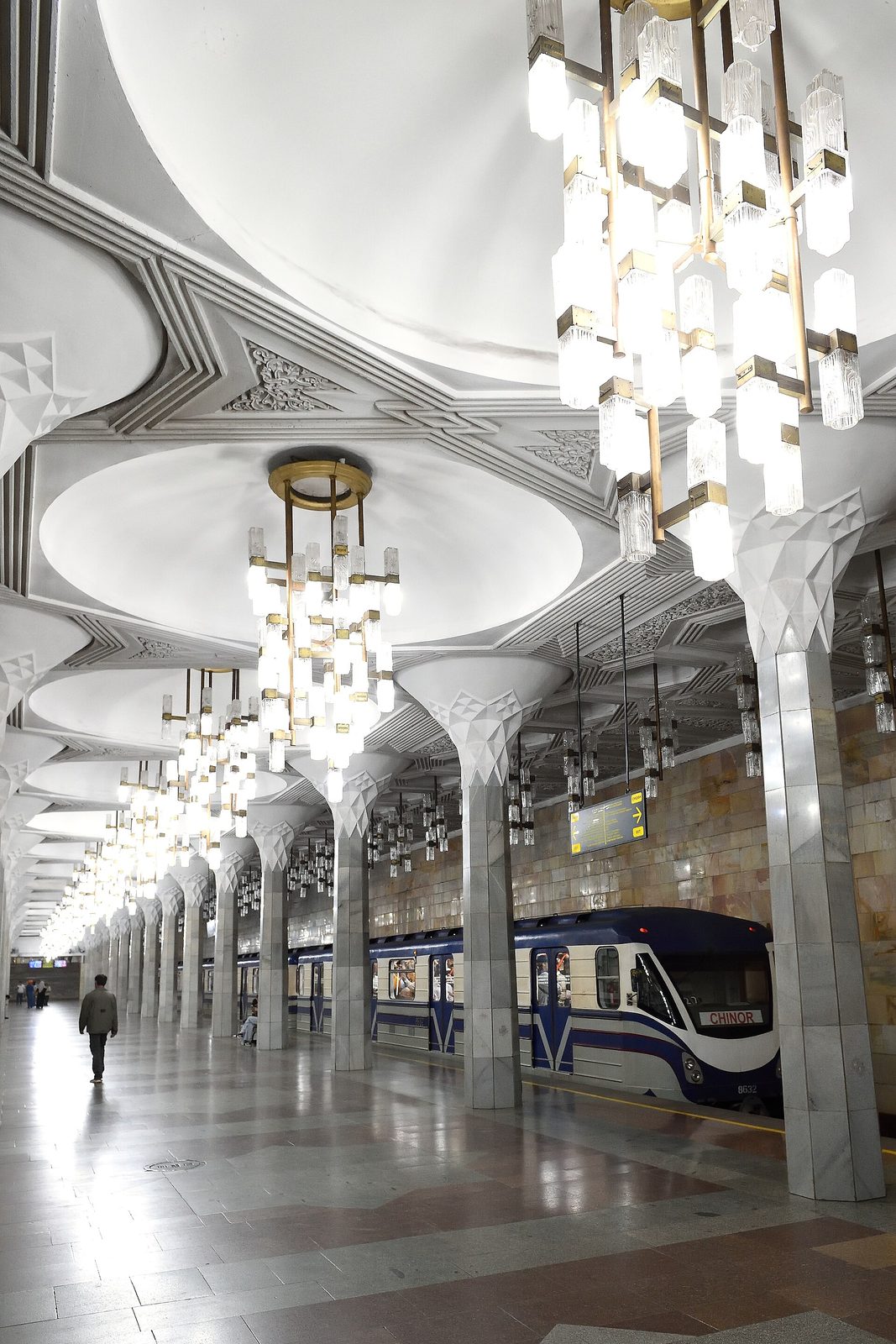
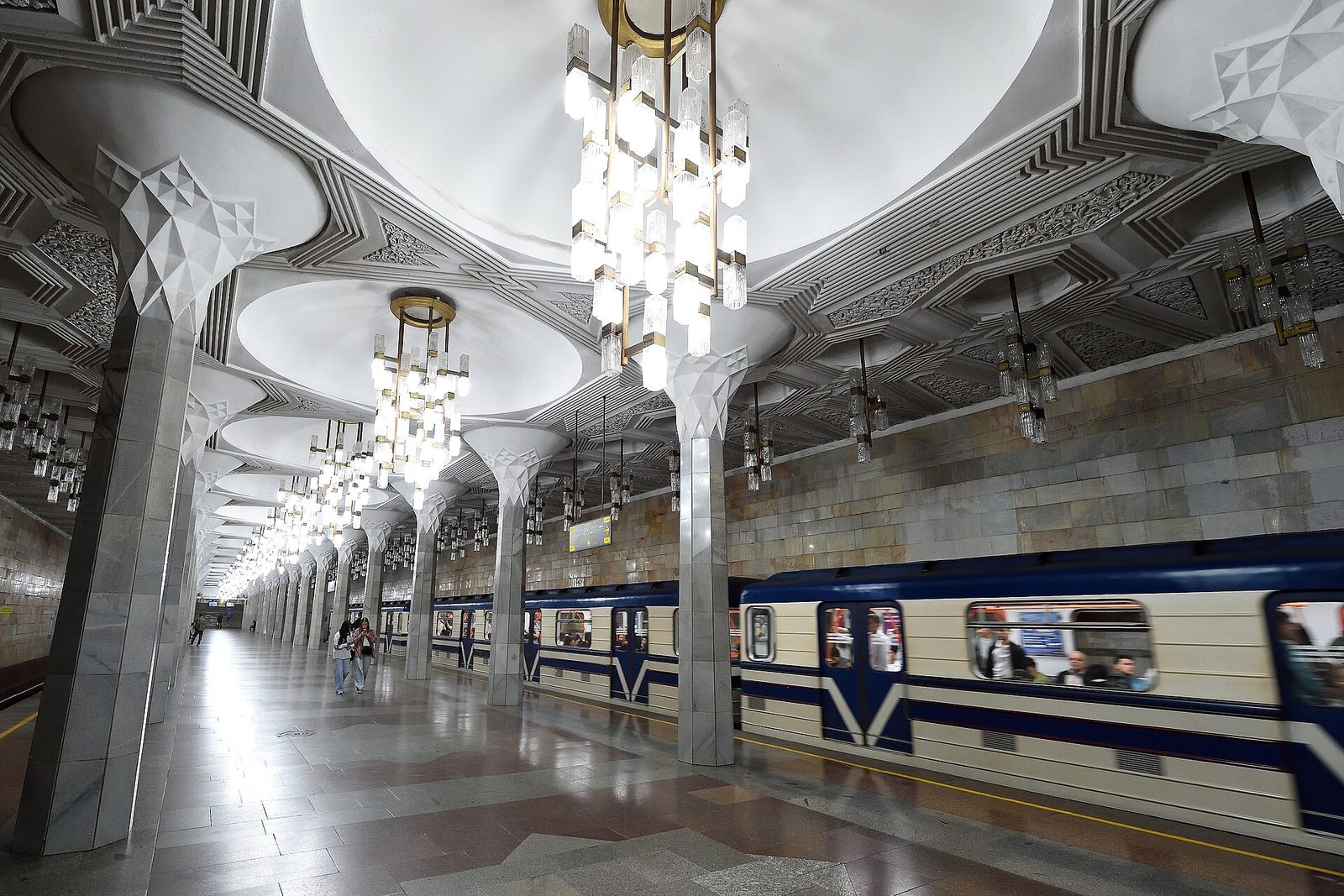
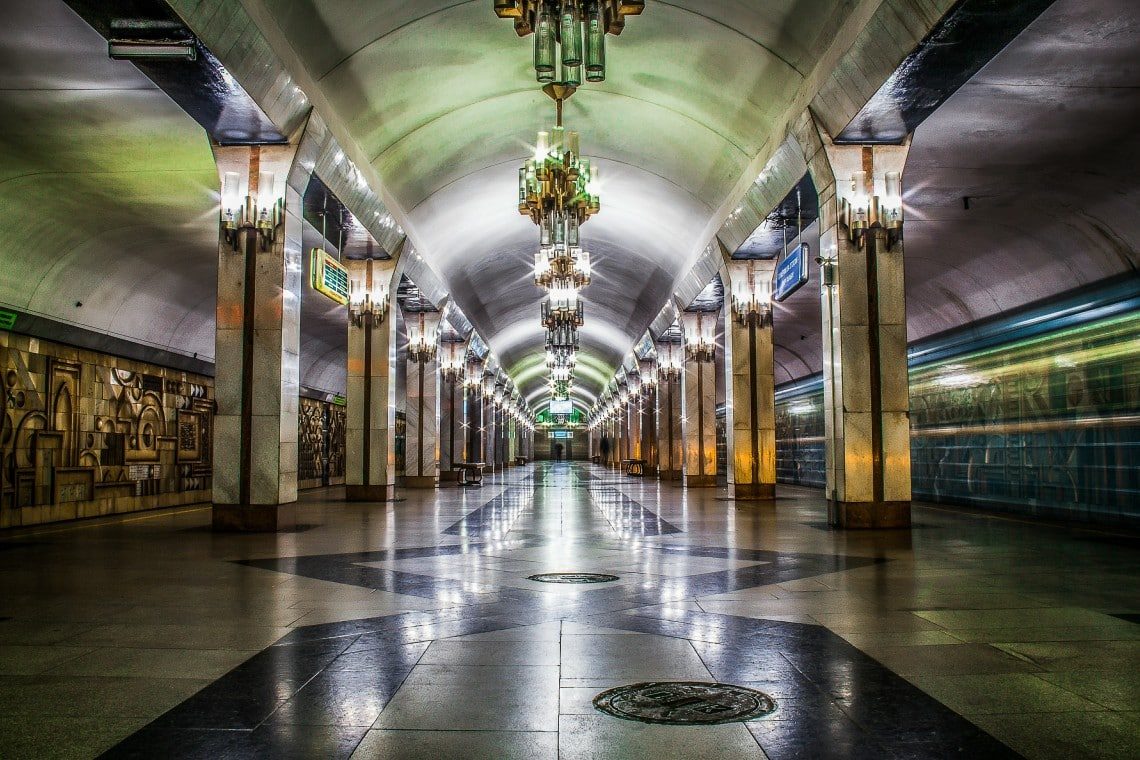
One stop further, under Independence Square, is a hall built to impress. It opened in 1977 as Lenin Square and took its present name in 1991. Crystal chandeliers hang in domes along the sides and down the centre of the hall, white Nurata marble covers the columns, pale pink Gazgan marble the walls, and the granite floor carries a national pattern.
Toshkent and Chorsu
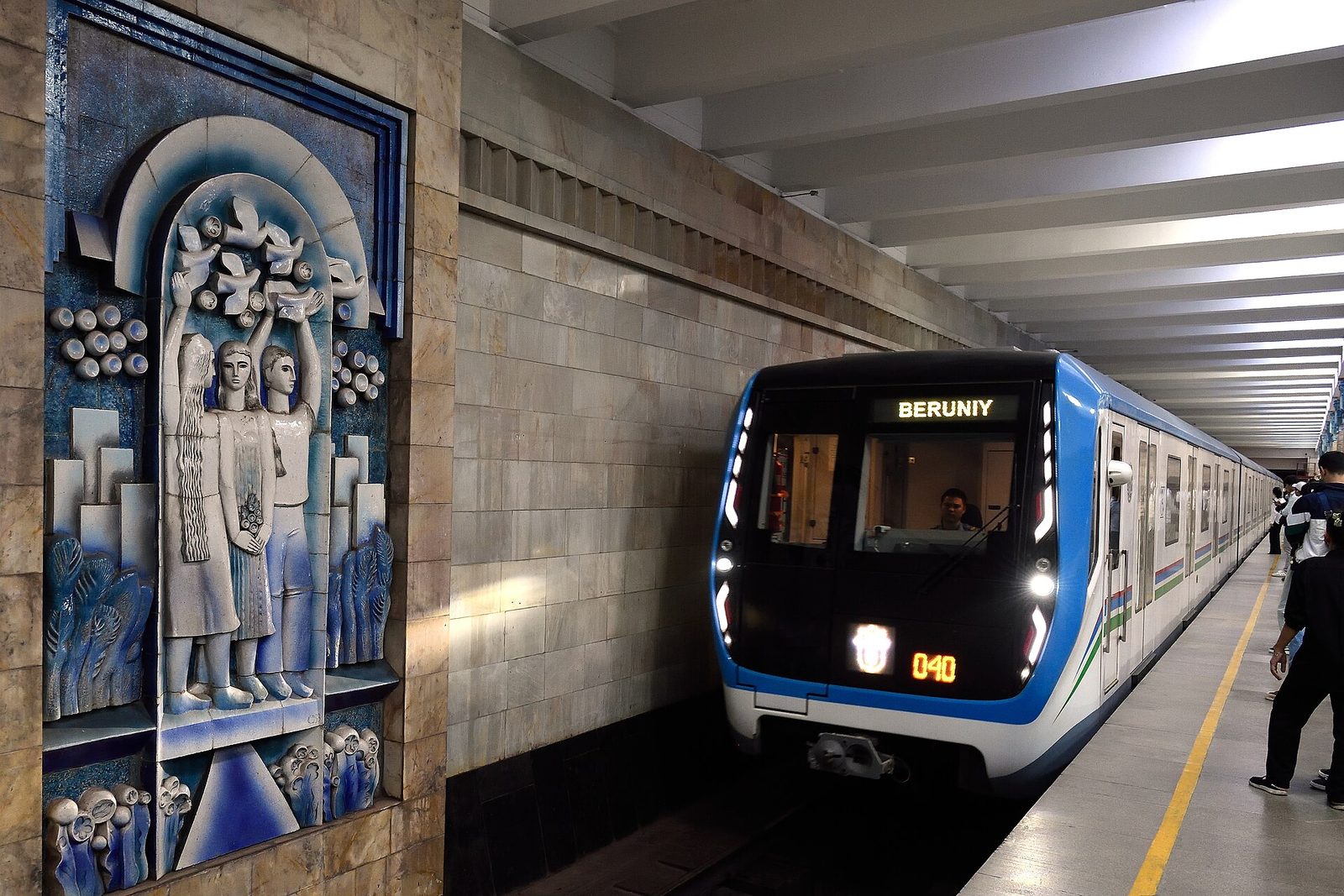
Toshkent lies under the square of the main railway station. Its ceramics are by Saparniyaz Sultanmuratov, and the stairways carry images made for the city’s 2,200th anniversary.
Tashkent's old bazaar under a big blue-green dome, not far from Hazrati Imam. Bring cash in so'm. Read more →, opened in 1989, was dug as an open pit right through the bazaar square while the bazaar itself was being rebuilt. It is finished in white Gazgan marble, with reliefs called “Ecology” and “Link of Times”.
Yunus Rajabiy and Bodomzor: the 2001 line
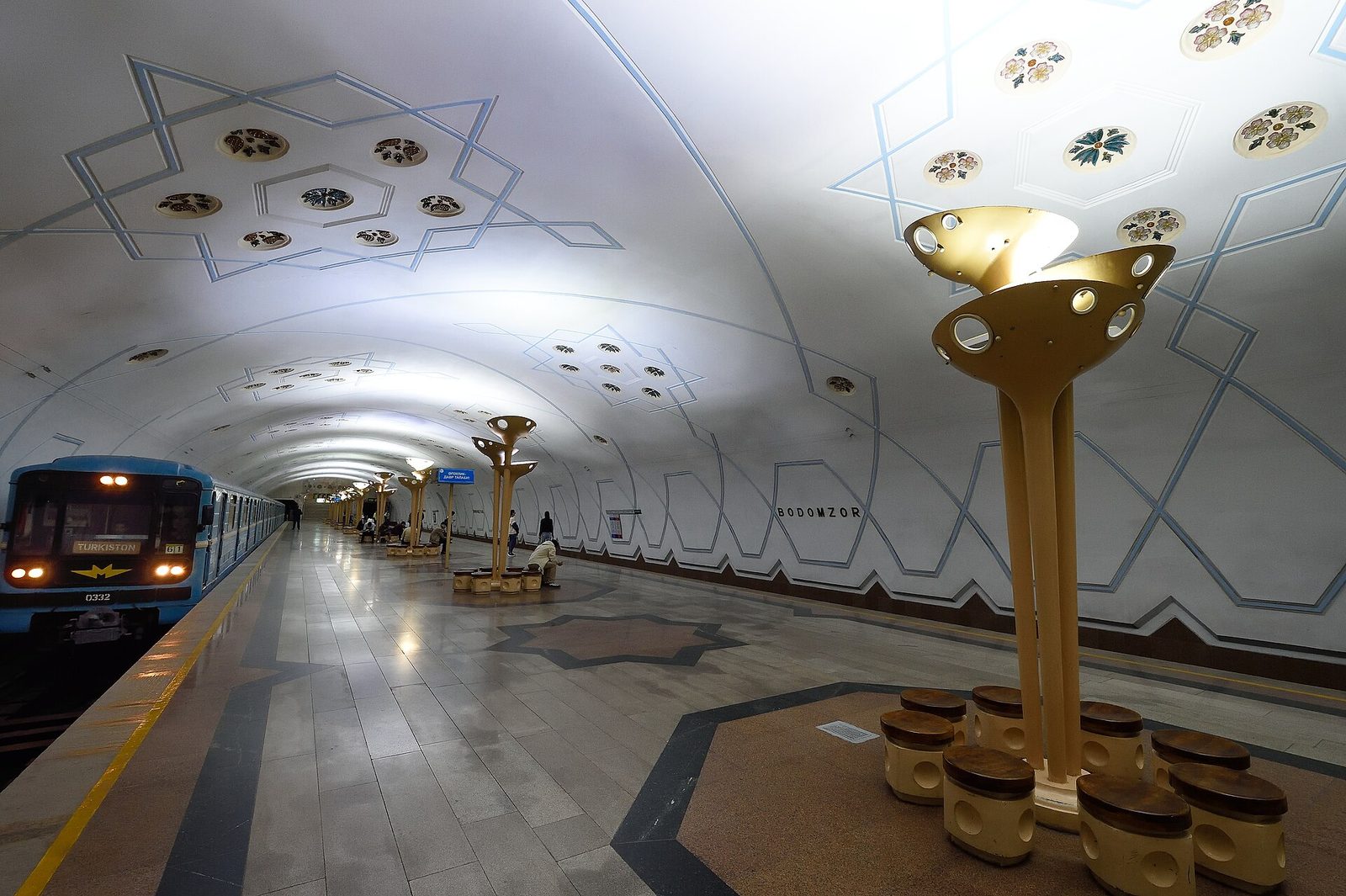
The green Yunusobod line opened in October 2001, after the slow years of the 1990s. Yunus Rajabiy is the deepest station in the system, 24 metres down, with ceilings more than 7 metres high; nineteen drainage wells were drilled to keep the groundwater out. Its columns are crowned with capitals that double as lamps.
Bodomzor, “almond orchard”, is three stops north: a white vault traced with blue star patterns and dotted with painted ceramic flowers.
Did you know?
- The metro was built to double as a shelter: its gates can seal a station hermetically. That is why photography was banned until 1 June 2018.
- From 1996 to 1 November 2020 you rode on blue plastic tokens. Since December 2024 you can also pay with the palm of your hand.
- After independence several stations were renamed: Lenin Square became Mustaqillik Maydoni, and October Revolution became Amir Temur Xiyoboni.
The Tashkent metro in dates
| Year | What happened |
|---|---|
| 1966 | An earthquake destroys much of old Tashkent |
| 1967 | Decree to design and build the metro |
| 1972 | Construction begins in Chilonzor |
| 1977 | The first line opens with nine stations |
| 1984 | The Uzbekistan line opens, with Alisher Navoi and Kosmonavtlar |
| 2001 | The Yunusobod line opens |
| 2018 | Photography is allowed |
| 2020 | The overground Circle Line opens; tokens give way to cards |
| 2026 | Kosmonavtlar joins the UNESCO World Heritage List |
A self-guided route: six stations in two hours
Buy one fare and stay inside the gates: changes between lines are free, so the whole route costs a single ride. Allow about two hours with stops.
| Stop | Line | What to look for |
|---|---|---|
| 1. Chorsu | Uzbekistan | White marble and the two reliefs. Ride two stops east. |
| 2. Alisher Navoi | Uzbekistan | Domes and the Khamsa panels. Walk through the passage to Pakhtakor. |
| 3. Pakhtakor | Chilonzor | Marble columns, lit capitals, mosaic. Ride one stop. |
| 4. Mustaqillik Maydoni | Chilonzor | Crystal chandeliers. Ride one stop to Amir Temur Xiyoboni and change. |
| 5. Yunus Rajabiy | Yunusobod | The deepest station. Ride one stop to Ming Orik, change to Oybek and ride one stop west. |
| 6. Kosmonavtlar | Uzbekistan | Medallions and glass stars. Come up here. |
With more time, add Bodomzor, three stops north of Yunus Rajabiy.
Tickets, hours and etiquette
- Fare: one fare covers any distance. Since 1 October 2026 a ride costs 2,500 som with an ATTO transport card or a payment app, and 3,000 som with a single paper QR ticket.
- Single tickets: buy them at the ticket office or, at more and more stations, from a ticket machine. The QR code works on paper or on your phone screen.
- ATTO card: sold at metro ticket offices and post offices, and topped up in the ATTO app or at terminals. On cards and cash in general, see cards, cash and tipping.
- Hours: 05:00 to midnight on the three underground lines; the Circle Line closes at 23:00.
- At the entrance: you walk through a metal detector, and staff may look into your bag.
- Photos: allowed.
- Etiquette: let passengers off before you board, and offer your seat to older passengers and parents with small children.
- Bags: watch your pockets in the crowds; our safety guide has the rest.
- Airport: the metro does not go there; take a Yandex Go taxi or a transfer.
Combine the metro with Chorsu, Hazrati Imam and Amir Timur Square
The route fits neatly into a day. Start at the The religious heart of old Tashkent: madrasahs, a Friday mosque and mausoleums. Right next to it stands the new Center of Islamic Civilization, opened in 2026. Read more → complex and the new Center of Islamic Civilization in the morning, take a short taxi to the Chorsu bazaar at midday, then go down into Chorsu station. Come up at Kosmonavtlar, a short walk from Amir Timur (Tamerlane, 1336–1405), founder of the Timurid empire, which had its capital in Samarkand. Born near Shahrisabz. Square, just as the evening starts. The full plan is in Tashkent in 1 or 2 days, and the rest of the city is in our Tashkent city guide.
The next morning, Toshkent station takes you to the train: Samarkand is 2 hours 30 minutes away on the Uzbekistan's high-speed train: Tashkent to Samarkand in 2 hours 30 minutes, Tashkent to Bukhara in about 4 hours. Tickets are tied to your passport. Read more → (see Tashkent to Samarkand and trains in Uzbekistan). If you would rather have a guide and a car, it is our Tashkent highlights tour, and there are more Tashkent tours in the catalogue.
In short
- Built after the 1966 earthquake to withstand the next one, the metro opened in 1977: the first in Central Asia.
- Four lines and 50 stations; the art is on the three underground lines.
- Don’t miss Kosmonavtlar (the only metro station on the UNESCO list), Alisher Navoi, Pakhtakor and Mustaqillik Maydoni.
- One fare covers the whole route as long as you stay inside the gates: 2,500 som with a transport card or app, 3,000 som with a paper QR ticket.
- Photography is allowed; trains run from 05:00 to midnight.
© Photos
- Mustaqillik Maydoni metro station, Tashkent — Tim Adams / Wikimedia Commons · CC BY 4.0
- Valentina Tereshkova medallion, Kosmonavtlar metro station, Tashkent — Schokifaktor / Wikimedia Commons · CC BY-SA 4.0
- Ceramic panels from Navoi's Khamsa, Alisher Navoi metro station, Tashkent — Schokifaktor / Wikimedia Commons · CC BY-SA 4.0
- Ceramic ornament on the track wall, Pakhtakor metro station, Tashkent — Schokifaktor / Wikimedia Commons · CC BY-SA 4.0
- Chandeliers at Mustaqillik Maydoni metro station, Tashkent — Tim Adams / Wikimedia Commons · CC BY 4.0
- Ceramic relief at Toshkent metro station, Tashkent — Tim Adams / Wikimedia Commons · CC BY 4.0
- Bodomzor metro station, Tashkent — Tim Adams / Wikimedia Commons · CC BY 4.0