
Places in this article: Bukhara
The Ark of Bukhara: history, legends and how to visit the fortress
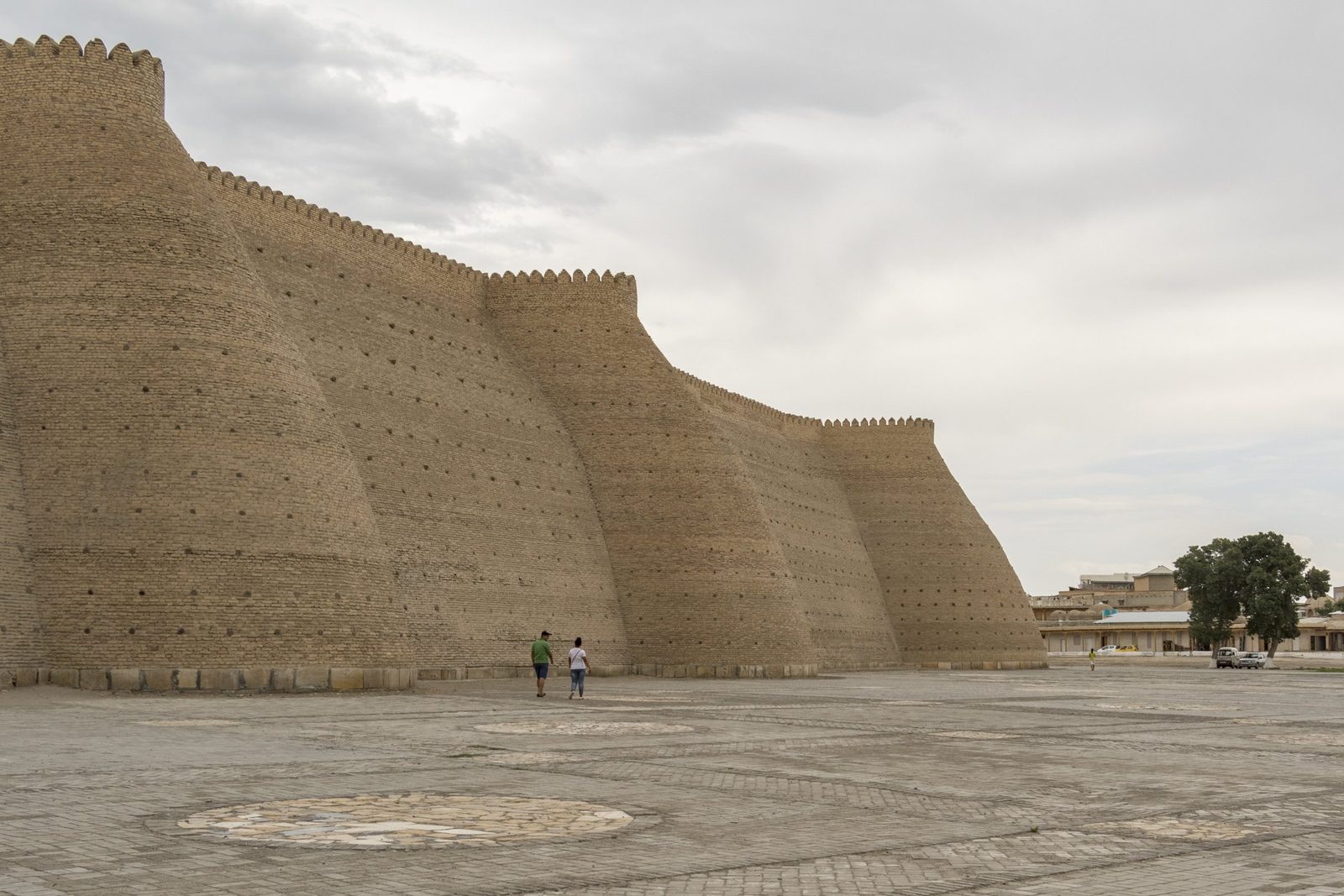
Walk a few minutes from the Did you know? Diggers went 13 m down and never found its base The Kalyan Minaret of 1127 rises about 46 m, and an excavation reached 13 m without finding the bottom of its foundations. Genghis Khan reportedly ordered it spared. Read more → and the lanes open onto a wide, bare square. On its far side a wall of yellow brick rises 16 to 20 metres, sloping back like the side of a hill, its top cut into battlements. That is close to the truth: The fortress-residence of the rulers of Bukhara on a high artificial hill: the oldest structure in the city. Read more → stands on a hill that people built up over more than two thousand years, with the rulers’ palace on top.
The Ark was the seat of Bukhara’s rulers for well over a thousand years, and it is where we start almost every Bukhara day with our guests. Here is the fortress as our guides tell it: the history, the legends (marked as such), the throne hall, the square at its gate and how to plan your visit.
Two thousand years on one hill
Under the Ark lie more than 20 metres of earlier buildings, about a third of them below today’s ground. In 1979–1980 archaeologists dug a test pit six metres square down to virgin soil. At the bottom they found two mud-brick walls: the older from the 4th–3rd centuries BC, the younger from the 4th–5th centuries AD.
Today’s walls run for 789.6 metres and enclose almost four hectares, a rough rectangle stretched from west to east. In 713 the Arabs built the first mosque of Bukhara inside them. In 1220 the townspeople took refuge here from Genghis Khan’s army, and the fortress fell. It took the shape you see in the 16th century, under the Shaybanids; the buildings inside are all from the last three centuries.
In 1753 Muhammad Rahim of the Manghit tribe took the throne with the title of emir. His dynasty gave Bukhara eight emirs and ruled until 1920. That year fighting reached the city, a fire raged in the Ark for four days and most of the buildings inside were lost. The west wall was restored first, archaeologists excavated the upper layers in 1970–1974, and a broad restoration came in the 1990s, ahead of Bukhara’s 2,500th anniversary. Since 1993 the Ark has been part of the Historic Centre of Bukhara on the UNESCO World Heritage List.
Legends: a bull’s hide and seven stars
These are legends, not history. The oldest credits the founding of the Ark to Siyavush, a prince of the Persian epic who fled from Iran to Turan, to the court of King Afrasiab. The story goes that he was offered as much land as a bull’s hide would cover. He cut the hide into thin strips, tied them end to end and laid out a circle big enough for a palace. Readers of Virgil know the trick: Queen Dido used it to found Carthage.
It ends badly for the prince. Afrasiab had him killed, and tradition placed his grave by the eastern gate of the Ark.
The second legend comes from Narshakhi, who wrote a history of the city in the 10th century and claimed that Bukhara was already 3,000 years old; archaeologists treat that figure as legend too. The first fortress, he wrote, fell into ruin. The next was built on seven stone pillars set out like the seven stars of the Great Bear, and after that it was never destroyed again.
Through the gate and up the ramp
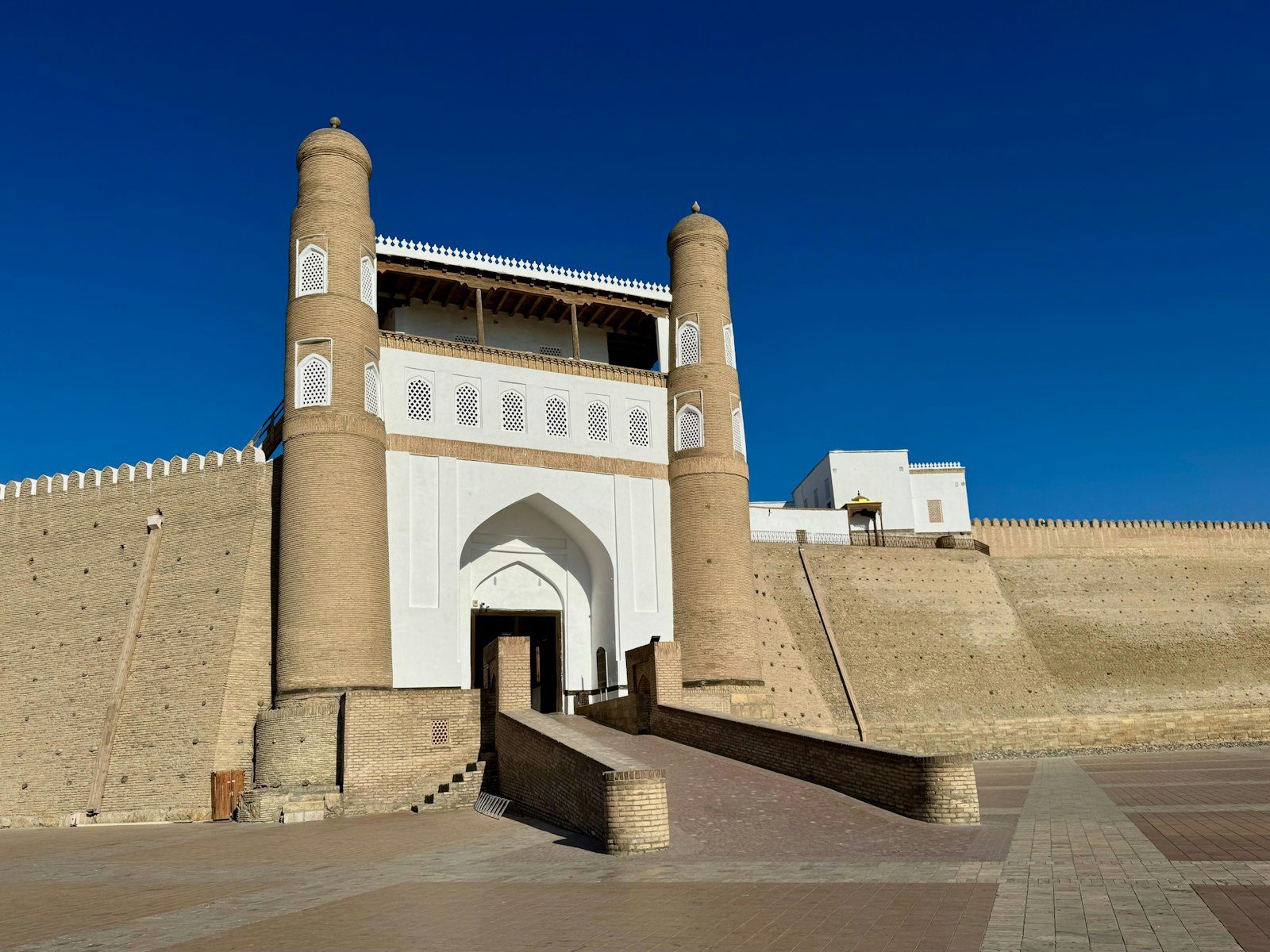
The entrance is in the west wall, facing the .Samarkand's main square, framed by three madrasahs: Ulugh Beg (15th century), Sher-Dor and Tilya-Kori (both 17th century). Read more → Two 18th-century towers frame the gate, joined high up by a gallery of latticed windows. Abdulaziz Khan, who ruled from 1645 to 1681, built a three-storey gatehouse here. Musicians in the music pavilion played maqom, the classical suites of the region, at set times through the day, and the city told the time by them.
Behind the gate a ramp climbs gently through a long, dim corridor called the dalon. Seventeen niches line its walls; they led to storerooms and cells. At the top the corridor brings you out by the Ark’s Friday mosque.
The emir’s mosque
The court mosque was built under Subhanquli Khan, who ruled from 1681 to 1702. Here the emir, his family and his officials gathered for Friday prayers. Its veranda runs along three sides, and inside, the wooden columns are carved from base to capital and the ceiling is painted with fine patterns.
The throne hall where emirs were crowned
Deeper inside is the kurinishkhana, the reception hall, added in the 17th century. Don’t expect a room. It is a brick-paved courtyard with verandas on wooden columns on three sides. The ruler sat in a deep alcove at the far end, the shahnishin; ministers and courtiers lined the sides.
The throne is still there: a marble takht dated 1669, carved by masters from Nurata, under a painted wooden canopy on marble posts. New emirs were crowned in this court. The last was Muhammad Alim Khan, who ruled from 1911 to 1920, the final emir of Bukhara. The roof of the court fell in during the bombardment of 1920.
The museums inside
The restored buildings now belong to the Bukhara State Museum-Reserve. Around the courtyard where visitors once waited to be received, rooms tell the ancient history of Bukhara; upstairs, reached by wooden stairs, is the history of the khanate and the emirate. The museum-reserve’s collections are large: the history department alone has about 14,000 items, and the department of coins and inscriptions nearly 20,000.
The Registan: the square at the gate
Bukhara has its own Registan, the “sandy place”. It runs along the west wall of the Ark and took shape under the Samanids. In the 10th century a palace with a grand portal faced the Ark across it, and the geographer al-Istakhri called it the finest in the lands of Islam. Until Genghis Khan, this was the public heart of the city.
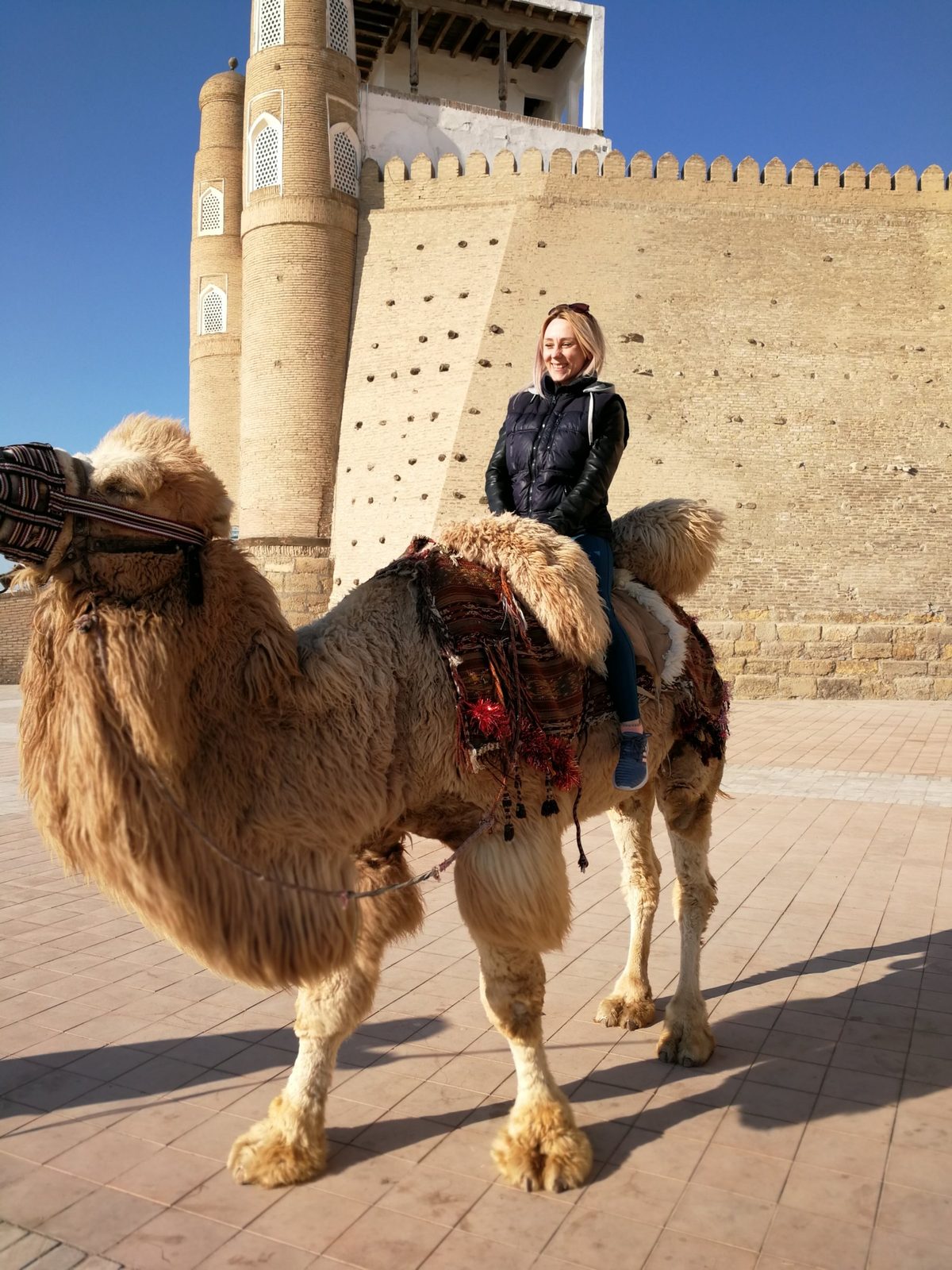
Later the square was the stage for the emirs’ ceremonies, watched from the veranda over the gate. On feast days carpets were laid across it, from the Ark to the emir’s mosque on the other side. Today it is open paving, and the best place to feel the size of the walls: stand at the far edge and the people at the foot of the ramp look tiny. On some days a camel waits by the gate for photos.
Samarkand’s square of the same name is a different story, with three madrasahs: see the Registan in Samarkand.
Bolo-Hauz and the Zindan
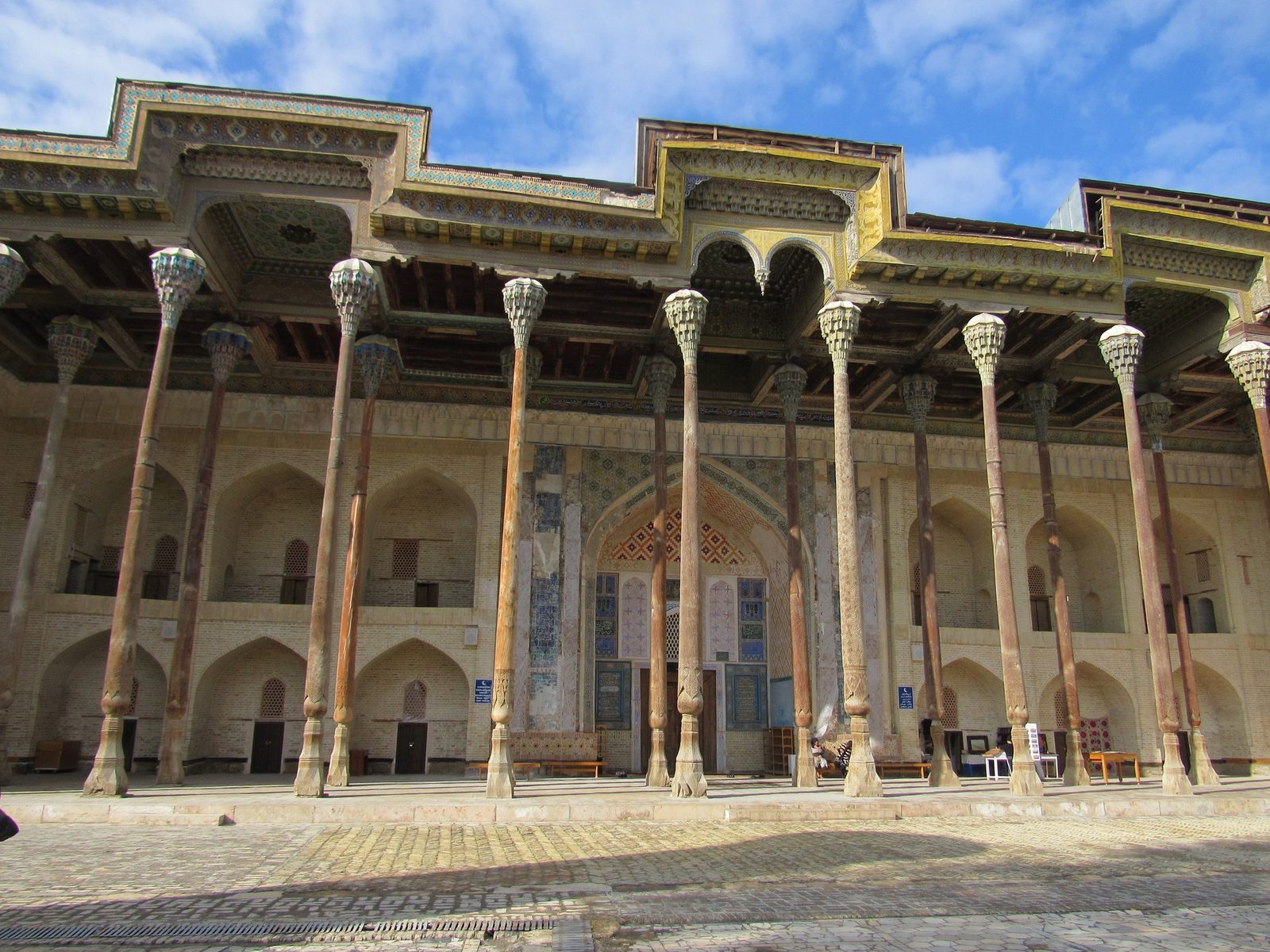
Across the Registan from the gate stands ,A mosque of 1712 opposite the Ark in Bukhara. Its twenty carved wooden columns reflect in the pond in front. the emirs’ main Friday mosque. It was completed in 1712, together with the octagonal pond in front, which held water for ablutions and for the people of the quarter.
The veranda that everyone photographs is younger. In 1917 the master Shirin Muradov added the iwan and the small minaret. Its roof rests on twenty slender wooden columns, 12 metres high, with carved and painted stalactite capitals, and the porch measures 42 by 10 metres. Stand by the pond in the late afternoon and look back across the square at the gate of the Ark.
The Zindan
A short walk behind the Ark is the Zindan, the emirs’ prison, built in the 18th century. It held no more than 40 people, mostly debtors and those who broke religious rules, and its deepest cell is a brick-lined pit about 6.5 metres deep. Today it is a small museum of justice in Bukhara in the 19th and early 20th centuries, with its own ticket. Twenty minutes is enough.
Visiting the Ark: tickets, hours and our tips
- Ticket: 60,000 som for a foreign adult. A guided tour in a foreign language costs 120,000 som, and photographing the exhibits 30,000 som. The Zindan has its own ticket: 20,000 som.
- Hours: 9:00–18:00, and 8:00–21:00 in the season. Hours can be shorter on some days, so we check them for our guests on the day.
- Time: 1.5 hours for the Ark, plus 20 minutes each for Bolo-Hauz and the Zindan.
- When: at opening time, before the heat settles on the open courtyards. The gate faces west and takes the late sun, so come back to the square at sunset for the best view of the walls.
- Dress: shoulders and knees covered in the mosques, above all at Bolo-Hauz. More in our guide to what to wear in Uzbekistan.
- Getting there: the Ark is a few minutes’ walk from The heart of old Bukhara: the Kalyan Minaret of 1127, the Kalyan Mosque and the Mir-i-Arab Madrasah facing each other across one square. Read more → and under a kilometre from .Did you know? Bukhara's ponds were once its water supply Pools like Lyabi-Hauz, dug around 1620 and 46 × 36 m, were the city's main source of water. Most were filled in during the 1920s–30s because they spread disease; Lyabi-Hauz survived. Read more →
To fit the Ark into your days, see Bukhara in 1, 2 or 3 days, our table of Bukhara and Khiva sights, tickets and hours and the Bukhara city guide. Next stop on foot: Poi-Kalyan and the Kalyan minaret. With a guide, the Ark is part of the Bukhara highlights tour, Bukhara in 2 days and our other Bukhara tours.
In short
- The Ark stands on a hill built by people; its oldest walls date from the 4th–3rd centuries BC, and today’s rise 16 to 20 metres.
- Siyavush and his bull’s hide, and the seven pillars set out like the Great Bear, are legends.
- The marble throne of 1669 still stands in the court where Bukhara’s emirs were crowned.
- Across the square is Bolo-Hauz of 1712 with its twenty columns of 1917; behind the Ark, the Zindan.
- Come at opening time, and come back to the square at sunset.