
Places in this article: Samarkand
Bibi-Khanym Mosque in Samarkand: history, legends and how to visit
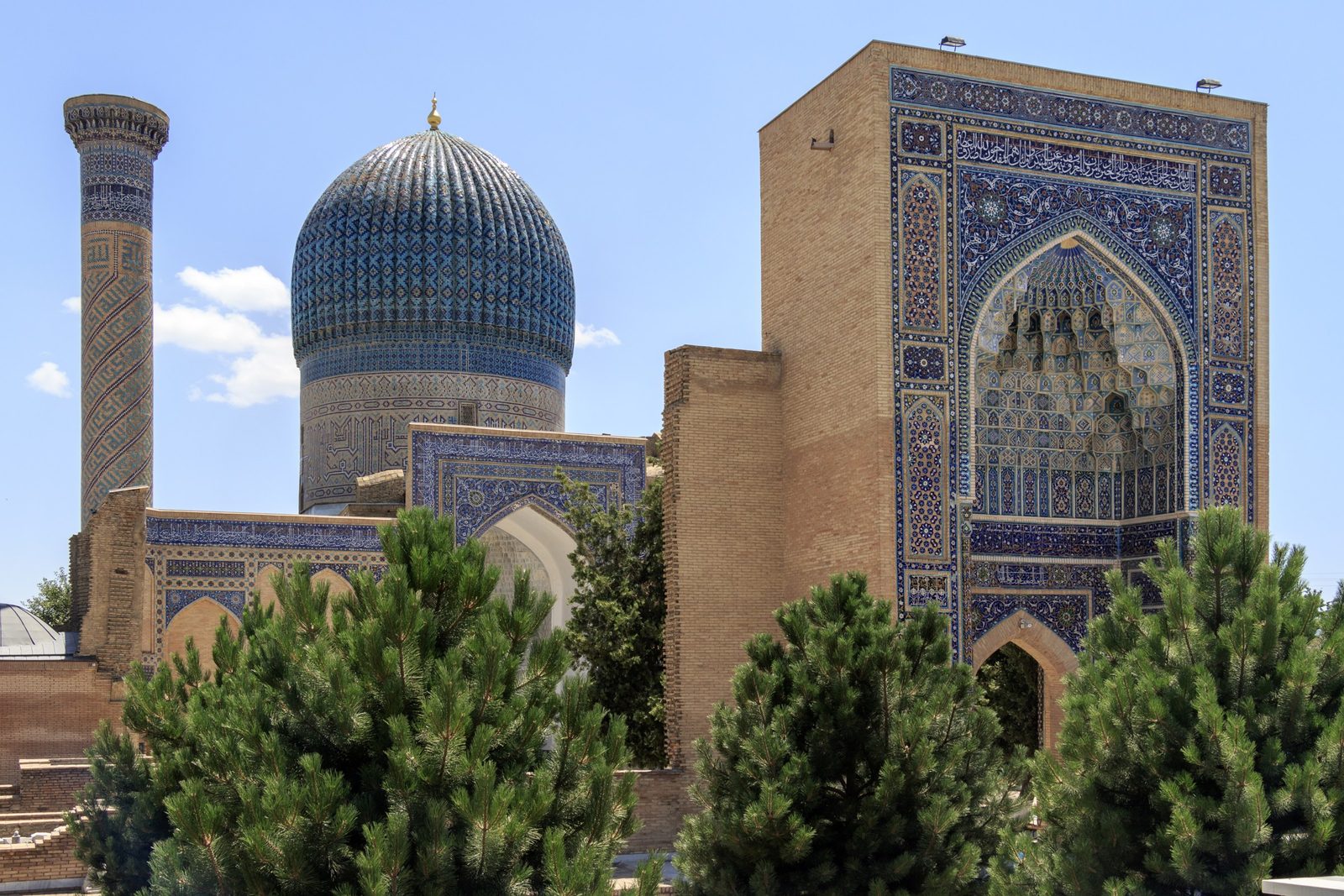
In the autumn of 1404 Amir Timur (Tamerlane, 1336–1405), founder of the Timurid empire, which had its capital in Samarkand. Born near Shahrisabz. came home to Samarkand, sick and nearly seventy, and went to look at his new mosque. He did not like the gate. Too low, he decided, and he had it pulled down and built again while he watched, carried to the site on a litter.
That impatience is written into .Did you know? Legend says the architect asked the queen for a kiss Legend says the architect of Bibi-Khanym would finish on time only for a kiss from Timur's wife, and Timur punished him. In fact the mosque was Timur's own project; his wife Saray Mulk Khanum built her madrasah across the road. Read more → It was the largest mosque in Timur’s empire, put up in about five years, and it began to fall apart almost as soon as it was finished. What you see today is part Timurid masonry, part 20th-century rebuilding, and still a work in progress. We walk guests here on the way from the Did you know? The Registan's sun-carrying lion went on a banknote The Sher-Dor Madrasah (1619–1636) is named for the big cats with the sun on their backs on its portal. The image appeared on the reverse of Uzbekistan's 200-som note of 1997. Read more → to .Samarkand's main bazaar, right next to Bibi-Khanym: Samarkand bread, dried fruit, nuts and halva. Read more → Here is the mosque as our guides tell it: the history, the giant marble Quran stand, the legends (marked as legends) and how to fit it into your day.
Built with the spoils of India
Timur took Delhi at the end of 1398 and came back from India rich. In May 1399 work began on a Friday mosque for his capital, large enough for the whole city to pray in at once. The courtyard alone was meant to hold 10,000 people.
The scale needed an army of builders. Two hundred stonecutters from Azerbaijan, Fars, Hindustan and other lands worked on the mosque itself, while 500 more cut stone in the mountains. Ninety-five elephants were brought from India to haul the loads. Craftsmen came from India, Iran, Khorezm and the Golden Horde.
Timur watched the first months and then left on his long campaign to the west, against the Ottomans. By the time he returned, in 1404, the main structure stood. Finishing work went on into 1405, the year he died.
The gate Timur ordered torn down
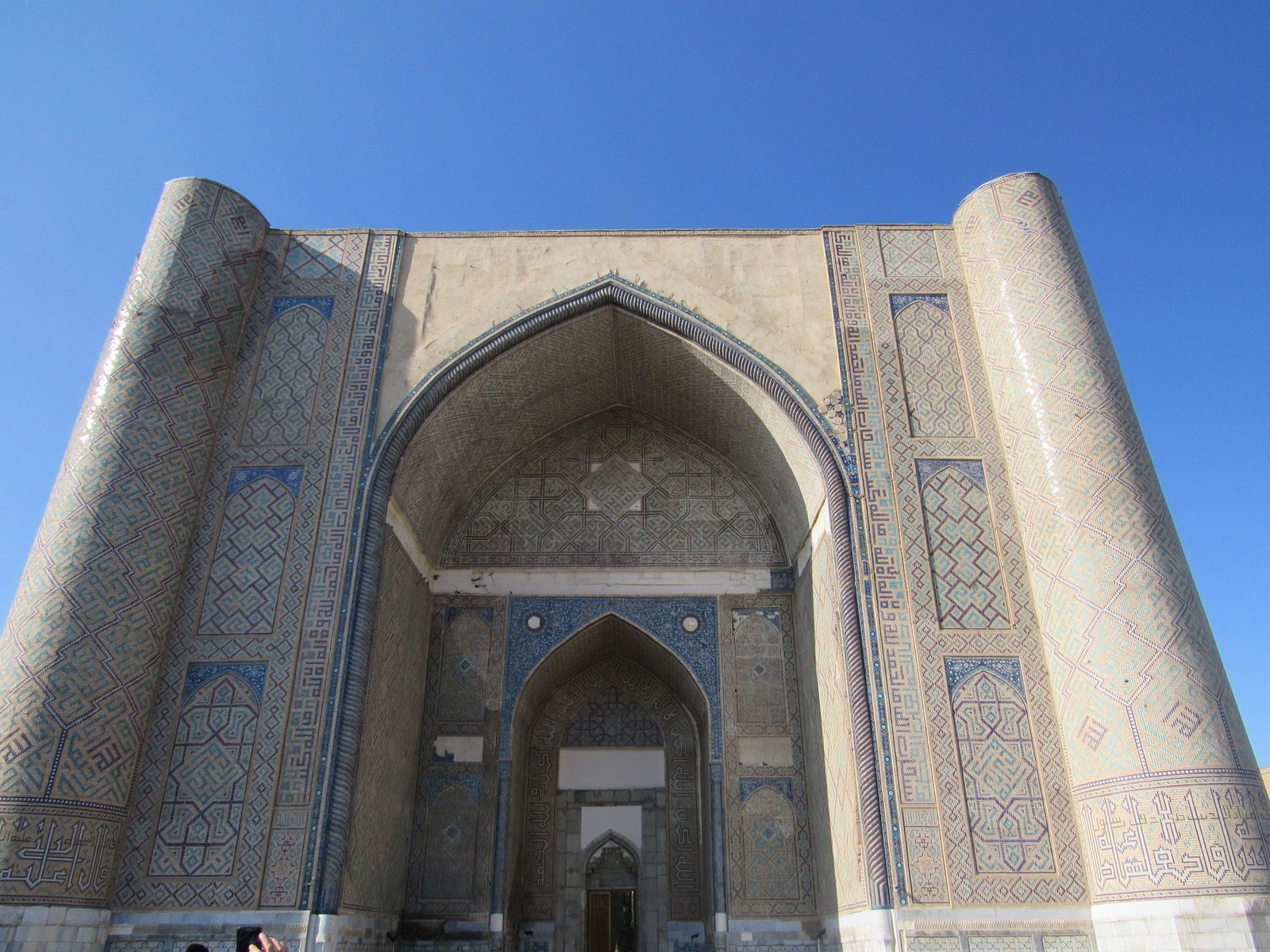
The portal in front of you is the second version. The Castilian envoy Ruy González de Clavijo, at Timur’s court at the time, recorded that Timur found the first gateway much too low and ordered it demolished. Too weak to walk, Timur had himself carried to the site every day, threw pieces of meat down to the workers and tossed coins to the masons who pleased him.
The new portal rises 35 metres. Its doors were cast from an alloy of seven metals. Stand at the foot of the arch and look at the two thick towers on either side, wrapped in a lattice of glazed bricks that forms inscriptions in square Kufic script.
A legend gives Timur a sharper motive: across the road stood the An Islamic college: student cells and classrooms around a courtyard behind a grand portal. In the old towns many now house museums and craft workshops. of his wife, and its gate was taller than his. History supports the first half of that story. The madrasah was real, and you can still visit what is left of it (see below).
How big it was
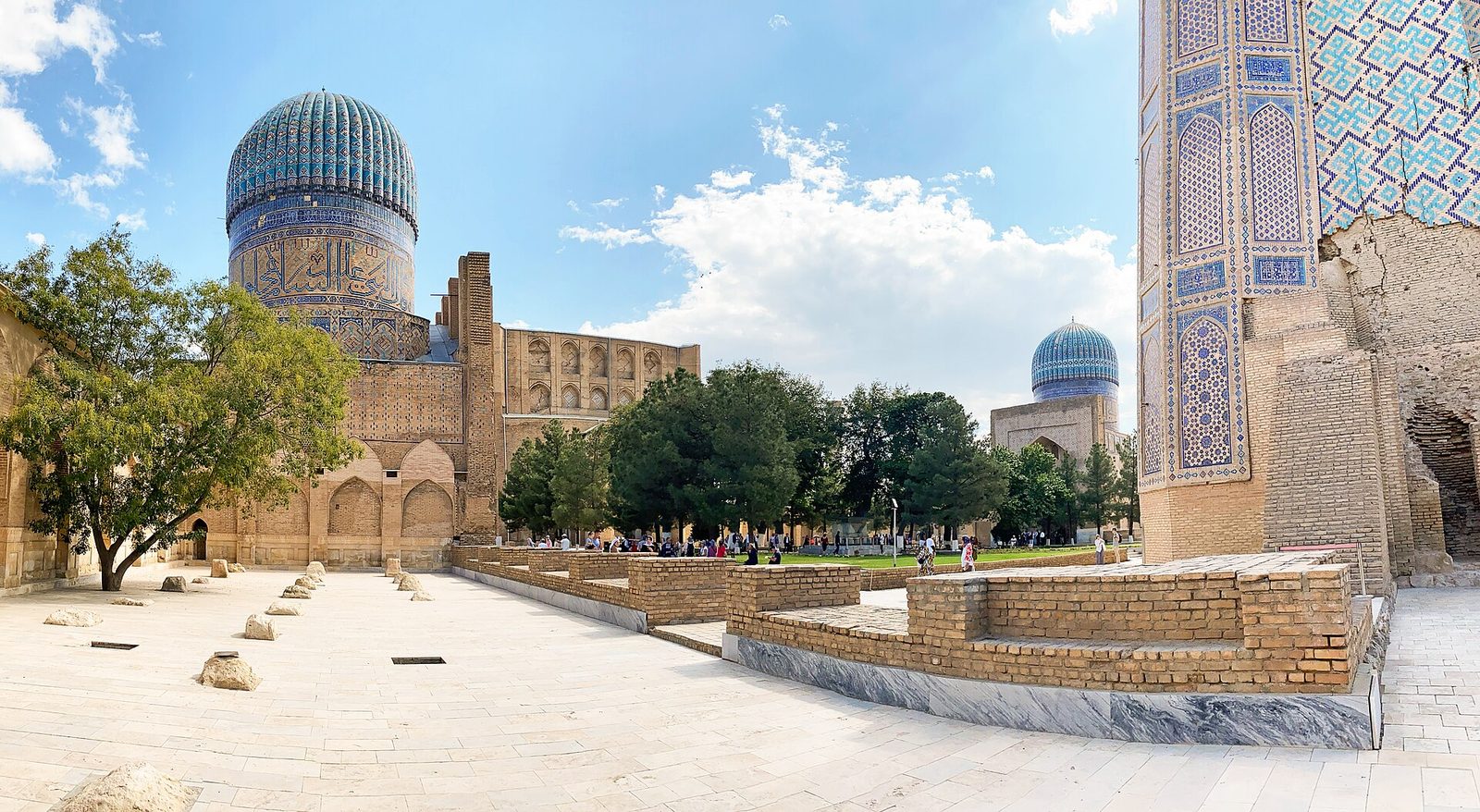
The outer walls enclose a rectangle of 167 by 109 metres. Inside lies an open courtyard of 78 by 64 metres. Around it ran covered galleries resting on more than 400 marble columns, and in each of the three other sides stood a domed hall facing the courtyard.
The biggest of them, the main sanctuary, sits opposite the entrance. Its outer dome reaches about 40 metres; inside, the vault above the mihrab rises 30 metres. Like the other great Timurid domes, it is double: a tall turquoise shell outside and a lower vault within. Putting domes over the side halls as well was a new idea in Central Asian mosques.
Walk to the middle of the courtyard and turn around. From here you see the main dome, the two smaller side mosques and the back of the portal at once, and you get a sense of how much empty space Timur wanted his city to fill on a Friday.
Five centuries of falling down
The haste showed quickly. Within a few years of completion, bricks began to drop from the dome over the mihrab, and by some point in the 15th century the domes were already giving way. The great mosque was turning into a ruin.
In the late 16th century the Bukhara ruler Abdullah Khan II called off the repairs. In the 17th century the city built its new Friday mosque on the Registan: ,Did you know? The 'gilded' mosque of the Registan Tilla-Kari, built in 1646–1660, means 'gilded'. With Bibi-Khanym in ruins, it served as Samarkand's main Friday mosque until the 1920s. Its prayer hall glows with kundal, relief painting finished in gold leaf, restored in 1979. Read more → which served as the main mosque of Samarkand until the 1920s.
The final blow came in 1897. An earthquake brought down the inner arch of the great portal and left the main dome unstable. For decades afterwards, residents carried off bricks from the ruins to build their own houses.
The 20th-century rebuilding
By the 1960s, scaffolding held up what was left of the great arches. In 1974 the government of the Uzbek SSR began a full reconstruction, and the pace picked up after independence: the main façade of the portal was finished by 1999. The three domes and the portal you see today are largely this work.
Look closely and you can often tell old from new: smooth, bright tilework next to patches of bare brick and faded glaze, especially on the inner walls around the courtyard.
The work is not over. In October 2024 a grant of 4.175 million US dollars was signed to complete the restoration of the complex, with the Aga Khan Trust for Culture carrying it out using traditional building methods.
The marble Quran stand
In the centre of the courtyard stands an enormous Quran stand carved from marble, about 2.3 metres long: the open V-shaped rest on which a book is laid for reading, made in stone and on a giant scale. It was commissioned by ,Did you know? Ulugh Beg measured the year to within 25 seconds Working at his Samarkand observatory, Ulugh Beg put the tropical year at 365 days 5 h 49 min 15 s, about 25 seconds too long, closer than Copernicus a century later. Read more → Timur’s grandson and the astronomer-ruler of Samarkand. At first it stood in the main sanctuary, under the dome, and was later moved out into the courtyard.
Two sheets of the largest Timurid Quran manuscripts, each about 1.8 metres tall, laid side by side, would fit it almost exactly. That tells you what kind of book it was built for.
Samarkand has a belief about the stand, and it is a belief, nothing more: a woman who crawls under it will have many children. Today it is a fragile monument nearly six hundred years old, so please look and photograph, but do not climb on it.
Legends: Bibi-Khanym and the architect
The mosque carries the name of Saray Mulk Khanum, Timur’s chief wife, known as Bibi-Khanym, “the senior lady”. She was a daughter of Qazan Khan, the last khan of the Chagatai Khanate, and a descendant of Genghis Khan. Marrying her gave Timur the right to the title Gurgan, “son-in-law” of the khan.
Around her name grew the best-known legend in Samarkand. This is a legend, not history. The architect of the mosque, the story goes, agreed to finish on time only in return for a kiss from the queen. When Timur found out, the architect was punished; in one version he was locked for ever in the vaults beneath the mosque. Tellers do not agree on the details, and our guides tell it lightly, as the city does.
The records tell a plainer story. The mosque was Timur’s own project, begun after the Indian campaign. Saray Mulk Khanum built her own madrasah across the road, around 1397.
The mausoleum across the road
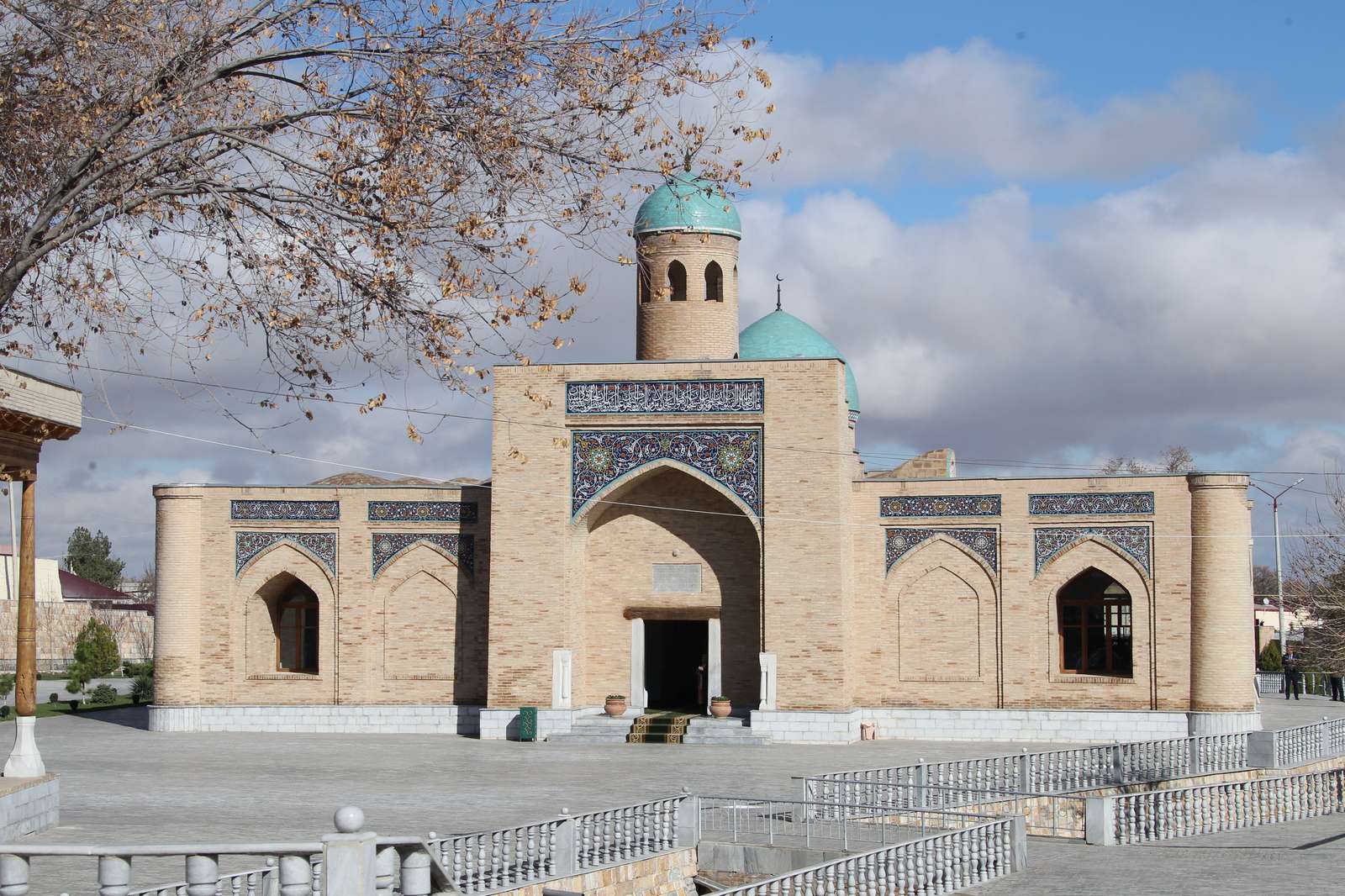
Of that madrasah only one corner building remains: an octagonal mausoleum with a tall cylindrical drum, from the early 15th century, directly opposite the mosque gate. It served as a burial place for women of Timur’s family. In the crypt below stand marble sarcophagi; the tombs were opened and studied in 1941.
Tradition holds that Saray Mulk Khanum herself rests here. The building is small and the visit is short, and crossing the road gives you the best straight-on view of the mosque portal.
How to visit: Siab next door, time and light
- Getting there: about 700 metres from the Registan along the pedestrian street, a 10-minute walk. Shah-i-Zinda is about 800 metres further on.
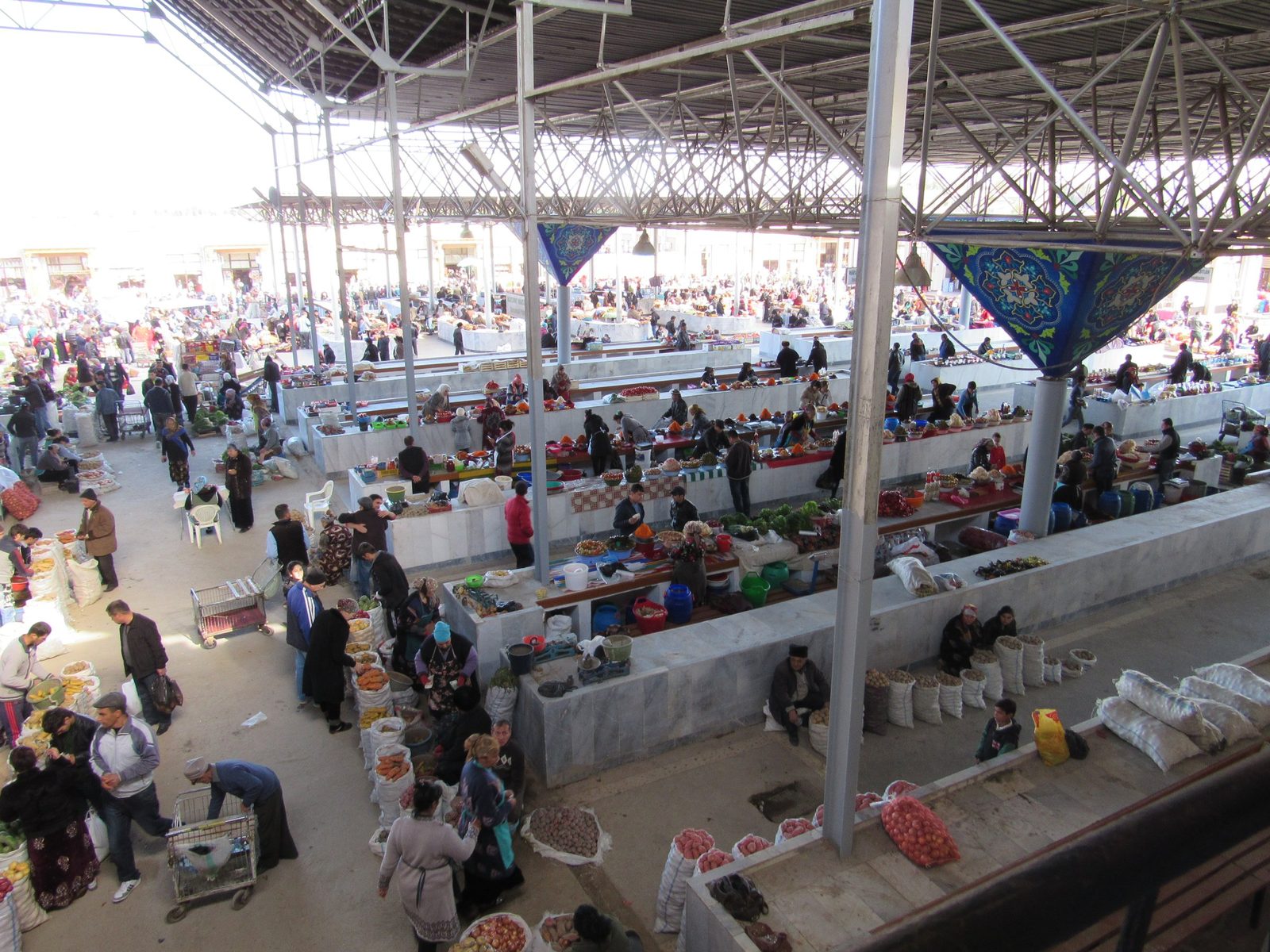
- Siab Bazaar: starts right beside the mosque. Buy ,Did you know? Legend: Samarkand bread can't be baked anywhere else Legend says a Bukhara ruler brought Samarkand's best baker to his court with his oven, flour and water, yet the bread came out different. The missing ingredient, the baker said, was the air of Samarkand. The round loaves keep for a long time. Read more → dried fruit and halva there; our guide to the bazaars of Uzbekistan explains what to look for.
- Time: 45 minutes for the mosque, 15 more for the mausoleum, about 2 hours with the bazaar.
- Light: the portal faces north-east, so come in the morning, when the sun is on the gate and on the courtyard side of the main dome. In the afternoon the portal is in shade.
- Tickets and hours: tickets are sold at the entrance; current hours are in our Samarkand sights, tickets and hours guide.
- Dress: shoulders and knees covered; women should bring a scarf.
Most of our guests see Bibi-Khanym on their first or second day. Our Samarkand in 1, 2 or 3 days shows how it fits between the Registan, Gur-e-Amir and .Did you know? Why Shah-i-Zinda means 'the Living King' The necropolis grew around the shrine of Qutham ibn Abbas, a cousin of the Prophet Muhammad. Legend says he did not die in battle but went down a deep well to a garden of paradise, where he lives on. Read more → For the rest of the city, see our Samarkand city guide and our Samarkand tours.
In short
- Timur began the mosque in 1399, after taking Delhi, and the main structure stood by 1404.
- Its portal is 35 metres high and was rebuilt on Timur’s orders because he found the first one too low.
- Hurried building, centuries of neglect and the 1897 earthquake left it a ruin; most of what you see was rebuilt from 1974 on.
- The marble Quran stand in the courtyard was commissioned by Ulugh Beg; the belief about crawling under it is only a belief.
- Come in the morning, cross the road to the mausoleum, then walk into Siab Bazaar.