
Rishtan ceramics: ishkor glaze, patterns and how to buy
The blue on a Rishtan bowl starts as a heap of ash. Wild herbs are gathered before the first frost and burned, and the cleaned ash is mixed with crushed quartz or white sand. Fired over painted clay, that grey powder turns into ishkor, the glassy glaze that runs from turquoise to deep cobalt and has made a small town in the Fergana Valley the best-known name in Uzbek ceramics.
Our Fergana Valley guide explains how to reach the valley and what else to see there. This article stays in the workshop: the clay, the glaze, the road from the wheel to the kiln, the patterns and the families behind them, how to tell brushwork from print, and how to get a stack of plates home in one piece.
Red earth under the town
Potters did not settle in Rishtan by chance. A layer of fine reddish clay lies under almost the whole town, a metre or so below the surface, and it can be used as it is dug, without refining or mixing in clay from elsewhere. Locals call it khoki surkh, red earth, and one explanation of the town’s name goes back to an old word with the same meaning.
The craft here is old. In the 18th century two brother masters, Abdujalol and Abdujamil, revived chinni, a fine glazed tableware made in answer to Chinese porcelain. By the end of the 19th century about eighty workshops employed some 300 people, many of them in the quarter still called Chinnigaron, after the chinni makers. In 1900 Rishtan pieces went to the World Exhibition in Paris.
Ishkor: a glaze made from ash
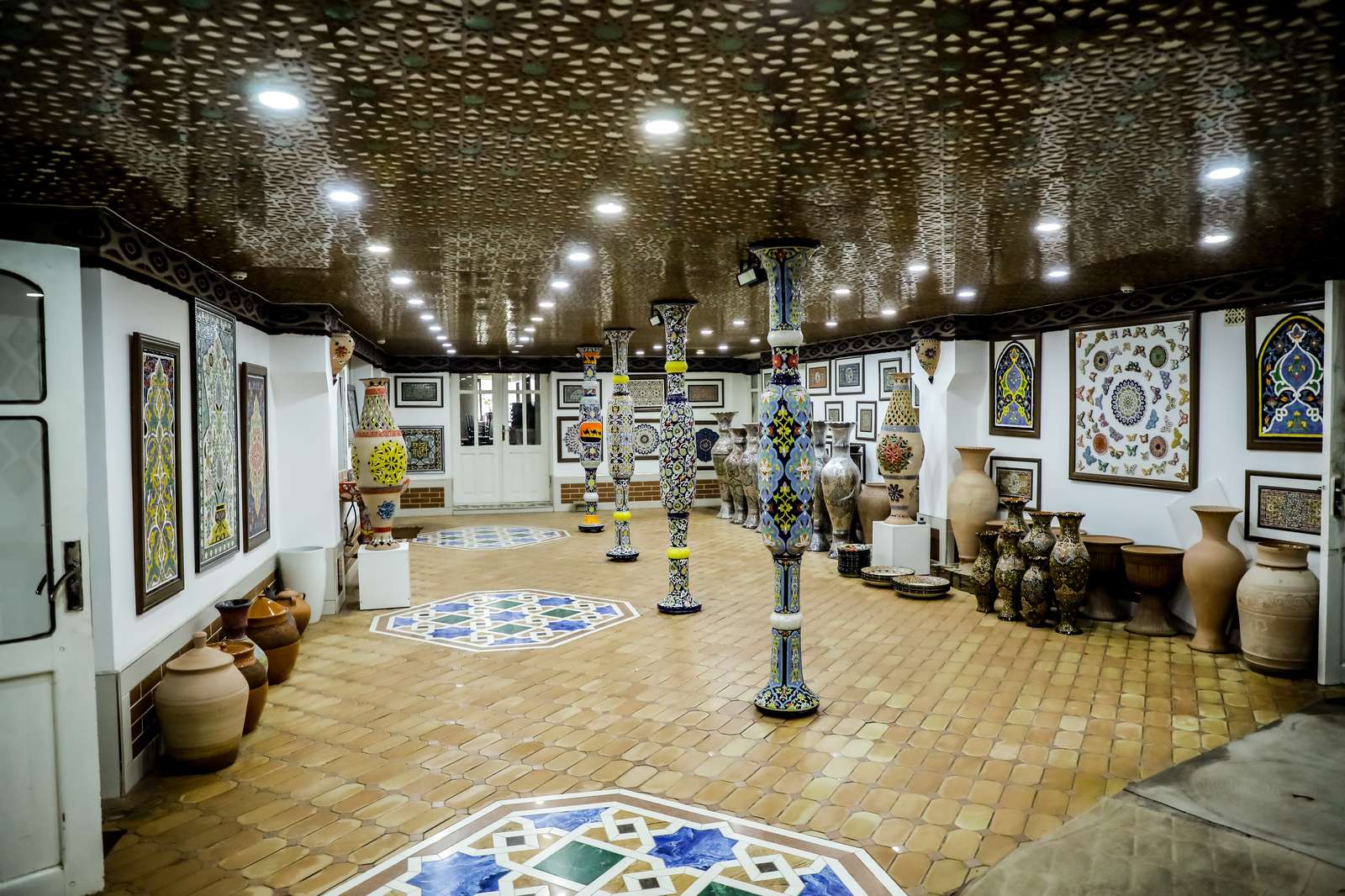
Ishkor is an alkaline glaze. Its power comes from the ash of wild herbs, rich in sodium, potassium and magnesium; mixed with quartz and fired, it melts into glass. Over blue and green pigments it gives Rishtan ware its deep emerald-turquoise, a colour that looks wet even on a dry shelf. Andijan potters rarely used ishkor and worked with lead glaze instead, which is why old Andijan ware looks yellow.
Making it is slow and temperamental. Each family has its own recipe, passed from father to son or from master to apprentice and rarely shown to outsiders. Ishkor production was revived in the 1970s, and today many masters combine it with factory pigments: copper oxide, cobalt and manganese oxide. The classic palette is turquoise, dark blue and brown on a milky-white ground.
From the wheel to the kiln
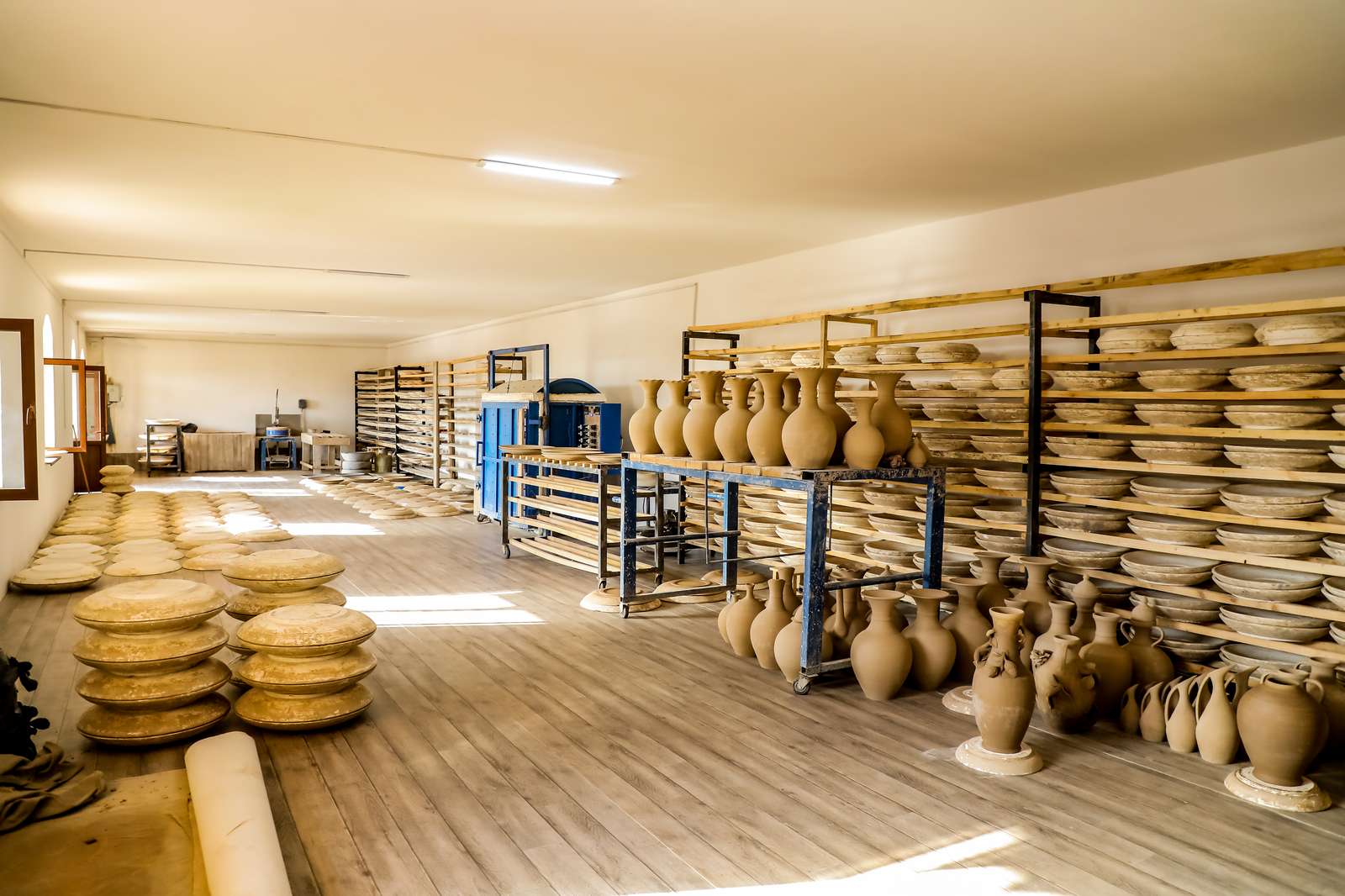
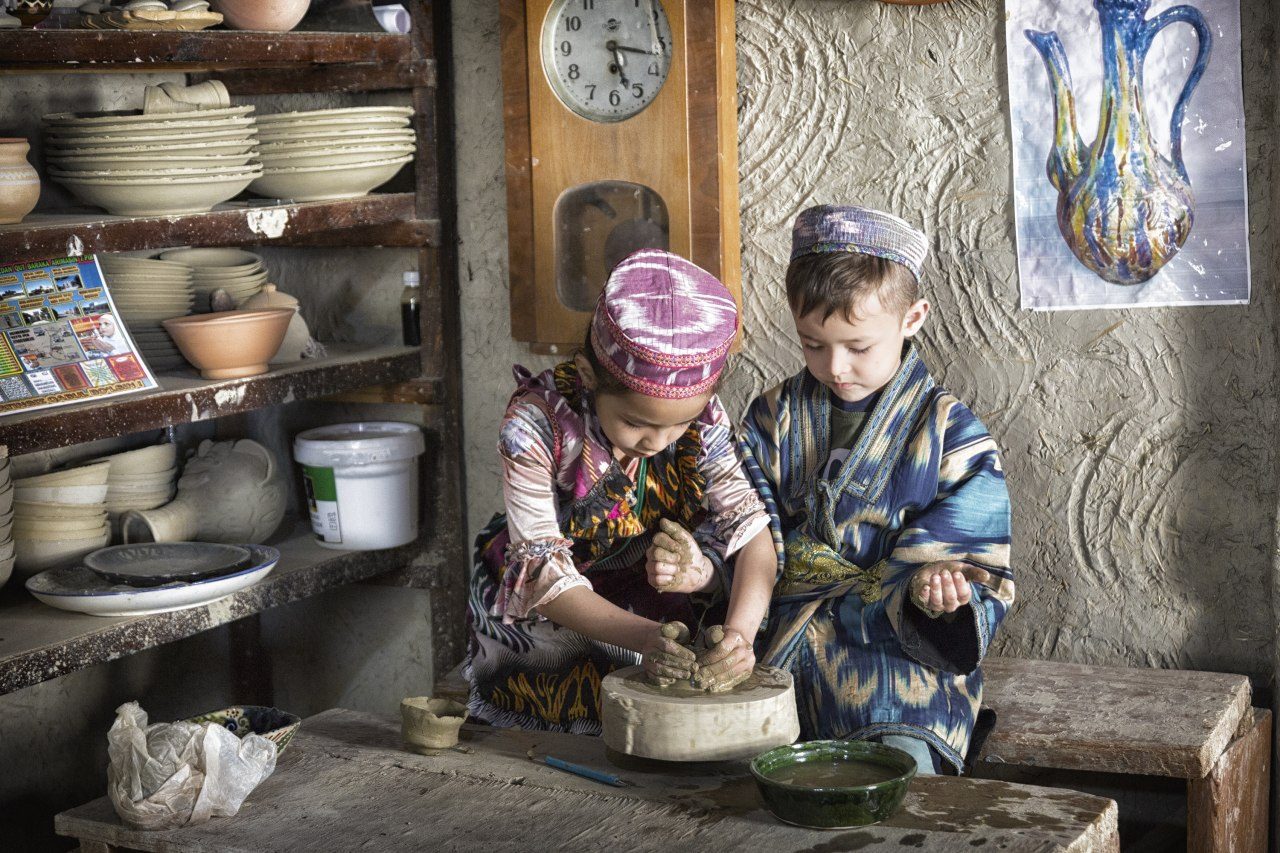
A Rishtan piece passes through several hands: in many workshops one master throws while the family paints. This is the order you see it in:
- The wheel. The clay is cleaned and kneaded, then thrown on a fast wheel: the piala tea bowl, the deep kosa for soup, jugs, and the big lagan platter for .Rice cooked in a kazan with carrots, onions and meat: the dish of every Uzbek celebration. Each region cooks it its own way.
- Drying. The raw pieces stand on racks until they are firm enough to handle.
- The white coat. Each piece gets a thin layer of white clay slip, angob. It hides the red body and gives the brush a smooth, bright surface.
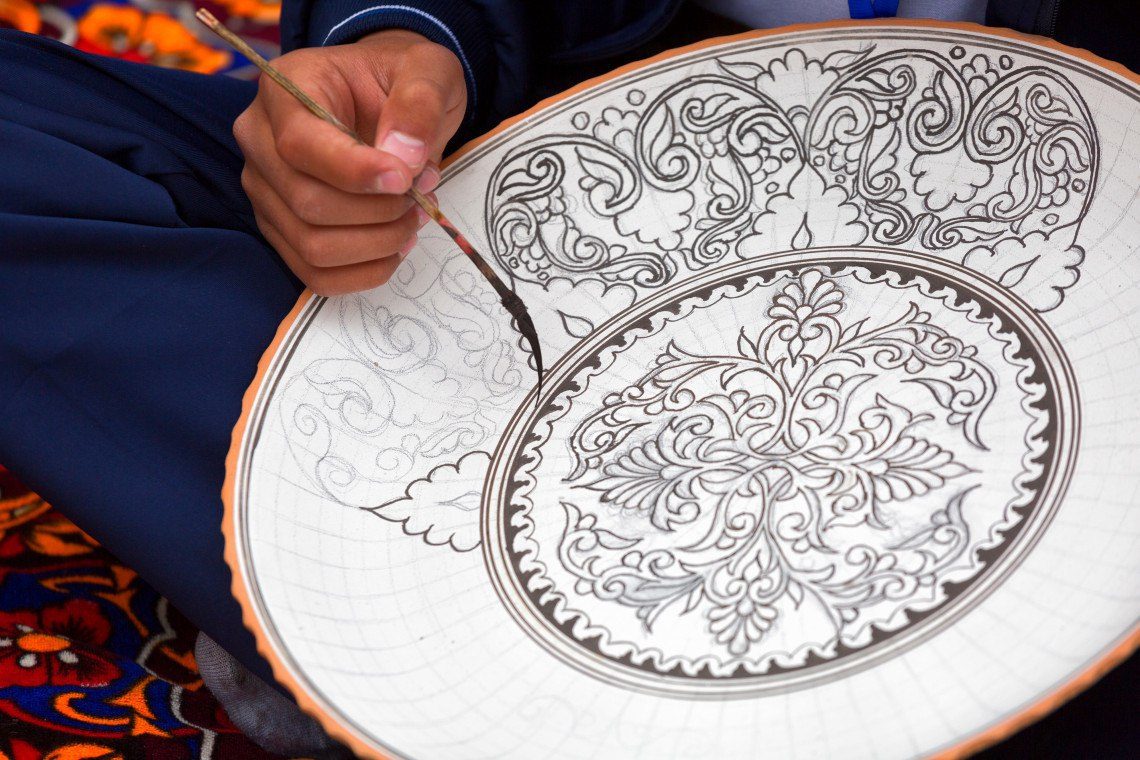
- Painting. The pattern is drawn by hand with underglaze paints made of metal oxides mixed with clay.
- Glaze and fire. The glaze goes over the painting and the piece goes into the kiln. The master has to judge the heat for the clay, the paints and the glaze, which do not always want the same temperature. A small mistake spoils the colour.
If you are in a workshop when the kiln is opened, stay. The pieces come out still warm, and this is the moment the family finds out what the fire has done to the blue.
Pomegranates, almonds and knives: reading the patterns
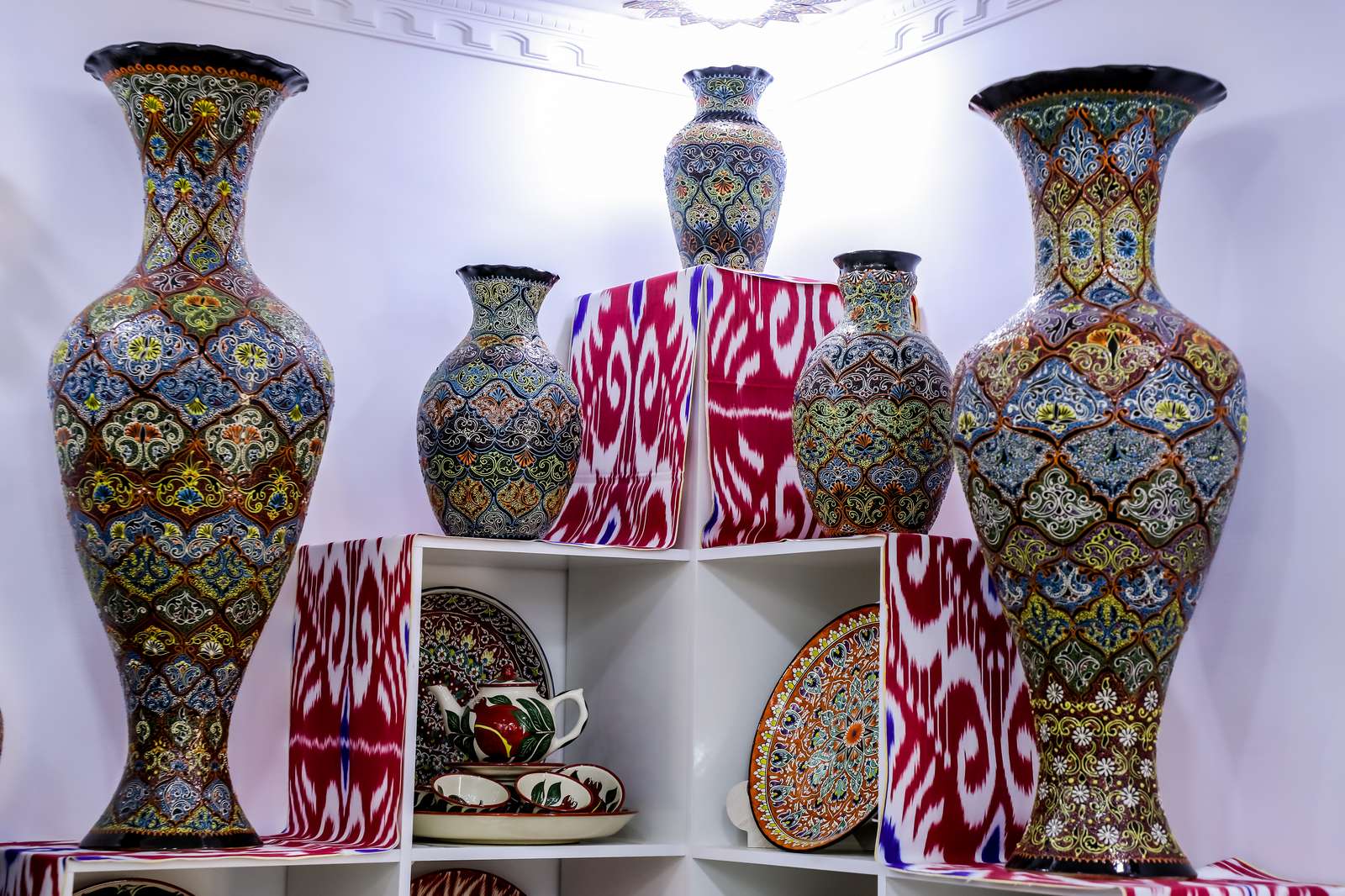
Rishtan painting is mostly plants: stylised petals, almond and pomegranate blossom, cypresses and branches, laid out around a centre or in rings. The Uzbek names make them easy to ask about: anor is the pomegranate, bodom the almond.
Look for objects too. The kumgan, a long-necked jug, is a favourite on plates, and so are knives, pepper pods, birds and fish, and zanjir, a chain running round the rim. Many of these motifs are protective, and a plate given as a present is chosen for what its pattern wishes on the household. The pomegranate, full of seeds, stands for fertility and plenty.
Newer work goes further: Arabic calligraphy, the outlines of minarets and madrasahs, even portraits. The big lagan is still the form that matters most, with a star or a rosette at the centre and borders in rings around it.
The families behind the bowls
About a thousand men in Rishtan work in pottery, and roughly a hundred of them come from families that have done it for generations. Skills still pass the old way, from master, usto, to apprentice, shogird, and techniques stay inside the family.
The town’s history runs through these lines. Around 1860–1870 a Rishtan master, Usto Abdulla, made tiles for the palace of Khudoyar Khan in Kokand, the palace you can visit on the way here. In 1918 seventy potters formed an artel called Chinnigaron, and in Soviet times much of the work moved to the Rishtan ceramics factory, with plans set from above.
Two names are known well beyond the valley. Ibrahim Kamilov, born in 1928 and a People’s Artist of Uzbekistan, belongs to the seventh generation of a potters’ dynasty and learned from his father; his house in Rishtan is a museum. Rustam Usmanov, born in Rishtan in 1954, painted at the ceramics factory and, after it laid him off, opened his own workshop to revive the old techniques. His son Damir works with him and specialises in ishkor, and the family keeps its best pieces in a small museum at home. Since 2020 the town has also had a ceramics centre, founded by the ceramist Alisher Nazirov, with some twenty workshops and a museum of Rishtan’s history under one roof.
Hand-painted or printed? How to tell
Rishtan-style bowls are also made in volume for bazaars, and copies for the tourist trade have multiplied. A few minutes with a piece in your hands usually settles the question.
- Follow a line. A brushstroke flows: it starts dark where the brush is full, thins as the paint runs out and does not break. Transfer prints give themselves away with dotted lines and joins in the pattern that do not quite meet.
- Look at the colour. On a genuine glazed piece the colour sits in the glaze and varies slightly across the surface. On a copy it lies flat and even.
- Compare two. Hand-painted repeats always differ a little. If two plates match line for line, nobody painted them.
- Turn it over. Established workshops now sign their work on the base. A mark alone proves little, but a mark plus a workshop you have stood in is the best guarantee there is.
Buying and getting it home
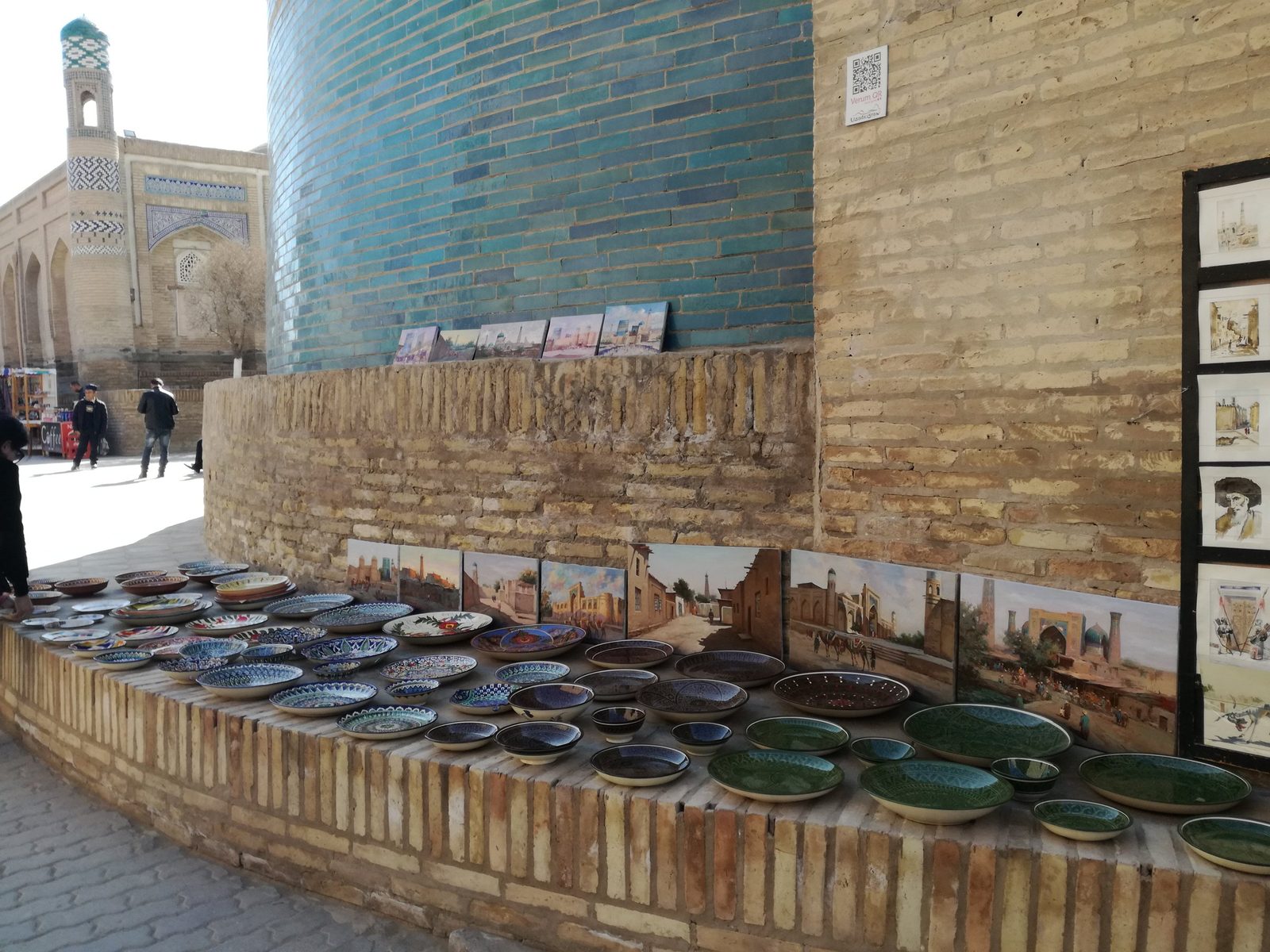
The best place to buy Rishtan ceramics is Rishtan, from the shelves of the people who made them. You pay the workshop directly, you can ask about any piece, and you may see its twin still drying on the rack. Bring cash in som; how to handle money is in cards, cash and tipping.
Modern handmade crafts need no export certificate. The rules apply to pieces fifty years old or more, which generally may not leave the country, and to some newer pieces of artistic value; keep your receipt and read registration and customs in Uzbekistan. Then the packing:
- Ask the workshop to wrap every piece separately and box the set.
- Carry plates and bowls in your hand luggage, standing on edge, with soft things around them. Stacked flat in a checked suitcase, they crack.
- For a large lagan or a tall vase, ask the workshop before you pay how they can pack it for a flight or send it on.
- Ask the master whether a piece is meant for the table or for the wall.
Other crafts worth bringing home, and where to find them, are in what to buy in Uzbekistan; for spices and dried fruit, see the bazaars of Uzbekistan.
Rishtan with Kokand and Margilan
Rishtan sits between two other craft towns. The World Crafts Council named Kokand a World Craft City for woodcarving in 2019 and gave Margilan its title for silk and ikat in 2022. Rishtan got its own in September 2025, when it hosted the second International Pottery Forum and opened the Rishtan Traditional Pottery Museum.
Our usual plan takes two days. Train No. 730 leaves Tashkent at 09:20 and reaches Kokand at 12:28. See the tiled facade of Khudoyar Khan’s palace, then drive about an hour to Rishtan for an afternoon in the workshops, and spend the night in Margilan or Fergana. Next morning, follow silk from the cocoon to the loom at Yodgorlik (our Margilan silk article tells you what to look for) and take No. 729, which leaves Margilan at 16:11 and reaches Tashkent at 19:53.
Want to sit at the wheel or pick up a brush yourself? Tell us in advance and we arrange a session with a master, subject to availability. It is part of our four-day Fergana Valley crafts tour.
- Where: Rishtan is about 45 km from Kokand, 50 km from Margilan and 60 km from Fergana. By car from Tashkent it takes about five hours.
- How long: half a day covers two or three workshops with time to buy; a session at the wheel adds an hour or two.
- When: April–May and September–October. July afternoons in the valley average 35 °C, and the workshops are hot.
- Visiting: these are family workshops, not museums with opening hours, so we agree each visit with the master in advance. Come with a guide who can translate: the questions are half the pleasure.
In short
- Rishtan stands on its own red clay, good enough to use straight from the ground.
- Ishkor, the alkaline glaze made from plant ash, gives Rishtan its turquoise and cobalt; every family guards its recipe.
- Look for anor, the pomegranate, and bodom, the almond, along with jugs, knives, pepper pods and fish.
- Hand painting shows in flowing, unbroken lines and colour that varies in the glaze; identical plates are printed.
- Buy in the workshops, carry plates on edge in your hand luggage, and pair Rishtan with Kokand and Margilan over two days.