
Ak-Saray: the ruined gate of Timur’s White Palace in Shahrisabz
Places in this article: Samarkand
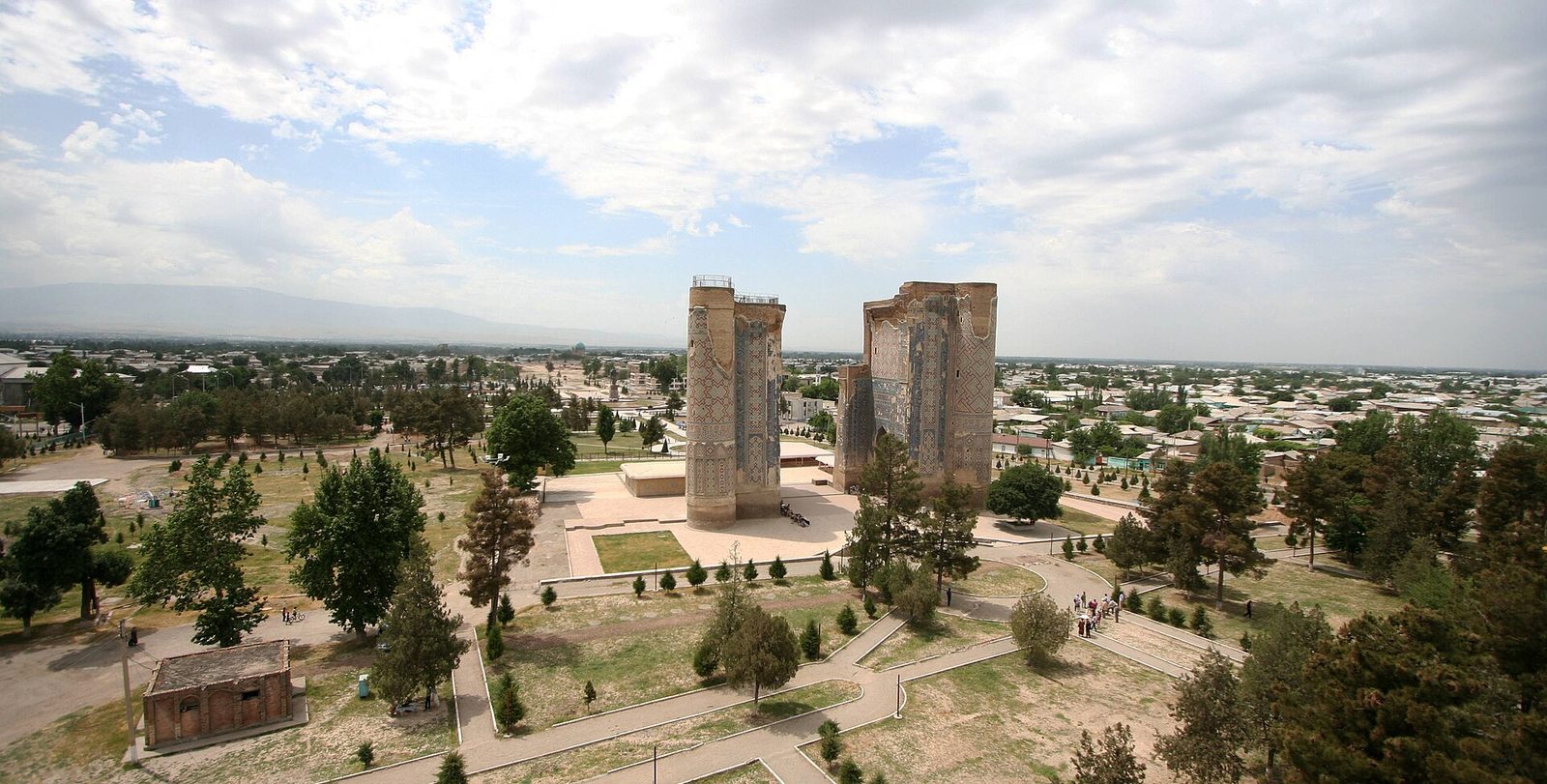
Stand between the two towers of The ruins of Amir Timur's palace in Shahrisabz, his home town. Only parts of the giant entrance arch still stand. Read more → and look up. The gap above your head is 22 metres wide. A single brick vault once closed it, and in 1404 an ambassador of the King of Castile was shown in under it while the builders were still at work. Today there is sky where the vault was. The towers that held it, broken off at the top, still rise about 38 metres: the height of a twelve-storey block.
We bring guests to Shahrisabz from Samarkand all year, and we always start here. This is what you are looking at, what an eyewitness saw six centuries ago, and how to see it well.
What Ak-Saray was
Amir Timur (Tamerlane, 1336–1405), founder of the Timurid empire, which had its capital in Samarkand. Born near Shahrisabz. was born in this town, then called Kesh, and in 1380 he began a palace here. Its name means the White Palace. The work took about 24 years: a plate on the gate gives 1404 as the year it was finished, and Timur died the following winter.
What survives is only the front door. Behind it lay a main courtyard of roughly 120 by 240 metres, with a pool in the middle and arcades around it. The gate was the tallest part of the whole complex: estimates of its original height run to 65–70 metres. Its arch, at 22.5 metres, had the widest span in Central Asia.
The builders were craftsmen brought from Khwarezm, which Timur had just conquered. One inscription in the tilework gives the year 798 of the Hijra, 1395–96, and the name of a master: Muhammad Yusuf Tabrizi. His name points to Tabriz, a long way west. Ak-Saray was a job for the best hands an empire could gather.
What the Castilian ambassador saw in 1404
Ruy González de Clavijo was on his way to Timur’s court in Samarkand when he stopped in Kesh. He was told that the palace had been under construction for twenty years, and the craftsmen were still working on it.
His account reads like a walk-through. First a very high portal, then a long entrance passage with brick arches on both sides, faced with blue tiles. Then a gateway worked from top to bottom in gold and blue. Beyond it, a vast courtyard paved with white flagstones and closed on all four sides by richly decorated arcades; he guessed it at some three hundred paces across. Further in, reception halls whose walls were panelled with gold and blue tiles.
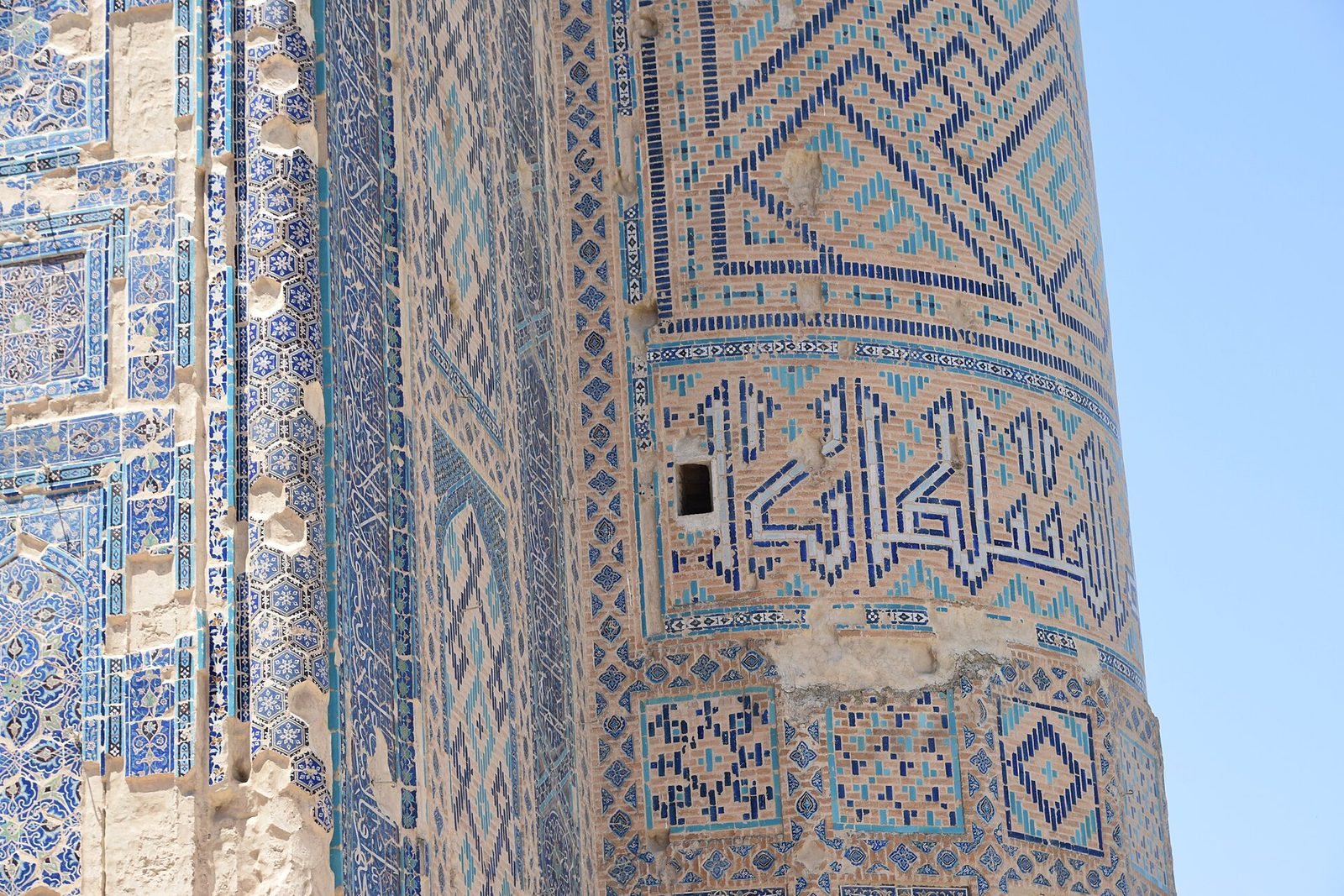
The gold has gone. The blue is still there. Look up at the faces of the pylons and you will find it: geometric panels of dark and light blue glazed brick, set against the ochre of plain brick, and whole words built out of bricks laid in a grid. Most of the inscriptions are from the Quran; a few are secular, including a scroll asking God to prolong the days of the Sultan.
“If you doubt our power, look at our buildings”
Our guides quote this line at the gate. It is the saying attributed to Ak-Saray, usually given in English as “If you challenge our power, look at our buildings!” Whoever first put it into words, the towers make the argument on their own. The gate was built to be seen from far off, and even as a ruin it still is.
It was also built to face a particular way. The main portal looked north, towards Samarkand, the capital: the road Clavijo arrived by and the road you will most likely take yourself.
How the White Palace became a ruin
Ak-Saray did not simply fall apart. Tradition puts the destruction on Abdullah Khan II, the 16th-century ruler of Bukhara, whose forces wrecked Shahrisabz and the palace with it. By the second half of the 18th century only the pylons and part of the arch of the main portal were still standing. That is, give or take, what you see now.
The towers were conserved in 1994–1998. In 1996, for the 660th anniversary of Timur’s birth, a statue of him was put up opposite the ruins: a standing figure on a high pedestal, with the two pylons as his backdrop.
How to see Ak-Saray well
Light. Because the gate faces north, around midday the sun stands behind the towers when you look at them from the approach side, and you end up shooting into the light. Mornings and late afternoons are easier. For the mosaic, open shade is your friend: the glaze keeps its colour without glare.
Lens. From the foot of the pylons, 38 metres of brick fills a frame fast. A wide angle helps; so does stepping back along the main axis to get both towers and the statue in one shot.
Time. Allow 45 minutes to an hour for Ak-Saray itself: the towers from both sides, the mosaic close up, the statue. Then walk south through the park to the rest of the old town.
The rest of Shahrisabz on one walk
The whole historic centre of Shahrisabz has been on the UNESCO World Heritage List since 2000, and the main monuments line up along the park within walking distance of each other.
- Chorsu. On the way from Ak-Saray to Kok Gumbaz you pass the old crossroads with its 18th-century covered bazaar under a high central dome. The bathhouse next to it is still heated through channels under the floor.
- Dorut Tilavat. The ensemble around Kok Gumbaz, the “Blue Dome”, the Friday mosque that Did you know? Ulugh Beg measured the year to within 25 seconds Working at his Samarkand observatory, Ulugh Beg put the tropical year at 365 days 5 h 49 min 15 s, about 25 seconds too long, closer than Copernicus a century later. Read more → built in 1437 in honour of his father Shah Rukh. Timur’s own father, Emir Taragay, was first buried in this ensemble.
- Dorus Saodat. A memorial complex intended for the whole Timurid dynasty, begun after Jahangir, Timur’s eldest son, died at twenty. Abdullah Khan’s forces destroyed most of it too; Jahangir’s mausoleum is what survived.
- Timur’s crypt. An underground chamber found by archaeologists in 1943, almost filled by one stone casket that was prepared for Timur. He never used it: he lies in the Gur-e Amir in Samarkand.
On foot, Ak-Saray and these four stops fit comfortably into three or four hours with lunch in between, which is why one day from Samarkand is enough. For timings, transport and a full plan of the day, see our Shahrisabz day trip from Samarkand, and the Shahrisabz destination page.
Getting there from Samarkand
About 90 km separate the Did you know? The Registan's sun-carrying lion went on a banknote The Sher-Dor Madrasah (1619–1636) is named for the big cats with the sun on their backs on its portal. The image appeared on the reverse of Uzbekistan's 200-som note of 1997. Read more → from Ak-Saray. The road climbs over the Takhtakaracha pass at around 1,700 metres, and without stops the drive takes an hour and a half to two hours. In winter, heavy snow can close the pass for a while, and the detour around the mountains takes about three hours. From December to March, check the pass the day before you go.
Most people come for a day: leave Samarkand in the morning, be back by evening. If you are planning a longer stay, our guide to Samarkand in 1, 2 and 3 days shows where Shahrisabz fits. To have the day organised, with a car and a local guide, look at the one-day Shakhrisabz extension or all tours that include Shakhrisabz.
In short
- Ak-Saray, Timur’s White Palace, was built from 1380 to about 1404; only the two pylons of its gate survive, still about 38 m high.
- The arch between them spanned 22.5 m, the widest in Central Asia, and the gate may once have reached 65–70 m.
- Clavijo saw it unfinished in 1404 and described blue and gold tilework; the blue is still on the towers.
- The gate faces north: come in the morning or late afternoon, and give it an hour before walking on to Kok Gumbaz and Dorus Saodat.
- Samarkand is about 90 km and 1.5–2 hours away over the Takhtakaracha pass; in winter, check the pass the day before.
Photos
- Glazed brick mosaic on a pylon of the Ak-Saray portal, Shahrisabz — Jean Housen / Wikimedia Commons · CC BY-SA 4.0
- Ak-Saray portal pylons seen from above, Shahrisabz — Erik Albers / Wikimedia Commons · CC BY-SA 4.0