
Places in this article: Samarkand
The Registan in Samarkand: history, legends and how to see it
Stand in the middle of the Did you know? The Registan's sun-carrying lion went on a banknote The Sher-Dor Madrasah (1619–1636) is named for the big cats with the sun on their backs on its portal. The image appeared on the reverse of Uzbekistan's 200-som note of 1997. Read more → and turn slowly. On your left is the An Islamic college: student cells and classrooms around a courtyard behind a grand portal. In the old towns many now house museums and craft workshops. where ,Did you know? Ulugh Beg measured the year to within 25 seconds Working at his Samarkand observatory, Ulugh Beg put the tropical year at 365 days 5 h 49 min 15 s, about 25 seconds too long, closer than Copernicus a century later. Read more → a ruler who preferred stars to conquest, taught astronomy six hundred years ago. On your right is its mirror image, built two centuries later by a governor who wanted to match it, with tigers and human-faced suns over the gate. Ahead, behind a calm two-storey front, is a mosque whose dome glows with gold leaf.
We bring guests here every week, at opening time and after dark, and it never looks the same twice. Here is the square as our guides tell it: history, legends (marked as such), the details most visitors miss and how to plan your visit.
Why the Registan is called the “sandy place”
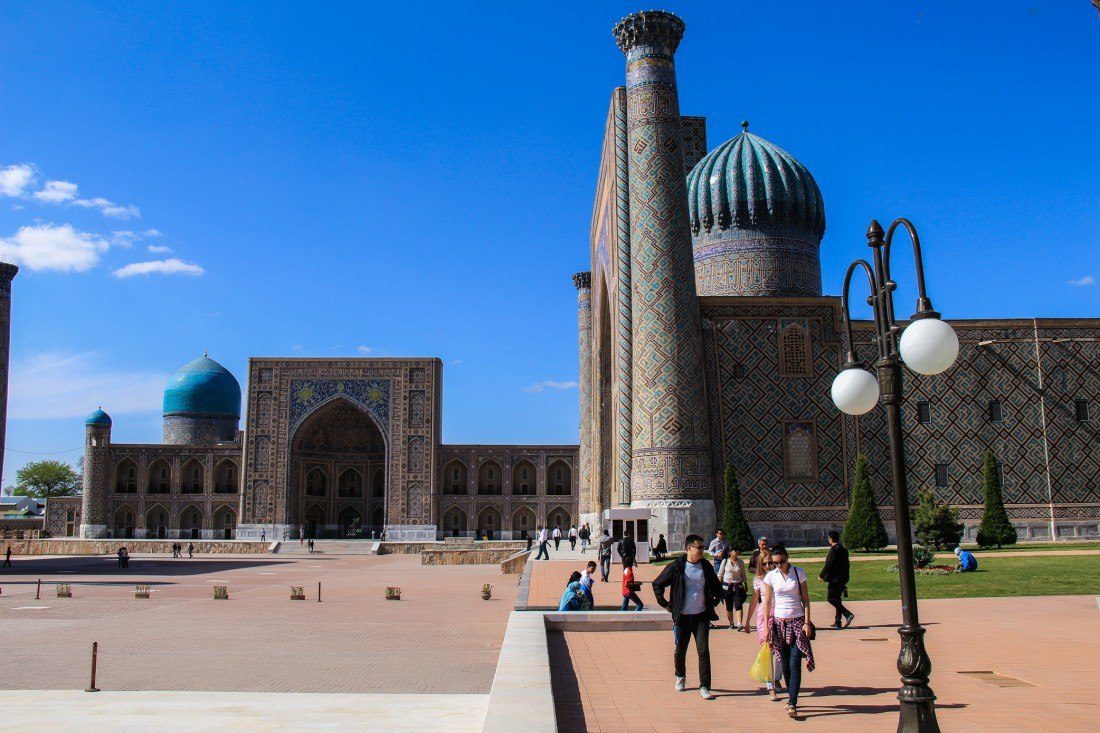
Registan is Persian for “place of sand”, and in the cities of Central Asia it was the usual name for the main square. Samarkand’s was a market and a meeting place long before it was a monument. Royal decrees were announced here to blasts on copper pipes, and crowds gathered for celebrations and for public executions.
The square took its shape under the Timurids. Ulugh Beg, Amir Timur (Tamerlane, 1336–1405), founder of the Timurid empire, which had its capital in Samarkand. Born near Shahrisabz.’s grandson and ruler of Samarkand from 1409, built his madrasah on the west side in 1417–1420. In 1424 a khanaka, a Sufi lodge, rose opposite, and a caravanserai closed the north side. That layout lasted about two hundred years.
Ulugh Beg’s madrasah: a university of the stars
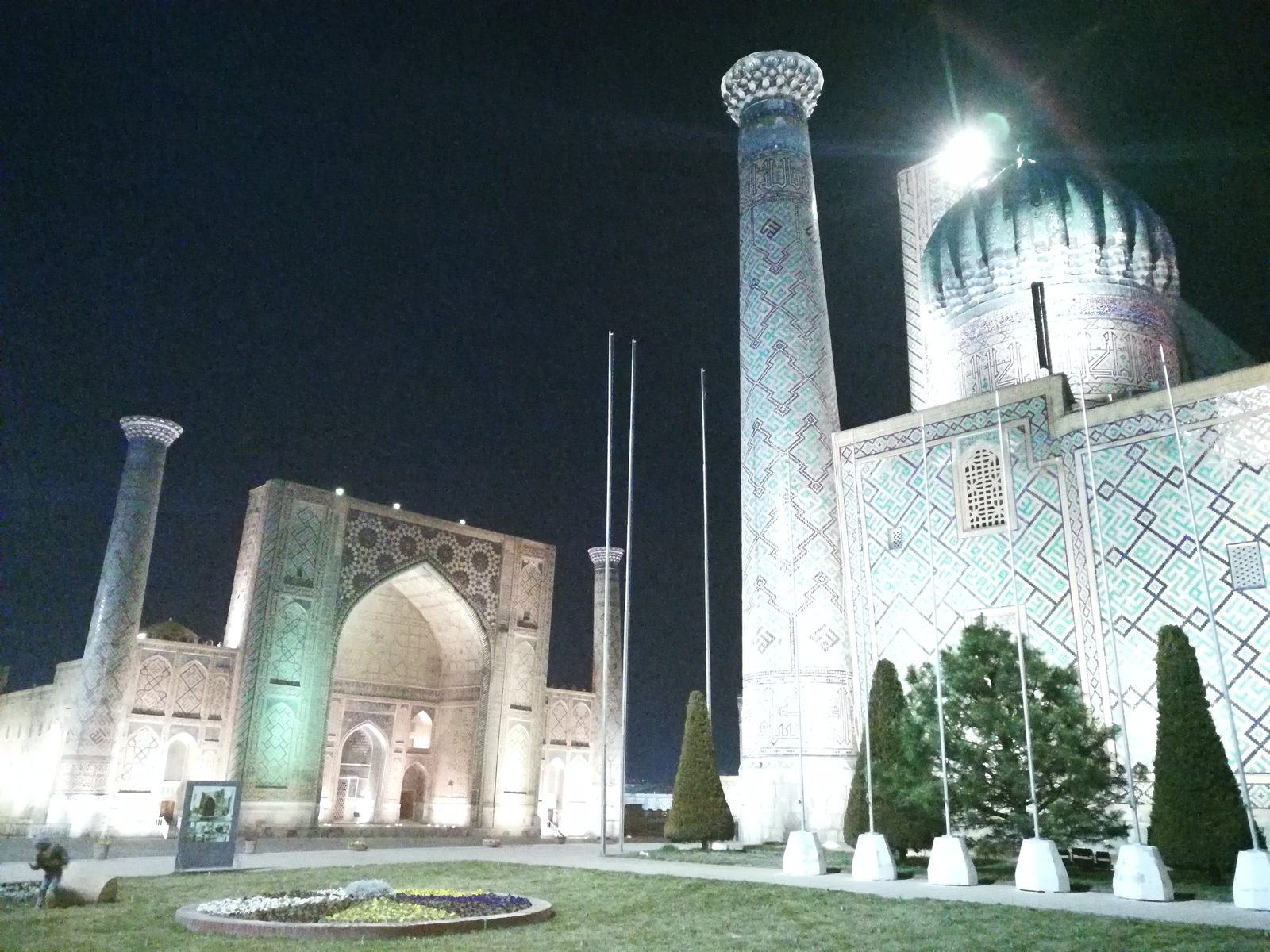
Ulugh Beg was 23 when work began on his madrasah: 81 by 56 metres, with two floors of student cells around a courtyard and four minarets.
It was no ordinary religious school. Astronomy was the most important subject, taught alongside mathematics, geometry, logic, the natural sciences and theology. Ulugh Beg chose the teachers himself and interviewed every one. Among them were the astronomer Qadi Zada al-Rumi and the mathematician Jamshid al-Kashi, and the ruler lectured here in person.
Four years later Ulugh Beg built his observatory on a hill outside town. His star catalogue lists 1,018 stars: the second such catalogue in seventeen centuries, after that of Hipparchus. In the courtyard, look above the doors of the cells. One mosaic inscription quotes the Prophet’s saying that the search for knowledge is the greatest of deeds.
Legend: the stranger who gave the first lecture
This is a legend, not a record. When the madrasah was nearly finished, Ulugh Beg was asked who would be its first teacher. The person who knows most in every science, he said. A plain-looking man stepped out of the crowd and offered himself. Ulugh Beg let him give the opening lecture. Ninety scholars came to listen. By the end, only two could follow him: Qadi Zada and Ulugh Beg himself.
History does record that the first head teacher was Maulana Muhammad Khavafi, a wandering dervish of humble birth, famous for his learning.
Sher-Dor: the madrasah with tigers on its gate
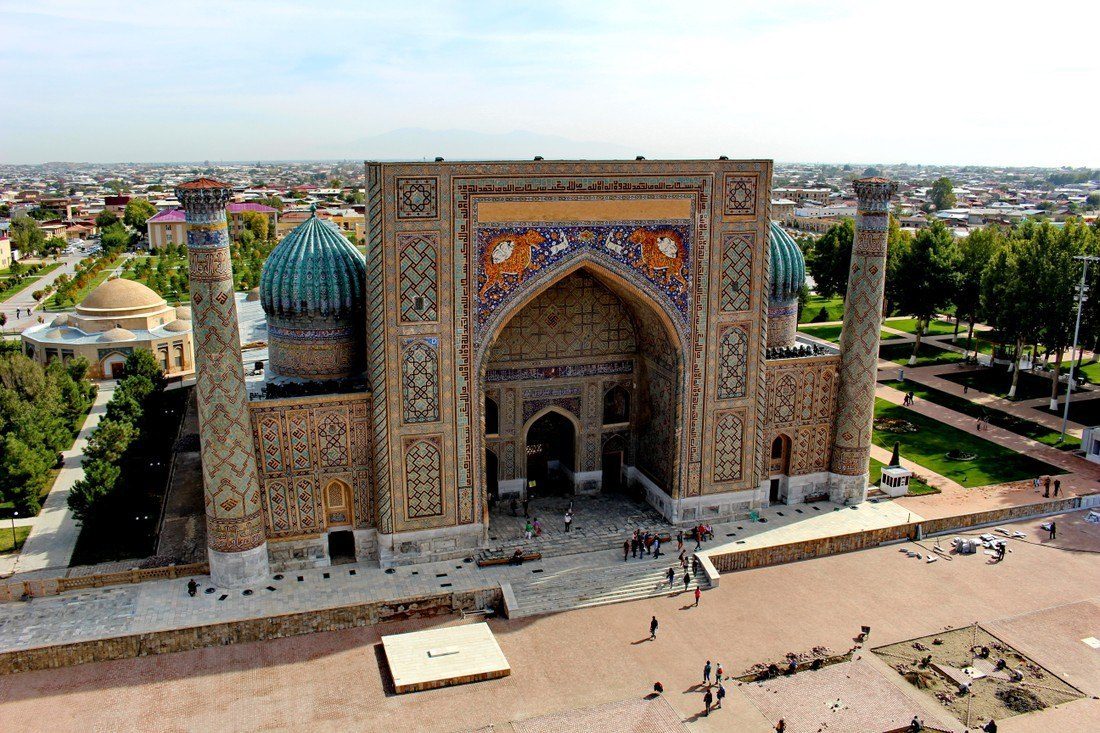
In 1619 Yalangtush Bahadur, governor of Samarkand under the khans of Bukhara, had Ulugh Beg’s khanaka taken down and reused its materials for a new madrasah on the same spot. Sher-Dor, finished in 1636, faces Ulugh Beg’s madrasah like a reflection. The architect was Abdul Jabbar; the decoration was by Muhammad Abbas.
It is a mirror with a twist. In two hundred years the ground of the square had risen by about two metres, so the copy came out squatter than the original. Its portal stands 31.5 metres high, its minarets 31 metres.
The tigers, the deer and the sun
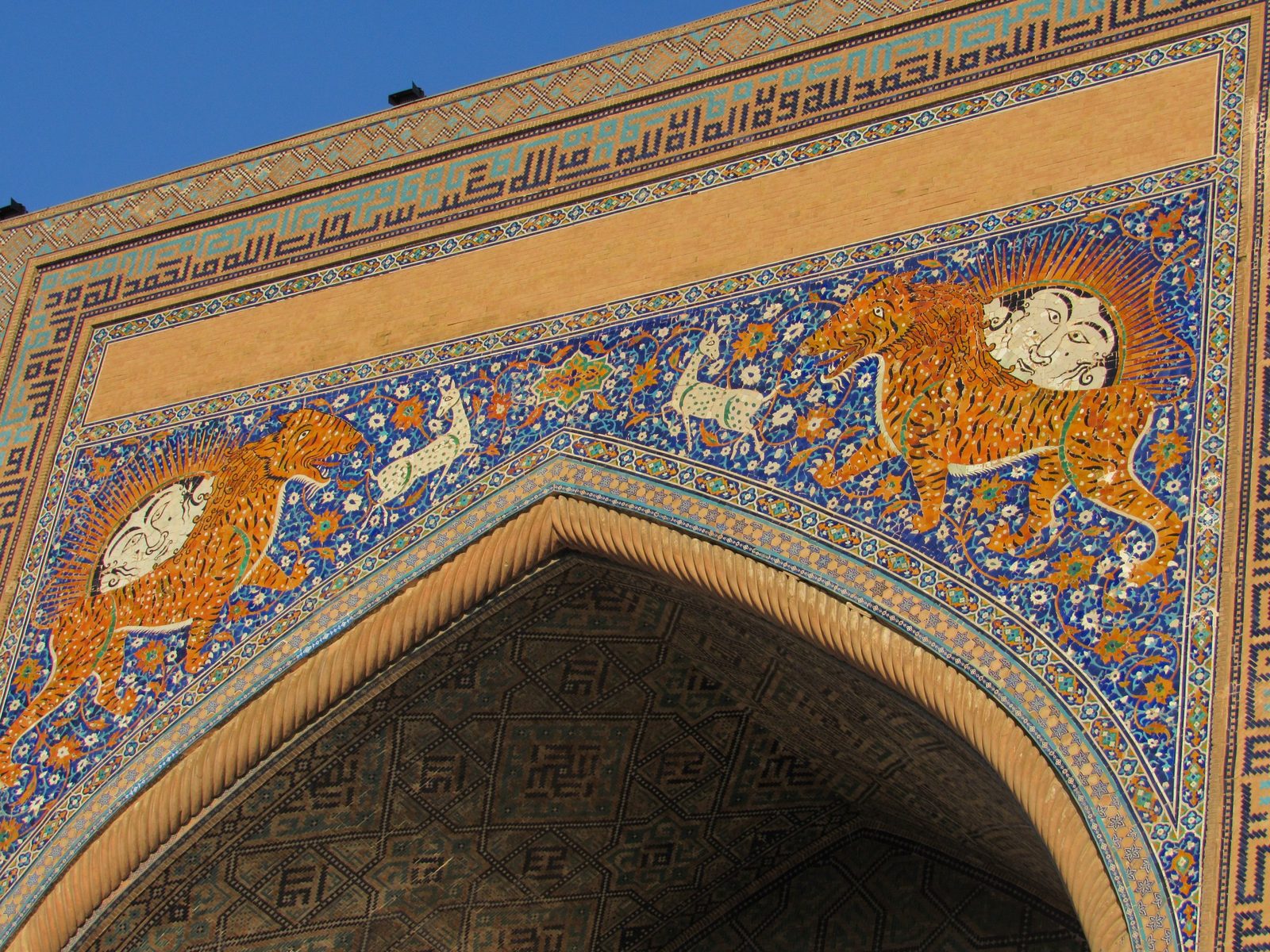
Look up at the arch. On each side a striped big cat with a lion’s mane chases a white deer, and from its back rises a sun with a human face. Sher-Dor means “having lions” or “having tigers”, and people still argue about which.
Images of living creatures are rare in Islamic religious architecture, which is why this gate stops people in their tracks. The motif is older than the building: the lion with the sun goes back to 12th-century Seljuk coins. Today it is one of the best-known images of Uzbekistan. It was on the back of the 200-som note of 1997, and the green 5,000-som note issued in 2021 shows the Sher-Dor madrasah itself. Check your wallet before you reach the square.
Legend: the leopard who approved the city
Another legend: when Samarkand was built, a leopard came down from the mountains, walked around the new walls as if inspecting them and went back to the hills. The people took it as a blessing and put the leopard on their banners. The city’s most famous big cats are the ones over the Sher-Dor arch, so we tell the story standing under them.
Tilla-Kari: the gilded mosque
The third madrasah went up in 1646–1660 on the site of the old caravanserai, partly on its foundations. Yalangtush Bahadur commissioned it too but did not live to see it finished. With The great mosque Amir Timur ordered after his Indian campaign of 1398–1399, one of the largest of its time. Read more → in ruins, Tilla-Kari was built as a madrasah and the city’s Friday mosque in one, and it served as the main mosque until the 1920s.
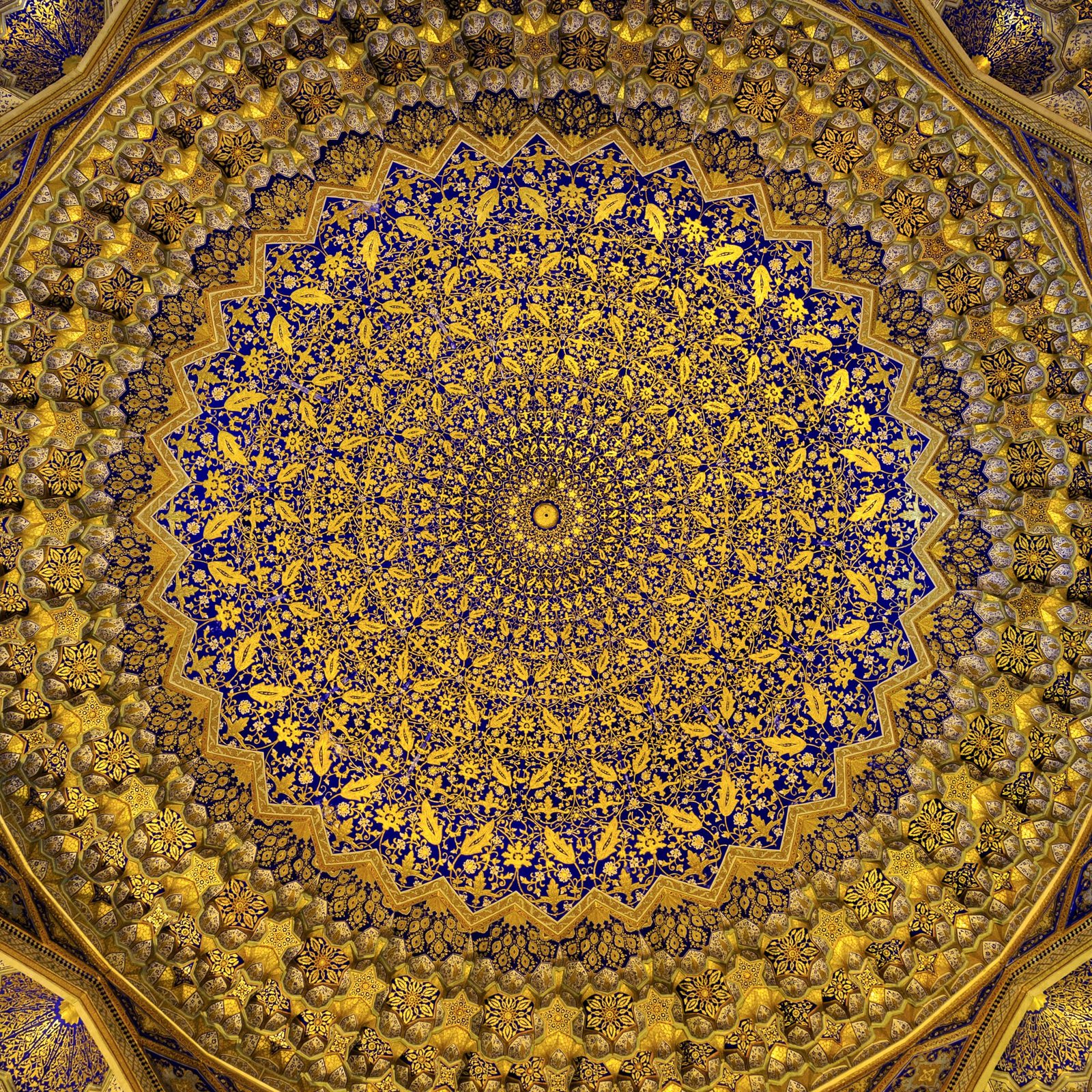
Its name means “gilded”, and you see why the moment you step into the prayer hall on the west side of the courtyard. Walls and dome are covered in kundal, painting in low relief finished with gold leaf, on a deep blue ground.
Much of it is the work of restorers. The earthquake of 1817–1818 brought down the top of the portal. The turquoise outer dome above the mosque was built only in the 1970s, and the painted and gilded interior was completed in 1979. The building also holds an exhibition on the restoration of the Registan.
Earthquakes and the minarets that were straightened
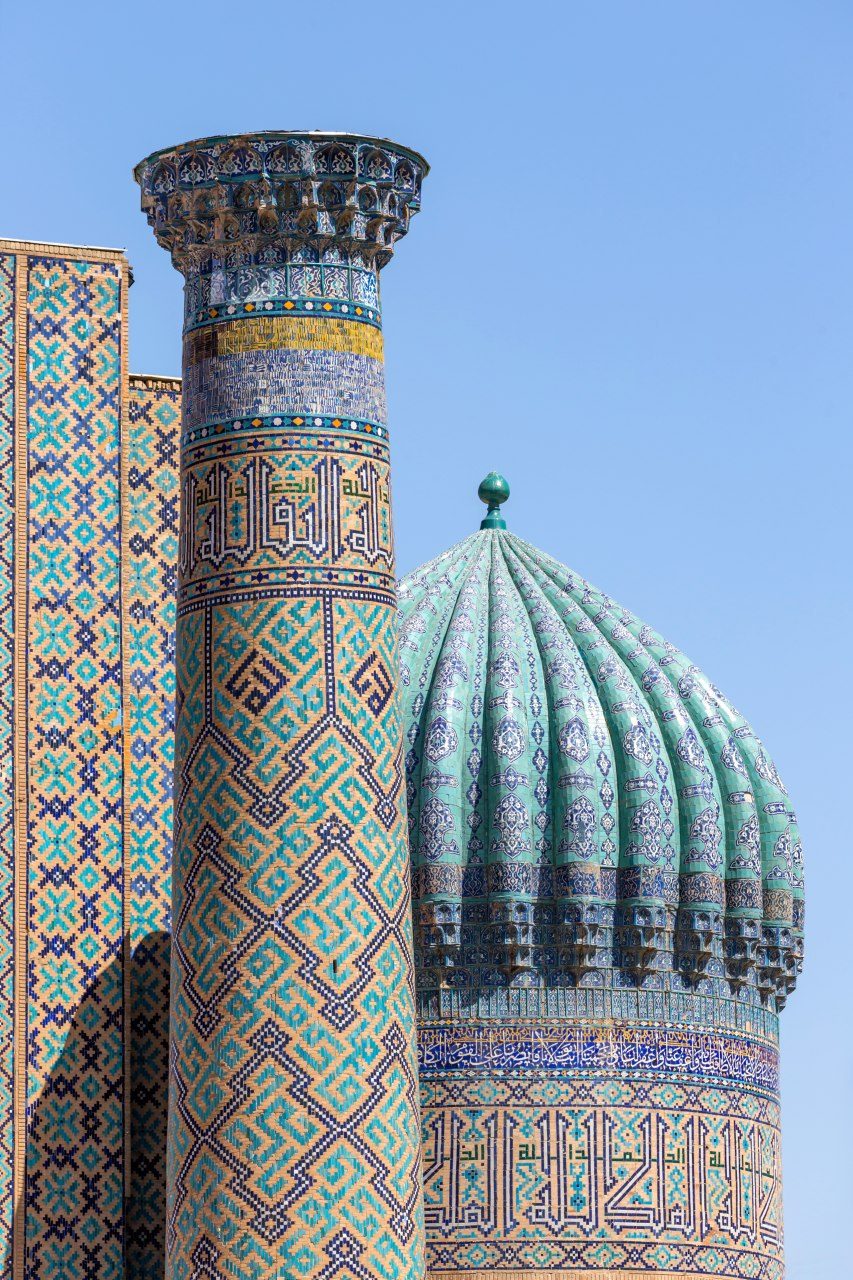
Samarkand lies in an earthquake zone, and the 19th century was hard on the square. One of the western minarets of Ulugh Beg’s madrasah fell in 1870. Photographs published in 1901 show its north and south wings as heaps of rubble.
In the autumn of 1918 the north-east minaret of Ulugh Beg’s madrasah was found to be leaning. Preparations to save it took a decade. In 1932 Vladimir Shukhov, the Moscow engineer famous for his openwork steel towers, straightened it; it was his last engineering work. The south-east minaret followed in 1965, under the engineer E. M. Gendel.
Restoration went on for more than seventy years. In the 1950s and 1960s the ground at Ulugh Beg’s madrasah was lowered by two metres. In the 1990s its lost upper floor of cells was rebuilt. In 2001 the Registan joined the UNESCO World Heritage List as part of “Samarkand – Crossroad of Cultures”.
Evenings on the Registan: light and music
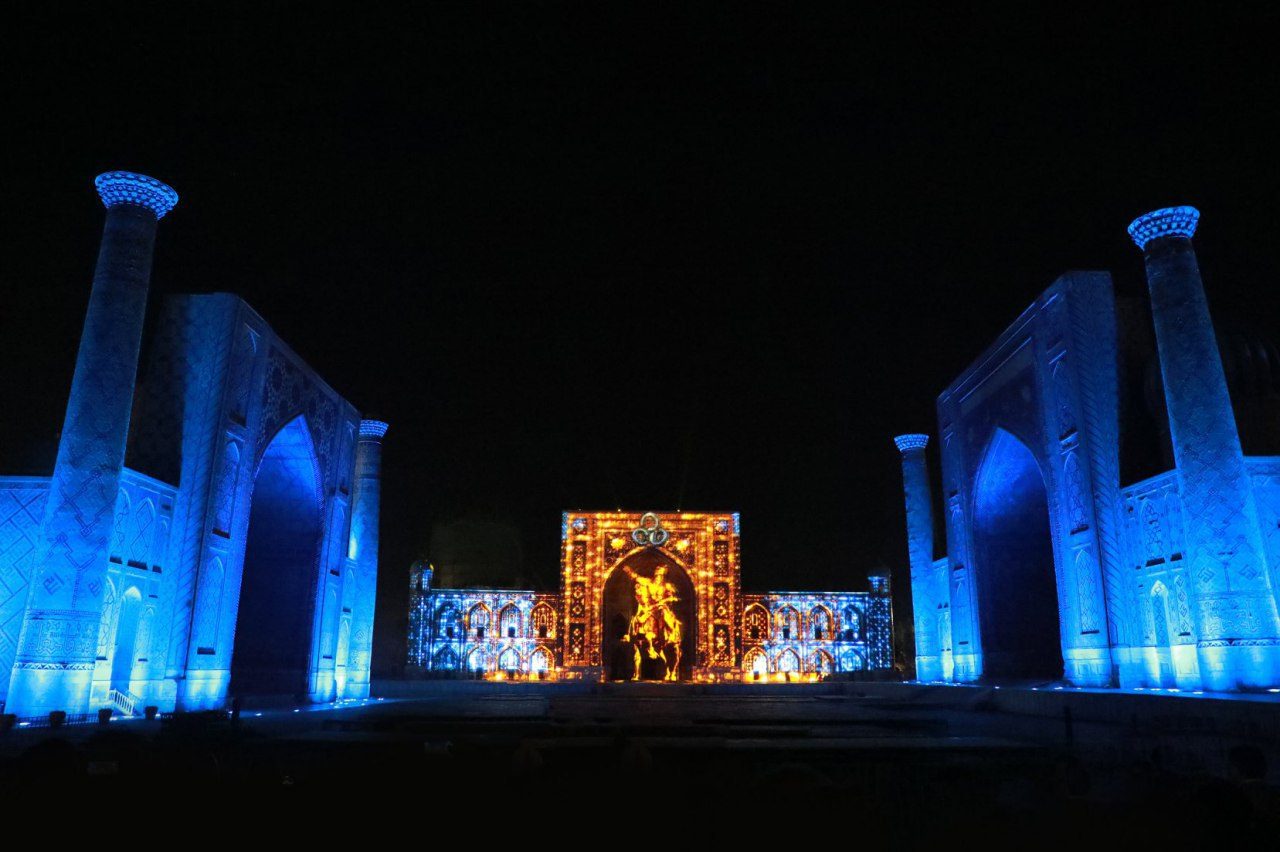
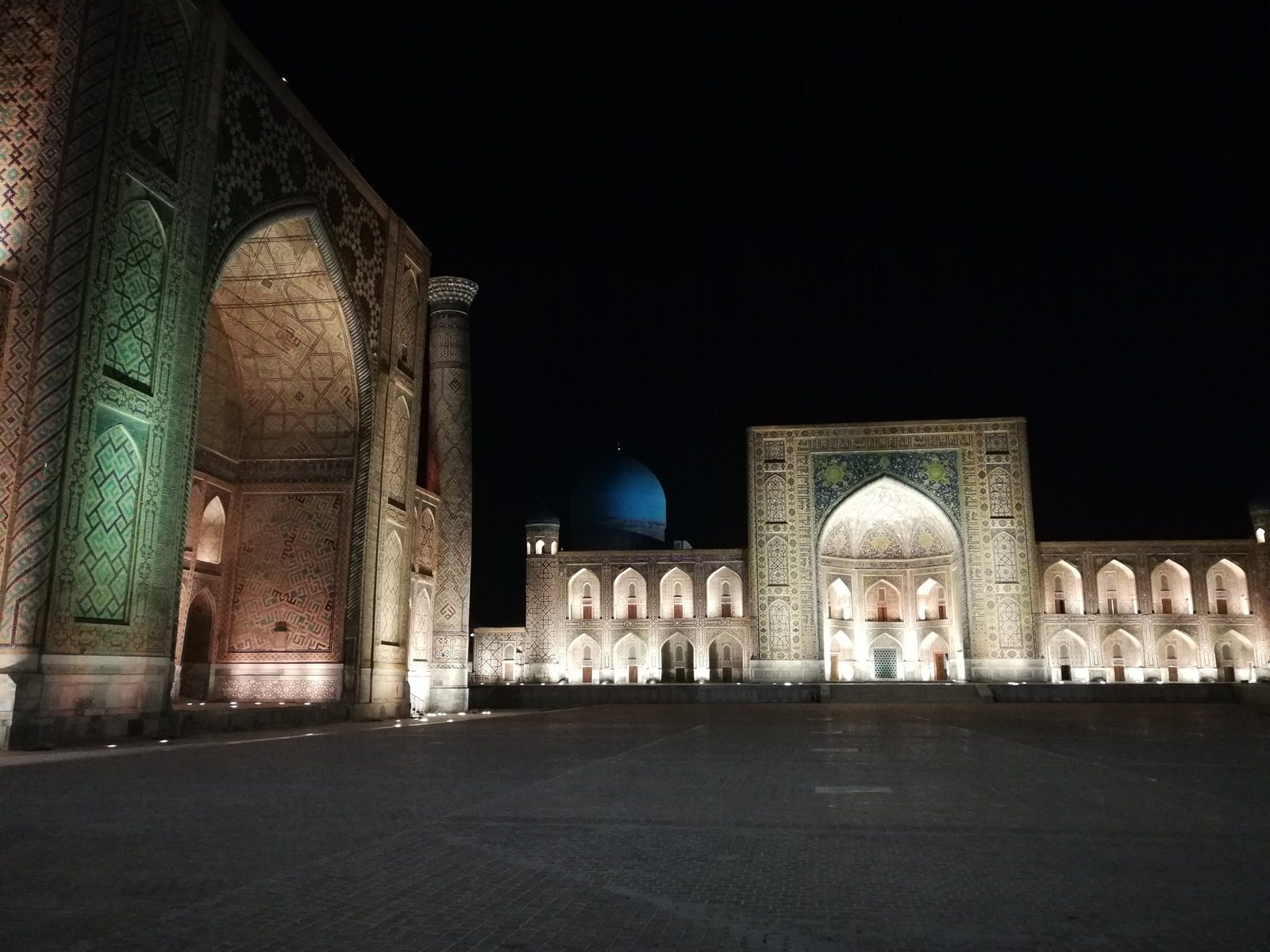
After dark all three facades are floodlit, and on some evenings a sound-and-light show throws 3D projections across the madrasahs. It pauses at times for maintenance, so we check the schedule for our guests on the day.
The square is a stage too. From 1997 the Sharq Taronalari international music festival was held here every two years, in the open air between the madrasahs; the 2024 edition moved to the Eternal City complex on the edge of town. On 6 September 2026 the pianist Lang Lang played on the Registan with the National Symphony Orchestra of Uzbekistan. What is next: our festival calendar.
Did you know?
- The archaeologist Vasily Vyatkin, who found Ulugh Beg’s observatory in 1908, was buried on the Registan in 1932. Two years later he was reburied at the observatory.
- Behind Sher-Dor stands Chorsu, an 18th-century trading dome. In 2005 restorers dug away three metres of soil to reveal its full height; it is now an art gallery.
- Next to Tilla-Kari lie the tombstones of the Shaybanid rulers; the latest is dated 1586.
- In 1989 the Soviet Union issued a 5-rouble coin with the Registan on it.
The Registan in dates
| Year | What happened |
|---|---|
| 1417–1420 | Ulugh Beg builds his madrasah |
| 1424 | A khanaka goes up opposite it |
| 1619–1636 | Sher-Dor replaces the khanaka |
| 1646–1660 | Tilla-Kari, madrasah and Friday mosque |
| 1817–1818 | Earthquake: the top of the Tilla-Kari portal collapses |
| 1932 | Shukhov straightens the north-east minaret |
| 1965 | The south-east minaret is straightened |
| 1979 | The gilded interior of Tilla-Kari is restored |
| 2001 | UNESCO World Heritage List |
Visiting the Registan: tickets, hours and our tips
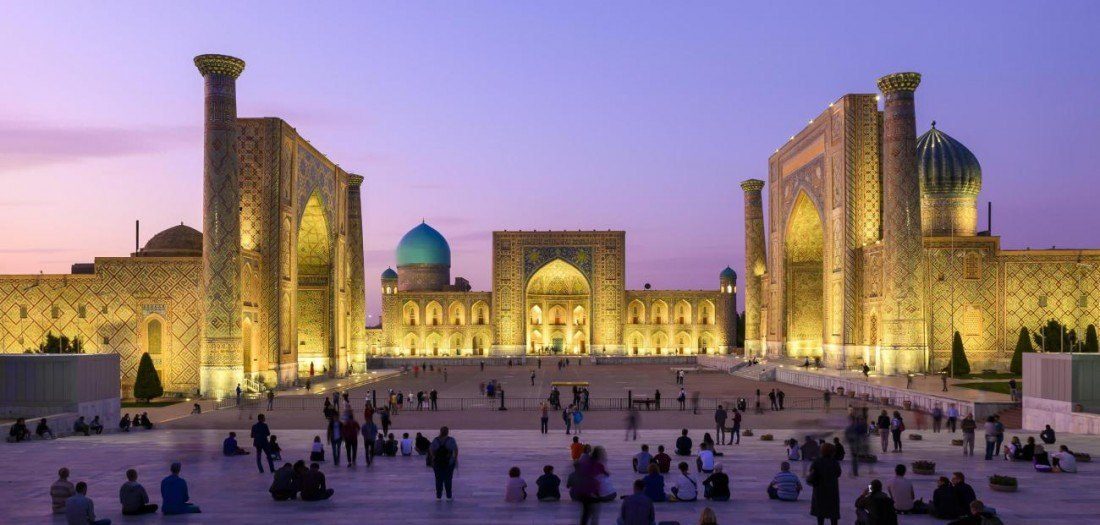
- Ticket: 100,000 som for a foreign adult, 50,000 som for ages 7 to 18, free for younger children. Buy it at tickets.registon.uz and pay online.
- Hours: from 8:00 into the evening, with longer hours in the season and shorter ones in winter.
- Light: come at opening time, when the morning sun lights Ulugh Beg’s madrasah. Sher-Dor, opposite, takes the afternoon light. Then come back after dark.
- Time: 1.5 to 2 hours, plus a short evening visit.
- Dress: shoulders and knees covered, above all in the Tilla-Kari mosque. More in our guide to what to wear in Uzbekistan.
- Photos: allowed; ask at the desk about any separate filming fee.
- Shopping: the ground-floor cells around the courtyards, once students’ rooms, now hold souvenir sellers: silk scarves, ikat, ceramics, carpets. Bargaining is normal.
Samarkand is 2 hours 30 minutes from Tashkent on the Uzbekistan's high-speed train: Tashkent to Samarkand in 2 hours 30 minutes, Tashkent to Bukhara in about 4 hours. Tickets are tied to your passport. Read more → express: see Tashkent to Samarkand and trains in Uzbekistan. For the rest of the city: Samarkand in 1, 2 or 3 days, Samarkand sights, tickets and hours and our Samarkand city guide. With a guide, the square is part of the Samarkand highlights tour and our other Samarkand tours.
In short
- Three madrasahs built over more than two centuries: Ulugh Beg (1417–1420), Sher-Dor (1619–1636) and Tilla-Kari (1646–1660).
- Ulugh Beg taught astronomy here; his catalogue lists 1,018 stars.
- The tigers with suns on Sher-Dor are a rare image in Islamic architecture, and you will find them on Uzbek money.
- The minarets you see were straightened in 1932 and 1965, and the gold of Tilla-Kari was restored in 1979.
- Buy your ticket online, come at 8:00, and come back after dark.