
Places in this article: Bukhara
Poi-Kalyan in Bukhara: the Kalyan minaret, mosque and Mir-i-Arab, with facts and legends
In February 1220 Genghis Khan took Bukhara and burned it. Its great Friday mosque was destroyed. The brick tower beside it, then less than a century old, was left standing. Eight hundred years later it is still the tallest thing in the old town, and every lane seems to lead you back to it.
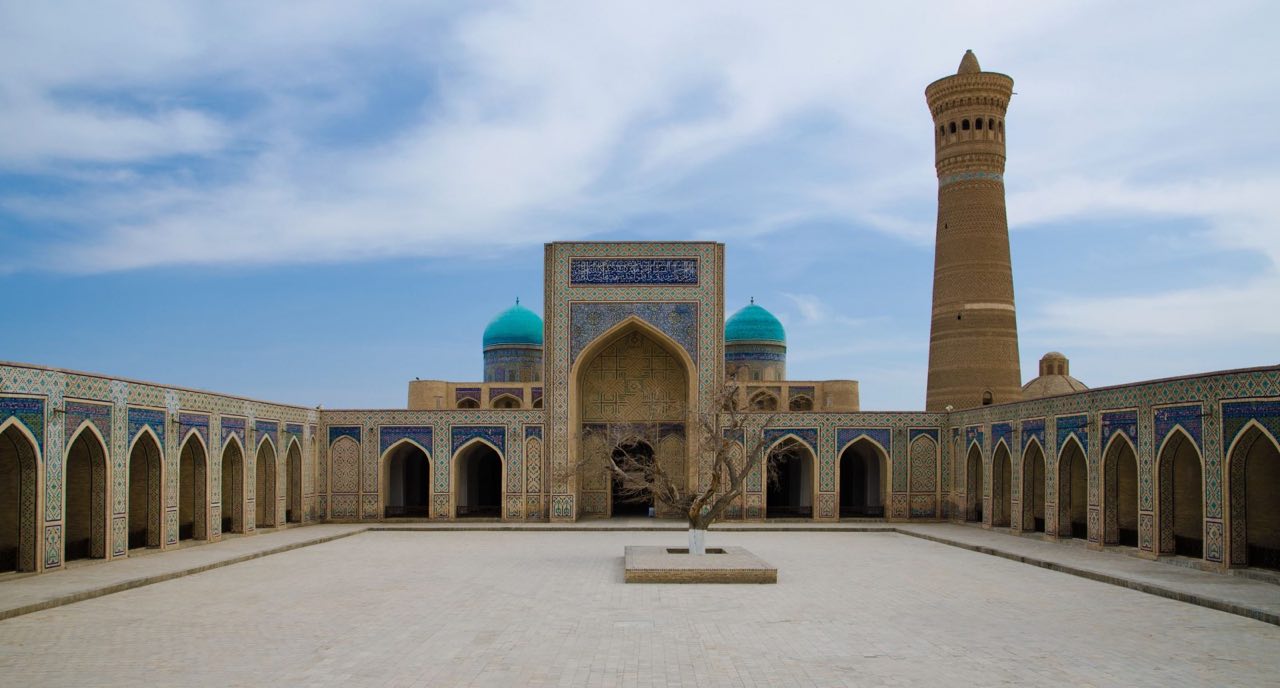
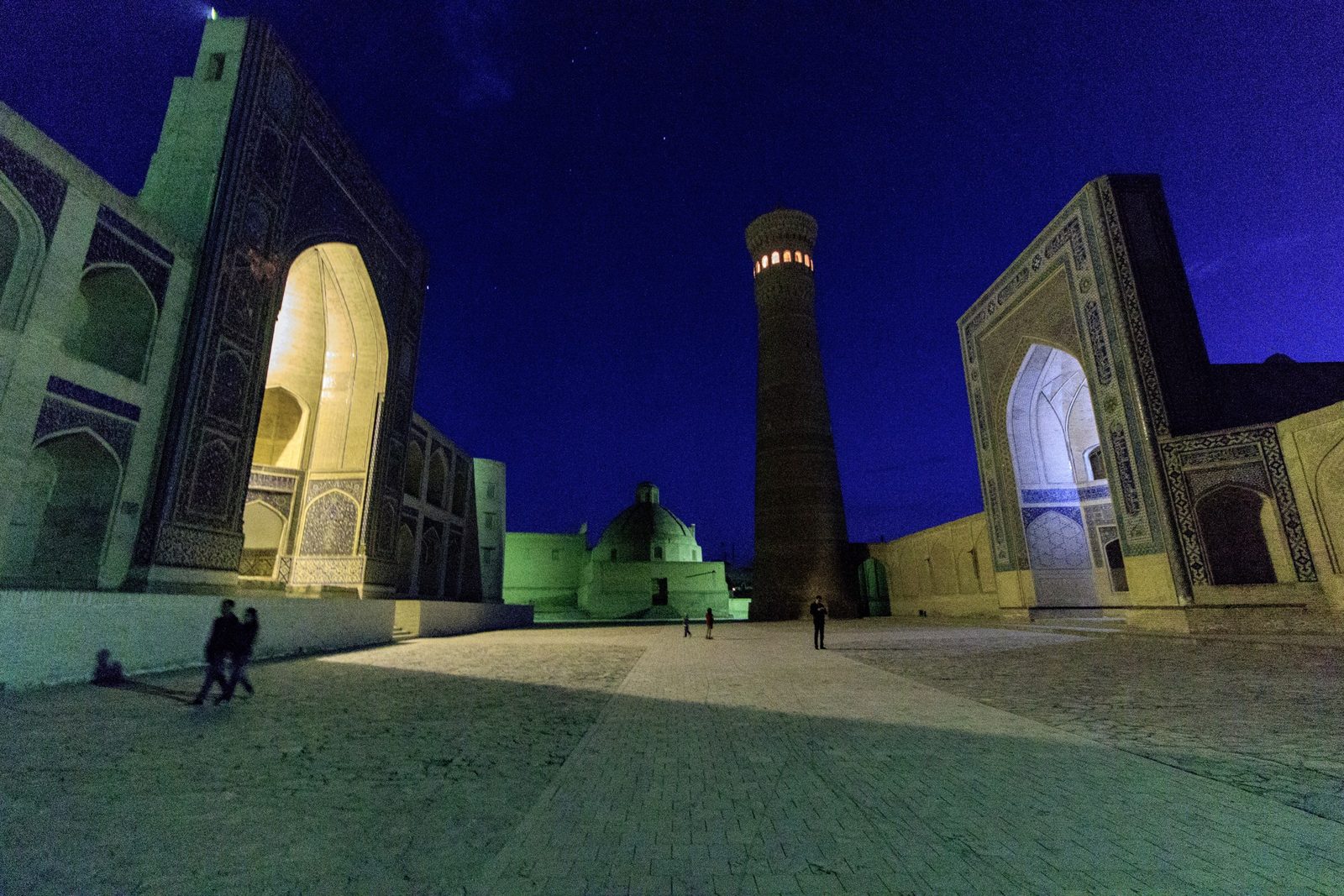
The tower is the ,Did you know? Diggers went 13 m down and never found its base The Kalyan Minaret of 1127 rises about 46 m, and an excavation reached 13 m without finding the bottom of its foundations. Genghis Khan reportedly ordered it spared. Read more → and the square at its foot is :The heart of old Bukhara: the Kalyan Minaret of 1127, the Kalyan Mosque and the Mir-i-Arab Madrasah facing each other across one square. Read more → the minaret, the Kalyan mosque and the Did you know? A madrasah still teaching after almost 500 years Mir-i-Arab, built in the 1530s opposite the Kalyan Mosque, was one of only three Islamic schools allowed to keep working in Soviet times, and it still trains students today. Read more → ,An Islamic college: student cells and classrooms around a courtyard behind a grand portal. In the old towns many now house museums and craft workshops. facing each other across the paving. We bring guests here on every Bukhara trip, at sunset and again after dark. Here is the ensemble as our guides tell it: history, legends (marked as such), the details most visitors walk past and how to plan your visit.
Poi-Kalyan: “at the foot of the great one”
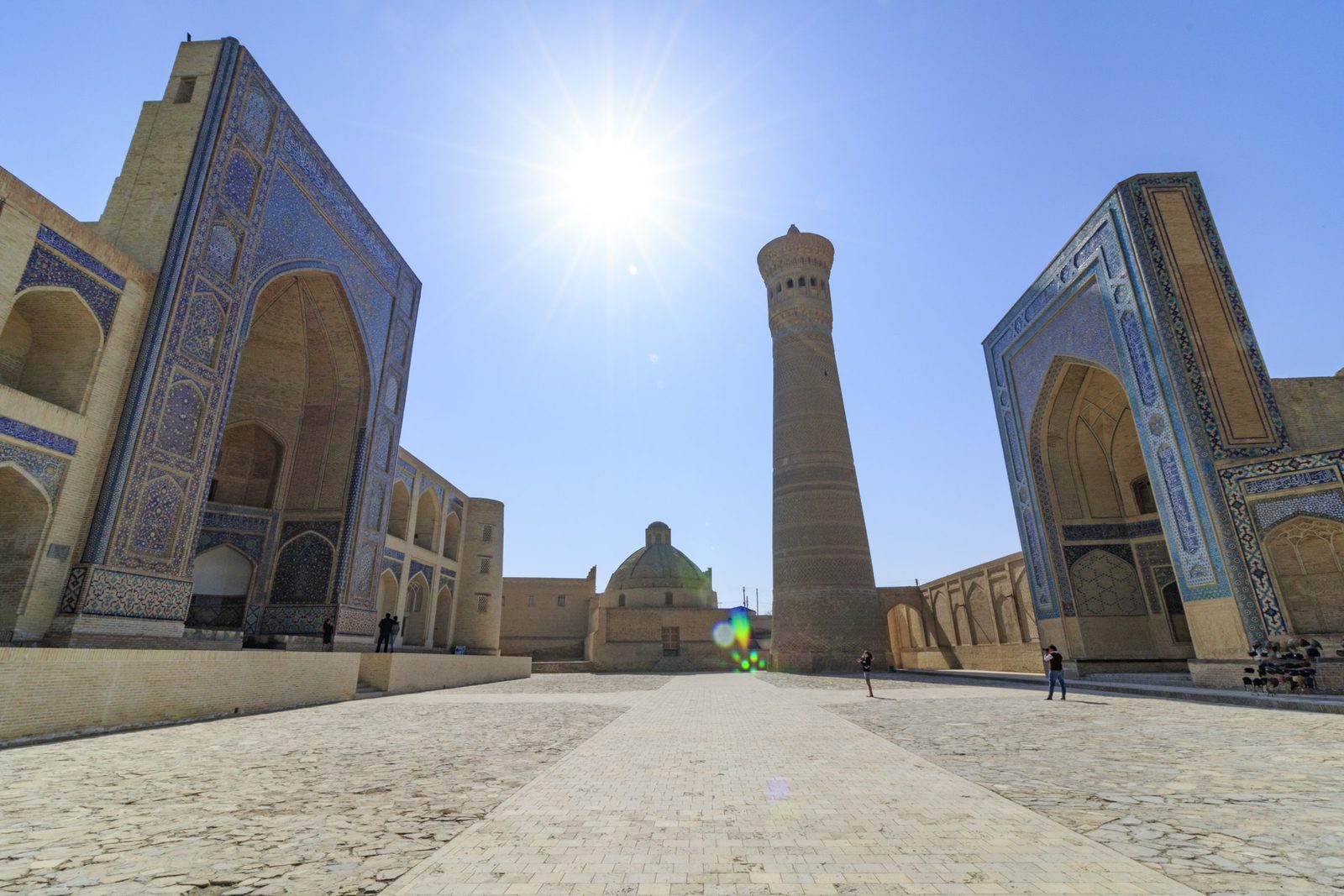
Poi-Kalyan is Persian for “at the foot of the great one”, and the great one is the minaret. Kalyan simply means big. The mosque is the Kalyan mosque, the big mosque, and the madrasah opposite takes its name from a sheikh known as Mir-i Arab.
The three were built over four centuries: the minaret in 1127, the mosque in its present form in 1514, the madrasah in the 1530s. Together they are the heart of the Historic Centre of Bukhara, on the UNESCO World Heritage List since 1993.
The Kalyan minaret: Arslan Khan’s tower of 1127
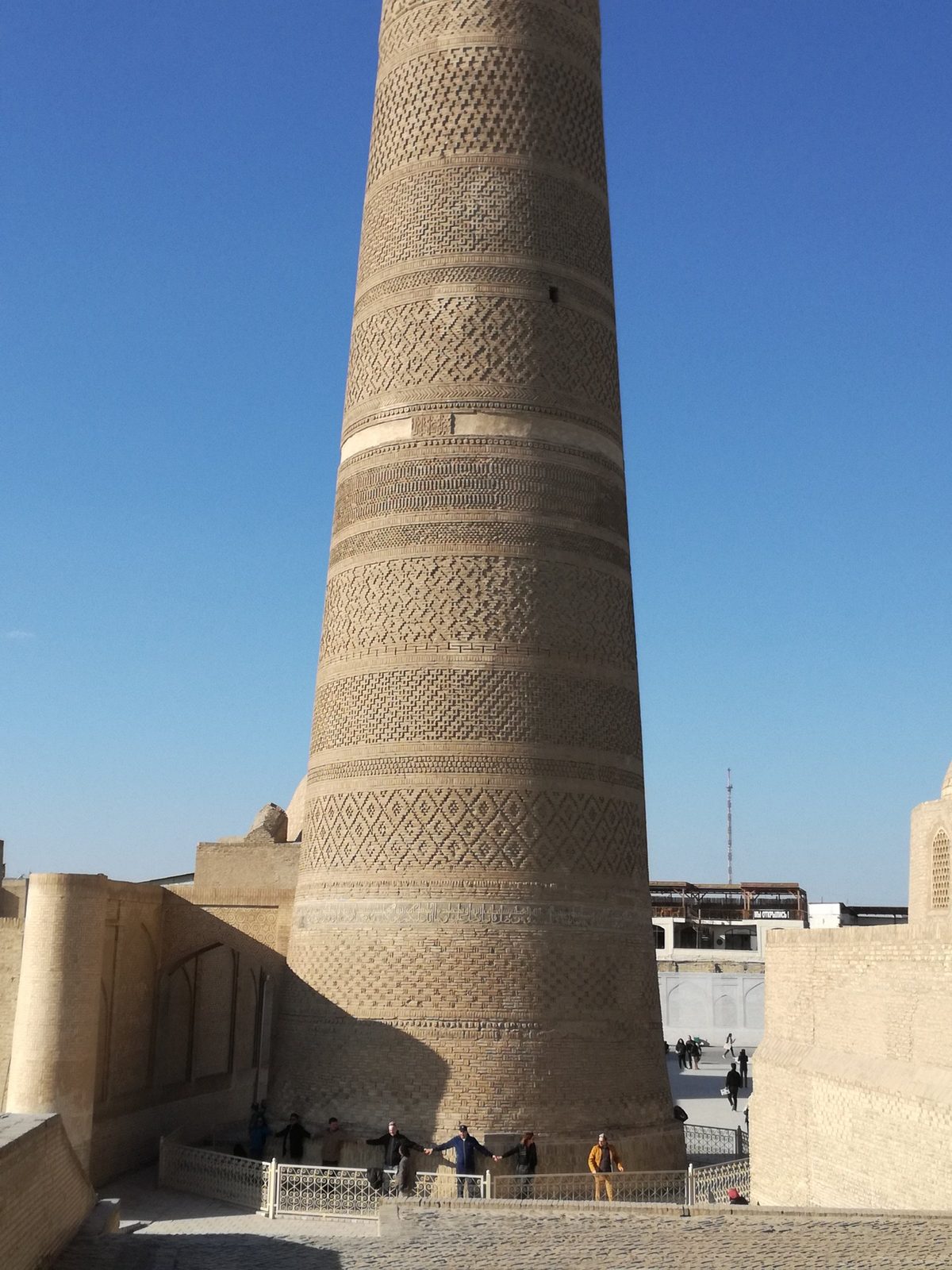
The minaret was paid for by Arslan Khan, the Karakhanid ruler of Bukhara from 1102 to 1130, who built a great deal in his city. It was his second attempt. An earlier minaret, crowned with a wooden lantern, fell soon after it was finished. The one he raised in 1127 is brick from top to bottom.
It rises 46.5 metres. At the base it is about 9 metres across, narrowing to 6 metres under the lantern. Archaeologists dug 13 metres down beside it without reaching the bottom of the foundations.
Walk slowly round it and look up. The whole shaft is wrapped in bands of brick ornament, and no two bands repeat a pattern. Near the top runs a thin strip of turquoise glaze. One band carries an inscription in Kufic script with the name of Arslan Khan. At the top, a round lantern opens in 16 arches. From here the call to prayer was given, and the tower also served as a watchtower and as a beacon seen far beyond the city.
The door is not at ground level. A brick bridge links the minaret to the roof of the mosque, and a spiral staircase climbs inside. In 1920, during the fighting for Bukhara, a shell destroyed almost half of the lantern. It was rebuilt, and the minaret was fully restored in 1997 for the city’s 2500th anniversary.
Legend: master Bako and the camel milk
This is a legend, not a record. The builder, known as master Bako, laid the foundations with a mortar of ganch, a local gypsum plaster, mixed with camel milk. Then he vanished. Two years later he came back, found the foundations as hard as stone, and only then began the tower. Some retellings add eggs and bull’s blood to the mix. People in the neighbourhood will still show you a grave they say is his, a short walk from the minaret.
The “Tower of Death”: what history records
Bukhara has a darker name for the minaret: the Tower of Death. This part is not a legend. In 1832 Alexander Burnes, a young British officer, reached Bukhara. In the book of his journey he wrote of the minaret: “Criminals are thrown from this tower.” He added that no one but the chief priest could climb it, and only on Fridays to call the people to prayer, so that he could not look down into the women’s courtyards of the houses around.
When the practice ended is less clear, and the accounts disagree. Some travellers wrote that it stopped around 1870; one who came secretly in 1938 heard that it had returned in the troubled years between 1917 and 1920. You may hear a precise date for the last execution. The records do not give one.
Legend: the woman in many skirts
Another legend. A cruel ruler learned that his wife had been secretly helping his people, and condemned her to be thrown from the tower. As a last wish she asked to dress as she chose. She put on every dress and skirt she owned, climbed the minaret and stepped off. Her skirts opened like a parachute and she landed unhurt. The ruler, moved by her courage, forgave her.
Genghis Khan and the minaret he spared
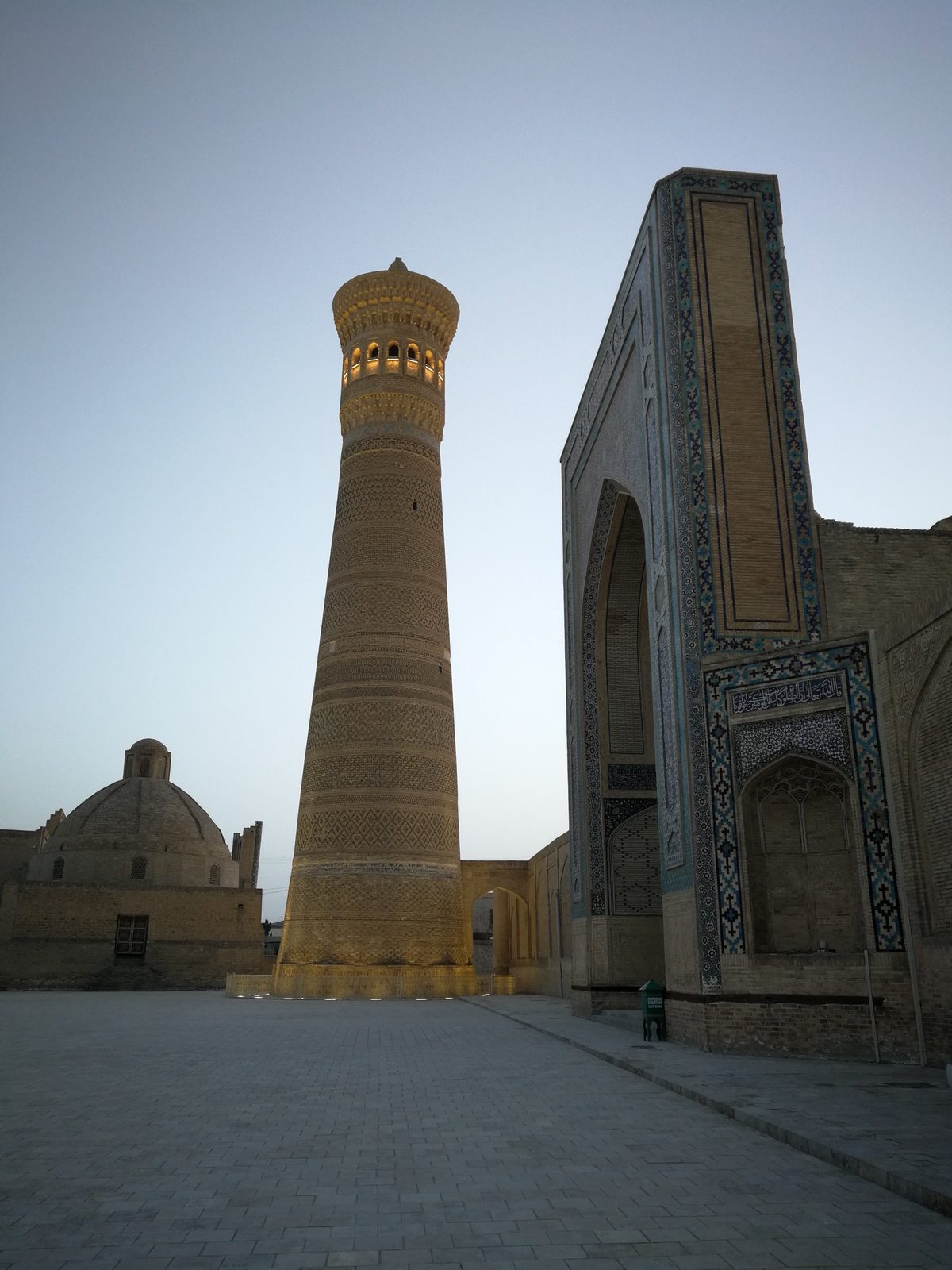
The history comes from a Persian chronicler of the 13th century. Genghis Khan rode into the Friday mosque of Bukhara and asked whether this was the sultan’s palace. Told it was the house of God, he had the chests that held the Qurans emptied in the courtyard and used as mangers for his horses. The city was then burned. The mosque was destroyed; the minaret survived.
Legend: the hat that fell
Why did the minaret survive? Here the legend takes over. Genghis Khan stopped below the tower and tipped his head back so far to see the top that his hat fell off. As he bent to pick it up, he said that if so great a man had bowed to this minaret, it should stand. In another version it is his helmet, and he takes the fall as a sign from above. We tell it at the foot of the tower, and every group looks up.
The Kalyan mosque: Bukhara’s Friday mosque
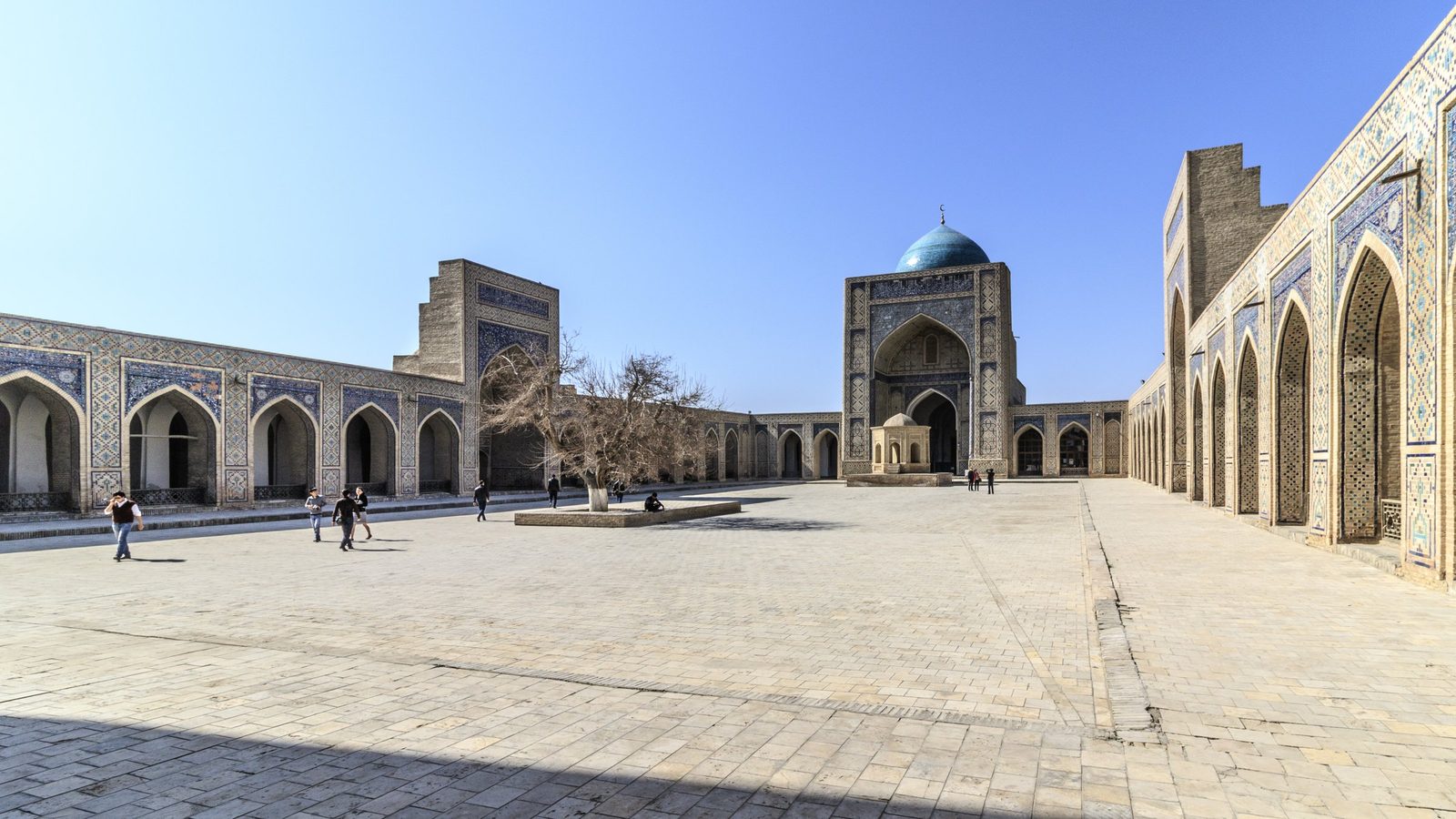
Archaeologists found two older mosques under the one you see. The lowest, from Arslan Khan’s time, was as large as today’s. In 1514, under the Shaybanid prince Ubaydullah Khan, the mosque was rebuilt and given its tiled facade and a new mosaic mihrab, signed by the calligrapher Bayazid al-Puroni.
It is built for crowds: about 130 by 80 metres, with room for up to 12,000 worshippers. Around the courtyard run galleries under 288 small domes, carried on 208 pillars. At the far end of the courtyard, a big blue dome rises over the prayer hall.
In the entrance portal, look for a marble slab with a decree of 1542 that freed the people of Bukhara from certain taxes. In the courtyard stands an octagonal pavilion built in 1915 by the Bukharan master Shirin Muradov. In the Soviet decades the mosque was closed to prayer. In 1996 it was handed back to the Muslim Board of Uzbekistan, and a second marble slab opposite the first records this. Today it is Bukhara’s Friday mosque again.
Mir-i-Arab: the madrasah that kept teaching
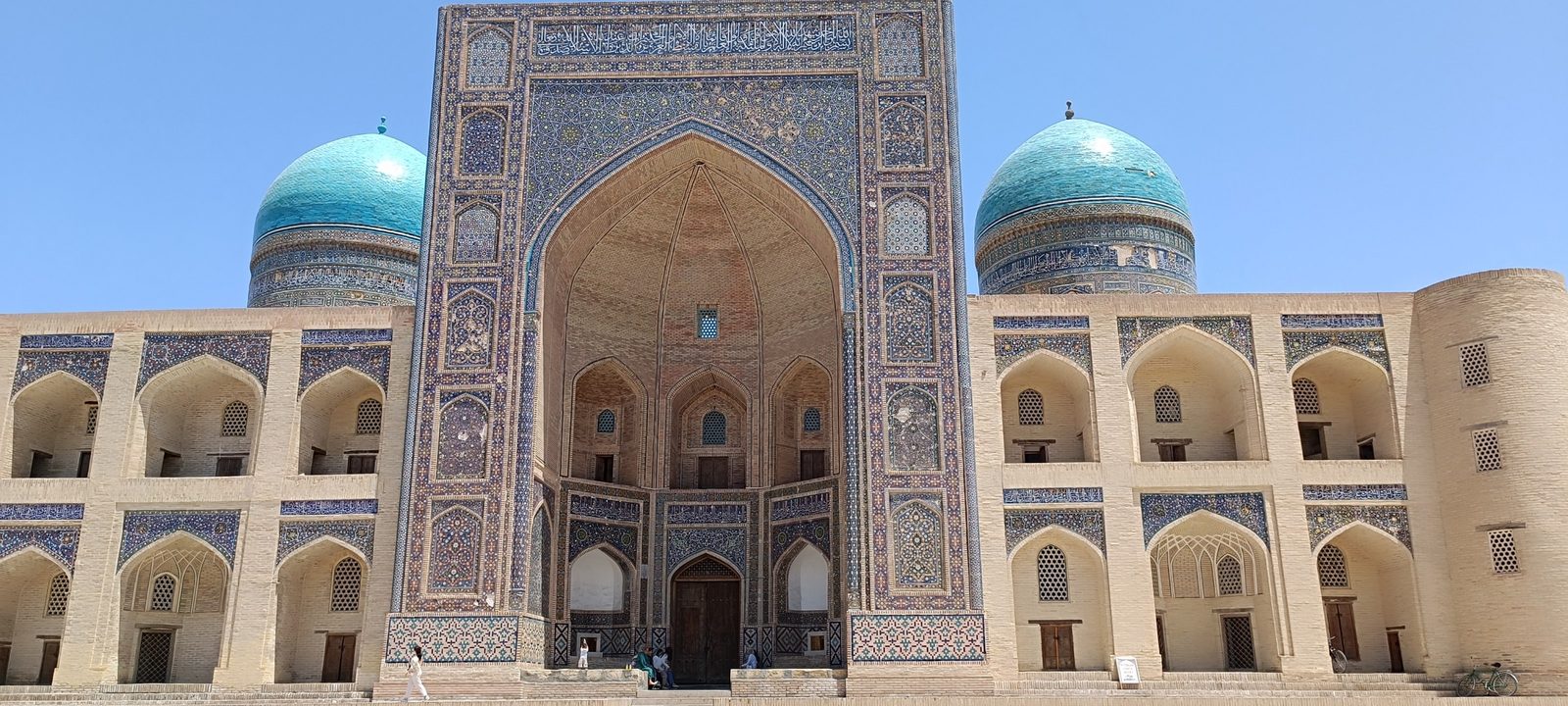
Across the square from the mosque stands the Mir-i-Arab madrasah, completed in 1535–1536. It is named after Sheikh Abdullah Yamani, called Mir-i Arab, a Sufi of the Naqshbandi order who came from Yemen and became the spiritual teacher of Ubaydullah Khan, the ruler who rebuilt the mosque.
Two tiers of student cells, 114 in all, surround the courtyard. Beside the entrance hall is the tomb chamber. Mir-i Arab lies here under a marble stone, and next to him is the wooden cenotaph of Ubaydullah Khan, who was buried beside his teacher.
Its Soviet story is unusual. The madrasah was closed in the 1920s and reopened in 1946, and for most of the Soviet decades it was one of a handful of Islamic schools allowed to teach anywhere in the USSR. It has been teaching ever since. Today it has about 170 students and 39 teachers.
Because it is a working school, visitors see the entrance hall and look into the courtyard through the grille; the courtyard belongs to the students. If Bukhara’s holy places interest you, our guide to shrines of Uzbekistan goes further.
Evening light and the best photo spots
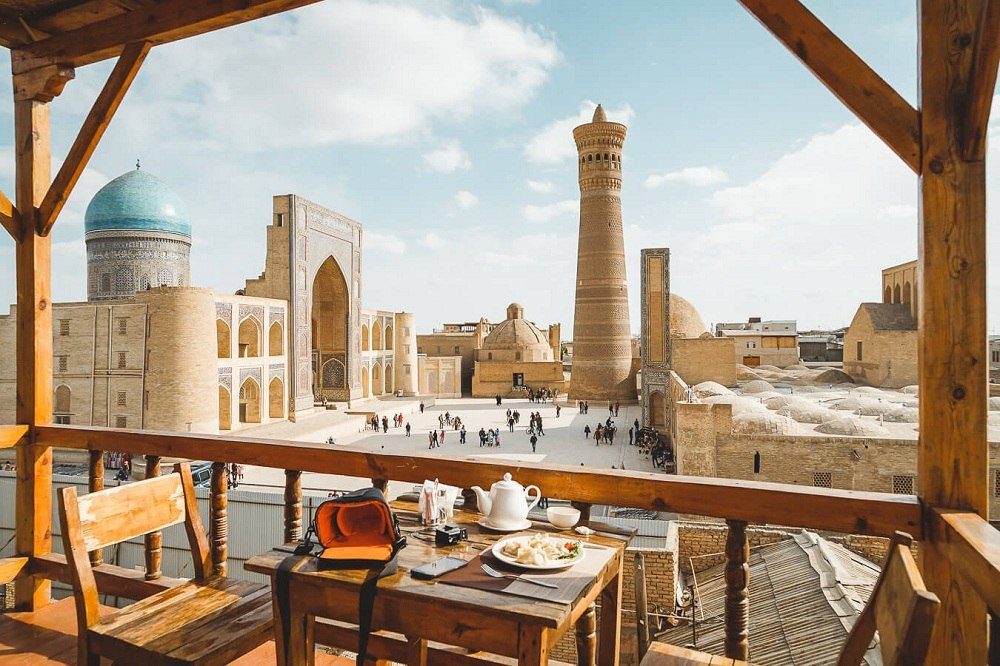
Poi-Kalyan changes colour through the day, so plan to see it at least twice.
- Early morning: the square is almost empty, and you can photograph the minaret between the two portals with nobody in the frame.
- Late afternoon: the low sun turns the brick of the minaret gold and lights up the turquoise domes of Mir-i-Arab.
- From above: the cafés around the square have terraces and upper galleries looking straight at the minaret and the domes. Order a pot of green tea and wait for the light.
- After dark: the minaret and the portals are floodlit, and the day groups have gone.
If photography is the point of your trip, our Uzbekistan photo tour includes Bukhara.
Did you know?
- The minaret’s base is among the widest in Central Asia; only the Kutlug-Amir Timur (Tamerlane, 1336–1405), founder of the Timurid empire, which had its capital in Samarkand. Born near Shahrisabz. minaret in Kunya-Urgench is wider.
- Nobody knows how deep the foundations go: digging stopped at 13 metres.
- The madrasah took the name Mir-i-Arab only after the sheikh’s death.
- Ubaydullah Khan rebuilt the mosque, but he lies across the square, in the madrasah, beside his teacher.
Poi-Kalyan in dates
| Year | What happened |
|---|---|
| 1127 | Arslan Khan’s brick minaret is finished |
| 1220 | Genghis Khan burns Bukhara; the mosque is destroyed, the minaret survives |
| 1514 | Ubaydullah Khan rebuilds the Kalyan mosque |
| 1535–1536 | The Mir-i-Arab madrasah is completed |
| 1542 | The tax decree is set into the mosque portal |
| 1832 | A British traveller records executions from the tower |
| 1920 | A shell destroys almost half of the lantern |
| 1946 | Mir-i-Arab reopens as a madrasah |
| 1993 | UNESCO World Heritage List |
| 1997 | Restoration for Bukhara’s 2500th anniversary |
Visiting Poi-Kalyan: tickets, hours and our tips
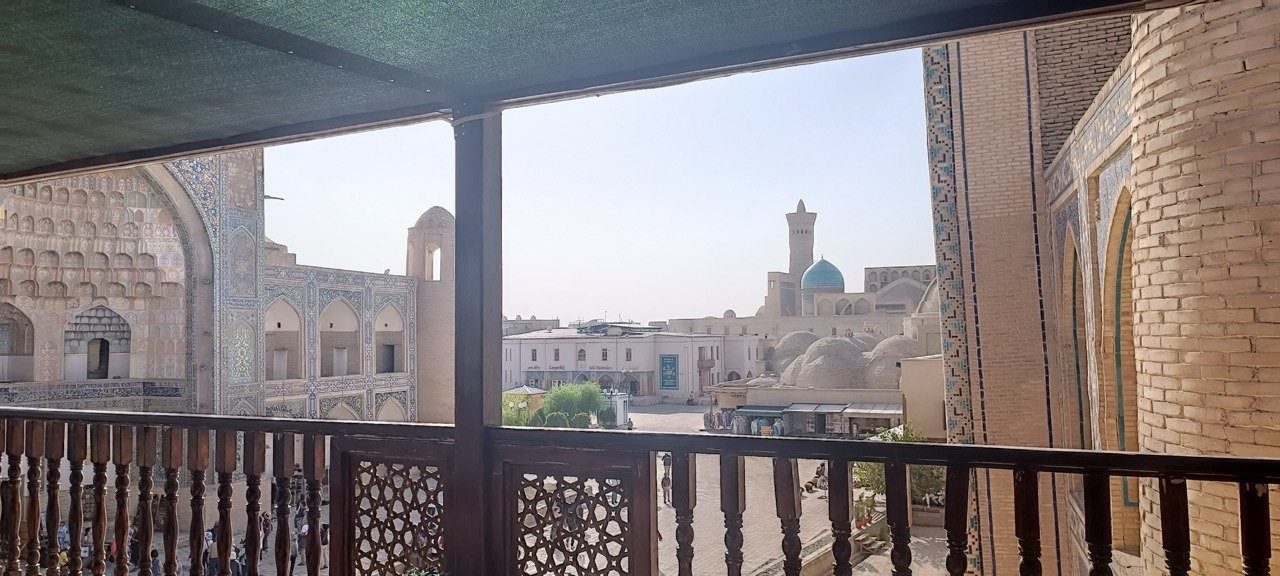
- The square: open to walk through, free.
- Ticket and hours: for the mosque courtyard, check at the ticket office.
- Time: about an hour, plus a short return after dark.
- Dress: this is a working mosque and a working madrasah. Cover shoulders and knees; women bring a scarf for the mosque. Never photograph people at prayer. More in our guide to what to wear in Uzbekistan.
- Fridays: the mosque fills for midday prayer, so we plan our guests’ visit for another time of day.
- Climbing the minaret: we don’t build a visit around it. Whether the stairs are open is up to the site, so ask at the ticket office on the day.
Poi-Kalyan is about 500 metres from Did you know? Bukhara's ponds were once its water supply Pools like Lyabi-Hauz, dug around 1620 and 46 × 36 m, were the city's main source of water. Most were filled in during the 1920s–30s because they spread disease; Lyabi-Hauz survived. Read more → and a few minutes’ walk from .The fortress-residence of the rulers of Bukhara on a high artificial hill: the oldest structure in the city. Read more → To fit it into your days, see Bukhara in 1, 2 or 3 days, our table of Bukhara and Khiva sights, tickets and hours and the Bukhara city guide. For Samarkand’s great square, read the Registan in Samarkand. With a guide, Poi-Kalyan is part of the Bukhara highlights tour, Bukhara in 2 days and our other Bukhara tours.
In short
- Three buildings, four centuries: the Kalyan minaret (1127), the Kalyan mosque (1514) and the Mir-i-Arab madrasah (1535–1536).
- The minaret is 46.5 metres of patterned brick; Genghis Khan burned the mosque in 1220 but left the tower standing.
- The “Tower of Death” is history: a traveller in 1832 recorded executions from the top. The hat that fell and the camel-milk mortar are legends.
- Mir-i-Arab reopened in 1946 and still trains students; visitors see the entrance hall and the tomb of Ubaydullah Khan and his teacher.
- Come in the early morning for an empty square, at sunset for gold brick, and cover shoulders and knees.