
Samarkand in 1, 2 and 3 days: how we plan it
Places in this article: Samarkand
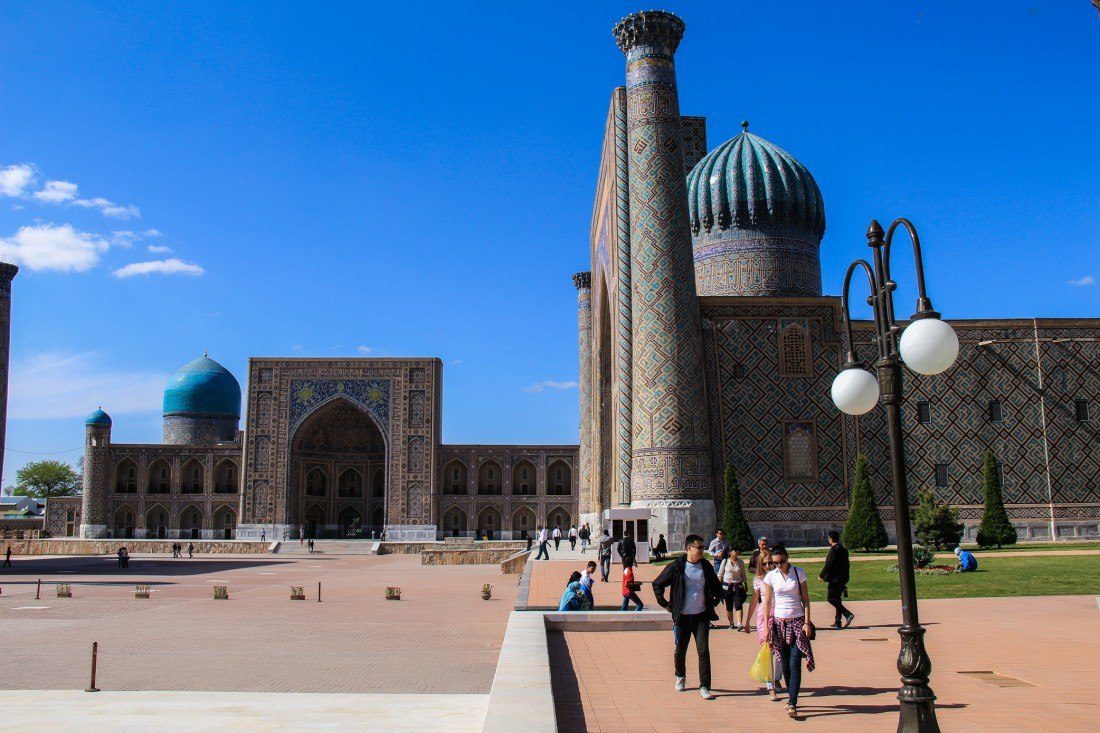
The Did you know? The Registan's sun-carrying lion went on a banknote The Sher-Dor Madrasah (1619–1636) is named for the big cats with the sun on their backs on its portal. The image appeared on the reverse of Uzbekistan's 200-som note of 1997. Read more → opens at 8 a.m. At that hour the sun is low in the east and falls straight on the Did you know? Engineers pulled a leaning minaret back upright By 1920 a minaret of the Ulugh Beg Madrasah on the Registan was tilting. In 1932 engineer Vladimir Shukhov straightened it; the second minaret was set upright in 1965. Read more →, which closes the west side of the square. By late afternoon the light has crossed to the Sher-Dor An Islamic college: student cells and classrooms around a courtyard behind a grand portal. In the old towns many now house museums and craft workshops. opposite. So if you have more than one day, we advise coming to the square twice, once for each facade.
That is how we plan Samarkand in general: the main sights are a walk apart, and each has its own best hour. Here is how we fit them into one, two or three days. For the history behind the monuments, see our article on ancient Samarkand.
What is where
The historic centre has been on the UNESCO World Heritage List since 2001 as Samarkand – Crossroads of Cultures. Almost everything lies on one line running north-east from Did you know? Timur's tombstone went to Persia and came back The dark-green jade slab on Timur's grave in Gur-e-Amir was carried off by Nader Shah in 1740. It broke, and on his advisers' urging he sent it back to Samarkand. Read more →. Only the Did you know? Ulugh Beg measured the year to within 25 seconds Working at his Samarkand observatory, Ulugh Beg put the tropical year at 365 days 5 h 49 min 15 s, about 25 seconds too long, closer than Copernicus a century later. Read more → is far enough to need a car.
| Sight | What it is | From the previous stop |
|---|---|---|
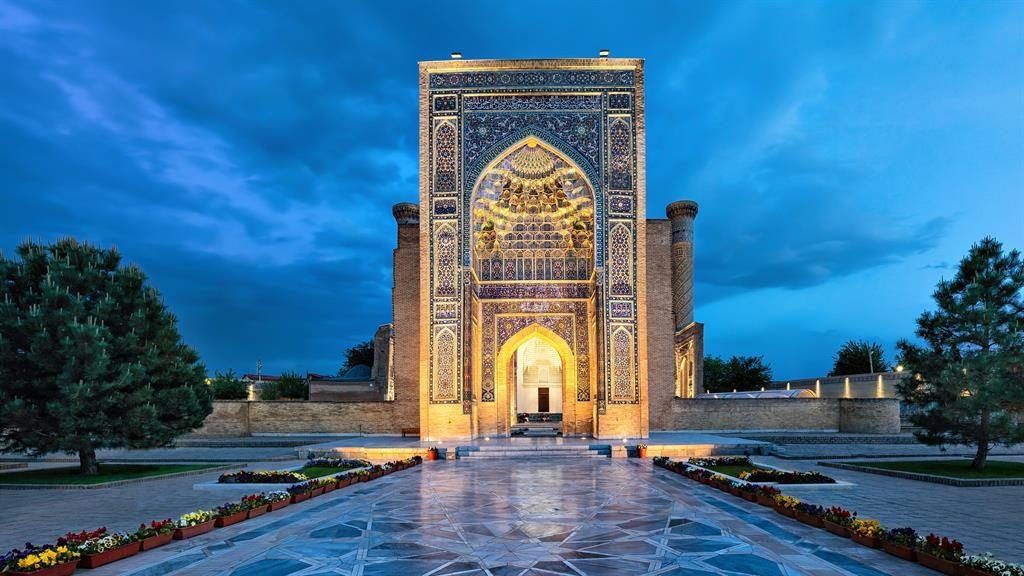
| Gur-e-Amir | Mausoleum of Amir Timur (Tamerlane, 1336–1405), founder of the Timurid empire, which had its capital in Samarkand. Born near Shahrisabz., completed in 1404; his sons and grandsons, Ulugh Beg among them, are buried here too | start |
| Registan | Three madrasas: Ulugh Beg (1417–1420), Sher-Dor (1619–1636), Tilla-Kari (1646–1660) | about 1 km |
| The great mosque Amir Timur ordered after his Indian campaign of 1398–1399, one of the largest of its time. Read more → Mosque | Timur’s Friday mosque, built 1399–1405 | about 700 m along a pedestrian street |
| Samarkand's main bazaar, right next to Bibi-Khanym: Samarkand bread, dried fruit, nuts and halva. Read more → | The city’s main bazaar | right next to the mosque |
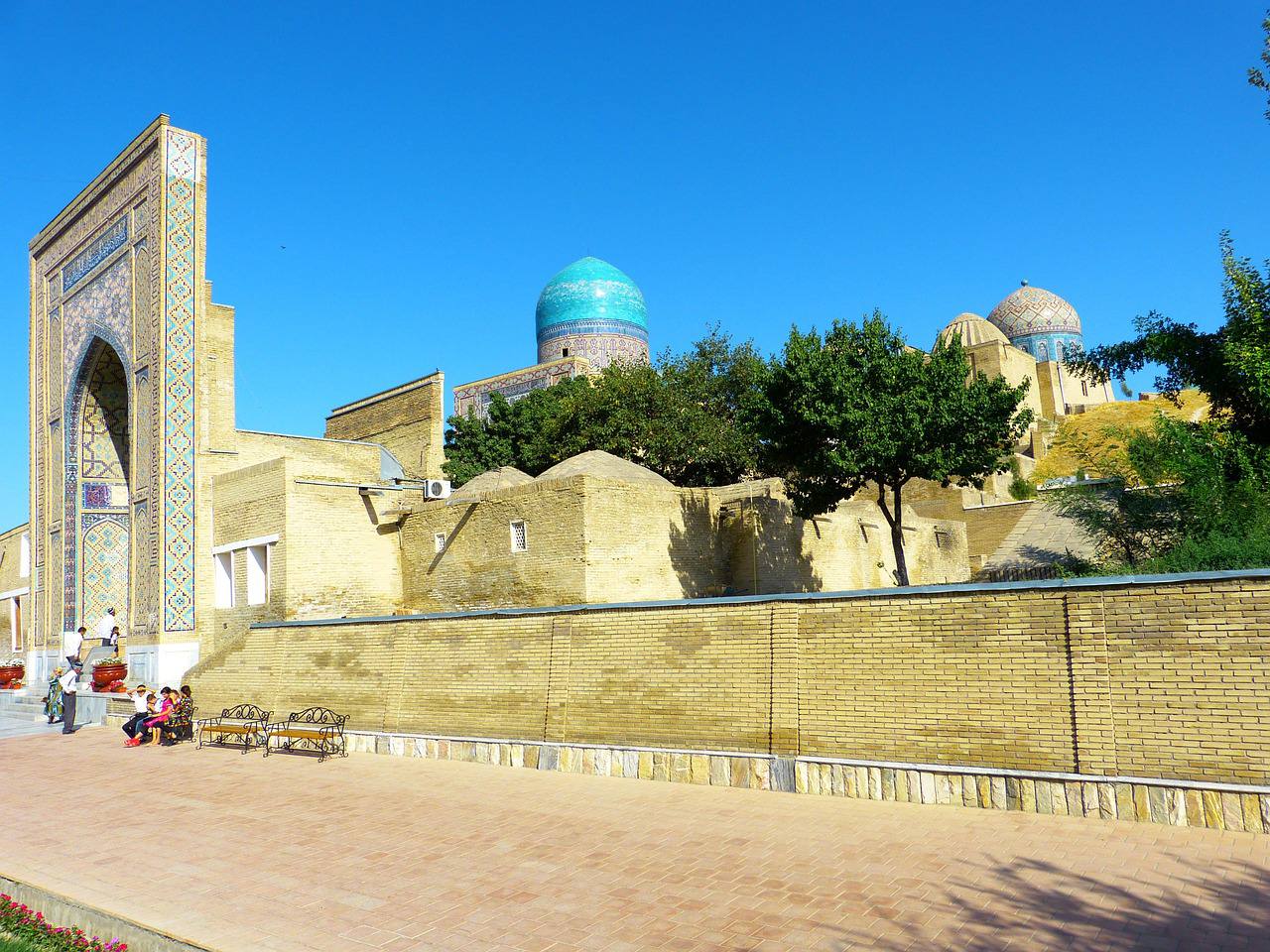
| Did you know? Why Shah-i-Zinda means 'the Living King' The necropolis grew around the shrine of Qutham ibn Abbas, a cousin of the Prophet Muhammad. Legend says he did not die in battle but went down a deep well to a garden of paradise, where he lives on. Read more → | Necropolis of more than twenty buildings, 11th–15th and 19th centuries | about 800 m |
| Did you know? A 7th-century mural shows envoys from Korea Uncovered by road builders in 1965, the Ambassadors' Painting at Afrasiyab shows delegations bearing gifts, Chinese with silk among them, and two men in feathered hats thought to be envoys from Korea's Goguryeo. Read more → | Site of the city before the Mongol invasion, with a museum | about 1 km |
| Ulugh Beg Observatory | Remains of the 1420s observatory and a museum | about 1.5 km further; 3.5 km from the Registan |
Every monument has its own ticket desk. At the Registan a foreign adult pays 100,000 som, teenagers pay half and children go in free; you can also buy the ticket online in advance. The bazaar costs nothing. Keep some cash in som for the smaller desks: our notes on cards and cash explain the rest.
One day: the core
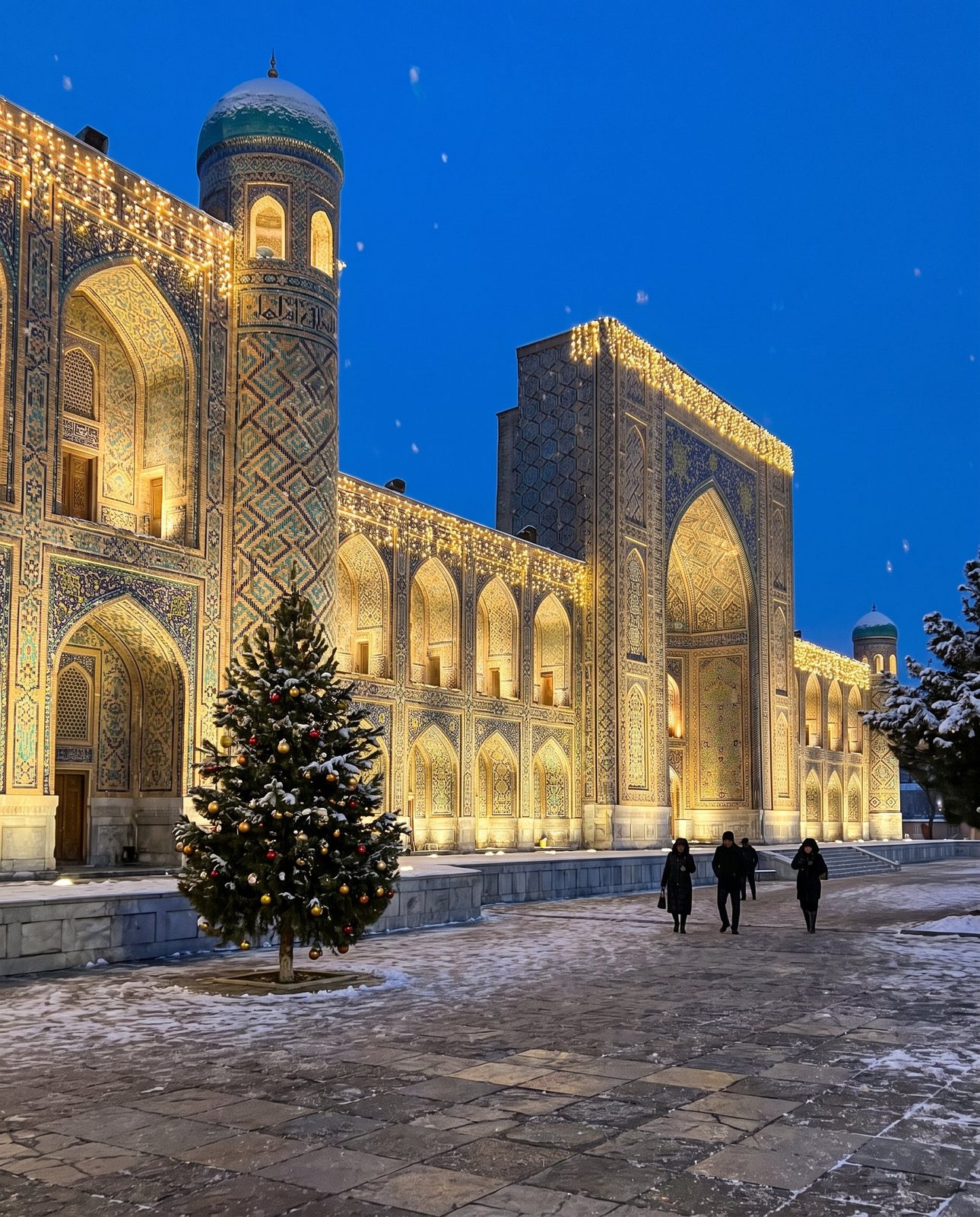
Be at the Registan at eight, while the morning sun is on Ulugh Beg’s madrasa. The square took more than two centuries to finish: Ulugh Beg built his madrasa in 1417–1420, the other two came in the 17th century. Look up at the portal of Sher-Dor, the madrasa named after the lions with the sun in its mosaic.
From there we walk guests about 700 m north along the pedestrian street to the Bibi-Khanym Mosque, Timur’s Friday mosque. Siab Bazaar starts right beside it and trades from first light until dark. Come hungry: dried fruit, nuts, spices, sweets, and more than seventeen kinds of flatbread. This is where we suggest stopping for lunch.
In the late afternoon go back to the Registan, when the light has moved onto Sher-Dor, and finish at Gur-e-Amir, about a kilometre away, as the day ends. Timur lies here with his descendants, including Ulugh Beg, whose madrasa you saw in the morning.
Two days: the necropolis and the older city
Start the second day at Shah-i-Zinda, about 800 m past Bibi-Khanym. A narrow lane climbs between tiled mausoleums built over eight centuries. According to legend, Qutham ibn Abbas, a cousin of the Prophet Muhammad, is buried at the top, and the name means “the Living King”. It is still a place of pilgrimage, so cover shoulders and knees; see what to wear. In summer we go in the morning, before the heat.
About a kilometre on is Afrasiyab, the hill where the city stood from around 500 BC until the Mongols took it in 1220. Its museum is open from 9:00 to 17:00, so plan it before lunch or straight after. The reason to go is the 7th-century wall painting of King Varkhuman receiving foreign embassies.
Leave the afternoon free: we suggest the bazaar again, or the Registan in the second light.
Three days: the observatory and Konigil
The Ulugh Beg Observatory is 3.5 km from the Registan, so take a taxi. In the 1420s it held a sextant with a 40 m radius. In 1908 the archaeologist Vassily Vyatkin dug out its buried marble arc, and that arc is what you see today, set into the hill. The small museum beside it explains how the instrument worked.
Then drive 13 km out to the village of A village near Samarkand where paper is made by hand from mulberry bark, the old way, at a working mill on the stream. and the Meros paper mill. Paper is still made there by hand from natural materials, slightly yellow because nobody bleaches it. There is a charkhpalak water wheel and a A teahouse: green tea, plov and conversation on wide wooden beds called topchan. by the river, a good place to slow down after two days of tilework.
If you would rather see another town, the third day works as a day trip to Shahrisabz, Timur’s birthplace.
Getting there and choosing the length of stay
From Tashkent the easiest way is the train: see trains in Uzbekistan. From abroad, start with flights to Uzbekistan. If Samarkand is one stop of several, the page Samarkand shows how it combines with Bukhara and Khiva, and the tour finder narrows tours by interest.
In short
- One day: the Registan at 8 a.m., Bibi-Khanym and Siab Bazaar on foot, back to the square in the late afternoon, Gur-e-Amir at the end of the day.
- Two days: Shah-i-Zinda in the morning with shoulders and knees covered, the Afrasiyab museum before 5 p.m.
- Three days: the observatory and the Konigil paper mill by car, or a day trip to Shahrisabz.
- The Registan costs 100,000 som for a foreign adult and nothing for children; carry cash in som for the other desks.