
Places in this article: Khiva · Bukhara
Kalta-Minor and Islam Khoja: the two minarets of Khiva
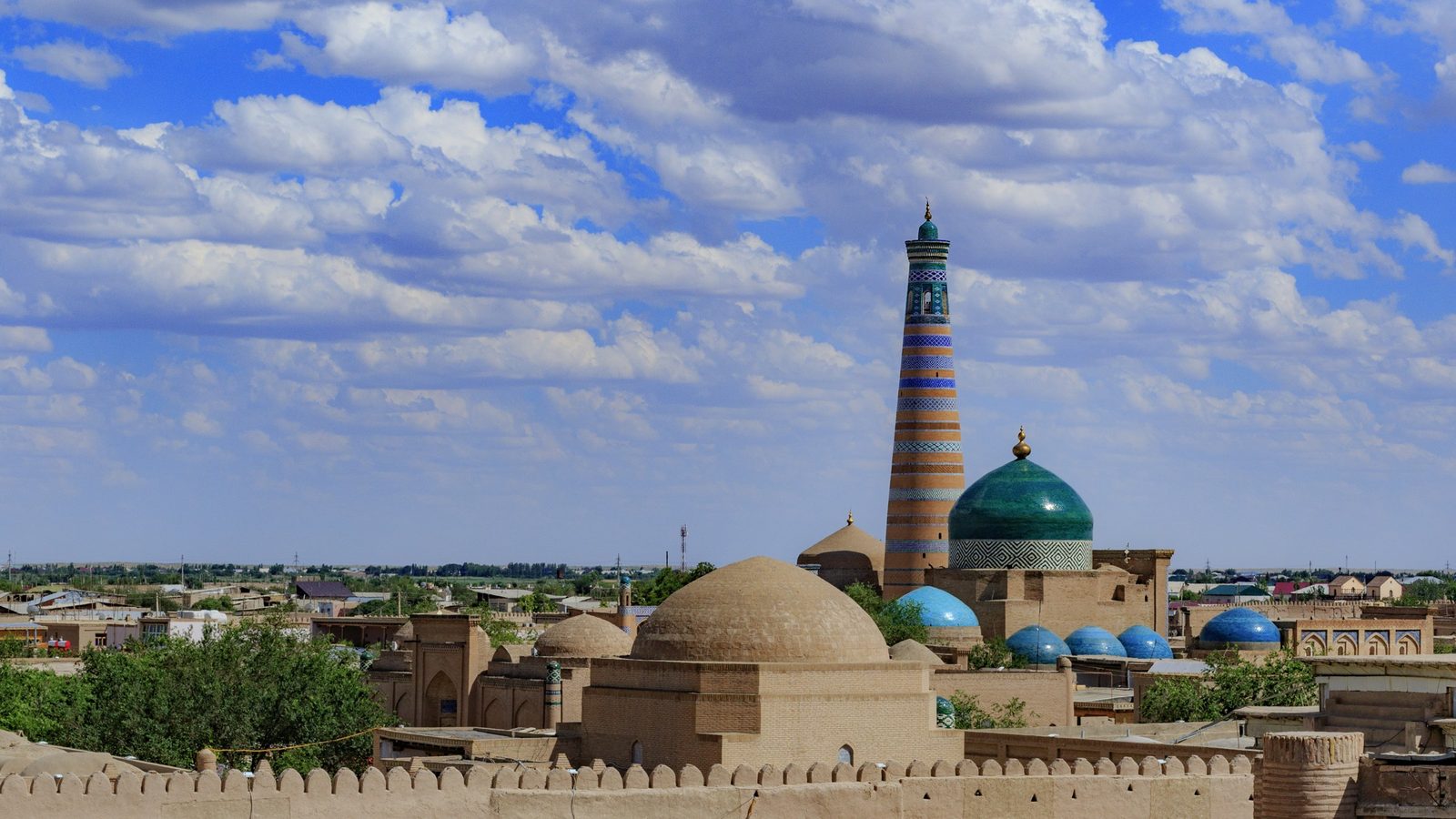
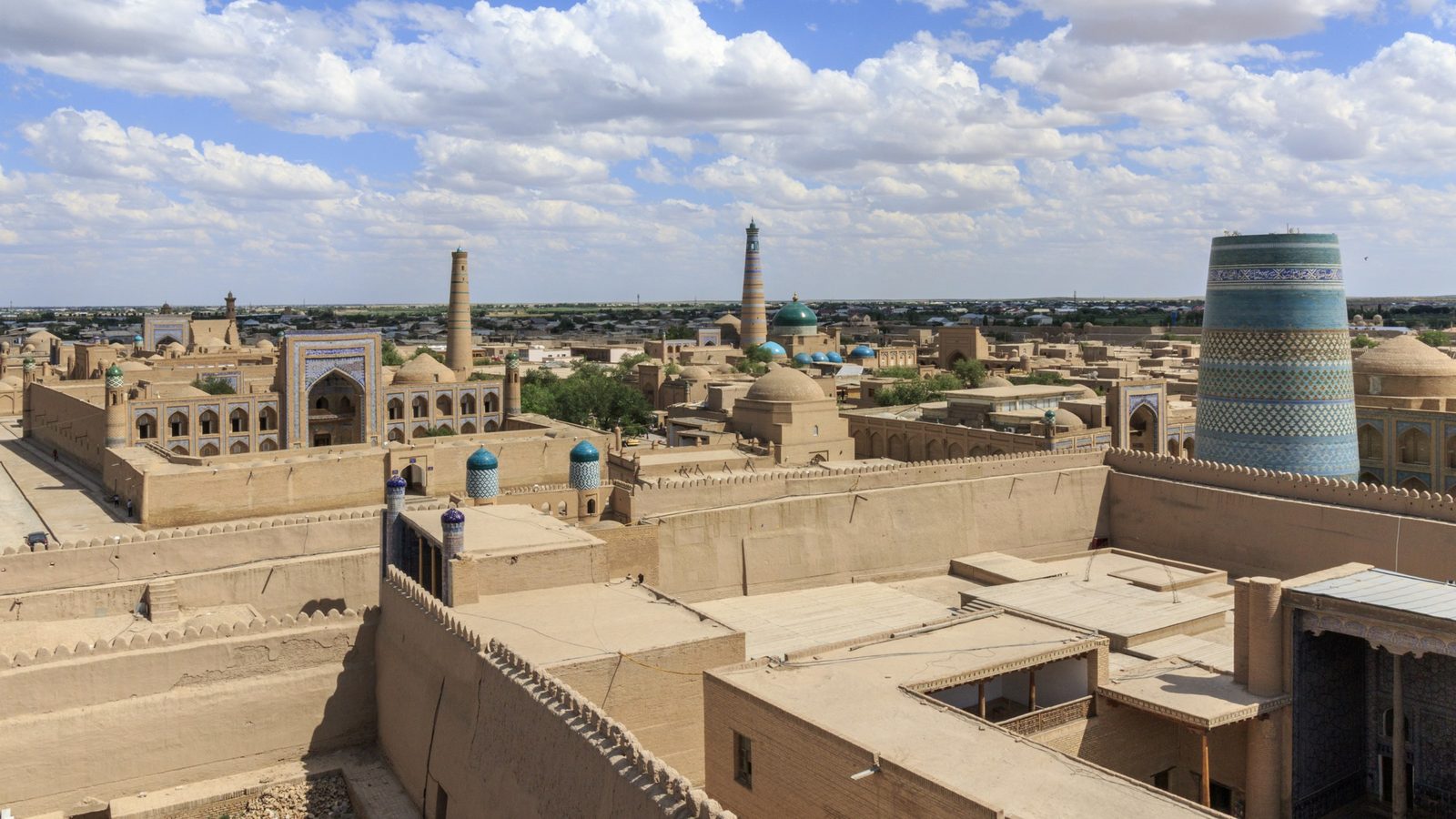
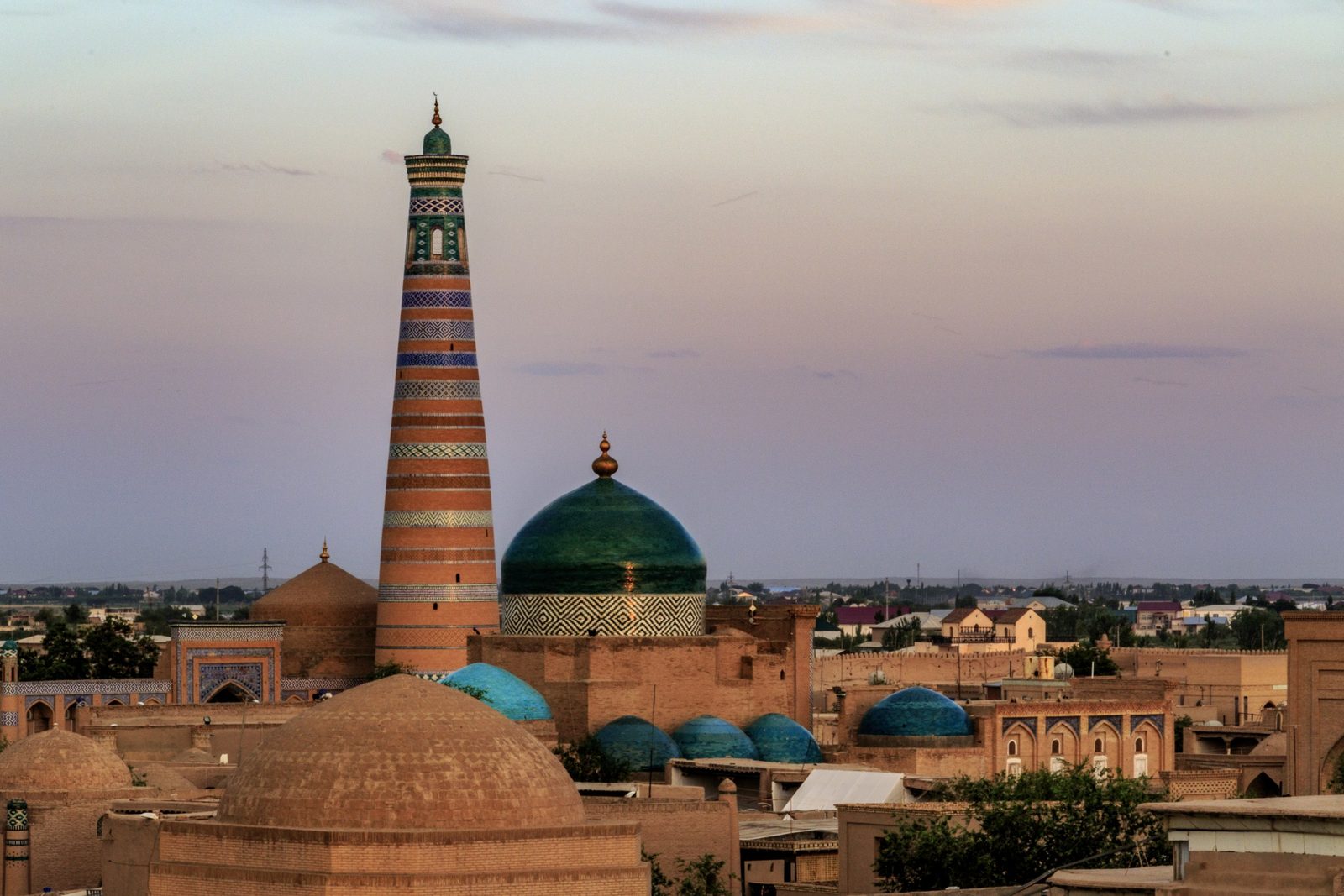
Stand inside the West Gate of Khiva and the old town plays a trick on your eyes. The widest minaret in sight is the short one, and the slim tower on the skyline is nearly twice its height. The Did you know? A 14-metre-wide base for a tower that stopped at 29 m Kalta Minor was begun in 1852 and meant to reach 70–80 m, but work halted in 1855 at about 29 m when its khan died. It is said to be the only minaret covered entirely in glazed tiles. Read more → is 14.2 metres across at the base and stops at 29 metres. The Did you know? Khiva's tallest minaret is barely a century old The Islam Khoja Minaret was begun in 1908, near the very end of the khans' era. At 56.6 m it is one of the tallest in Central Asia; a spiral stair of 175 steps leads up to its windowed top. Read more → is 9.5 metres across and rises to 56.6. More than half a century and a ten-minute walk separate them.
Our overview of the old town is in Ichan-Kala, Khiva, and the hour-by-hour plan is in Khiva in 1 or 2 days. Here we go deeper into the two towers: who built them, what the tiles say, the museum, the climb and the best places to photograph them.
Two minarets, one skyline
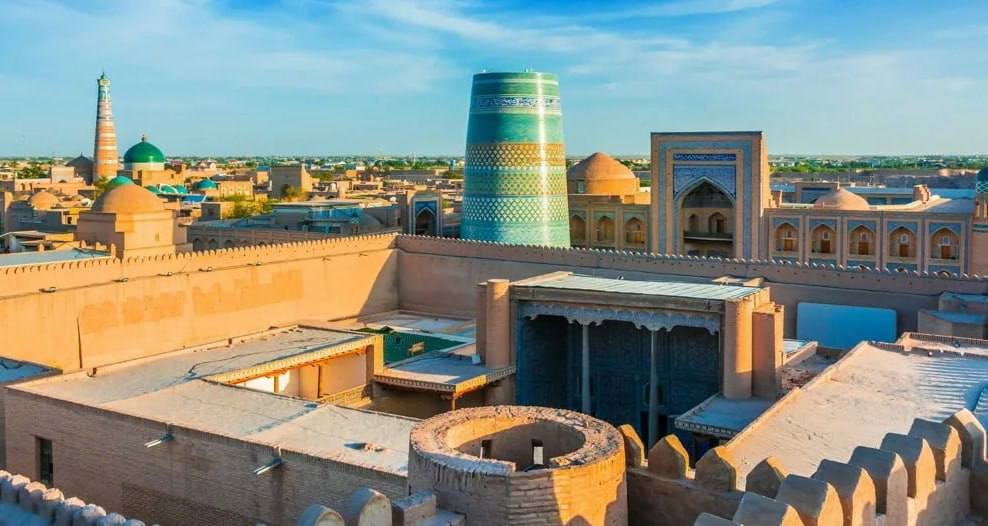
They belong to two different Khivas. The Kalta-Minor was begun in 1852 by Muhammad Amin Khan, a ruler who wanted the biggest minaret in the region. The Islam Khoja minaret was finished in 1910 for a vizier who spent his own money on a hospital, a post office and schools. One was meant to astonish; the other became the town’s lookout.
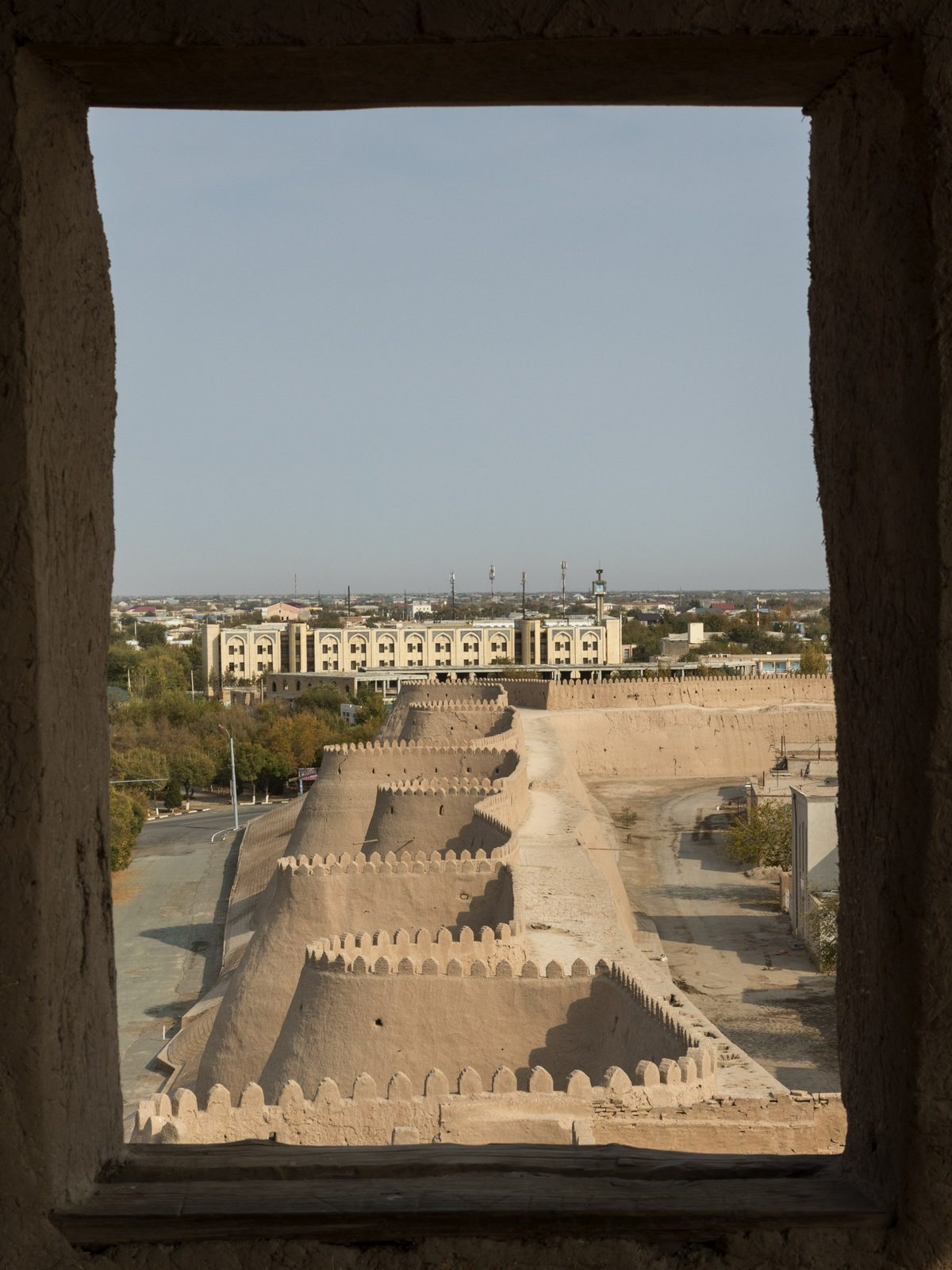
Between them they frame .Did you know? People still live inside Khiva's museum city Itchan Kala packs more than 50 historic monuments and about 250 old houses inside clay walls 8–10 m high and 5–6 m thick, and families still live and work in its lanes. Read more → The Kalta-Minor stands at the western entrance, by the gate where most visitors come in; the Islam Khoja rises in the south-east quarter, next to the Did you know? Legend: a wrestler freed captives with a single cowhide Legend says Pahlavan Mahmud won a bout in India and asked to free as many fellow Khorezmians as would fit in a cowhide. He cut it into one long thin strip and encircled them all. The real Mahmud, a poet and wrestler of around 1300, is Khiva's patron saint. Read more → mausoleum.
Kalta-Minor: the base of a 70-metre tower
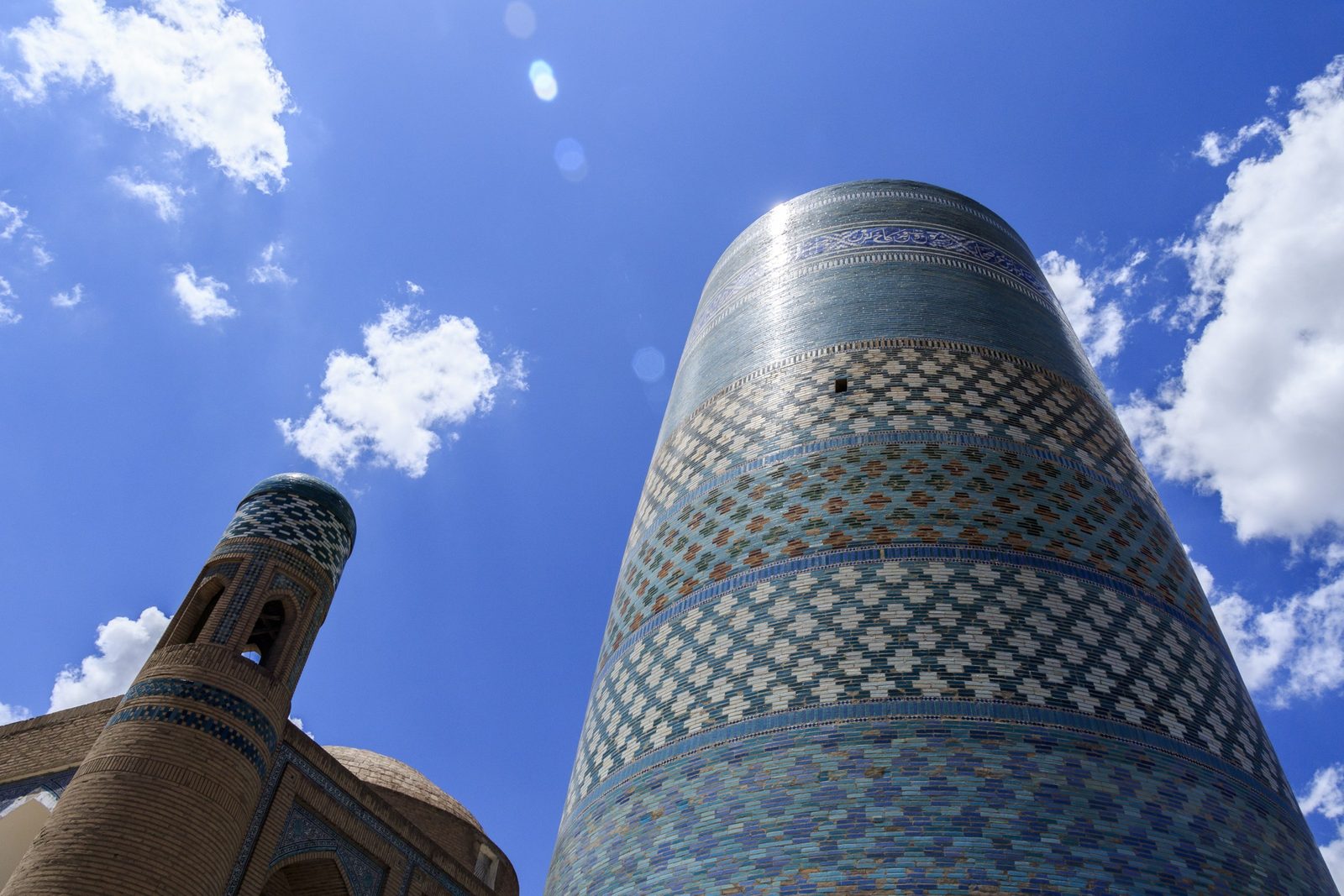
Kalta-Minor means “short minaret”. Muhammad Amin Khan, who ruled Khiva from 1846 to 1855, began it in 1852 in front of his new ,An Islamic college: student cells and classrooms around a courtyard behind a grand portal. In the old towns many now house museums and craft workshops. the largest in Khiva. With a base of 14.2 metres, it was planned to reach 70 to 80 metres, and some accounts say 110. Either way it would have topped the 73-metre Qutb Minar in Delhi. That is why the drum is so wide and tapers so fast: what you see is the bottom third of a much taller tower.
It is not a freestanding tower. A small wooden bridge links it to the madrasah, and the wooden staircase inside starts from the madrasah’s second floor. The madrasah, about 130 rooms around a courtyard 38 metres square, now houses a hotel, so some travellers sleep a few steps from the minaret.
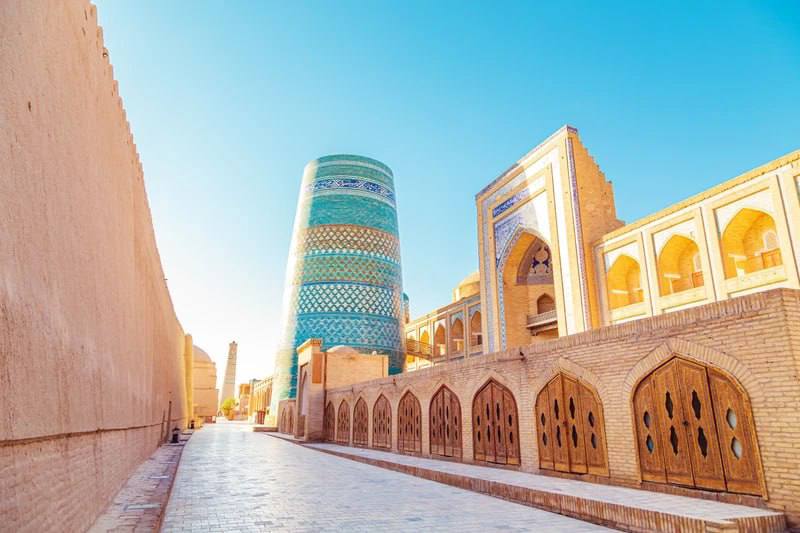
What sets the Kalta-Minor apart is its skin: it is the only minaret covered entirely in glazed tiles, in bands of turquoise, green and white. Stand close and each band turns out to be a different geometric pattern, stacked like rings. The inscriptions carry verses by Muhammad Riza Ogahi, the Khivan poet and historian; 12 of his 16 verses can still be read on the minaret. One compares it to Tuba, the tree of paradise, and to a pillar holding up the sky.
Some of the lettering was broken off in Soviet times. For Khiva’s 2,500th anniversary in 1996–1997 the minaret was restored, and the lost inscriptions were put back from Ogahi’s own manuscript.
Why it stopped at 29 metres: the chronicle and the legends
The chronicle is brief. In 1855 Muhammad Amin Khan was killed in battle near Sarakhs, on a campaign against the Turkmens, and the khans who came after him did not carry on.
Khiva prefers its legends, and our guides tell two. In the first, the ruler of Bukhara secretly hired the master builder to raise an even taller minaret in Bukhara; the khan found out, the master never laid another brick, and the tower stayed as it was. In the second, the khan wanted to see Bukhara from the top, far across the desert. The master knew no tower could do that and slipped out of Khiva before the khan found out.
Both are stories, not history. The ambition behind them is real, though, and you can measure it yourself: walk around the base, about 45 metres, and picture it rising to the height of a 25-storey building.
Islam Khoja: the vizier who built schools
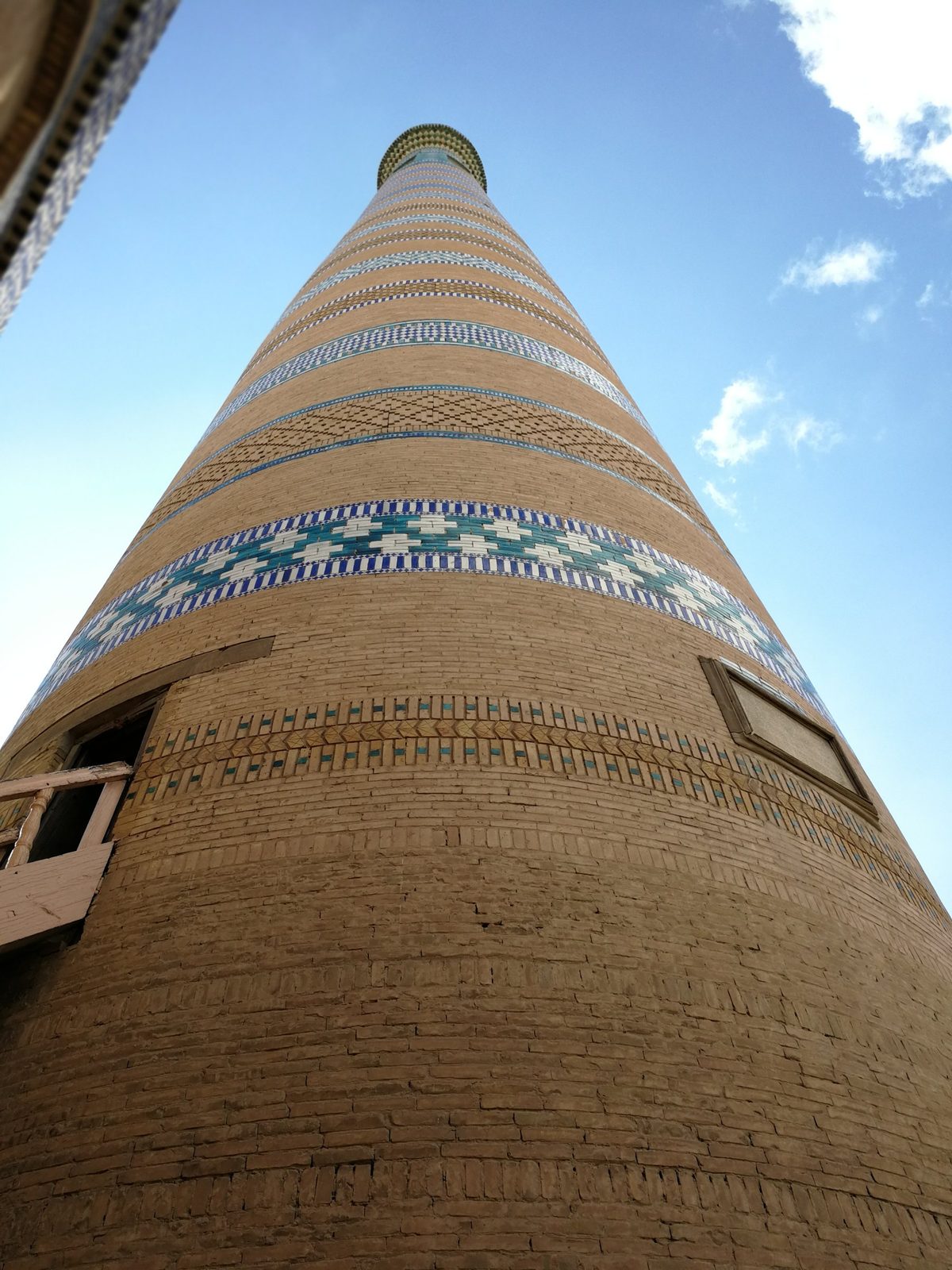
Islam Khoja was the first vizier of Khiva under Muhammad Rahim Khan II and then under his son Isfandiyar Khan, whose father-in-law he was. He is remembered as a moderniser. From his own funds he paid for a hospital, a pharmacy, a post and telegraph office, secular schools, a cotton gin and new iron bridges.
In 1908–1910 he built the last large ensemble of Ichan-Kala: a madrasah, a mosque and a minaret. The architect was Khudoybergan Haji, and the decoration was the work of the masters Eshmuhammad Khudoyberdiev and Bolta Voisov.
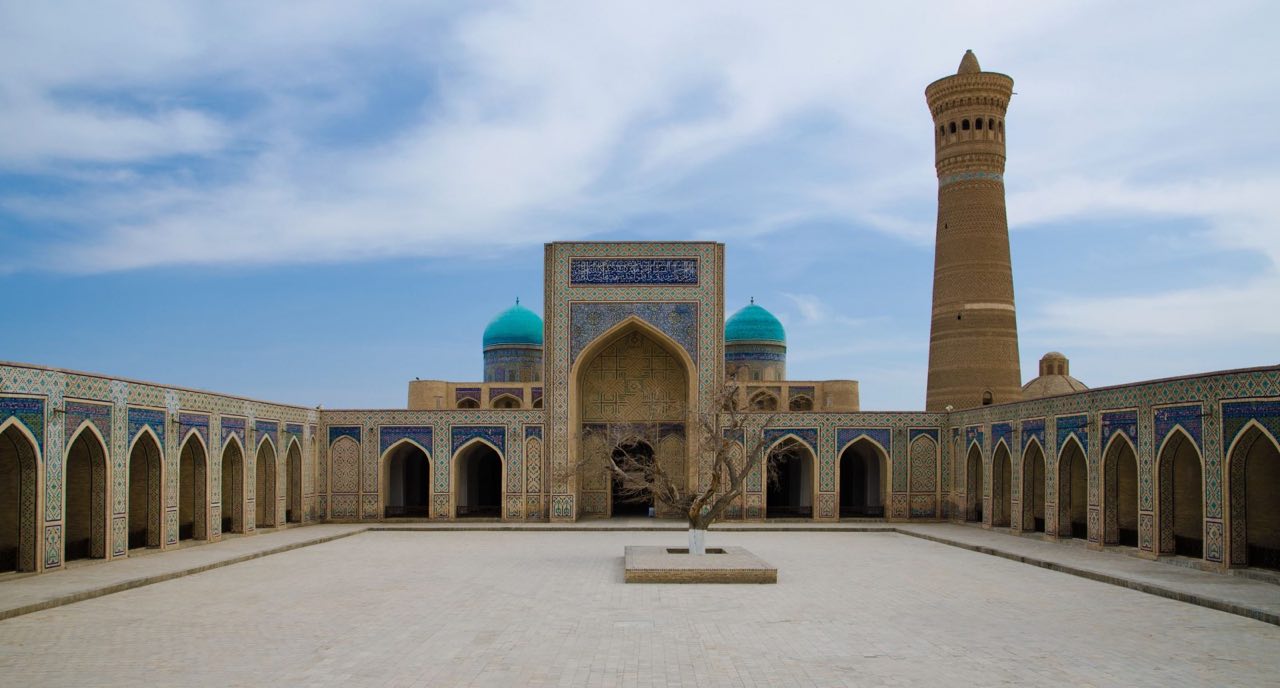
The minaret is 56.6 metres tall, 57 with its foundation: the tallest in Khiva and taller than the Did you know? Diggers went 13 m down and never found its base The Kalyan Minaret of 1127 rises about 46 m, and an excavation reached 13 m without finding the bottom of its foundations. Genghis Khan reportedly ordered it spared. Read more → in Bukhara. From a base 9.5 metres across it narrows steadily to a lantern with windows, a stalactite cornice and ceramic lattices. Bands of dark blue, white, blue and green glazed tiles ring the brick at intervals, a deliberate echo of the minarets of the 11th and 12th centuries.
Inside the madrasah: the museum of Khorezm applied art
The madrasah is the smallest in Khiva: 42 cells around a courtyard of about 23 by 20 metres, with the mosque taking up one whole side. Since 1983 it has housed the museum of Khorezm applied art; the display was renewed in 1991 and 2014.
This is the place to see up close the crafts that decorate the rest of Khiva. Woodcarving comes first, including a carved double door with Arabic inscriptions that has been shown at an exhibition in Germany. Around it are chased copper, jewellery, textiles and carpets, clay vessels, everyday objects, coins and stones with old Arabic inscriptions: more than 400 pieces from the 14th century to the 21st.
Give the museum half an hour, before or after the climb.
Up the 175 steps
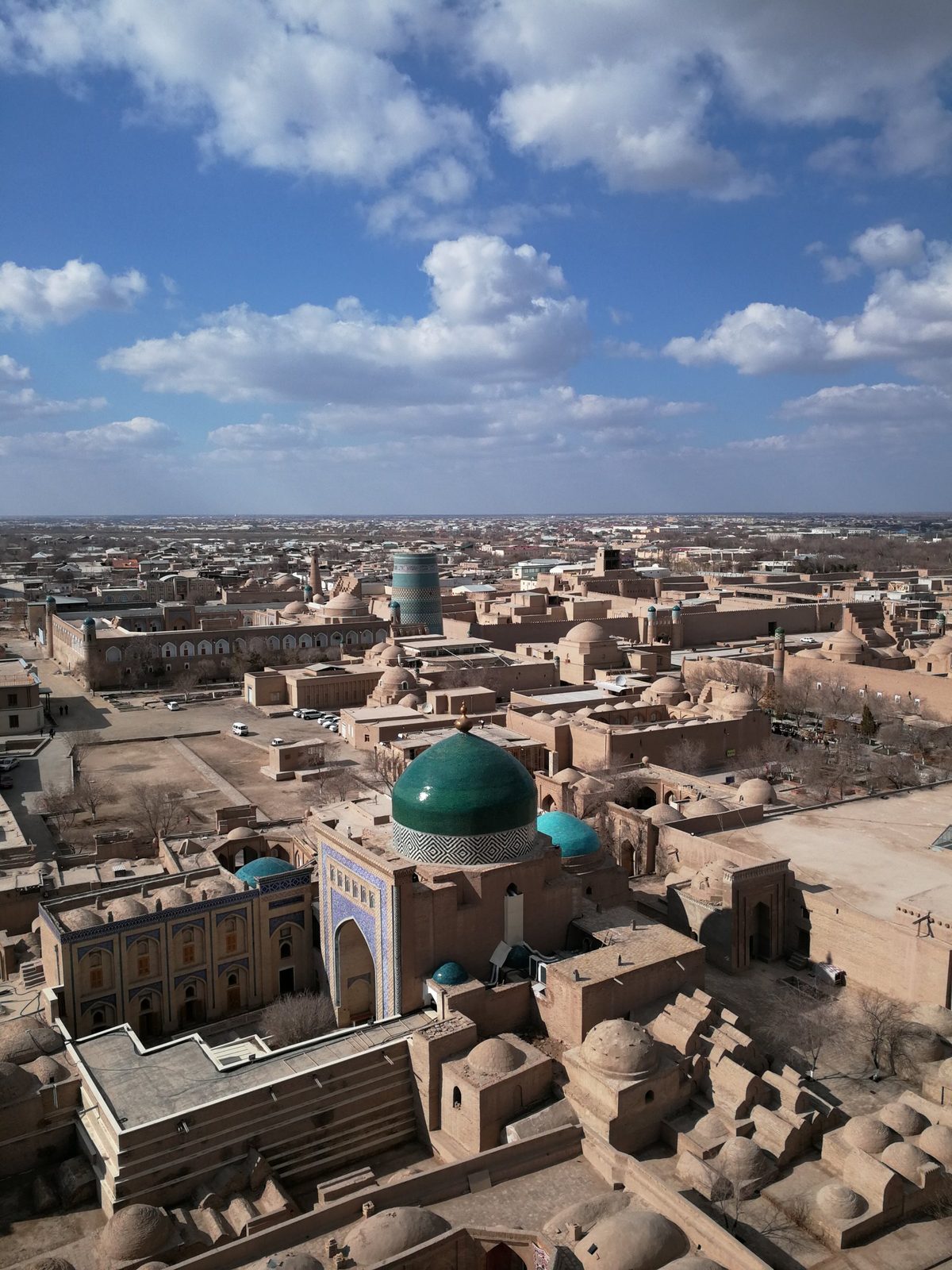
The Kalta-Minor is admired from the ground; the Islam Khoja is the minaret visitors climb. A spiral staircase of fired brick, 175 steps, winds up inside the tower to the lantern, where windows open at about 45 metres: the highest viewpoint in Khiva.
From there you see the plan of Ichan-Kala at once: the tiled dome of Pahlavan Mahmud directly below, the flat clay roofs and small domes of the houses, the crenellated line of the walls and, across town, the turquoise drum of the Kalta-Minor.
- The staircase is narrow, steep and dark, with worn steps. Use your phone torch, leave big bags below and take your time on the way down.
- It is not for anyone with bad knees or a fear of tight spaces. The Ak Sheikh Bobo watchtower of the The old fortress-residence of the khans of Khiva, inside the walls of Itchan Kala. gives a similar view over the old town.
- Whether the minaret is open that day, until what time and whether the climb is included in the combined ticket are decided at the ticket office. We never promise the climb in advance.
- Go up in the morning or in the late afternoon, when the low sun picks out the domes.
Where to photograph the two minarets
- The square inside the West Gate. The classic Kalta-Minor picture: the whole drum with the madrasah beside it. Come at sunrise for an empty square or in the last hour of light, when the tiles glow.
- At its foot. Lean back and shoot straight up: the bands of pattern close in towards the sky. It is also the best way to see the inscriptions.
- The street along the wall. The lane between the clay wall and the madrasah puts the Kalta-Minor at the end of a long row of arches.
- The Ak Sheikh Bobo watchtower. From the top of the Kunya-Ark both minarets fit into one frame, with the roofs of the old town between them.
- Rooftop café terraces. Several cafés inside the walls have terraces at roof level with a minaret over the parapet.
- Islam Khoja with Pahlavan Mahmud. The banded minaret beside the tiled dome of the mausoleum is the second classic picture of Khiva, at its best in the evening.
At sunset we split the hour: the Kalta-Minor while the light is golden, then up to the watchtower or a roof terrace as the sun goes down behind the walls. Ask before you photograph people. Coming mainly for the pictures? See our photo tour of Uzbekistan.
One walk for both, and the practical part
Both minarets lie on the usual walk through Ichan-Kala. Our route: in through the West Gate to the Kalta-Minor and the Kunya-Ark; along the main street past the ;Did you know? Khiva's Juma Mosque stands on 212 wooden columns Recorded as early as the 10th century and rebuilt in 1788, the Juma Mosque has no portal and no domes: its flat roof rests on 212 carved columns in 17 rows, and some of them are older than the building itself. Read more → then south to Pahlavan Mahmud and the Did you know? A grand vizier brought Khiva a hospital and a telegraph Islam Khoja, grand vizier of Khiva from 1898, funded the khanate's first European-style school, a hospital, a pharmacy, a post office and a telegraph. In 1908–1910 he also built the small madrasah beside his famous minaret. Read more → for the museum and the climb; and back to the Kalta-Minor at the end of the day for the evening light.
- Getting there: the fast Jaloliddin Manguberdi train leaves Tashkent at 07:00 and reaches Khiva at 14:31, every day except Sunday; the station is a half-hour walk from the walls. See trains in Uzbekistan.
- Tickets: the Kalta-Minor is free to see from the street. The museum and the minaret belong to the Ichan-Kala museum-reserve: buy the combined ticket at the office by the West Gate and ask there what it includes. Cards for each monument are in Bukhara and Khiva sights.
- Hours: the lanes never close; the museum and the minaret keep daytime hours set by the ticket office.
- How long: 15 minutes at the Kalta-Minor, longer if you come back for the evening light; about an hour for the Islam Khoja museum and climb.
- Dress: no strict dress code at either minaret, but next door at Pahlavan Mahmud cover shoulders and knees. Wear shoes with a good grip for the staircase.
- Afterwards: take a taxi to Arda Khiva on Lake Govuk. It has its own copy of the Kalta-Minor, so you can compare it with the original you saw at sunset.
With one of our guides, this walk is the Khiva walking tour. All our routes through the city are under Khiva tours, and more about the city is on the Khiva page.
In short
- The Kalta-Minor (1852–1855) is 29 metres tall and 14.2 metres across: the base of a 70–80-metre tower that stopped when its khan died, and the only minaret covered entirely in glazed tiles.
- Legends blame a disloyal master builder or an impossible view of Bukhara; the chronicle names a battle in 1855.
- The Islam Khoja minaret (1908–1910) is 56.6 metres, the tallest in Khiva, built by a vizier who also gave the town a hospital, a post office and schools.
- His madrasah holds the museum of Khorezm applied art; the minaret’s 175 steps lead to the highest viewpoint in town on the days it is open.
- Photograph the Kalta-Minor at sunrise or in the golden hour, both minarets together from the Kunya-Ark watchtower, and end the day at .A new tourist complex on the shore of Lake Govuk, a short drive from Ichan-Kala, opened in May 2025: 17 hotels and guest houses, a 3,000-seat amphitheatre, restaurants, a bazaar under domes and a canal with gondolas. Read more →