
Places in this article: Samarkand · Bukhara · Khiva · Tashkent
Uzbek ceramics: the schools of Rishtan, Gijduvan, Khorezm and Samarkand
Put a Did you know? Legend says a Rishtan apricot made a great scholar praise God Legend says 12th-century Rishtan folk brought a new apricot to their countryman Burhan al-Din al-Marghinani in Samarkand; he tasted it and said 'Subhanallah' three times, so it is called subhoni. The scholar is real: he wrote al-Hidaya. Read more → bowl next to one from Gijduvan and you will not need a guide to tell them apart. One is turquoise and cobalt on milky white. The other glows honey-yellow, green and brown, its glaze run into soft streaks in the kiln. The colours come from two different glazes, and that split runs through all of Uzbek ceramics.
Here is our map of the schools, as we explain it to guests before the first workshop: what each centre makes, how to recognise it on a shelf, where to see the finest pieces and where to buy from the people who made them. The step-by-step story of one town, from the clay to the kiln, is in our guide to Rishtan ceramics.
Three schools, two glazes
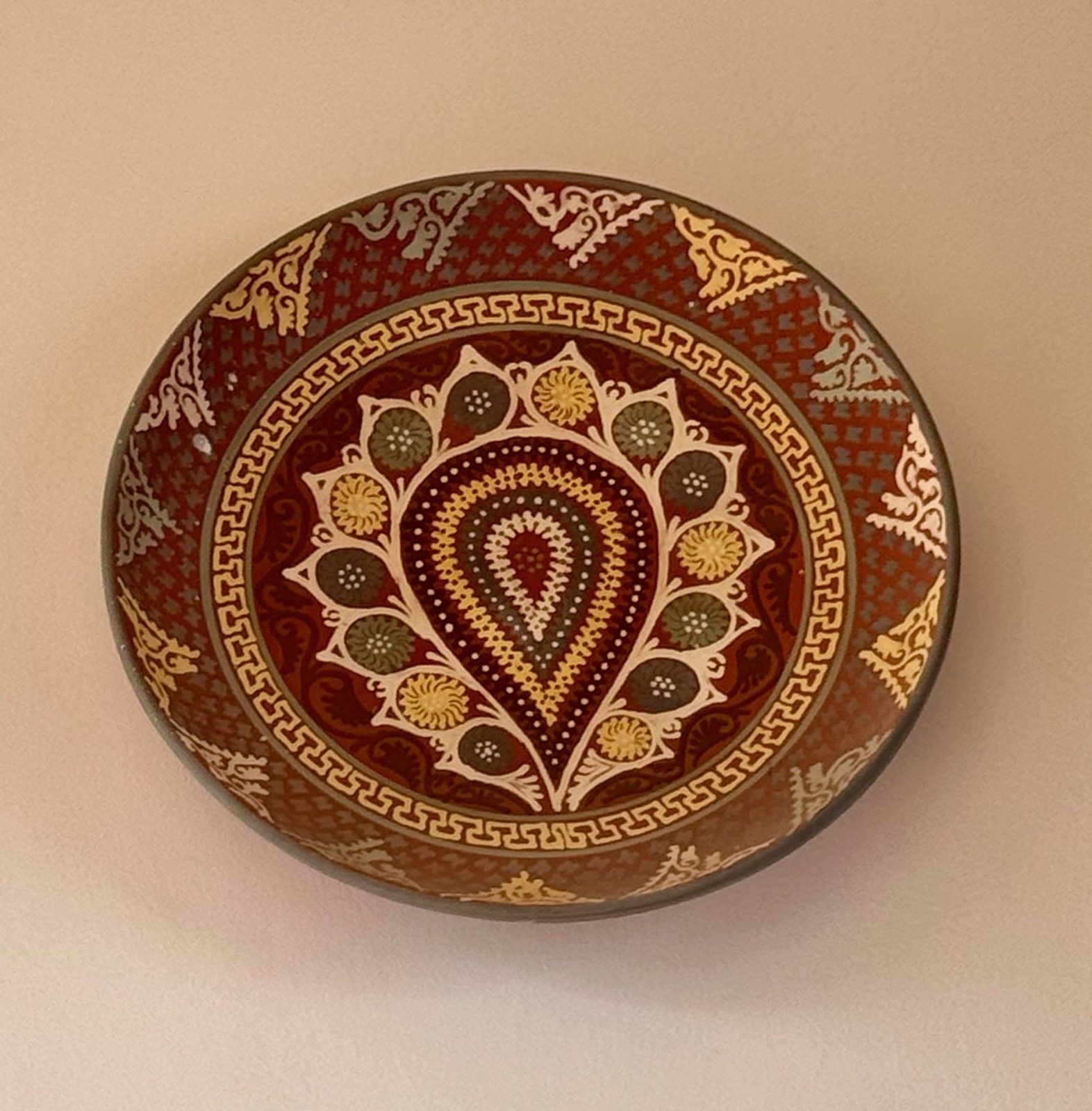
By the 19th century the potteries of today’s Uzbekistan fell into three large schools. The Fergana school, with Rishtan and Gurumsaray, and the Khorezm school around Khiva both worked with ,Did you know? Rishtan’s famous blue comes from the ash of steppe plants Rishtan’s traditional glaze, ishkor, is an alkali made from the ash of wild plants gathered in spring and mixed with quartz sand; copper turns it turquoise. Most workshops now use ready-made glazes, but a few masters have revived the old recipe. Read more → an alkaline glaze that gives blue and turquoise. The Bukhara–Samarkand school, from Gijduvan and Bukhara to Samarkand, Urgut and Shahrisabz, mostly used lead glaze, and its ware is yellow, green and brown.
So start with the colour. Blue on white points east to the Did you know? Legend says Fergana's 'heavenly horses' sweated blood Legend says the horses of Dayuan, as Chinese chronicles called Fergana, sweated blood, and around 102 BC Emperor Wu of Han sent an army to bring some home. The 'blood' was most likely a skin parasite that causes tiny bleeding spots. Read more → or west to Khorezm; warm earth tones point to the middle of the country. Tashkent sat in between, in style as on the map: its potters, who lived in the Kulolgaron quarter of the old city, borrowed from both the Fergana and the Bukhara–Samarkand schools.
Rishtan: turquoise from plant ash
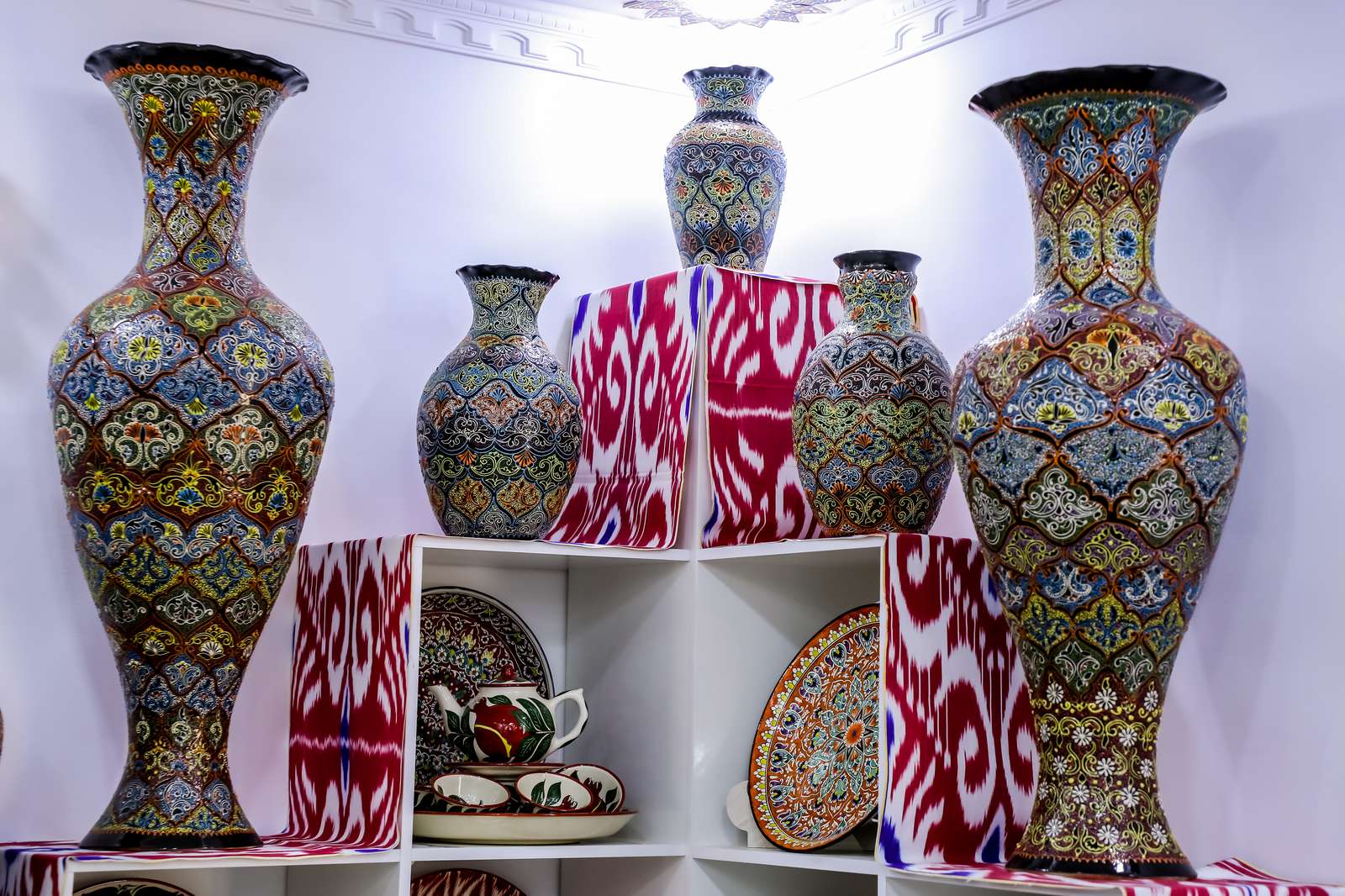
Rishtan, in the Fergana Valley, is the best-known name in Uzbek pottery. The town stands on a layer of red clay that can be used straight from the ground, and its ishkor glaze is made from the ash of wild herbs mixed with quartz. Over painted white slip it gives the classic palette: turquoise, dark blue and brown on a milky-white ground, with pomegranates, almond blossom and chains of leaves. About a thousand people in Rishtan work in pottery, and in 2025 the town was named a .Did you know? Kokand was the first World Craft City in the CIS In 2019 the World Crafts Council, founded in 1964 and affiliated with UNESCO, named Kokand a World Craft City for woodcarving — the first in the CIS. The carved columns of the Juma Mosque and the palace ceilings show why. Read more →
The family glaze recipes, the road from the wheel to the kiln and the potters’ dynasties are all in our Rishtan guide. To sit at the wheel yourself, take our four-day Fergana Valley crafts tour: it includes a session with a Rishtan master, at the wheel or with the brush.
Gijduvan: honey, green and brown
Gijduvan, about 40–45 km north-east of Bukhara, is the living centre of the Bukhara–Samarkand school. Its ware is warm: golden yellow, ochre, green and brick red over a brown or light ground, with flowers combined with geometric patterns. The lead glaze moves in the kiln, so the colours flow into one another, and layers of slip give the surface a slight relief you can feel with a finger.
The craft is kept by families. The best known, the Narzullaevs, are in their sixth generation of potters, and in 1992 the family opened a museum of ceramics in its workshop. Gijduvan also has a An Islamic college: student cells and classrooms around a courtyard behind a grand portal. In the old towns many now house museums and craft workshops. built by Did you know? Ulugh Beg measured the year to within 25 seconds Working at his Samarkand observatory, Ulugh Beg put the tropical year at 365 days 5 h 49 min 15 s, about 25 seconds too long, closer than Copernicus a century later. Read more → in 1433, so half a day here gives you both. From Bukhara we run Gijduvan: ceramics workshop and lunch, with a car and a guide; what else to see on the way is in around Bukhara: day trips.
Khorezm: cobalt and white, from tiles to dishes
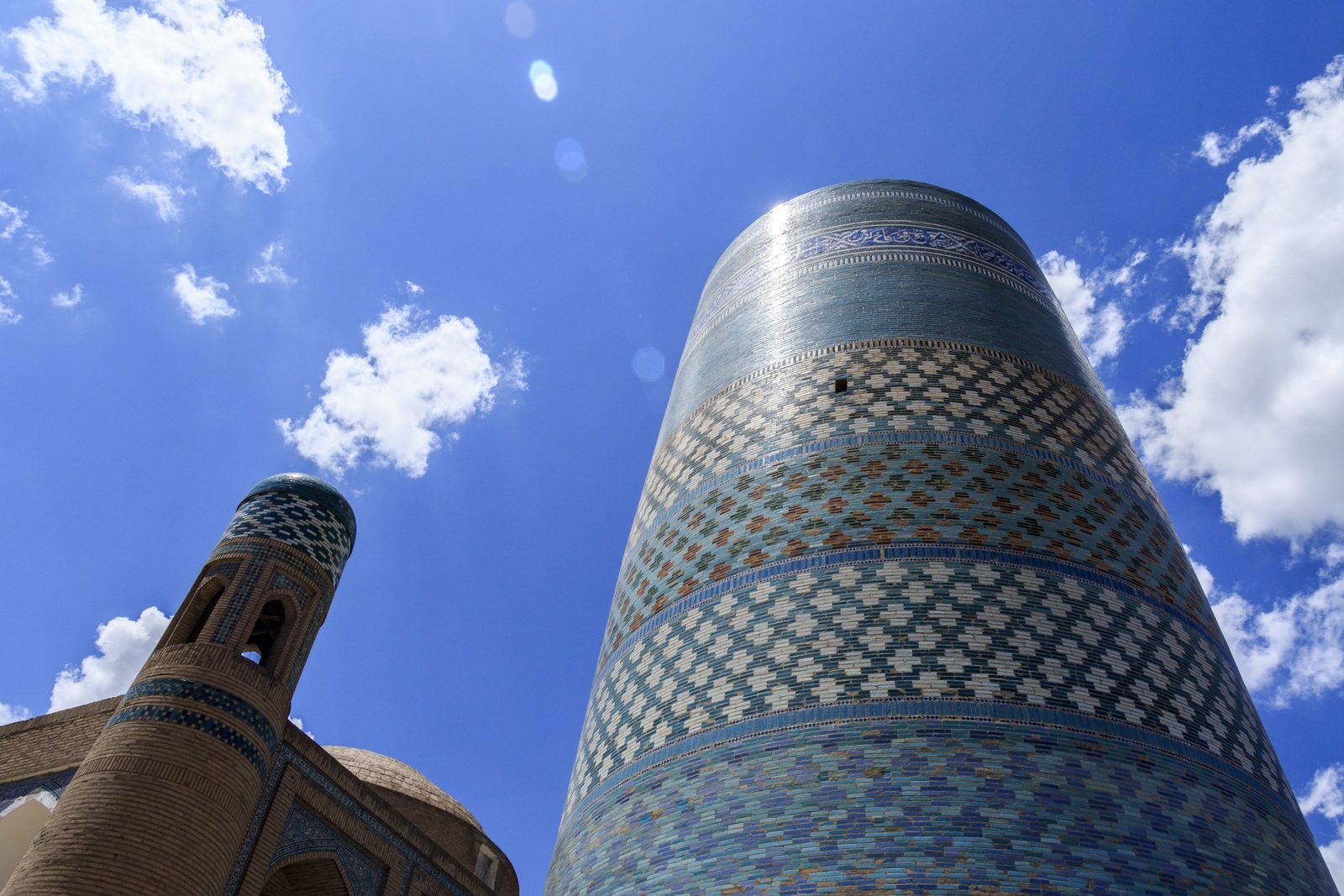
In Khorezm, around Khiva, pottery and architecture speak the same language. The potters of Madyr and Kattabog, the main centres near Khiva, used the same alkaline glaze as Fergana, and their ware is blue and turquoise on white, often a deep ultramarine. The patterns come from the tilework of buildings: ,Did you know? Physicists argued that girih patterns behave like quasicrystals In 2007 the physicists Peter Lu and Paul Steinhardt argued that girih patterns, laid with a small set of tile shapes, have the properties of quasicrystalline tilings, the kind Western mathematics described only in the 1970s as Penrose tilings. Read more → the geometric knot of stars and polygons, comes first, then vines and shoots, and stylised everyday things such as knives, combs and musical instruments.
Look for the badiya, a large dish with high, upright sides: only Khorezm made it. At the start of the 20th century the region had 15 ceramic workshops with more than 80 masters. Then walk through Did you know? People still live inside Khiva's museum city Itchan Kala packs more than 50 historic monuments and about 250 old houses inside clay walls 8–10 m high and 5–6 m thick, and families still live and work in its lanes. Read more → with the same eyes: the blue and white tiles of the Did you know? In Tash-Hauli's harem each of four wives had her own loggia Allakuli Khan built the Tash-Hauli palace in 1830–1838 around three courtyards. In the harem four tall loggias belonged to the khan's four wives and a fifth, the largest, to the khan himself; behind each summer terrace lay a winter room. Read more → palace are the work of the master Abdullah Jin, and the Did you know? A 14-metre-wide base for a tower that stopped at 29 m Kalta-Minor was begun in 1852 and meant to reach 70–80 m, but work halted in 1855 at about 29 m when its khan died. It is said to be the only minaret covered entirely in glazed tiles. Read more → is the only minaret covered entirely in glazed tiles. Our Itchan Kala guide goes building by building, and at Arda Khiva you can paint a ceramic dish yourself.
Samarkand, Urgut and Shahrisabz
Samarkand’s great contribution is old. In the 9th–11th centuries potters here and in Nishapur made bowls coated with white slip and written over in dark Kufic script, usually a proverb or a blessing. Excavations at ,Did you know? A 7th-century mural shows envoys from Korea Uncovered by road builders in 1965, the Ambassadors' Painting at Afrasiyab shows delegations bearing gifts, Chinese with silk among them, and two men in feathered hats thought to be envoys from Korea's Goguryeo. Read more → the ancient city on the northern edge of Samarkand, have turned up large numbers of them since the 1870s. The museum on the site is in our guide to the museums of Samarkand and Bukhara.
The living tradition is in Urgut, about 40 km south-east of the city. Urgut ware is easy to spot: green glaze dripped over a golden-yellow ground, and jugs and dishes engraved with a needle in archaic designs called chizma. The local school traces itself to a master of the 17th century. Urgut’s big bazaar sells ceramics too, and its textile section is fullest on Sundays and Wednesdays; we pair it with the old plane trees of Chor-Chinor, as in around Samarkand: day trips.
Shahrisabz belongs to the same school, and its older pottery is known for abstract designs in a rich, warm palette. Today the town is better known for embroidery: in 2026 it became a World Craft City for it, and our suzani guide explains its stitch.
Where to see the finest pieces
- Tashkent: the ,Did you know? A diplomat's house that became a museum of crafts In 1896 diplomat Alexander Polovtsov bought a merchant's house and had it rebuilt in the Central Asian style. Today it is the Museum of Applied Arts, with over 7,000 pieces of folk craft. Read more → in the Polovtsov house, holds more than 7,000 pieces, ceramics among them. We bring guests here before Samarkand and Bukhara: after an hour you read a bazaar shelf differently. More in museums of Tashkent.
- Samarkand: the Afrasiyab Museum, for the finds from the ancient city.
- Bukhara: the museum of Varakhsha and Bukhara ceramics in the Did you know? A caravanserai that became a madrasah by a khan's word Nadir Divan-Begi built his 1622 building by Lyabi-Hauz as a caravanserai. At the opening Imam Quli Khan praised it as a fine madrasah, and a khan's word could not be taken back: a portal and cells were added, and a madrasah it became. Read more → khanaqah at .Did you know? Bukhara's ponds were once its water supply Pools like Lyabi-Hauz, dug around 1620 and 46 × 36 m, were the city's main source of water. Most were filled in during the 1920s–30s because they spread disease; Lyabi-Hauz survived. Read more →
- Khiva: the museum of Khorezm applied art in the .Did you know? A grand vizier brought Khiva a hospital and a telegraph Islam Khoja, grand vizier of Khiva from 1898, funded the khanate's first European-style school, a hospital, a pharmacy, a post office and a telegraph. In 1908–1910 he also built the small madrasah beside his famous minaret. Read more →
- Rishtan and Gijduvan: the Rishtan Traditional Pottery Museum, opened in 2025, and the family museum in the Narzullaev workshop.
Hand-painted or printed, and where to buy
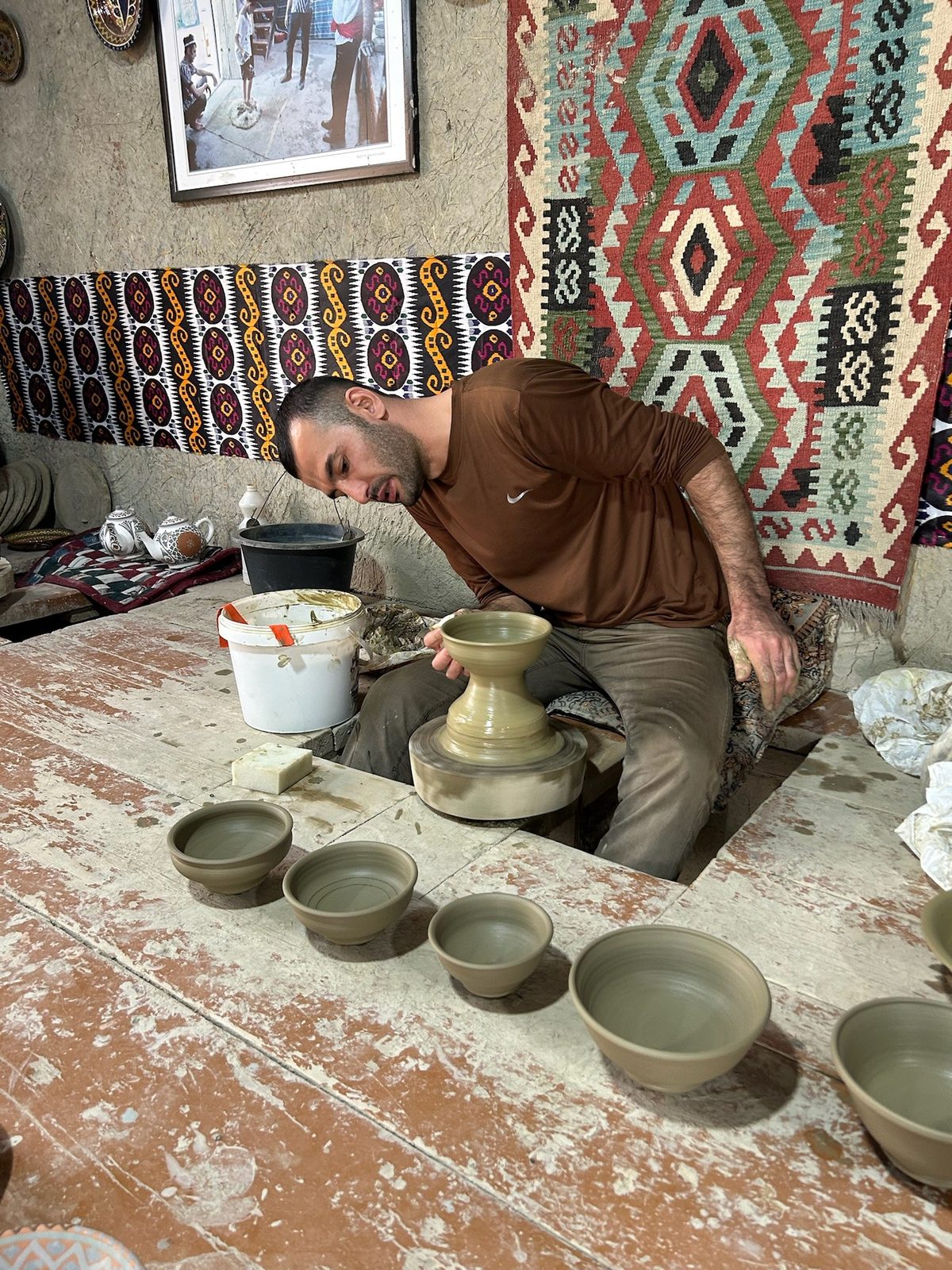
The best place to buy is the workshop: you pay the people who made the piece, and you can ask about anything on the shelf. Bazaars such as Tashkent's old bazaar under a big blue-green dome, not far from Hazrati Imam. Bring cash in so'm. Read more → in Tashkent and Samarkand's main bazaar, right next to Bibi-Khanym: Samarkand bread, dried fruit, nuts and halva. Read more → in Samarkand are good for everyday bowls. A few minutes with a piece in your hands tells you most of what you need:
- Follow a line. A brushstroke thins as the paint runs out and does not break; a transfer print shows dotted lines and joins that do not quite meet.
- Compare two. Hand-painted repeats always differ a little. Two plates identical line for line were not painted by hand.
- Look at the glaze. Gijduvan pieces are fired upside down on a small tripod: look for glaze gathered at the rim and three tiny marks on the base.
- Turn it over. Many workshops sign the base. A mark alone proves little; a mark plus a workshop you have stood in is the best guarantee there is.
Other crafts, from Did you know? One suzani was often stitched by several women at once A family member or a pattern drawer, the kalamkash, drew the design across strips of cotton. The strips went to different women of the family or neighbourhood, who embroidered them at the same time; sewn back together, they show slightly mismatched seams. Read more → to knives, and how to bargain, are in what to buy in Uzbekistan; our older overview of ceramics, carpets and suzani covers carpets and weaving.
Getting it home
New handmade ceramics need no export certificate. The rules are for pieces fifty years old or more, which generally may not leave the country, and for some newer pieces of artistic value. Keep your receipt, and read registration and customs in Uzbekistan before you fly.
- Ask the workshop to wrap every piece separately and box the set.
- Carry plates and bowls in your hand luggage, standing on edge. Stacked flat in a checked suitcase, they crack.
- For a big platter or a tall vase, ask before you pay how it can be packed for a flight.
- Ask the master whether a piece is meant for the table or for the wall.
Ceramics in our tours
For the two old cities, our five-day Crafts of Bukhara and Samarkand tour ends with the potters of Gijduvan, a session at the wheel or painting a plate with a master, and lunch, after paper-making at ,A village near Samarkand where paper is made by hand from mulberry bark, the old way, at a working mill on the stream. the woodcarvers of Samarkand and the gold embroidery of Bukhara. For Rishtan, take the Fergana Valley crafts tour; the two tours join by train. On both, a guide speaking your language is included in the price. Sessions with masters depend on their schedules, so we agree them for your dates in advance.
In short
- Blue and turquoise on white: Rishtan and the Fergana Valley, or Khorezm, both with the alkaline ishkor glaze.
- Yellow, green and brown: the Bukhara–Samarkand school and its lead glaze; Gijduvan is its living centre.
- Khorezm: girih patterns taken from architecture and the high-sided badiya dish.
- Urgut: green dripped over golden yellow, and needle-engraved chizma.
- Buy in the workshop, check the brushwork, carry plates on edge in your hand luggage.