
 Deutsch
 English
 Español
 Français
 Italiano
 Polski
 Português
 Suomi
 Svenska
 Türkçe
 Русский
 עברית
 한국어
 中文
 日本語
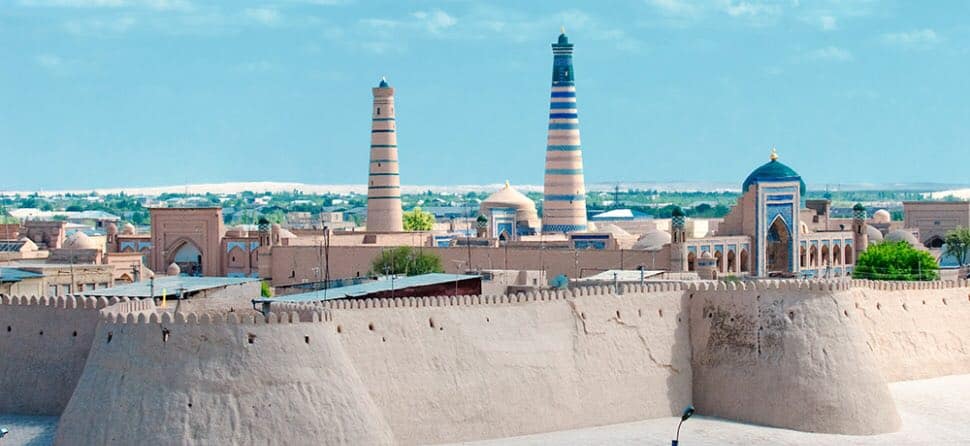
Places in this article: Samarkand · Bukhara · Khiva
Traditional Crafts of Uzbekistan: Which Town Makes What, and Where to Watch
Turn a Did you know? One suzani was often stitched by several women at once A family member or a pattern drawer, the kalamkash, drew the design across strips of cotton. The strips went to different women of the family or neighbourhood, who embroidered them at the same time; sewn back together, they show slightly mismatched seams. Read more → over before you buy it. On the back of a hand-embroidered piece you will see the stitches of several women: one hand a little tighter, another a little looser, a strip where the work passed from mother to daughter. A machine never leaves that trace. In Uzbekistan most crafts can be read like this, and each one has a home town where you can still watch it made.
We are a tour operator in Tashkent, and craft visits are among the stops our guests remember longest. This guide is a map: which craft belongs to which town, what to look at in the workshop, and how to tell a handmade piece from a souvenir. Several of these towns carry the title of World Craft City: Kokand for woodcarving since 2019, Rishtan for ceramics since 2025 and Shahrisabz for embroidery since 2026, while Margilan was named a world city of silk and ikat craftsmen in 2022.
Rishtan: the blue of the Fergana Valley
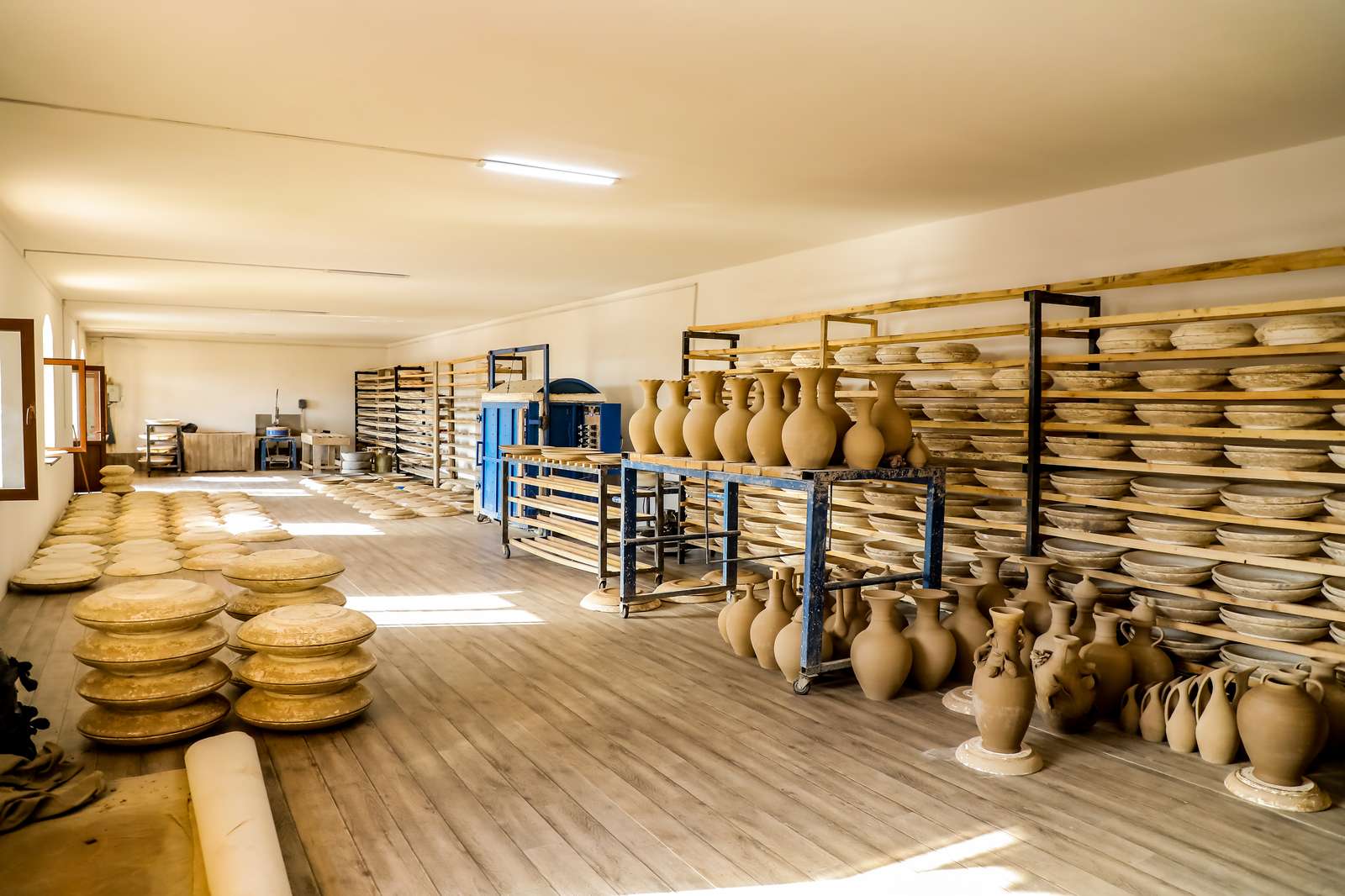
Rishtan, in the Fergana Valley, has made pottery since at least the 9th century. It owes its craft to two materials. The first is the red clay that lies right under the town and can be used almost without refining. The second is ishkor, a glaze made with the ash of desert plants, which gives Rishtan ware its deep turquoise and blue. The town has around a thousand potters, about a hundred of them from hereditary families, and a museum of traditional pottery opened during the town's international pottery forum.
In a good workshop you will see the whole cycle: the wheel, the white base coat, the painting by hand, the glaze and the kiln. Ask to see the kiln, not only the shop. More on the patterns and how to buy is in our article on Rishtan ceramics.
Gijduvan: the warm colours of Bukhara
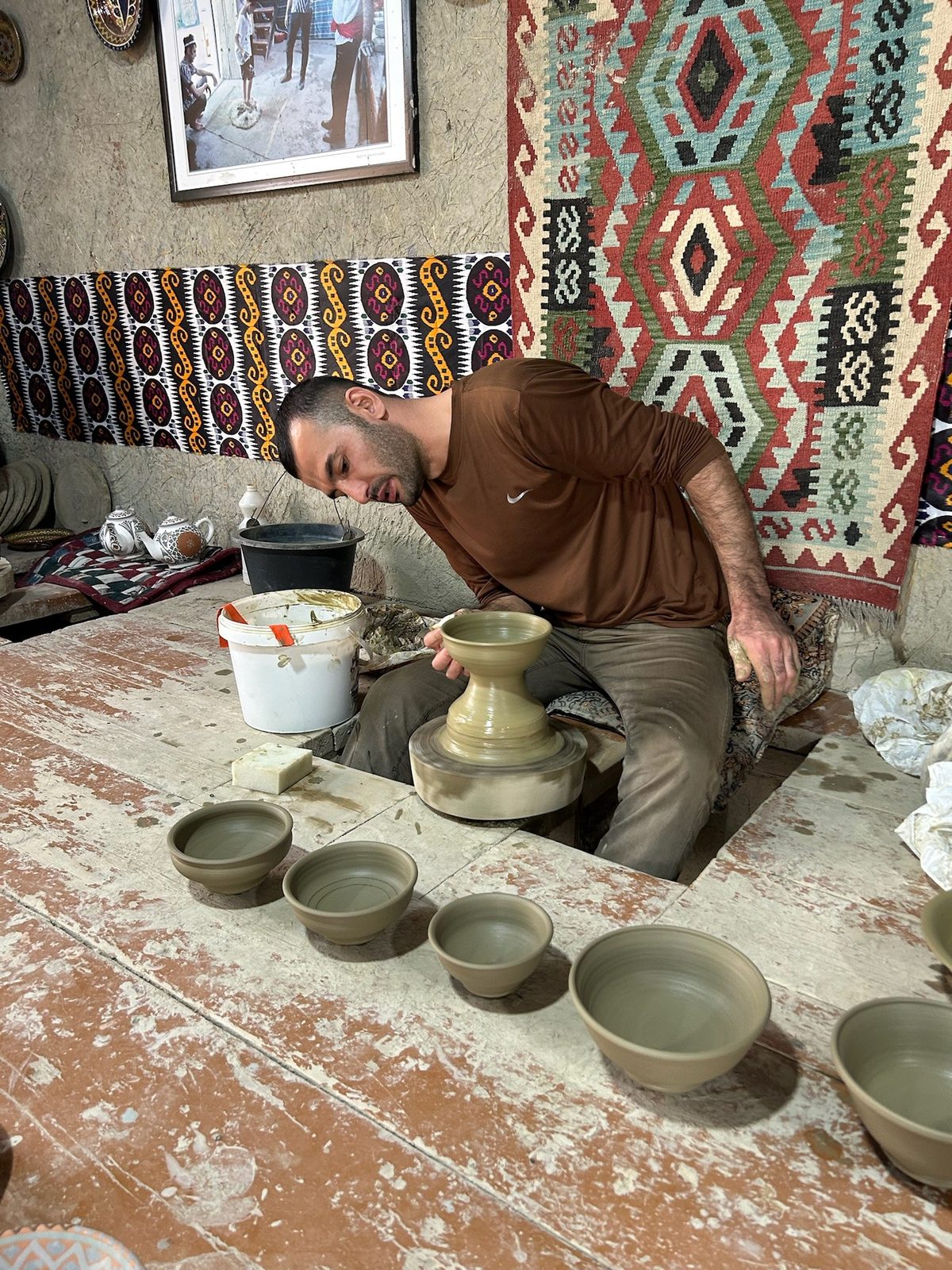
An hour from Bukhara, Gijduvan has its own school of ceramics, and after Rishtan you will recognise it at once: instead of blue, brown, ochre, yellow and green, with flowers and geometric patterns. The best-known workshop belongs to the Narzullaev family, potters for six generations, who opened a ceramics museum at their workshop in 1992. In its cases you can follow how the style changed, and after one visit you will never confuse a Gijduvan plate with a Rishtan one.
From Bukhara we organise a half-day trip to a Gijduvan ceramics workshop with lunch, and the town itself is covered in our guide to day trips around Bukhara.
Margilan: silk and ikat
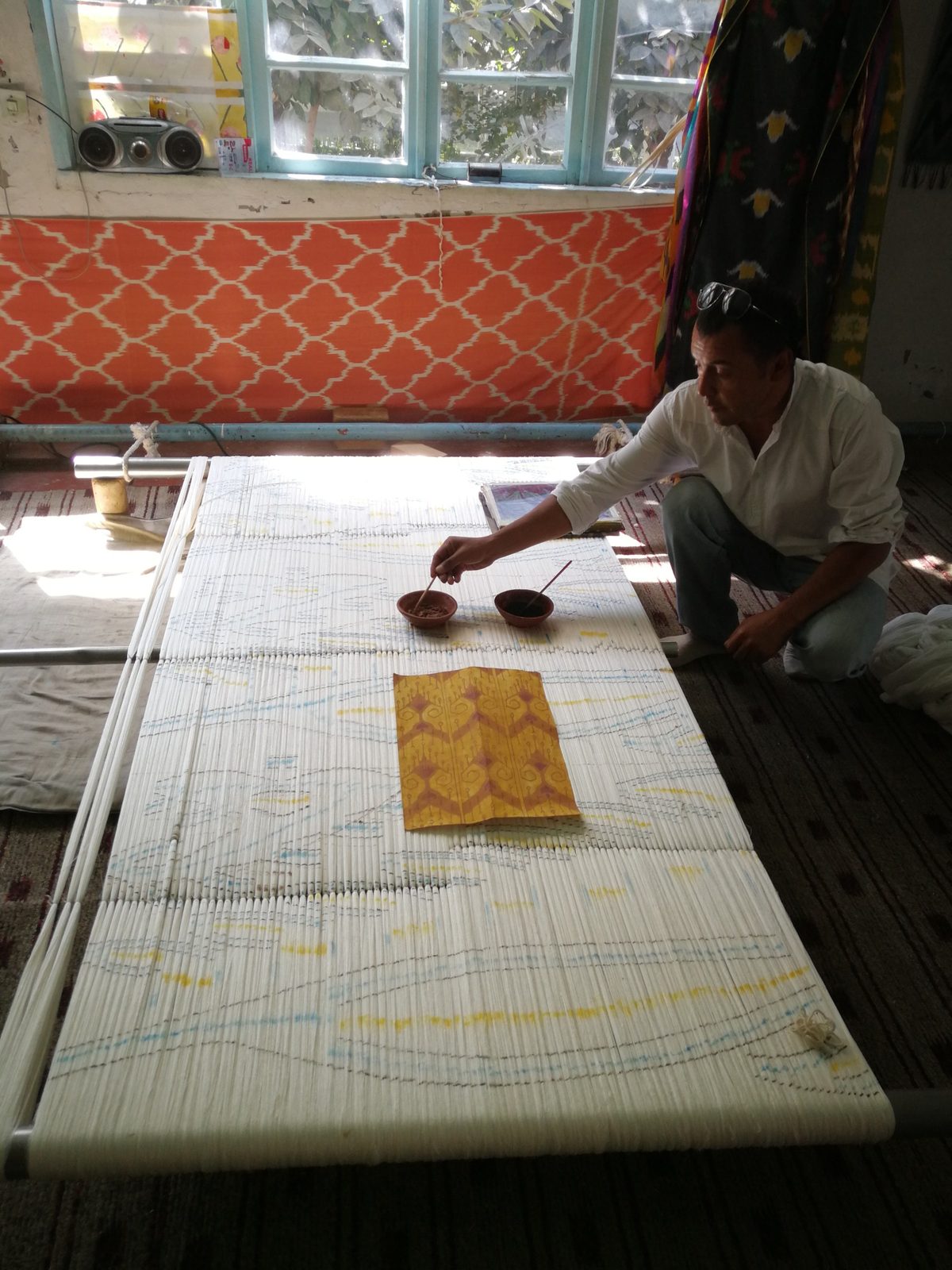
Margilan is the silk town of the Fergana Valley. Here you can watch the full path of silk: cocoons in hot water, reeling the thread, dyeing it, and weaving. The famous fabrics are atlas, all silk, and adras, with a silk warp and a cotton weft. Both are ikat: the pattern is tied and dyed into the threads before weaving, so the weaver has to know in advance where every patch of colour will fall. The threads shift slightly on the loom, which is why the edges of the pattern look soft and blurred. That blur is the signature of the technique.
The Yodgorlik factory, founded in 1972, is the easiest place to see it, and in 2017 UNESCO added the Margilan Crafts Development Centre for atlas and adras to its register of good safeguarding practices. Our article on Margilan silk and the Yodgorlik factory follows the process step by step.
Suzani: embroidery that told where it was made
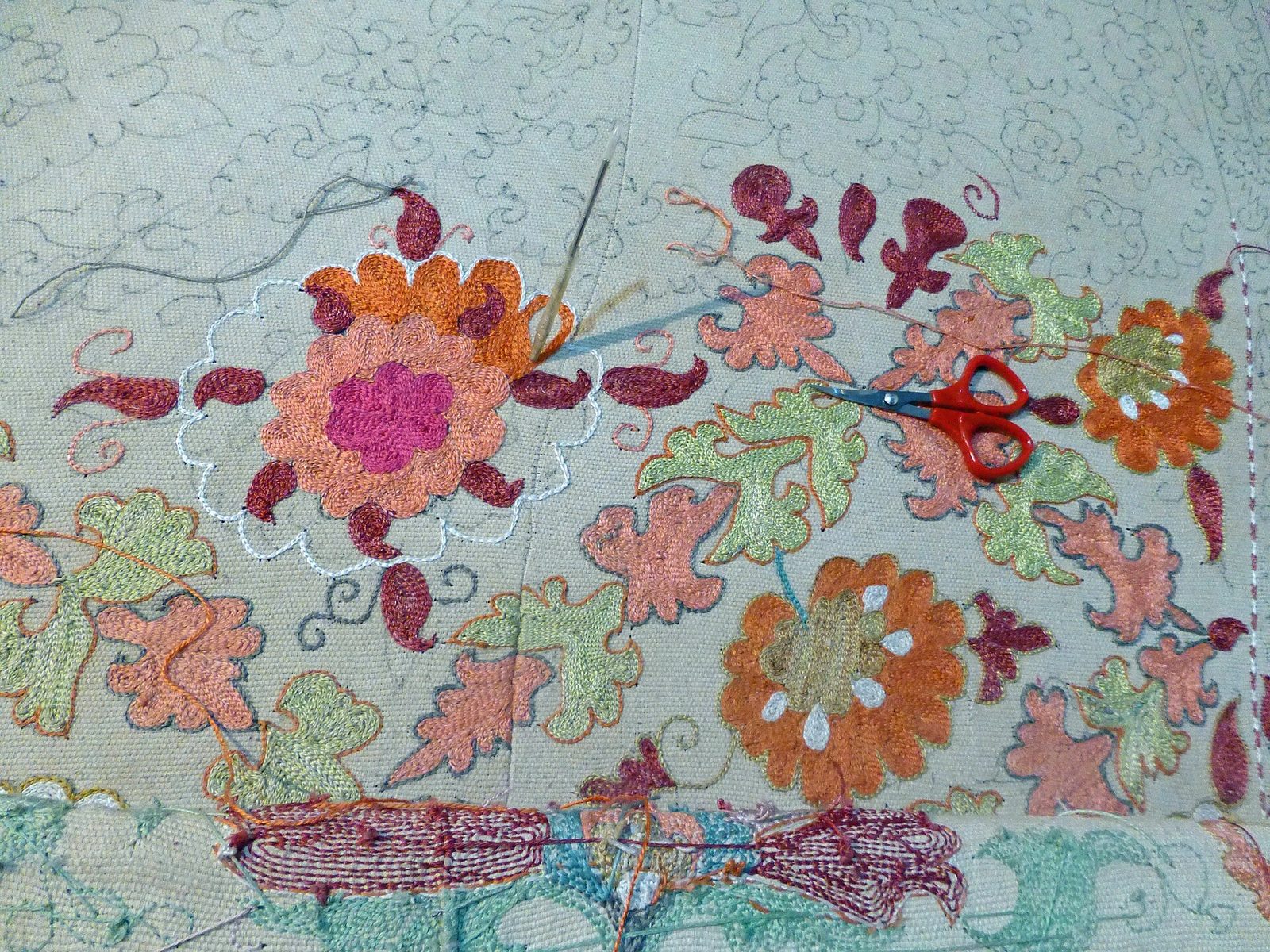
The word suzani comes from the Persian for needle. A suzani is a large embroidered cloth, traditionally part of a bride's dowry, often stitched in strips by several women and then sewn together, which is why the pattern sometimes does not quite meet at the seams. Each region had its own style: Bukhara, Did you know? Legend credits Alexander with Nurata's underground canals Legend says Alexander the Great founded Nur in 327 BC and laid its kariz, underground channels with wells dug a few metres apart for cleaning. Whoever built them, parts of the kariz near Nurata still carry water today. Read more → with its soft colours, Samarkand, and Shahrisabz with the fine iroqi stitch that won the town its World Craft City title in August 2026.
For old and new pieces side by side, go to the bazaar in Urgut near Samarkand, where the textile rows are fullest on Sundays and Wednesdays. How to choose a suzani, and what the motifs mean, is in our guide to suzani embroidery.
Paper from mulberry bark in Samarkand
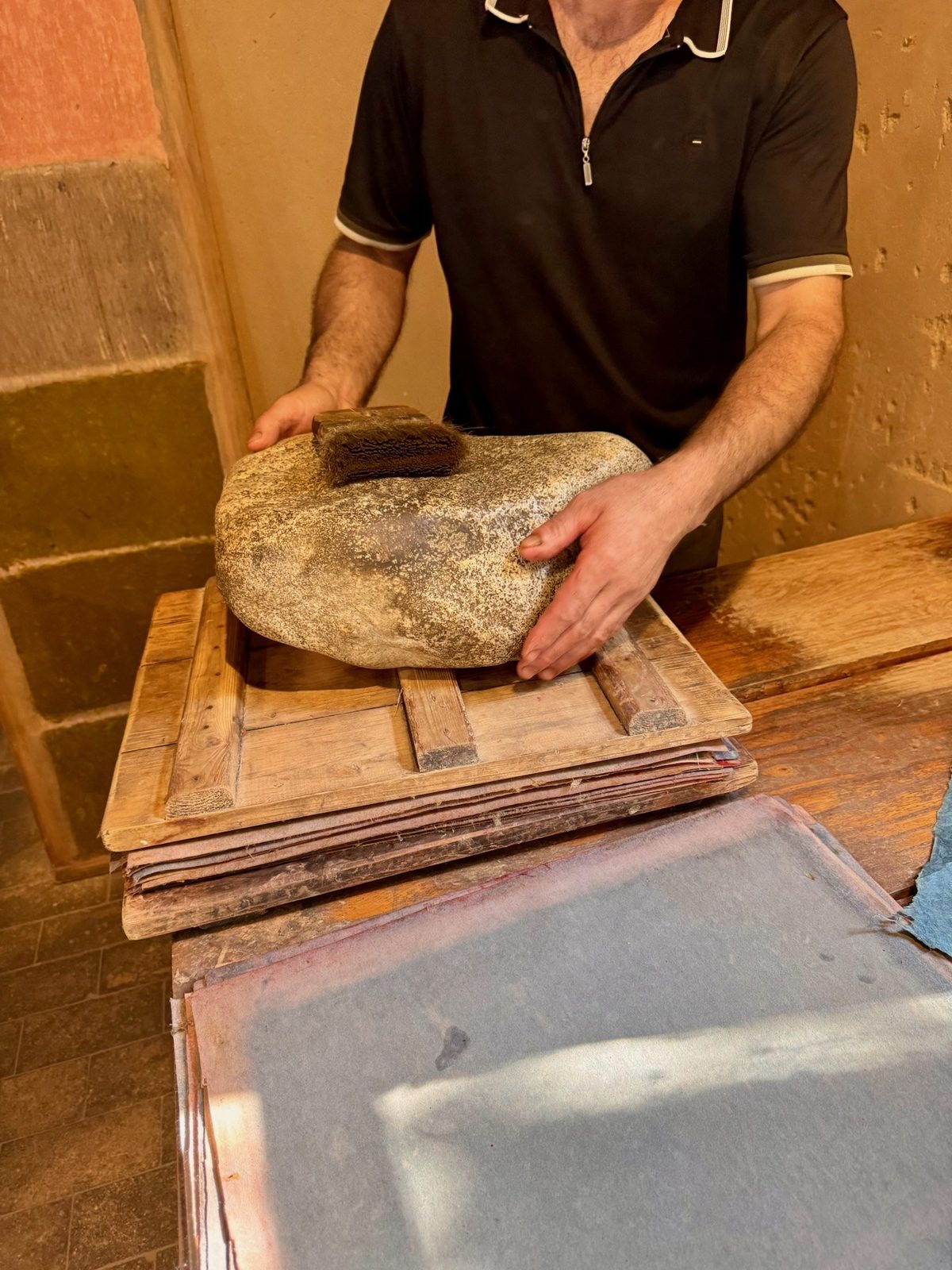
For centuries Did you know? Legend says Chinese prisoners taught Samarkand paper A legend recorded in the 11th century says Chinese prisoners taken at the Battle of Talas in 751 taught Samarkand to make paper. In fact paper was used here earlier, and the craft most likely came gradually along the Silk Road. Read more → was prized across the Muslim world. The method was lost in the 19th century and revived in the 1990s: in 1996 the Mukhtarov brothers founded the Did you know? Paper polished with stone, made to last 400 years At the Meros mill in Konigil, founded in 1996 to revive a craft that had died out, a water wheel beats mulberry bark into pulp, and each sheet is polished for hours with agate, shell or horn. It is made to last some 400 years. Read more → paper mill in the village of ,A village near Samarkand where paper is made by hand from mulberry bark, the old way, at a working mill on the stream. a short drive from the city. Bark from young mulberry branches is boiled, beaten by a mill turned by a water wheel, formed into sheets and polished with a stone until it shines. It is one of the most peaceful hours you can spend near Samarkand. Details are in our article on Samarkand paper and the Konigil mill.
Wood, steel and gold thread
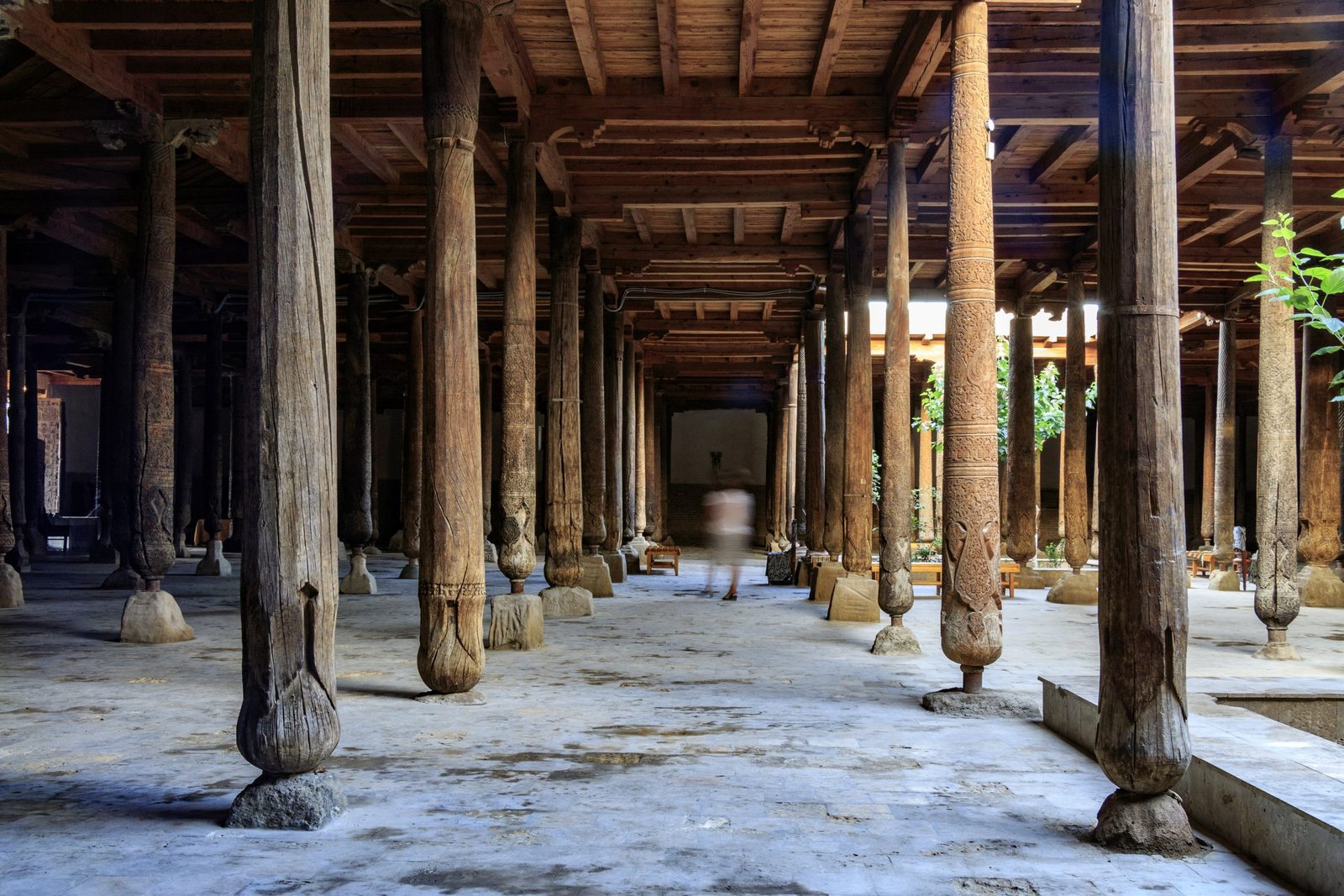
Khiva is the town of carved wood. The Did you know? Khiva's Juma Mosque stands on 212 wooden columns Recorded as early as the 10th century and rebuilt in 1788, the Juma Mosque has no portal and no domes: its flat roof rests on 212 carved columns in 17 rows, and some of them are older than the building itself. Read more → in Did you know? People still live inside Khiva's museum city Itchan Kala packs more than 50 historic monuments and about 250 old houses inside clay walls 8–10 m high and 5–6 m thick, and families still live and work in its lanes. Read more → stands on 212 wooden columns, some of them taken from older buildings, and carvers in the old town still make doors and columns by hand. In the Fergana Valley, Kokand holds the World Craft City title for woodcarving.
Steel belongs to Chust, in the Namangan region, famous for its knives with decorated blades and handles. Bukhara has two crafts of its own: metal chasing, which you can watch in the workshops around the ,Did you know? Under Bukhara's domes merchants changed money and gold Four 16th-century trading domes still stand over old crossroads. Toki Sarrafon was the money changers' dome, where merchants from India and China swapped coins; Toki Zargaron held jewellers' workshops, Toki Telpak Furushon sold caps. Read more → and gold embroidery on velvet, once made for the emir's court and now for robes, caps and panels. All of these make good gifts; our list of what to buy in Uzbekistan has the details.
Carpets
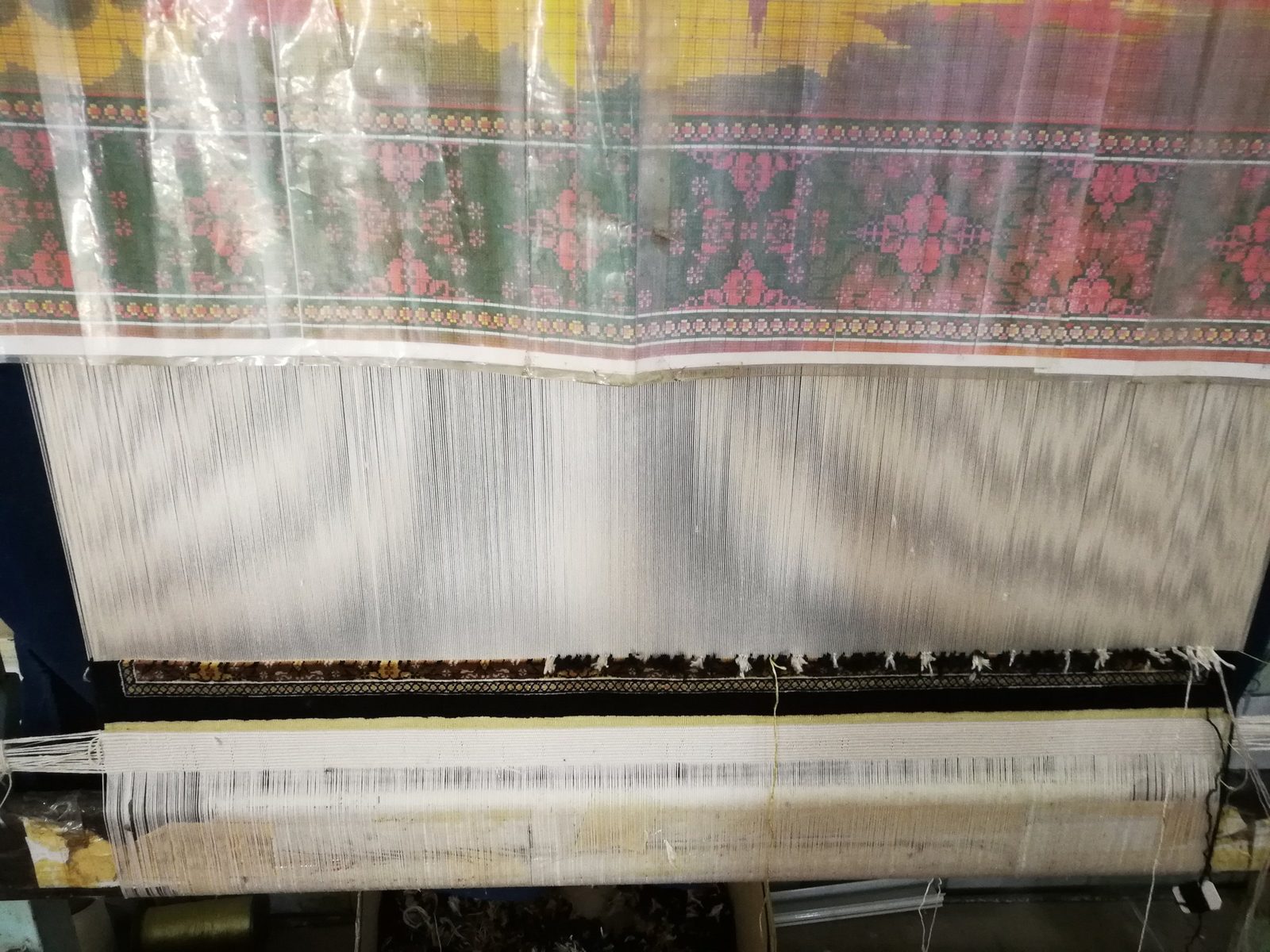
Hand-knotted carpets are woven today in Khiva, Bukhara, Samarkand and Margilan, in wool and in silk, many with natural dyes. Look at the back: on a hand-knotted carpet the pattern shows through clearly, knot by knot, and slight irregularities are normal. The fringe should be the end of the warp threads, not a strip sewn on afterwards. In a workshop you can watch the weavers follow a pattern chart one knot at a time, which explains the price better than any certificate.
How to see crafts on a trip
The craft towns fall into two clusters. Rishtan, Margilan and Kokand are in the Fergana Valley and fit together into one or two days; our Fergana Valley crafts tour is built around their workshops. Gijduvan, Konigil, Urgut and the workshops of Bukhara and Samarkand are covered by the crafts of Bukhara and Samarkand tour. Both are private, with a guide in your language.
Two practical rules. Ask to see the process, not only the showroom: the kiln, the dye vats, the loom. And keep a receipt for everything you buy. Pieces 50 years old or more generally may not leave the country, and some newer pieces of artistic value need an export certificate from the Ministry of Culture, so if a seller calls something antique, ask for the certificate before you pay. Modern handmade crafts need none; the full rules are in our article on registration and customs.
In short
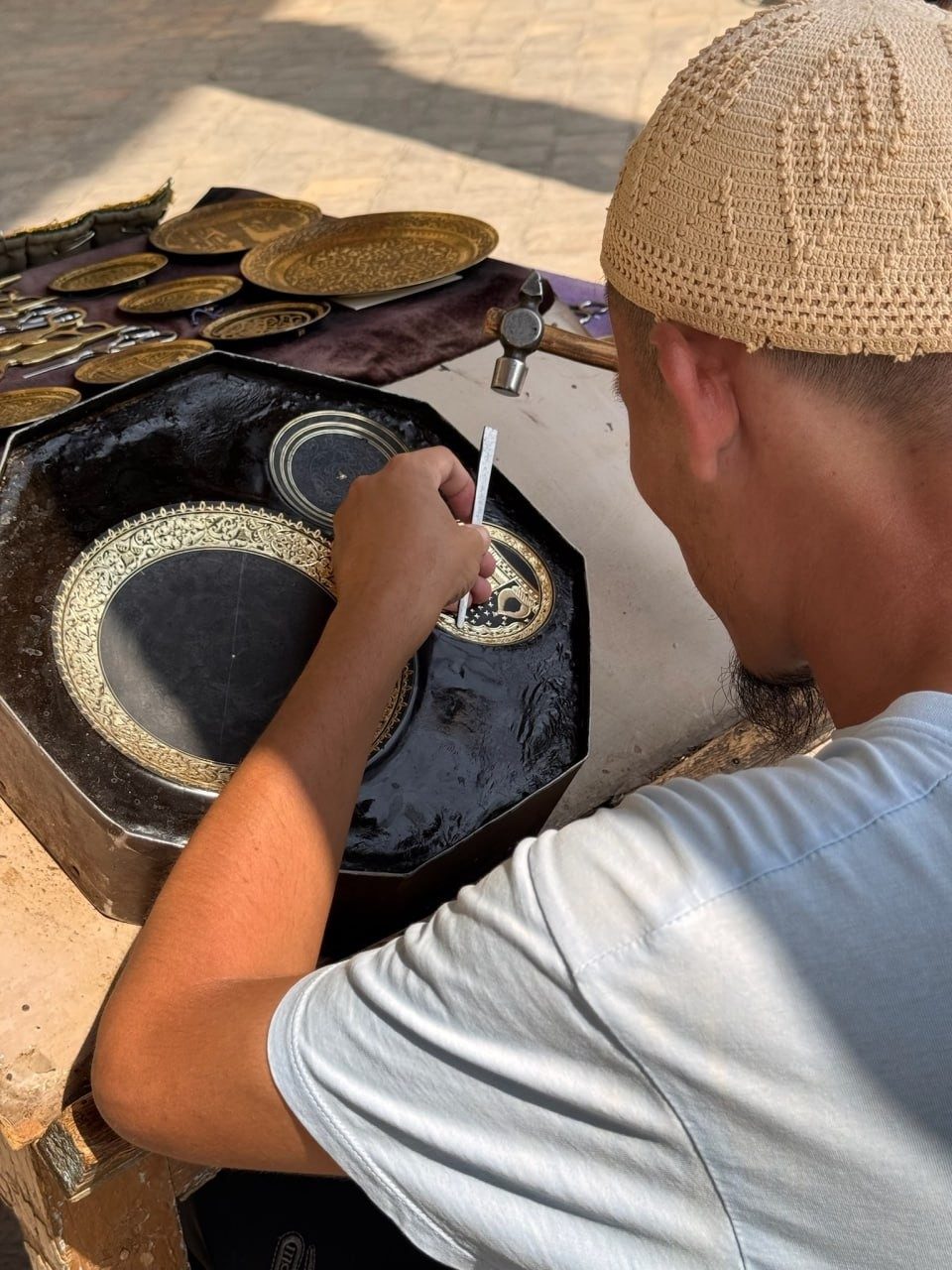
- Each craft has a home town: Rishtan for blue ceramics, Gijduvan for warm-coloured ceramics, Margilan for silk and ikat, Samarkand for mulberry paper, Khiva and Kokand for woodcarving, Chust for knives, Bukhara for metal chasing and gold embroidery.
- Handmade shows itself: an uneven back on a suzani, blurred edges on ikat, a clear knot pattern on the back of a carpet.
- In a workshop, ask for the process, not the shop.
- Keep receipts; anything sold as antique needs an export certificate, modern handmade crafts do not.
- The Fergana Valley and Bukhara–Samarkand make two natural craft routes.
© Photos
- A suzani being embroidered in a Bukhara workshop — Ji-Elle / Wikimedia Commons · CC BY-SA 4.0