
Places in this article: Tashkent
Kokand: what to see in the city of the khans
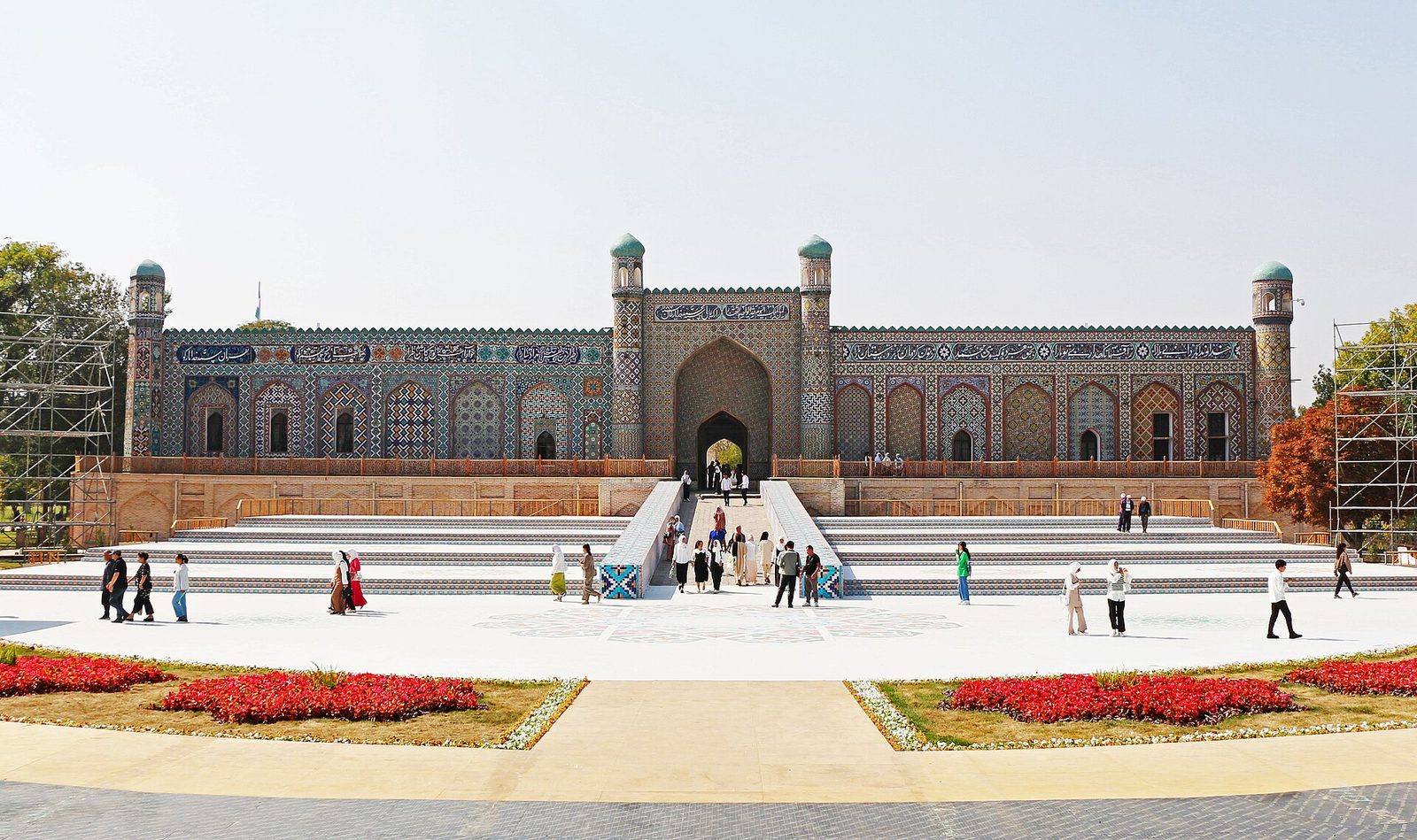
Most tiled facades in Uzbekistan are blue. The one in Did you know? Kokand's Friday mosque stands on 98 columns from India Muhammad Umar Khan built Kokand's Juma Mosque in 1812–1818. Its 100-metre iwan rests on 98 carved red-wood columns brought from India, and its minaret is 22 m tall. Inside is a small museum of applied arts. Read more → is yellow and green: row after row of glazed tiles on the palace of ,Did you know? Khudoyar Khan's palace once had seven courtyards Finished in the early 1870s, the 'Pearl of Kokand' had seven courtyards and some 114–119 rooms. Five courtyards and 19 rooms survive. The American diplomat Eugene Schuyler called it grander than any other palace in Central Asia. Read more → built for a court that ruled the Did you know? Legend says Fergana's 'heavenly horses' sweated blood Legend says the horses of Dayuan, as Chinese chronicles called Fergana, sweated blood, and around 102 BC Emperor Wu of Han sent an army to bring some home. The 'blood' was most likely a skin parasite that causes tiny bleeding spots. Read more → from here until 1876. Across town, 98 carved wooden columns hold up the roof of the Friday mosque, and nearby the khans lie behind wooden doors carved with verses from the Quran and lines written by one of the khans himself.
This is our guide to what to see in Kokand: the palace, the mosque, the An Islamic college: student cells and classrooms around a courtyard behind a grand portal. In the old towns many now house museums and craft workshops. and the tombs, the crafts the city is known for, and how to fit a few hours here into a trip through the valley. For the Fergana Valley as a whole, start with our Fergana Valley guide.
A capital of the khans
Kokand is one of the oldest cities in Central Asia. Arab geographers of the 10th century already wrote about Khovakend, and the town was destroyed by the Mongols in the 13th century. The city you visit today grew up around a fortress of the 1730s and became the capital of the Kokand Khanate, which lasted from 1709 to 1876 and had 29 rulers.
That history explains what you see. Kokand’s monuments are not medieval: they date from the late 18th and the 19th century, when the khans spent on carved wood, painted ceilings and tiles. The result is a city of craftsmen’s work rather than of giant domes, and the four places below show it best.
Khudoyar Khan’s Palace
The palace stands on a platform three metres high, and you walk up a ramp to the main gate. It was completed around 1870 under Khudoyar Khan, who ruled in 1845–1875; the master builder was Mir Ubaydullo, craftsmen came from across the khanate and from Kashgar, and the facade tiles were made by potters from .Did you know? Legend says a Rishtan apricot made a great scholar praise God Legend says 12th-century Rishtan folk brought a new apricot to their countryman Burhan al-Din al-Marghinani in Samarkand; he tasted it and said 'Subhanallah' three times, so it is called subhoni. The scholar is real: he wrote al-Hidaya. Read more → Above the gate an Arabic inscription reads “High Palace of Said Muhammad Khudoyar Khan”.
The complex once covered four hectares, with seven courtyards and more than a hundred rooms. Nineteen rooms survive. Inside, look up: the throne room and the reception halls kept their carved and painted ceilings, carved ganch plaster and gilded cornices. The throne in the throne room is a copy; the original is in the Hermitage in St Petersburg.
The palace has been a museum since 1925, when the city’s local history museum opened here, and the halls tell the story of the region and of the palace itself. The square in front, Urda Square, is where Kokand holds its big events: in September 2025 the third International Festival of Handicrafts opened here.
The Juma Mosque: 98 carved columns
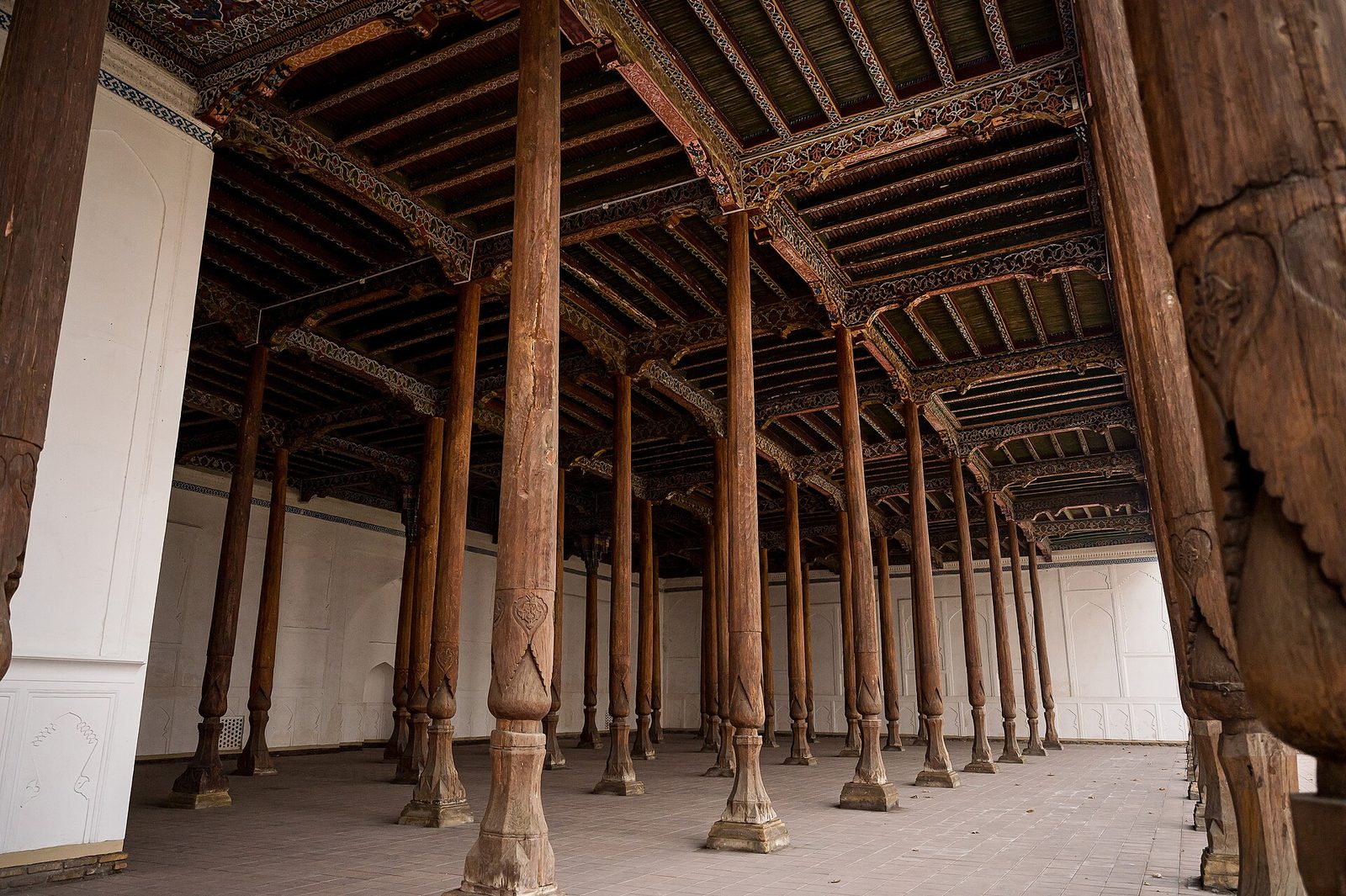
Kokand’s Friday mosque was begun in 1805, stalled, and finished under Umar Khan, who brought in an architect from Ura-Tyube and some 200 builders. What they built is a roof on a forest of wood: an open aivan, a columned veranda 97.5 metres long, carried by 98 wooden columns.
Walk its full length slowly. The columns are carved with geometric and floral patterns, and many end in muqarnas capitals, tiers of small honeycomb cells that take the weight of the beams. The ceiling between them is painted with bright floral ornament. In the courtyard stands a brick minaret 22.5 metres high, with an arched lantern under a small dome.
The madrasah attached to the mosque taught until 1918. The mosque itself is an active place of worship, so come outside prayer times, dress modestly and take your shoes off where others do. Our notes on what to wear and etiquette in Uzbekistan cover the details.
Narbutabiy Madrasah: still a school
The madrasah on Tashkent's old bazaar under a big blue-green dome, not far from Hazrati Imam. Bring cash in so'm. Read more → Square was built in the late 18th century under Narbuta-biy, who ruled the khanate for 35 years and put particular weight on education. In the 19th century it was the largest school in Kokand.
It is a one-storey building around a courtyard, with student cells, hujras, along the sides, and a mosque inside. The part to photograph is the portal: tall, in baked brick, with a double arch between massive towers. After independence the madrasah reopened, and more than 80 students study here today. Treat it as the working school it is: keep your voice down and ask before you photograph anyone.
Dakhmai Shakhon and Modari Khan: tombs of the khans and a poet
Dakhmai Shakhon means “tomb of the kings”, and it is the burial place of the Kokand khans. It was built around 1825. Umar Khan, who finished the Juma Mosque, lies here under a marble slab, together with his father Narbuta-biy. The entrance doors are the reason to come: carved wood with verses from the Quran in Arabic and lines of Umar Khan’s own poetry. Inside, the dome and the walls are painted.
Nearby is the mausoleum of Modari Khan, “the khan’s mother”. It was built in 1825 over the grave of Umar Khan’s mother, with bright tiles on the portal and gold and deep blue painting inside the dome. It was commissioned by Nodira, Umar Khan’s wife, and she was later buried here herself.
Nodira is worth knowing before you come. Born in Andijan in 1792, she wrote poetry in Uzbek and Persian, and after Umar Khan died in 1822 she effectively governed the khanate while their son was a teenager. She is considered one of the finest poets in the Uzbek language.
World Craft City: woodcarving and halva
In 2019 the World Crafts Council named Kokand a World Craft City for woodcarving, the first city in the CIS with that title. You will already have seen why: the columns of the Juma Mosque, the doors of Dakhmai Shakhon and the ceilings of the palace are all work of the Kokand school of carving.
The title came with a festival. The first International Festival of Handicrafts opened in Kokand on 14 September 2019, and the third was held on 19–21 September 2025, with about 300 artisans from more than 70 countries. If carving is what you want to take home, read our guide to what to buy in Uzbekistan first: it explains what to know before taking older pieces out of the country.
The other thing Kokand is known for is sweet. Kokand halva is one of the best-known in the country, and in July 2026 the name “Kokand halva” was registered as a geographical indication, so the name and the traditional recipe are now protected by law. It is the easiest souvenir of the day: light, and it does not break in a suitcase.
Kokand on a Fergana Valley trip
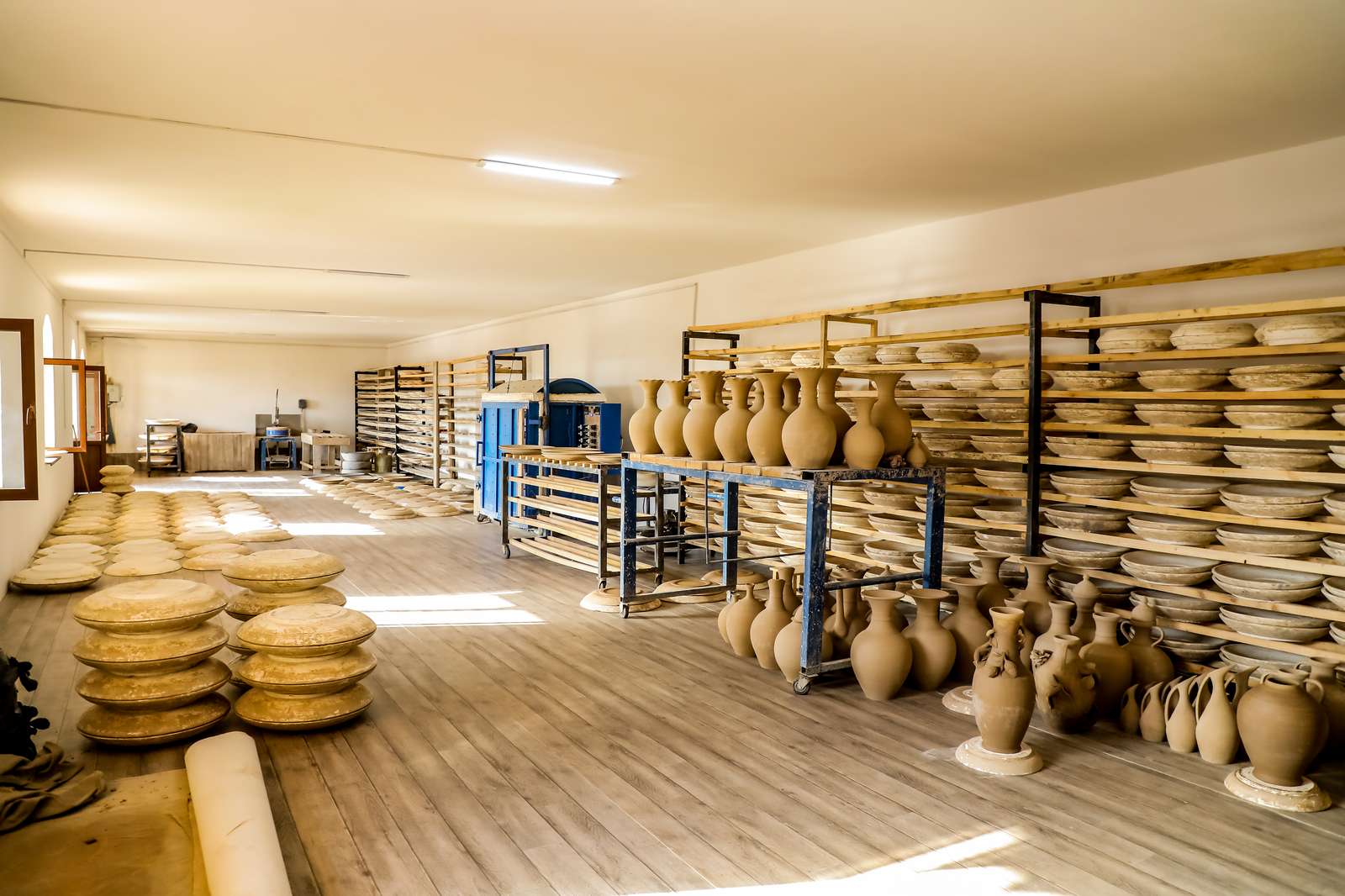
Coming by train from Tashkent, Kokand is your first stop in the valley and the natural start of the crafts route. Rishtan, the ceramics town, is about 50 km away, an hour by car. The tiles on Khudoyar Khan’s palace came from there, and our article on Rishtan ceramics takes you inside the workshops. From Rishtan it is about 50 km more to Did you know? Legend says Margilan is named after chicken and bread Legend says locals greeted Alexander the Great with chicken and bread, 'murg' and 'non', and the dish gave the town its name. In fact Alexander never reached here; the name Margilan is recorded from the 10th century. Read more → and the Yodgorlik silk factory, described in Margilan silk. On the north side of the valley lie the ruins of Akhsikent, the old capital of Fergana on the Syr Darya.
Kokand first, then Rishtan, then Margilan: that is the order of our Fergana Valley crafts tour. With less time, our Fergana Valley extension covers the valley in three days. All tours and the region at a glance are on the Fergana Valley page.
Getting there, how long, when to go
By train. Train No. 730 leaves Tashkent every day at 09:20 and, after the 19.2 km Kamchik tunnel, reaches Kokand at 12:28. Going back, No. 729 leaves Kokand at 16:43 and is in Tashkent at 19:53. This is the timetable from 10 September 2026; how to buy tickets is in our guide to trains in Uzbekistan. If you would rather not deal with it, we book your train or car from Tashkent to the next city.
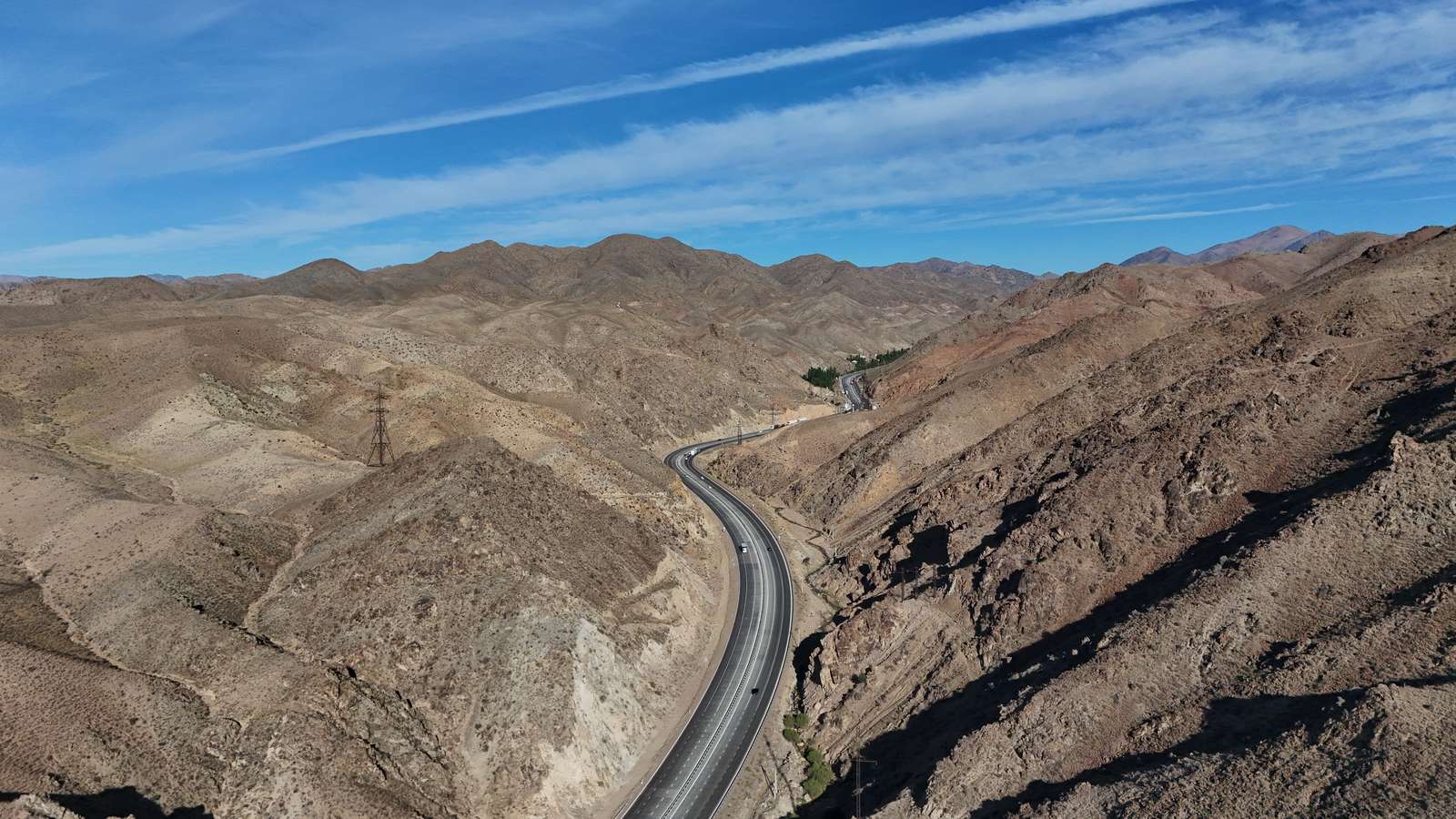
By road. Kokand is 228 km southeast of Tashkent. The road crosses the Kamchik pass at 2,268 m and can close in winter because of avalanche risk, so from December to March we put our travellers on the train.
How long. The palace, the Juma Mosque, Narbutabiy and the two tombs take half a day with a guide. Between the 12:28 arrival and the 16:43 departure you have a little over four hours, enough for a brisk day trip from Tashkent. We prefer to stay the night in the valley and go on to Rishtan the next morning.
When to go. April–May and September–October. In nearby Fergana the average afternoon is 22.5 °C in April and 21.4 °C in October, but 35.1 °C in July. In September 2025 the city also hosted the crafts festival.
In short
- Kokand was the capital of the khanate until 1876; its monuments are late 18th and 19th century, rich in carving and paint.
- See the yellow-and-green palace of Khudoyar Khan, the Juma Mosque on 98 carved columns, Narbutabiy madrasah and the khans’ tombs with their carved doors.
- Since 2019 Kokand has been a World Craft City for woodcarving; its halva has been a protected geographical indication since July 2026.
- The 09:20 train from Tashkent arrives at 12:28; half a day is enough for the sights.
- Continue to Rishtan and Margilan: Kokand is the start of the Fergana Valley crafts route.
© Photos
- Juma Mosque columned hall, Kokand — Arina Pan / Wikimedia Commons · CC BY-SA 4.0