Places in this article: Samarkand · Bukhara · Tashkent
Suzani: Uzbek embroidery, where to see it and how to choose
Look at an old Did you know? One suzani was often stitched by several women at once A family member or a pattern drawer, the kalamkash, drew the design across strips of cotton. The strips went to different women of the family or neighbourhood, who embroidered them at the same time; sewn back together, they show slightly mismatched seams. Read more → closely and you will often find that the pattern jumps at a seam: a stem stops, then carries on a few millimetres higher, and the red on one side is not quite the red on the other. It is not a mistake. It is the signature of the way suzani were made, by several women at once, each with her own strip of cloth.
A suzani is the great embroidered cloth of Uzbekistan, and you will see it everywhere: on museum walls, in hotel lobbies, in rolls at the bazaar. Here is our guide to Uzbek embroidery: where it comes from, how it was made, how the schools of Bukhara, ,Did you know? Legend credits Alexander with Nurata's underground canals Legend says Alexander the Great founded Nur in 327 BC and laid its kariz, underground channels with wells dug a few metres apart for cleaning. Whoever built them, parts of the kariz near Nurata still carry water today. Read more → Samarkand and Shahrisabz differ, where to see good work, and how to tell needlework from a machine before you buy.
What a suzani is
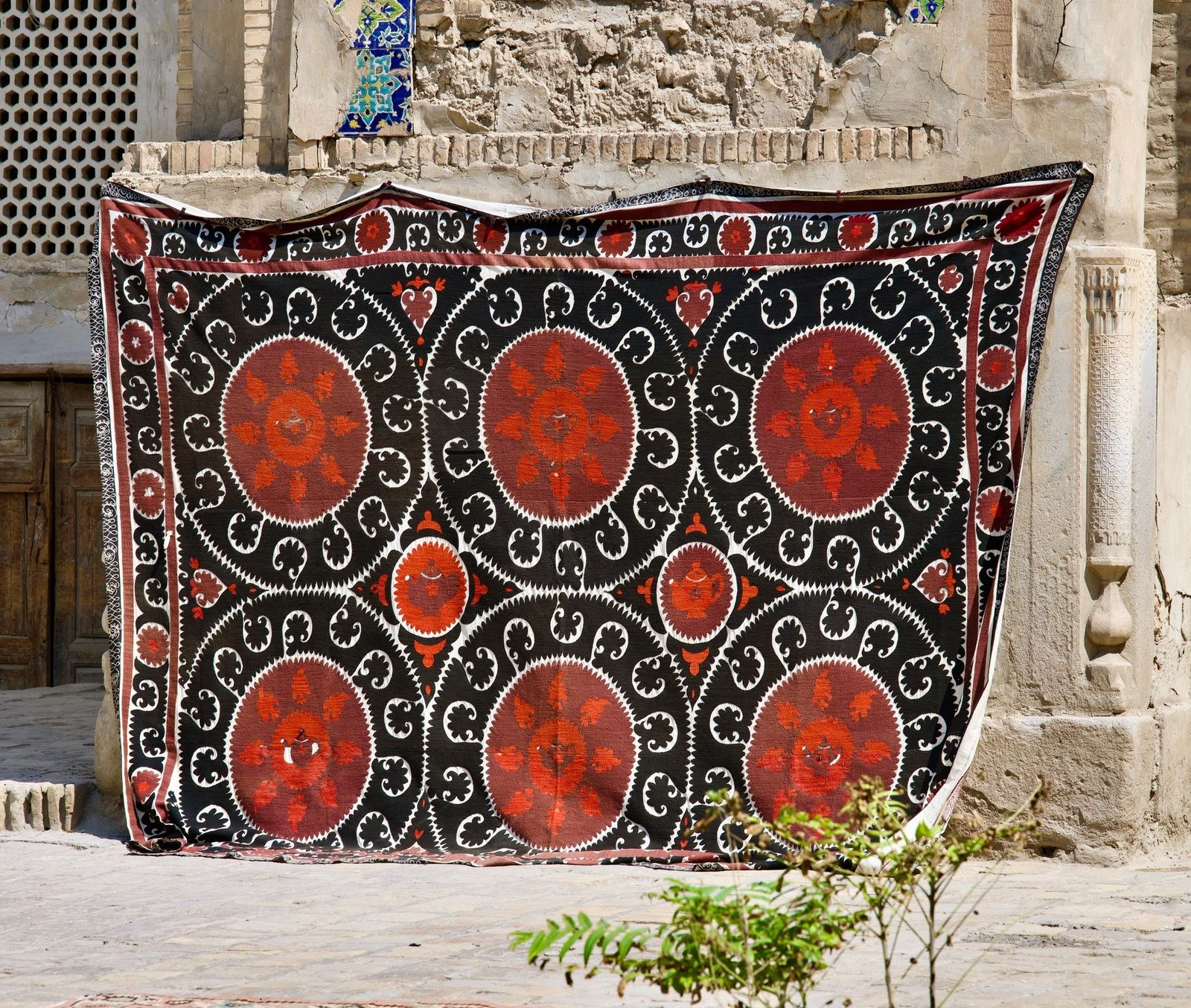
The name comes from the Persian word for needle. A suzani is a large embroidered textile, often several metres long, that a girl prepared for her dowry and that was presented on her wedding day. It was the most important textile in a dowry, and in the house it served as a bedcover, a cover for the stack of quilts and clothes, or a hanging on the wall.
Embroidery is old in this part of the world. In the early 15th century Ruy González de Clavijo, the Castilian envoy to Amir Timur (Tamerlane, 1336–1405), founder of the Timurid empire, which had its capital in Samarkand. Born near Shahrisabz.'s court in Samarkand, described embroideries that were probably forerunners of the suzani. Cloth is fragile, though, and very few suzani survive from before the late 18th and early 19th centuries; most pieces in museums are from the 19th century.
How a suzani is made
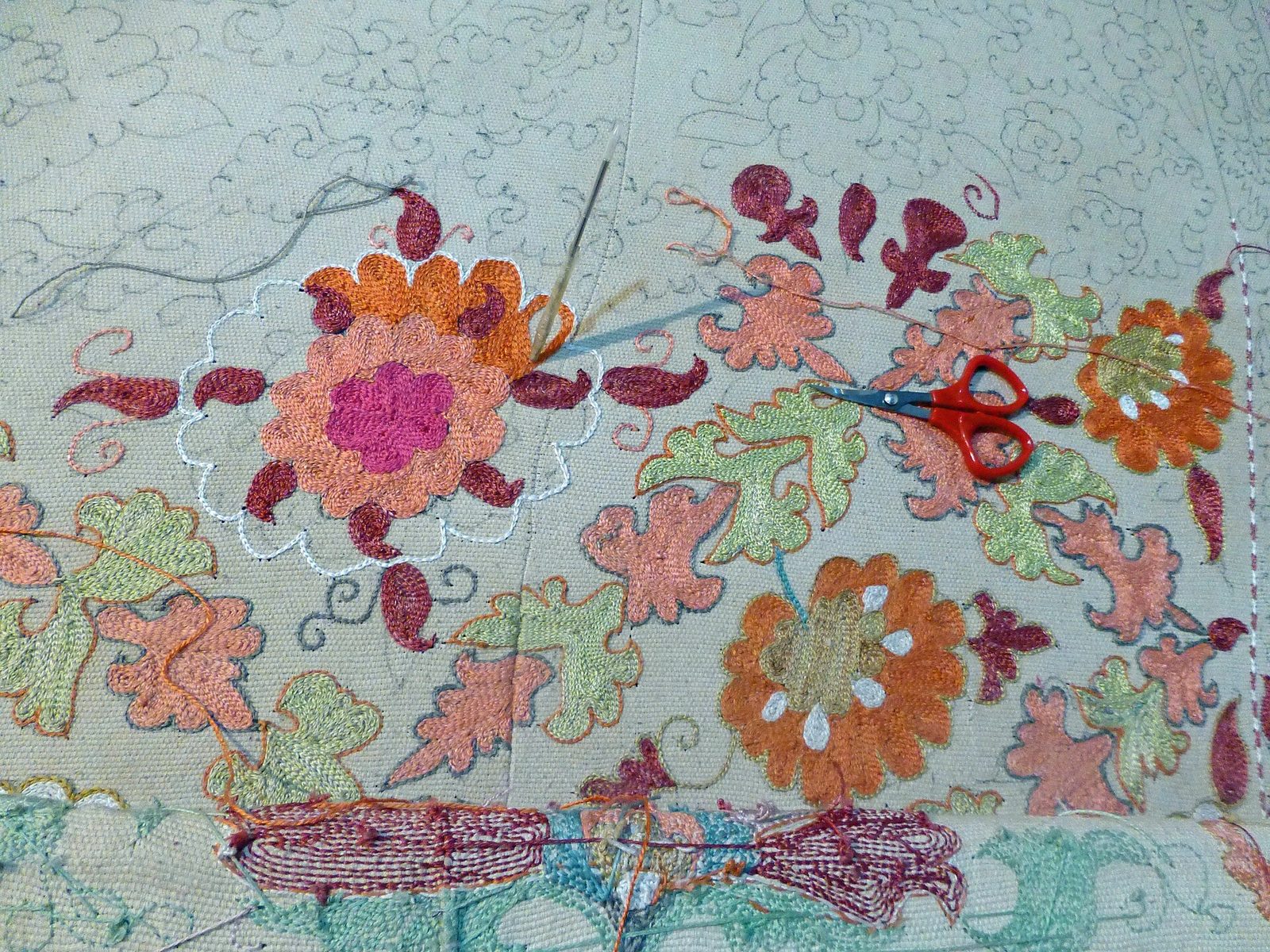
First comes the drawing. A family member or a kalamkash, a woman who drew patterns for a living, sketched the design onto strips of cotton loosely joined together. Then the strips were taken apart and handed out: different women of the family or the neighbourhood embroidered them at the same time. When every strip was finished, they were sewn together again. That is why the seams of a hand-made suzani show small shifts in the pattern and in the colour of the thread.
The classic ground was homespun cotton; silk grounds appeared in Bukhara, Samarkand and Shahrisabz towards the end of the 19th century. The thread was silk, often from silkworms raised at home. Colours came from plants: madder root for reds, pomegranate peel, onion skins, saffron. Factory thread and synthetic dyes arrived in the 1890s.
Stitches: basma, yurma and iroqi
Three stitches are worth knowing by name, because sellers will use them.
- Basma is a couching stitch that covers large areas of the pattern solidly. Most Samarkand suzani are worked in it. It takes a lot of thread and time, because the back is densely stitched too.
- Yurma is a chain stitch. In Gijduvan near Bukhara it was worked with a small hook, in Bukhara itself with a needle; up close it looks like a fine chain.
- Iroqi is a variant of cross-stitch, very small and even, laid so close that it covers the cloth completely: museum pieces from Shahrisabz have more than ten stitches to the square centimetre.
Motifs and what they mean
The big round rosettes that fill so many suzani are the sun and the moon. In Tashkent a suzani of this kind is called palak, “the sky”, or oy-palak, “the moon sky”. Around them grows a garden: flowers, leaves and vines, a wish for happiness, plenty and children.
Some motifs carry a particular meaning by tradition. The pomegranate, full of seeds, stands for fertility. The chili pepper protects against the evil eye. Embroiderers also say that a small part of the pattern is always left unfinished, so that the work, like life, goes on.
The schools of suzani: Bukhara, Nurata, Samarkand, Shahrisabz
Each embroidery centre had its own hand, and a good seller can tell you where a piece comes from.
- Bukhara: dense compositions full of small detail, worked in fine chain stitch; in the 19th century some pieces added gold thread to the silk.
- Nurata: a large round centre surrounded by flowering branches, worked in silk on light cotton in soft colours. One traditional pattern is called chor shohu, yak moh, “four branches, one moon”. More in our Nurata guide.
- Samarkand: larger, simpler designs, with round rosettes in raspberry tones framed by leaves, mostly in basma.
- Shahrisabz: coloured grounds and often a big central medallion, close to the composition of a carpet, and the fine iroqi stitch. In August 2026, at the closing of the international Iroqi embroidery festival, the World Crafts Council named Shahrisabz a Did you know? Kokand was the first World Craft City in the CIS In 2019 the World Crafts Council, founded in 1964 and affiliated with UNESCO, named Kokand a World Craft City for woodcarving — the first in the CIS. The carved columns of the Juma Mosque and the palace ceilings show why. Read more → for embroidery.
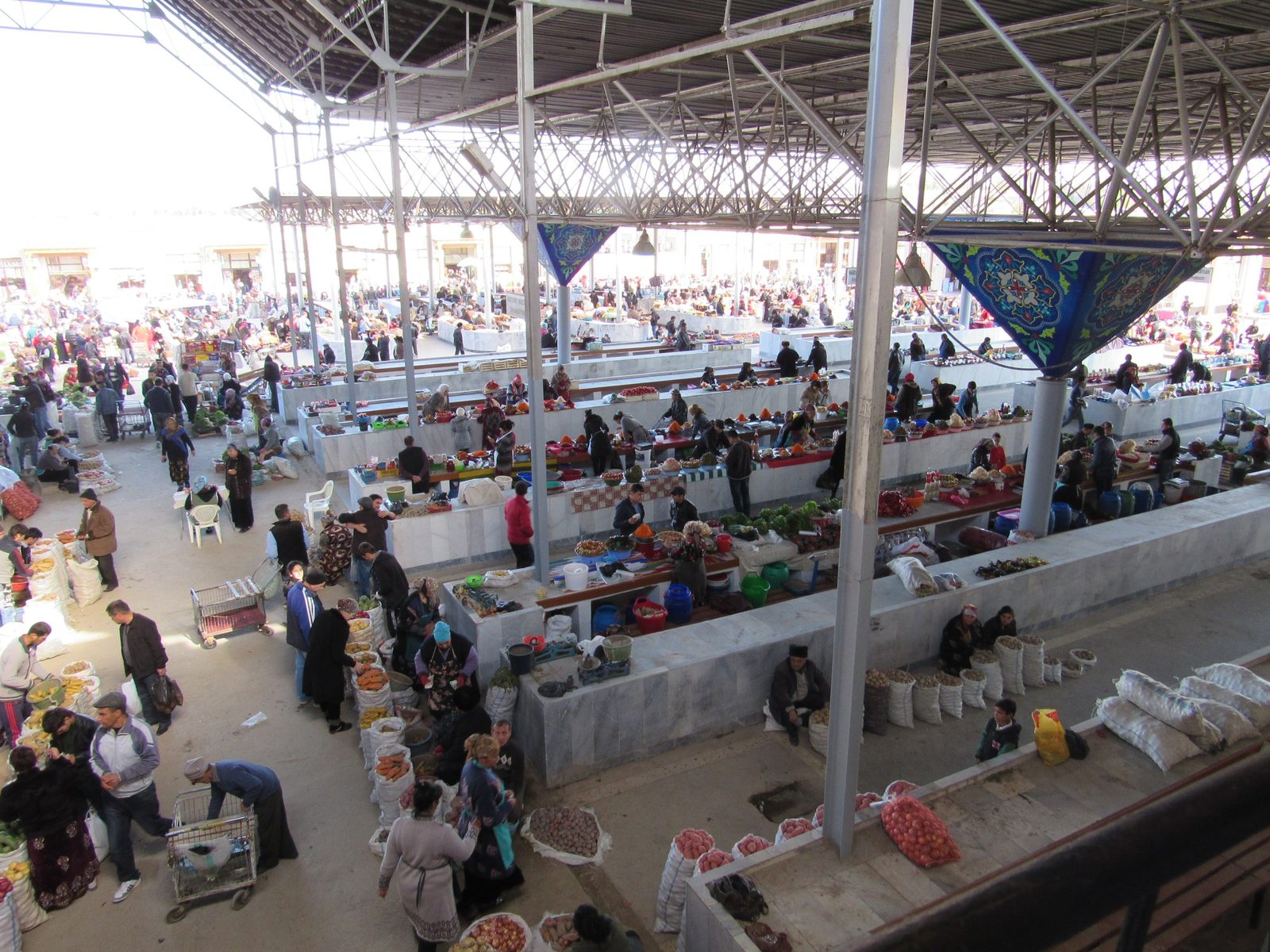
Urgut, about 40 km south-east of Samarkand, is a different story: it is famous less as a school than as a market. Its bazaar is the biggest crafts market in the Samarkand region, with old and new suzani, and the textile rows are at their fullest on Sundays and Wednesdays.
Where to see suzani
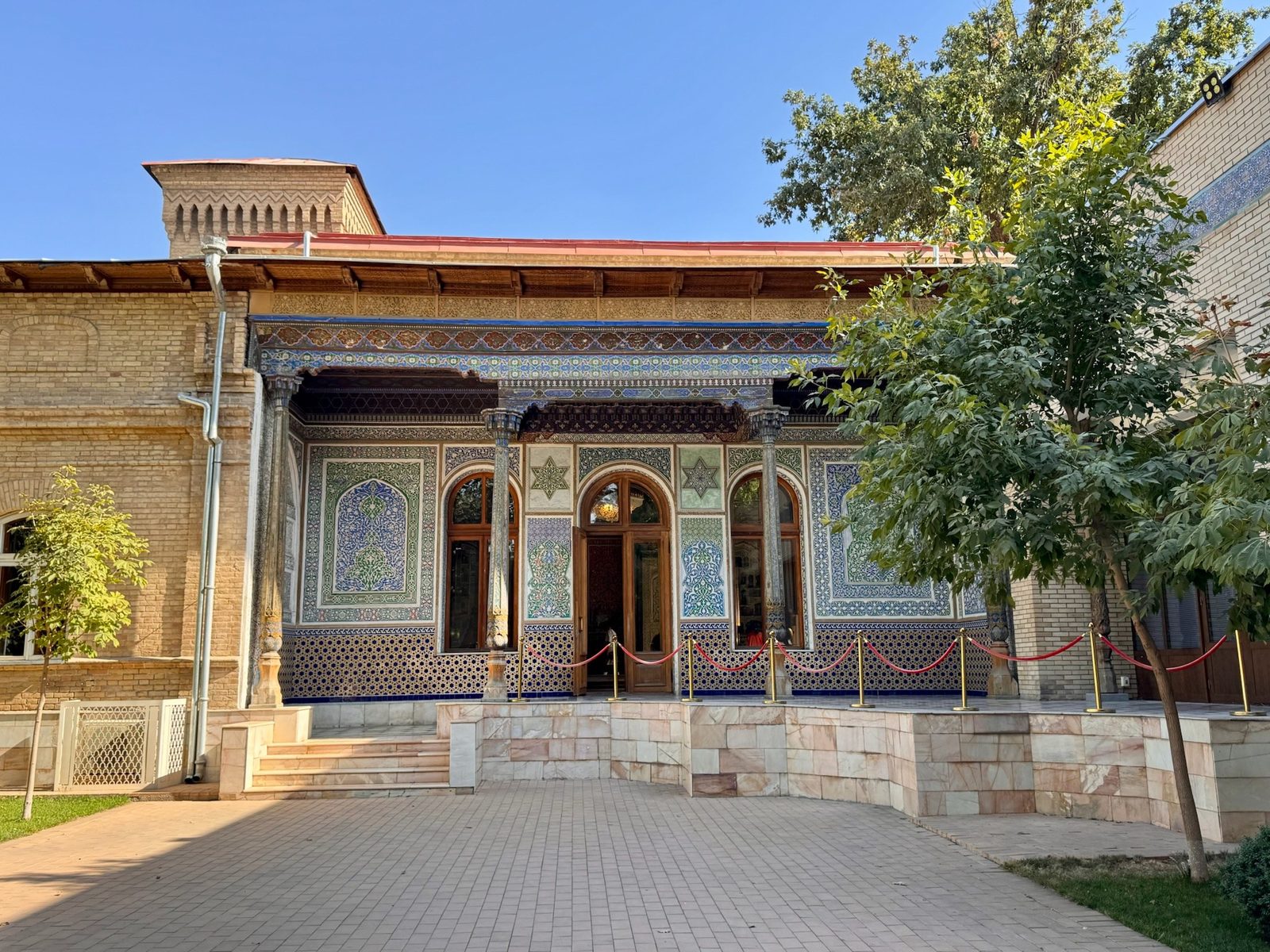
In Tashkent, start at the Did you know? A diplomat's house that became a museum of crafts In 1896 diplomat Alexander Polovtsev bought a merchant's house and had it rebuilt in the Central Asian style. Today it is the Museum of Applied Arts, with over 7,000 pieces of folk craft. Read more →, which holds more than 7,000 pieces of folk craft, embroidery among them. An hour there trains your eye before the bazaars. The State Museum of Arts of Uzbekistan keeps old suzani from Bukhara and Nurata, including a Nurata piece dated 1827–1832.
In Bukhara, the summer palace of Did you know? Legend: the emir's palace site was chosen with meat Legend says that when Emir Nasrullah wanted a summer palace in the mid-19th century, sheep carcasses were hung in several places around Bukhara, and the spot where the meat spoiled last was chosen. Sitorai Mohi-Hosa there today dates from 1912–1918. Read more → has been a museum since 1927, with suzani and gold-embroidered robes. In the old town there are embroidery workshops where you can watch the work. Our day trips from Bukhara explain how to reach the palace.
Shahrisabz, the home of iroqi, is a day trip from Samarkand over the mountain pass, with The ruins of Amir Timur's palace in Shahrisabz, his home town. Only parts of the giant entrance arch still stand. Read more → and the monuments of Timur's family. Our trip to Shahrisabz includes a guide, transfer and entrance tickets; the town itself is in our Shahrisabz day trip guide.
To see the work from the inside, our private Crafts of Bukhara and Samarkand tour gives five days to the masters of the two cities, from paper at A village near Samarkand where paper is made by hand from mulberry bark, the old way, at a working mill on the stream. to gold embroidery and suzani in Bukhara. Our older article on ceramics, carpets and suzani covers the other crafts.
How to tell hand embroidery from machine work
Machine-made and printed suzani are sold next to hand-made ones, often in the same stall. Nothing is wrong with buying either, as long as you know which you are paying for. Our guides teach guests five checks:
- Turn it over. On the back of hand embroidery the stitches vary in length and tension, and you see knots and threads carried from one flower to the next. Machine work looks regular on the back, row after row.
- Look for the drawing. On hand-made pieces the drawn outline of the pattern sometimes shows at the edges of a motif.
- Compare two identical motifs. By hand, no two rosettes are quite the same. If they match stitch for stitch, it is a machine.
- Check the seams. A large suzani made the traditional way is assembled from strips, and the pattern shifts slightly where they meet.
- Is it embroidered at all? A printed cloth has no raised stitches and is pale on the back.
Hand embroidery takes time, and the price reflects it. Smaller hand-stitched pieces, such as cushion covers or a nim-suzani, a half-size cloth, are the easiest way to own real needlework. More on bazaar shopping is in our guides to what to buy in Uzbekistan and the bazaars of Uzbekistan.
Taking an old suzani home
The line is fifty years. Pieces 50 years old or more stay in Uzbekistan. Newer pieces of artistic value can need an export certificate from the Ministry of Culture, while machine-made suzani, suzani made within the last 50 years and modern hand-made folk crafts need none. Take a receipt for every suzani you buy, and if a seller calls a piece antique, ask for the certificate before you pay. The full rules are in our article on registration and customs in Uzbekistan.
In short
- A suzani is a large embroidered dowry cloth; most surviving old pieces are from the 19th century.
- It was drawn by a kalamkash and embroidered in strips by several women, so the pattern shifts at the seams.
- Bukhara is dense and fine, Nurata has a big round centre, Samarkand large raspberry rosettes, Shahrisabz the tiny iroqi stitch.
- See the best work in the museums of Tashkent and at Sitorai Mohi-Hosa in Bukhara before you buy.
- Turn every piece over, keep the receipt, and leave anything 50 years old or more in the country.
© Photos
- A suzani being embroidered in a Bukhara workshop — Ji-Elle / Wikimedia Commons · CC BY-SA 4.0