Places in this article: Tashkent
Tashkent modernism: the UNESCO-listed buildings and a one-day route
Tashkent’s most photographed facade is not on the World Heritage List, and its old-looking bazaar is younger than its .Did you know? A metro designed to ride out a magnitude-9 earthquake The three original lines of the Tashkent Metro were built to withstand an earthquake of magnitude 9.0, and the tunnels lie unusually shallow, only 8–25 m below the street. Read more → Since July 2026, ten buildings put up as the city was rebuilt after the 1966 earthquake have been inscribed by UNESCO as Tashkent modernism, and nine of them stand in the centre, close enough to see in one day.
We drive past these buildings every day. Here is what each one is, the detail we point out to guests, and our route for a day of Tashkent modernism: the order, the light and what is open.
The 1966 earthquake and the ten buildings on the list
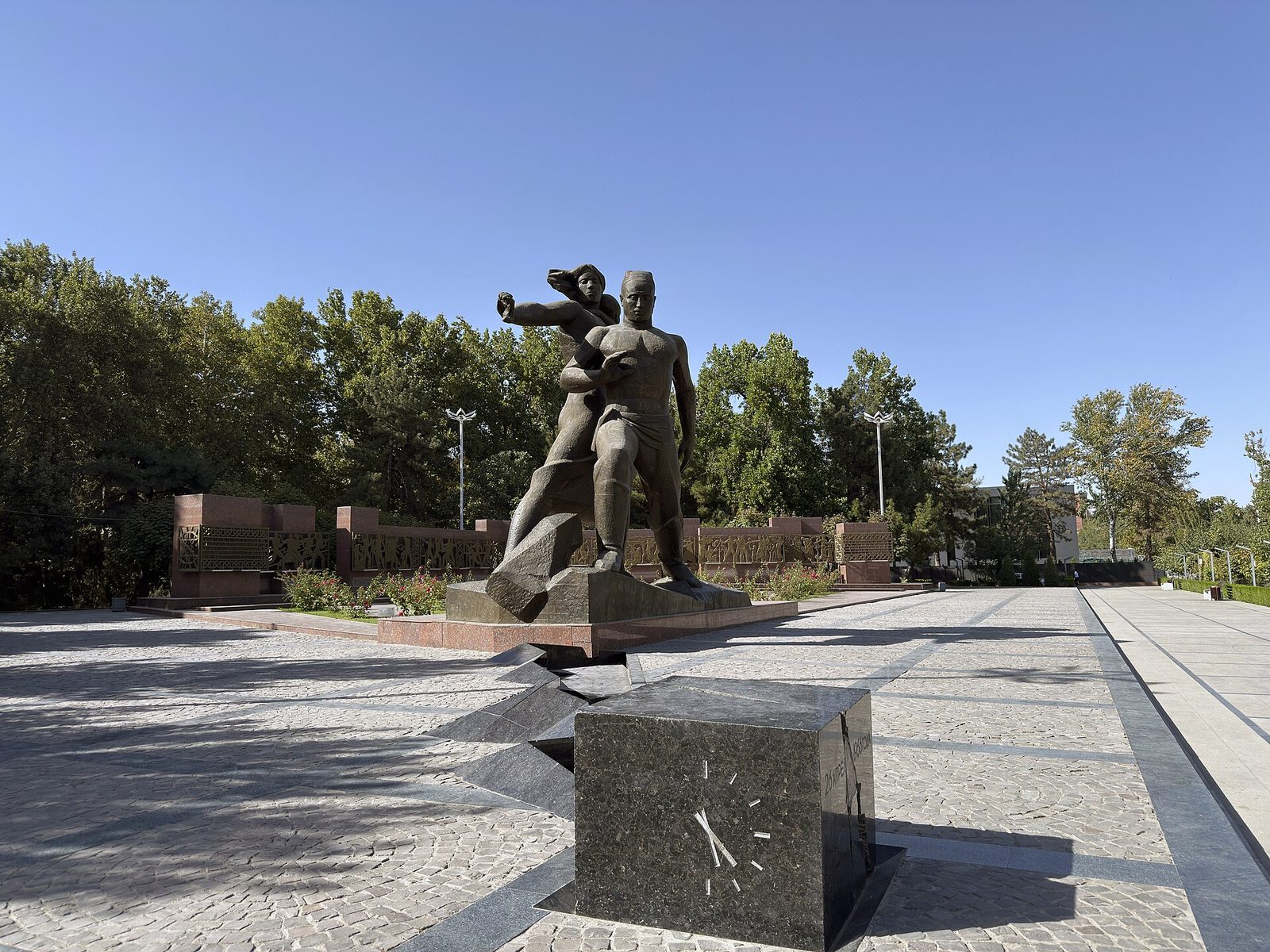
At 5:23 in the morning on 26 April 1966 an earthquake struck with its epicentre right under the centre of Tashkent, only a few kilometres down. Low adobe houses fell, while many concrete public buildings stood. A new general plan followed the same year, and the city was rebuilt around wide avenues, a metro and public buildings that combined concrete with the patterns of Central Asian craft.
The Courage memorial marks the epicentre. It opened on 20 May 1976: a cube of black labradorite split by a crack, with the date on one face and a clock dial on another, its hands stopped at 5:23. The sculptor was Dmitry Ryabichev and the architect Sabir Adylov, a name you will meet again at .Tashkent's old bazaar under a big blue-green dome, not far from Hazrati Imam. Bring cash in so'm. Read more →
On 26 July 2026 the World Heritage Committee, meeting in Busan, inscribed “Tashkent Modernist Architecture. Modernity and Tradition in Central Asia”. The ten parts are the State Museum of History, the State Museum of Arts, the Central Exhibition Hall of the Academy of Arts, the Alisher Navoi Cinema Palace, the Peoples’ Friendship Palace, the State Circus, Chorsu Market, Did you know? A metro station where Ulugh Beg meets Gagarin Kosmonavtlar station, opened in 1984, has ceramic medallions of Ulugh Beg, Galileo, Icarus, Gagarin and Tereshkova, and glass stars in the ceiling that hint at the Milky Way. Read more → metro station, the Zhemchug residential building and the Big Solar Furnace about 45 km east of the city. It was the first nomination of Uzbekistan alone to reach the list in 25 years; the other sites are in our guide to the sights of Uzbekistan.
Chorsu: a bazaar under an 86-metre dome
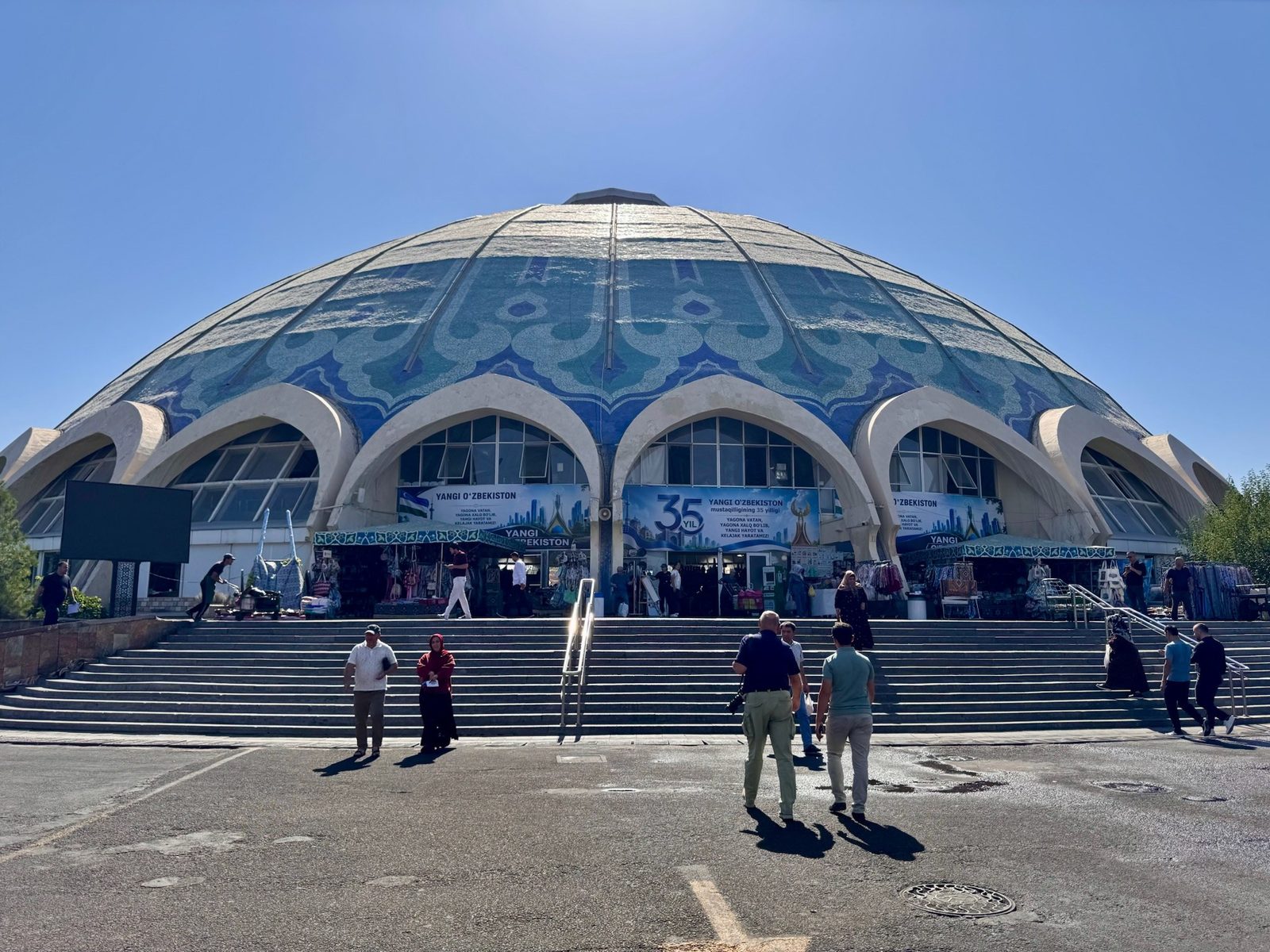
The bazaar at the old city’s crossroads is centuries old; the building is not. The architects Vladimir Azimov and Sabir Adylov designed the new market, built mainly in the 1980s and opened in 1990: a main dome of 86 metres ringed by seven smaller domes 10 to 15 metres across. A large-span steel structure carries the big dome, and tiling it went on until 1993.
The idea of putting Tashkent’s markets under domes is usually traced to Andrey Kosinsky, a Moscow architect who came to help rebuild the city in 1966 and taught here until 1978. The story goes that he was won over at the medieval sardoba, a domed water cistern, beside the Rabat-i Malik caravanserai on the road to Bukhara, by how well a dome keeps the heat out. You can stand under that sardoba on the day we describe in our guide to the Sarmysh petroglyphs near Navoi.
Come in the morning, when the bazaar is at its busiest. Chorsu metro station across the street, opened in 1989, was dug as an open pit through the bazaar square. What to buy under the dome is in our guide to the bazaars of Uzbekistan.
The State Circus and the Peoples’ Friendship Palace
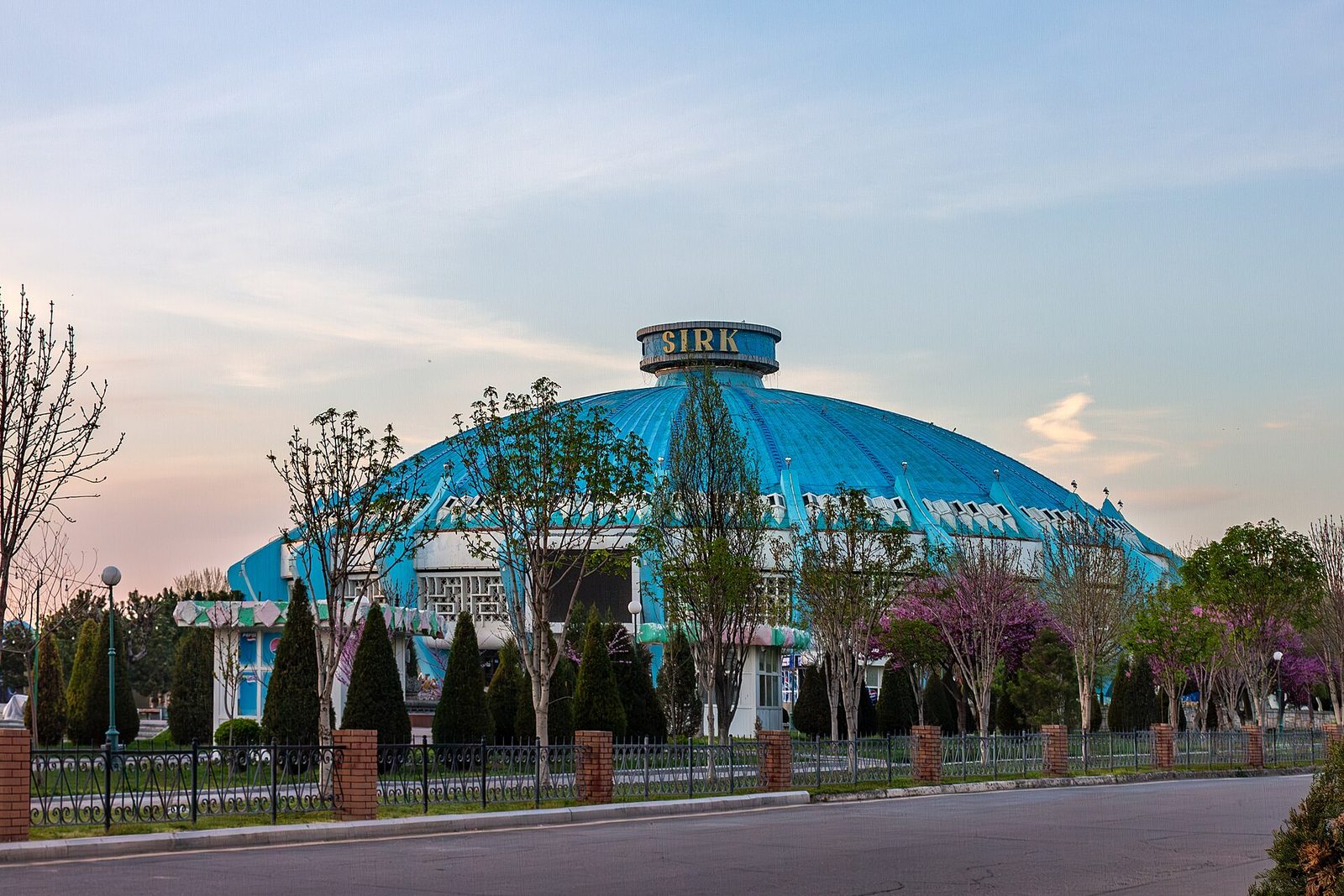
A short walk from Chorsu, the State Circus stands on Khadra Square, on the old line between the old and the new city. It was designed in 1962 and took until 1976 to build, with a pause for the earthquake. Its dome is often compared to a flying saucer. The architect Genrikh Aleksandrovich left out the glass foyer that most Soviet circuses had and wrapped the building in heavy sun screens instead. The doors to the ring are walnut, carved in several layers.
From the circus a single north–south axis runs to the Peoples’ Friendship Palace, and the two buildings were meant to be seen from each other. The palace opened in 1981 to a design by a team that included Yevgeny Rozanov, and it is the country’s main concert hall, with almost 4,000 seats. The facade borrows the stalactite vaults, muqarnas, of old portals, worked in Did you know? Legend credits Alexander with Nurata's underground canals Legend says Alexander the Great founded Nur in 327 BC and laid its kariz, underground channels with wells dug a few metres apart for cleaning. Whoever built them, parts of the kariz near Nurata still carry water today. Read more → and Gazgan marble, and inside are three large stone mosaics. The palace also appeared on the 100-som banknote of 1994. Its halls open for concerts and events, so on most days you admire it from the square.
The Panorama cinema, built for a 34-metre screen
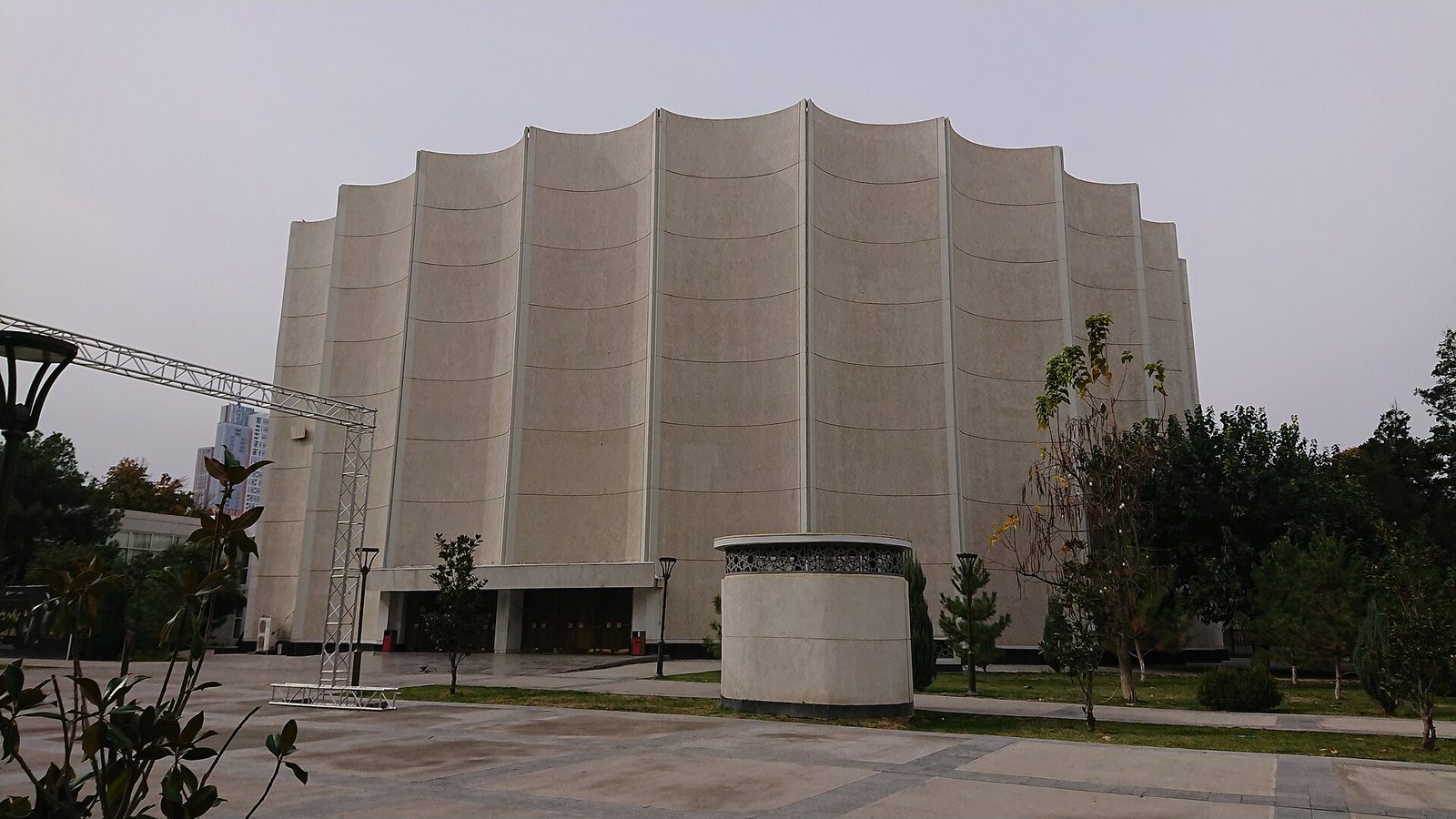
The oldest building on the list went up before the earthquake. The Panorama cinema on Navoi Street opened in 1964 as the first cinema in Central Asia built for wide-screen films. Its round main hall, a drum of precast concrete fluted like a Doric column, seats 2,300 people in front of a curved screen 34 metres wide and 14 metres high. The 1966 earthquake left it largely undamaged.
From 1968 to 1988 it hosted the Tashkent International Film Festival, and in 1991 it was named after the poet Alisher Navoi. The foyer now holds the Museum of Cinema of Uzbekistan.
Rashidov Avenue: the Museum of History and the Exhibition Hall
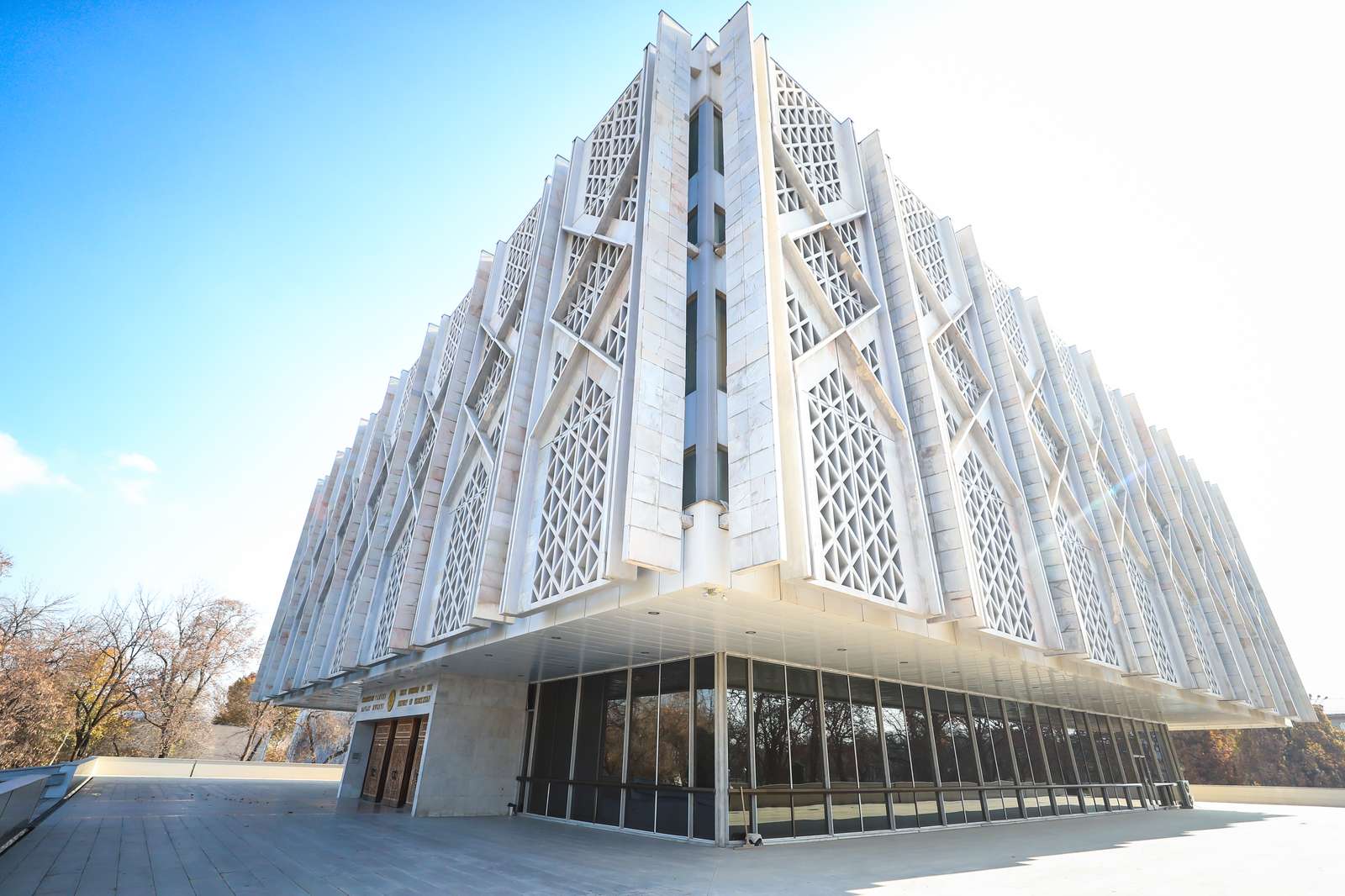
If we could show you only one building, it would be the State Museum of History. It opened in 1970 as the Lenin Museum, designed by Yevgeny Rozanov and Vladimir Shestopalov: a cube behind geometric sun screens faced with whitish-pink marble, the carved window lattice of Central Asia grown to the size of a facade. It stands where the city’s circus of 1914 stood until the 1966 earthquake destroyed it.
The museum reopened on 24 July 2026 after two years of renovation, and its halls run from the Stone Age to the present; look for the alabaster Buddhist relief from Fayaz Tepe near Termez, the site we visit in our Termez guide. This autumn the museum turned 150, as we wrote in our news about the anniversary. Plan an hour and a half inside.
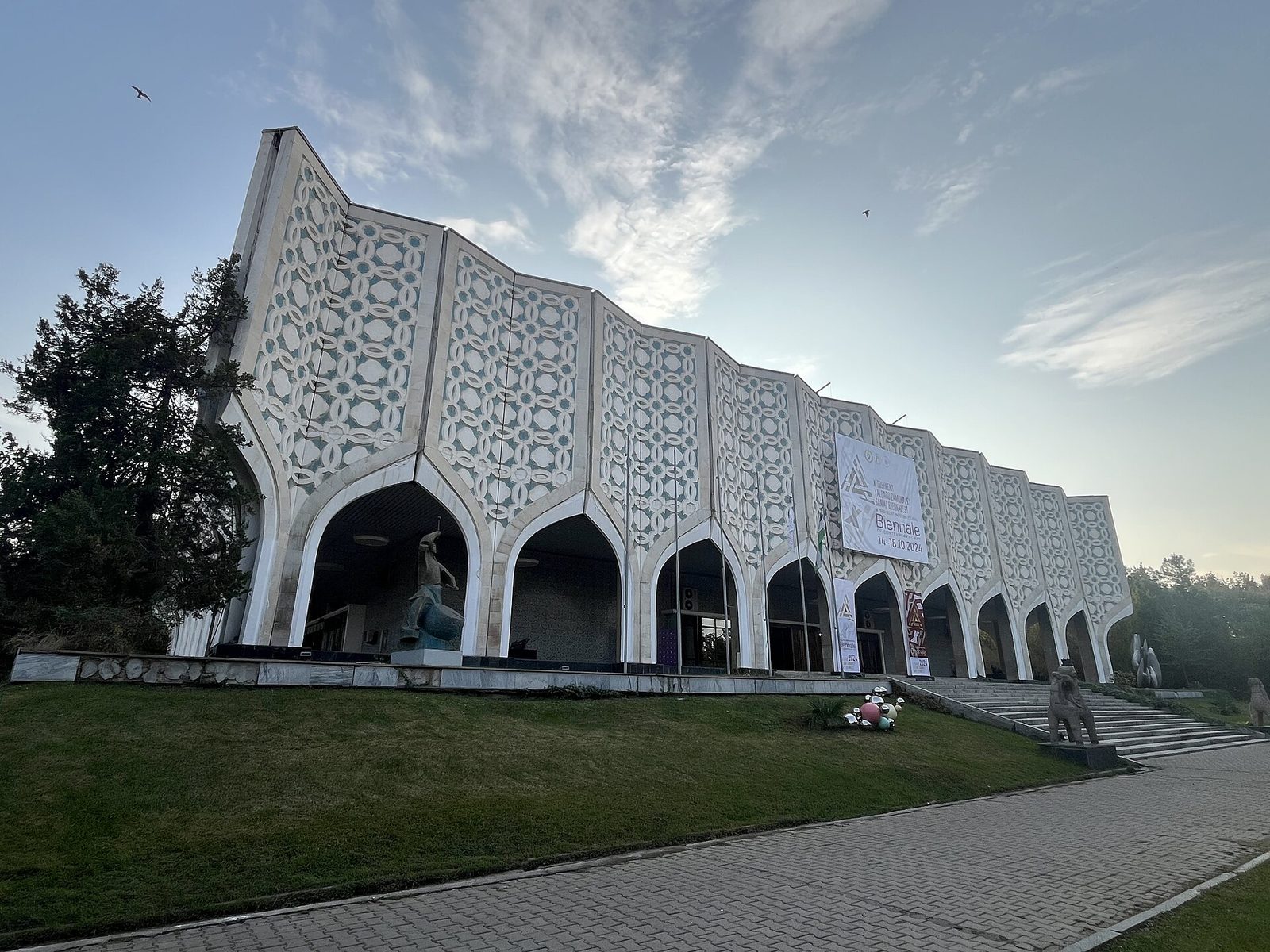
A few minutes’ walk away is the Central Exhibition Hall of the Academy of Arts, opened in 1974 to a design by Rafael Khairutdinov with Farkhad Tursunov. Its arcade of folded pointed arches recalls the pishtaq, the portal of Central Asian buildings. The hall was built without air conditioning: deep shade under the arcade and double walls that vent air through roof lights keep the galleries cool, a method taken from traditional houses. It is the main venue of the Tashkent Biennale of contemporary art, whose 11th edition opened here in October 2026, as we reported in our Biennale news.
Kosmonavtlar and Zhemchug: a station and a house of terraces
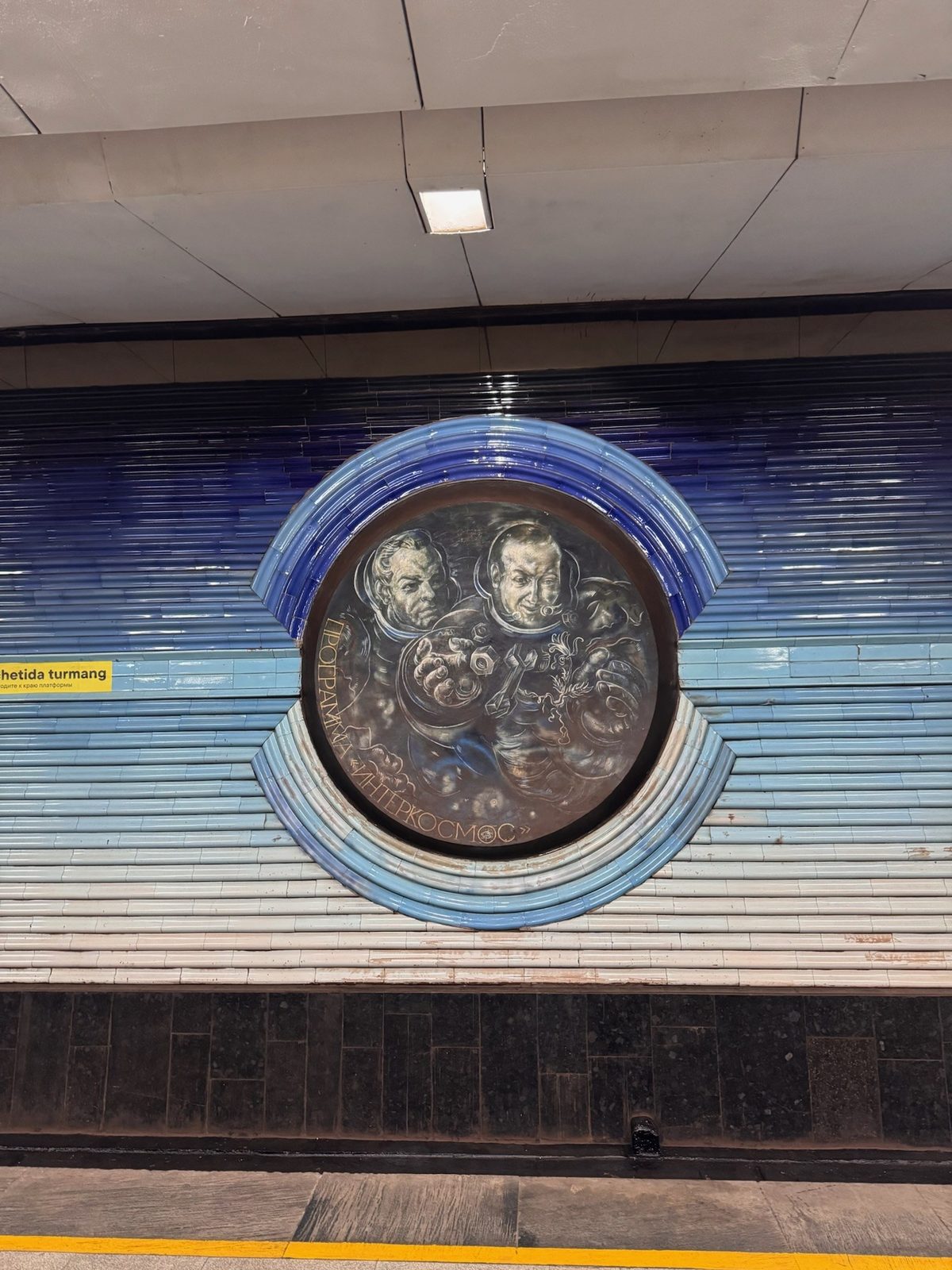
Walk south along Rashidov Avenue to Kosmonavtlar, the only metro station on the list. Designed by Sergo Sutyagin and Sergey Sokolov and opened on 8 December 1984, it shades its walls from turquoise at the floor to deep blue at the ceiling, with glass stars along the ceiling like the Milky Way and twelve ceramic medallions of figures from astronomy and spaceflight, from Timur's grandson, ruler of Samarkand and an astronomer. He built a madrasah on the Registan and an observatory whose star catalogue was used for centuries. Read more → to Yuri Gagarin and Valentina Tereshkova. Photography in the metro has been allowed since 2018, and more stations worth a stop are in our guide to the Tashkent metro.
Next to the station stands Zhemchug, the “Pearl”, a 16-storey block of flats by Ofelia Aydinova, built from 1975 to 1985 in monolithic concrete. Every few floors its two halves are joined by open terraces, shared courtyards lifted into the air, like a mahalla neighbourhood turned on its end. The nickname came from a jewellery shop on the ground floor and stuck so firmly that it replaced the address. Families live here, so we look from the street.
The Museum of Arts and the Hotel Uzbekistan
A short walk east, the State Museum of Arts is the quiet member of the list. Built in 1974 to a design by I. Abdulov, A. Nikiforov and S. Rosenblum, it was a cube clad in anodised aluminium, glazed on all four sides with stevite glass that gives the halls an even, soft light. In 2002 the outside was re-clad with column and arch motifs, so the skin you see today is later than the halls behind it.
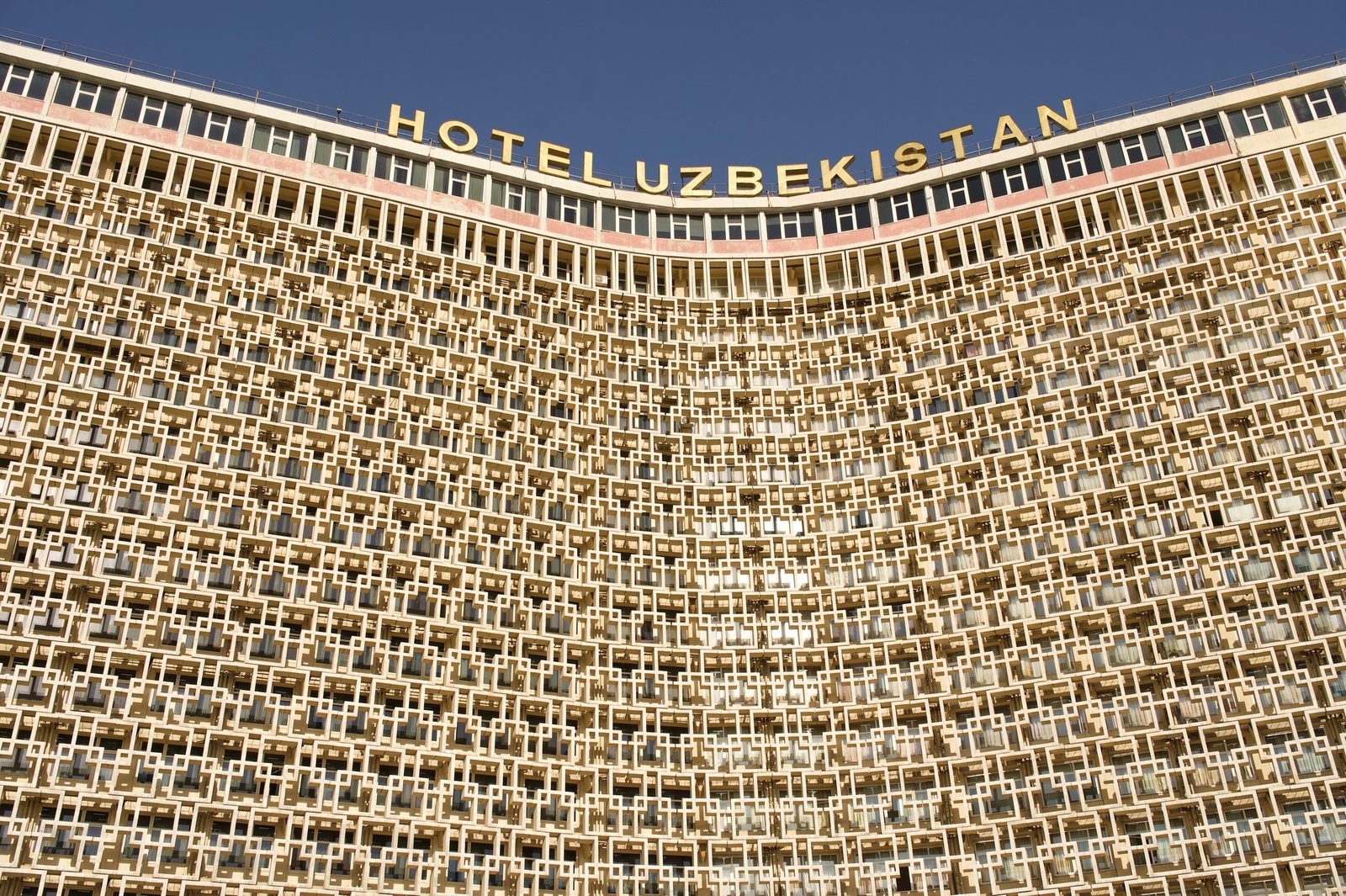
End the day at the building that is not on the list but is on every postcard. The Hotel Uzbekistan opened in October 1974 on ,Did you know? Legend: “Strength lies in justice” were Timur's own words The equestrian statue of Amir Timur in central Tashkent, unveiled in 1994, bears the motto “Strength lies in justice” in four languages. Tradition attributes the words to Timur himself, but historians cannot confirm he said them. Read more → 17 floors designed by a team led by Ilya Merport. Its curved facade is one huge panjara, the concrete sun lattice of Central Asian windows, scaled up to the whole building to soften the light in the rooms. The hotel, the Did you know? A 375-metre tower with a viewing deck at 97 m The Tashkent TV Tower, begun in 1978 and operating since January 1985, rises 375 m to the tip of its spire. Its observation deck at about 97 m looks out over the whole city. Read more → and the Palace of Aviation Constructors are being considered as a later addition to the World Heritage site.
The facade faces west across the square, so it glows in the late afternoon. The restaurant on the 17th floor looks over the centre and is a good place for the sunset. If you want to stay out after dark, our Evening Tashkent walk and our guide to Tashkent in the evening take it from there.
Tashkent modernism in one day: our route
We start in the old city in the morning and finish on foot in the centre in the late afternoon:
- Chorsu Bazaar at 9:00, about 45 minutes.
- The State Circus, a short walk across Khadra Square, 15 minutes outside.
- By car down the axis to the Peoples’ Friendship Palace, 20 minutes on the square.
- The Panorama cinema on Navoi Street, 15 minutes.
- The Courage memorial, 15 minutes.
- The State Museum of History from about 11:30, an hour and a half inside, then lunch.
- The Central Exhibition Hall, 30 minutes, inside when an exhibition is on.
- On foot to Kosmonavtlar station and Zhemchug, 40 minutes.
- The State Museum of Arts from the outside, 10 minutes.
- The Hotel Uzbekistan from about 17:00, in the late sun.
The first five stops are short drives apart; from the Museum of History to the Hotel Uzbekistan it is roughly 3 km on foot. Chorsu and Kosmonavtlar are on the same blue metro line, so you can also make the jump underground. If you have two days for Tashkent, our plans for Tashkent in 1 or 2 days and Tashkent in 3 days fit this route around the old city and the museums.
When to go and what is open
Spring, from March to June, and autumn, from September to November, are the best seasons for a day on foot; in summer, start early and keep the walking part for the late afternoon. The State Museum of History is open Tuesday to Sunday from 10:00 to 18:00 and closed on Mondays, so do not plan this day for a Monday. In late July 2026 a ticket for foreign visitors cost 100,000 som. The circus and the Friendship Palace open their halls for performances; on an ordinary day you see them from outside.
The tenth building: the Big Solar Furnace
The only part of the site outside the city is the Big Solar Furnace near Parkent, about 45 km away, at around 1,100 m. Built between 1981 and 1987, it uses 62 moving mirrors to throw sunlight onto a curved wall of 10,700 mirrors, and at its focus the temperature reaches 3,000 °C. Give it half a day on a clear morning: a transfer there and back is one of our Travel Moments, and our two-day Tashkent Modernism tour covers all ten buildings with a guide.
In short
- Ten buildings of the 1960s to the early 1990s were inscribed by UNESCO on 26 July 2026; nine are in central Tashkent and one, the Solar Furnace, is 45 km away.
- Do Chorsu and the circus in the morning, the museums at midday and the Hotel Uzbekistan in the late afternoon sun.
- The State Museum of History is the one to go inside; it is closed on Mondays.
- One full day covers the city; add half a day for the Solar Furnace.
© Photos
- The Courage memorial with its split stone cube and clock dial, Tashkent — 26D / Wikimedia Commons · CC BY-SA 4.0
- The blue dome of the State Circus on Khadra Square, Tashkent — ElenaLitera / Wikimedia Commons · CC BY-SA 4.0
- The fluted drum of the Alisher Navoi Cinema Palace, the former Panorama cinema, Tashkent — Shum3rR / Wikimedia Commons · CC BY-SA 4.0
- The pointed arcade of the Central Exhibition Hall of the Academy of Arts, Tashkent — Oqsaqol / Wikimedia Commons · CC BY-SA 4.0