
Bukhara and Khiva sights: tickets, opening hours and how long to stay
Places in this article: Bukhara · Khiva
The short answer: in Bukhara The fortress-residence of the rulers of Bukhara on a high artificial hill: the oldest structure in the city. Read more → costs 60,000 som for a foreign adult, and so does the emir's summer palace, The summer palace of the last emirs of Bukhara, built in the late 19th and early 20th century in a mix of European and Central Asian styles. (official museum-reserve tariffs). Did you know? Bukhara's ponds were once its water supply Pools like Lyabi-Hauz, dug around 1620 and 46 × 36 m, were the city's main source of water. Most were filled in during the 1920s–30s because they spread disease; Lyabi-Hauz survived. Read more → and the trading domes cost nothing to walk through. In Khiva you buy one combined ticket for the museums inside the Did you know? People still live inside Khiva's museum city Itchan Kala packs more than 50 historic monuments and about 250 old houses inside clay walls 8–10 m high and 5–6 m thick, and families still live and work in its lanes. Read more → walls; its price and validity are set at the ticket office, so check there.
We are a Tashkent company and take guests to both cities every week. Here is the table we give our own travellers, then a short card for each sight: what it is, the ticket, the hours, how long to stay, the best time of day, what to wear and our tip. As a rule of thumb, Bukhara needs two full days and Khiva one full day plus an evening.
Bukhara and Khiva at a glance
Bukhara
| Sight | Foreign adult ticket | Hours | Allow |
|---|---|---|---|
| Ark fortress | 60,000 som | 9:00–18:00, in season 8:00–21:00 | 1.5 hours |
| The heart of old Bukhara: the Kalyan Minaret of 1127, the Kalyan Mosque and the Mir-i-Arab Madrasah facing each other across one square. Read more → | Check at the ticket office | Check at the ticket office | 1 hour |
| A 9th–10th-century family tomb of the Samanid dynasty, one of the oldest surviving monuments of Islamic architecture in Central Asia, built entirely of patterned brick. Read more → | Check at the ticket office | Check at the ticket office | 30 minutes |
| Lyabi-Hauz | Free | Open square | An evening hour |
| Trading domes | Free | Shops keep daytime hours | 1–2 hours |
| Sitorai Mohi-Hosa | 60,000 som | 9:00–18:00, in season 8:00–21:00 | 1.5 hours |
| Bahauddin Naqshband complex | Check at the ticket office | Check at the ticket office | 1–1.5 hours plus the drive |
Khiva
| Sight | Foreign adult ticket | Hours | Allow |
|---|---|---|---|
| Itchan Kala combined ticket | Check at the ticket office | Check at the ticket office | A full day |
| Did you know? A 14-metre-wide base for a tower that stopped at 29 m Kalta Minor was begun in 1852 and meant to reach 70–80 m, but work halted in 1855 at about 29 m when its khan died. It is said to be the only minaret covered entirely in glazed tiles. Read more → | Free to see from the street | Open street | 15 minutes |
| Did you know? Khiva's tallest minaret is barely a century old The Islam Khoja Minaret was begun in 1908, near the very end of the khans' era. At 56.6 m it is one of the tallest in Central Asia; a spiral stair of 175 steps leads up to its windowed top. Read more → | Check at the ticket office | Check at the ticket office | 45 minutes |
| The old fortress-residence of the khans of Khiva, inside the walls of Itchan Kala. | Check at the ticket office | Check at the ticket office | 1 hour |
| Khiva's Friday mosque: a single hall without a dome, held up by more than two hundred carved wooden columns of different ages. | Check at the ticket office | Check at the ticket office | 30 minutes |
| Tash Hovli palace | Check at the ticket office | Check at the ticket office | 45 minutes |
| A new tourist complex on the shore of Lake Govuk, a short drive from Ichan-Kala, opened in May 2025: 17 hotels and guest houses, a 3,000-seat amphitheatre, restaurants, a bazaar under domes and a canal with gondolas. Read more → | Check at the ticket office | Check at the ticket office | An evening |
Bukhara: the old centre
Ark fortress
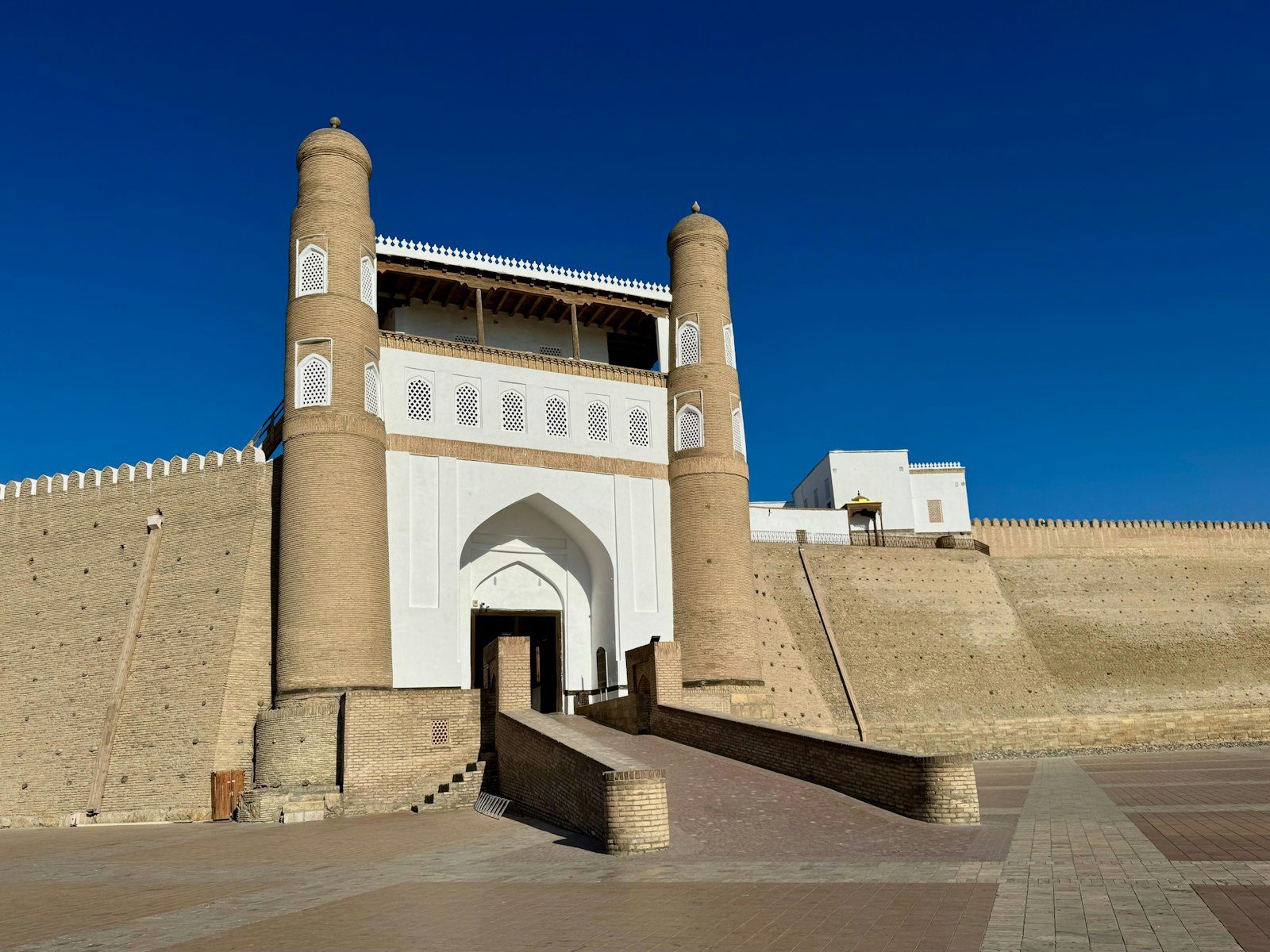
The earthen citadel of the emirs, inhabited since around the 5th century; its walls rise 16 to 20 m and enclose almost 4 hectares. Inside are the throne room, the court mosque and the museum-reserve's local history museum.
- Ticket: 60,000 som for a foreign adult (official museum-reserve tariff). A guided tour in English or another foreign language costs 120,000 som for the Ark; an audio guide, 20,000 som.
- Hours: 9:00 to 18:00, in season 8:00 to 21:00, open daily (museum-reserve hours).
- Allow: 1.5 hours.
- Best time: first thing in the morning, before the heat builds on the open courtyards.
- Dress and photos: no strict dress code; covered shoulders are the safe norm. Photographing the museum exhibits costs 30,000 som, filming with a video camera 100,000 som.
- Our tip: start your Bukhara day here: the Ark explains the city, and Poi-Kalyan is a short walk away.
Poi-Kalyan
Bukhara's central square: the Did you know? Diggers went 13 m down and never found its base The Kalyan Minaret of 1127 rises about 46 m, and an excavation reached 13 m without finding the bottom of its foundations. Genghis Khan reportedly ordered it spared. Read more → of 1127, about 46 m tall, the Kalyan Mosque beside it and the Did you know? A madrasah still teaching after almost 500 years Mir-i-Arab, built in the 1530s opposite the Kalyan Mosque, was one of only three Islamic schools allowed to keep working in Soviet times, and it still trains students today. Read more → An Islamic college: student cells and classrooms around a courtyard behind a grand portal. In the old towns many now house museums and craft workshops. opposite.
- Ticket: check at the ticket office.
- Hours: check at the ticket office.
- Allow: 1 hour.
- Best time: late afternoon, when the low sun warms the brick.
- Dress and photos: this is a working religious complex: shoulders and knees covered, a scarf for women in the mosque. Never photograph people at prayer.
- Our tip: come back after dinner and see the square again from its edge, when the day groups have gone.
Samanid Mausoleum
A small cube of baked brick, about 9.4 m on each side, built in the 10th century; Nasr II of the Samanid dynasty is among those buried here. The brickwork is laid in basketweave and chequerboard patterns.
- Ticket: check at the ticket office.
- Hours: check at the ticket office.
- Allow: 30 minutes.
- Best time: morning or late afternoon, when side light brings out the patterns in the brick.
- Dress and photos: a mausoleum: covered shoulders and knees, and quiet inside.
- Our tip: walk all the way round it: each facade shows the patterns in a different light.
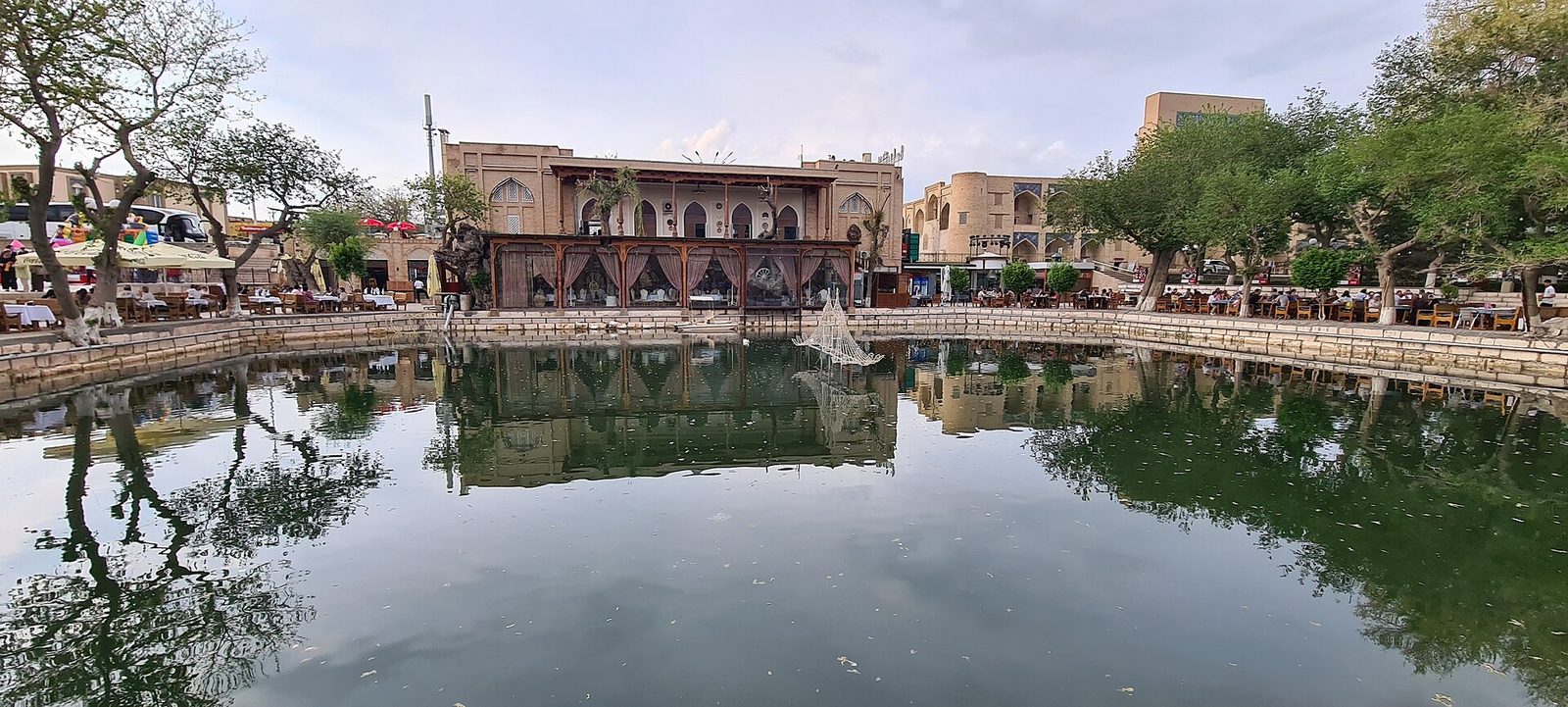
Lyabi-Hauz
A pond of about 1620, 46 by 36 m, framed by the Kukeldash madrasa (1568–1569) to the north, the khanqah of Nadir Divan-Begi to the west and his madrasa of 1622 to the east.
- Ticket: free.
- Hours: an open square.
- Allow: an evening hour.
- Best time: evening, when the city comes out to the water.
- Dress and photos: no dress code. Ask before you photograph people.
- Our tip: end each Bukhara day here: everything in the old centre is within walking distance.
Trading domes
The 16th-century covered crossroads of the old merchant streets, where caps, knives, carpets and jewellery are still sold under the domes.
- Ticket: free.
- Hours: the shops keep daytime hours.
- Allow: 1 to 2 hours, depending on your shopping.
- Best time: midday, when the domes give shade from the heat.
- Dress and photos: no dress code. Ask before you photograph a craftsman.
- Our tip: carry cash in som: small shops often do not take cards. See cards and cash.
Bukhara: outside the centre
Sitorai Mohi-Hosa
The country residence of the last emir of Bukhara, Alim Khan, built in 1912–1918: European outside, Bukharan inside. Today it is the museum of decorative and applied arts, with suzani embroidery, porcelain and gold-embroidered robes.
- Ticket: 60,000 som for a foreign adult (official museum-reserve tariff). A foreign-language guided tour costs 120,000 som.
- Hours: 9:00 to 18:00, in season 8:00 to 21:00, open daily (museum-reserve hours).
- Allow: 1.5 hours.
- Best time: morning, combined with Bahauddin in one drive.
- Dress and photos: no strict dress code. Photographing the exhibits costs 30,000 som.
- Our tip: take a taxi; it lies outside the old town.
Bahauddin Naqshband complex
The burial place of the Sufi master Bahauddin Naqshband (1318–1389), about 10 km north-east of Bukhara. Its largest building, the khanqah, dates from 1544–1545; since 2023 the complex has been part of a UNESCO World Heritage listing.
- Ticket: check at the ticket office.
- Hours: check at the ticket office.
- Allow: 1 to 1.5 hours plus the drive.
- Best time: morning, before the heat and the day groups.
- Dress and photos: this is a place of pilgrimage: shoulders and knees covered for everyone, a scarf for women. Never photograph people at prayer.
- Our tip: go with a guide who can explain the rituals you will see; on a day tour from Bukhara we pair it with Sitorai Mohi-Hosa.
Khiva: inside Itchan Kala
Itchan Kala combined ticket
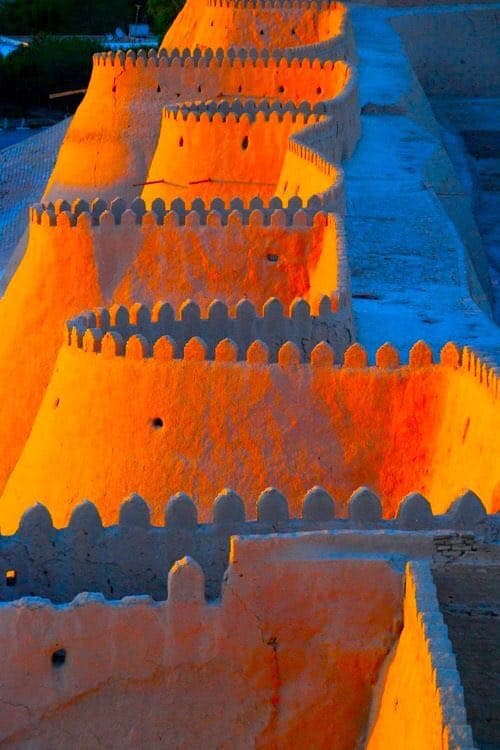
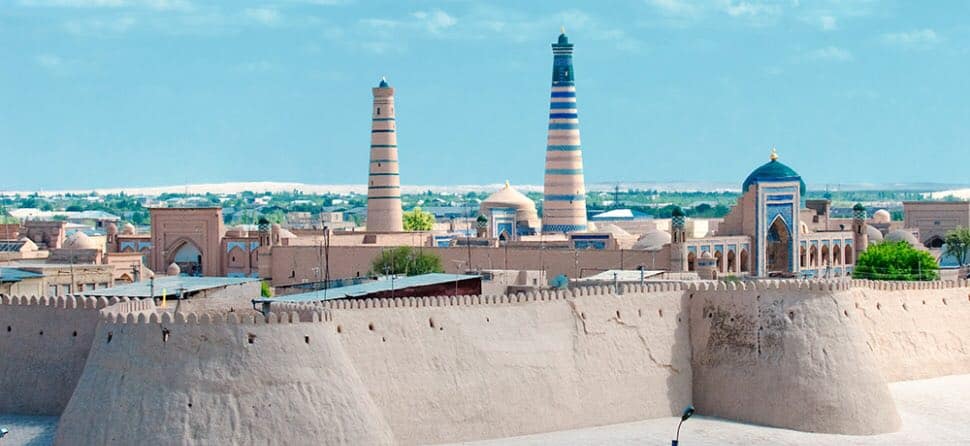
Itchan Kala, the walled inner town of Khiva, has been a UNESCO World Heritage Site since 1990, with more than 50 historic monuments and 250 old houses. Walking its streets needs no ticket; the museums and monuments inside are covered by a combined ticket sold at the ticket office by the West Gate.
- Ticket: check at the ticket office. Ask there exactly which sites it includes, how long it is valid and whether the minaret climbs are extra.
- Hours: check at the ticket office.
- Allow: a full day.
- Best time: early morning and the last hours before sunset; in summer we rest in the middle of the day.
- Dress and photos: covered shoulders and knees inside mosques and mausoleums; elsewhere, ordinary summer clothes are fine.
- Our tip: buy the ticket on the morning you start, not on your evening of arrival, so you get the most out of it.
Kalta Minor
The "short minaret": begun in 1852 and stopped in 1855 at 29 m when Muhammad Amin Khan died in battle; it was meant to rise to 70–80 m. Its base is 14.2 m across, and it is the only minaret covered entirely in glazed tiles.
- Ticket: free to see from the street.
- Hours: an open street.
- Allow: 15 minutes.
- Best time: sunset, when the turquoise tiles glow.
- Dress and photos: no dress code; this is the most photographed spot in Khiva.
- Our tip: come at sunrise for the same view without the crowd.
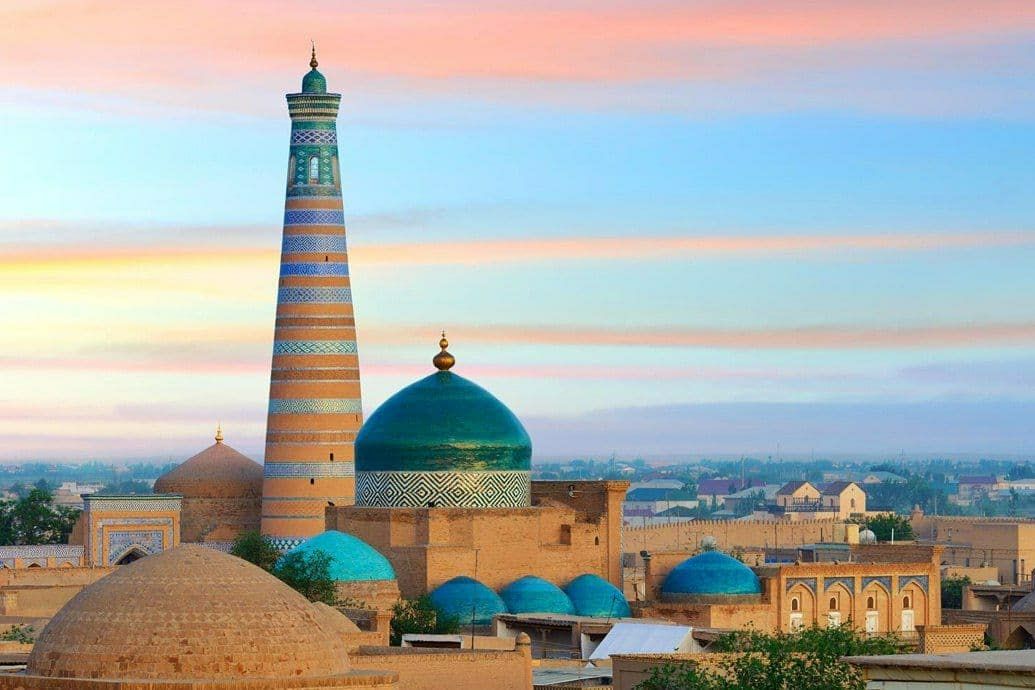
Islam Khoja minaret
Khiva's tallest minaret, 56.6 m, begun in 1908; it is the second tallest in Central Asia. A spiral brick staircase of 175 steps leads to the lantern with windows.
- Ticket: check at the ticket office. Whether the climb is open on a given day, and at what price, is decided there; we never promise it in advance.
- Hours: check at the ticket office.
- Allow: 45 minutes with the climb.
- Best time: late afternoon, for the light on the domes below.
- Dress and photos: no strict dress code. The staircase is narrow and steep: not for anyone with knee trouble or a fear of tight spaces.
- Our tip: if the climb is closed, the Kunya Ark's watchtower gives a similar view over the old town.
Kunya Ark
The khans' citadel by the West Gate, strengthened in the 17th century, when the khan's reception hall was built in 1686–1688. Its Ak Sheikh Bobo watchtower is the highest point of the fortress; the original throne was taken to Moscow in 1873.
- Ticket: check at the ticket office.
- Hours: check at the ticket office.
- Allow: 1 hour.
- Best time: morning for the tiled reception hall; the watchtower at sunset.
- Dress and photos: covered shoulders in the mosque; photos are fine.
- Our tip: since it stands by the West Gate, make it your first stop.
Juma Mosque
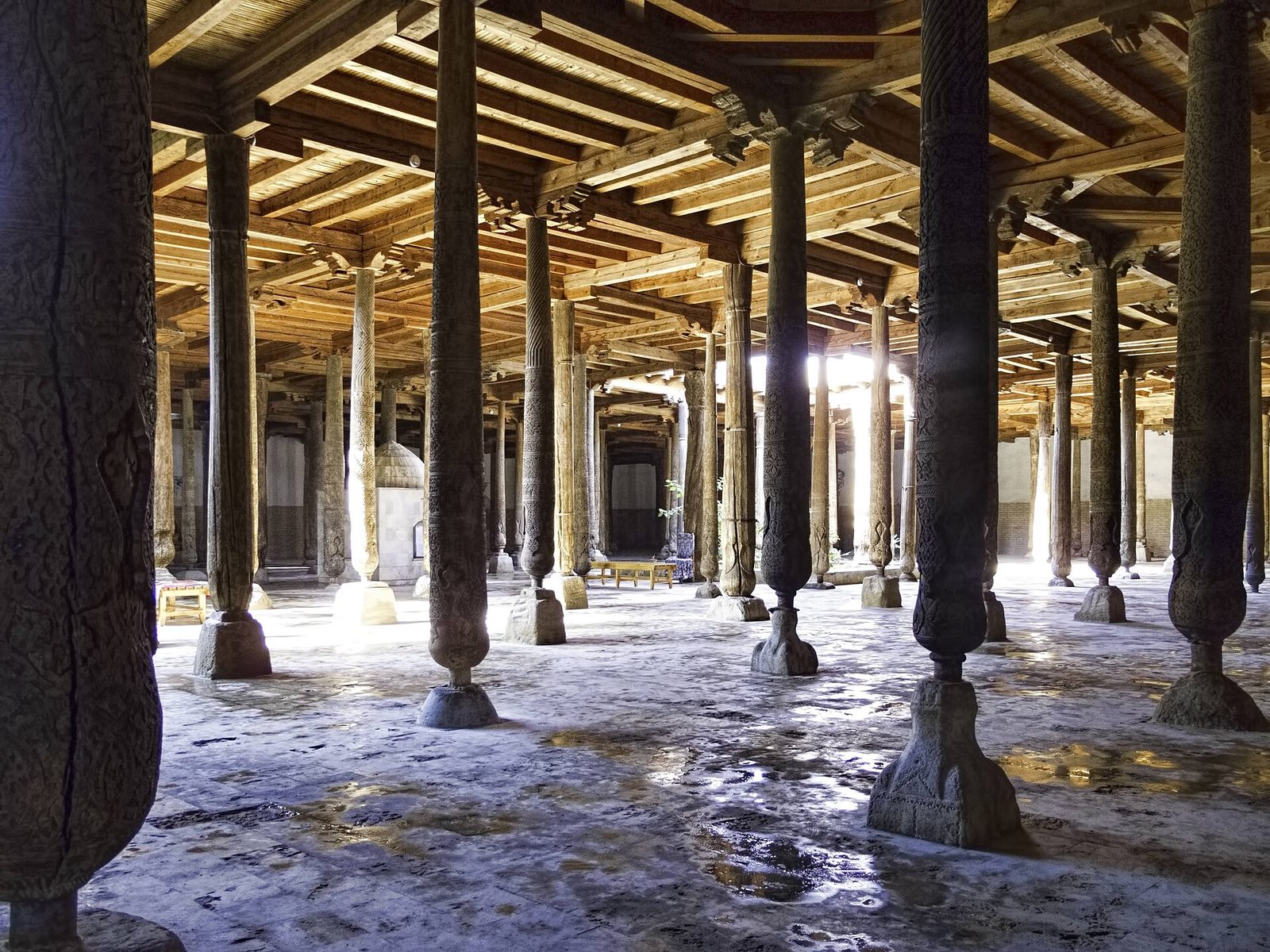
The Friday mosque, first documented in the 10th century and rebuilt in 1788: a dim hall held up by 212 carved wooden columns in 17 rows, with a 42 m minaret.
- Ticket: check at the ticket office.
- Hours: check at the ticket office.
- Allow: 30 minutes.
- Best time: midday, when light falls through the openings in the roof.
- Dress and photos: shoulders and knees covered, a scarf for women.
- Our tip: look for differences between the columns: they were carved at different times.
Tash Hovli palace
The palace of Allah Kuli Khan, built in the 1830s, with more than 260 rooms. Its harem courtyard has five loggias on carved wooden pillars: four for the khan's wives, the largest for the khan himself.
- Ticket: check at the ticket office.
- Hours: check at the ticket office.
- Allow: 45 minutes.
- Best time: morning, when the tiled courtyards are cool.
- Dress and photos: no strict dress code; photos are fine.
- Our tip: look up at the painted wooden ceilings of the loggias.
Khiva: an evening at Arda Khiva
Arda Khiva opened in May 2025 on 25 hectares by Lake Govuk, a short drive from the walls: hotels, a 3,000-seat amphitheatre by the water, a bazaar under domes and a canal with gondolas. After a day in the museums, this is where we take guests for dinner and a walk. Read more in our guide to Arda Khiva.
- Ticket: check at the ticket office.
- Allow: an evening of 2 to 3 hours.
- Our tip: compare its copy of the Kalta Minor with the original in Itchan Kala on the same day.
Getting there and planning the days
Between the two cities, see Khiva to Bukhara; for the fast train from Tashkent, see trains in Uzbekistan. The pages Bukhara and Khiva show how they fit into a longer route.
With a guide you skip the queues at the desks: try our Bukhara highlights tour, the Bukhara discovery tour, Bukhara in 2 days, the Itchan Kala walking tour or Khiva in 3 days.
In short
- Bukhara: the Ark and Sitorai Mohi-Hosa cost 60,000 som each for a foreign adult; Lyabi-Hauz and the trading domes are free.
- Bukhara museums are open daily, 9:00 to 18:00, and 8:00 to 21:00 in season; photographing exhibits costs 30,000 som.
- Khiva: one combined ticket covers the museums inside Itchan Kala; check its price, validity and what it includes at the ticket office by the West Gate.
- Never count on climbing the Islam Khoja minaret: whether it is open is decided on the day.
- Cover shoulders and knees at mosques and mausoleums, and carry a scarf for Bahauddin and the Juma Mosque.
Photos
- Lyabi-Hauz pond, Bukhara — BeshevI / Wikimedia Commons · CC BY-SA 4.0
- Wooden columns of the Juma Mosque, Khiva — Dan Lundberg / Wikimedia Commons · CC BY-SA 2.0