Places in this article: Bukhara
The Samanid Mausoleum and Bolo-Hauz: Bukhara beyond the old centre
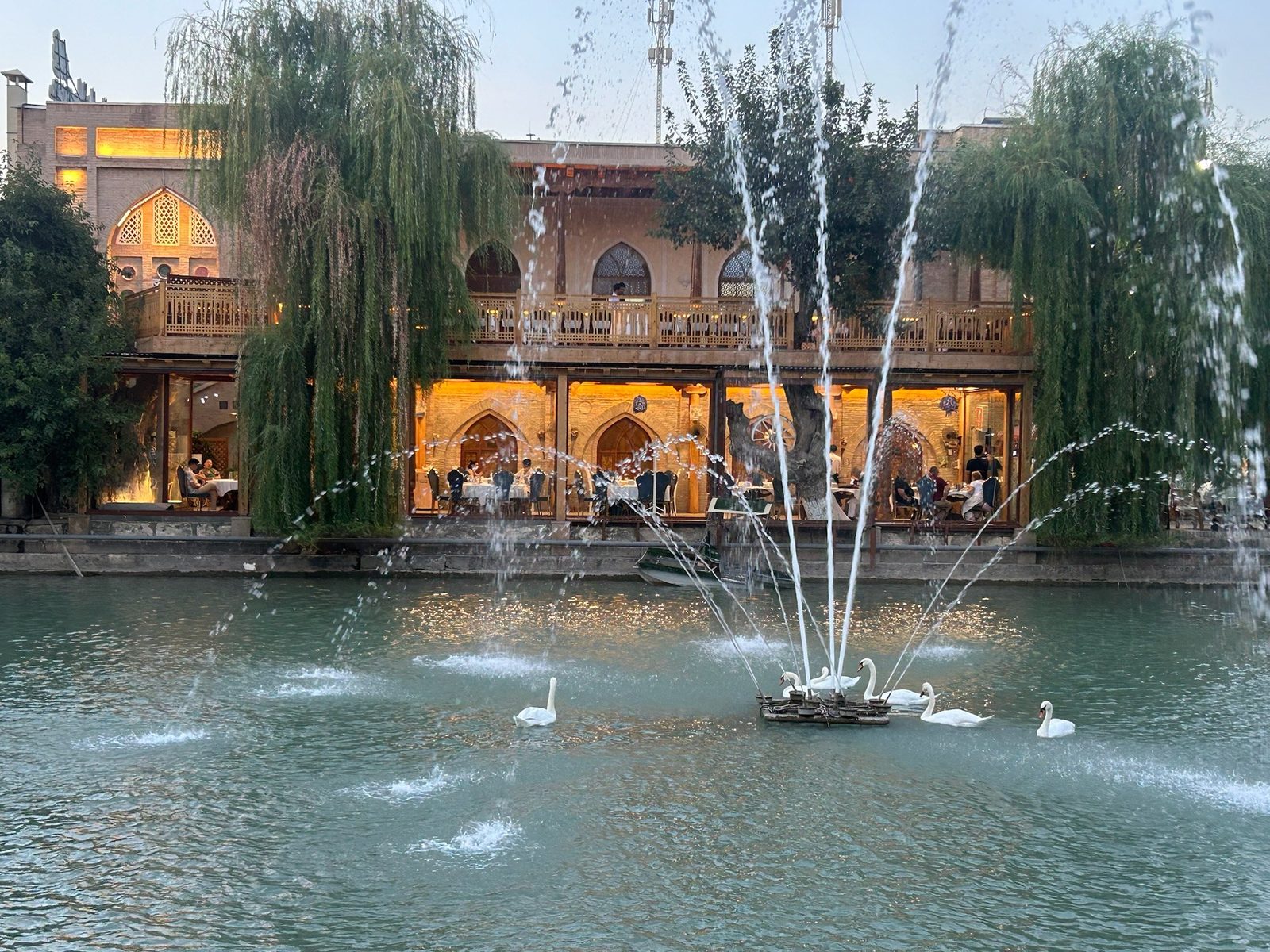
Most people see Bukhara along one line, from Did you know? Bukhara's ponds were once its water supply Pools like Lyabi-Hauz, dug around 1620 and 46 × 36 m, were the city's main source of water. Most were filled in during the 1920s–30s because they spread disease; Lyabi-Hauz survived. Read more → past the Did you know? Under Bukhara's domes merchants changed money and gold Four 16th-century trading domes still stand over old crossroads. Toki Sarrafon was the money changers' dome, where merchants from India and China swapped coins; Toki Zargaron held jewellers' workshops, Toki Telpak Furushon sold caps. Read more → to Did you know? Legend: the minaret's foundation was laid with camel milk Legend says master Bako laid the foundations of the Kalyan minaret with ganch plaster mixed with camel milk, then vanished for two years to let them harden, and only then built the tower. Locals still show a grave they say is his. Read more → and .The fortress-residence of the rulers of Bukhara on a high artificial hill: the oldest structure in the city. Read more → Cross the square in front of the Ark, keep walking west, and the old centre gives way to trees, flowerbeds and a small brick cube that has stood here for more than a thousand years. That cube is the Did you know? Buried in mud, this tomb escaped Genghis Khan The 10th-century Samanid Mausoleum, one of the oldest monuments of Islamic Central Asia, was covered by flood mud and sand before the Mongols came in 1220. Hidden for centuries, its brick lacework survived intact. Read more → in Bukhara, one of the very few buildings left from the age of the Samanids.
Here is the half-day we walk with our guests beyond the old centre: the mausoleum and its park, ,Did you know? A cone-shaped dome over Job's spring Chashma-Ayub, 'Job's Spring', has a conical dome in the Khorezm style, rare in Bukhara. Legend says Job struck the ground with his staff and water flowed; inside is a museum of Bukhara's water supply. Read more → the Did you know? The famous columns of Bolo-Hauz are barely a century old The Bolo-Hauz mosque opposite the Ark was completed in 1712, but its best-known feature, the tall, slender carved columns along the front of the iwan, was added only in 1917, together with the small minaret of 1916–1917. Read more → mosque with its twenty columns, and the Ark across the square. The facts come first, and the legends are marked as legends.
The Samanid Mausoleum: a family tomb of the 10th century
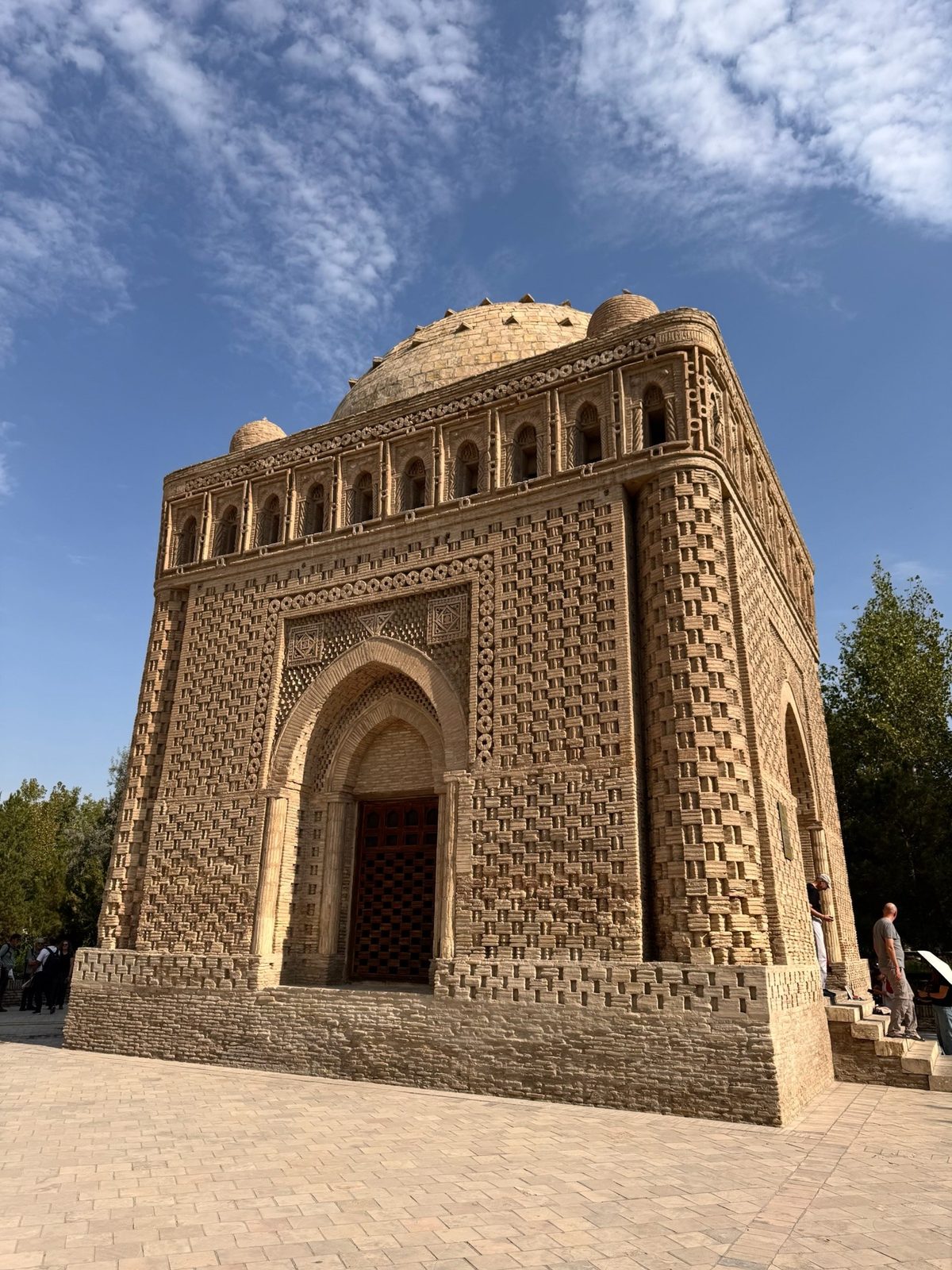
The Samanids ruled from Bukhara in the 9th and 10th centuries, and their tomb dates from the turn of those two centuries, the time of ,Did you know? Legend says Ismail Samani answered requests after death People long believed that Ismail Samani, the ruler buried in the Samanid Mausoleum, still helped his people: a written request slipped through an opening on one side would be answered by the next day. Notes were left here into the 20th century. Read more → who reigned from 892 to 907. A 16th-century copy of a deed of endowment says that Ismail gave land in the cemetery for a tomb for his father, Ahmad. Ismail himself was later buried here too.
The building became the family vault of the dynasty. During restoration in the 1930s a wooden lintel was found carved in Kufic script with the name of Nasr, Ismail’s grandson, who ruled until 943. That is why you will see two sets of dates on signs and in books: the age of Ismail, and the last ruler laid to rest here.
Brick that changes with the light
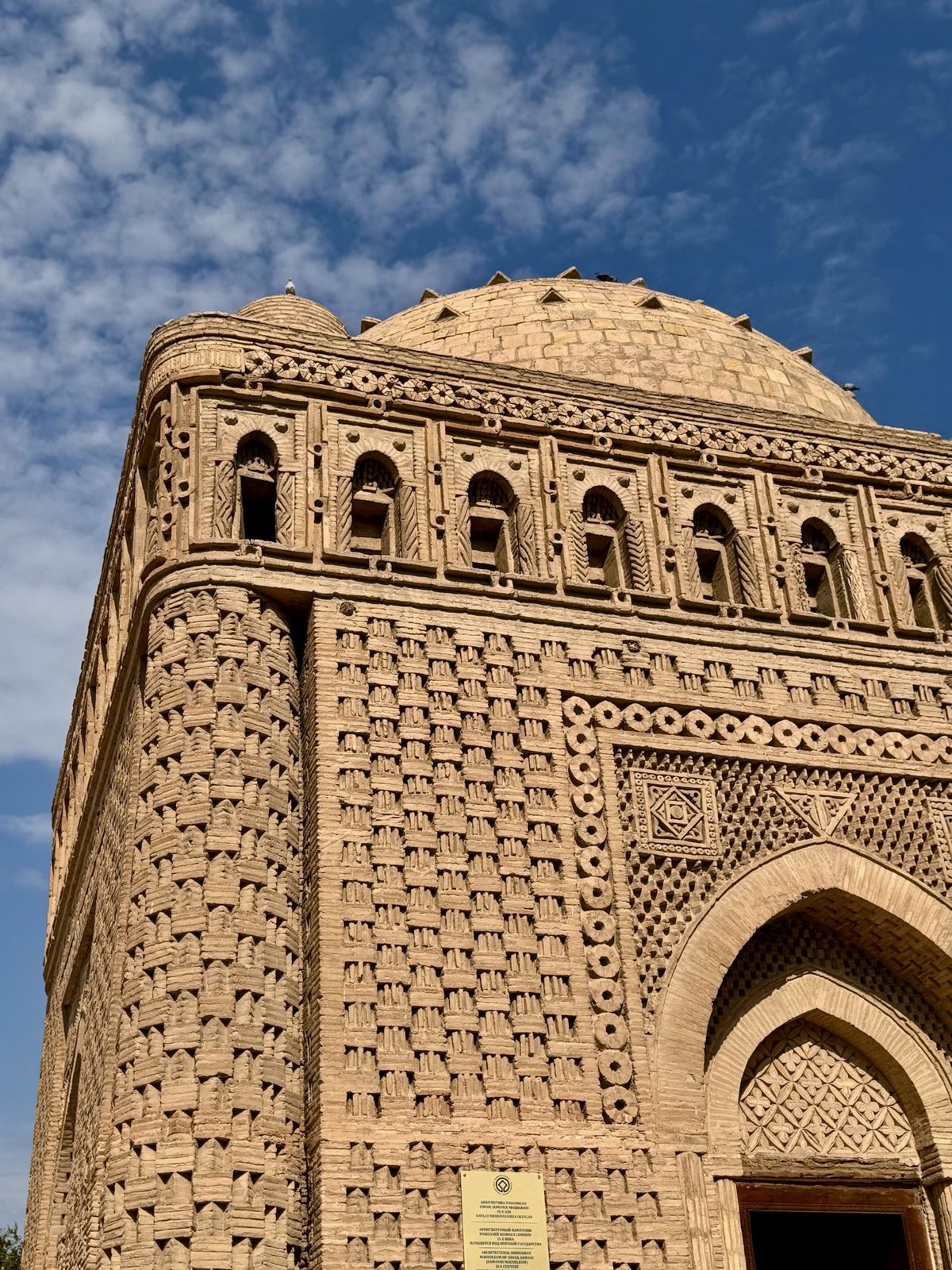
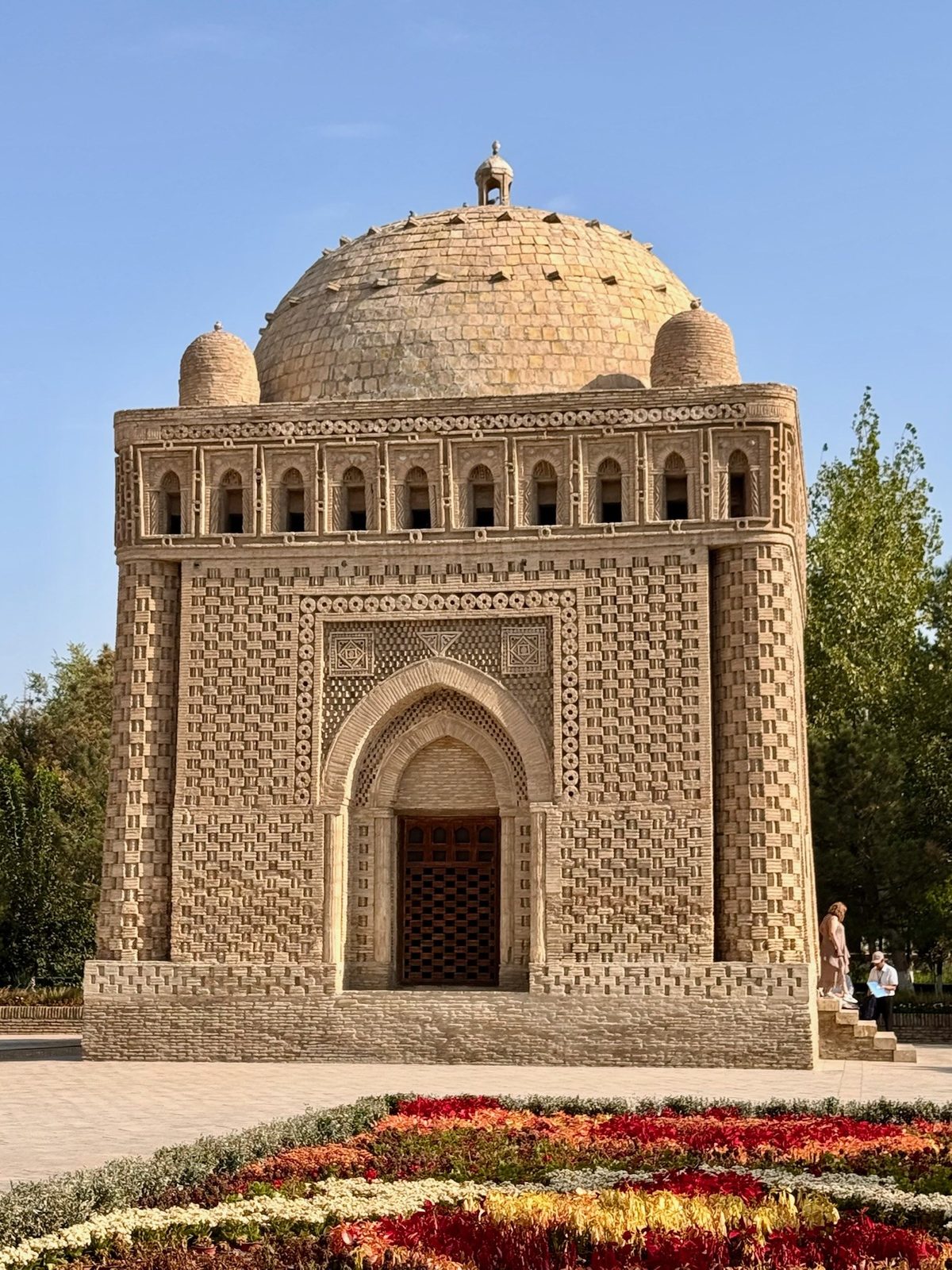
The mausoleum is small: about ten metres a side, with walls 1.8 metres thick. A broad dome sits in the middle and four small domes on the corners. All four sides are alike, each with an arched entrance, so there is no main facade; you can walk round it and see the same building from every side.
Everything is baked brick. Large bricks carry the weight, and small ones, set in groups of two to five, make the ornament: basketweave, chequerboard, rosettes and rows of brick “pearls”. Under the dome runs a gallery of small arched openings that lightens the walls and lets daylight in. Because the bricks stand at different depths, the pattern shifts as the sun moves: flat at noon, deep and textured in the low light of morning and late afternoon.
How it survived: silt, a cemetery and a park
Before Genghis Khan’s army took Bukhara in 1220, floods had already covered the mausoleum with mud and sand, and the cemetery around it kept growing in layers until it hid almost a third of its height. That is how a brick building of the 10th century came through the centuries in such good shape.
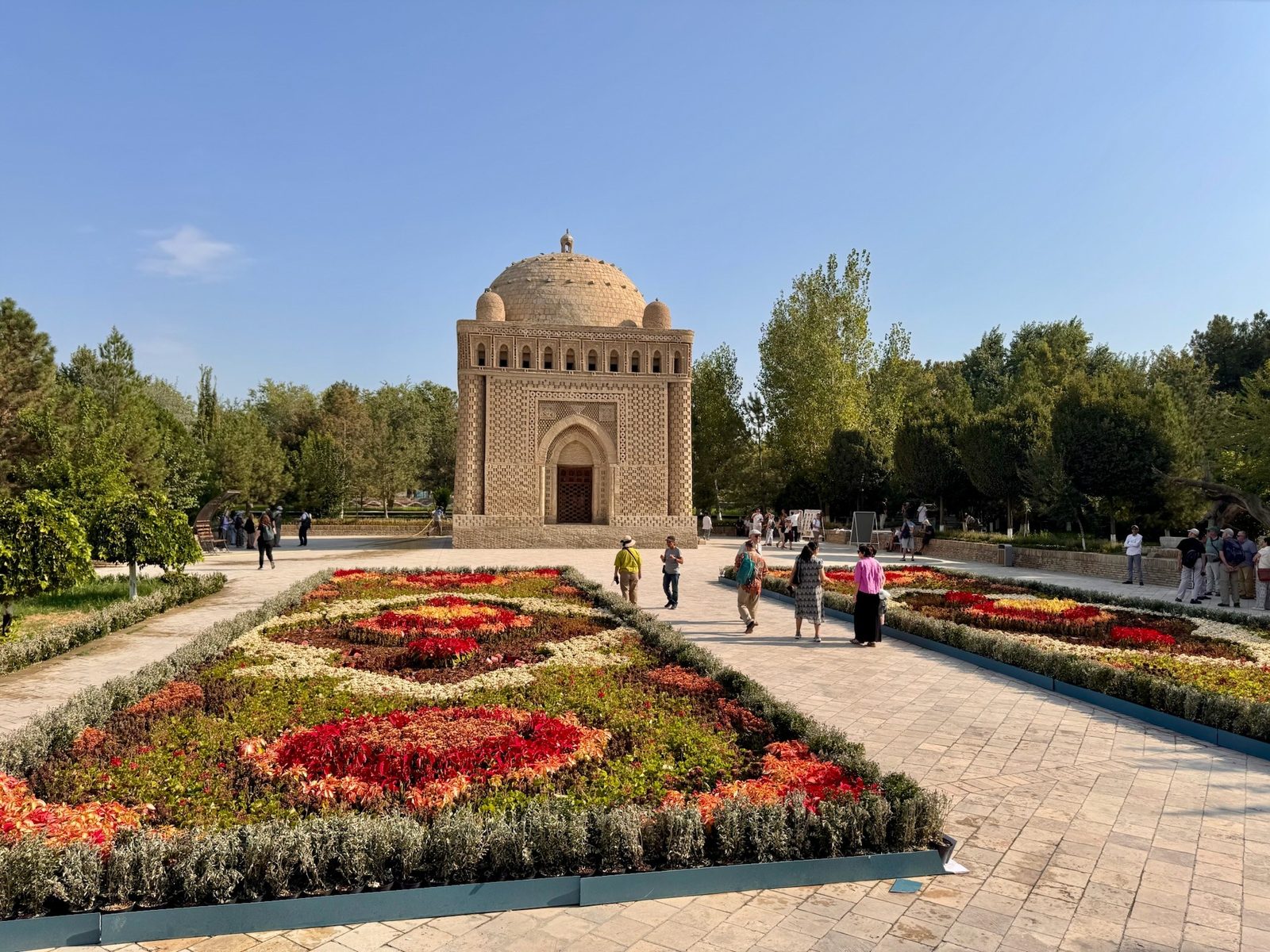
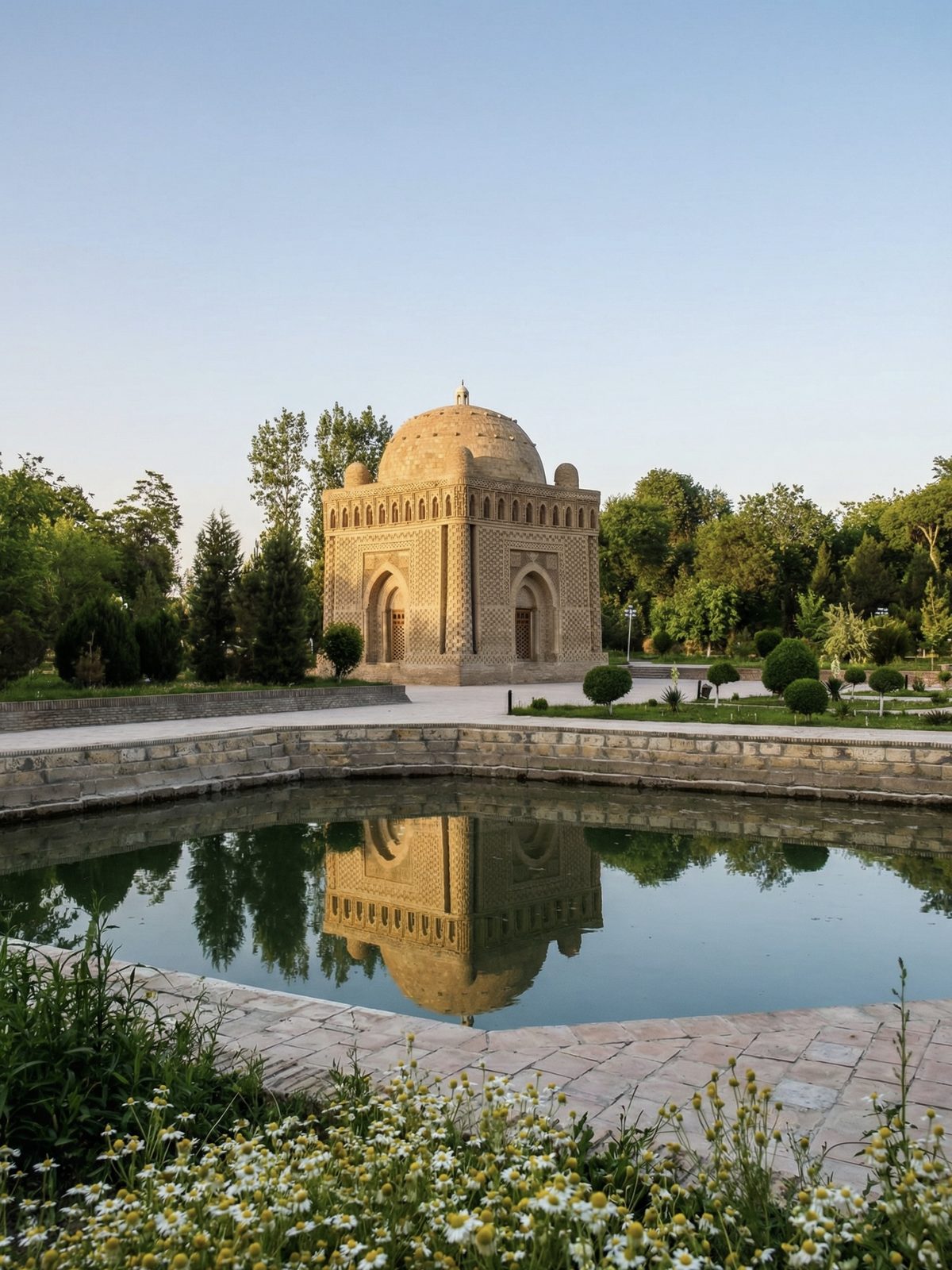
Archaeologist Vasily Vyatkin dug it out in 1926–1928, and the major restoration came in 1937–1939. In the same years the old cemetery was cleared and the ground became the city’s central park. Today the mausoleum stands at the end of an avenue of flowerbeds, with a restored pond to the south-east, where the walls show in the water on a still morning. The park also has rides and a big wheel, so families with children find it an easy place to rest between museums.
Legends of the mausoleum
Legend says that Ismail Samani, remembered in Bukhara as Hazrat Sultan, went on ruling after his death. People slipped written requests into an opening on the south side of the tomb and waited for an answer to appear on the north side. It is a story, of course; what is true is that people came to this tomb for centuries, and it was a living place, not a ruin.
Guides also tell you that Genghis Khan’s men passed it by because it was lost among the graves, and that the builders mixed camel’s milk and egg yolk into the mortar to make it last. The first is a legend that rests on a real fact, the silt and the cemetery. The second is pure folklore. For the forty brick beads and the story of the forty spirits, see our legends of Bukhara.
Chashma-Ayub: Job’s spring and the water museum
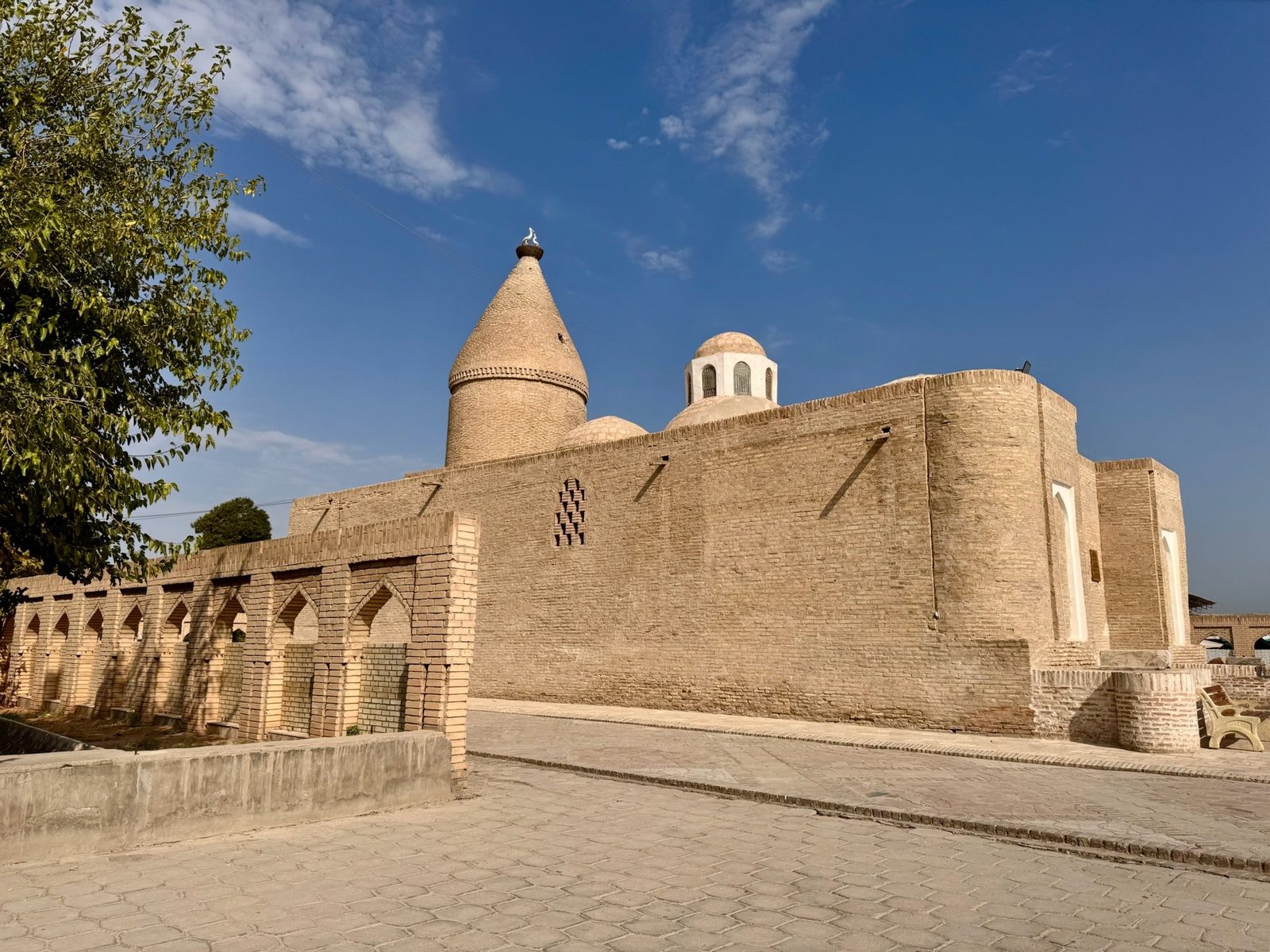
A few minutes’ walk from the mausoleum, at the edge of the park, stands a long brick building with a pointed dome. By legend, the prophet Job, Ayub, struck the ground here with his staff and a spring came up; the name means “Job’s spring”.
The oldest room goes back to the 12th century. An inscription of 1379–1380 credits Amir Timur (Tamerlane, 1336–1405), founder of the Timurid empire, which had its capital in Samarkand. Born near Shahrisabz. with the grand domed chamber, and the conical dome, common in Khorezm and rare in Bukhara, is put down to Khorezmian masters. The building measures about 19 by 26 metres, with four rooms in a row from west to east, each under its own dome. Inside is a museum of Bukhara’s water supply: canals, ponds and how a city in the desert kept itself in water.
Bolo-Hauz: the emir’s mosque by the pond
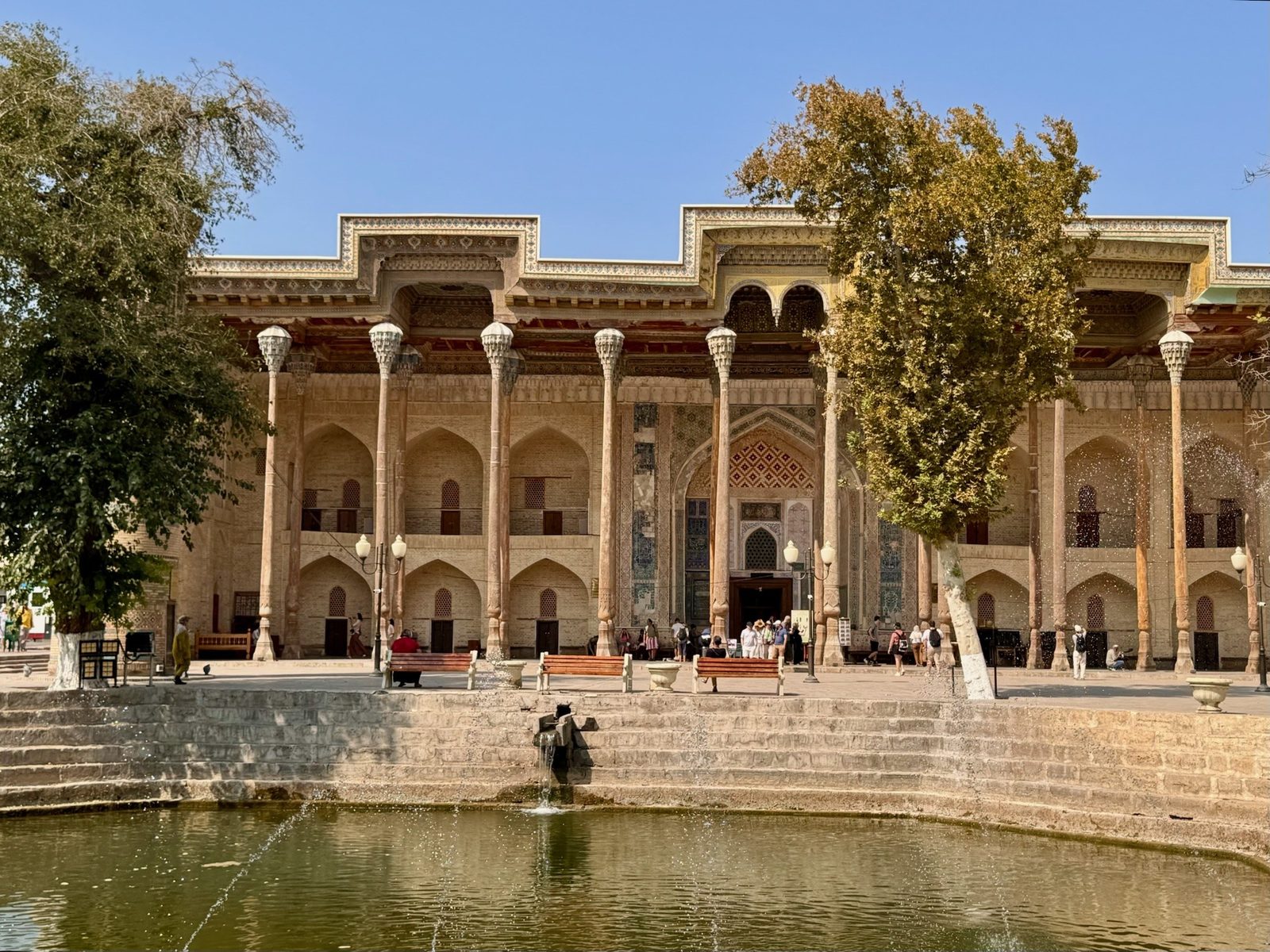
Walk back east towards the Ark, and on the edge of the Samarkand's main square, framed by three madrasahs: Ulugh Beg (15th century), Sher-Dor and Tilya-Kori (both 17th century). Read more → square you reach Bolo-Hauz. The mosque and the octagonal pond in front of it date from 1712. It was the emirs’ Friday mosque: on feast days carpets were laid across the square from the gate of the Ark to its door. The pond held water for ablutions and for the people of the quarter.
Bolo-Hauz is still a working mosque, and on Friday at midday it is busy with prayers. On other days and at other hours you can stand in the iwan and look across the water.
Twenty columns, forty in the water
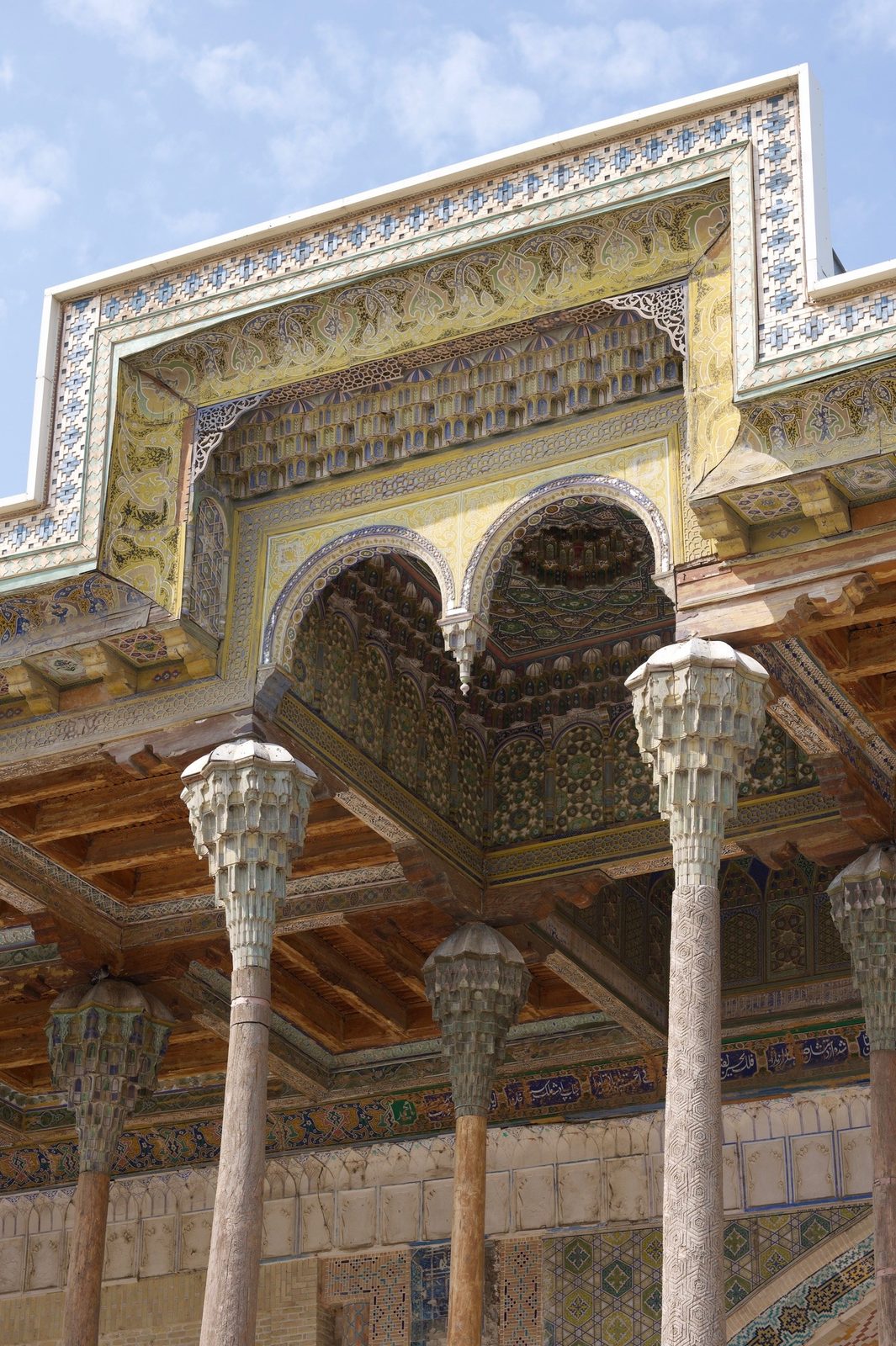
The iwan everyone photographs is two centuries younger than the mosque. In 1917 master Shirin Muradov added it on three sides, together with the small minaret. Its roof rests on twenty slender wooden columns, 12 metres tall, with carved and painted stalactite capitals, and the porch measures 42 by 10 metres. Look up: the ceiling between the beams is carved and painted too.
People in Bukhara like to call Bolo-Hauz the mosque of forty columns. Count them and you will find twenty; the saying goes that the other twenty stand upside down in the pond. The minaret beside the pond, also of 1917, is banded with brick and blue glazed tiles.
The Ark across the square, and a view from the water tower
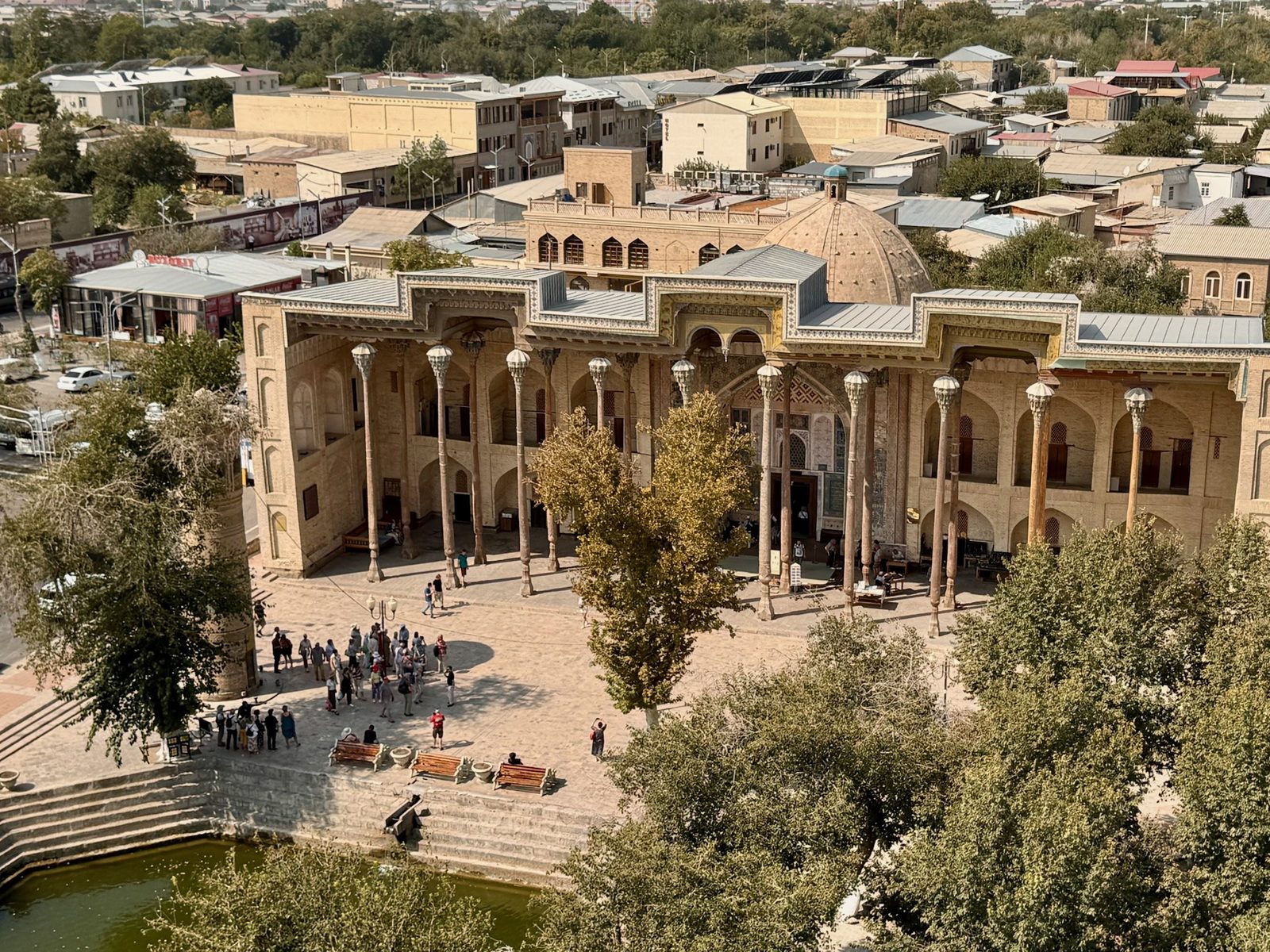
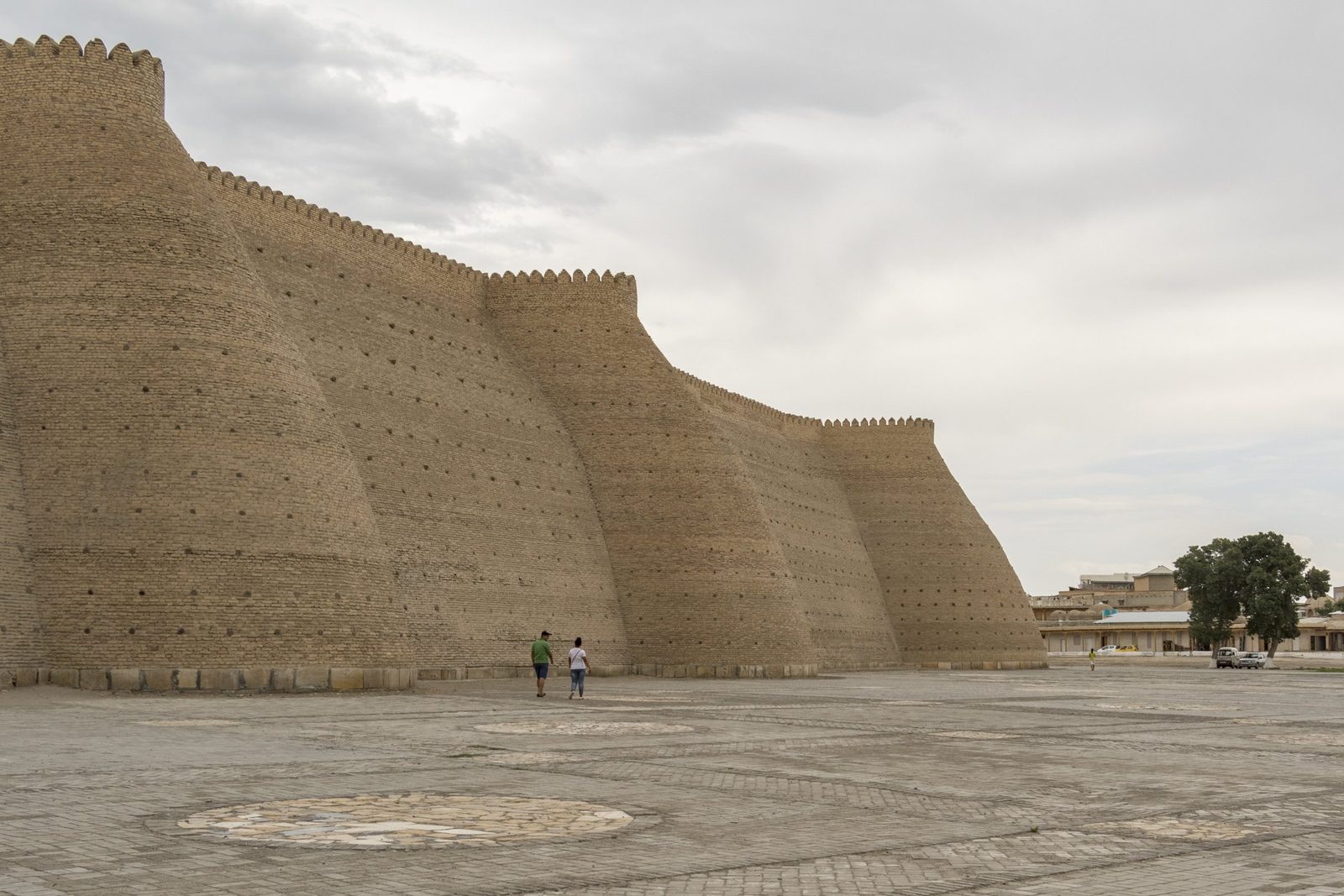
Opposite Bolo-Hauz rise the sloping walls of the Ark, the fortress of Bukhara’s rulers for more than a thousand years, with the throne court where emirs were crowned. We tell its story, legends included, in our guide to the Ark of Bukhara.
On the square between them stands a steel lattice water tower designed by engineer Vladimir Shukhov and built in 1929. It no longer holds water; it has been restored, with cafes on the lower floors and a viewing floor at the top. From there you see Bolo-Hauz and its pond from above, the Ark beside you and the domes of the old centre beyond.
Walking route and practical tips
- Route: the Ark at opening time, then across the square to Bolo-Hauz, west through the park to the Samanid Mausoleum, and on to Chashma-Ayub. From there it is a short walk back east to Poi-Kalyan and, in the evening, Lyabi-Hauz.
- Time: half a day. About 1.5 hours for the Ark, 20 minutes for Bolo-Hauz, 30 minutes for the mausoleum and the park, and half an hour for Chashma-Ayub and its museum.
- Light: come in the morning. The sun falls on the columns of Bolo-Hauz, and the low side light brings out the brick pattern of the mausoleum. In summer the park is the shadiest stop of the day.
- Tickets: 60,000 som for a foreign adult at the Ark and 20,000 som for the water museum in Chashma-Ayub. The museums open 9:00–18:00, and 8:00–21:00 in the season.
- What to wear: shoulders and knees covered for Bolo-Hauz; women may want a light scarf. Comfortable shoes for the paving and the park paths. More in what to wear in Uzbekistan.
To place this walk in your days, see Bukhara in 1, 2 or 3 days; for sights outside the city, day trips around Bukhara. With a guide, this route is part of the Bukhara highlights tour and our other Bukhara tours. After a day on foot, end it at dinner with a local family.
In short
- The Samanid Mausoleum dates from the turn of the 9th and 10th centuries, the time of Ismail Samani; very few buildings of the Samanid age have survived.
- Its brick pattern changes with the light: come in the morning.
- It survived under silt and the layers of a cemetery; it was dug out in 1926–1928.
- Bolo-Hauz dates from 1712; its iwan of twenty columns, “forty” with the reflection, was added in 1917.
- Ark, Bolo-Hauz, the park and Chashma-Ayub make an easy half-day on foot.