
 Deutsch
 English
 Español
 Français
 Italiano
 Polski
 Português
 Suomi
 Svenska
 Türkçe
 Русский
 עברית
 한국어
 中文
 日本語
Places in this article: Samarkand · Bukhara · Tashkent
Uzbek national costume: doppi, chapan and atlas, and where to see them
Look at the caps at a wedding in Tashkent and you can often tell where the guests’ families come from. A black cap with white peppers is from Chust. One heavy with gold thread is from Bukhara. A tall shaggy sheepskin hat means Khorezm. The Uzbek national costume is still worn, mostly for celebrations, and it still works as a map.
We are a tour operator in Tashkent. Below is how to read the costume, and where on a trip with us you see it made, sold and worn.
The doppi: a cap that says where you are from
The doppi is the Uzbek skullcap, square or round. In Russian it is called a tubeteika. Men, women and children wear it, and in the cities it comes out mostly for family celebrations and holidays. Uzbek caps are named after the place they come from. There are six large regional groups of headwear: Tashkent, Samarkand, Bukhara, Kashkadarya, Surkhandarya and Khorezm.
The most common cap is four-gored, folded from four panels. A man’s cap usually has a light pattern on a dark ground. A woman’s cap is in many colours. The cap is old: miniatures painted here in the 15th century already show women and girls in round caps with embroidered edges. It was also a talisman, and an old cap is not thrown away or given away.
Chust: black velvet and white peppers
The best-known men’s cap comes from Chust, a town of craftsmen in the Namangan region of the Fergana Valley. It is black velvet embroidered by hand in white silk, and women make it. On top are the bodom, almonds, and the qalampir, a pepper pod repeated four times. Around the edge run sixteen arches, alternating with ram’s horns. People read them as a fortress around the person wearing the cap.
Once a week Chust holds a special skullcap market with hundreds of handmade caps. The town bazaar also sells its famous knives and gold-embroidered chapans. Chust is not on our standard Fergana route, but on a private trip you can ask us to add it. For the knives and the town itself, see Andijan and Namangan.
The chapan, the yaktak and the sash
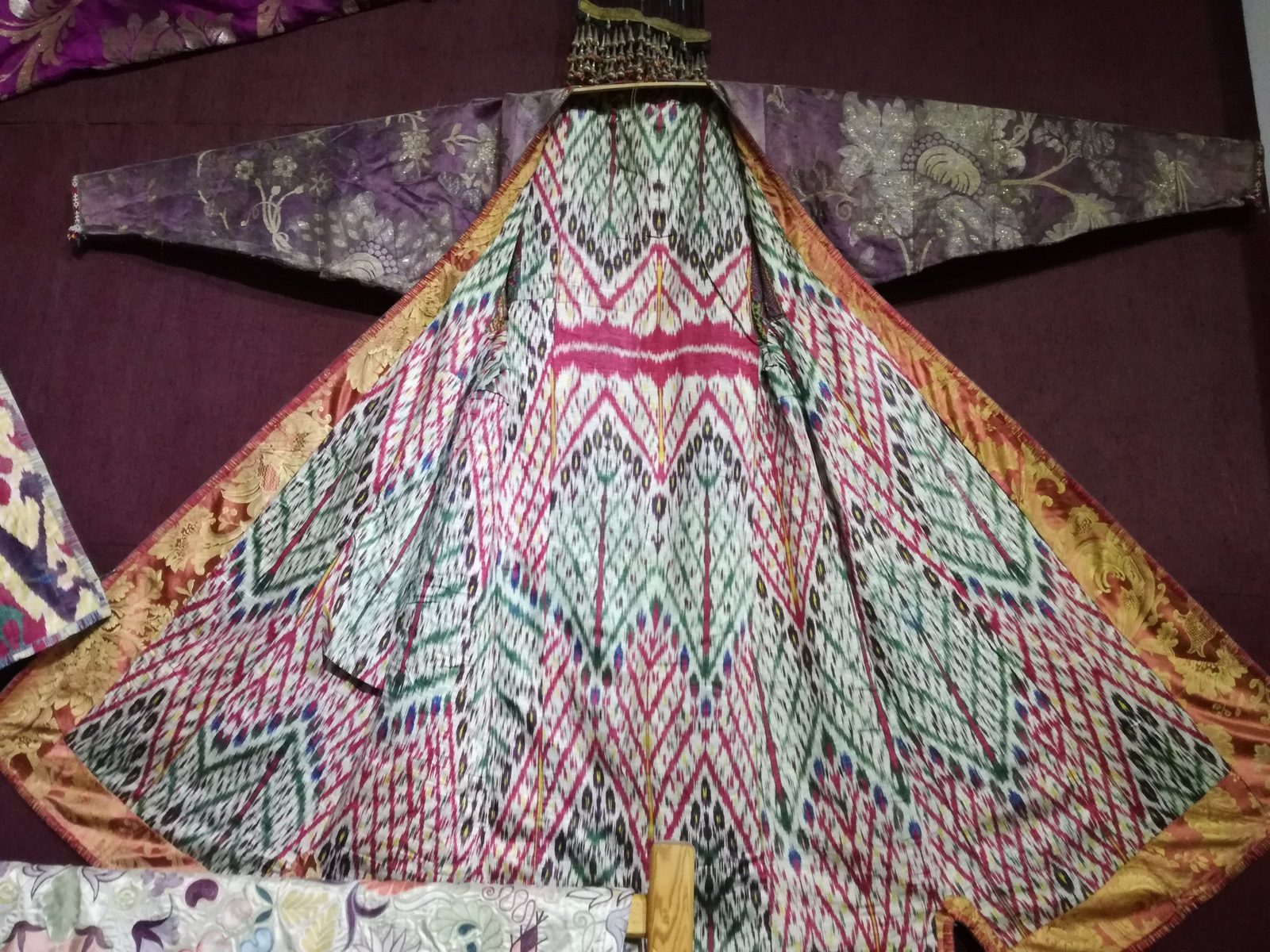
A traditional man’s outfit is a shirt, trousers called ishton, a robe, a sash, leather boots and, without fail, something on the head: a turban or a doppi. In Tashkent and the Did you know? Legend says Fergana's 'heavenly horses' sweated blood Legend says the horses of Dayuan, as Chinese chronicles called Fergana, sweated blood, and around 102 BC Emperor Wu of Han sent an army to bring some home. The 'blood' was most likely a skin parasite that causes tiny bleeding spots. Read more → men also wore the yaktak, a shirt that wraps at the front. Children and old people wore the guppicha, a shirt quilted on cotton wadding.
The chapan (chopon) is the long coat on top, worn mostly in the cold months, in many colours and patterns. For special occasions men put on richly embroidered chapans, and you still see them at weddings and big family days. Soft leather boots were worn with backless leather overshoes, which came off at the door.
Atlas, adras and gold
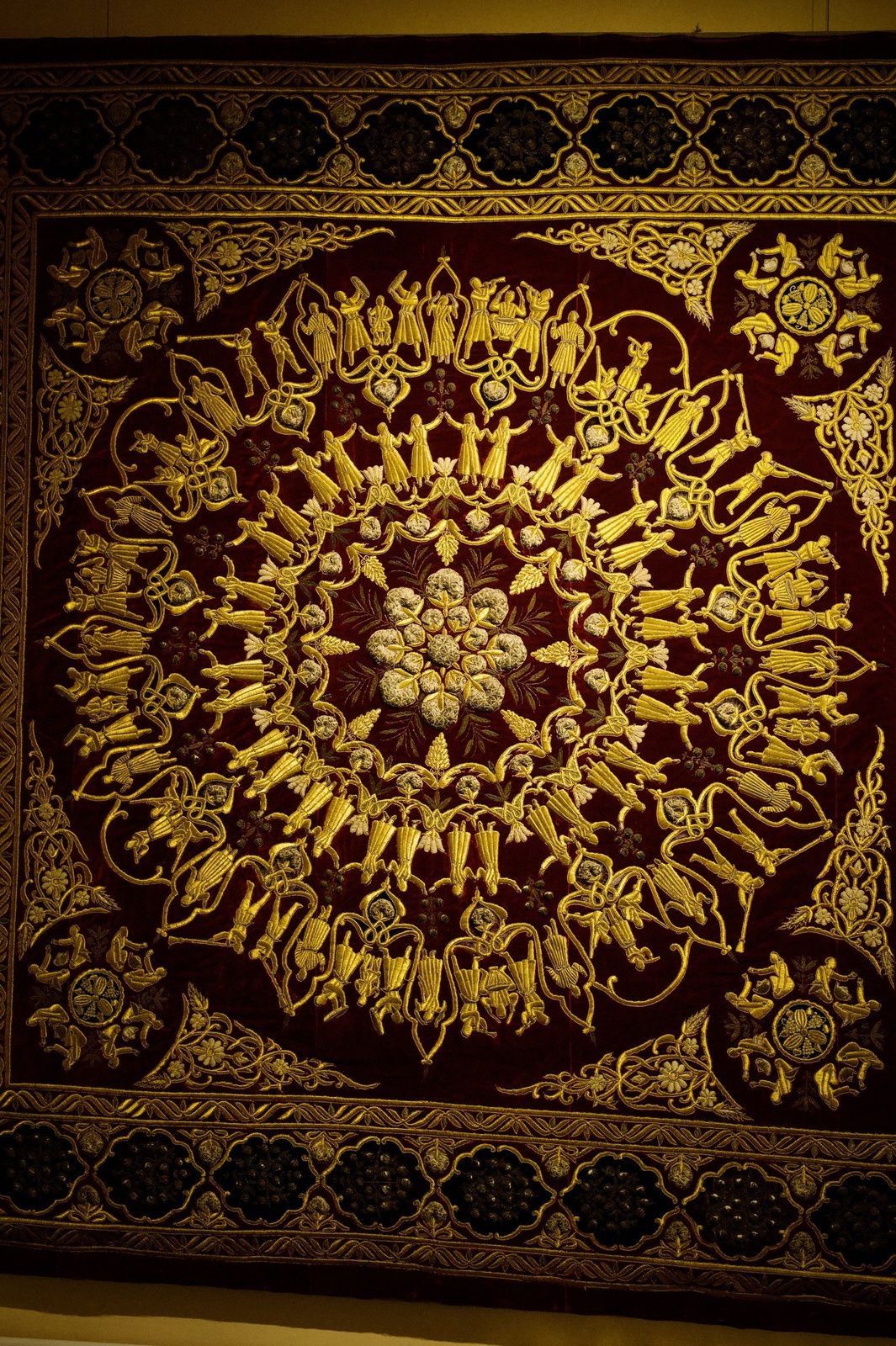
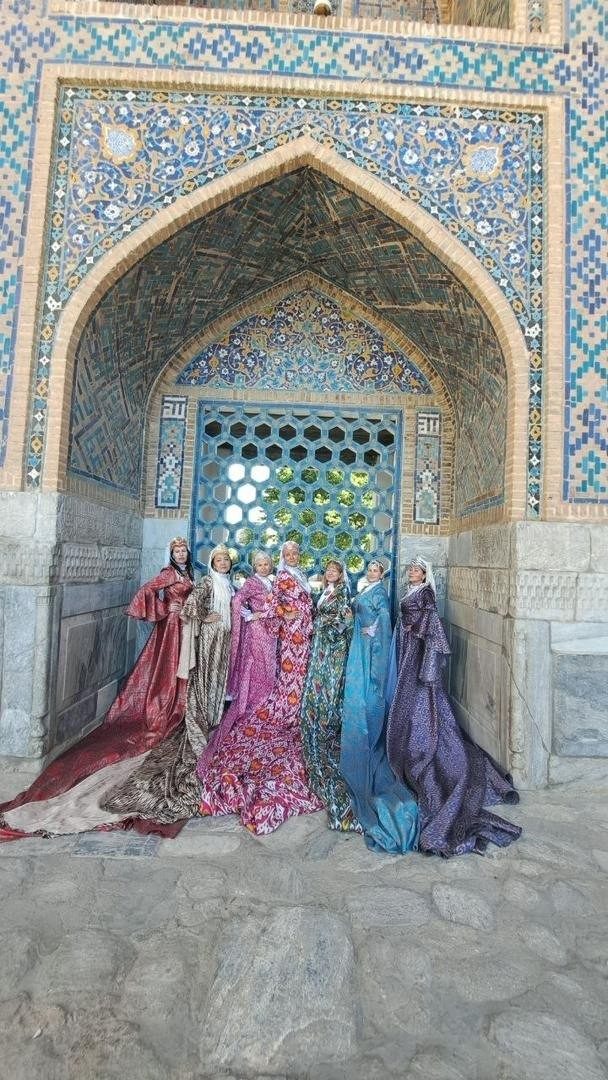
A woman’s costume is a dress, wide trousers, a robe, a headscarf, a cap and soft shoes, with gold or silver jewellery. The trousers were often cut from ikat, the cloth whose pattern is dyed into the threads before weaving. For festive days women wear dresses of Did you know? Legend says the first atlas silk copied a rainbow on water Legend says a Margilan khan wanted to marry a weaver’s daughter but promised to give her up for something more beautiful by morning. By a canal the weaver saw clouds and a rainbow reflected after rain — and wove the first khan-atlas. Read more → and silk, often embroidered with gold thread.
Atlas and Did you know? UNESCO holds up Margilan's silk weavers as a model In 2017 UNESCO added the Margilan Crafts Development Centre, which revives the hand-making of atlas and adras, to its Register of Good Safeguarding Practices. Atlas is pure silk; adras mixes silk and cotton. Read more → come from .Did you know? Legend says Margilan is named after chicken and bread Legend says locals greeted Alexander the Great with chicken and bread, 'murg' and 'non', and the dish gave the town its name. In fact Alexander never reached here; the name Margilan is recorded from the 10th century. Read more → The town’s Crafts Development Centre, opened in 2007, teaches the old way of making them, and in 2017 UNESCO put it on its Register of Good Safeguarding Practices. How the cloth is made, and how to tell the two apart, is in our article on Uzbek ikat.
Gold embroidery was the highest of the town crafts. It covered the clothes of the emir and the nobility of Bukhara, and the gold-embroidered Bukhara cap is the richest of all doppis. At the Did you know? Legend: the emir's palace site was chosen with meat Legend says that when Emir Nasrullah wanted a summer palace in the mid-19th century, sheep carcasses were hung in several places around Bukhara, and the spot where the meat spoiled last was chosen. Sitorai Mohi-Hosa there today dates from 1912–1918. Read more → summer palace you see gold-embroidered robes next to Bukhara .Did you know? One suzani was often stitched by several women at once A family member or a pattern drawer, the kalamkash, drew the design across strips of cotton. The strips went to different women of the family or neighbourhood, who embroidered them at the same time; sewn back together, they show slightly mismatched seams. Read more →
Khorezm: hats of sheepskin
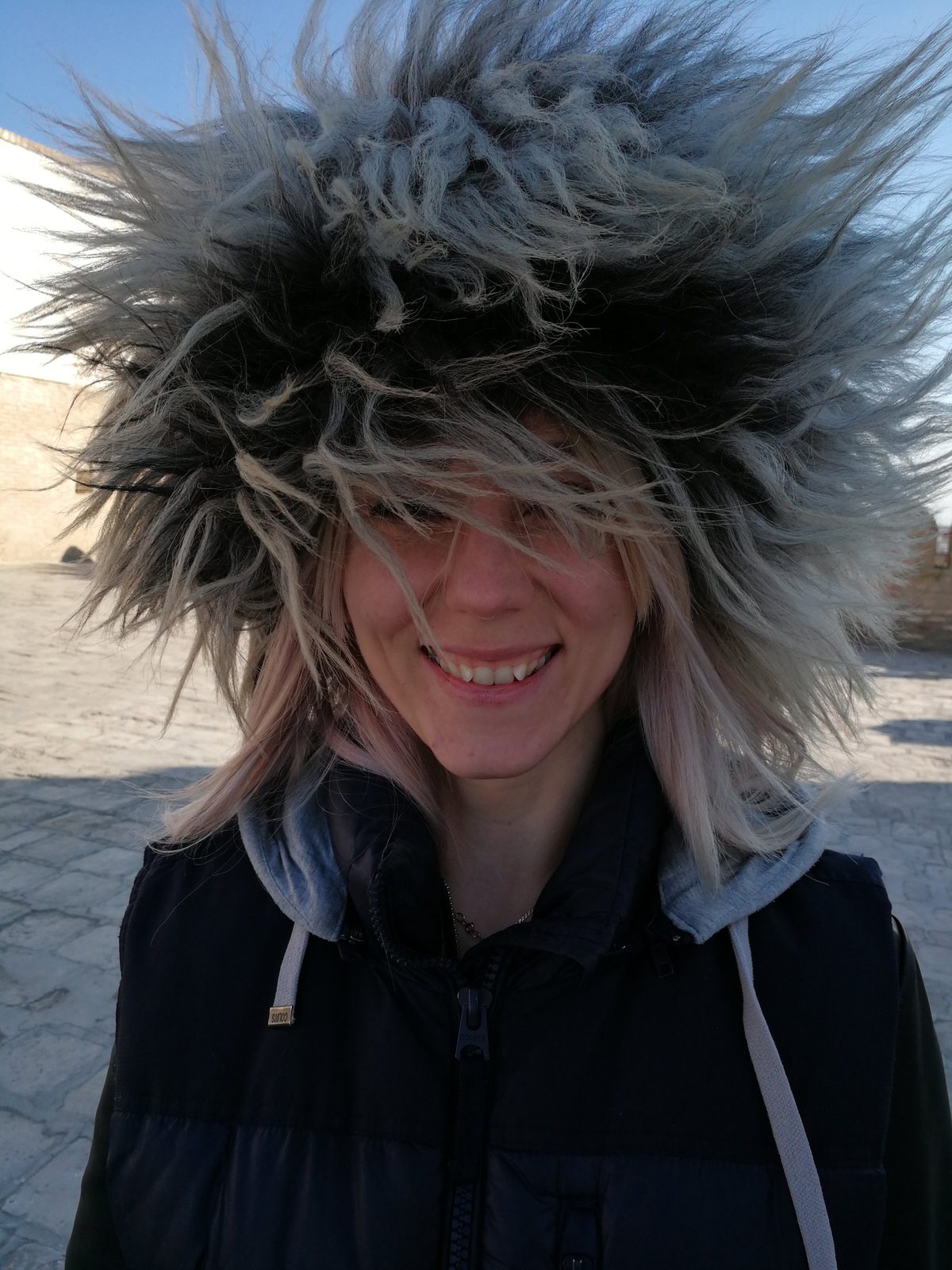
In Khorezm, around Khiva, men prefer tall hats of sheepskin in different colours to the doppi. Our guests try them on at the stalls of the old towns. In Bukhara the cap sellers had their own trading dome, Toki Telpak Furushon, the dome of the cap sellers, and embroidered caps are still sold under the domes (see the trading domes of Bukhara).
Where you see the costume on a trip with us
- On the Fergana Valley Crafts Tour you follow atlas from the cocoon to the loom in Margilan. On Crafts of Bukhara and Samarkand you meet the blacksmiths and the gold thread of Bukhara, and on request we add a gold-embroidery workshop.
- Groups see national costume at our folk show in Samarkand, on request. At a wedding or a family dinner, as in Uzbek wedding traditions, you see the chapans and caps on real guests.
- Book a photographer for a walk in Samarkand, Bukhara or Khiva and take home pictures in front of the Did you know? The Registan's sun-carrying lion went on a banknote The Sher-Dor Madrasah (1619–1636) is named for the big cats with the sun on their backs on its portal. The image appeared on the reverse of Uzbekistan's 200-som note of 1997. Read more → or Itchan Kala.
- Caps, robes and fabric are sold in the domes of Bukhara and the factory shop in Margilan. What to look for is in what to buy in Uzbekistan.
In short
- The doppi is the Uzbek skullcap. Its pattern tells you the region, and Uzbek caps are named after their towns.
- The Chust cap is black velvet with white almonds and peppers and sixteen arches around the edge, made by hand by women. Chust has a weekly cap market.
- The chapan is the long coat on top. Embroidered chapans and atlas dresses come out for weddings and holidays.
- Atlas and adras come from Margilan. Gold embroidery was the court craft of Bukhara.
- Our craft tours show the costume being made. Ask about a folk show for groups or a photographer for your walk.