
Places in this article: Samarkand · Bukhara · Tashkent
Uzbek ikat: khan-atlas, adras and velvet, what the patterns mean and how to buy
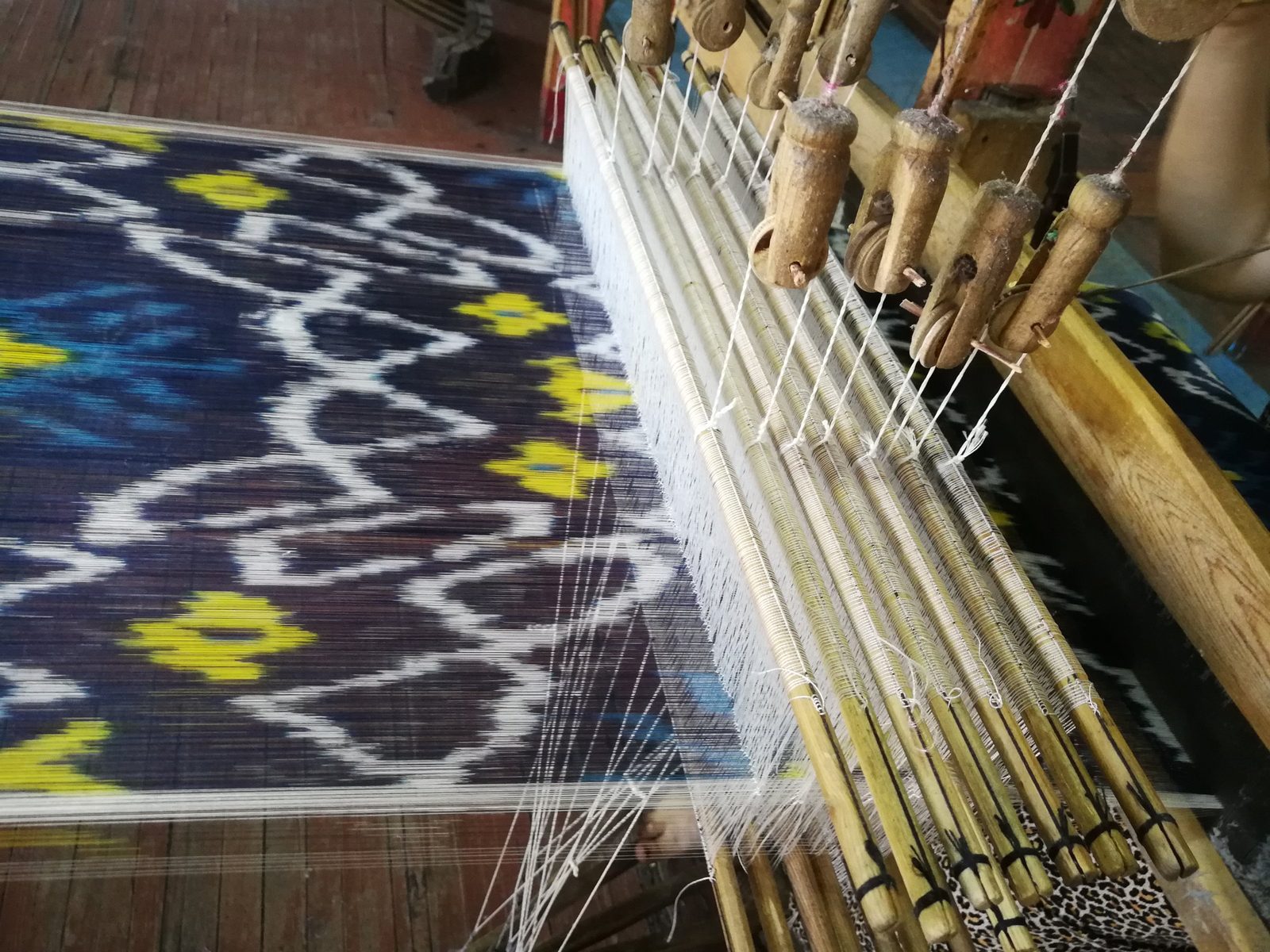
Lay a length of Uzbek silk on a table and look at the edge of any motif. It does not stop at a line; it dissolves, like ink in water. Weavers here call the cloth abr, “cloud”, and the blur is deliberate: the pattern was tied and dyed into the threads before the loom was even set up. The rest of the world calls it ikat.
Our article on Margilan silk and the Yodgorlik factory follows the process room by room. This one steps back: where Uzbek ikat comes from, how ,Did you know? UNESCO holds up Margilan's silk weavers as a model In 2017 UNESCO added the Margilan Crafts Development Centre, which revives the hand-making of atlas and adras, to its Register of Good Safeguarding Practices. Atlas is pure silk; adras mixes silk and cotton. Read more → adras and velvet ikat differ, what the old motif names mean, where to see fine pieces and how to buy cloth that is really woven by hand.
Abr: a cloud tied into the thread
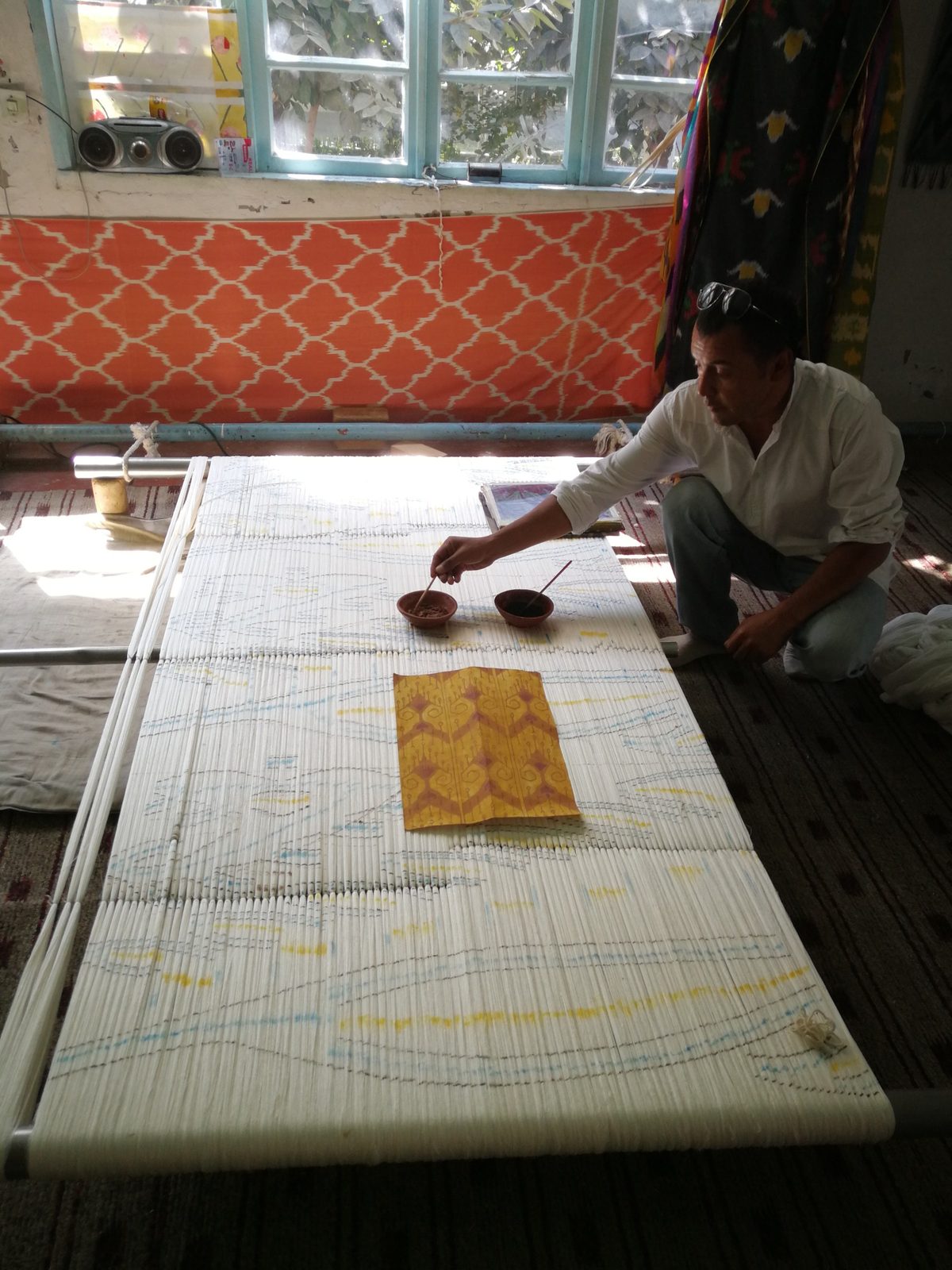
In Uzbek ikat the pattern lives in the warp, the long threads of the cloth. The warp is stretched, the design is marked across bundles of threads, and every section that must keep its colour is bound tight with thread. Then the warp goes into the dye bath. For each new colour the bundles are untied, bound again in new places and dyed again; complex designs went through six to eight rounds. The craft of tying is called abrbandi.
Only then is the warp set up on the loom. Threads dyed in bundles never line up perfectly, so every motif wavers a little at its edges. Ikat weavers in Indonesia or South America aim for crisp outlines; Central Asian weavers keep the blur on purpose. That soft edge is the first thing to look for in a shop.
From Sogdian finds to the robes of Bukhara
Ikat-type cloth is old in this land: finds from Samarkand and Penjikent show that it was made in Central Asia by the 9th century. Its great age came much later, in the 18th and 19th centuries, when Bukhara, Samarkand, Did you know? Kokand's Friday mosque stands on 98 columns from India Muhammad Umar Khan built Kokand's Juma Mosque in 1812–1818. Its 100-metre iwan rests on 98 carved red-wood columns brought from India, and its minaret is 22 m tall. Inside is a small museum of applied arts. Read more → and Did you know? Legend says Margilan is named after chicken and bread Legend says locals greeted Alexander the Great with chicken and bread, 'murg' and 'non', and the dish gave the town its name. In fact Alexander never reached here; the name Margilan is recorded from the 10th century. Read more → were the leading silk-weaving towns. In the Bukhara emirate ikat was a prestige cloth, and it went as a diplomatic gift to Russia and Persia. By the end of the 19th century people of every class and background wore ikat robes.
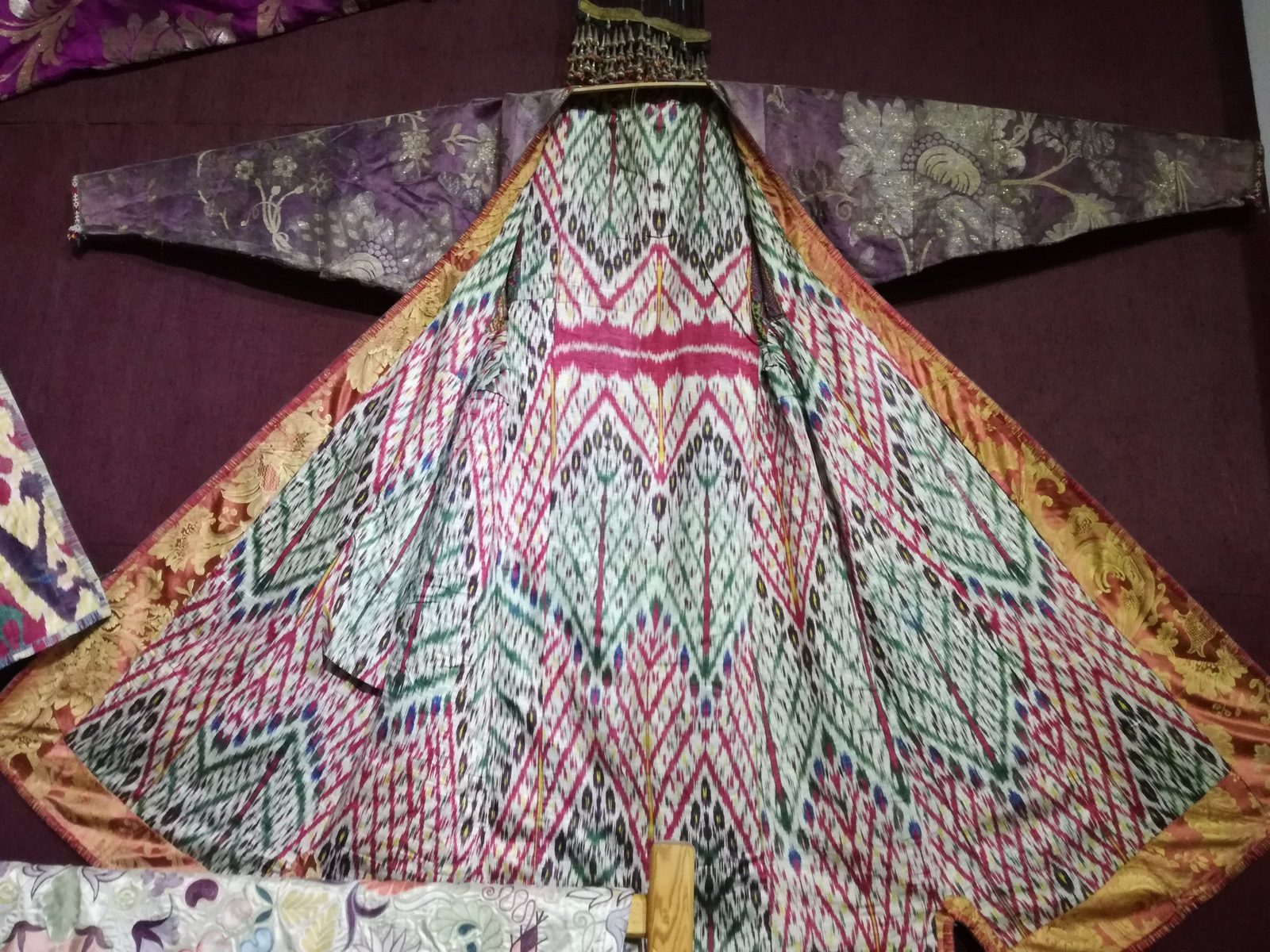
The richest of all was velvet ikat, baghmal: the pile itself was tie-dyed, so the pattern glows out of a soft, deep surface. Bukhara workshops made women’s robes of it in the third quarter of the 19th century, and such robes now hang in museums far from Uzbekistan, among them the Los Angeles County Museum of Art.
The 20th century brought factories. In 1934 the Tashkent textile mill began printing ikat-style patterns by machine, and hand weaving shrank. It came back in the 1970s and 1980s in workshops in Margilan, and after independence it grew again.
Khan-atlas, adras and their relatives
Khan-atlas is pure silk, dense and glossy, the cloth for weddings and holidays. Adras has a silk warp and a thicker cotton weft, which gives it a fine ribbed surface; it is warmer, cheaper and easier to wash, and in the 19th century it was the everyday ikat of the central regions, used for men’s and women’s robes, children’s clothes and things for the house.
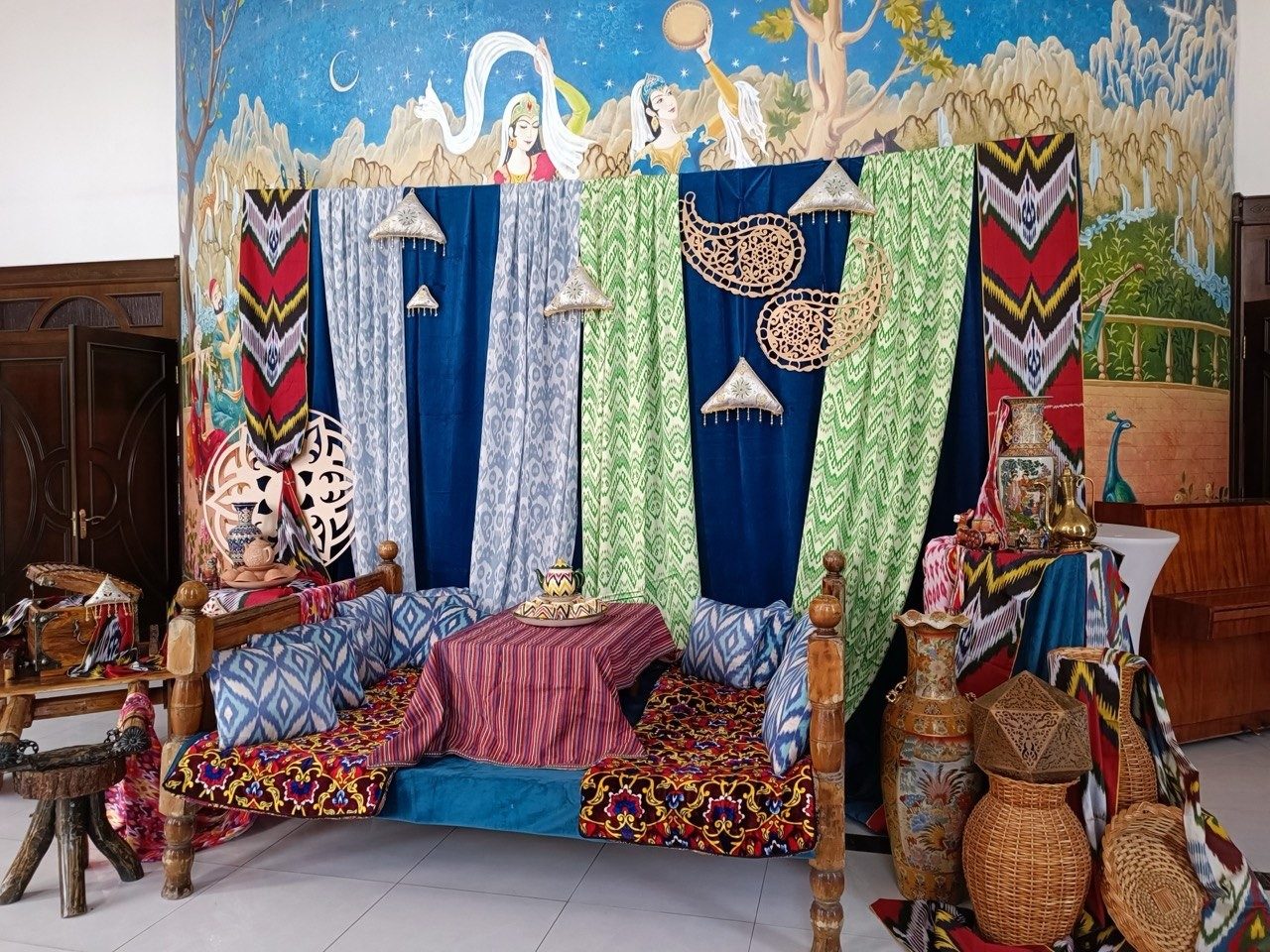
There are more names to know. Bekasab is a dense striped half-silk for robes and chapans. Shoyi is a light pure silk, a speciality of Margilan. Parama, with bold geometric motifs, was woven for curtains and bedspreads. A simple rule for buying: adras for something you will wear and wash, khan-atlas for a piece you will keep for special days.
Natural dyes and the colours of ikat
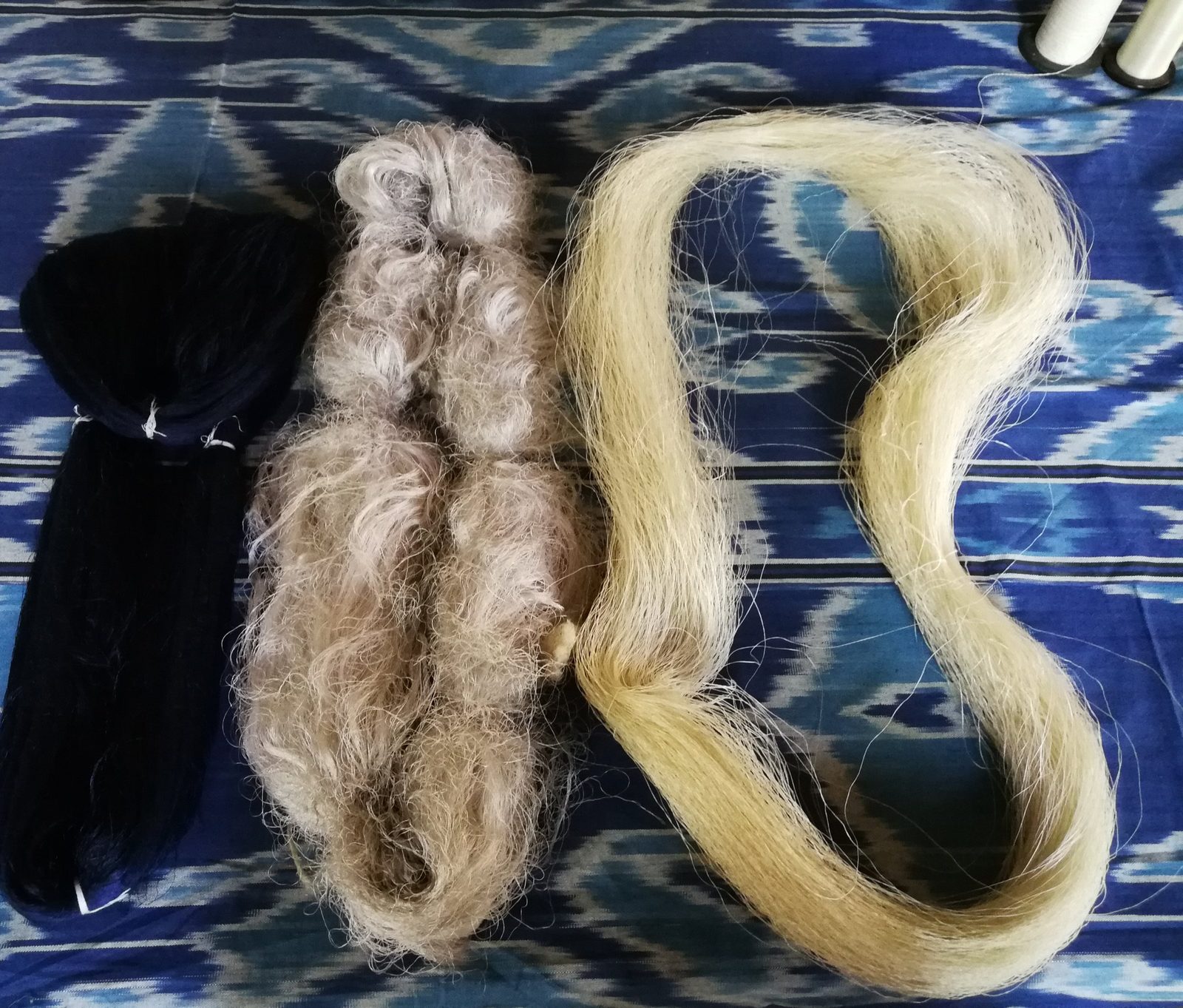
Until the 1880s every colour came from plants and insects: indigo for blue, madder root and cochineal for reds and pinks, walnut and oak bark for browns, saffron and weld for yellows. Then synthetic dyes took over almost everywhere, and the palette grew sharper.
The classic ikat palette joins red, blue, yellow and green, and a traditional reading links them with fire, water, earth and plants. Natural dyeing has returned in Margilan, where it is taught master to apprentice, and in 2017 UNESCO added the Margilan Crafts Development Centre’s work on Did you know? Legend says the first atlas silk copied a rainbow on water Legend says a Margilan khan wanted to marry a weaver’s daughter but promised to give her up for something more beautiful by morning. By a canal the weaver saw clouds and a rainbow reflected after rain — and wove the first khan-atlas. Read more → and adras to its Register of Good Safeguarding Practices. When you buy, ask which dyes went into the piece: natural colours are softer and differ slightly from one length to the next.
Reading the motifs
Every ikat motif has a name, and most of the names come from the house, the garden and the road. In 1962 the art historian Sayera Makhkamova recorded the names weavers used. Some of them:
- Anorcha, the little pomegranate, and bodom, the almond. The pomegranate, full of seeds, has long stood for plenty and children.
- Kuchkor shokhi, ram’s horns: strength and protection.
- Tumorcha, the amulet, and motifs shaped like an eye: protection from the evil eye.
- Tarok, the comb, ilon izi, the snake’s track, and tuya taypok, the camel’s footprint.
- Nogora, the drum, kumgon, the jug, and shokila, the pendants of a necklace.
Ask a weaver the name of a pattern, and the answer is usually an everyday thing. The same pomegranates, horns and amulets appear on ,Did you know? One suzani was often stitched by several women at once A family member or a pattern drawer, the kalamkash, drew the design across strips of cotton. The strips went to different women of the family or neighbourhood, who embroidered them at the same time; sewn back together, they show slightly mismatched seams. Read more → tiles and carved doors; we have gathered them in symbols in Uzbek ornament.
Where to see ikat made, and where to see old pieces
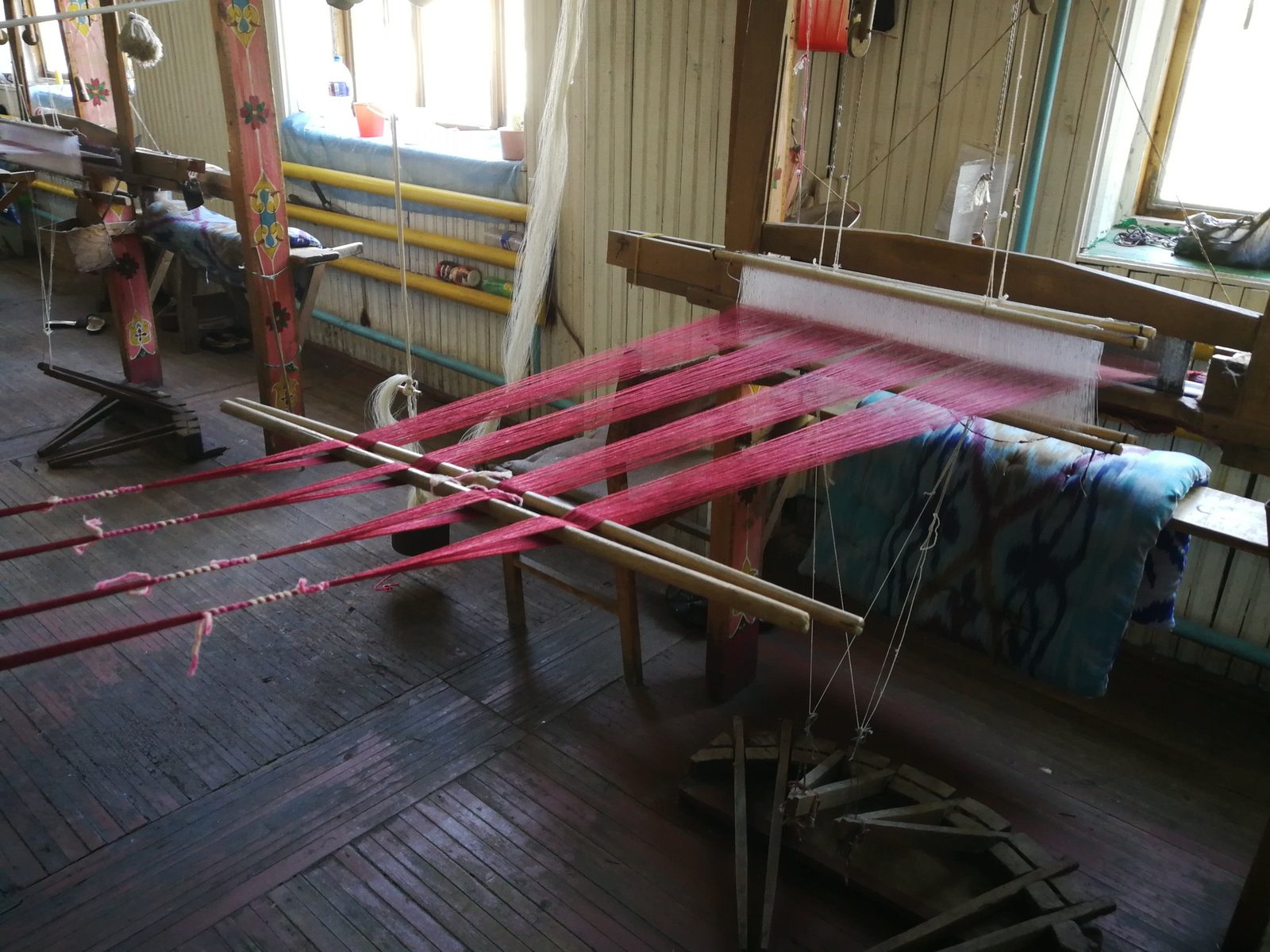
- Margilan, in the Fergana Valley: the whole process at the Yodgorlik factory, from cocoons in hot water to the loom, and the Margilan Crafts Development Centre. The town’s textile festival, Atlas Bayrami, held its seventh edition in September 2026. Our 4-day Fergana Valley crafts tour gives Yodgorlik a whole morning.
- Bukhara: shops and workshops in the old town sell khan-atlas and adras by the metre, scarves and ready-made robes. Our 5-day crafts of Bukhara and Samarkand tour adds the gold embroiderers and blacksmiths of Bukhara.
- Samarkand: a visit to a silk workshop fits into any day in the city.
- Tashkent: the Did you know? A diplomat's house that became a museum of crafts In 1896 diplomat Alexander Polovtsov bought a merchant's house and had it rebuilt in the Central Asian style. Today it is the Museum of Applied Arts, with over 7,000 pieces of folk craft. Read more → shows textiles among more than 7,000 pieces of folk craft. The State Museum of Arts, whose collection holds Bukhara adras and velvet and Margilan silks, is closed for reconstruction in October 2026. Both are in Tashkent museums.
Hand-woven, machine-woven or printed: how to tell
The ikat look is copied in two ways: printed on plain cloth, or woven from dyed warps on mechanical looms. Both can be pretty; only hand tying and hand weaving are the traditional craft. Five checks:
- Turn it over. Dyed into the threads, the pattern is as strong on the back as on the front. A print is pale or blank on the back.
- Look at the edges. On ikat they feather along the length of the cloth, the way the warp runs. A print has sharp edges, or a blur that is printed on.
- Compare the repeats. A hand-tied motif drifts a little from one repeat to the next; a print repeats exactly.
- Ask about the loom. At Yodgorlik, machine-woven cloth costs about a third less than hand-woven. Both are honest products, but they are not the same thing.
- Buy matching lengths from one roll. Each hand-dyed batch is a little different.
New ikat goes home in your suitcase without paperwork; pieces 50 years old and more count as cultural property, as explained in registration and customs. For other gifts, see what to buy in Uzbekistan.
In short
- Abr means “cloud”: the pattern is tied and dyed into the warp before weaving, which gives Uzbek ikat its soft edges.
- Khan-atlas is pure silk; adras has a silk warp and a cotton weft; baghmal, velvet ikat, was the 19th-century luxury of Bukhara.
- Motif names come from the house and garden: pomegranate, almond, ram’s horns, comb, amulet.
- Real ikat shows its pattern on both sides, and its edges blur along the length of the cloth.
- Watch it being made in Margilan, buy in Margilan, Bukhara or Samarkand, and see older pieces in Tashkent.