
Programme and details
Tashkent · Khiva · Bukhara · Samarkand · Amirsoy if you wish · 8 Days / 7 Nights · Private Tour
Winter Silk Road
December to February: Tashkent – Khiva – Bukhara – Samarkand – Tashkent by train
In winter the old towns of Uzbekistan belong to the people who live in them. In the morning you can have a An Islamic college: student cells and classrooms around a courtyard behind a grand portal. In the old towns many now house museums and craft workshops. courtyard in Bukhara almost to yourself, the high-speed train crosses the The Kyzylkum, or Red Sands: the desert between the Amu Darya and Syr Darya rivers that the road and the railway cross on the way to Khiva. to Khiva in a warm carriage, and in December the Did you know? The Registan's sun-carrying lion went on a banknote The Sher-Dor Madrasah (1619–1636) is named for the big cats with the sun on their backs on its portal. The image appeared on the reverse of Uzbekistan's 200-som note of 1997. Read more → is lit up before five in the afternoon. We built this route for the cold months: the trains cover the long distances, each day is planned around the short daylight, and between the monuments there are warm rooms: museums, workshops, teahouses and a kazan of plov at lunch. If you wish, the last day is in the mountains at Amirsoy, on skis or just for the view.
| Duration | 8 days / 7 nights |
| Price | on request |
| Format | Private, on your dates, from December to February |
| Where | Tashkent, Khiva, Bukhara and Samarkand; if you wish, a day at Amirsoy in the mountains near Tashkent |
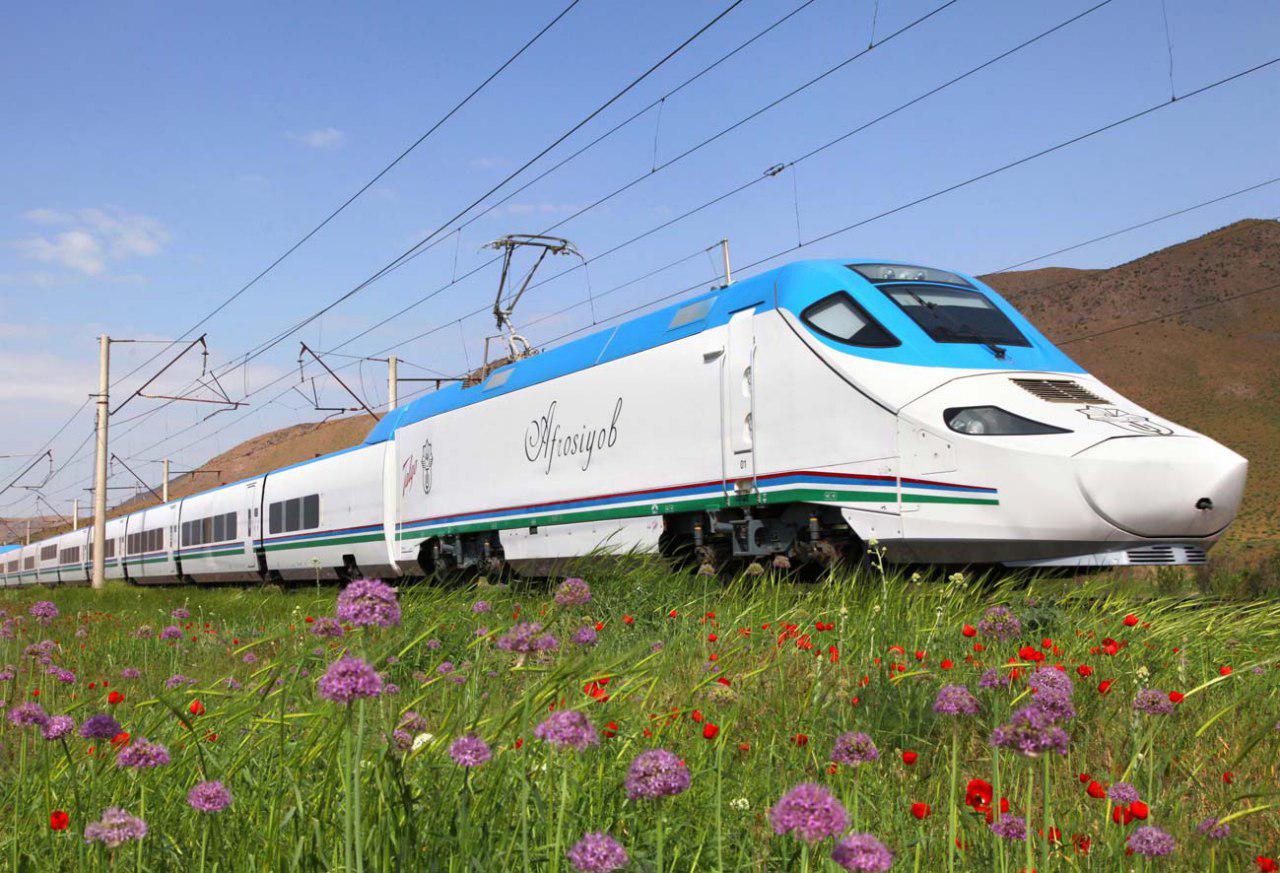
| Getting around | The high-speed train Tashkent – Khiva and Khiva – Bukhara, the Afrosiyob Bukhara – Samarkand – Tashkent; a private car with driver for the airport, the stations and the trips out of town |
| Guide | A guide who speaks your language; it is included in the price |
| Best time | December to February, outside the New Year week |
Ideal for travellers who prefer quiet courtyards to crowds, photographers who like the low winter light, guests coming back to Uzbekistan in a new season, and anyone who wants a week of history with a day on the snow at the end.
The Registan at dusk — in December the lights come on before dinner.
Warm rooms — the ,Did you know? A diplomat's house that became a museum of crafts In 1896 diplomat Alexander Polovtsov bought a merchant's house and had it rebuilt in the Central Asian style. Today it is the Museum of Applied Arts, with over 7,000 pieces of folk craft. Read more → the Did you know? A 7th-century mural shows envoys from Korea Uncovered by road builders in 1965, the Ambassadors' Painting at Afrasiyab shows delegations bearing gifts, Chinese with silk among them, and two men in feathered hats thought to be envoys from Korea's Goguryeo. Read more → Museum, the Konigil paper mill and the potters of Gijduvan.
Itinerary
Day by Day
Day 1 · Tashkent — The Museum of Applied Arts, plov and Chorsu
Our driver meets you at Tashkent airport and takes you to your hotel. With your guide you start indoors, at the Museum of Applied Arts: a merchant’s house rebuilt at the end of the 19th century with carved wood, painted ceilings and carved ganch plaster, and inside it ,Did you know? One suzani was often stitched by several women at once A family member or a pattern drawer, the kalamkash, drew the design across strips of cotton. The strips went to different women of the family or neighbourhood, who embroidered them at the same time; sewn back together, they show slightly mismatched seams. Read more → ceramics, embroidery and jewellery. After an hour here you recognise good work at the bazaars of Khiva and Bukhara.
Lunch is plov. Plov centres light the fires under their kazans in the morning, and around midday all the cauldrons are open. Then ,Did you know? Tashkent’s Chorsu dome is younger than the city’s metro Trade at the old crossroads is centuries old, but the domed building opened only in 1990, thirteen years after the metro. Architects Vladimir Azimov and Sabir Adylov gave it a main dome of 86 m ringed by seven smaller ones. Read more → where the big covered halls keep you out of the cold: dried fruit, nuts and fresh round bread for tomorrow’s train.
Good to know: tomorrow’s train leaves early, so we keep the evening short. If your flight lands late in the day, we move the museum to day 8. More in our guides to Tashkent museums and plov in Uzbekistan.
Overnight in Tashkent
Day 2 · Tashkent – Khiva — The high-speed train to the end of the line
An early transfer to the station. The high-speed train to Khiva leaves at 7:00 and takes about 7.5 hours, via Samarkand, Bukhara and Urgench: from the window you watch the country turn from cotton fields to the sand of the Kyzylkum and back to the canals of Khorezm. It reaches Khiva at about half past two.
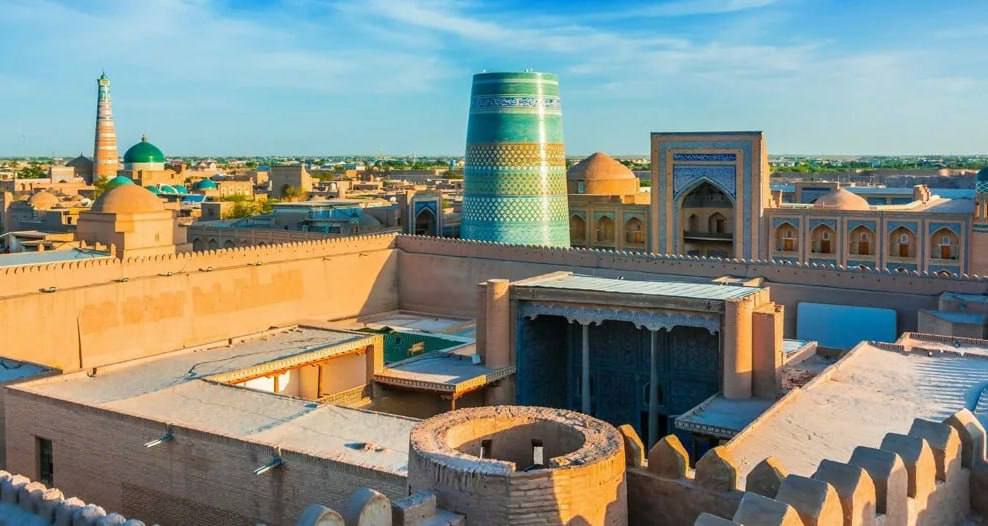
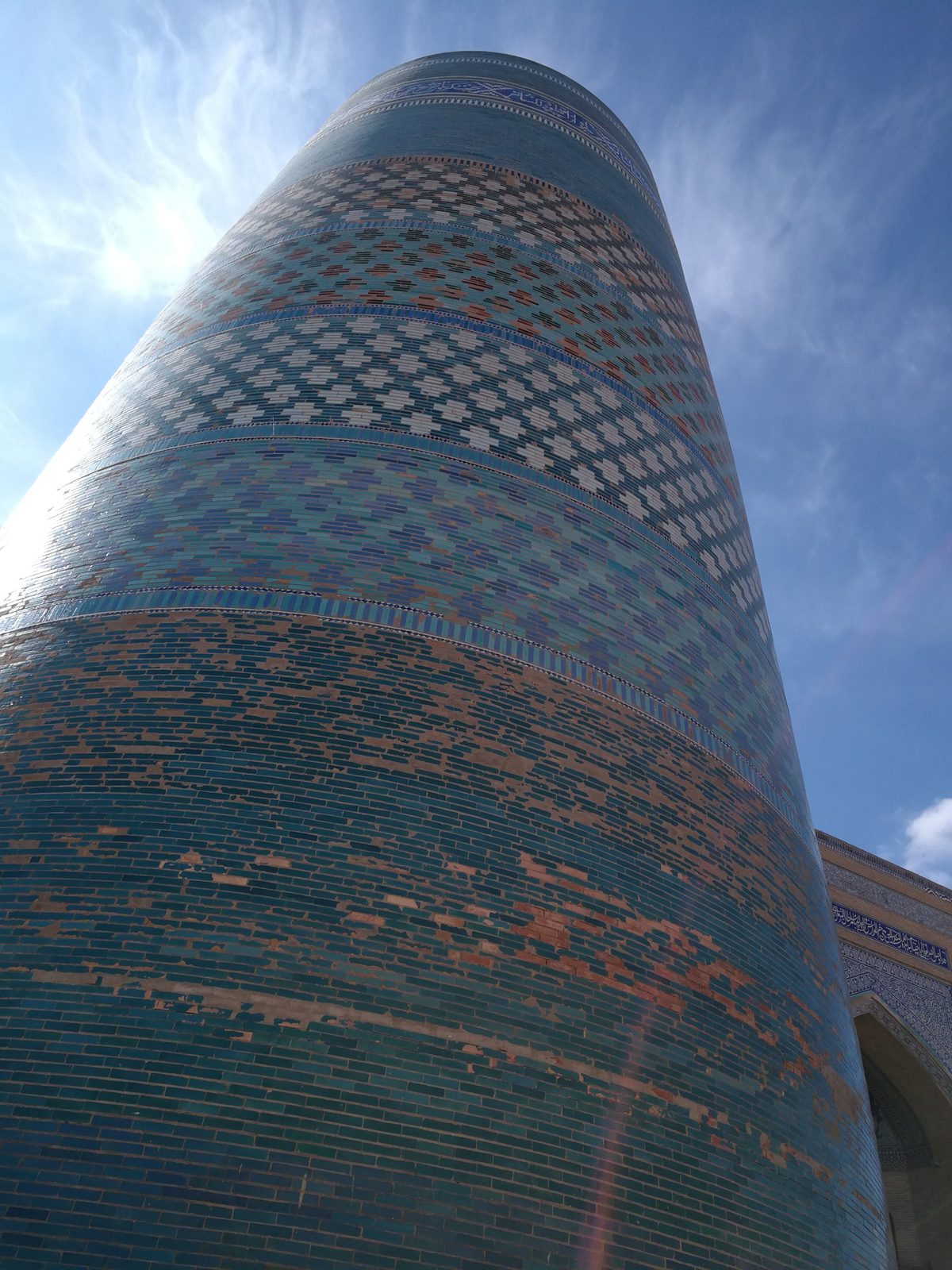
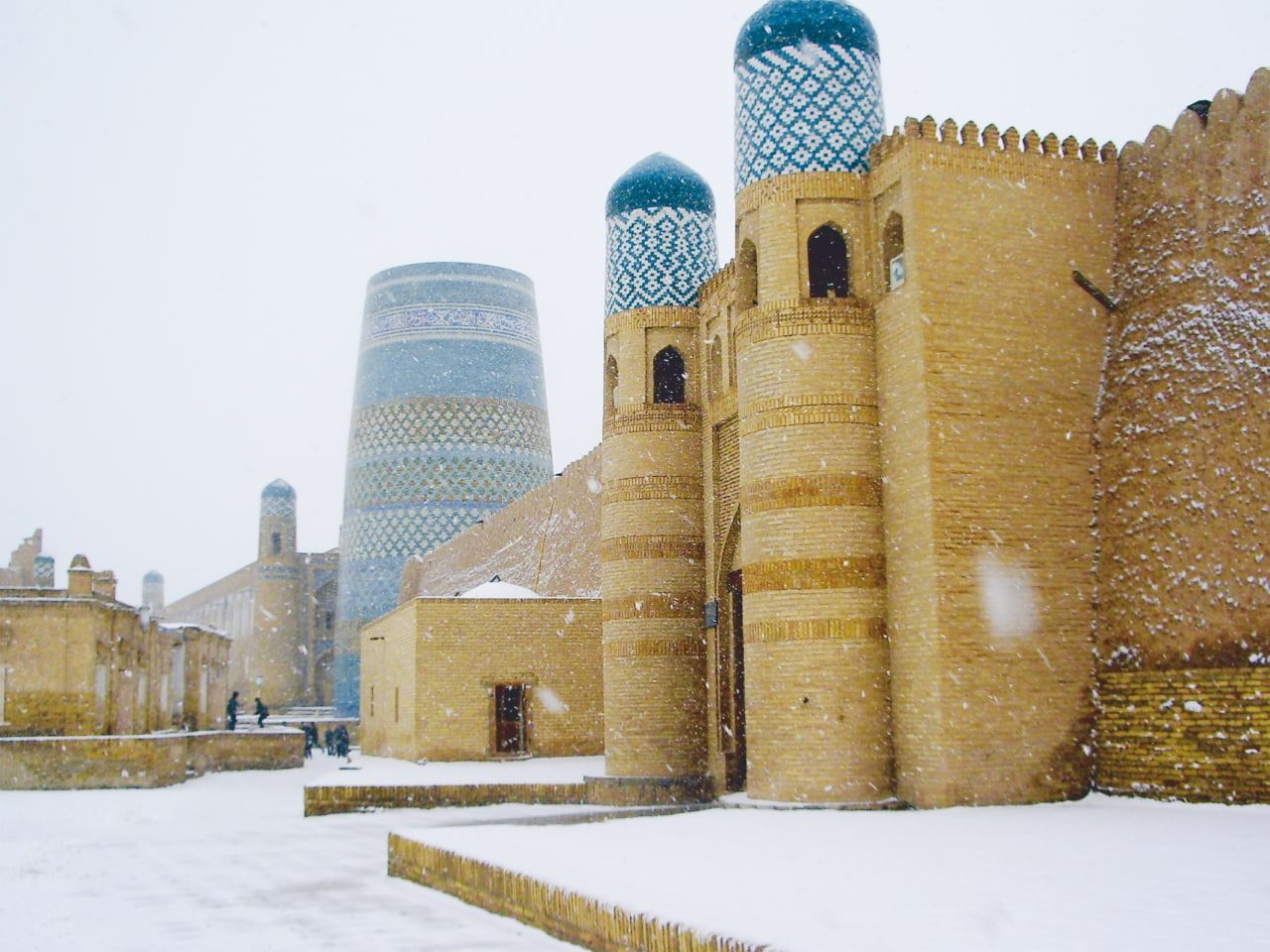
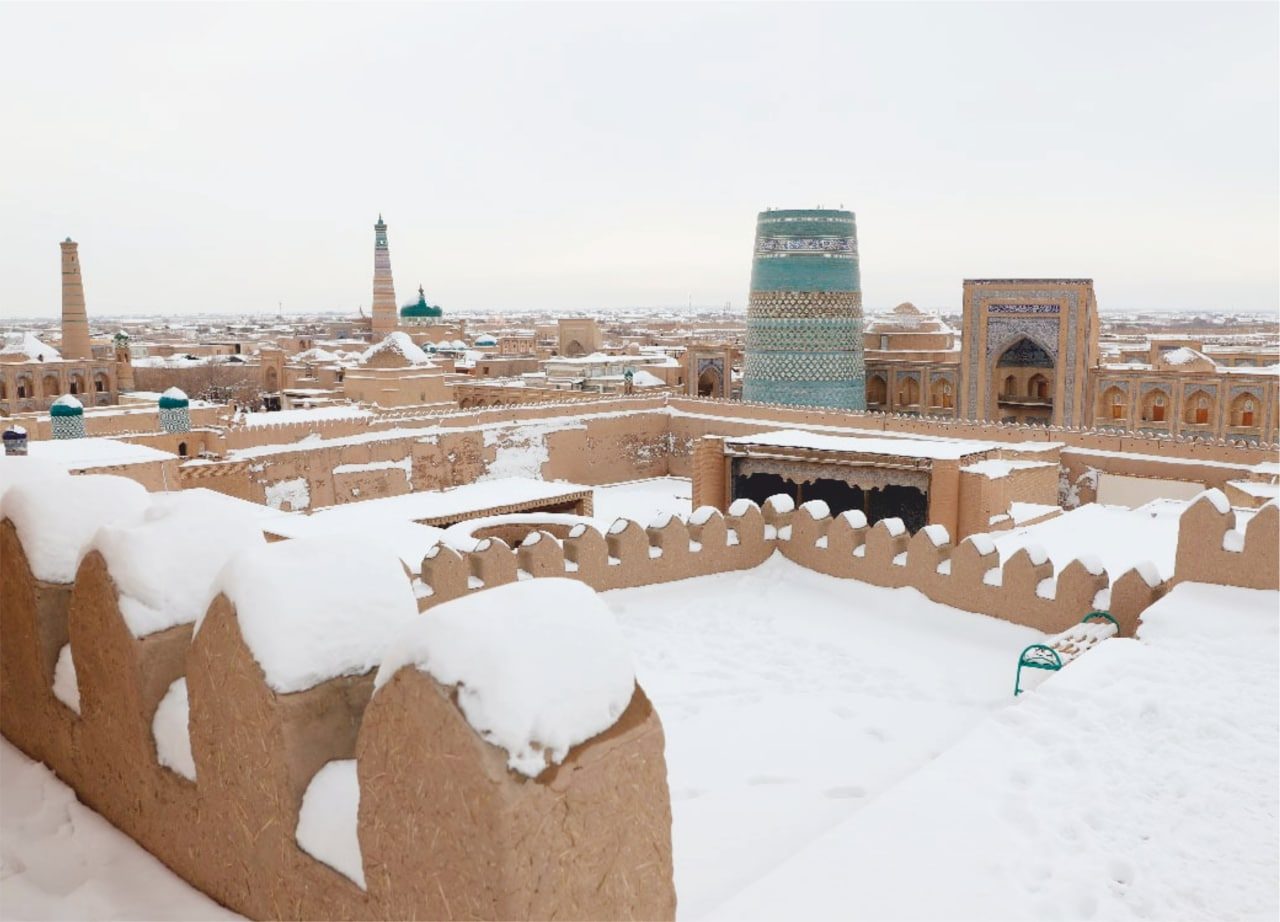
Khiva station is a half-hour walk from Itchan Kala: your guide walks in with you, and the driver takes the luggage to the hotel. In December the sun sets here at about half past five, so you have the last light on the clay walls and the Did you know? A 14-metre-wide base for a tower that stopped at 29 m Kalta-Minor was begun in 1852 and meant to reach 70–80 m, but work halted in 1855 at about 29 m when its khan died. It is said to be the only minaret covered entirely in glazed tiles. Read more → before dinner.
Good to know: as of autumn 2026 this train leaves Tashkent every day except Sunday. Tickets go on sale 60 days before departure; we check the winter timetable and book as soon as your dates are fixed. More in our guide to trains in Uzbekistan.
Overnight in Khiva
Day 3 · Khiva — Itchan Kala, the Juma Mosque and Tash-Hauli
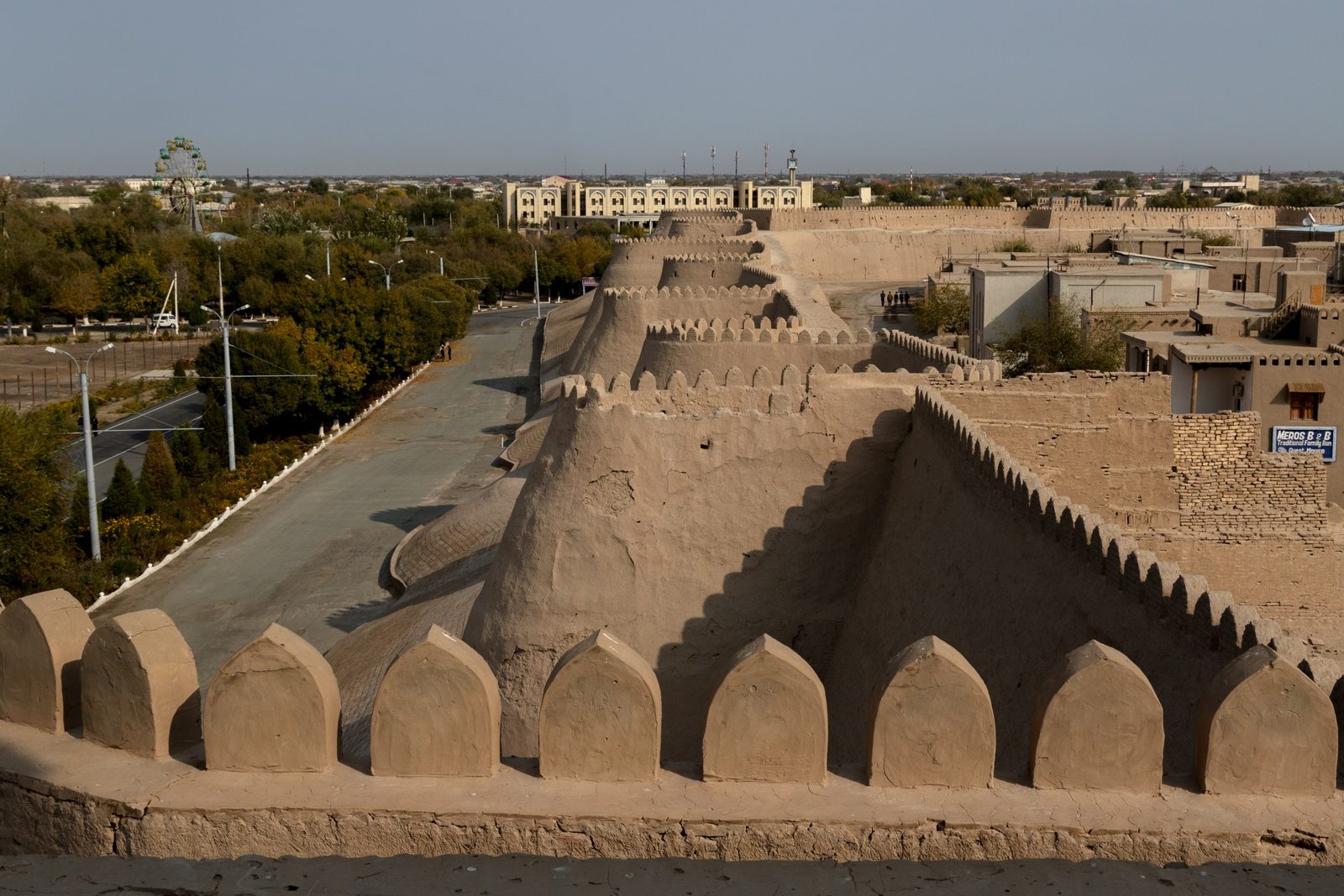
A full day inside the walls, starting when the sun has taken the edge off the frost. The ,Did you know? In the khan’s courtyard a round platform waited for a yurt The Kunya-Ark, the khans’ citadel, had its own mint, arsenal and harem. In the courtyard of its reception hall of 1804–1806 stands a round platform: a yurt was set up on it, and there the khan received envoys of the steppe nomads. Read more → the old fortress of the khans; the Did you know? Khiva's Juma Mosque stands on 212 wooden columns Recorded as early as the 10th century and rebuilt in 1788, the Juma Mosque has no portal and no domes: its flat roof rests on 212 carved columns in 17 rows, and some of them are older than the building itself. Read more → with its hall of carved wooden columns; the Did you know? In Tash-Hauli's harem each of four wives had her own loggia Allakuli Khan built the Tash-Hauli palace in 1830–1838 around three courtyards. In the harem four tall loggias belonged to the khan's four wives and a fifth, the largest, to the khan himself; behind each summer terrace lay a winter room. Read more → palace with its tiled courtyards and painted ceilings; and the ,Did you know? Khiva's tallest minaret is barely a century old The Islam Khoja Minaret was begun in 1908, near the very end of the khans' era. At 56.6 m it is one of the tallest in Central Asia; a spiral stair of 175 steps leads up to its windowed top. Read more → the tallest in Khiva. Between them, green tea in a teahouse and, for lunch, shivit oshi, the green dill noodles of Khorezm.
Khiva is the coldest of the four cities in winter: about 3–6 °C in the afternoon and down to −6 °C at night. In some winters snow settles on the flat roofs and the walls, and the old town turns white and silent. We cannot promise it; if it falls, we go out early, before the paths are trodden.
Good to know: the monuments are not heated, so dress as for a day outdoors; the stops between them are warm. If you wish, we add a visit to a silk factory (on request). More in our article on Itchan Kala.
Overnight in Khiva
Day 4 · Khiva – Bukhara — Across the desert, then the trading domes
In the morning the high-speed train takes you back across the Kyzylkum from Khiva to Bukhara, about 450 km in some three and a half hours. Bukhara’s station is in Kagan, about 12 km from the old town; your driver meets you there.
In the afternoon, Did you know? Bukhara's ponds were once its water supply Pools like Lyabi-Hauz, dug around 1620 and 46 × 36 m, were the city's main source of water. Most were filled in during the 1920s–30s because they spread disease; Lyabi-Hauz survived. Read more → and the ,Did you know? Under Bukhara's domes merchants changed money and gold Four 16th-century trading domes still stand over old crossroads. Toki Sarrafon was the money changers' dome, where merchants from India and China swapped coins; Toki Zargaron held jewellers' workshops, Toki Telpak Furushon sold caps. Read more → where carpets, suzani and metalwork are sold under brick vaults, and the carpet museum in the Did you know? Magoki-Attori: a mosque 'in the pit' Magoki-Attori means roughly 'in the pit': even in the 10th century it lay below street level. Beneath it lie remains of a pre-Islamic temple. Read more → mosque. Suzani are best understood up close: your guide shows you how to tell needlework from machine embroidery before you buy.
Good to know: as of autumn 2026 the train leaves Khiva every day except Monday, so this day never falls on a Monday. If the winter timetable does not suit your dates, a private car takes you from Khiva to Bukhara instead, 6 to 7 hours on the road (on request). More in our guide to suzani.
Overnight in Bukhara
Day 5 · Bukhara — The Ark, the potters of Gijduvan and Poi Kalyan at dusk
In the morning, ,The fortress-residence of the rulers of Bukhara on a high artificial hill: the oldest structure in the city. Read more → the fortress of the rulers of Bukhara, where the museum rooms around the old courtyards show coins, documents and the city’s gold embroidery and silk; then the Did you know? Buried in mud, this tomb escaped Genghis Khan The 10th-century Samanid Mausoleum, one of the oldest monuments of Islamic Central Asia, was covered by flood mud and sand before the Mongols came in 1220. Hidden for centuries, its brick lacework survived intact. Read more → in its park.
At midday we drive about 40–45 km to Gijduvan, a town of potters with its own school of ceramics: flower ornament combined with geometric patterns. You visit a ceramics workshop and have lunch there. Back in Bukhara at dusk, :Did you know? Legend: the minaret's foundation was laid with camel milk Legend says master Bako laid the foundations of the Kalyan minaret with ganch plaster mixed with camel milk, then vanished for two years to let them harden, and only then built the tower. Locals still show a grave they say is his. Read more → the Did you know? Diggers went 13 m down and never found its base The Kalyan Minaret of 1127 rises about 46 m, and an excavation reached 13 m without finding the bottom of its foundations. Genghis Khan reportedly ordered it spared. Read more → of 1127, lit up between the Kalyan Mosque and the Did you know? A madrasah still teaching after almost 500 years Mir-i-Arab, built in the 1530s opposite the Kalyan Mosque, was one of only three Islamic schools that kept working through the Soviet period, and it still trains students today. Read more → madrasah.
Good to know: in the evening, if you wish, dinner as the guests of a local family (on request). More in our guide to the museums of Samarkand and Bukhara.
Overnight in Bukhara
Day 6 · Bukhara – Samarkand — The Afrosiyob and the Registan lit up
In the morning, if you wish, ,Did you know? Legend: the emir's palace site was chosen with meat Legend says that when Emir Nasrullah wanted a summer palace in the mid-19th century, sheep carcasses were hung in several places around Bukhara, and the spot where the meat spoiled last was chosen. Sitorai Mohi-Hosa there today dates from 1912–1918. Read more → the summer palace of the last emir of Bukhara, about 4 km outside the old town and now a museum of decorative and applied arts. Then the Afrosiyob to Samarkand, under 2 hours. Samarkand station is more than 6 km from the Registan; your driver meets you there.
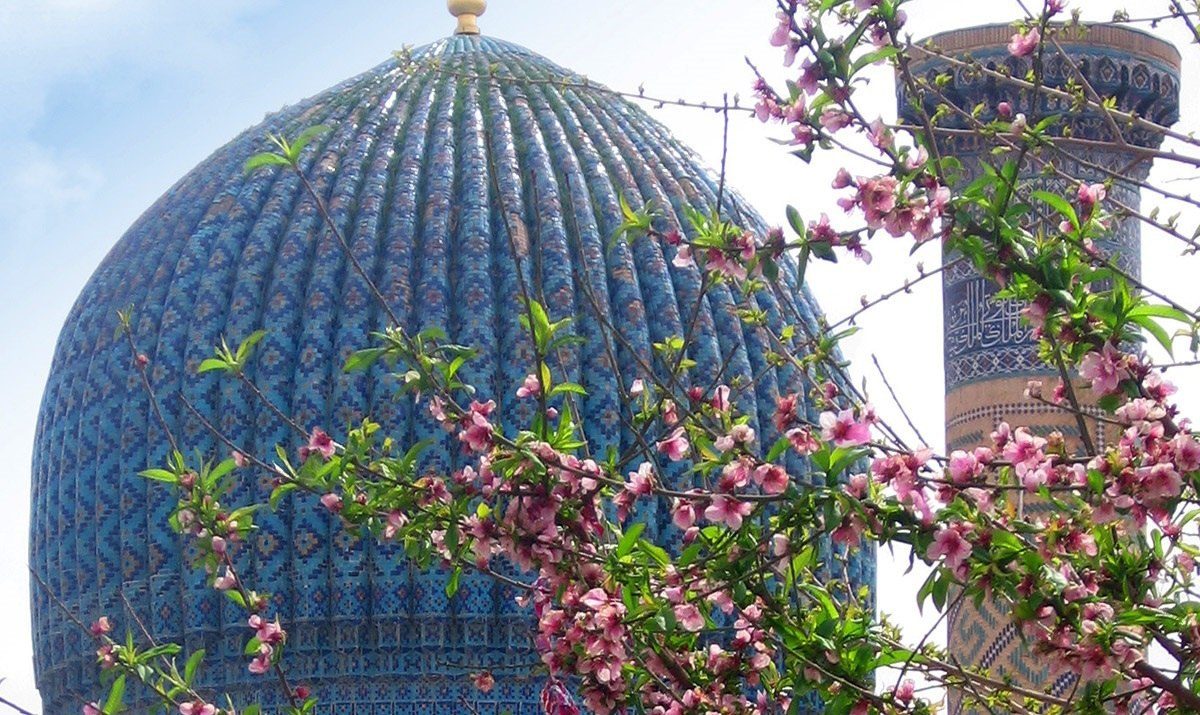
In the late afternoon, ,Did you know? Timur's tombstone went to Persia and came back The dark-green jade slab on Timur's grave in Gur-e-Amir was carried off by Nader Shah in 1740. It broke, and on his advisers' urging he sent it back to Samarkand. Read more → the mausoleum completed in 1404 where Amir Timur (Tamerlane, 1336–1405), founder of the Timurid empire, which had its capital in Samarkand. Born near Shahrisabz. lies, and then the Registan. In December the sun sets before five, so you see the three madrasahs of the square in the last light and then lit up, before dinner.
Good to know: the oldest building on the Registan is the madrasah of ,Did you know? Ulugh Beg measured the year to within 25 seconds Working at his Samarkand observatory, Ulugh Beg put the tropical year at 365 days 5 h 49 min 15 s, about 25 seconds too long, closer than Copernicus a century later. Read more → built in 1417–1420, where astronomy was taught; your guide shows you the tigers on the portal of Sher-Dor opposite.
Overnight in Samarkand
Day 7 · Samarkand – Tashkent — Konigil, the Afrasiyab Museum and Shah-i-Zinda
In the morning, the village of Konigil, about 13 km from the city, where the Meros workshop makes paper from mulberry bark the old way, with a water wheel turning on the stream. Then the Afrasiyab Museum, on the hill where ancient Samarkand stood: its hall holds the Ambassadors’ Painting of about 650, envoys bringing gifts to King .Did you know? The Ambassadors’ Painting was found by road builders The murals of about 650 for King Varkhuman came to light in 1965, when a road was cut through the Afrasiyab hill; the bulldozers had already taken their upper part. A Sogdian inscription on one envoy’s robe names him: Pukarzate, chancellor of Chaganian. Read more →
After lunch, ,Did you know? Why Shah-i-Zinda means 'the Living King' The necropolis grew around the shrine of Qutham ibn Abbas, a cousin of the Prophet Muhammad. Legend says he did not die in battle but went down a deep well to a garden of paradise, where he lives on. Read more → a street of tiled mausoleums climbing the slope, most of them of the 14th and 15th centuries. In the evening, the Afrosiyob to Tashkent, about 2 h 10 min.
Good to know: the Afrasiyab Museum is open Monday to Saturday, so we set your dates so that this day does not fall on a Sunday. Shah-i-Zinda is a revered place: cover shoulders and knees, women bring a scarf, and speak quietly. More in our article on the Konigil paper mill.
Overnight in Tashkent
Day 8 · Amirsoy or Tashkent — The mountains, or a warm day in the capital
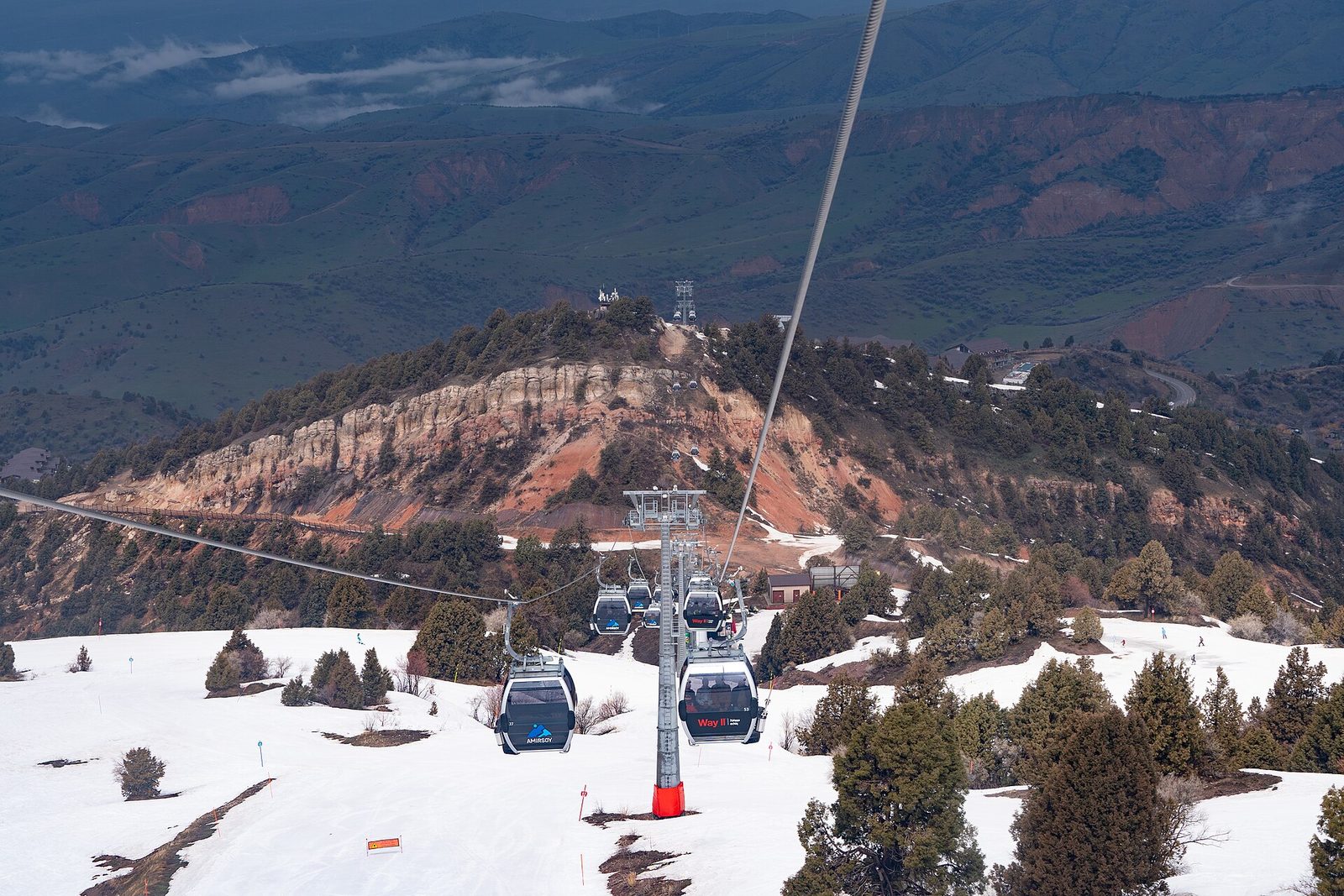
You choose the last day. In the mountains: we drive about an hour and a half to Amirsoy, 65 km from Tashkent. The ski season usually runs from December to March, depending on the snow; most of the 15 km of runs are easy and intermediate, so the resort suits beginners and holiday skiers, and rental is on site. If you do not ski, the gondola takes you up to 2,290 m for the view. In the afternoon we drive back to Tashkent and the airport.
In the city: the State Museum of History, reopened in July 2026, the ,Did you know? A metro designed to ride out a magnitude-9 earthquake The three original lines of the Tashkent Metro were built to withstand an earthquake of magnitude 9.0, and the tunnels lie unusually shallow, only 8–25 m below the street. Read more → where every station was designed as a hall of its own, and the Center of Islamic Civilization, open every day until 22:00, before your flight.
Good to know: in strong wind the lifts can stop, so we go up in the morning. Ski passes and rental are paid at the resort. For two days on the snow, see our Ski Weekend in the Tashkent Mountains; more in our guide to Amirsoy.
Without Khiva, 6 days — For the coldest weeks or if the train days do not fit
In the coldest weeks of January, or if the days of the Khiva train do not fit your dates, we leave Khiva out. On day 2 the Afrosiyob takes you from Tashkent to Bukhara in about 4 hours; then you have the same day in Bukhara with Gijduvan, the train to Samarkand, the day with Konigil and Shah-i-Zinda, and the last day in the mountains or in the city.
Good to know: Khiva in winter is the most beautiful and the coldest part of the trip; we help you choose when we know your dates.
Accommodation
Where you stay
| City | Stay |
|---|---|
| Tashkent | A hotel in Tashkent, 2 nights (days 1 and 7) |
| Khiva | A hotel in Khiva, 2 nights |
| Bukhara | A hotel in Bukhara, 2 nights |
| Samarkand | A hotel in Samarkand, 1 night |
In winter we choose hotels with good heating, and we confirm them for your dates before booking.
Price
Price
The price is given on request: it depends on the dates, the hotels, the train classes, the size of your group and your choice for the last day.
Good to know
Conditions
- Winter here is cold. In Tashkent, Samarkand and Bukhara the long-term average is about 7–10 °C in the afternoon and around zero at night; in Khiva about 3–6 °C by day and down to −6 °C at night. Bring a warm coat, a hat, gloves and waterproof boots with a good grip.
- The days are short: on 21 December the sun sets in Tashkent at 16:58, and by the end of February at 18:13. We start the walks at about nine and keep the dark hours for museums, workshops and dinner.
- Snow is not guaranteed. In some winters it settles on the old towns for a few days, in others there is none. In the mountains the ski season usually runs from December to March, depending on the snow.
- This is not a New Year tour: in the last days of December trains and hotels fill up. For the night itself, see our tours New Year in Samarkand, New Year in Bukhara and New Year in Uzbekistan, 8 days.
- Train tickets go on sale 60 days before departure and need the full name and passport number of every traveller. The timetable can change: we check it on eticket.uzrailpass.uz before we confirm the programme, and we set the start date around the days of the Khiva train.
- Your guide speaks your language, and that is included in the price. Tell us the language you need when you book, ideally well in advance.
- At the mausoleums and mosques, cover shoulders and knees; women bring a scarf, and shoes come off on the carpets.
- Drink bottled water: it is sold everywhere.
- Read before you go: our guides to Uzbekistan in December, in January and in February. If the trains are your main reason to come, see Uzbekistan by Train, which runs in every season.
- Reservations are confirmed with passport copies only.
Cancellation policy
| Cancellation timing | Penalty |
|---|---|
| 21 days before the service | 20% |
| 20–7 days | 50% |
| 6–0 days | 100% |
Transportation
| Vehicle | Group size |
|---|---|
| Chevrolet Cobalt | 2 pax |
| Hyundai Starex | 3–4 pax |
| Toyota Hiace / King Long | 5–8 pax |
| Mercedes Sprinter | 9–14 pax |
Vehicles may differ in make and colour.
🌿 Responsible tourism: we allocate part of our profits to good causes and are preparing for GSTC certification.
Expert opinion
Pluses
- Trains, not long drives: the high-speed train to Khiva and on to Bukhara, the Uzbekistan's high-speed train: Tashkent to Samarkand in about 2 hours 10 minutes, Tashkent to Bukhara in about 4 hours. Tickets are tied to your passport. Read more → to Samarkand and back to Tashkent.
- Quiet old towns: winter is low season, with calm courtyards in the morning and a wider choice of hotels.
- A warm stop every day: museums, the A village near Samarkand where paper is made by hand from mulberry bark, the old way, at a working mill on the stream. ,Did you know? Paper polished with stone, made to last 400 years At the Meros mill in Konigil, founded in 1996 to revive a craft that had died out, a water wheel beats mulberry bark into pulp, and each sheet is polished for hours with agate, shell or horn. It is made to last some 400 years. Read more → a ceramics workshop in Gijduvan, Rice cooked in a kazan with carrots, onions and meat: the dish of every Uzbek celebration. Each region cooks it its own way. at lunch and tea in a .A teahouse: green tea, plov and conversation on wide wooden beds called topchan.
Minuses
- It is cold: in Khiva nights go down to −6 °C, and the monuments are not heated.
- Short days: in December the sun sets before five in Tashkent, so the open-air sights fit between about nine and four.
- No snow promised: some winters bring snow to the old towns, others do not; the mountains are the surest bet.
AroundCA numbers
How we counted
By the AroundCA programme: we count only what is written in the day-by-day programme of this tour. If the programme gives no figure, we show nothing.
- Hotel changes
- 4
- Walking
- Medium
Walking: Moderate: whole days in the old towns in the cold, with warm stops in between.
Best time
Jan–Feb, Dec
December to February: the quietest months in the old towns and the ski season in the mountains near Tashkent.
Cool, fewer people: Jan–Feb
A typical day
On day 5 you see the Ark and the Samanid Mausoleum in Bukhara in the morning, drive about 40–45 km to the potters of Gijduvan for a ceramics workshop and lunch, and come back at dusk to see the Kalyan minaret lit up.
What the price includes
What is included
- Meeting at Tashkent airport and all transfers on the programme
- Accommodation: 7 nights with breakfast (Tashkent 2, Khiva 2, Bukhara 2, Samarkand 1)
- Train tickets: the high-speed train Tashkent – Khiva and Khiva – Bukhara, the Afrosiyob Bukhara – Samarkand and Samarkand – Tashkent
- A private car with driver for the airport, the stations, Gijduvan and Konigil
- A local guide in every city on the programme, speaking your language
- Entrance tickets on the programme
- The ceramics workshop in Gijduvan with lunch
- On day 8: the car with driver and the guide for the day at Amirsoy or in Tashkent
Not included
- International flights to and from Uzbekistan
- Lunches (except in Gijduvan), dinners and drinks
- Ski passes, equipment rental and gondola tickets at Amirsoy
- Dinner with a local family in Bukhara and the silk factory in Khiva (on request)
- A private car from Khiva to Bukhara if the train does not suit your dates (on request)
- Photo and video fees at the sites
- Tips and personal expenses
Extra cost on site
- Lunches (except in Gijduvan), dinners and drinks
- Ski passes, equipment rental and gondola tickets at Amirsoy
- Dinner with a local family in Bukhara and the silk factory in Khiva (on request)
- Photo and video fees at the sites
- Tips and personal expenses
Good for
- Travellers who prefer quiet courtyards to crowds: winter is low season in the old towns
- Photographers who like the low winter light, and in some winters snow on the walls of Khiva
- Guests who want the four great cities by train, with a day in the mountains at the end
Maybe not for you if
- Anyone who does not like the cold: in Khiva nights go down to −6 °C, and the monuments are not heated
- Those who want to see in the New Year: for that night we have separate New Year tours
- Travellers who come mainly to ski: for two days on the snow, see our Ski Weekend in the Tashkent Mountains
Questions about this tour
How much does the tour cost?
The price is given on request: it depends on the dates, the hotels, the train classes, the size of your group and your choice for the last day, in the mountains or in Tashkent.
How cold is it, and what should I pack?
In Tashkent, Samarkand and Bukhara the long-term average is about 7–10 °C in the afternoon and around zero at night; Khiva is colder, about 3–6 °C by day and down to −6 °C at night. Bring a warm coat, a hat, gloves and waterproof boots with a good grip. More in our guides to <a href="/blog/uzbekistan-in-january/">Uzbekistan in January</a> and <a href="/blog/what-to-pack-for-uzbekistan/">what to pack</a>.
Will there be snow?
We cannot promise it. In some winters snow settles on the old towns for a few days, in others there is none. In the mountains near Tashkent the ski season usually runs from December to March, depending on the snow, so the day at Amirsoy is the surest place to find it.
Is Khiva worth it in winter, and how do we get there?
Yes, if you dress for it: the clay walls under a low sun, and sometimes under snow, are the most beautiful part of the trip. The high-speed train from Tashkent takes about 7.5 hours and arrives at about half past two; as of autumn 2026 it does not leave Tashkent on Sundays or Khiva on Mondays, so we set your dates around it. If you prefer to leave Khiva out, the trip takes 6 days.
Can we spend New Year on this tour?
This is not a New Year tour, and in the last days of December trains and hotels fill up. For the night of 31 December, see our tours <a href="/tours/new-year-in-samarkand-5-days/">New Year in Samarkand</a>, <a href="/tours/new-year-in-bukhara-4-days/">New Year in Bukhara</a> and <a href="/tours/new-year-in-uzbekistan-8-days/">New Year in Uzbekistan, 8 days</a>.
Do I need to ski for the day at Amirsoy?
No. Most runs are easy and intermediate, rental is on site, and if you do not ski, the gondola takes you up to 2,290 m for the view. If you prefer, you spend the last day in Tashkent instead, in the museums and the metro.
Didn’t find your answer? Ask about this tour →
Make it your trip
Tick what you’d like to add — it goes into your request, and the manager confirms the final price.
Add a few days
Arrival, departure, transfers
© Photos
Gondola cabins above the slopes of Amirsoy — Iplossusvulpes19 / Wikimedia Commons · CC BY-SA 4.0