
Programme and details
Tashkent · 2 Days / 1 Night · Private Tour
Tashkent Modernism
Tashkent – Parkent – Tashkent
In July 2026 UNESCO added ten buildings of Soviet-era Tashkent to the World Heritage List: a museum hidden behind marble sun screens, a bazaar under a blue dome, a circus that looks like a flying saucer, a metro station full of cosmonauts and a solar furnace in the foothills. Most of them went up as the city was rebuilt after the earthquake of 1966, with new avenues, seismic engineering and ornament borrowed from the old masters. In two days with your own guide you see all ten.
| Duration | 2 days / 1 night |
| Price | on request |
| Format | Private, or a small group on your dates |
| Where | Central Tashkent, Tashkent's old bazaar under a big blue-green dome, not far from Hazrati Imam. Bring cash in so'm. Read more → and the Big Solar Furnace near Parkent |
| Getting around | By car with driver and by metro; about 45 km out to Parkent |
| Best time | March–June and September–November; the tour runs all year |
Ideal for travellers who love architecture and design, for photographers, and for anyone with a day or two in Tashkent before or after Samarkand.
Kosmonavtlar — the only metro station on the list, opened in 1984, with ceramic medallions of ,Timur's grandson, ruler of Samarkand and an astronomer. He built a madrasah on the Registan and an observatory whose star catalogue was used for centuries. Read more → Gagarin and Tereshkova.
Big Solar Furnace — 62 moving mirrors and a concentrator as tall as a twelve-storey building, the only part of the site outside the city.
Itinerary
Day by Day
Day 1 · Tashkent — Marble screens, an aluminium cube and the metro
Your guide meets you at your hotel in the morning, and we start with the building that became the emblem of modernist Tashkent: the State Museum of History. It opened in 1970 as the Lenin Museum, a cube whose walls hide behind geometric sun screens faced with whitish-pink marble. The architects Yevgeny Rozanov and Vladimir Shestopalov answered the Tashkent sun with the old idea of the carved lattice. The museum reopened in July 2026 after two years of renovation, and we go inside: it holds more than 350,000 objects, from archaeology to manuscripts.
Next come two buildings of 1974. The State Museum of Arts is another cube, clad in aluminium sheets set in metal frames, with a glazed upper part that softens the light in the halls. The Central Exhibition Hall of the Academy of Arts carries national ornament on its facade, with skylights over the halls.
On Navoi Avenue stands the Alisher Navoi Cinema Palace, opened in 1964 as the Panoramic Cinema. Its main hall was built for a curved screen about 34 m wide, and from 1968 to 1988 it hosted the Tashkent International Film Festival. The foyer now holds the Museum of Cinema of Uzbekistan.
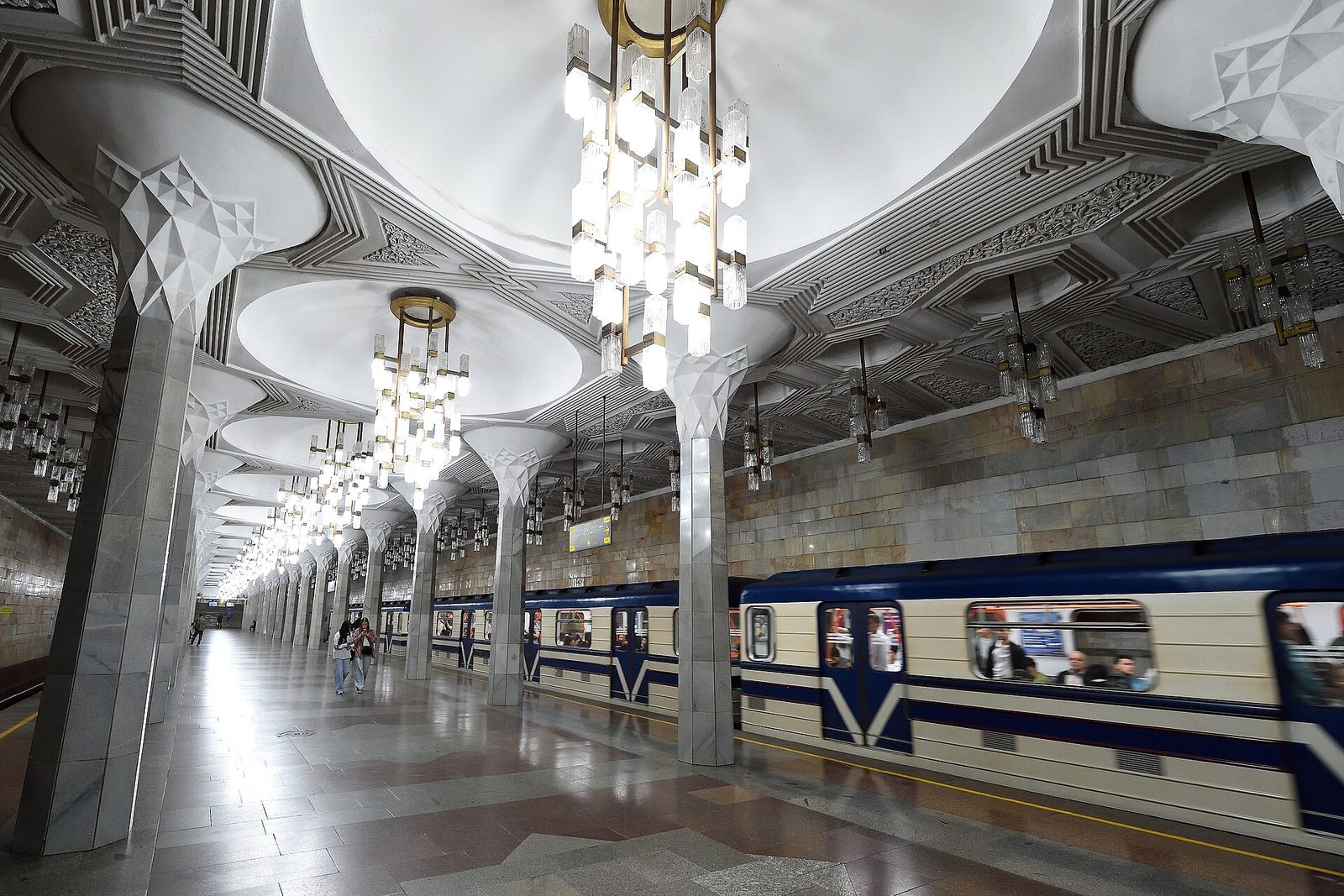
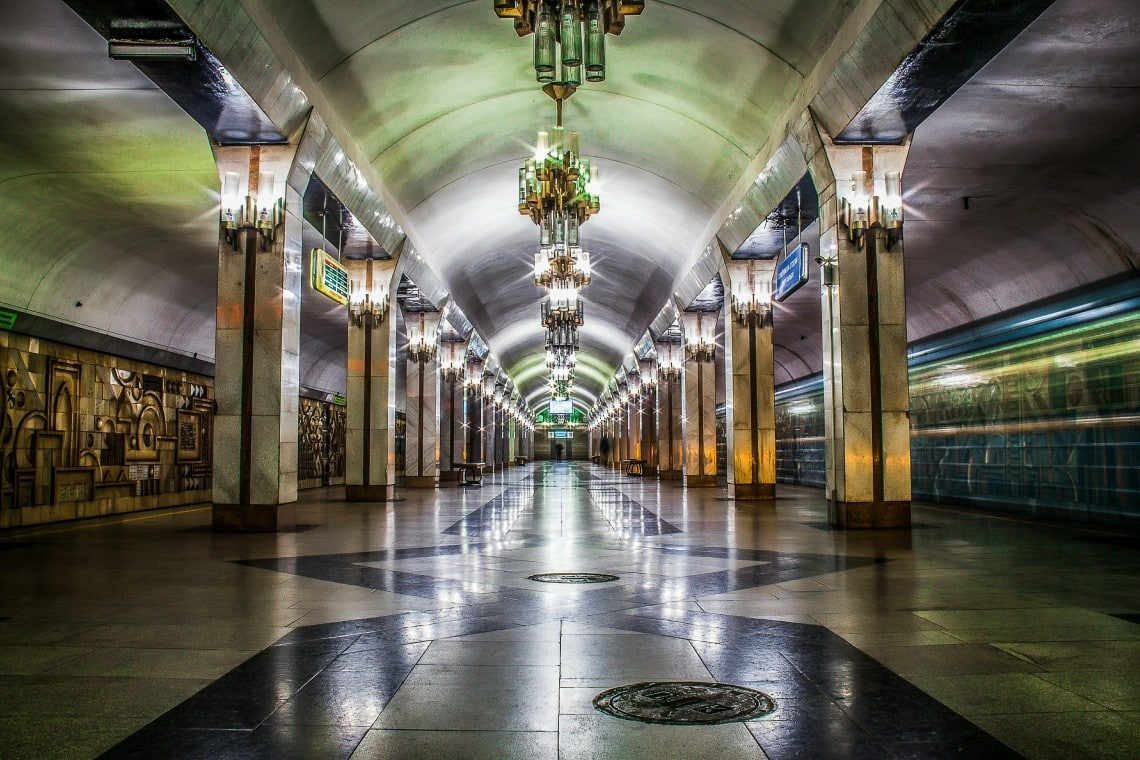
In the afternoon we go underground. The Tashkent metro was designed after the earthquake for shaking of up to 9 points, in thick reinforced concrete, and every station got its own theme and its own artists. We ride from Alisher Navoi, with its domes and turquoise reliefs from Navoi’s Khamsa, past the crystal chandeliers of Mustaqillik Maydoni, to Kosmonavtlar, opened in 1984: walls that deepen from turquoise to dark blue, glass stars along the ceiling and ceramic medallions of Ulugh Beg, Icarus, Gagarin and Tereshkova.
Near Kosmonavtlar stands Zhemchug, the “Pearl”, a block of flats finished in 1985 to a design by Ofelia Aydinova. Its two semicircular halves are joined every three floors by open terraces, shared courtyards in the air for the residents.
Good to know: Photography in the metro has been allowed since June 2018. Zhemchug is a home to many families, so we see it from the street.
Overnight in Tashkent
Day 2 · Tashkent – Parkent – Tashkent — Chorsu, the circus and the Solar Furnace
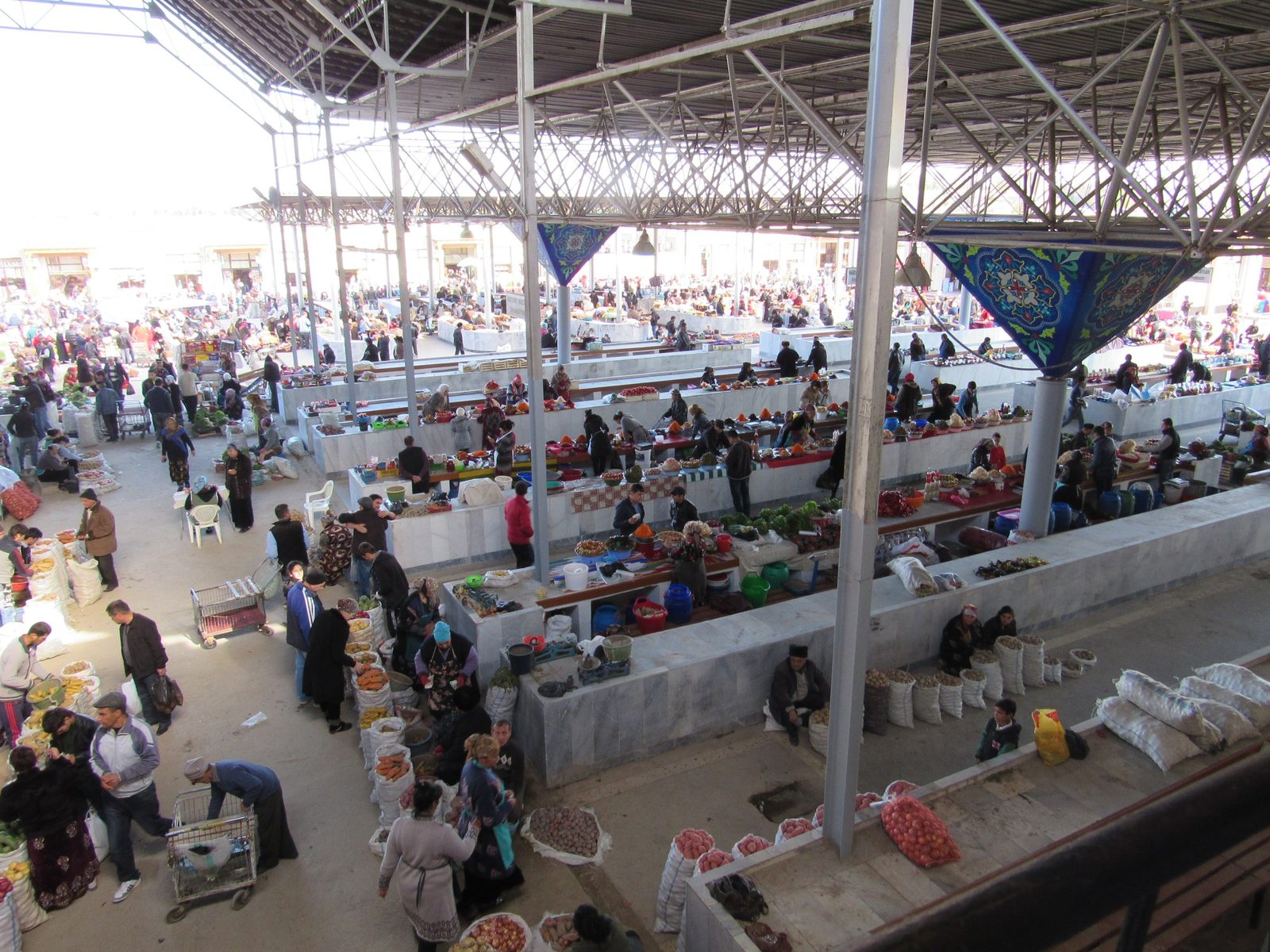
We start at Chorsu in the morning, when the bazaar is at its busiest. The market is old, the building is not: the project by the architects Vladimir Azimov and Sabir Adylov dates from 1980, and the complex opened in 1990 under a main dome of 86 metres ringed by seven smaller ones. Tiling the big dome took until 1993. Across the street, Chorsu station of 1989 was dug as an open pit through the bazaar square and lined with white Gazgan marble.
Nearby, on Khadra Square, the State Circus opened in 1976. Its scaled turquoise-blue dome is often compared to a flying saucer; below it you find a concrete lattice, carved ganch, marble, stained glass and ceramic mosaic. It has no glazed foyer, a choice made for the Tashkent climate.
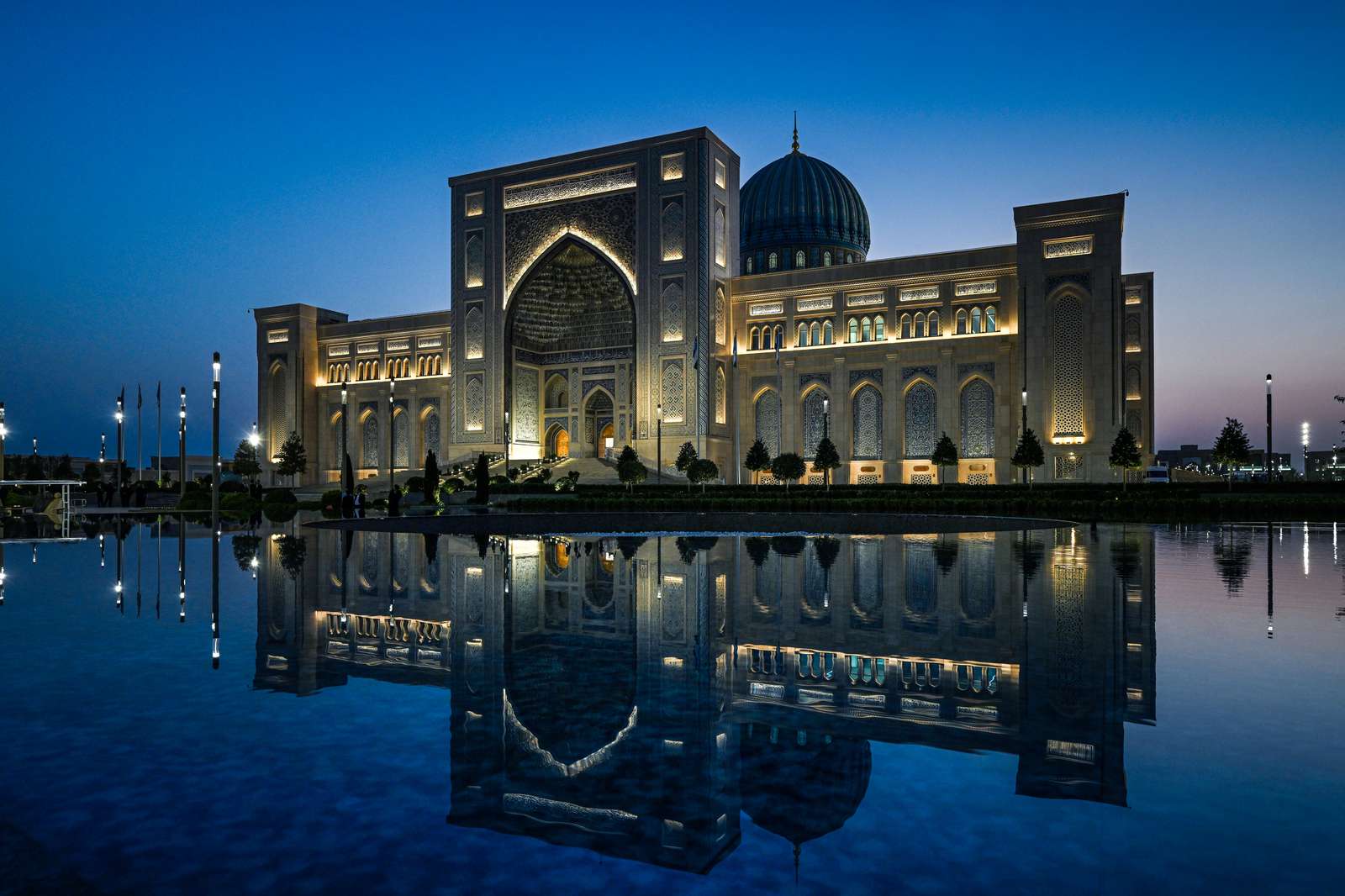
Then the Peoples’ Friendship Palace, opened in 1981 to a design by Yevgeny Rozanov: the largest concert hall in the country, built with Nurata and Gazgan marble, its facade drawn from national ornament and the stalactite vaults of old portals. The banquet hall inside holds three large Florentine mosaics; the halls open for concerts and events.
After lunch we drive out to Parkent, about 45 km from Tashkent, into the foothills at around 1,100 m. Here stands the Big Solar Furnace, built between 1981 and 1987. Sixty-two moving mirrors, the heliostats, throw sunlight onto a concave concentrator as tall as a twelve-storey building, and at its focus the temperature can reach 3,000 °C. From the viewpoint at the top of the site you see the whole wall of mirrors at once. In the evening we drive you back to your hotel in Tashkent.
Good to know: The furnace is the only part of the UNESCO site outside the city. If you have one day only, we leave it out and keep the rest.
Accommodation
Where you stay
| City | Stay |
|---|---|
| Tashkent | A comfortable hotel in the centre of Tashkent, 1 night |
We confirm the hotel for your dates before booking. If you already have a hotel in Tashkent, we plan the tour without one.
Price
Price
The price is given on request: it depends on the dates, the hotel, the size of your group and the language of the guide. We are finalising the programme details and confirm the times, the hotel and the route for your dates.
Good to know
Conditions
- Some halls open only for concerts and events, and museums have their days off: we confirm what you can see inside on your dates.
- Zhemchug is a residential building: we see it from outside and do not enter the courtyards and stairways.
- Comfortable shoes help: the metro part of the day means stairs and platforms.
- Programme details, times and the hotel are confirmed for your dates.
- Reservations are confirmed with passport copies only.
Cancellation policy
| Cancellation timing | Penalty |
|---|---|
| 21 days before the service | 20% |
| 20–7 days | 50% |
| 6–0 days | 100% |
Transportation
| Vehicle | Group size |
|---|---|
| Chevrolet Cobalt | 2 pax |
| Hyundai Starex | 3–4 pax |
| Toyota Hiace / King Long | 5–8 pax |
| Mercedes Sprinter | 9–14 pax |
Vehicles may differ in make and colour.
🌿 Responsible tourism: we allocate part of our profits to good causes and are preparing for GSTC certification.
Expert opinion
Pluses
- The whole UNESCO site: all ten buildings of Tashkent’s modernist architecture, inscribed in 2026, including the Solar Furnace near Parkent.
- The Did you know? A metro designed to ride out a magnitude-9 earthquake The three original lines of the Tashkent Metro were built to withstand an earthquake of magnitude 9.0, and the tunnels lie unusually shallow, only 8–25 m below the street. Read more → with a guide: Alisher Navoi, Mustaqillik Maydoni and ,Did you know? A metro station where Ulugh Beg meets Gagarin Kosmonavtlar station, opened in 1984, has ceramic medallions of Ulugh Beg, Galileo, Icarus, Gagarin and Tereshkova, and glass stars in the ceiling that hint at the Milky Way. Read more → the only metro station on the UNESCO list, on one fare.
- Easy to add: starts and ends at your hotel in Tashkent, before or after Samarkand, Bukhara and Khiva.
Minuses
- Not every interior: the Friendship Palace and the Cinema Palace open their halls for events, and Zhemchug is seen from the street.
- Hot in summer: in July afternoons in Tashkent average about 36 °C.
AroundCA numbers
How we counted
By the AroundCA programme: we count only what is written in the day-by-day programme of this tour. If the programme gives no figure, we show nothing.
- Hotel changes
- none — one hotel
- Walking
- Medium
Walking: Medium: walks between the buildings of the centre, stairs and platforms in the metro, Chorsu Bazaar and the viewpoint at the Solar Furnace.
Best time
Mar, Nov
March and November: the start and the end of the season, with pleasant weather and few visitors.
Cool, fewer people: Jan–Feb, Dec
Better to avoid
Jul–Aug
July and August: afternoons in Tashkent average about 35–36 °C.
A typical day
On day 2 you start at Chorsu Bazaar under its blue dome and the marble-lined Chorsu metro station, see the State Circus on Khadra Square and the Peoples’ Friendship Palace, and after lunch drive about 45 km to the Big Solar Furnace near Parkent, back at your hotel in Tashkent in the evening.
What the price includes
What is included
- A private car with driver on both days, including the trip to Parkent
- A guide speaking your language on both days
- Accommodation in Tashkent: 1 night with breakfast
- Metro fares on the programme
- Entrance tickets on the programme
Not included
- Lunches, dinners and drinks
- Photo and video fees at the sites
- Tickets for a circus show or a concert (on request)
- International flights
- Tips and personal expenses
Extra cost on site
- Lunches, dinners and drinks
- Photo and video fees at the sites
- Tickets for a circus show or a concert
Good for
- Travellers who love architecture, design and 20th-century history
- Photographers: marble screens, mosaics, metro chandeliers and a wall of mirrors
- Anyone with a day or two in Tashkent before or after Samarkand, Bukhara and Khiva
Maybe not for you if
- Travellers who want mosques and madrasas: for old Tashkent, ask us about Hazrati Imam and the Center of Islamic Civilization
- Anyone who expects to go inside every building: some halls open only for concerts and events, and Zhemchug is a residential house
Questions about this tour
How much does the tour cost?
The price is given on request: it depends on the dates, the hotel, the size of your group and the language of the guide.
Can I do it in one day?
Yes. In one day we go inside the Museum of History, ride the metro to Kosmonavtlar and see Zhemchug, Chorsu and the circus, with short stops at the Museum of Arts, the Central Exhibition Hall, the Cinema Palace and the Friendship Palace. We leave out the Big Solar Furnace near Parkent, which takes half a day with the drive. The one-day version needs no hotel night.
Do we go inside all ten buildings?
Not all of them. The Museum of History, the metro stations and Chorsu Bazaar are open to everyone, and the Solar Furnace has a viewpoint for visitors. Zhemchug is a residential building, so we see it from the street, and the halls of the Friendship Palace and the Cinema Palace open for concerts and events. We confirm what is open on your dates.
Why did Tashkent build so much in those years?
On 26 April 1966 an earthquake destroyed much of old Tashkent. The city was rebuilt with new avenues, a modernist centre and a metro designed for shaking of up to 9 points. UNESCO inscribed the ten buildings for the way they adapted modernist architecture to the local climate, earthquakes and craft traditions.
When is the best time to go?
The season runs from March to June and from September to November, and we like March and November best: pleasant weather and few visitors. The tour runs all year: in July afternoons in Tashkent average about 36 °C, so we plan the outdoor stops for the morning, and in winter the days are sunny and quiet.
Can I combine it with other tours?
Yes. It starts and ends at your hotel in Tashkent, so it fits before or after Samarkand, Bukhara and Khiva. For the old city, add a day with Hazrati Imam, the Center of Islamic Civilization and Chorsu.
Didn’t find your answer? Ask about this tour →
Make it your trip
Tick what you’d like to add — it goes into your request, and the manager confirms the final price.
Add a few days
Arrival, departure, transfers
© Photos
Kosmonavtlar metro station, Tashkent — Oqsaqol / Wikimedia Commons · CC BY-SA 4.0; Valentina Tereshkova medallion, Kosmonavtlar metro station, Tashkent — Schokifaktor / Wikimedia Commons · CC BY-SA 4.0; Palace of Peoples' Friendship, Tashkent — Humoyun Mehridinov / Wikimedia Commons · CC BY-SA 4.0; Ceramic panels from Navoi's Khamsa, Alisher Navoi metro station, Tashkent — Schokifaktor / Wikimedia Commons · CC BY-SA 4.0