
Places in this article: Bukhara · Khiva
Uzbek crafts in wood, metal and gold: Khiva carving, Bukhara copper, Chust knives
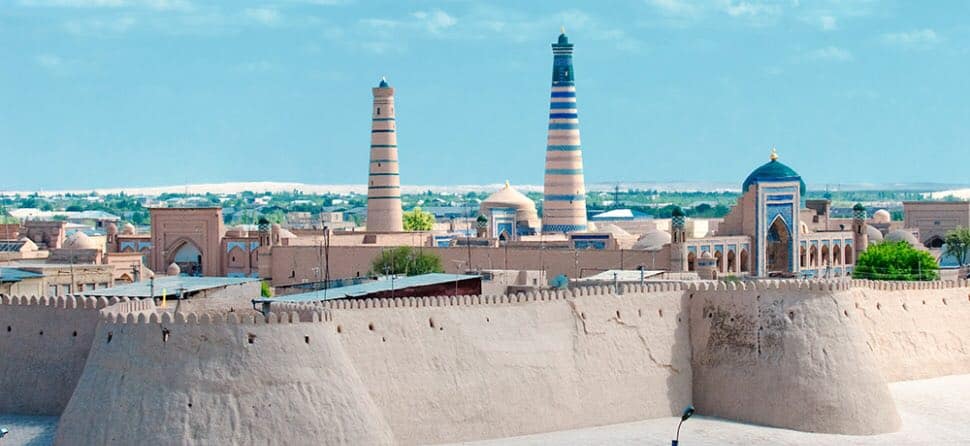
In 1945 two woodcarvers from Khiva made carved double doors for the new opera house in Tashkent, the Alisher Navoi Theatre. The older of them, Ata Palvanov, was 78; he had learned the trade from his father and grandfather and lived past a hundred. The craft he carried is still alive in the workshops of .Did you know? People still live inside Khiva's museum city Itchan Kala packs more than 50 historic monuments and about 250 old houses inside clay walls 8–10 m high and 5–6 m thick, and families still live and work in its lanes. Read more →
Ceramics, silk and Did you know? One suzani was often stitched by several women at once A family member or a pattern drawer, the kalamkash, drew the design across strips of cotton. The strips went to different women of the family or neighbourhood, who embroidered them at the same time; sewn back together, they show slightly mismatched seams. Read more → have their own articles on our site. This one is about the harder materials and the finer threads: carved wood in Khiva and Kokand, chased copper and forged steel in Bukhara, the knives of Chust, Bukhara gold embroidery and miniature painting. For each craft: what to look at, what the names mean, and where you can watch a master at work.
Carved wood: the columns and doors of Khiva
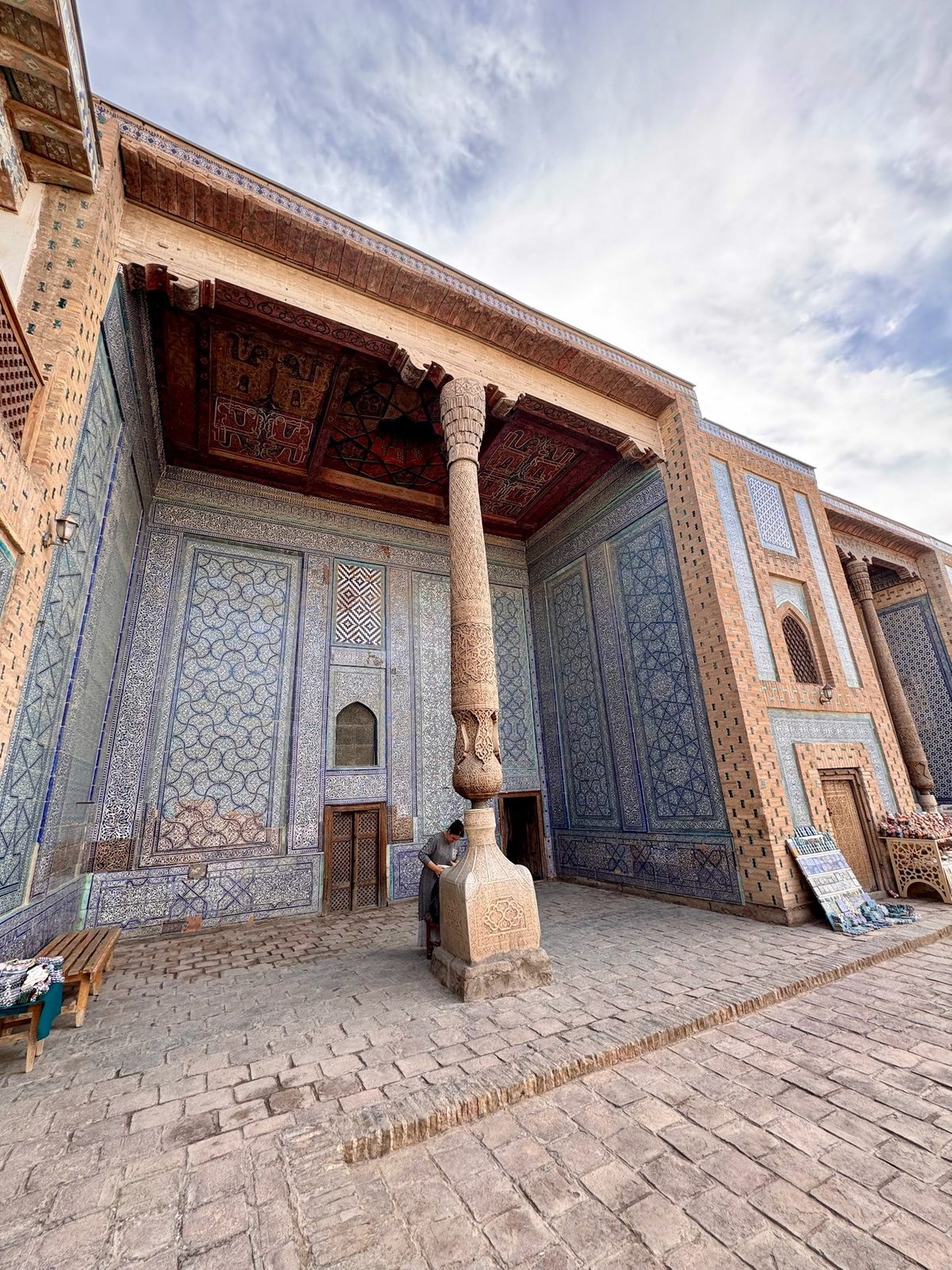
Khiva stands on wooden columns. The Did you know? Khiva's Juma Mosque stands on 212 wooden columns Recorded as early as the 10th century and rebuilt in 1788, the Juma Mosque has no portal and no domes: its flat roof rests on 212 carved columns in 17 rows, and some of them are older than the building itself. Read more → in Itchan Kala, rebuilt in 1788, has a flat roof on 212 wooden columns in 17 rows, carved in different periods and each one different. Walk through the palaces and you will see the same work outside: slender columns holding up the open porches, the ayvans, and heavy double doors covered in carving.
The Khiva school is known for aylanma islimi, spiral plant patterns: stems that wind around each other, shoots with flowers and leaves, rosettes, framed by narrow bands of simple geometry. Masters gave the motifs names such as olma guli, apple blossom. They worked in gujum, a hard local elm, and in plane wood, and they did not lacquer it: doors and columns were rubbed with unrefined vegetable oil, which shows the grain and helps the wood last.
Woodcarvers still work inside Itchan Kala, and their workshops double as schools where apprentices learn to draw, cut and finish a pattern. In the Fergana Valley, Kokand carries the title of World Craft City for woodcarving, given by the World Crafts Council in 2019. How to tell the parts of a building apart is in how to read Uzbek architecture.
Chased copper: the quiet style of Bukhara
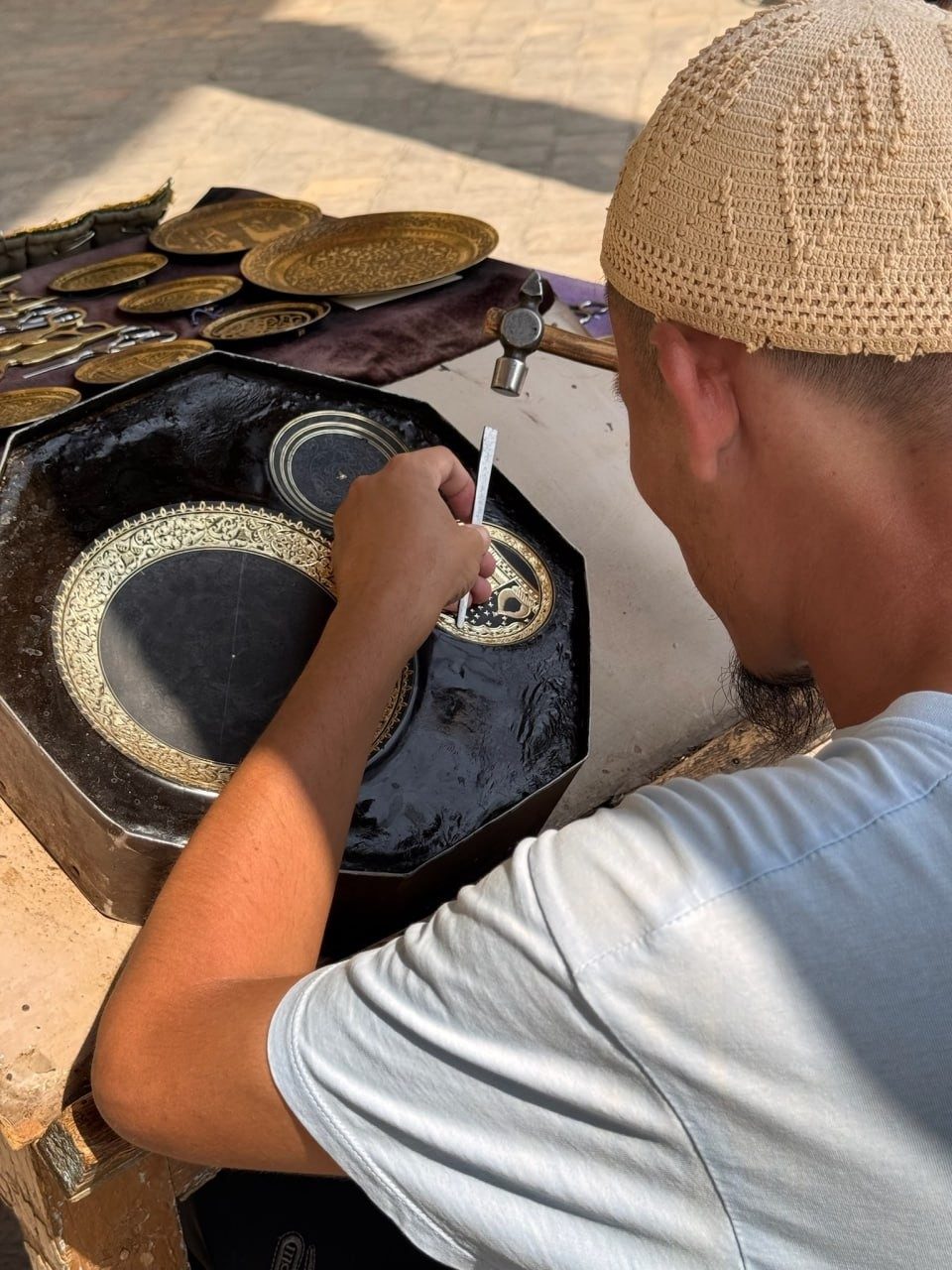
Bukhara was one of the main centres of decorated copper and brass from the 18th to the early 20th century. A single jug passed through three trades: coppersmiths made the body and tinned the inside, casters made the handle, spout and hinges, and the chaser decorated the finished piece with a hammer and fine punches.
Bukhara work is recognisable by its restraint: classic, balanced shapes, plant motifs larger and calmer than in other towns, and lines of calligraphy hidden among the leaves. Khiva had a similar school; Kokand’s was freer and less exact. Jugs for water and tea, trays and basins were the everyday pieces.
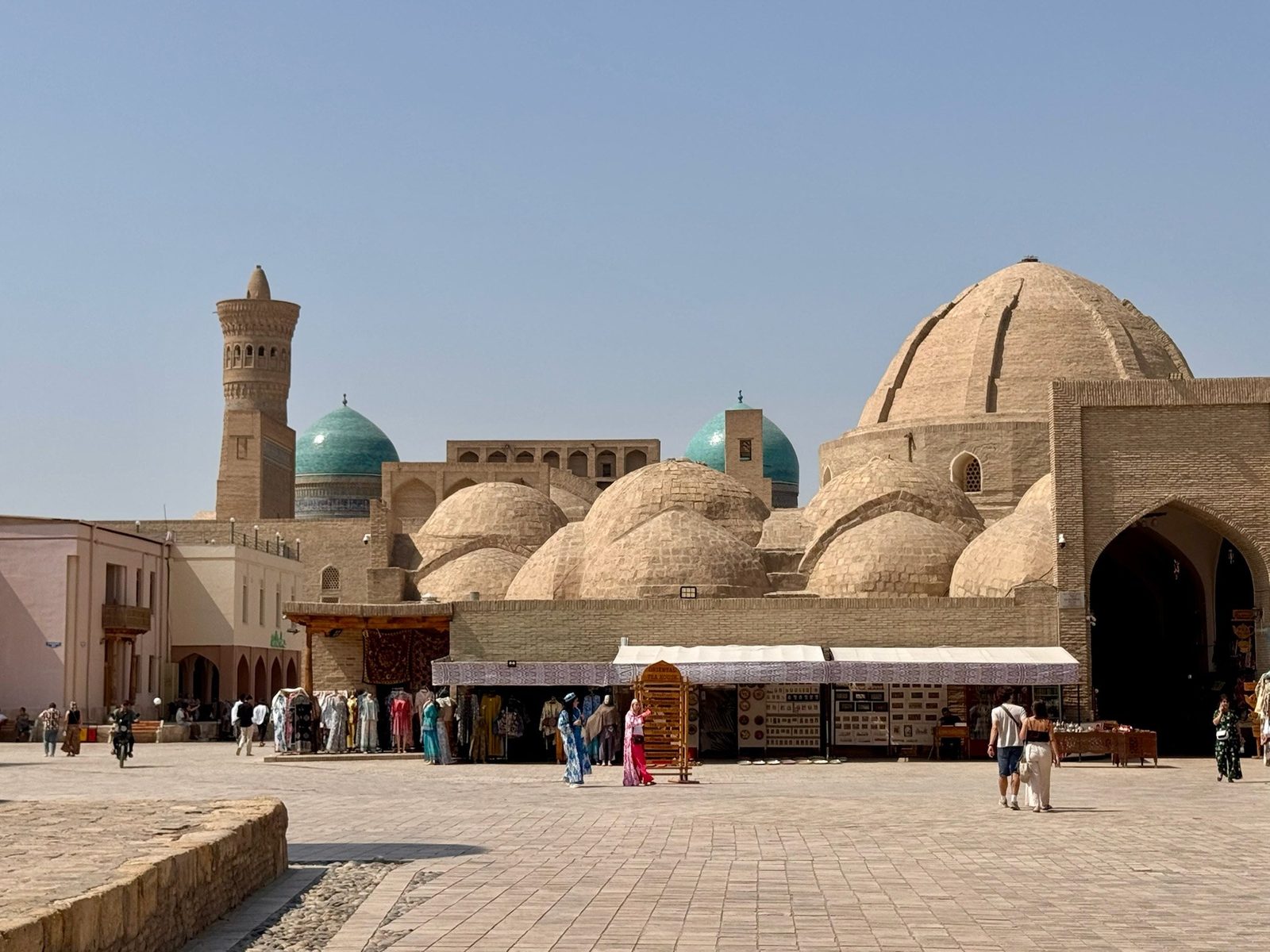
Today chasers work in small shops around the Did you know? Under Bukhara's domes merchants changed money and gold Four 16th-century trading domes still stand over old crossroads. Toki Sarrafon was the money changers' dome, where merchants from India and China swapped coins; Toki Zargaron held jewellers' workshops, Toki Telpak Furushon sold caps. Read more → of Bukhara. Stop and watch: a plate takes its pattern strike by strike. The jewellers’ dome, Toki Zargaron, built in 1570, is a reminder of how old this trade is in the city.
Steel: Bukhara blacksmiths and the knives of Chust
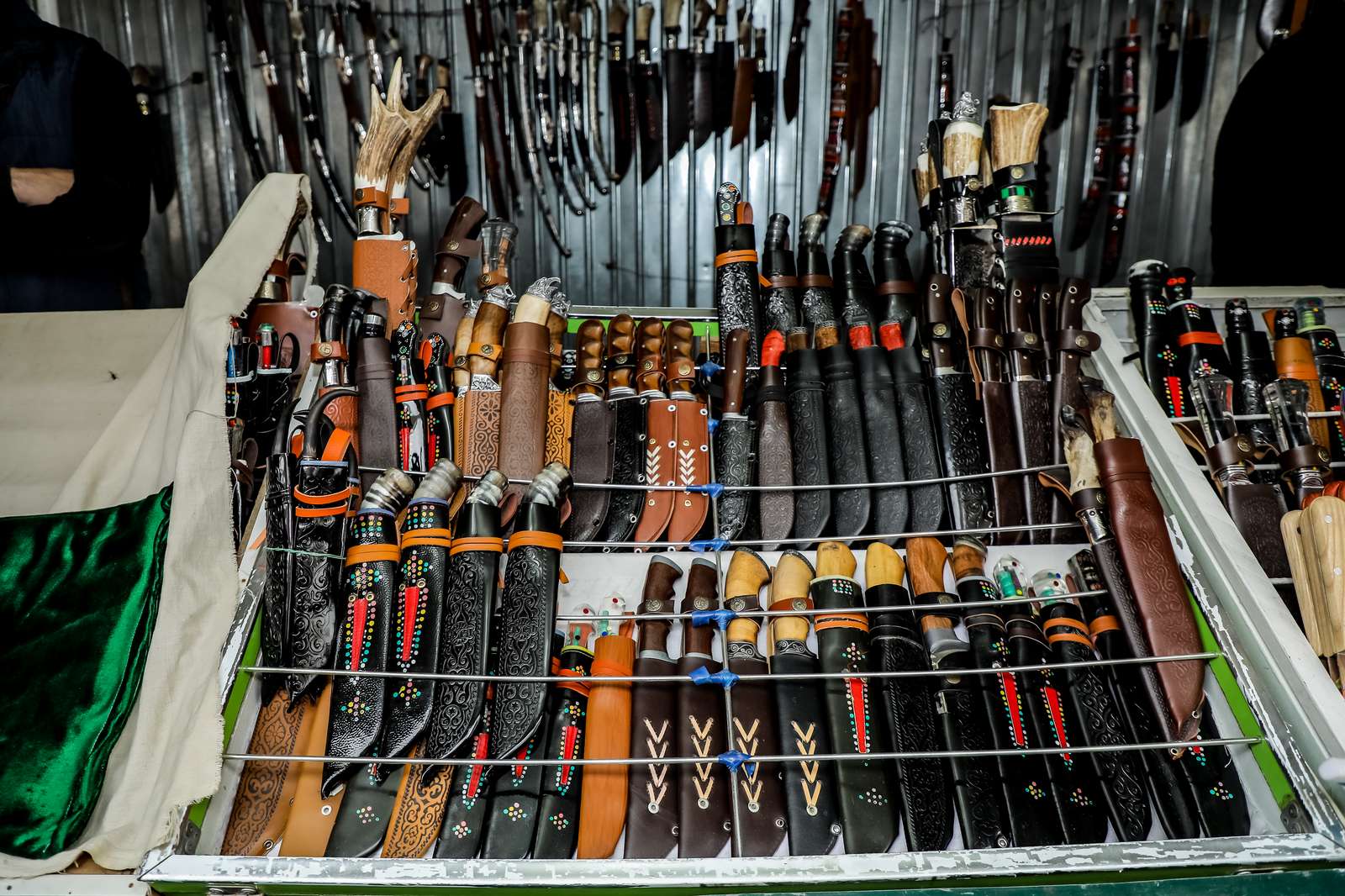
In the trading dome of Telpak Furushon in Bukhara you can watch knives forged in a blacksmith’s workshop next door. Look for the bird-shaped scissors of the Bukhara smiths: open them, and the beak becomes the two blades.
The most famous Uzbek knife, though, comes from Chust in the Namangan region of the Fergana Valley. The pichoq has a straight, wide blade and a handle of horn or bone, sometimes inlaid; an especially fine one is called guldor pichoq, the patterned knife. Each Chust blade carries the town’s stamp, and its old smiths’ quarter is still called Suzangaron. Shahrikhan near Andijan is the other knife town of the valley, with family dynasties of knife makers and workshops you can visit.
In an Uzbek house a knife is more than a tool: it is kept as a talisman that protects the home. Keep yours in its sheath, wipe it dry, and pack every blade in checked luggage. The valley towns are in our Andijan and Namangan guide.
Gold embroidery: zardozi of Bukhara
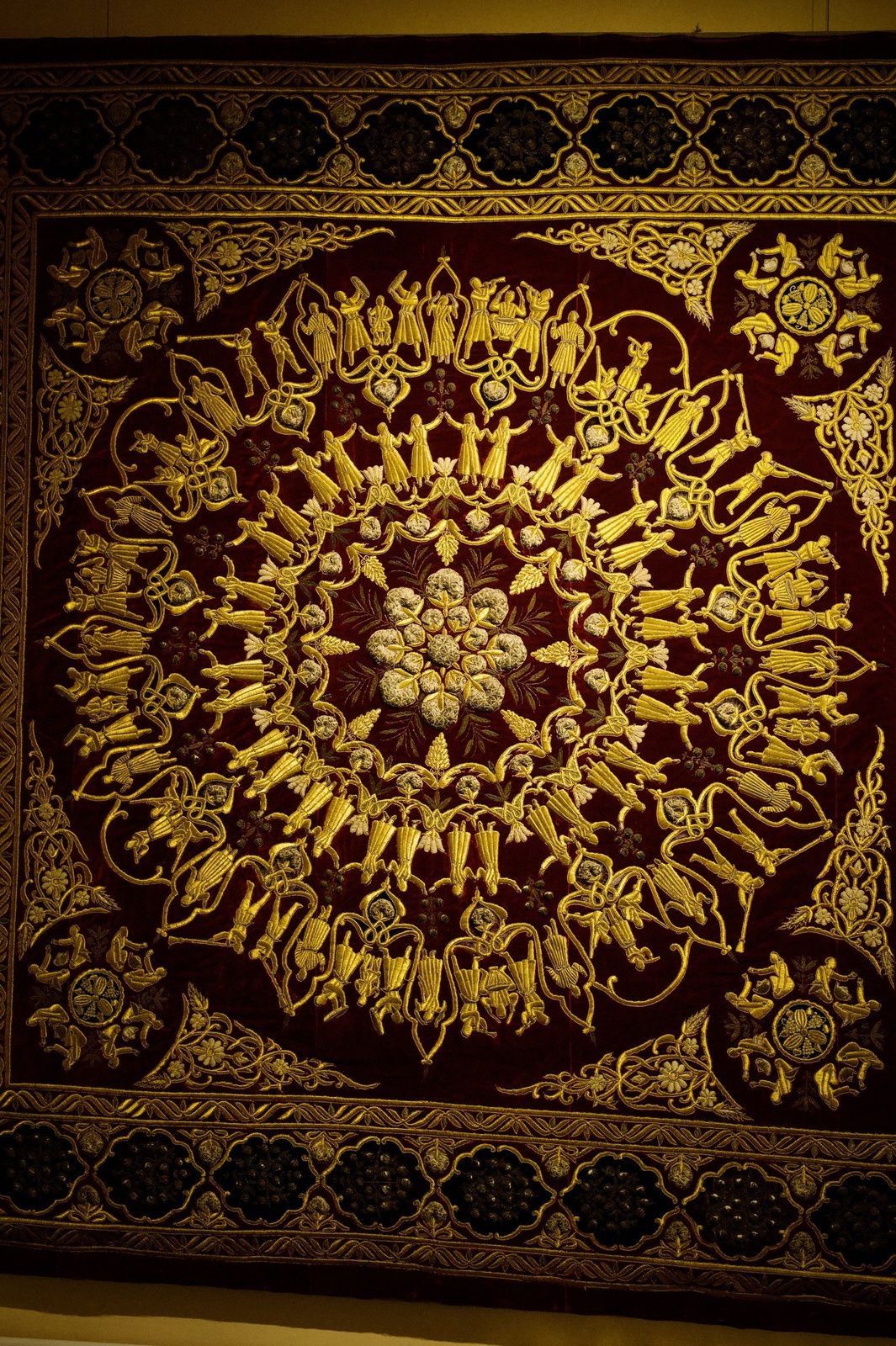
Zardozi means “sewing with gold”. In the emirate it was a court art and, unlike silk embroidery, it was done only by men; in the mid-19th century about 350 gold embroiderers worked in the Bukhara emirate, many of them in workshops in .The fortress-residence of the rulers of Bukhara on a high artificial hill: the oldest structure in the city. Read more → Today women do most of the work.
There are two main techniques. In zaminduzi gold thread covers the whole ground. In gulduzi the motif is cut out from a stencil, fixed to the stretched velvet and covered with gold thread, so the pattern stands out against the cloth. Masters know more than thirty stitches. In the 1930s the workshops were gathered into artels, and in 1960 into the Bukhara Gold Embroidery Factory. The curtain of the Navoi Theatre in Tashkent was embroidered by Bukhara masters.
To see the emir’s own robes, go to the museum of the Did you know? Legend: the emir's palace site was chosen with meat Legend says that when Emir Nasrullah wanted a summer palace in the mid-19th century, sheep carcasses were hung in several places around Bukhara, and the spot where the meat spoiled last was chosen. Sitorai Mohi-Hosa there today dates from 1912–1918. Read more → summer palace outside Bukhara; see day trips around Bukhara. Caps, bags and small panels are sold in the old town.
Miniature painting: from Herat to Bukhara
Book painting came to these cities from the Timurid court. In Herat, Kamoliddin Behzad headed the royal workshop from 1486 under Sultan Husayn Bayqara, and the poet Alisher Navoi was his patron. In the 16th century, under the Shaybanids, Bukhara had a school of its own, and its painters illustrated the poems of the day, such as Hatifi’s Khusraw and Shirin. The Center of Islamic Civilization in Tashkent has shown original Bukhara miniatures of that century, bought back at auctions in Britain.
Today miniaturists in Bukhara teach apprentices and grind their own colours from minerals and plants, and the Konigil paper mill near Samarkand sells miniatures on mulberry-bark paper. The poet behind many of these scenes has his own article: Alisher Navoi.
Ceramics, carpets and the rest
Pottery has a whole map of its own: Rishtan’s turquoise, Gijduvan’s browns and greens, Khorezm’s cobalt. Read the schools of Uzbek ceramics, and from Bukhara add a half-day trip to a Gijduvan ceramics workshop with lunch. Silk is in Uzbek ikat, embroidery in suzani, and the overview of which town makes what is in our guide to traditional crafts of Uzbekistan.
How to visit workshops
Most of these crafts are made in family workshops and small studios, not in museums. Masters are glad to show their work, but they are working, so come with a guide who can translate and ask the right questions. Our 5-day crafts of Bukhara and Samarkand tour visits paper makers, woodcarvers, gold embroiderers, blacksmiths and potters; the guide speaks your language and is included in the price. A trip built around other crafts, such as Khiva woodcarving or the knives of Chust, can be planned on request.
Buying in a workshop is the simplest way to know who made a piece. New crafts need no export paperwork; old pieces are covered in what to buy in Uzbekistan.
In short
- Khiva carves wood in spiral plant patterns and finishes it with oil, not lacquer; the Juma Mosque stands on 212 carved columns.
- Bukhara chased copper is quiet and balanced; watch the chasers around the trading domes.
- The Chust pichoq has a straight, wide blade and the town’s stamp; pack knives in checked luggage.
- Zardozi, Bukhara gold embroidery, was once a men’s court art; see the emir’s robes at Sitorai Mohi-Hosa.
- Miniature painting came from Timurid Herat; Bukhara had its own school in the 16th century.