
Places in this article: Samarkand · Bukhara
Symbols in Uzbek ornament: how to read tiles, suzani, ikat and carved doors
The same small fruit turns up all over Uzbekistan. It is woven into silk in Margilan as anorcha, the little pomegranate; it is stitched on a Bukhara ;Did you know? One suzani was often stitched by several women at once A family member or a pattern drawer, the kalamkash, drew the design across strips of cotton. The strips went to different women of the family or neighbourhood, who embroidered them at the same time; sewn back together, they show slightly mismatched seams. Read more → it ripens in the bazaar in October. A pomegranate is full of seeds, and for centuries it has been drawn as a wish for plenty and children. Once you know a dozen such signs, a tiled portal, an embroidered cloth or a carved door starts to read like a sentence.
This is a small dictionary of Uzbek ornament: the geometry of Did you know? Physicists argued that girih patterns behave like quasicrystals In 2007 the physicists Peter Lu and Paul Steinhardt argued that girih patterns, laid with a small set of tile shapes, have the properties of quasicrystalline tilings, the kind Western mathematics described only in the 1970s as Penrose tilings. Read more → and the garden of islimi, fruits and horns, amulets, animals and letters, with the places where each sign is easiest to see. For the buildings themselves, start with how to read Uzbek architecture.
Two languages: girih geometry and islimi gardens
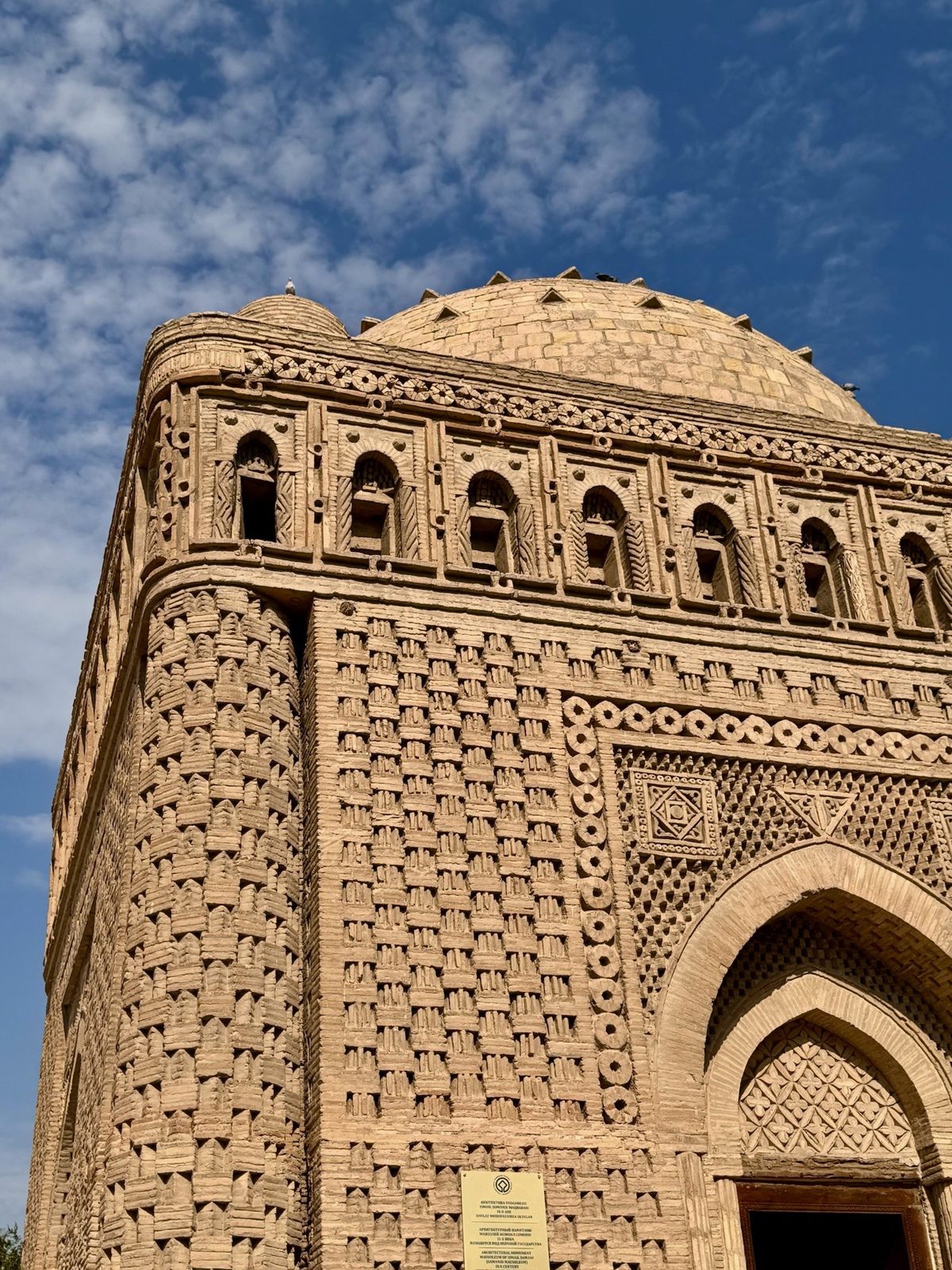
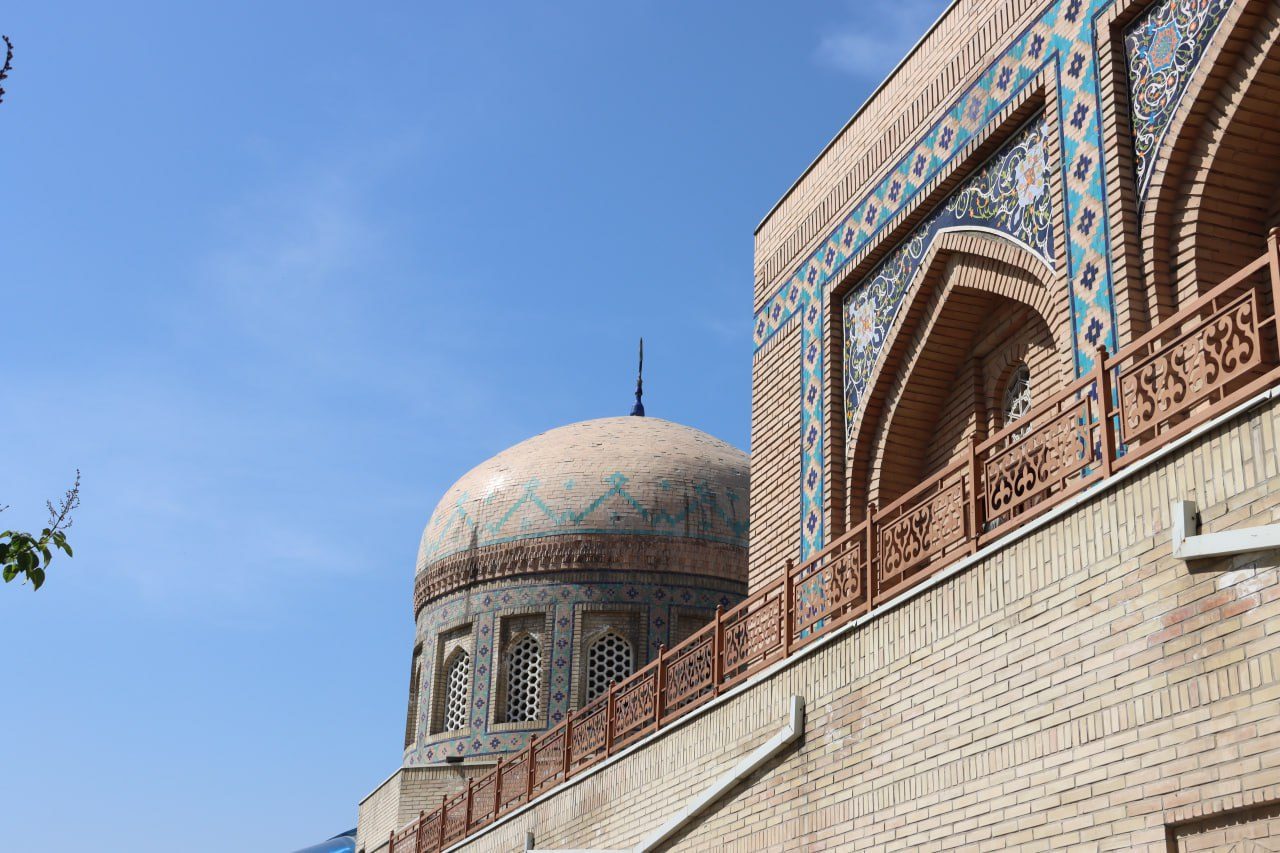
Almost every Uzbek pattern belongs to one of two families. Girih, Persian for “knot”, is geometry: straight interlacing bands that form stars and polygons and can repeat in every direction without a beginning or an end. One of the earliest examples in the country is on the gateway of the Did you know? Legend says a nomad chief built Rabat-i Malik Local tradition, recorded by a traveller in the 19th century, remembered the ruin as the castle of a khan and his heirs, built by a nomad chief called Malik Khan. What is known: the Karakhanids raised it around 1078–1079 on the road from Bukhara. Read more → caravanserai of 1078, on the road from Navoi to Bukhara. Even earlier, in the 10th century, the builders of the Did you know? Buried in mud, this tomb escaped Genghis Khan The 10th-century Samanid Mausoleum, one of the oldest monuments of Islamic Central Asia, was covered by flood mud and sand before the Mongols came in 1220. Hidden for centuries, its brick lacework survived intact. Read more → in Bukhara laid the bricks themselves in patterns, so that the whole cube is ornament.
Islimi is the garden: stems that wind, split and flower, with leaves and rosettes. Under the Timurids plant scrolls took over much of the surface of buildings, and the same spirals run across carved doors in Khiva, where masters call the style aylanma islimi, the turning islimi. Geometry and garden are often used together: a frame of girih, a field of flowers.
Pomegranate and almond: the fruits of the garden
The pomegranate, anor, is the clearest sign of all. Full of seeds, it stands for fertility, and it appears on suzani and, as anorcha, on ikat. A suzani was traditionally part of a bride’s dowry, so its pomegranates carried a wish for the new family.
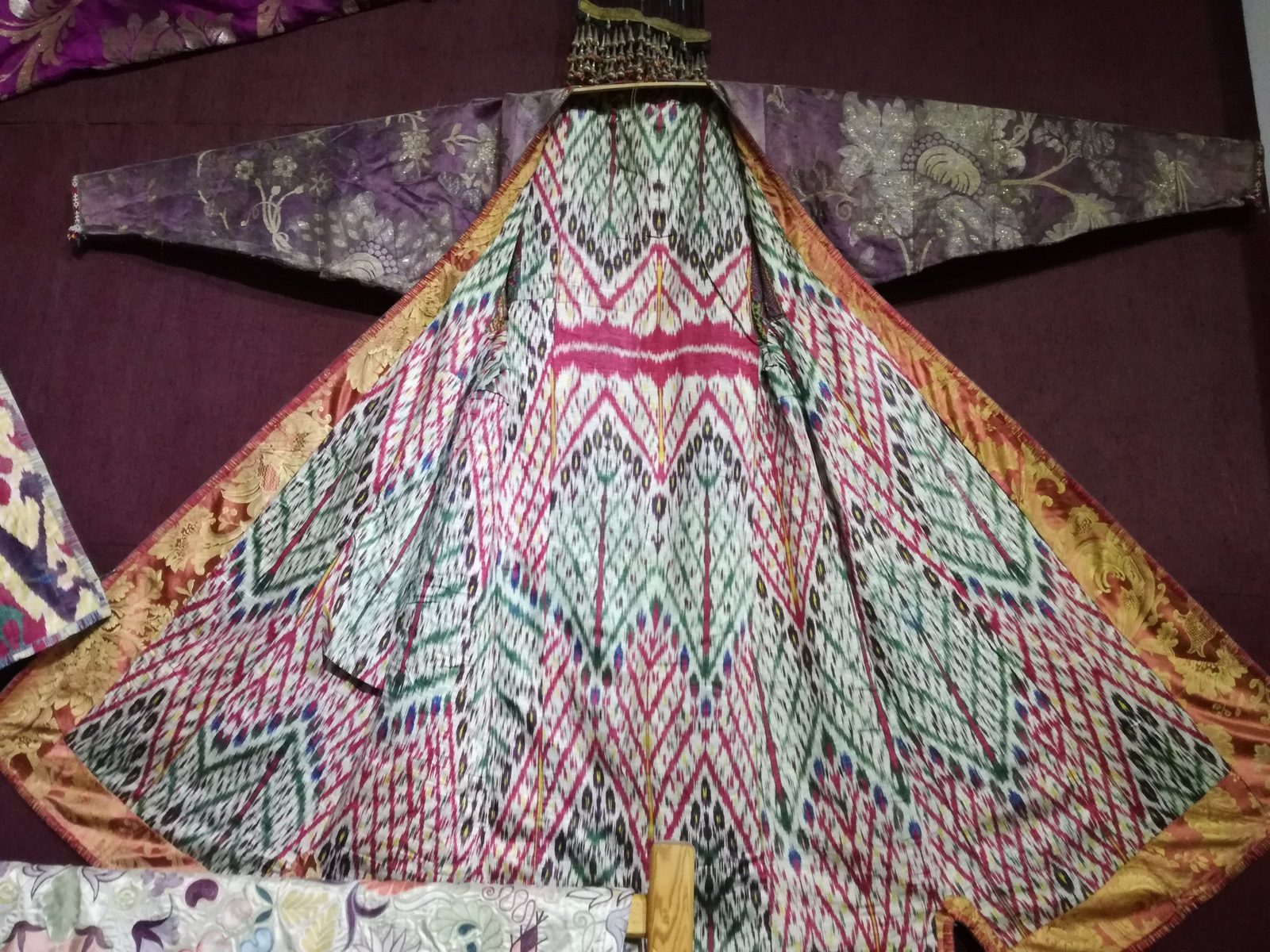
The almond, bodom, is the curved teardrop that Europe knows as paisley. In the Persian world the form is called buta, and it is believed to join a spray of flowers with a cypress, an old sign of life. In Uzbekistan you will see bodom woven into ikat, embroidered on caps and shaped in jewellery.
Sun, moon and sky on a suzani
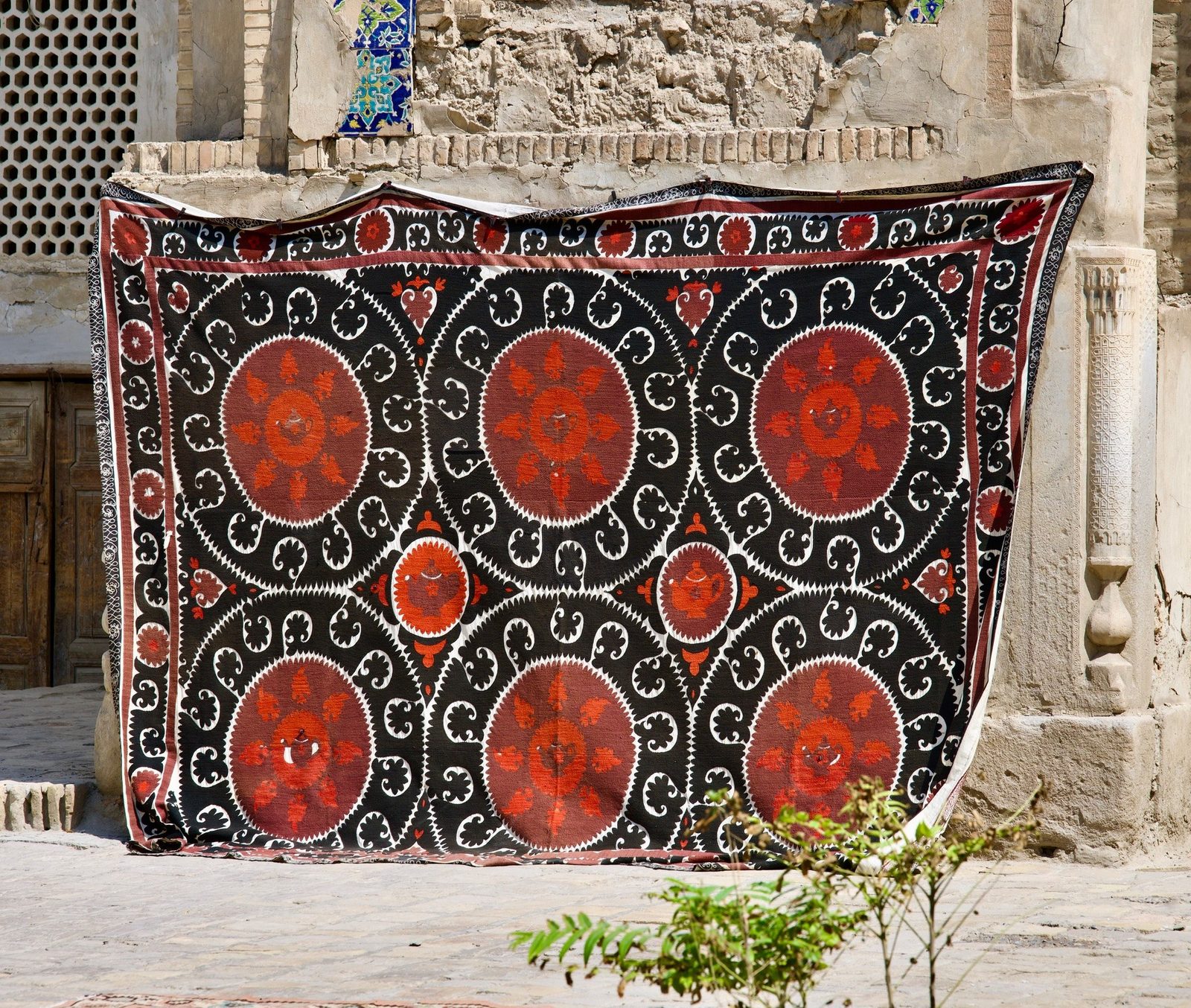
The large round rosettes that fill many suzani are the sun and the moon. In Tashkent such a suzani is called palak, “the sky”, or oy-palak, “the moon sky”. Around the discs grows a garden of flowers, leaves and vines, and embroiderers say a small part of the pattern is often left unfinished, so that the work, like life, goes on. How suzani are made and how to choose one is in suzani embroidery.
Ram’s horns, amulets and peppers: signs that protect
A pair of curls back to back is kuchkor shokhi, ram’s horns, and in ikat and embroidery it stands for strength and protection. The triangle is the tumar, the amulet: across Central Asia small triangular amulets were sewn onto clothes and horse trappings, and rows of triangles in patchwork and embroidery were meant to keep the evil eye away. In ikat the motif is called tumorcha, the little amulet, and eye-shaped motifs serve the same purpose.
On suzani a red chili pepper does the same job. Even a skullcap can protect: the black Chust doppi carries sixteen white arches, read as a fortress around its wearer.
Tigers, suns and birds on the portals
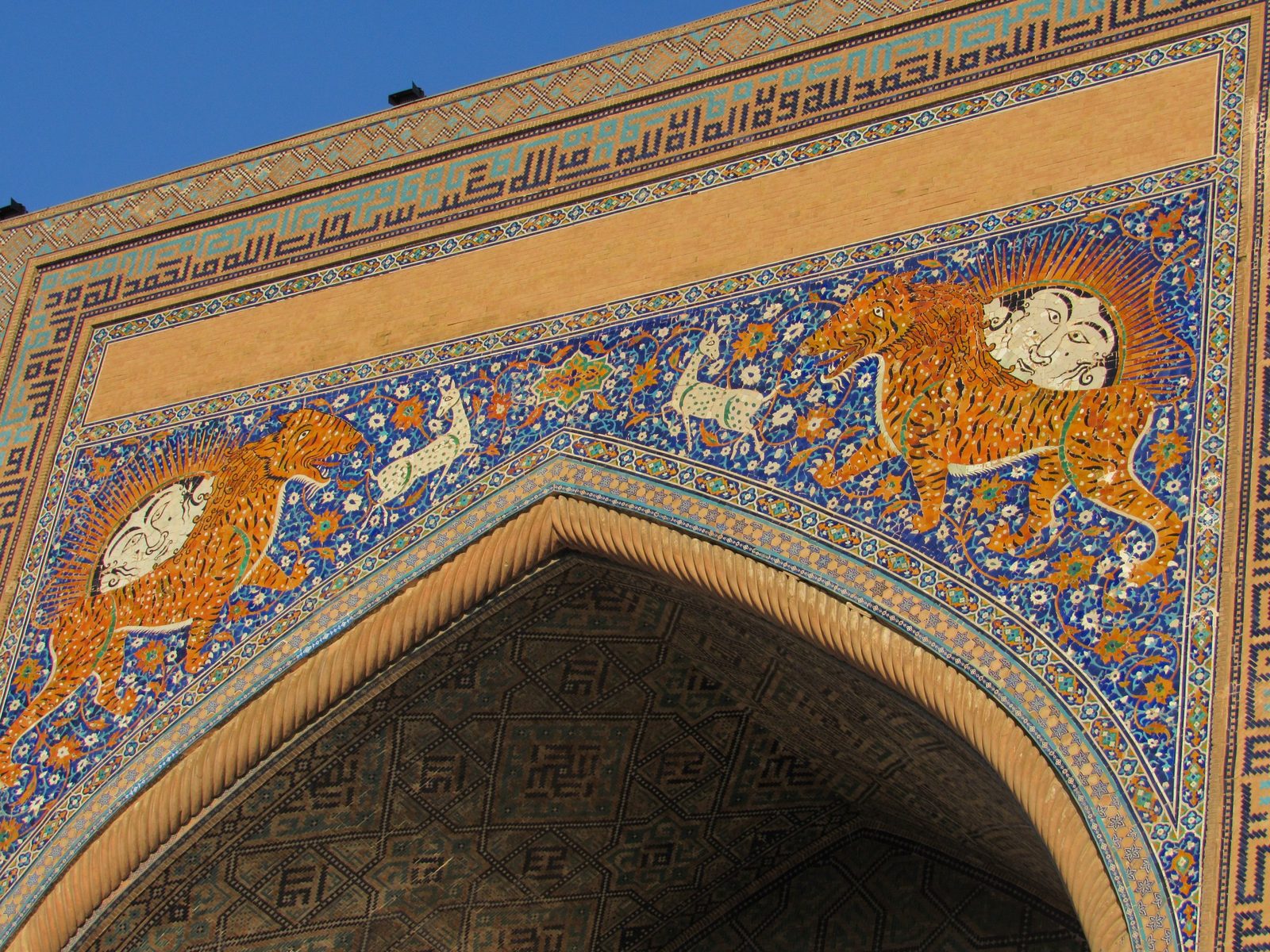
Living creatures are rare on Islamic buildings, which makes two portals famous. On the Did you know? The Registan's sun-carrying lion went on a banknote The Sher-Dor Madrasah (1619–1636) is named for the big cats with the sun on their backs on its portal. The image appeared on the reverse of Uzbekistan's 200-som note of 1997. Read more → An Islamic college: student cells and classrooms around a courtyard behind a grand portal. In the old towns many now house museums and craft workshops. Read more → on the Registan, built in 1619–1636, two striped big cats chase white deer, and on each cat’s back rises a sun with a human face. The name means “having lions” or “having tigers”, and Samarkand still argues about which; the image is on Uzbek money today. In Bukhara, on the Did you know? A caravanserai that became a madrasah by a khan's word Nadir Divan-Begi built his 1622 building by Lyabi-Hauz as a caravanserai. At the opening Imam Quli Khan praised it as a fine madrasah, and a khan's word could not be taken back: a portal and cells were added, and a madrasah it became. Read more → at ,Did you know? Bukhara's ponds were once its water supply Pools like Lyabi-Hauz, dug around 1620 and 46 × 36 m, were the city's main source of water. Most were filled in during the 1920s–30s because they spread disease; Lyabi-Hauz survived. Read more → two simurghs, the phoenix-like birds of Persian legend, fly towards a sun with a human face, each carrying a white deer in its claws.
The guides will tell you more than one reading, from royal power to the old sun-and-lion emblem; what is certain is that the masters chose these images on purpose, for the main gate of the building. More in the Registan and Lyabi-Hauz.
Letters as ornament
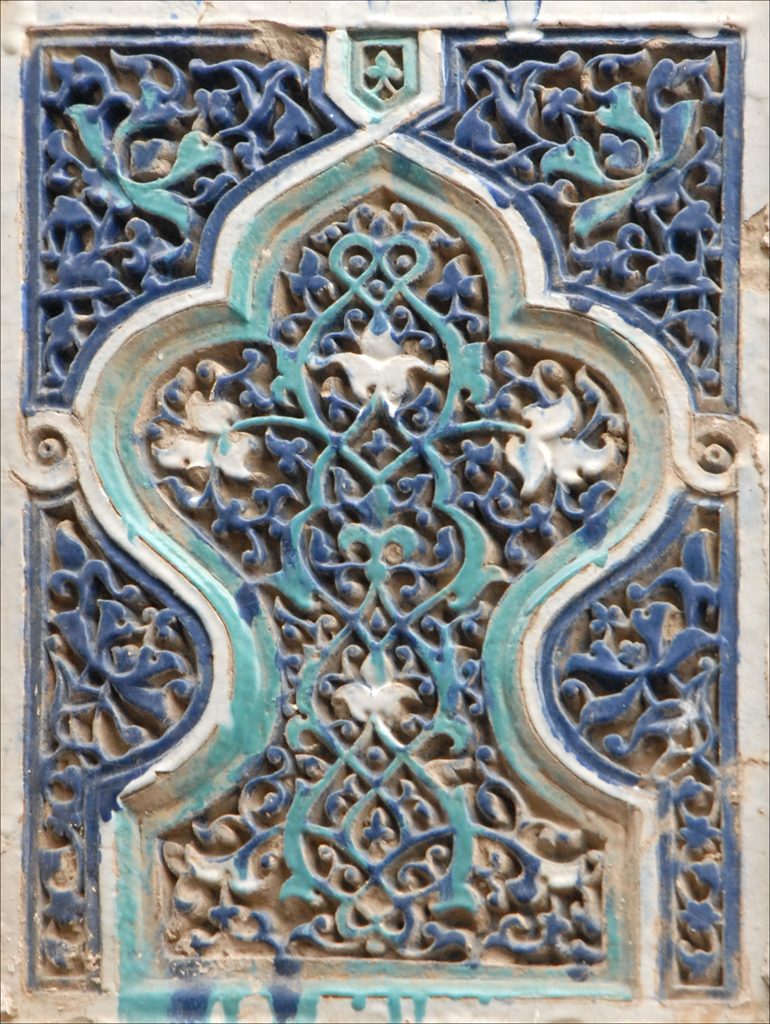
On many buildings the most important ornament is writing. Kufic, the oldest style of Arabic calligraphy, is angular and upright, and its square form suits brick: on the pylons of The ruins of Amir Timur's palace in Shahrisabz, his home town. Only parts of the giant entrance arch still stand. Read more → in Shahrisabz whole words are laid out in blue and white bricks, like pixels. Most inscriptions on mosques and madrasahs are verses from the Quran, but buildings also record their own story. A Kufic band on the Did you know? Diggers went 13 m down and never found its base The Kalyan Minaret of 1127 rises about 46 m, and an excavation reached 13 m without finding the bottom of its foundations. Genghis Khan reportedly ordered it spared. Read more → in Bukhara names ,Did you know? Legend: Genghis Khan bowed to the Kalyan minaret Legend says that in 1220 Genghis Khan tipped his head back to see the top of the minaret and his hat fell off; since so great a man had bowed to it, it was spared. What is known: Arslan Khan finished it in 1127, and the Mongols left it standing. Read more → the ruler who built it, and on the Shadi Mulk Aka mausoleum of 1371–1372 at Did you know? Why Shah-i-Zinda means 'the Living King' The necropolis grew around the shrine of Qutham ibn Abbas, a cousin of the Prophet Muhammad. Legend says he did not die in battle but went down a deep well to a garden of paradise, where he lives on. Read more → the tile makers left their names: Shamsiddin, Badriddin and Zayniddin.
You do not need to read Arabic to enjoy this. Look for the bands that run along the top of a portal or around a dome: where the pattern turns into lines of letters, the building is speaking. A phone zoom helps with inscriptions high on a wall.
Carpets and doors
The deep red carpets sold in Bukhara and Khiva are full of octagonal medallions, gul. The design known in carpet shops worldwide as “Bukhara” comes from the Turkmen weaving tradition, with rows of gul on a red or tan ground. Carved doors speak the islimi language: spirals, rosettes and borders of simple geometry, carved in elm and rubbed with oil. Where to watch carvers at work is in Uzbek crafts in wood, metal and gold.
A pocket dictionary
| Sign | Where you see it | Traditional meaning |
|---|---|---|
| Pomegranate (anor) | Suzani, ikat | Fertility, children, plenty |
| Almond (bodom), the paisley drop | Ikat, caps, jewellery | Life; a garden motif |
| Rosette, sun and moon (palak) | Suzani | The sky over the house |
| Ram’s horns (kuchkor shokhi) | Ikat, embroidery | Strength, protection |
| Triangle amulet (tumar) | Embroidery, patchwork, ikat | Protection from the evil eye |
| Chili pepper | Suzani | Protection from the evil eye |
| Girih star | Brick, tiles, carved wood | Endless repetition rather than a single meaning |
| Islimi scroll | Tiles, doors, copper, gold embroidery | The garden |
| Tiger or simurgh with the sun | Sher-Dor, Nadir Divan-Begi | Several readings, chosen for the main gate |
| Kufic and other script | Portals, domes, minarets | Quranic verses, names, dates |
The fullest single walk for these signs is Samarkand: the Registan and Shah-i-Zinda in one morning. Our 10-day Tiles and Master Builders tour follows ornament from Samarkand and Shahrisabz to Bukhara and Khiva, with the guide in your language included.
In short
- Uzbek ornament speaks two languages: girih geometry and the islimi garden of plant scrolls.
- The pomegranate means fertility and plenty; the almond, bodom, is the paisley drop.
- Ram’s horns, the triangle tumar and the chili pepper protect; the suzani rosette is the sun or the moon.
- Animals are rare on buildings: see the tigers of Sher-Dor and the simurghs of Nadir Divan-Begi.
- Bands of letters are ornament too: Quranic verses, rulers’ names and, at Shah-i-Zinda, the names of the tile makers.