
Places in this article: Bukhara
Legends of Bukhara: nine stories and where to hear them
Ask a Bukharan why the Did you know? Diggers went 13 m down and never found its base The Kalyan Minaret of 1127 rises about 46 m, and an excavation reached 13 m without finding the bottom of its foundations. Genghis Khan reportedly ordered it spared. Read more → survived Genghis Khan, and you will not get a date. You will get a hat. Almost every old building in Bukhara comes with a story attached, and the stories travel faster than the facts: guides tell them at the gates, A teahouse: green tea, plov and conversation on wide wooden beds called topchan. owners tell them over green tea, and grandparents tell them on the steps of .Did you know? Bukhara's ponds were once its water supply Pools like Lyabi-Hauz, dug around 1620 and 46 × 36 m, were the city's main source of water. Most were filled in during the 1920s–30s because they spread disease; Lyabi-Hauz survived. Read more →
Here are the nine we tell our guests most often. They are legends, and we tell them as legends. For each one: the story in a few lines, what is actually known, and where to stand when you hear it. Where we have a full article on the place, we link to it instead of repeating it.
The Ark: a palace inside a bull’s hide
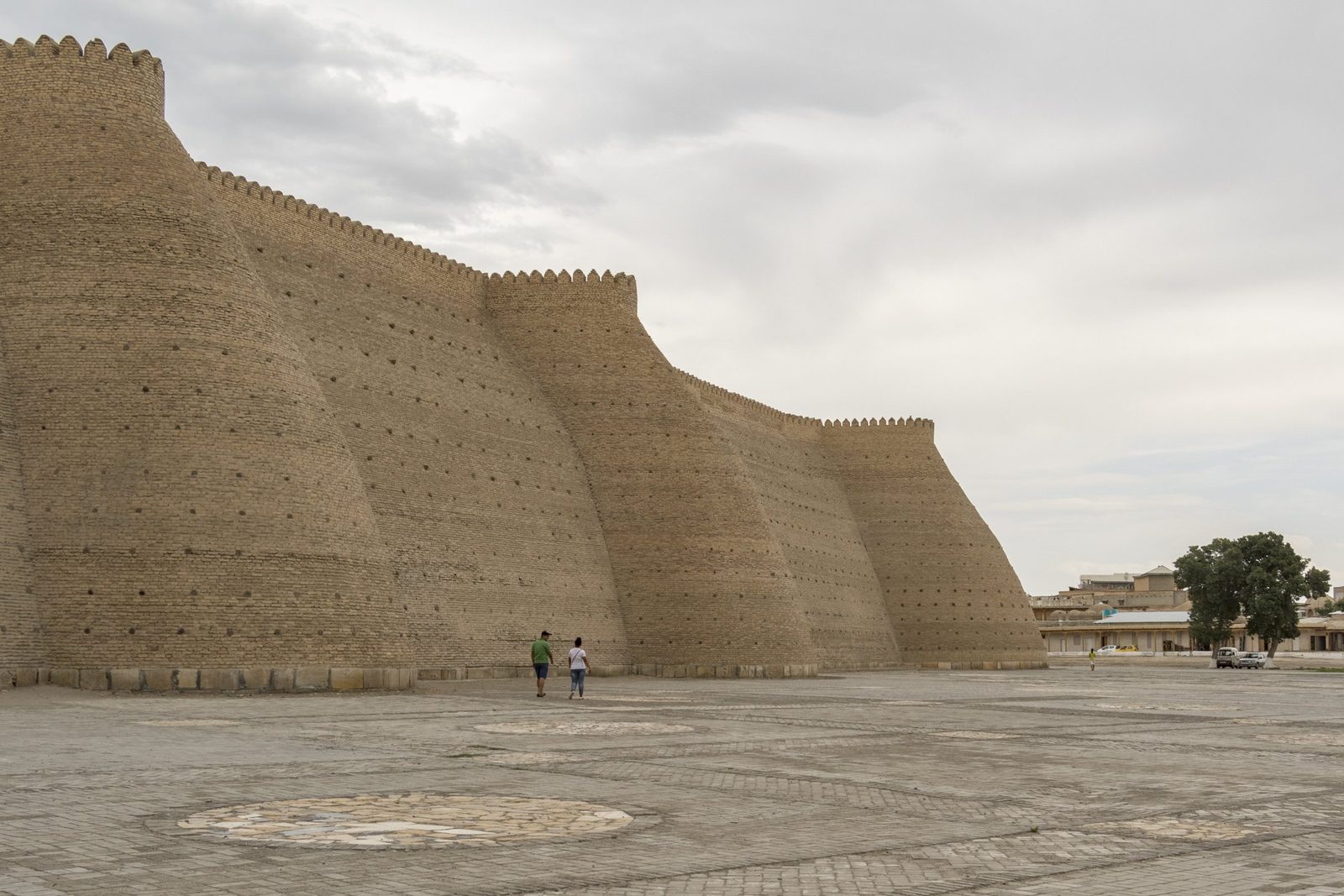
The legend. ,Did you know? Legend: the Ark was laid out with a bull's hide Legend credits the Ark to Siyavush, a prince of the Persian epic, who was offered as much land as a bull's hide would cover. He cut it into thin strips and circled a hill. In fact people built up the Ark's hill over more than 2,000 years. Read more → a prince of the Persian epic, fled to Turan and asked to marry the daughter of its king. The king set a condition he thought impossible: first build a palace inside the boundary of a single bull’s hide. Siyavush cut the hide into thin strips, tied them end to end and drew a circle big enough for a palace. That circle, Bukhara says, became .The fortress-residence of the rulers of Bukhara on a high artificial hill: the oldest structure in the city. Read more → A second story, from the 10th-century historian Narshakhi, adds that the fortress kept falling down until it was built on seven pillars set out like the stars of the Great Bear.
What is known. The Ark stands on a hill that people built up layer by layer; archaeologists found walls from the 4th–3rd centuries BC at the bottom. It was the seat of Bukhara’s rulers until 1920.
Where to hear it. On the open square in front of the gate, before you climb the ramp. The full story of the fortress is in the Ark of Bukhara.
The Kalyan minaret: the day Genghis Khan bowed
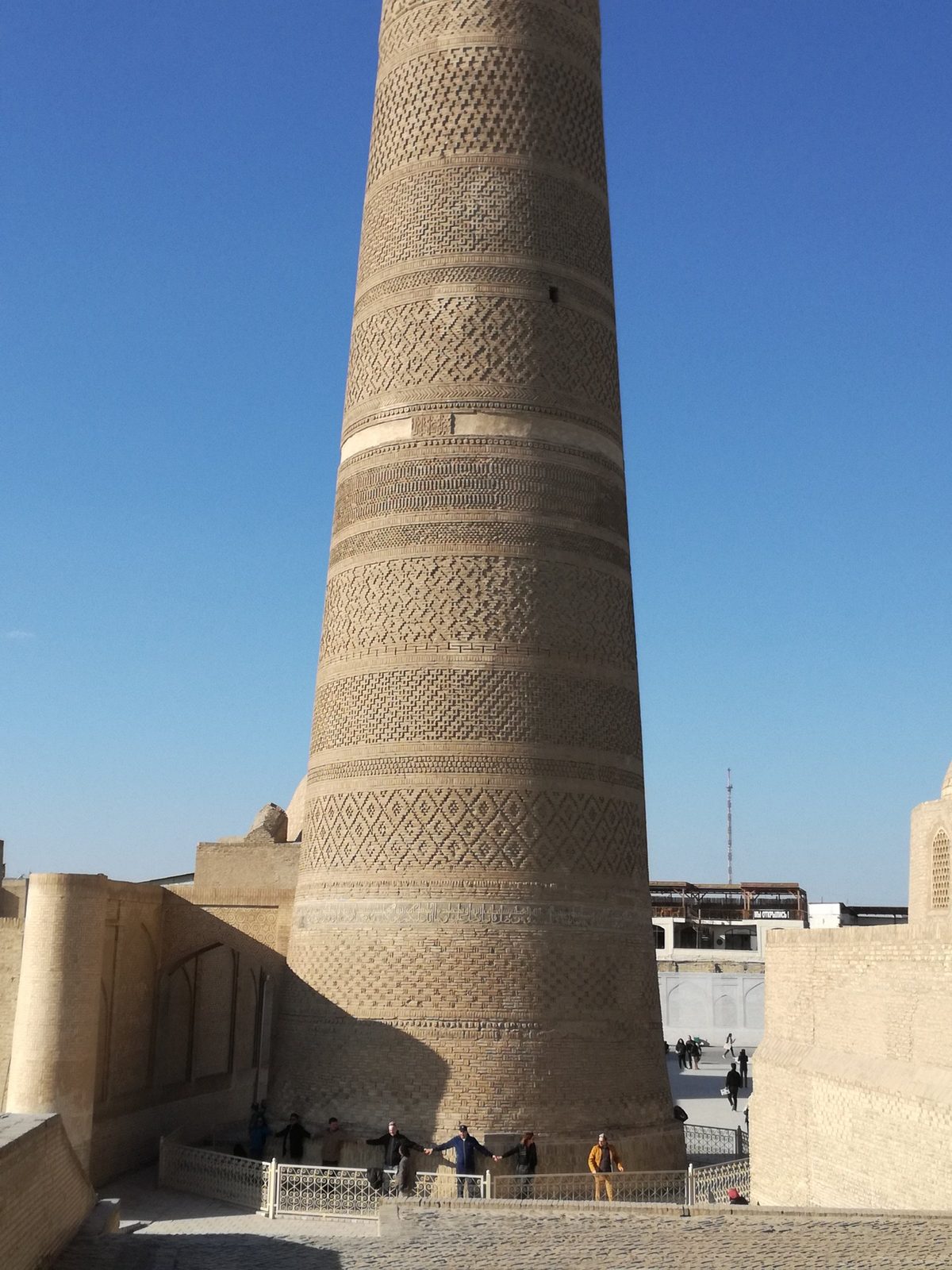
The legend. In 1220 Genghis Khan rode up to the great minaret and tipped his head back to see the top. He leaned so far that his hat fell off. As he bent to pick it up, he said that if so great a man had bowed to this tower, it should be left standing. In another version it is his helmet, and he takes the fall as a sign from above.
What is known. Arslan Khan finished the minaret in 1127. When the Mongols took Bukhara in 1220 they burned the city and destroyed the great mosque beside it, but the minaret was spared. Why, nobody wrote down. The tale of master Bako and his mortar mixed with camel milk is another legend of the same tower.
Where to hear it. At the foot of the minaret on Did you know? Legend: the minaret's foundation was laid with camel milk Legend says master Bako laid the foundations of the Kalyan minaret with ganch plaster mixed with camel milk, then vanished for two years to let them harden, and only then built the tower. Locals still show a grave they say is his. Read more → square. Look up and you will see why the story works. More in Poi-Kalyan and the Kalyan minaret.
Chashma-Ayub: the spring of Job’s staff
The legend. The prophet Job, Ayub in the East, came to this place and struck the ground with his staff, and a spring of clear water rose where it hit. The water is still thought to be pure and healing, and people come to drink it.
What is known. The oldest part of the building goes back to the 12th century. An inscription credits Amir Timur (Tamerlane, 1336–1405), founder of the Timurid empire, which had its capital in Samarkand. Born near Shahrisabz. with a grand chamber in 1379–1380, and the work is attributed to masters from Khorezm, which explains the conical dome: common in Khorezm, rare in Bukhara. Inside is a museum of Bukhara’s water supply, a good place to learn how a desert city lived on canals and ponds.
Where to hear it. At the edge of the Samanid park, a few minutes’ walk from the .Did you know? Buried in mud, this tomb escaped Genghis Khan The 10th-century Samanid Mausoleum, one of the oldest monuments of Islamic Central Asia, was covered by flood mud and sand before the Mongols came in 1220. Hidden for centuries, its brick lacework survived intact. Read more → Look for the pointed roof.
The Samanid Mausoleum: forty saints in the brickwork
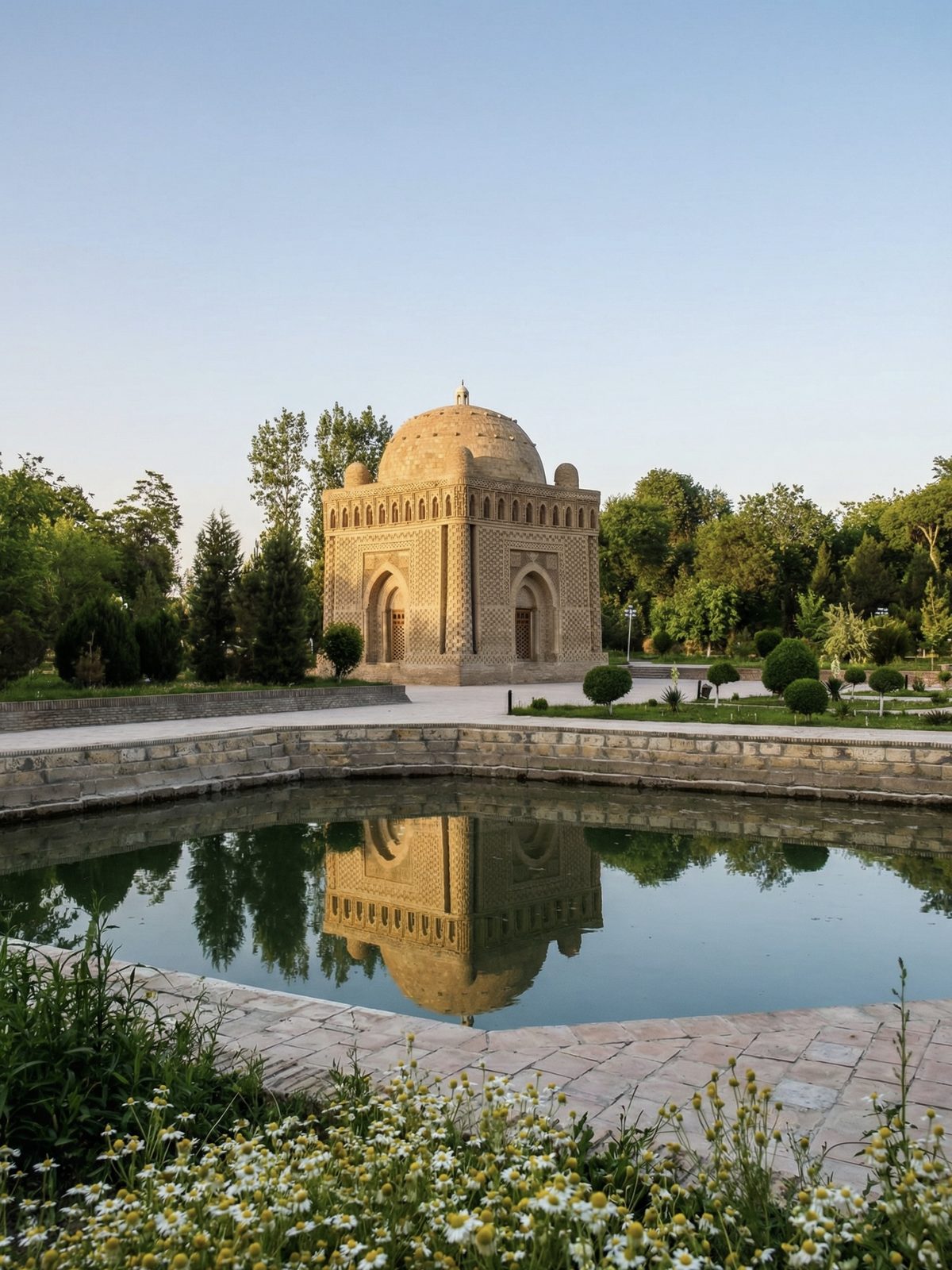
The legend. Count the small brick beads set into the ornament of the outer walls. Local tradition links their number, forty, to the chiltan, the forty protective spirits of Central Asian folk tales. Guides also tell you that the tomb hid from Genghis Khan under the earth.
What is known. The mausoleum dates from the 10th century. Nasr II of the Samanid dynasty is among those buried here, and tradition adds ,Did you know? Legend says Ismail Samani answered requests after death People long believed that Ismail Samani, the ruler buried in the Samanid Mausoleum, still helped his people: a written request slipped through an opening on one side would be answered by the next day. Notes were left here into the 20th century. Read more → the founder of the dynasty. The second story is close to the truth: floods buried the building in silt for centuries, and it was dug out in 1926–1928.
Where to hear it. In the Samanid park, west of the Ark. Come in the morning, when the low side light brings out the pattern of the bricks.
Magoki-Attari: the mosque in a pit
The legends. Before Islam, the story goes, a market stood here where idols, potions and spices were sold, beside a temple of the Moon, Mah; others say a fire temple. Bukhara also remembers that the city’s Jewish community prayed in this mosque before it had a synagogue of its own.
What is known. Magok is Persian for “in a pit”, and you will see why: the floor lies about 4.5 metres below today’s street, because the city rose around the building over the centuries. The facade dates from the 12th century and was restored in the 1930s. Today the mosque is a carpet museum.
Where to hear it. Among the ,Did you know? Under Bukhara's domes merchants changed money and gold Four 16th-century trading domes still stand over old crossroads. Toki Sarrafon was the money changers' dome, where merchants from India and China swapped coins; Toki Zargaron held jewellers' workshops, Toki Telpak Furushon sold caps. Read more → on the way from Lyabi-Hauz to Poi-Kalyan. Stand at the top of the steps and look down at the portal.
Lyabi-Hauz: the widow who would not sell
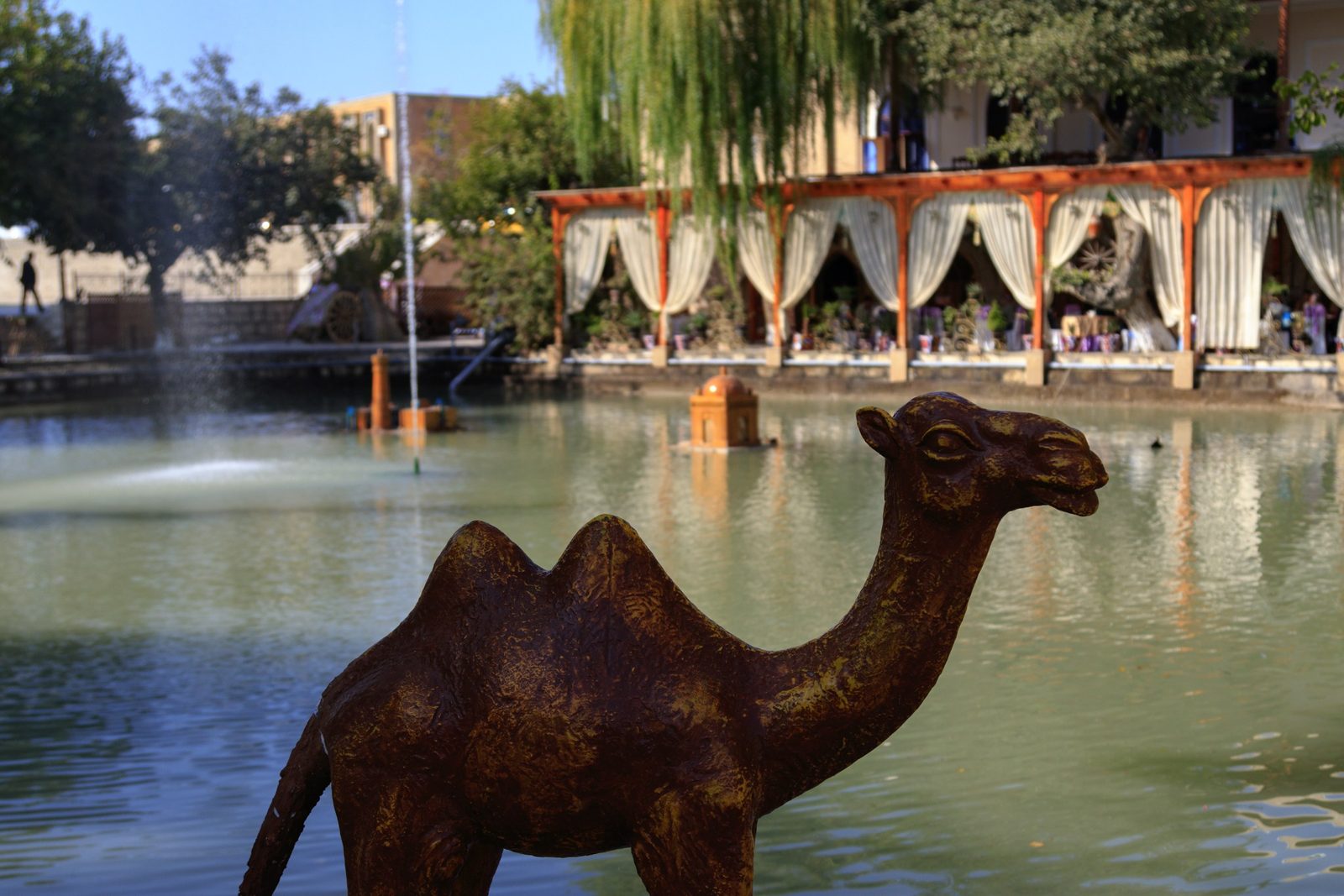
The legend. The vizier Did you know? A caravanserai that became a madrasah by a khan's word Nadir Divan-Begi built his 1622 building by Lyabi-Hauz as a caravanserai. At the opening Imam Quli Khan praised it as a fine madrasah, and a khan's word could not be taken back: a portal and cells were added, and a madrasah it became. Read more → wanted a pond on land that belonged to an old Jewish widow, and she refused to sell. He had a channel dug past her house until the water soaked her foundations, and she gave in on one condition: land elsewhere for a synagogue. Bukhara still calls the pond, half in jest, “the pond made by force”.
What is known. The pond was dug in about 1620 for Nadir Divan-Begi and measures about 46 by 36 metres. It is one of the few hauz ponds left in a city that once had dozens.
Where to hear it. On the stone steps by the water, in the evening. The square, its madrasahs and its teahouses are in Lyabi-Hauz and Chor Minor.
Chor Minor: four towers, four faiths?
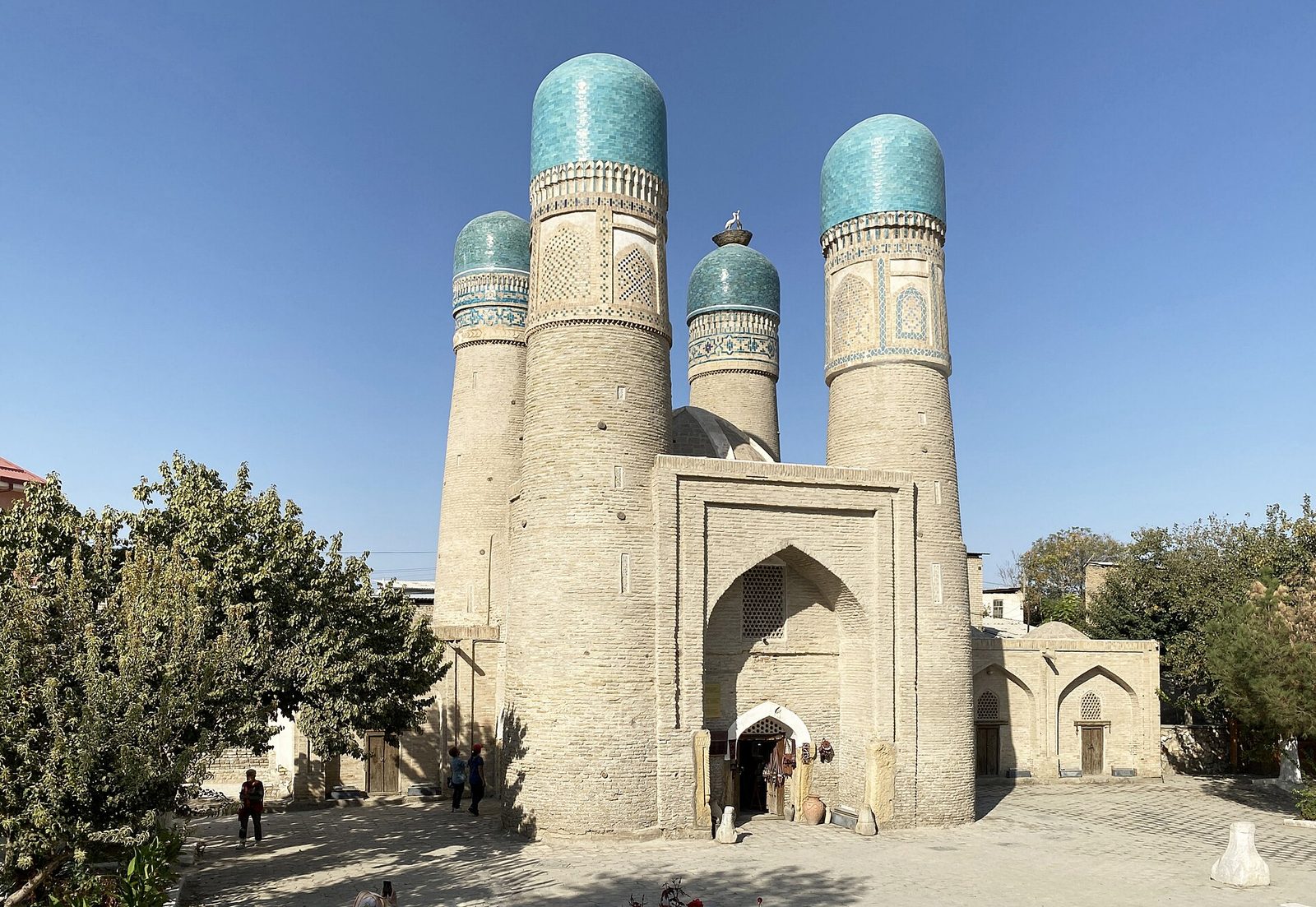
The legend. Each of the four towers is decorated differently, and the favourite explanation is that they stand for four religions. Visitors hunt the ornament for a cross, a fish and a prayer wheel, and many find them.
What is known. The building was finished in 1807 by Khalif Niyaz-kul, a wealthy Bukharan, as the gatehouse of his .An Islamic college: student cells and classrooms around a courtyard behind a grand portal. In the old towns many now house museums and craft workshops. The madrasah is gone; the gatehouse stayed. The towers are not minarets, and why there are four, nobody recorded.
Where to hear it. In the small square in front of it, a ten-minute walk north-east of Lyabi-Hauz through quiet lanes.
Khoja Nasreddin: Bukhara’s favourite son
The legend. Bukharans will tell you that Did you know? Sit a child on Nasreddin's donkey for a happy life By Lyabi-Hauz stands a statue of Nasreddin, the trickster of tales told from Turkey to China, whom Uzbeks count as a Bukharan. Locals say a child placed on his donkey will have a life full of joy. Read more → was one of them. In one of the best-known stories, Timur asks him what he, the great conqueror, is worth. “About twenty gold pieces,” says Nasreddin. “My belt alone is worth that much!” “I know,” Nasreddin replies. “I counted the belt.”
What is known. Nobody can prove where Nasreddin lived, or whether he lived at all, and many countries claim him. In 2022 the telling of his anecdotes was added to UNESCO’s list of the intangible cultural heritage of humanity, in a joint nomination by seven countries including Uzbekistan.
Where to hear it. At Lyabi-Hauz, beside the bronze Nasreddin on his donkey, which has stood under the mulberry trees since 1979. Ask your guide for one more story; there is always one more.
Bahauddin Naqshband: hands at work, heart with God
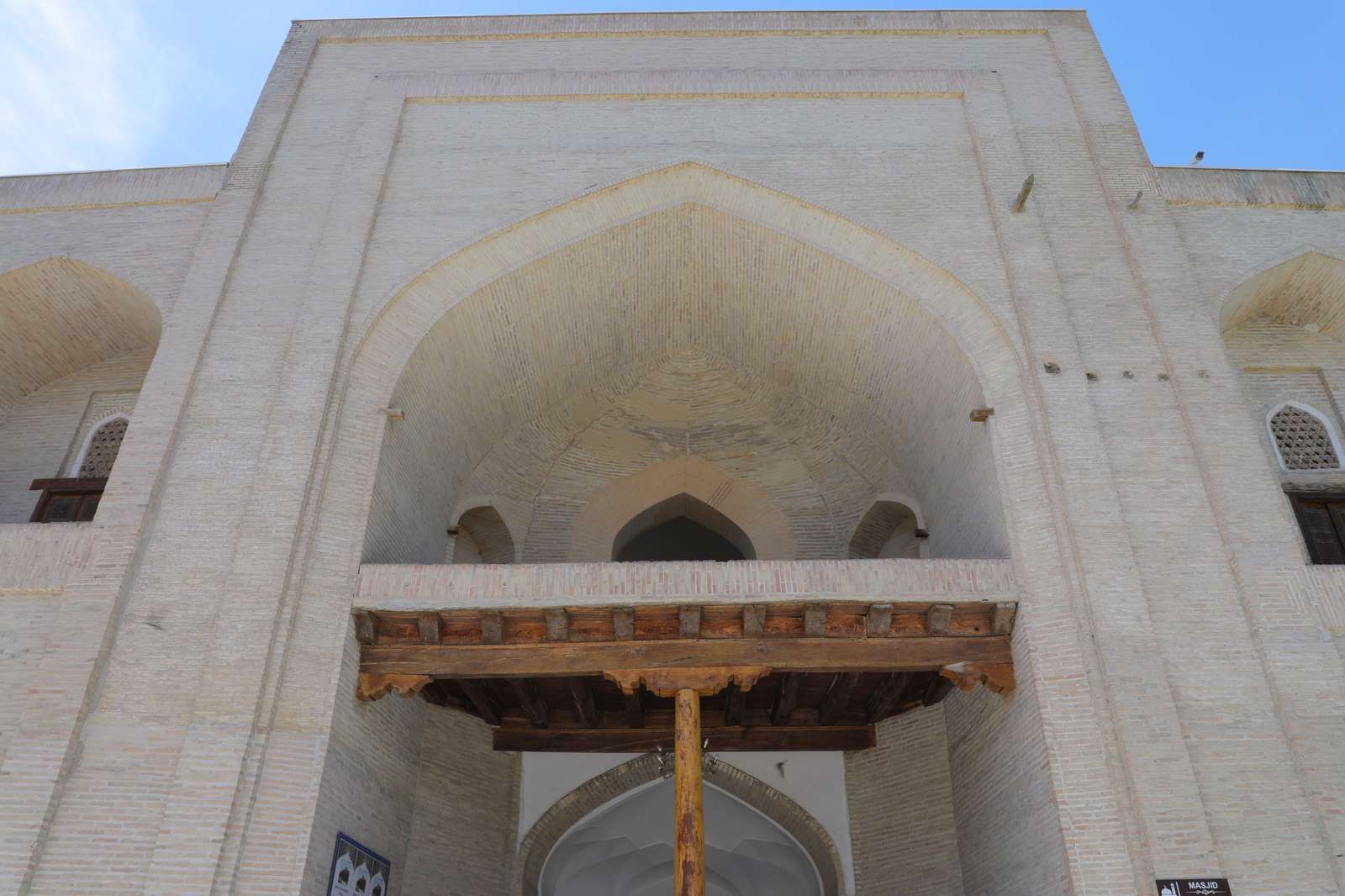
The tradition. As a young man, the story goes, Bahauddin saw in a dream Abdulkhaliq Gijduvani, a Sufi master who had died long before, and was told to become the pupil of Amir Kulal. He did. His teaching is remembered in four words, dil ba yor, dast ba kor: the heart with God, the hands at work. His name points the same way. His father was a weaver and a chaser of metal, and naqshband means a maker of patterns.
What is known. Did you know? A village renamed in honour of a Sufi master Bahauddin Naqshband (1318–1389), who gave his name to one of the largest Sufi orders, was born and buried near Bukhara in Qasr-i Hinduvan. The village was later renamed Qasr-i Arifan in his honour; the tomb over his grave dates from 1544. Read more → lived from 1318 to 1389 and gave his name to the Naqshbandi order. He was buried in Qasri Orifon, outside Bukhara, and the complex grew around his grave for centuries; the khanaqah was built under Abdulaziz Khan in 1544–1545. Since 2023 it has been part of the UNESCO World Heritage property Silk Roads: Zarafshan-Karakum Corridor.
Where to hear it. In the courtyard of the complex, about 10–12 km north-east of the old town. It is a place of reverence: cover shoulders and knees, and women bring a scarf. Our guide to shrines of Uzbekistan covers the seven pirs of Bukhara.
Walking the legends: our route and tips
- Route: start at the Ark at opening time, walk west to the Samanid Mausoleum and ,Did you know? A cone-shaped dome over Job's spring Chashma-Ayub, 'Job's Spring', has a conical dome in the Khorezm style, rare in Bukhara. Legend says Job struck the ground with his staff and water flowed; inside is a museum of Bukhara's water supply. Read more → then back east to Poi-Kalyan, down through the trading domes past Did you know? Legend: a mosque shared with Bukhara's Jews Magoki-Attori means roughly 'in the pit': even in the 10th century it lay below street level. Tradition says Bukhara's Jews once prayed here in the evenings, after the Muslims. Beneath it lie remains of a pre-Islamic temple. Read more → to Lyabi-Hauz and Nasreddin, and finish at .Did you know? Legend: four towers for four world religions? Chor Minor, a gatehouse of 1807, has four towers, each decorated differently. Guides say they stand for four world religions and look for a cross, a fish and a prayer wheel in the decor; others say four dynasties. All are interpretations. Read more → Bahauddin Naqshband needs a car; we pair it with the emir’s summer palace in one morning.
- How long: the old-town legends fill a day on foot, about 5–6 hours with lunch. Add 1–1.5 hours plus the drive for Bahauddin Naqshband.
- When: the Ark in the morning, Poi-Kalyan at sunset, Lyabi-Hauz after dark, when the stories sound best.
- Tickets and hours: the squares are free; the museums have their own tickets. Cards for each sight are in Bukhara and Khiva sights, tickets and hours.
- Getting there: Bukhara’s station is in Kagan, about 12 km from the old town, so plan a taxi or a transfer. See trains in Uzbekistan.
To fit the walk into your trip, see Bukhara in 1, 2 or 3 days and the Bukhara city guide. With one of our guides, most of these stories are told on the Bukhara highlights tour; all our routes are under Bukhara tours. Heading west next? Read the legends of Khiva.
In short
- Bukhara’s legends are tied to real places: you can stand where each story is set.
- The bull’s hide, the fallen hat, Job’s staff and the stubborn widow are legends; the Ark’s ancient walls, the minaret of 1127 and the pond of 1620 are history.
- Some stories are half true: the Samanid Mausoleum really did survive under the earth.
- Nasreddin belongs to many countries, and his anecdotes are UNESCO intangible heritage since 2022.
- Walk the legends in one day, from the Ark in the morning to Lyabi-Hauz at night, and add Bahauddin Naqshband by car.