Places in this article: Samarkand · Bukhara
Sarmysh Gorge petroglyphs near Navoi, and what to see on the way
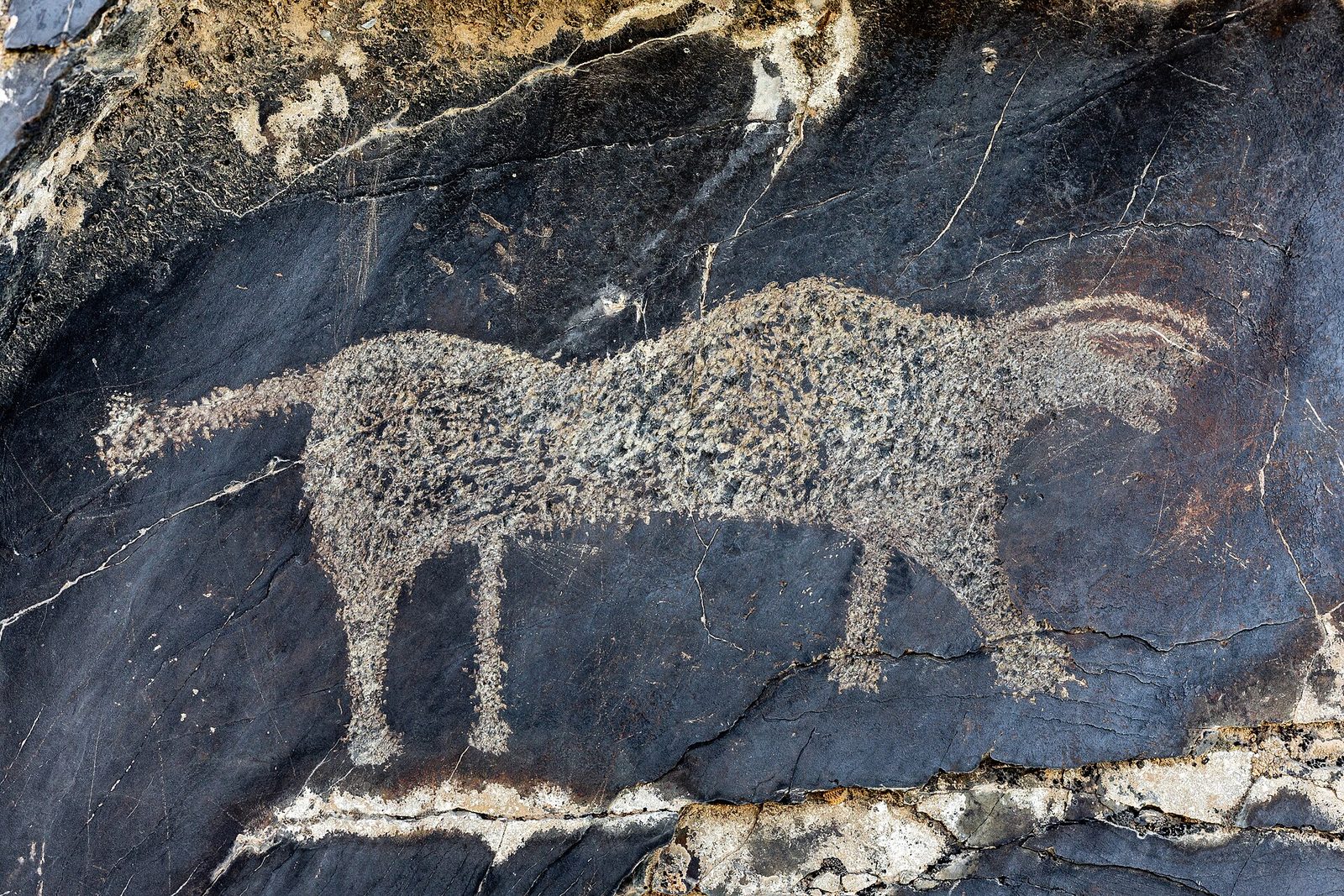
Thousands of years ago, someone in a narrow gorge north-east of today's Navoi pecked a wild bull into a dark rock and filled its body with a neat geometric pattern. The animal he drew vanished from Central Asia about three thousand years ago. The carving is still there, one of roughly ten thousand that make the Sarmysh Did you know? Mountain goats carved on rocks thousands of years ago Near the village of Khodjikent, about 70 km from Tashkent, more than 90 petroglyphs line the rocks above the Chirchik River, mostly mountain goats. The finest date from the 4th–3rd millennia BC. Read more → the largest gathering of rock art in Uzbekistan.
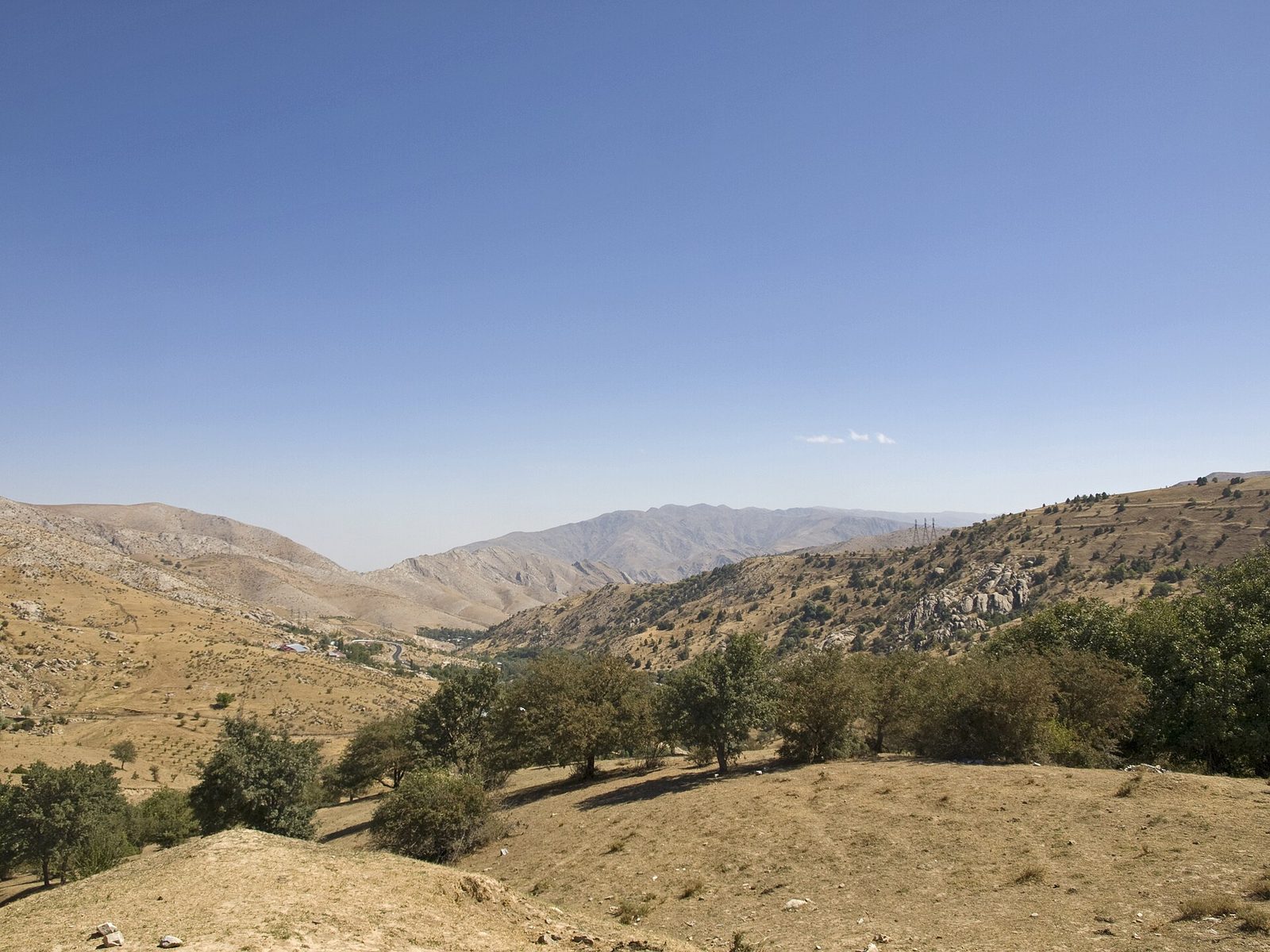
Sarmysh (also spelled Sarmishsay) lies about 40 km from Navoi, a short detour from the main road between Samarkand and Bukhara, yet most travellers drive past it without knowing. Here is how we plan the gorge for our guests: what you will see on the rocks, when the light is right, and what else is worth a stop along the same road, from an 11th-century royal caravanserai to a cistern that once held river water under a brick dome.
Ten thousand carvings in one gorge
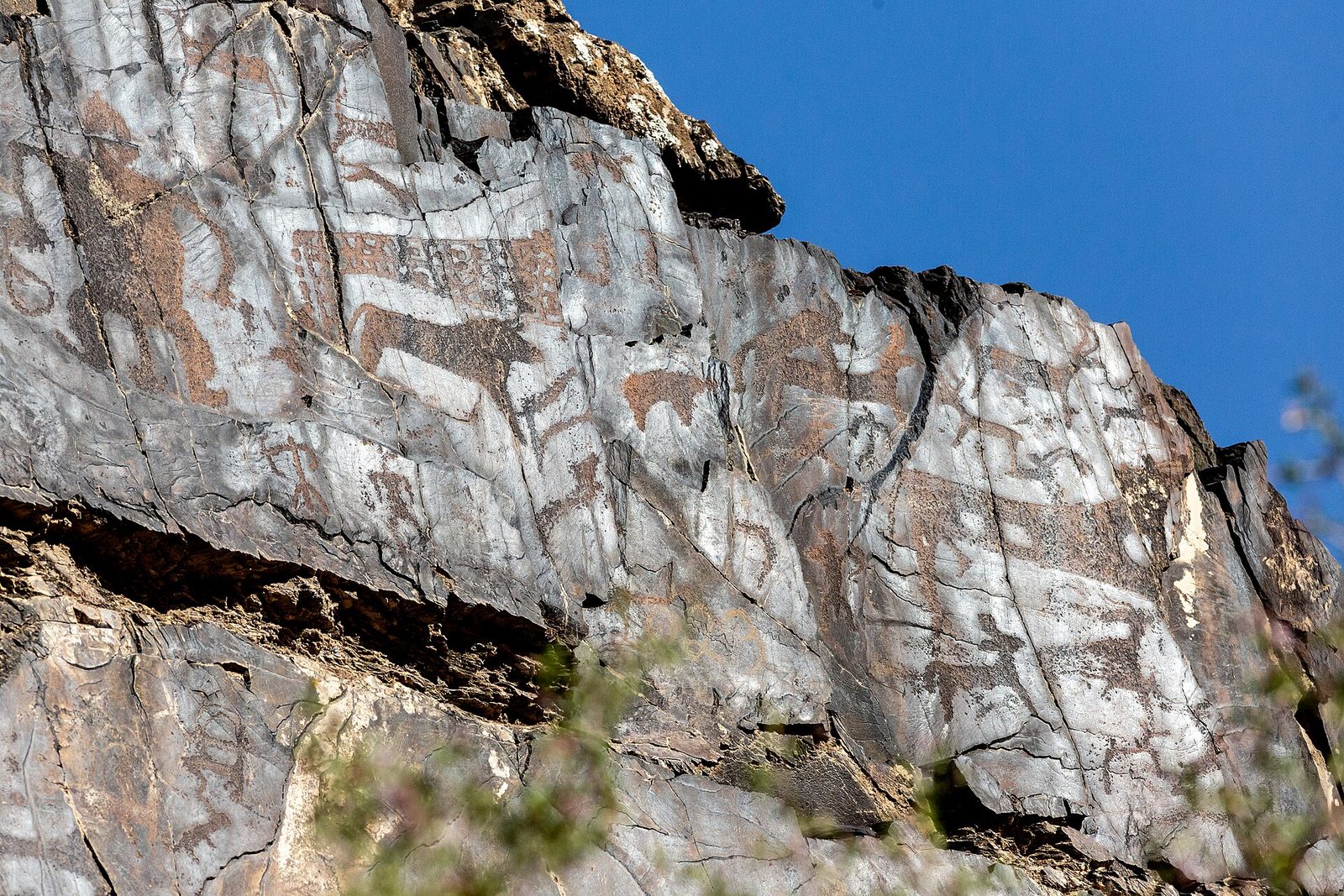
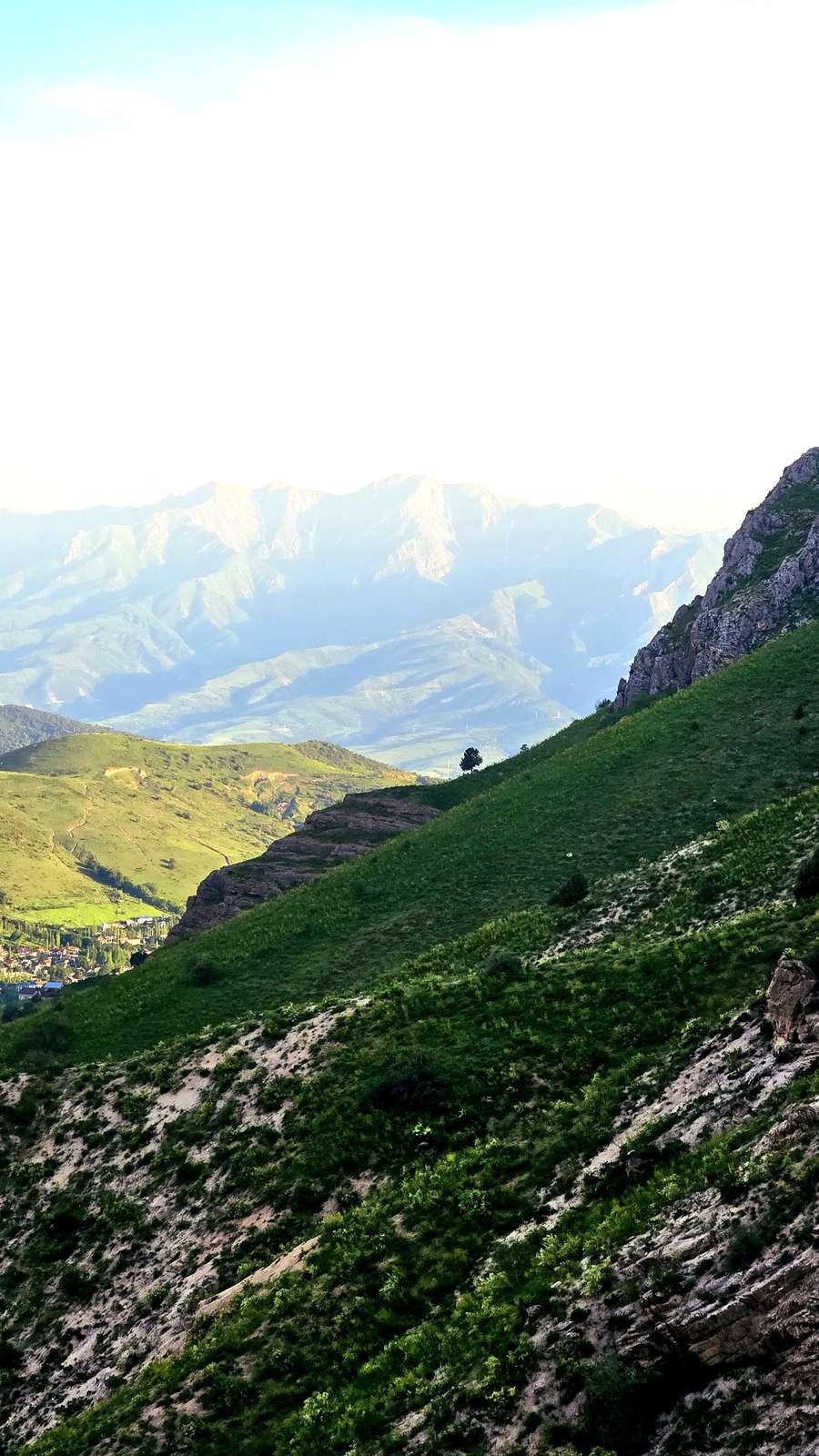
The Sarmysh stream has cut a gorge through the low Karatau mountains of the Navoi region, and the rock walls on both sides are dark, smooth and split into slabs, an ideal surface for carving. The drawings are grouped in two main sites along a gorge about 2.5 km long. Some panels hold a single animal; others, like the one above, are so crowded that later figures were cut over earlier ones.
The gorge is protected as a museum-reserve of about 5,000 hectares, first created in 2004 as a branch of the regional museum of history in Navoi and given the status of a state museum-reserve in 2019. Uzbekistan first placed Sarmysh on its UNESCO Tentative List in 2008, and in October 2024 submitted an updated entry that presents it as a mixed site, valued for both its rock art and its nature. The same text compares Sarmysh with Tamgaly in Kazakhstan and Saimaluu-Tash in Kyrgyzstan, the best-known rock art landscapes of the region.
The oldest layer: wild bulls
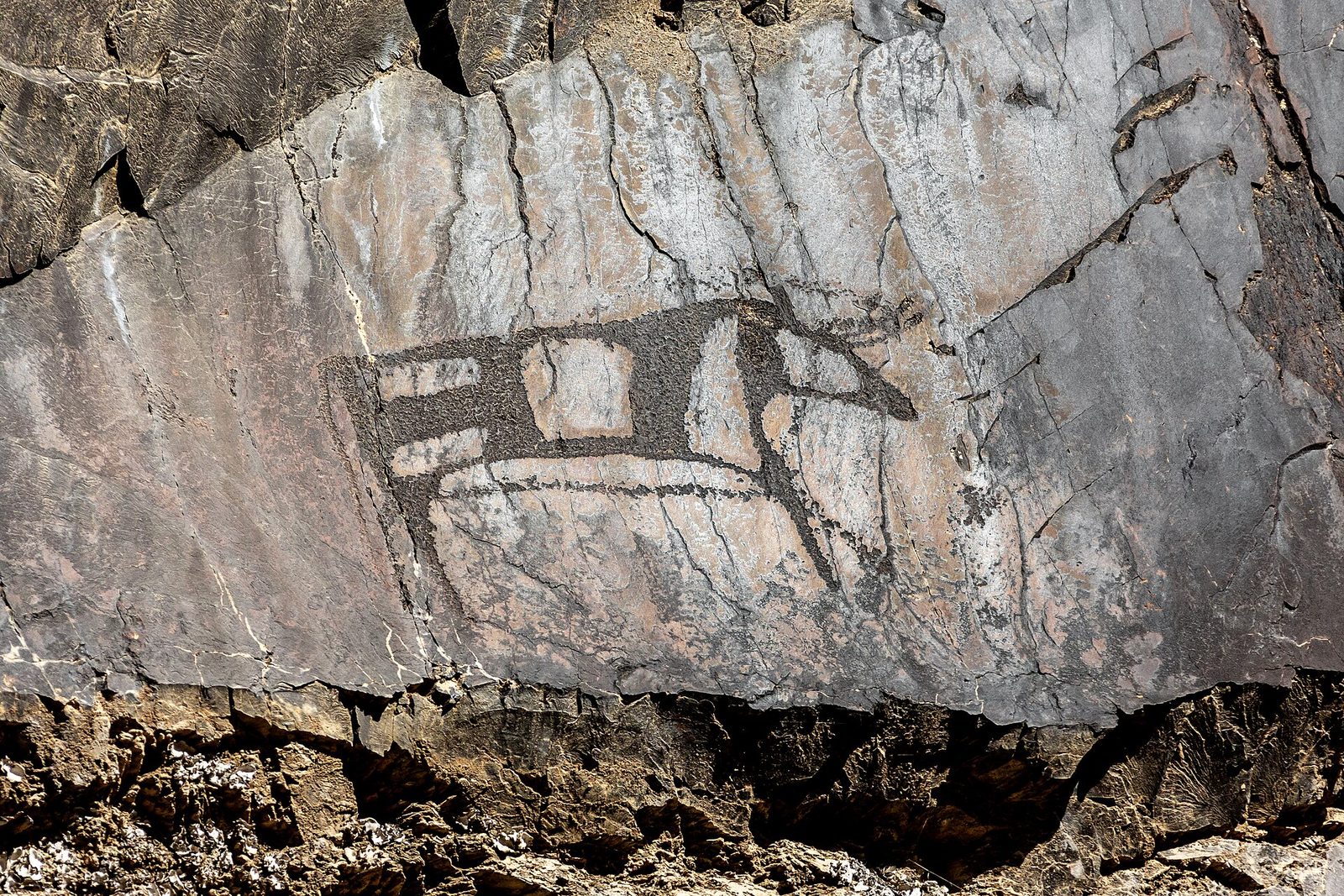
Most of the carvings date from the Bronze Age, roughly 3000–900 BC, but some motifs are older, going back to the Neolithic and beyond. The oldest recognisable subject is the wild bull, the aurochs. These bulls are usually 30–80 cm long and made in such a similar technique that researchers think many of them may be the work of a single master. Look for bodies filled with lines, triangles and grids: this ornamental style is one of those researchers single out at Sarmysh.
The bulls also work as a clock. Bones of wild bulls turn up in local excavations dated to the end of the 2nd millennium BC, and by the start of the 1st millennium BC the animals had disappeared from Central Asia. A rock that shows an aurochs was carved while people here still saw them alive.
Later layers: argali, riders and Arabic script
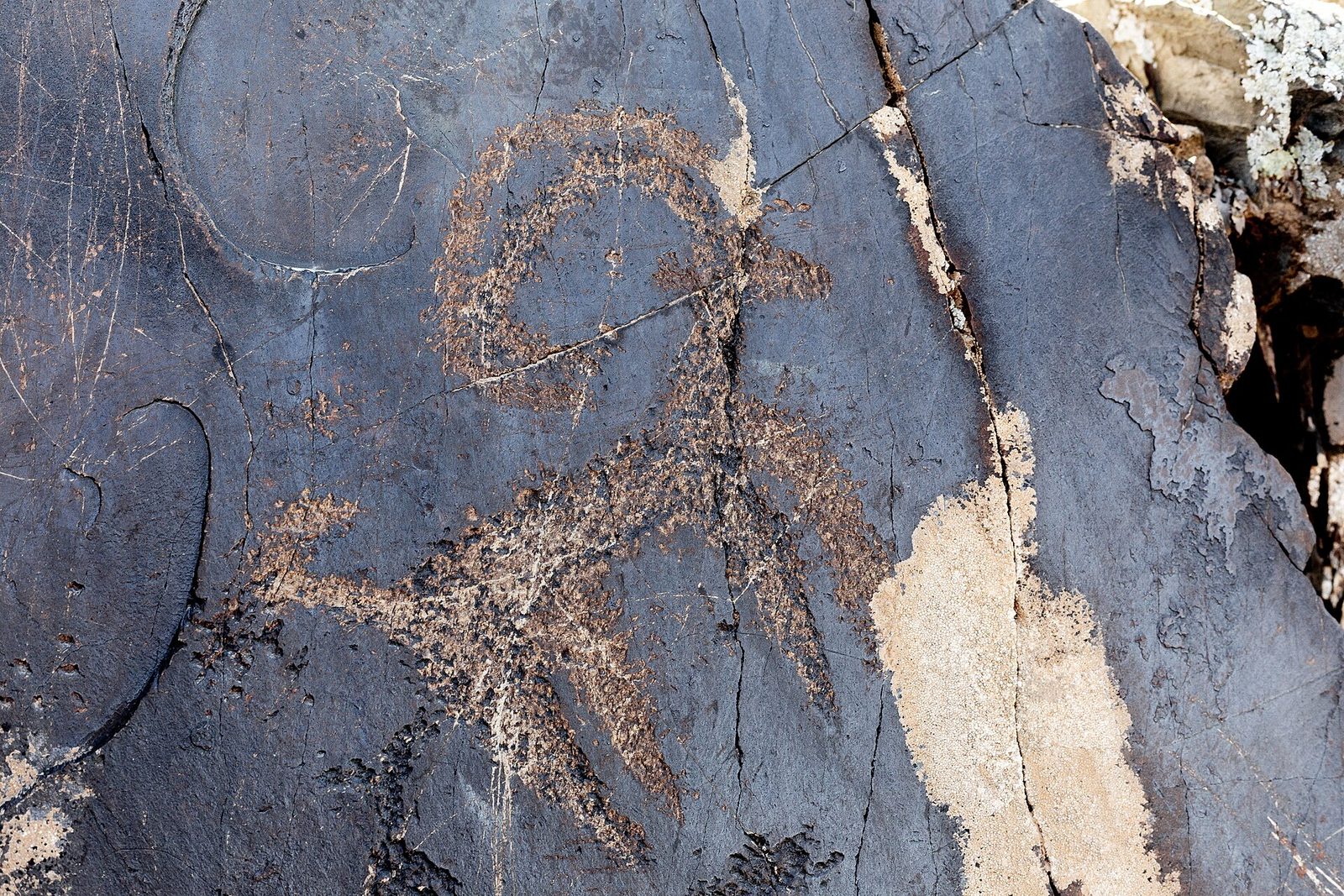
In the Early Iron Age the gorge was used by nomadic tribes of the Saka-Scythian world, and the pictures change with them. The bulls disappear; deer, argali, horses and camels take their place, drawn smaller and in the flowing "animal style" typical of the steppe. Bows and arrows appear, and so do horsemen and hunting scenes. Ibex and bulls are the most common subjects in the whole gorge, and argali with huge curled horns, like the one above, are easy to spot.
The latest carvings belong to the Middle Ages: domestic goats, camels and dogs, and inscriptions in Arabic script that are easy to date. Among the motifs you will also find the outline of an open five-fingered hand. Our guide helps you read the layers on the rock, from the bulls to the riders and the script, so that one panel becomes a timeline.
The gorge itself: water, flowers and 200 sites
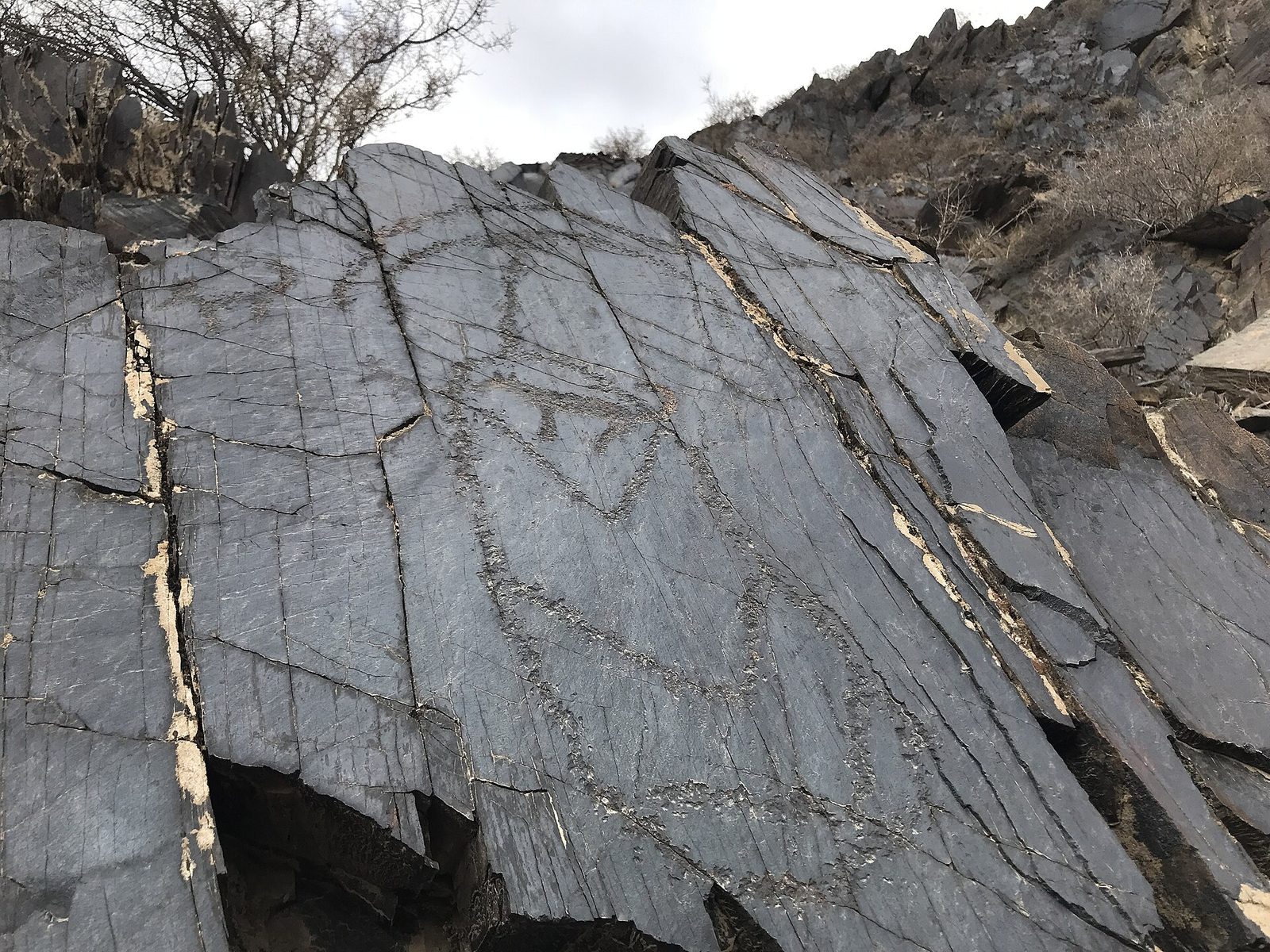
The carvings are only part of the story. Archaeologists have recorded more than 200 sites in and around the gorge: Stone Age camps, flint workshops and mines, burial mounds, the remains of ancient villages and irrigation canals. Water was the reason people kept coming back to the same place for thousands of years.
In spring the slopes turn green and the gorge is at its prettiest. More than 650 plant species grow in the area, 27 of them found only here. The reserve also protects animals listed in the Red Book of Uzbekistan, among them the black vulture and Severtzov's argali, the wild sheep that still lives in the Did you know? The Nuratau ridge protects a rare wild sheep The Nurata Nature Reserve was set up on the Nuratau ridge in 1975 to protect wild walnut groves and Severtsov's argali, an endemic wild sheep on the Red List. Golden eagles and bearded vultures are protected here too. Read more → mountains nearby. Walkways and viewing platforms keep visitors a step away from the rock; please do not touch or chalk the carvings.
Rabat-i Malik and the Malik sardoba
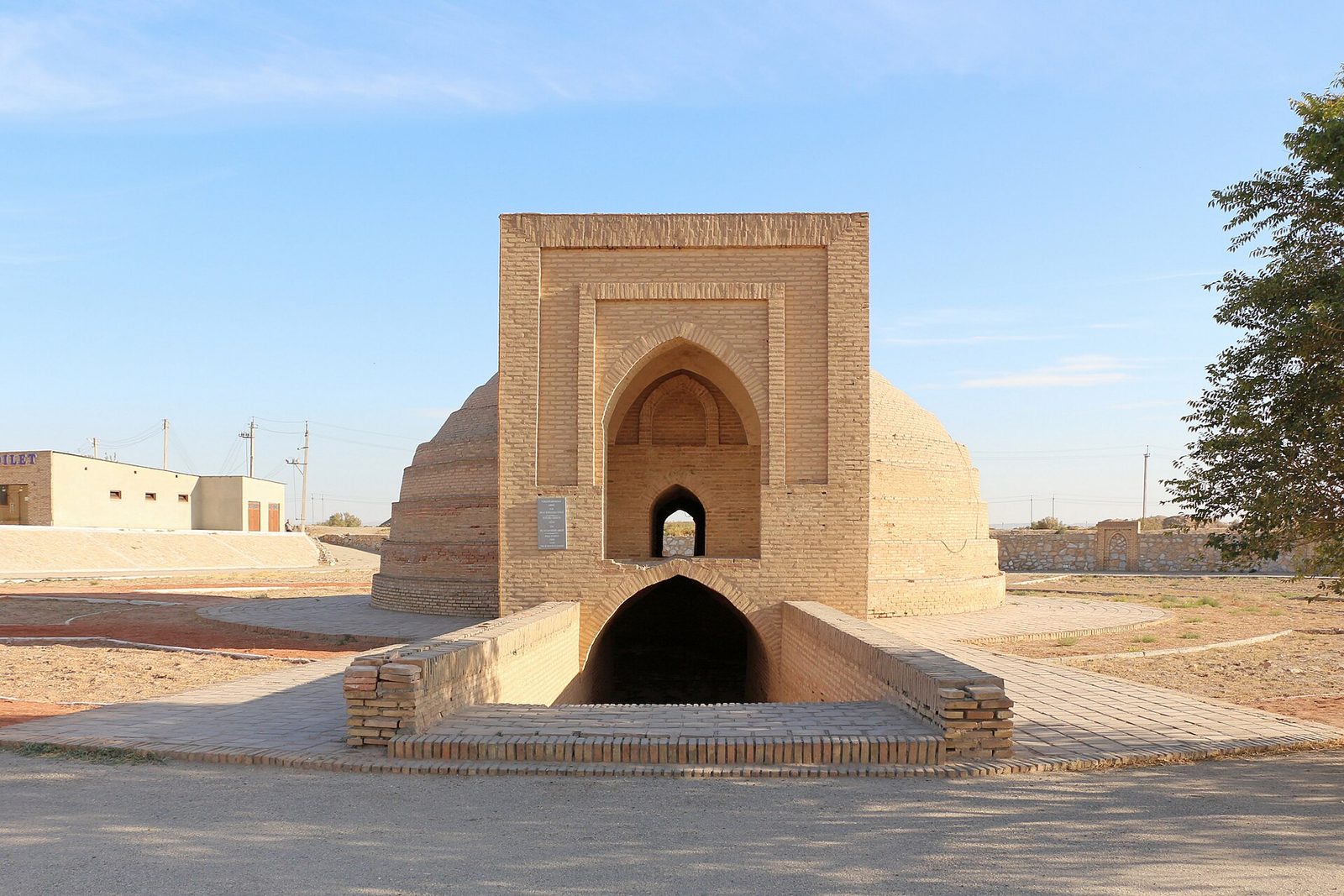
On the way back to the main road, stop at Rabat-i Malik, on the Bukhara road a short drive west of Navoi. It was built in the 1070s by the Karakhanid ruler Shams al-Mulk Nasr, who governed from Samarkand, and restored in the early 12th century. Researchers see it as a royal residence in the steppe as much as a roadside inn; it went on serving travellers until the early 18th century. Its tall brick portal still carries a Kufic inscription that praises the "Sultan of the World" for building a place of rest. In 2023 Rabat-i Malik became part of the UNESCO World Heritage site Silk Roads: Zarafshan-Karakum Corridor.
Local tradition, recorded by a traveller in the 19th century, remembered the ruin as the castle of a khan and his heirs, built, in one version, by a nomad chief called Malik Khan. It is a legend; the inscription and the historians point to the Karakhanids.
Across the road stands the sardoba, a covered cistern of the same period. The word comes from Persian and means "cold water". Water from the Zarafshan river reached it through an underground channel with wells along its line, and a stepped passage leads down under the dome, more than 10 m deep. If you are curious about other stories from the Bukhara oasis, our legends of Bukhara collect them.
Karmana, the old heart of Navoi
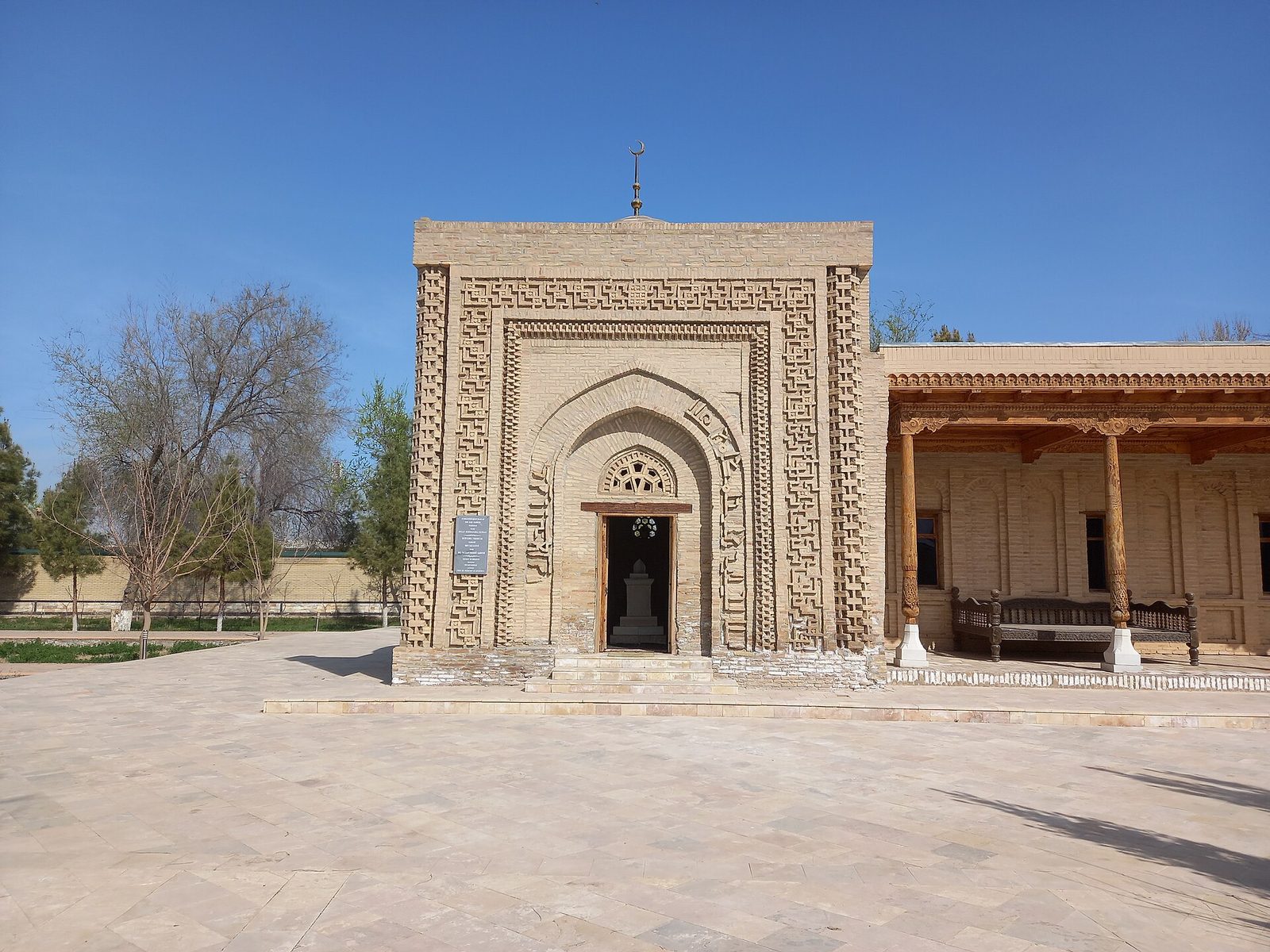
Navoi itself is a young city, founded in 1958 next to the old town of Karmana and named after the poet Alisher Navoi. Karmana is where its history lies. The small Mir-Sayid Bakhrom mausoleum, dated to the 10th–11th centuries, measures only about 4.5 by 4.4 m inside, but its brick portal is covered with patterns and a band of Quranic verses in Kufic script.
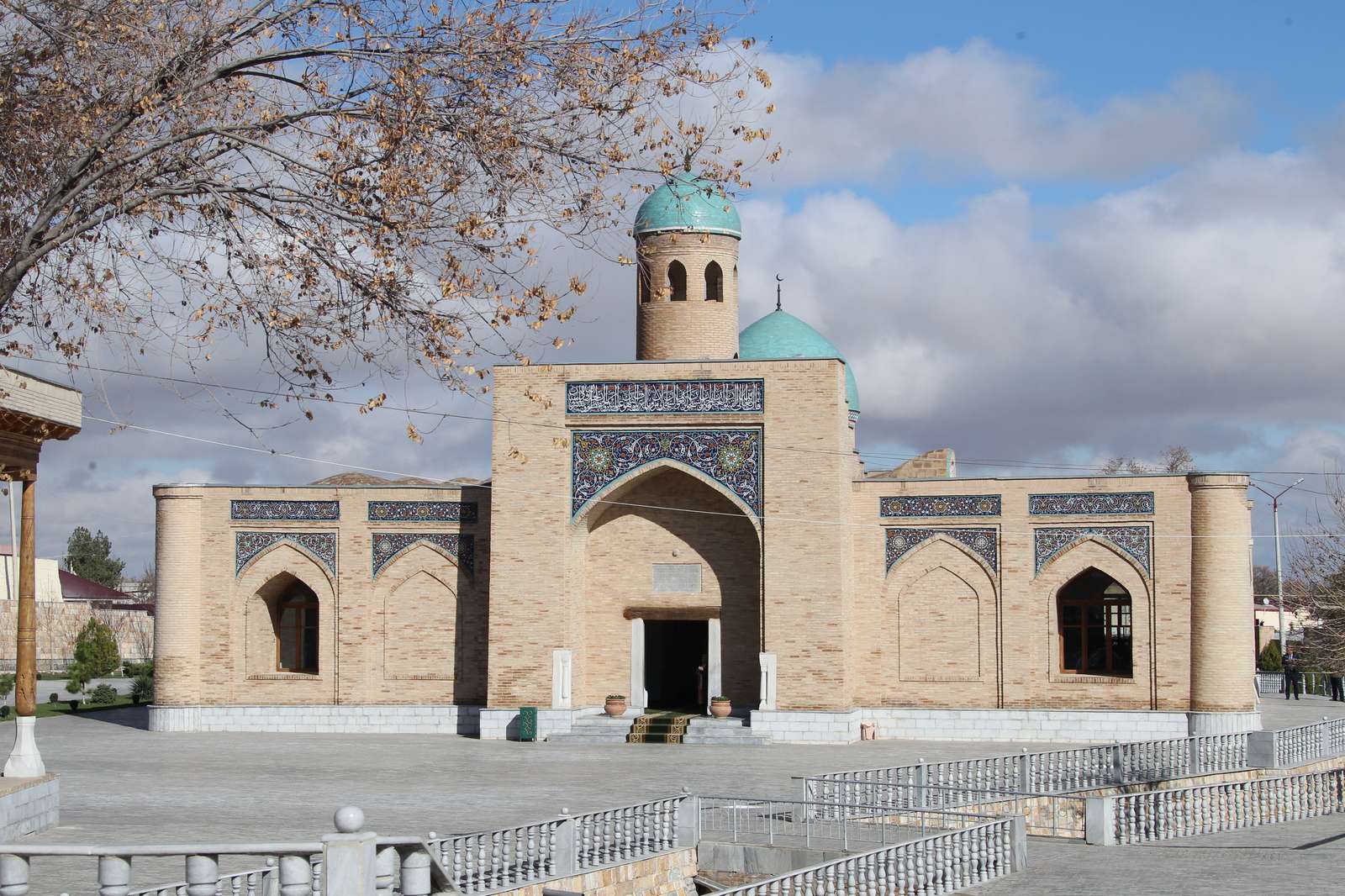
A few minutes away is the 16th-century complex of Kasim Sheikh, a revered Sufi master, with its domed khanaka, a hostel for pilgrims and dervishes. Both monuments belong to the same UNESCO Silk Roads listing as Rabat-i Malik. If you want to understand the custom of visiting holy places, our guide to ziyarat in Uzbekistan explains it. Allow 40 minutes for both.
Onward: Nurata and a night at Aydarkul
Sarmysh sits on the road from Navoi to ,Did you know? Legend credits Alexander with Nurata's underground canals Legend says Alexander the Great founded Nur in 327 BC and laid its kariz, underground channels with wells dug a few metres apart for cleaning. Whoever built them, parts of the kariz near Nurata still carry water today. Read more → so the gorge can just as well open a longer trip north. Nurata, about 50 km from Navoi, grew around a spring full of sacred fish. Legend says a glowing stone fell from the sky there and water rose where it struck; nur means "light". The facts and the legend are in our Nurata guide.
From Nurata the yurt camps on Lake Did you know? Aydarkul is a wetland of international importance In 2008 the Aydar-Arnasay lake system, about 527,000 ha, became a Ramsar site. It lies where two great bird flyways cross and shelters Dalmatian pelicans and the rare white-headed duck. Read more → are about 60 km further, in the :The Kyzylkum, or Red Sands: the desert between the Amu Darya and Syr Darya rivers that the road and the railway cross on the way to Khiva. a camel ride, dinner by the fire and a night in a felt yurt, described in our Aydarkul yurt camp guide. If you would rather sleep in a village, our Nuratau Mountains extension adds a night with a family in the mountains and a morning hike with a local guide, on the road between Bukhara and Samarkand.
Getting there, when to go and how long to stay
- From Navoi: about 40 km north-east, the last stretch on a country road up the stream bed. Uzbekistan's high-speed train: Tashkent to Samarkand in 2 hours 30 minutes, Tashkent to Bukhara in about 4 hours. Tickets are tied to your passport. Read more → fast trains between Tashkent and Bukhara stop at Navoi, so you can also start here by train.
- From Bukhara: about 140 km. A full day with Sarmysh, Rabat-i Malik and Karmana, back in Bukhara for dinner. More ideas for day trips are in our guide to day trips around Bukhara.
- From Samarkand: best as a stop on the way to Bukhara (the two cities are about 280 km apart by road). Book a transfer with a driver from Samarkand and ask us to add the gorge and Rabat-i Malik to the route. For trips that return to Samarkand the same day, see day trips around Samarkand.
- Time: 1.5–2 hours in the gorge, 30–40 minutes at Rabat-i Malik and the sardoba, 40 minutes in Karmana.
- When: April–May for green slopes and flowers, September–October for mild days. In nearby Navoi July afternoons average about 36 °C, and there is almost no shade on the rocks.
- Light: the carvings were pecked through the dark surface of the stone, so they read best when the sun is low and to the side. Aim for the morning or the late afternoon; at midday the panels look flat.
- What to bring: closed shoes for loose stones, a hat, water and a snack.
In short
- The Sarmysh petroglyphs are the largest rock art site in Uzbekistan: about 10,000 carvings, most from the Bronze Age.
- Look for three layers: patterned wild bulls, Saka-era argali and riders, and medieval goats, camels and Arabic script.
- The gorge is on Uzbekistan's UNESCO Tentative List; Rabat-i Malik, its sardoba and Karmana are already part of a World Heritage site.
- Go in spring or autumn, early or late in the day, for the best light on the rocks.
- Plan it as a stop between Samarkand and Bukhara, or as the start of a trip to Nurata and Aydarkul.
© Photos
- A large pecked bull on a dark rock face in the Sarmysh gorge, Navoi region — Relisa Granovskaya / Wikimedia Commons · CC BY-SA 4.0
- A rock face crowded with ancient carvings in the Sarmysh gorge, Navoi region — Relisa Granovskaya / Wikimedia Commons · CC BY-SA 4.0
- A bull with a geometric patterned body carved on a rock in the Sarmysh gorge — Relisa Granovskaya / Wikimedia Commons · CC BY-SA 4.0
- A wild mountain sheep with curled horns carved on a rock in the Sarmysh gorge — Relisa Granovskaya / Wikimedia Commons · CC BY-SA 4.0
- Dark slate slabs with carved outlines on a slope of the Sarmysh gorge — Alpasli / Wikimedia Commons · CC BY-SA 4.0
- The brick portal of the Mir-Sayid Bakhrom mausoleum in Karmana, Navoi — Jamshid Nurkulov / Wikimedia Commons · CC BY-SA 4.0