Programme and details
Tashkent · Samarkand · Shahrisabz · Bukhara · Khiva · 10 Days / 9 Nights · Private Tour
Tiles and Master Builders
Tashkent – Samarkand – Shahrisabz – Samarkand – Bukhara – Gijduvan – Bukhara – Khiva – Tashkent
The masters signed their work. On the portal of Did you know? Timur's tombstone went to Persia and came back The dark-green jade slab on Timur's grave in Gur-e-Amir was carried off by Nader Shah in 1740. It broke, and on his advisers' urging he sent it back to Samarkand. Read more → the mosaic carries the name of the builder, Muhammad ibn Mahmud of Isfahan; at Shah-i-Zinda two masters of Samarkand put their names in a portal niche; on the Did you know? Legend: gold was kneaded into Ak-Saray's first blocks Legend says the architect, in front of Timur, mixed gold from the treasury into the clay for the foundation blocks, then gave it all back: he only wished to be sure the ruler was truly committed to so costly a building. Work began in 1380. Read more → an inscription names Muhammad Yusuf Tabrizi. In ten days we read the buildings of the A network of caravan routes between China and the Mediterranean. Samarkand, Bukhara and Khiva grew rich as stops along it. with you, from the 10th-century brick of the Samanid Mausoleum to the tiled minarets of 19th-century Khiva: how carved terracotta, majolica and mosaic are made, what is old and what the restorers renewed, and where the craft lives on, in the Did you know? Paper polished with stone, made to last 400 years At the Meros mill in Konigil, founded in 1996 to revive a craft that had died out, a water wheel beats mulberry bark into pulp, and each sheet is polished for hours with agate, shell or horn. It is made to last some 400 years. Read more → of Konigil and the potteries of Gijduvan.
| Duration | 10 days / 9 nights |
| Price | on request |
| Format | Private, or a small group on your dates |
| Where | Tashkent, Samarkand, Shahrisabz, Bukhara, Gijduvan and Khiva |
| Getting around | Uzbekistan's high-speed train: Tashkent to Samarkand in about 2 hours 10 minutes, Tashkent to Bukhara in about 4 hours. Tickets are tied to your passport. Read more → high-speed trains Tashkent – Samarkand – Bukhara, the high-speed train Bukhara – Khiva, a flight Urgench – Tashkent; a car with driver for the stations and the day trips |
| Guide | A guide who speaks your language, Italian included; it is included in the price |
| Best time | April–May and September–October |
Ideal for travellers who come for the buildings: architects, restorers, lovers of art and ceramics, and guests from Italy who want the great monuments with time to look closely, timed to the Milan flights.
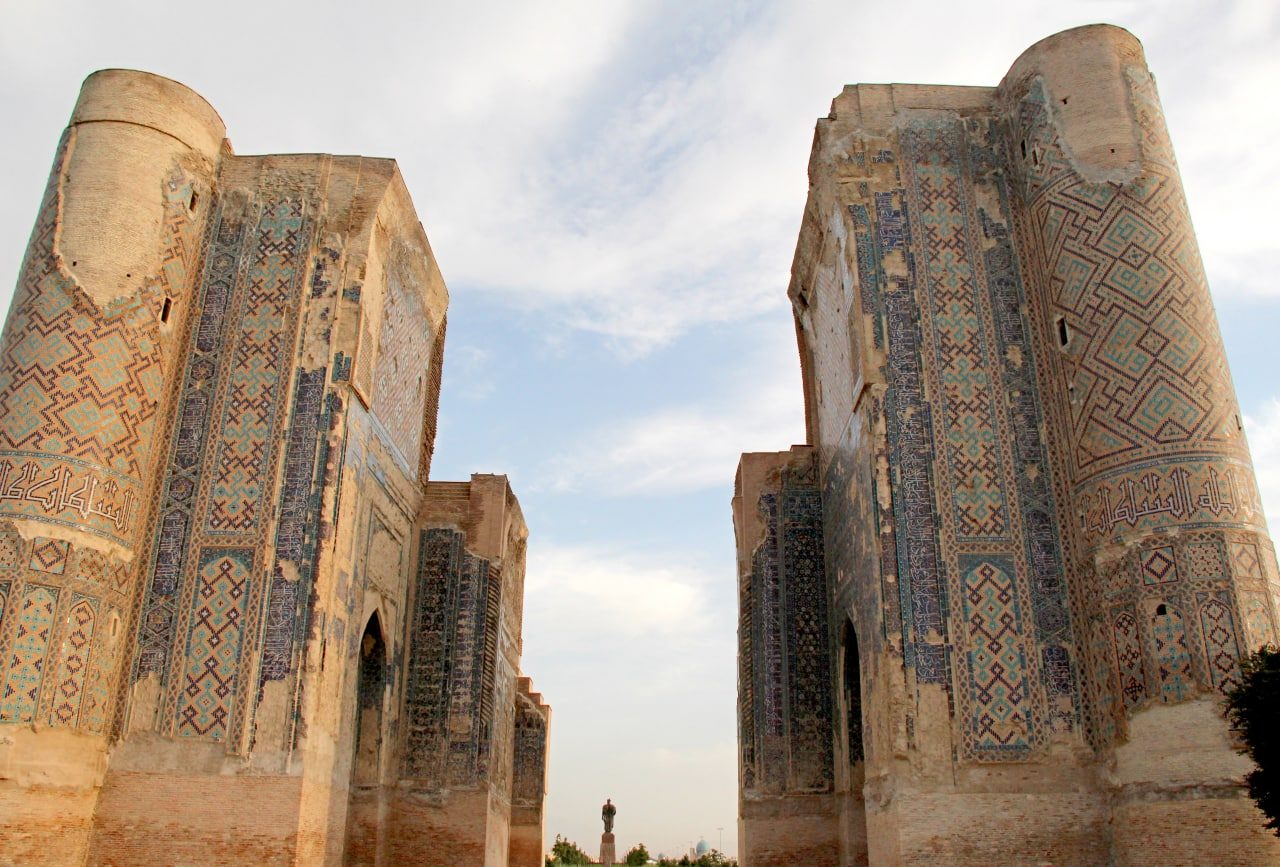
Ak-Saray — the towers of Amir Timur (Tamerlane, 1336–1405), founder of the Timurid empire, which had its capital in Samarkand. Born near Shahrisabz.’s gate in Shahrisabz, still about 38 metres high, with the blue glazed brick that an ambassador saw being laid in 1404.
Gijduvan — a family pottery where you see the whole process, from the clay to the kiln.
Itinerary
Day by Day
Day 1 · Tashkent — Arrival, the Museum of Applied Arts and the metro
Our driver meets you at Tashkent airport and takes you to your hotel. The flight from Milan lands at dawn, so we book your room from the night before on request, and you can sleep first.
In the afternoon your guide takes you to the .Did you know? A diplomat's house that became a museum of crafts In 1896 diplomat Alexander Polovtsev bought a merchant's house and had it rebuilt in the Central Asian style. Today it is the Museum of Applied Arts, with over 7,000 pieces of folk craft. Read more → In 1896 the diplomat Alexander Polovtsov bought a merchant’s house and had it rebuilt in the Central Asian style; the best masters of painting, woodcarving and carved ganch plaster decorated its rooms, and it has been a museum of crafts since 1937. Look up at the ceilings as often as into the cases: the building is part of a collection of more than 7,000 pieces of folk craft.
Then underground. The Did you know? A metro designed to ride out a magnitude-9 earthquake The three original lines of the Tashkent Metro were built to withstand an earthquake of magnitude 9.0, and the tunnels lie unusually shallow, only 8–25 m below the street. Read more → opened in 1977, the first in Central Asia. At Alisher Navoi station, domes rest on tapered columns, and turquoise ceramic reliefs show scenes from the poems of Navoi; at ,Did you know? A metro station where Ulugh Beg meets Gagarin Kosmonavtlar station, opened in 1984, has ceramic medallions of Ulugh Beg, Galileo, Icarus, Gagarin and Tereshkova, and glass stars in the ceiling that hint at the Milky Way. Read more → ceramic medallions line the walls.
Good to know: We check the museum’s opening days for your dates. If you land later in the day, the metro moves to the evening.
Overnight in Tashkent
Day 2 · Tashkent – Samarkand — The Registan and Gur-e-Amir
In the morning the Afrosiyob high-speed train takes you to Samarkand in about 2 h 10 min. The station is more than 6 km from the centre, and your car is waiting.
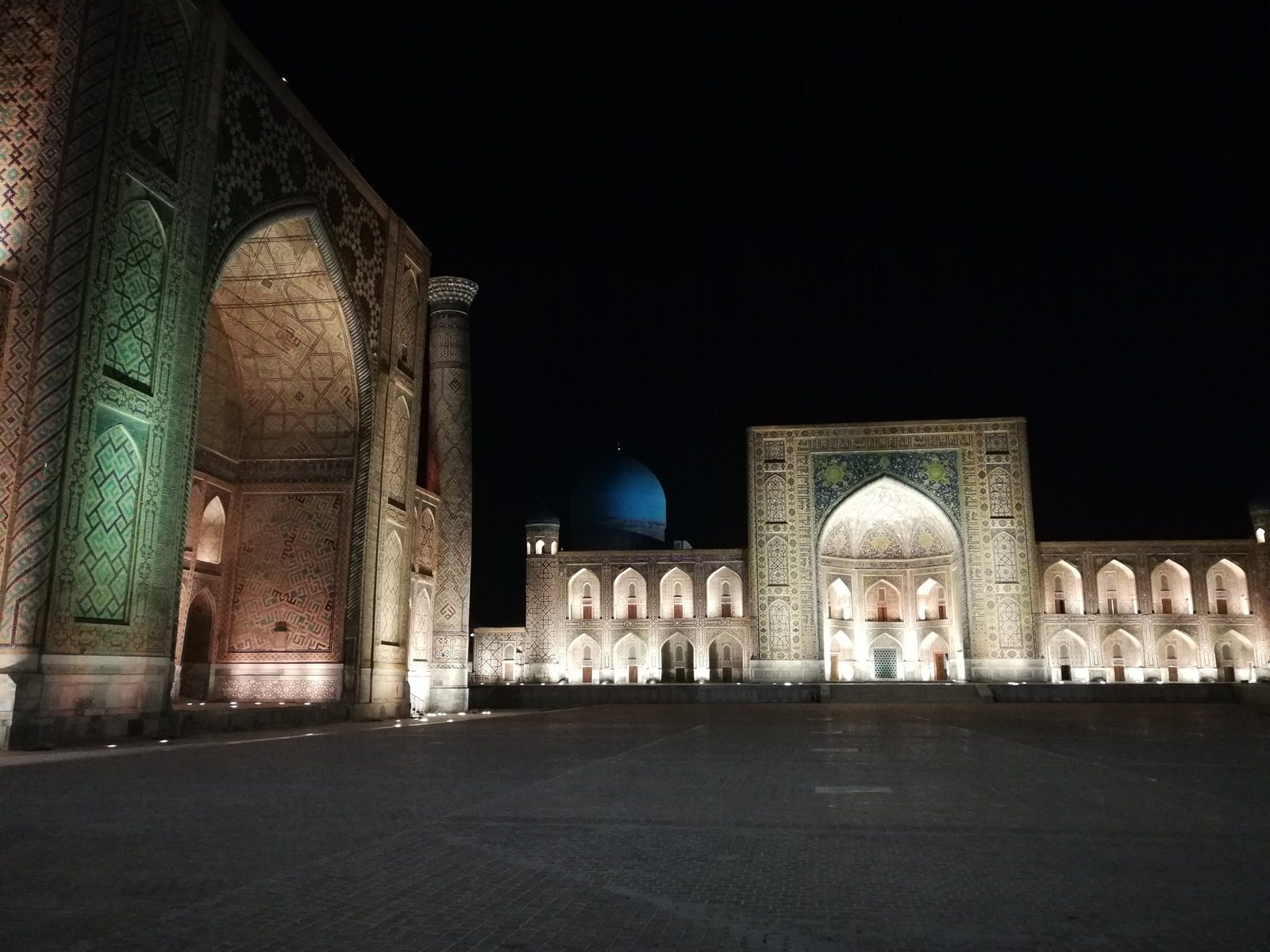
In the afternoon, the :Did you know? The Registan's sun-carrying lion went on a banknote The Sher-Dor Madrasah (1619–1636) is named for the big cats with the sun on their backs on its portal. The image appeared on the reverse of Uzbekistan's 200-som note of 1997. Read more → three madrasahs facing one square, Did you know? Ulugh Beg measured the year to within 25 seconds Working at his Samarkand observatory, Ulugh Beg put the tropical year at 365 days 5 h 49 min 15 s, about 25 seconds too long, closer than Copernicus a century later. Read more → (1417–1420), Sher-Dor (1619–1636) and Did you know? The 'gilded' mosque of the Registan Tilla-Kari, built in 1646–1660, means 'gilded'. With Bibi-Khanym in ruins, it served as Samarkand's main Friday mosque until the 1920s. Its prayer hall glows with kundal, relief painting finished in gold leaf, restored in 1979. Read more → (1646–1660). Over the gate of Sher-Dor, tigers chase deer under suns with human faces, a rare image in Islamic architecture. Inside Tilla-Kari, walls and dome are covered in kundal, painting in low relief finished with gold leaf on a deep blue ground; much of it is the work of restorers, completed in 1979, and an exhibition in the building tells the story of the restoration of the square.
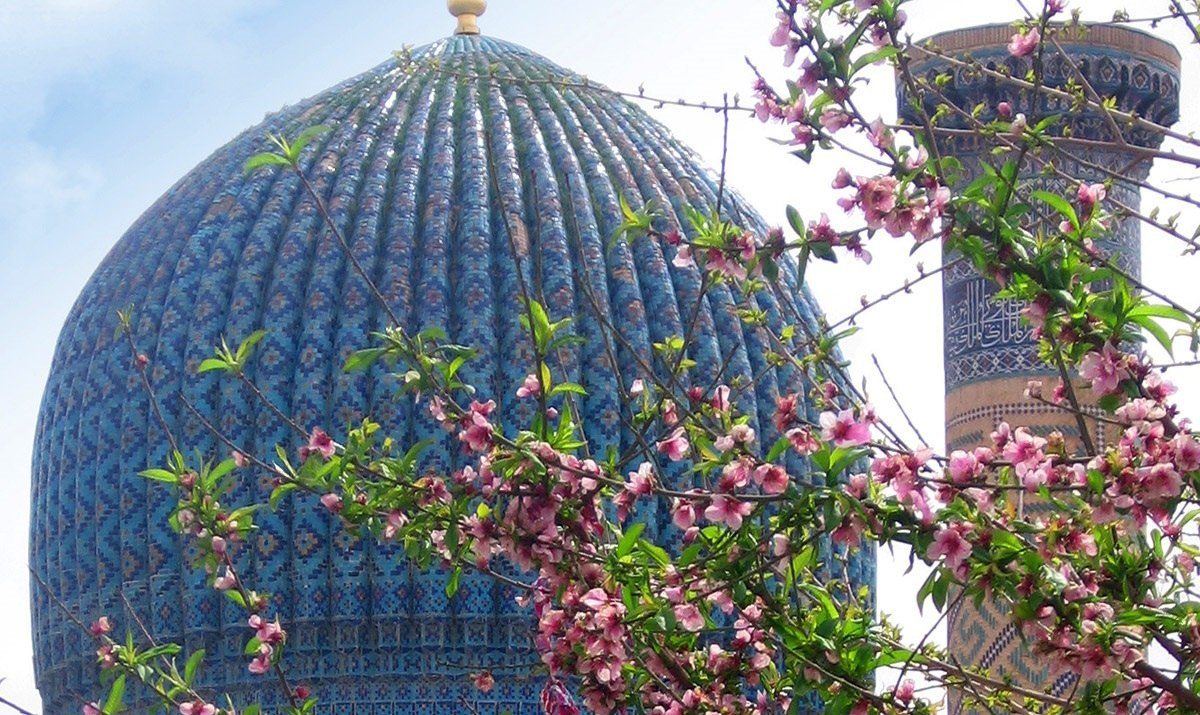
At the end of the day, Gur-e-Amir, the mausoleum of Timur, completed in 1404. Its portal mosaic carries the name of the builder, Muhammad ibn Mahmud of Isfahan. Inside, onyx panels line the lower walls, and above them relief ornament of papier-mâché, painted blue and gilded, makes the chamber glow.
Good to know: Afrosiyob seats sell out, so we book the tickets as soon as your dates are fixed; we need the passport details of every traveller. After dark, if you wish, we drive you to see the Registan lit up.
Overnight in Samarkand
Day 3 · Samarkand — Shah-i-Zinda, Bibi-Khanym and the paper of Konigil
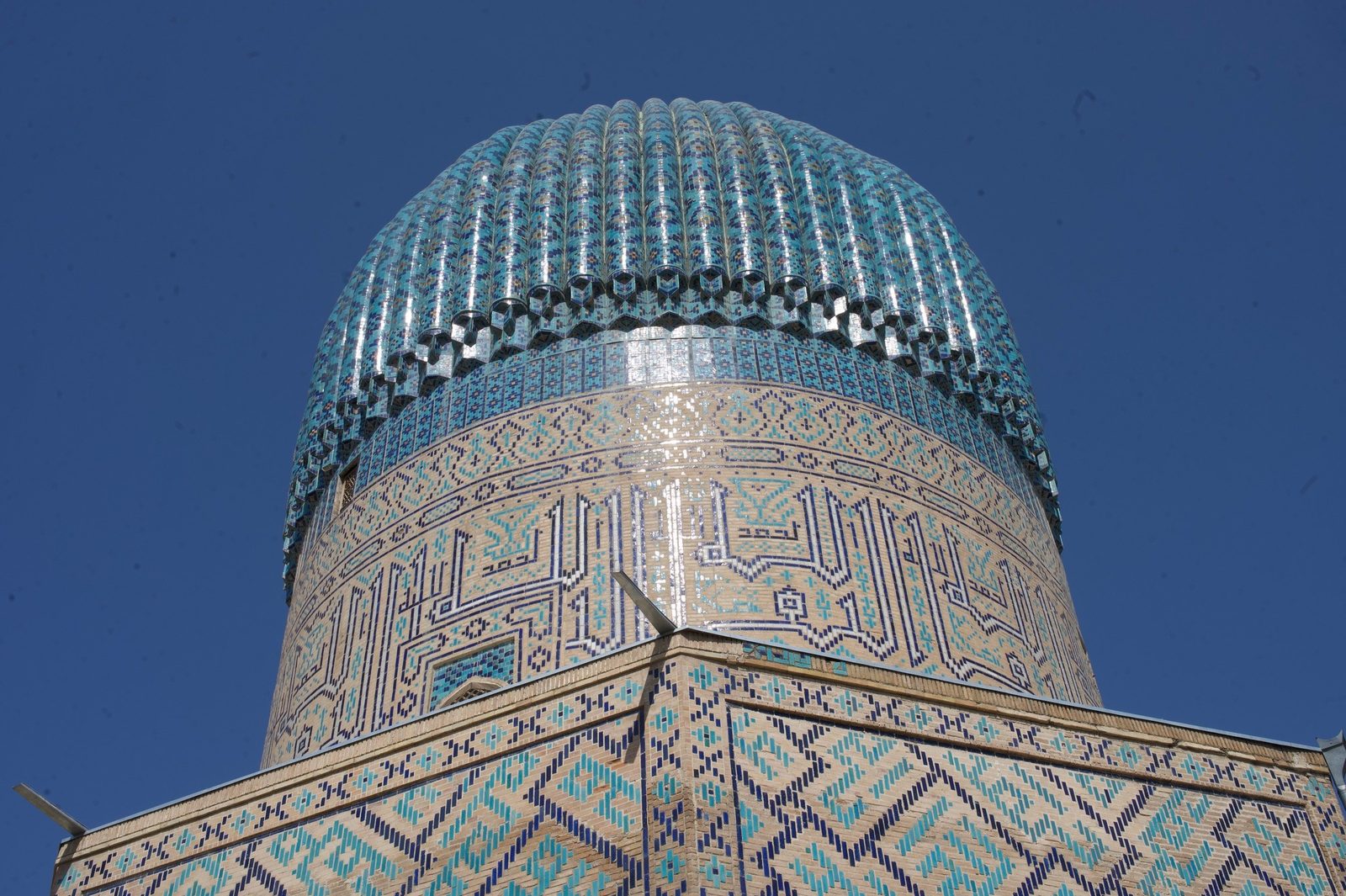
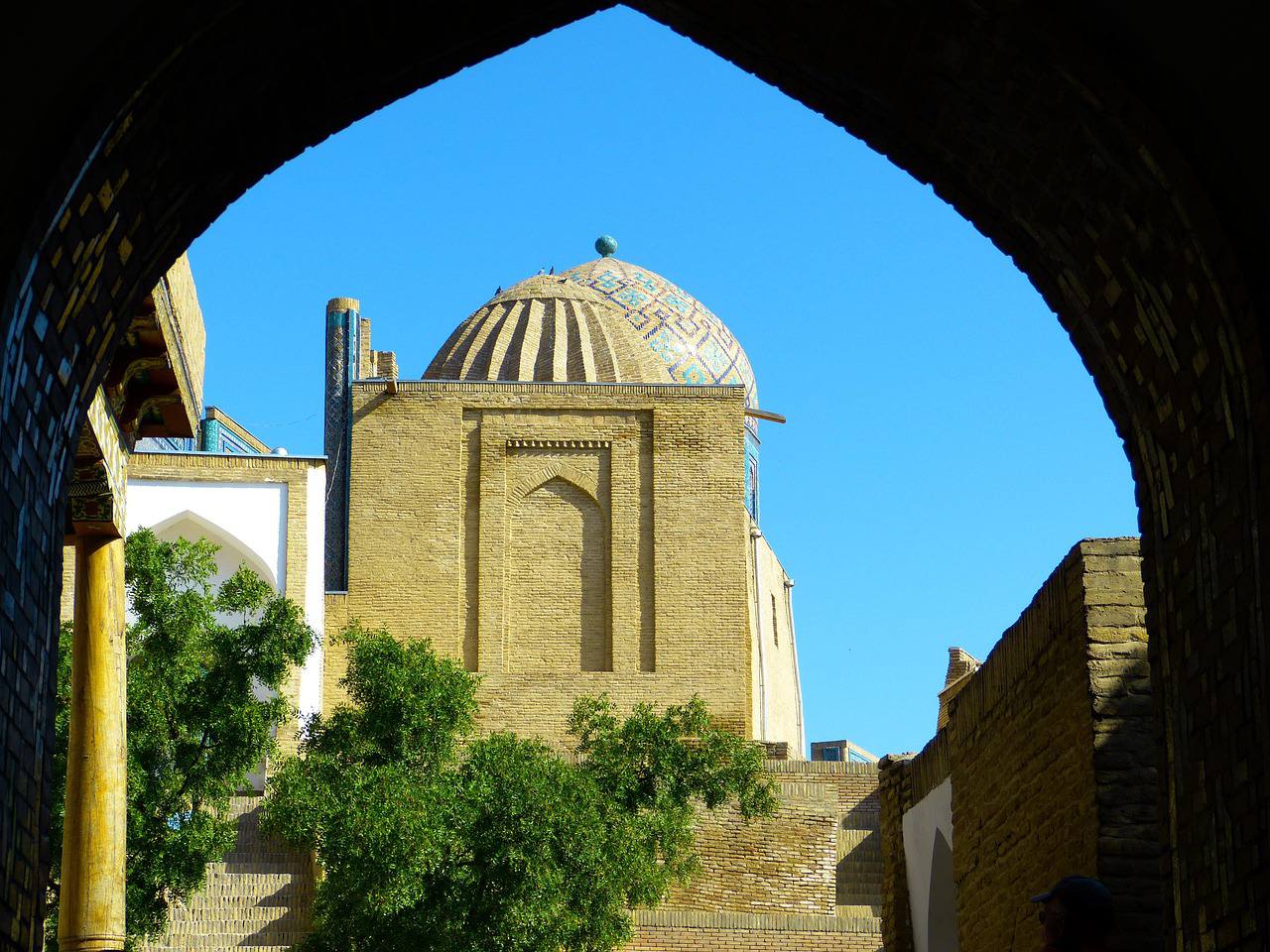
We go to Shah-i-Zinda in the morning, when the light on the tiles is soft. Along one short lane of mausoleums you find every technique of Timurid tilework: carved and glazed terracotta, where the pattern is cut deep into the clay before glazing; majolica, painted on the glaze, which covers almost the whole interior of the Shadi Mulk Aka mausoleum of 1372; and mosaic, tiles glazed in single colours and cut into small pieces. The masters signed their work: Shams ad-Din and Barr ad-Din of Samarkand in a portal niche, the potter Zayn ad-Din of Bukhara on the base of a carved column. The restoration of 2004–2005 replaced many old tiles; your guide shows you how to tell them apart: old tiles have softer colours, worn glaze and slightly uneven edges.
Then Timur’s Friday mosque of ,Did you know? Legend says the architect asked the queen for a kiss Legend says the architect of Bibi-Khanym would finish on time only for a kiss from Timur's wife, and Timur punished him. In fact the mosque was Timur's own project; his wife Saray Mulk Khanum built her madrasah across the road. Read more → built in 1399–1405 by craftsmen from India, Iran, Khorezm and the Golden Horde. On the towers of its gate, glazed and plain bricks form inscriptions in square Kufic script.
In the afternoon, Konigil, about 13 km from Samarkand. At the Meros mill, Did you know? Legend says Chinese prisoners taught Samarkand paper A legend recorded in the 11th century says Chinese prisoners taken at the Battle of Talas in 751 taught Samarkand to make paper. In fact paper was used here earlier, and the craft most likely came gradually along the Silk Road. Read more → is made from mulberry bark the way it was before the craft died out in the 19th century: the bark is soaked, boiled and beaten into pulp by wooden poles that a water wheel lifts and drops, and you lift a sheet out of the vat yourself. More in our article on Samarkand paper at Konigil.
Good to know: Shah-i-Zinda is a place of pilgrimage: cover shoulders and knees, and women bring a scarf. Before you go, read our guide to Shah-i-Zinda.
Overnight in Samarkand
Day 4 · Samarkand – Shahrisabz – Samarkand — The gate of Ak-Saray
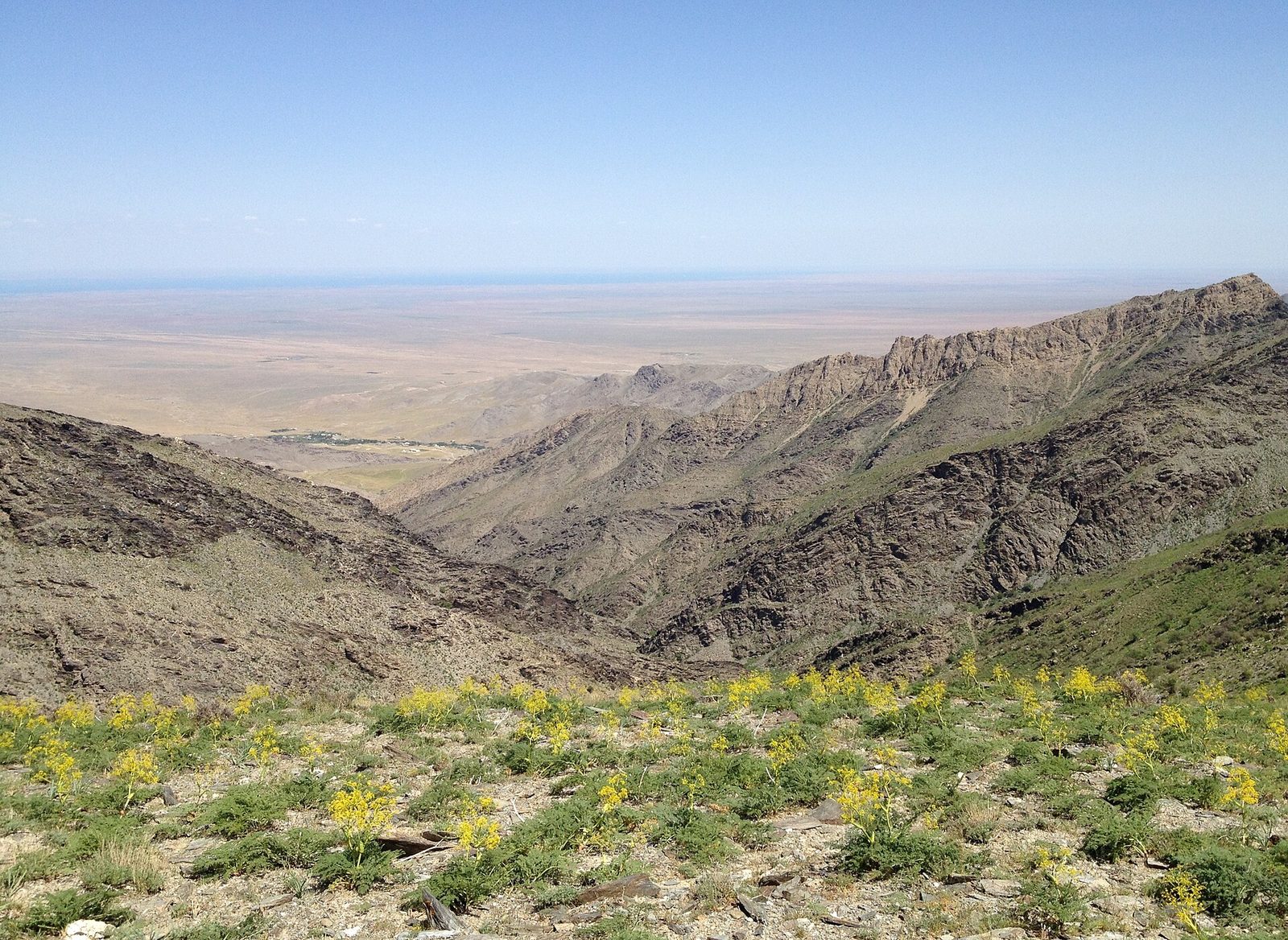
The road climbs over the Did you know? Legend: water once cascaded from a pool on Ak-Saray's roof Guides tell of a pool on the roof of Timur's White Palace, fed with water from the Takhtakaracha pass, from which streams poured down the façade. Nothing of the roof survives, so the story cannot be checked: only the gate pylons still stand. Read more → pass, at around 1,700 m, and in about 90 km, an hour and a half to two hours without stops, it brings you to Shahrisabz, Timur’s home town. Stop at the top of the pass for the view.
Ak-Saray, the ,Did you know? A Spanish ambassador saw Ak-Saray being built Ruy González de Clavijo, sent by King Henry III of Castile, visited Shahrisabz in 1404 and found Timur's palace, begun in 1380, still unfinished after more than twenty years of work. Read more → was begun in 1380. What survives is its gate: two towers that still rise about 38 metres, on either side of an arch of 22.5 metres, once the widest span in Central Asia. The builders were craftsmen brought from Khorezm, and one inscription in the tilework names a master, Muhammad Yusuf Tabrizi. In 1404 Ruy González de Clavijo, ambassador of the King of Castile, saw the work still going on and described walls panelled with gold and blue tiles. The gold has gone; look up, and the blue is still there, in geometric panels of dark and light blue glazed brick against plain brick.
Then a walk south through the park: ,Did you know? Kok Gumbaz's inscription likens its dome to the Prophet's tomb Ulugh Beg built Kok Gumbaz, the “Blue Dome”, in 1435 as Shahrisabz's Friday mosque, in the name of his father Shahrukh. The portal inscription compares its dome with the one over the Prophet's tomb in Medina, and Ulugh Beg's name stands out in gold. Read more → the Friday mosque that Ulugh Beg built in 1437, and the tomb of ,Did you know? Dorus Saodat began as a tomb for Timur's son Jahangir Timur's eldest son and heir Jahangir died in 1376 aged just twenty. Timur then began Dorus Saodat, the “Seat of Power”, as a burial place for the whole dynasty; Jahangir's mausoleum, the Hazrati Imam mosque and Timur's crypt survive. Read more → Timur’s eldest son, in Dorus Saodat. Back in Samarkand by evening.
Good to know: From December to March snow can close the pass for a while; the detour around the mountains takes about three hours one way, so we check the road the day before. The full story is in our article on Ak-Saray.
Overnight in Samarkand
Day 5 · Samarkand – Bukhara — The Afrosiyob and the brick of the Samanids
In the morning, the Afrosiyob to Bukhara, under 2 hours. Bukhara’s station is in Kagan, about 12 km from the old city; your driver meets you there.
In the late afternoon, when the side light brings out the pattern, the Samanid Mausoleum: a cube of baked brick of the 10th century, about ten metres a side. Large bricks carry the weight, and small ones, set in groups, make the ornament: basketweave, chequerboard, rosettes. Because the bricks stand at different depths, the pattern shifts as the sun moves.
A few minutes away, ,Did you know? A cone-shaped dome over Job's spring Chashma-Ayub, 'Job's Spring', has a conical dome in the Khorezm style, rare in Bukhara. Legend says Job struck the ground with his staff and water flowed; inside is a museum of Bukhara's water supply. Read more → whose conical dome, common in Khorezm and rare in Bukhara, is put down to Khorezmian masters. Then the Did you know? The famous columns of Bolo-Hauz are barely a century old The Bolo-Hauz mosque opposite the Ark was completed in 1712, but its best-known feature, the tall, slender carved columns along the front of the iwan, was added only in 1917, together with the small minaret of 1916–1917. Read more → mosque, where in 1917 master Shirin Muradov added the porch on twenty slender wooden columns, 12 metres tall, with carved and painted stalactite capitals.
Good to know: More in our article on the Samanid Mausoleum and Bolo-Hauz.
Overnight in Bukhara
Day 6 · Bukhara — Poi Kalyan, the trading domes and the phoenixes of Lyabi-Hauz
In the morning, ,Did you know? Legend: the minaret's foundation was laid with camel milk Legend says master Bako laid the foundations of the Kalyan minaret with ganch plaster mixed with camel milk, then vanished for two years to let them harden, and only then built the tower. Locals still show a grave they say is his. Read more → where the Did you know? Diggers went 13 m down and never found its base The Kalyan Minaret of 1127 rises about 46 m, and an excavation reached 13 m without finding the bottom of its foundations. Genghis Khan reportedly ordered it spared. Read more → of 1127 stands between the Kalyan Mosque and the Did you know? A madrasah still teaching after almost 500 years Mir-i-Arab, built in the 1530s opposite the Kalyan Mosque, was one of only three Islamic schools that kept working through the Soviet period, and it still trains students today. Read more → .An Islamic college: student cells and classrooms around a courtyard behind a grand portal. In the old towns many now house museums and craft workshops. Look at its brick: band after band of a different pattern, all of baked brick. When the Venetian merchants Niccolò and Maffeo Polo, Marco’s father and uncle, spent three years in Bukhara in the 1260s, the minaret had already stood for more than a century.
Then the Did you know? Engineers pulled a leaning minaret back upright By 1920 a minaret of the Ulugh Beg Madrasah on the Registan was tilting. In 1932 engineer Vladimir Shukhov straightened it; the second minaret was set upright in 1965. Read more → of 1417, the oldest preserved in Central Asia, and the Did you know? Under Bukhara's domes merchants changed money and gold Four 16th-century trading domes still stand over old crossroads. Toki Sarrafon was the money changers' dome, where merchants from India and China swapped coins; Toki Zargaron held jewellers' workshops, Toki Telpak Furushon sold caps. Read more → of the 16th century, built over the old merchant crossroads.
In the afternoon, ,Did you know? Bukhara's ponds were once its water supply Pools like Lyabi-Hauz, dug around 1620 and 46 × 36 m, were the city's main source of water. Most were filled in during the 1920s–30s because they spread disease; Lyabi-Hauz survived. Read more → the square around a pond of about 1620. On the portal of the Did you know? A caravanserai that became a madrasah by a khan's word Nadir Divan-Begi built his 1622 building by Lyabi-Hauz as a caravanserai. At the opening Imam Quli Khan praised it as a fine madrasah, and a khan's word could not be taken back: a portal and cells were added, and a madrasah it became. Read more → two simurghs, the phoenix-like birds of Persian legend, fly towards a sun with a human face, each carrying a white deer in its claws. Living creatures are rare in the tilework of Central Asian madrasahs; you saw their cousins, the tigers of Sher-Dor, in Samarkand.
Good to know: In the evening we can arrange dinner as guests of a local family (on request).
Overnight in Bukhara
Day 7 · Bukhara – Gijduvan – Bukhara — The potters of Gijduvan
Gijduvan is about 45 km north-east of Bukhara, a working town with its own school of ceramics: flower ornament combined with geometric patterns. In the town’s best-known family workshop the sixth generation of potters is at work, and their museum holds ceramics from many centres of Central Asia. You see the whole process, from the clay to the kiln, and then sit at the wheel or paint a plate with a master, subject to the master’s schedule.
In Gijduvan also stands the small madrasah that Ulugh Beg built in 1433, the third and last of his madrasahs after Samarkand and Bukhara. Lunch is in town.
In the afternoon, back in Bukhara, free time in the old town, or ,Did you know? Legend: four towers for four world religions? Chor Minor, a gatehouse of 1807, has four towers, each decorated differently. Guides say they stand for four world religions and look for a cross, a fish and a prayer wheel in the decor; others say four dynasties. All are interpretations. Read more → the gatehouse with four towers, each crowned by a blue dome.
Good to know: Ask the workshop to wrap your plates well and carry them in your hand luggage.
Overnight in Bukhara
Day 8 · Bukhara – Khiva — The high-speed train and the Kalta Minor
In the late morning, the high-speed Jaloliddin Manguberdi stops in Bukhara on its way from Tashkent to Khiva and reaches Khiva at about half past two, some 3 h 30 min later. Your driver takes you and your luggage to a hotel inside or right by .Did you know? People still live inside Khiva's museum city Itchan Kala packs more than 50 historic monuments and about 250 old houses inside clay walls 8–10 m high and 5–6 m thick, and families still live and work in its lanes. Read more →
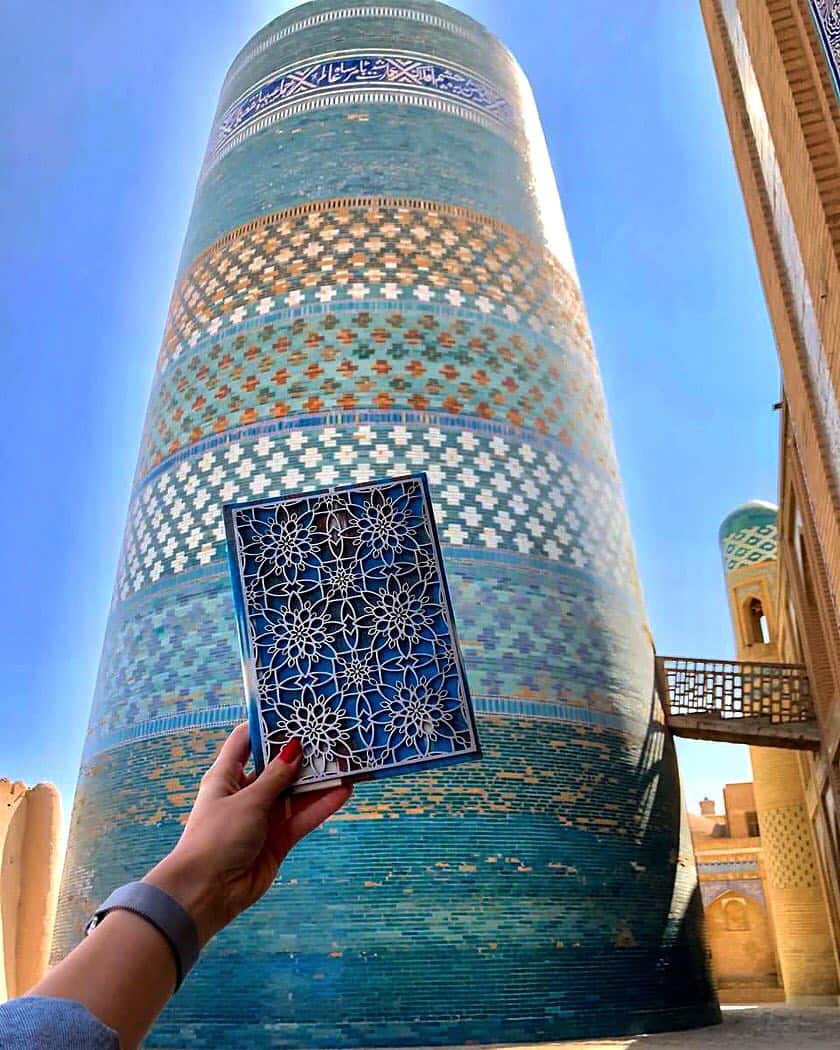
In the afternoon, the ,Did you know? A 14-metre-wide base for a tower that stopped at 29 m Kalta Minor was begun in 1852 and meant to reach 70–80 m, but work halted in 1855 at about 29 m when its khan died. It is said to be the only minaret covered entirely in glazed tiles. Read more → begun in 1852 and never finished: 29 metres tall and 14.2 metres across, and the only minaret covered entirely in glazed tiles, in bands of turquoise, green and white. Its inscriptions carry verses by the Khivan poet Ogahi; some were lost and were put back during the restoration for Khiva’s 2,500th anniversary in 1997. Then the ,Did you know? In the khan’s courtyard a round platform waited for a yurt The Kunya-Ark, the khans’ citadel, had its own mint, arsenal and harem. In the courtyard of its reception hall of 1804–1806 stands a round platform: a yurt was set up on it, and there the khan received envoys of the steppe nomads. Read more → the khans’ citadel, with its reception hall of 1804–1806 lined with blue and white tiles.
Good to know: This train does not leave Tashkent on Sundays, so this day of the tour never falls on a Sunday. The low sun turns the tiles of the Kalta Minor turquoise.
Overnight in Khiva
Day 9 · Khiva – Tashkent — Tash Hovli, the Juma Mosque and the evening flight
In the morning, ,Did you know? In Tash-Hauli's harem each of four wives had her own loggia Allakuli Khan built the Tash-Hauli palace in 1830–1838 around three courtyards. In the harem four tall loggias belonged to the khan's four wives and a fifth, the largest, to the khan himself; behind each summer terrace lay a winter room. Read more → the palace of Allakuli Khan of the 1830s, with more than 260 rooms. The blue and white tiles of its courtyards are the work of the master Abdullah Jin, and the wooden ceilings are painted red and yellow.
Around noon, the ,Did you know? Khiva's Juma Mosque stands on 212 wooden columns Recorded as early as the 10th century and rebuilt in 1788, the Juma Mosque has no portal and no domes: its flat roof rests on 212 carved columns in 17 rows, and some of them are older than the building itself. Read more → when light falls through the openings in its roof onto 212 carved wooden columns; carved dates on doors and columns run from 1316 to 1789. Then the mausoleum of ,Did you know? Legend: a wrestler freed captives with a single cowhide Legend says Pahlavan Mahmud won a bout in India and asked to free as many fellow Khorezmians as would fit in a cowhide. He cut it into one long thin strip and encircled them all. The real Mahmud, a poet and wrestler of around 1300, is Khiva's patron saint. Read more → whose double dome, the largest in Khiva, is covered in turquoise tiles, and the Did you know? Khiva's tallest minaret is barely a century old The Islam Khoja Minaret was begun in 1908, near the very end of the khans' era. At 56.6 m it is one of the tallest in Central Asia; a spiral stair of 175 steps leads up to its windowed top. Read more → of 1908–1910, at 56.6 metres the tallest in Khiva, banded in blue, white and green tiles.
In the late afternoon, the transfer to Urgench airport, about 30 km away, and the flight to Tashkent, about 1 h 20 min to 1 h 30 min. Your driver meets you in Tashkent.
Good to know: Pahlavan Mahmud is a place of pilgrimage: cover shoulders and knees, women bring a scarf, and keep your voice down. More in our guide to Itchan Kala.
Overnight in Tashkent
Day 10 · Departure — Home or onward
A free morning, then the transfer to the airport for your flight home. The flight to Milan leaves in the afternoon, so there is time for a last walk; our guide to Tashkent in 1 or 2 days has ideas.
Before the trip, read our article on Uzbekistan tours from Italy: flights, Entry rules depend on your passport. Once you are here, each stay must be registered within three days, and hotels do it for you; customs and registration rules are in our guide. Read more →-free entry, the 2027 holidays and money.
Accommodation
Where you stay
| City | Stay |
|---|---|
| Tashkent | A comfortable hotel, 1 night + 1 night |
| Samarkand | A comfortable hotel, 3 nights |
| Bukhara | A comfortable hotel, 3 nights |
| Khiva | A comfortable hotel, 1 night |
We confirm the hotels for your dates before booking.
Price
Price
The price is given on request: it depends on the dates, the hotels, the train classes and the size of your group.
Good to know
Conditions
- The best months are April–May and September–October. From June to August afternoons in Bukhara reach about 37 °C; in summer we start early and keep the middle of the day for lunch and shade.
- Your guide speaks your language, Italian included, and that is included in the price. Tell us the language you need when you book, ideally well in advance.
- Citizens of Italy can stay in Uzbekistan for up to 30 days without a visa (rules as of October 2026). We check the current entry rules for your passport before booking.
- With the Milan flights on Tuesdays and Fridays, the tour runs from Wednesday to Friday. If you arrive on a Saturday, we add a night, or plan your return through Istanbul.
- At the mausoleums and mosques, cover shoulders and knees; women bring a scarf, and shoes come off on the carpets.
- Train tickets go on sale 60 days before departure and sell out; tickets need the full name and passport number of every traveller.
- Read before you go: our article on Uzbekistan tours from Italy and our guides to the Registan and the Kalta Minor and Islam Khoja.
- Reservations are confirmed with passport copies only.
Cancellation policy
| Cancellation timing | Penalty |
|---|---|
| 21 days before the service | 20% |
| 20–7 days | 50% |
| 6–0 days | 100% |
Transportation
| Vehicle | Group size |
|---|---|
| Chevrolet Cobalt | 2 pax |
| Hyundai Starex | 3–4 pax |
| Toyota Hiace / King Long | 5–8 pax |
| Mercedes Sprinter | 9–14 pax |
Vehicles may differ in make and colour.
🌿 Responsible tourism: we allocate part of our profits to good causes and are preparing for GSTC certification.
Expert opinion
Pluses
- Architecture you learn to read: brick, carved terracotta, majolica and mosaic, explained on ,Did you know? Why Shah-i-Zinda means 'the Living King' The necropolis grew around the shrine of Qutham ibn Abbas, a cousin of the Prophet Muhammad. Legend says he did not die in battle but went down a deep well to a garden of paradise, where he lives on. Read more → ,Did you know? Ak-Saray's gate arch spanned 22 metres Only the pylons of the portal of Timur's White Palace survive, yet they still stand about 38 m high. The vault that once joined them spanned 22 m, and the facade glows with ochre and blue glazed brick. Read more → the Did you know? Buried in mud, this tomb escaped Genghis Khan The 10th-century Samanid Mausoleum, one of the oldest monuments of Islamic Central Asia, was covered by flood mud and sand before the Mongols came in 1220. Hidden for centuries, its brick lacework survived intact. Read more → and the minarets of Khiva.
- The names of the masters: signatures from Isfahan, ,Did you know? Ak-Saray's tiles bear the name of a master from Tabriz A tile-mosaic moulding on Ak-Saray's portal records the name of Muhammad ibn Yusuf al-Tabrizi. Craftsmen came from many lands: work began in 1380, right after Timur took Khorezm, and many masters from Urgench worked here. Read more → Samarkand and Bukhara, and what the restorers renewed.
- The crafts alive: mulberry paper in A village near Samarkand where paper is made by hand from mulberry bark, the old way, at a working mill on the stream. and painted ceramics in Gijduvan, with time at the workshops.
Minuses
- Four hotel changes: five cities in ten days, with one night in Khiva.
- Hot in summer: from June to August afternoons in Bukhara and Khiva reach about 37 °C.
- Meals mostly extra: only breakfasts are included; lunches, dinners and drinks are paid on site.
AroundCA numbers
How we counted
By the AroundCA programme: we count only what is written in the day-by-day programme of this tour. If the programme gives no figure, we show nothing.
- Hotel changes
- 4
- Walking
- Medium
Walking: Medium: walks through the old towns of Samarkand, Shahrisabz, Bukhara and Khiva, without long hikes.
Best time
Apr–May, Sep–Oct
April–May and September–October: comfortable days for walking the old towns and soft light on the tiles.
Better to avoid
Jun–Aug
June to August: afternoons in Bukhara and Khiva reach about 37 °C.
A typical day
On day 3 you walk the lane of Shah-i-Zinda in the soft morning light and learn to tell carved terracotta from majolica and mosaic, and old tiles from new. Then the Bibi-Khanym mosque, and in the afternoon you lift a sheet of mulberry paper out of the vat at Konigil.
What the price includes
What is included
- Meeting at Tashkent airport and all transfers on the programme
- Accommodation: 9 nights with breakfast (Tashkent 2, Samarkand 3, Bukhara 3, Khiva 1)
- Train tickets: the Afrosiyob Tashkent – Samarkand and Samarkand – Bukhara, the high-speed train Bukhara – Khiva
- The flight Urgench – Tashkent
- A private car with driver for the stations, the airports and the trips to Konigil, Shahrisabz and Gijduvan
- A local guide in every city on the programme, speaking your language
- Entrance tickets on the programme, a metro ride on day 1, the paper mill in Konigil and the pottery in Gijduvan
Not included
- International flights to and from Tashkent
- Lunches, dinners and drinks
- An early check-in or a room from the night before (on request)
- Dinner with a local family in Bukhara (on request)
- Photo and video fees at the sites
- Tips and personal expenses
Extra cost on site
- Lunches, dinners and drinks
- An early check-in or a room from the night before (on request)
- Dinner with a local family in Bukhara (on request)
- Photo and video fees at the sites
- Tips and personal expenses
Good for
- Architects, restorers and lovers of art who want to look closely at the buildings
- Travellers who enjoy ceramics and crafts and want to see the workshops at work
- Guests from Italy: the tour runs from Wednesday to Friday, to fit the Milan flights
Maybe not for you if
- Travellers who want mountains and nature: this is a city and heritage route
- Anyone who wants a slow week in one place: there are four hotel changes
- Summer trips: from June to August afternoons in Bukhara reach about 37 °C
Questions about this tour
How much does the tour cost?
The price is given on request: it depends on the dates, the hotels, the train classes and the size of your group.
Do Italian citizens need a visa?
No: Italian citizens can stay in Uzbekistan for up to 30 days without a visa, with a passport that has at least three months of validity left. That is the rule as of October 2026; we check it for every booking, and details are in our article on <a href="/blog/uzbekistan-tours-from-italy/">Uzbekistan tours from Italy</a>.
Is there a guide who speaks Italian?
Yes: your guide speaks your language, Italian included, and that is included in the price. Tell us when you book, ideally well in advance.
How does the tour fit the flights from Milan?
Uzbekistan Airways flies from Milan Malpensa on Tuesdays and Fridays in winter 2026/27 and lands in Tashkent at dawn. The tour starts on Wednesday morning and ends on Friday, when the flight back leaves in the afternoon. If you arrive on a Saturday, we add a night or plan your return through Istanbul.
Can we try the crafts ourselves?
Yes, subject to the masters’ schedule: at the Meros mill in Konigil you lift a sheet of paper out of the vat, and in Gijduvan you can sit at the wheel or paint a plate. For more workshops, add our five-day <a href="/tours/crafts-of-bukhara-and-samarkand-tour/">crafts of Bukhara and Samarkand</a> tour.
Can we add the Savitsky Museum in Nukus?
Yes. From Khiva it is a natural extension: our <a href="/tours/karakalpakstan-khorezm-fortresses-tour/">Karakalpakstan tour</a> adds the desert fortresses of Khorezm and the Savitsky Museum, whose paintings were shown in Florence and Venice in 2024.
Didn’t find your answer? Ask about this tour →
Make it your trip
Tick what you’d like to add — it goes into your request, and the manager confirms the final price.
Add a few days
Arrival, departure, transfers
© Photos
Carved glazed terracotta panel on the portal of the Shadi Mulk Aka mausoleum, Shah-i-Zinda, Samarkand — Jean-Pierre Dalbéra / Wikimedia Commons · CC BY 2.0; Glazed brick mosaic on a pylon of the Ak-Saray portal, Shahrisabz — Jean Housen / Wikimedia Commons · CC BY-SA 4.0