
 Deutsch
 English
 Español
 Français
 Italiano
 Polski
 Português
 Suomi
 Svenska
 Türkçe
 Ελληνικά
 Български
 Русский
 עברית
 한국어
 中文
 日本語
Programme and details
Uzbekistan · 12 Days / 11 Nights · Group Photo Tour
Uzbekistan Photo Tour
Tashkent – Samarkand – Bukhara – Khiva – Tashkent
Some places photograph themselves. Others ask for time, light and someone who knows where to look. Uzbekistan is one of the latter. In twelve days you will travel through the four cities that shaped the :A network of caravan routes between China and the Mediterranean. Samarkand, Bukhara and Khiva grew rich as stops along it. turquoise domes, tiled madrasahs, bazaars beneath brick vaults and an entire city inside its walls. We take care of trains, flights, hotels and timing. You take care of the camera.
| Duration | 12 days / 11 nights |
| Price | on request |
| Cities | Tashkent – Samarkand (UNESCO) – Bukhara (UNESCO) – Khiva (UNESCO) – Tashkent |
| Getting around | High-speed train Tashkent – Samarkand – Bukhara, train Bukhara – Khiva, flight Urgench – Tashkent |
Ideal for photographers, architecture lovers and first-time travellers to Central Asia.
Samarkand — the ,Did you know? The Registan's sun-carrying lion went on a banknote The Sher-Dor Madrasah (1619–1636) is named for the big cats with the sun on their backs on its portal. The image appeared on the reverse of Uzbekistan's 200-som note of 1997. Read more → the Did you know? Timur's tomb was built for his grandson Gur-e-Amir was begun in 1404 for Muhammad Sultan, Timur's grandson and chosen heir. Timur had a crypt ready in his home town of Shahrisabz, but when he died in 1405 he was laid in Samarkand, in the tomb meant for the young prince. Read more → and .Did you know? 95 elephants hauled stone for Timur's great mosque Bibi-Khanym, begun in 1399 after Timur took Delhi, was the largest mosque of his empire. Some 200 stonecutters worked on site and 95 elephants brought from India hauled the loads; the courtyard was meant to hold 10,000 people. Read more →
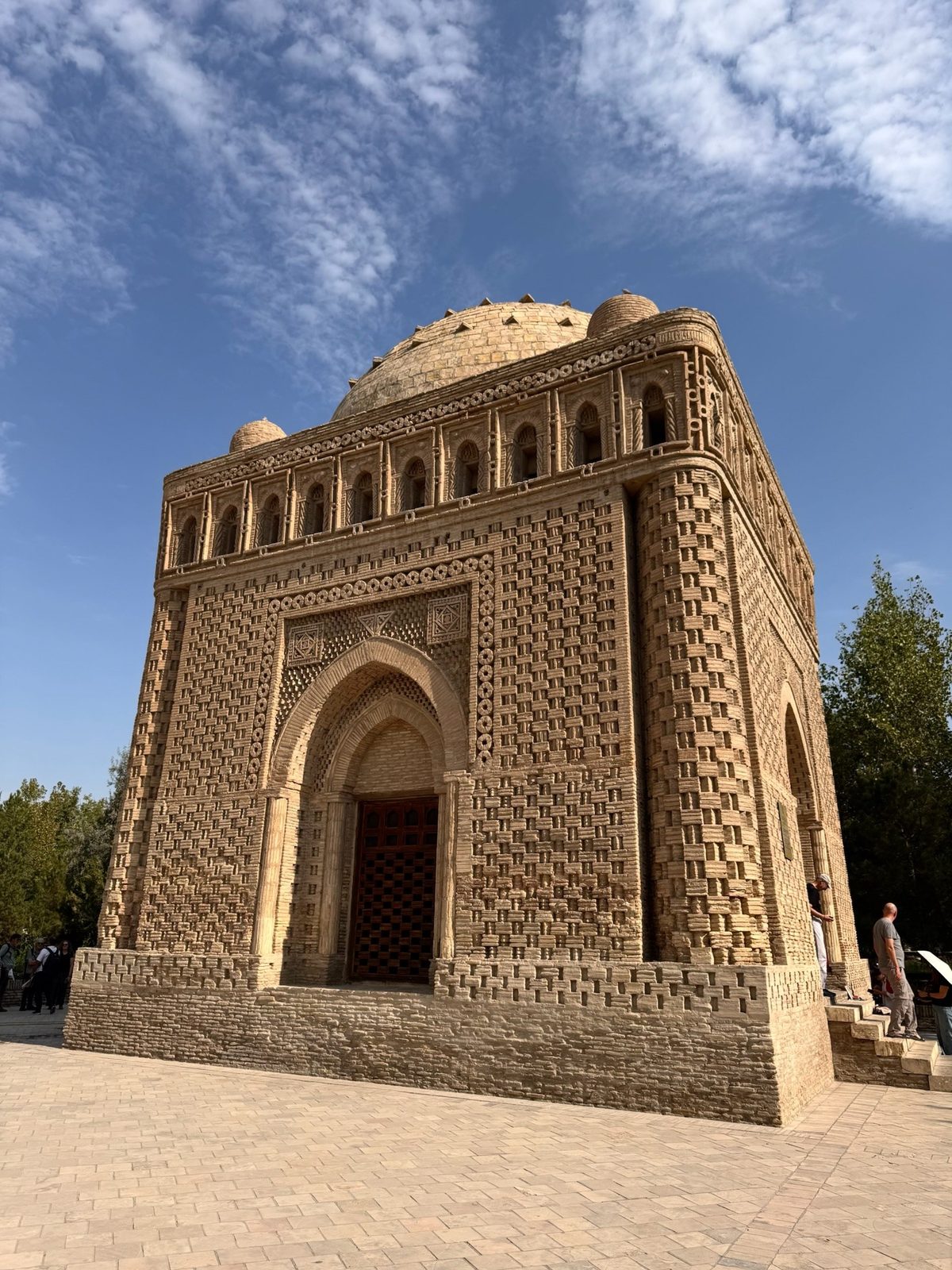
Bukhara — ,Did you know? Bukhara's ponds were once its water supply Pools like Lyabi-Hauz, dug around 1620 and 46 × 36 m, were the city's main source of water. Most were filled in during the 1920s–30s because they spread disease; Lyabi-Hauz survived. Read more → the ,Did you know? Buried in mud, this tomb escaped Genghis Khan The 10th-century Samanid Mausoleum, one of the oldest monuments of Islamic Central Asia, was covered by flood mud and sand before the Mongols came in 1220. Hidden for centuries, its brick lacework survived intact. Read more → The fortress-residence of the rulers of Bukhara on a high artificial hill: the oldest structure in the city. Read more → Fortress and the .Did you know? Under Bukhara's domes merchants changed money and gold Four 16th-century trading domes still stand over old crossroads. Toki Sarrafon was the money changers' dome, where merchants from India and China swapped coins; Toki Zargaron held jewellers' workshops, Toki Telpak Furushon sold caps. Read more →
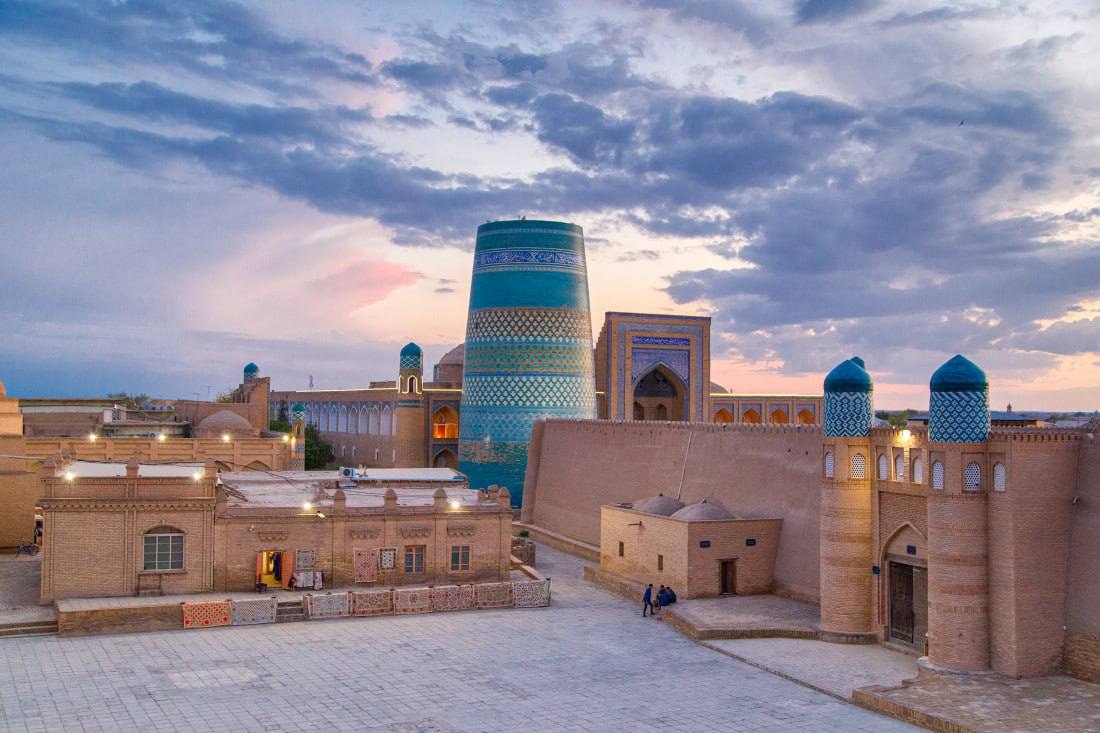
Khiva — Itchan Kala, an entire city inside its walls, with a free morning to shoot at first light.
Itinerary
Day by Day
Day 1 · Tashkent — Arriving without a rush
Our team meets you at the airport. Transfer to the hotel, breakfast and a room ready from the very first moment: we book the night before so you don’t have to wait for check-in.
The rest of the day is yours. After a transcontinental flight, the best plan is to rest.
Overnight in Tashkent · Meals: breakfast
Day 2 · Tashkent — A day to reset the clock and the gear
Free day. We leave it this way on purpose: your body adjusts to the time zone, batteries get charged, and tomorrow you start with fresh eyes.
Overnight in Tashkent · Meals: breakfast
Day 3 · Tashkent — Two cities in one
Morning in the Old City. The Hazrati Imam (Khast Imam) complex is the religious heart of Tashkent: ,Did you know? A mausoleum built for a khan who was buried in another city Barak Khan Madrasah was built in 1531–32. One of its two mausoleums was meant for Barak Khan himself, but he was buried in Samarkand, so the tomb is still called the Nameless Mausoleum. Its cell doors were inlaid with ivory. Read more → Tilla Sheikh Mosque, the Mausoleum of Did you know? Tashkent's patron saint was nicknamed “the locksmith” Abu Bakr Kaffal Shashi, born in Shash, old Tashkent, in 903–904 and died in 976, was a jurist and poet and the son of a locksmith: “kaffal” means locksmith. His mausoleum at Hazrati Imam dates from 1541–1542. Read more → and the Did you know? Legend says Muyi Muborak keeps a hair of the Prophet Muyi Muborak means “the blessed hair”: by tradition, a hair of the Prophet Muhammad is kept in this building on Hazrati Imam square. That is a matter of faith; what is certain is that for years it housed the library with the Uthman Quran. Read more → library, home to the ,Did you know? Legend: Caliph Uthman's own Quran is kept in Tashkent Tradition holds that this huge parchment Quran is the personal copy of Caliph Uthman, and one story says Timur brought it to Samarkand. Radiocarbon dating gives 775–995, so it is more likely an early copy, yet still one of the oldest. Read more → a 7th-century manuscript. We finish the morning at Kukeldash Madrasah.
Lunch at a local restaurant.
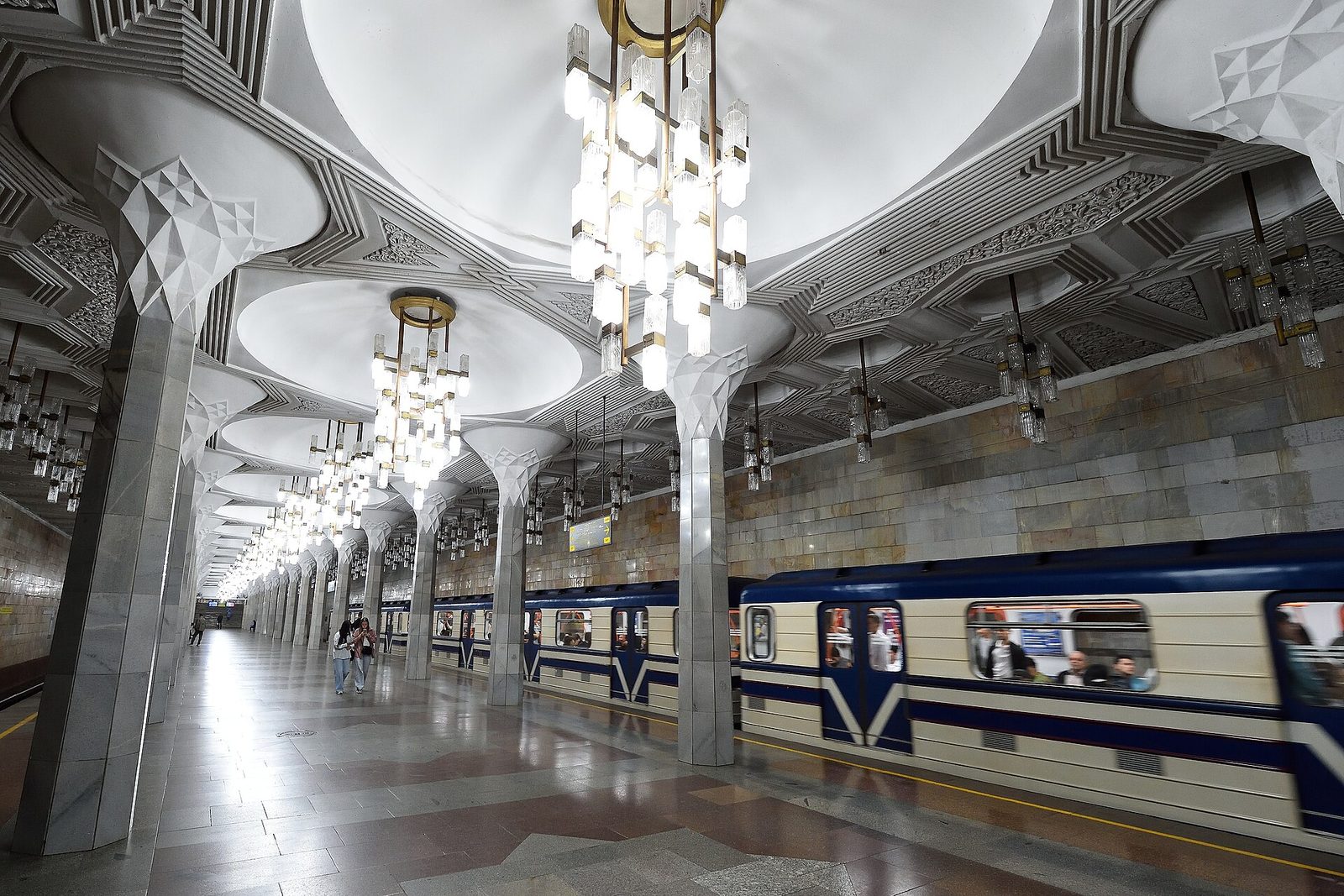
Afternoon in the modern city. Independence Square, Did you know? Legend: “Strength lies in justice” were Timur's own words The equestrian statue of Amir Timur in central Tashkent, unveiled in 1994, bears the motto “Strength lies in justice” in four languages. Tradition attributes the words to Timur himself, but historians cannot confirm he said them. Read more → and the Did you know? A Romanov grand duke gave Tashkent its first cinema Grand Duke Nikolai Konstantinovich Romanov lived in Tashkent from the 1880s; his palace of 1891 is by Heinzelman and Benois. He opened the city's first cinema, “Khiva”, funded canals in the Hungry Steppe, and his paintings seeded the Museum of Arts. Read more → (exterior, 19th century). We end underground, in the Tashkent Metro: marble, mosaics and monumental chandeliers in every station.
Photo moment: Photography in the metro has been allowed since 2018. Stations such as Did you know? A metro station where Ulugh Beg meets Gagarin Kosmonavtlar station, opened in 1984, has ceramic medallions of Ulugh Beg, Galileo, Icarus, Gagarin and Tereshkova, and glass stars in the ceiling that hint at the Milky Way. Read more → or Alisher Navoi are worth several shots.
Overnight in Tashkent · Meals: breakfast, lunch
Day 4 · Tashkent – Samarkand — Heading to Maracanda
High-speed train to Samarkand, the city Alexander the Great knew as .Did you know? Legend: Alexander found Samarkand more beautiful than told Alexander the Great took Maracanda, ancient Samarkand, in 329 BC. Legend credits him with saying that all he had heard of the city was true, except that it was even more beautiful. No ancient author records the words. Read more → Lunch at a local restaurant, check-in and a free afternoon for a first walk on your own.
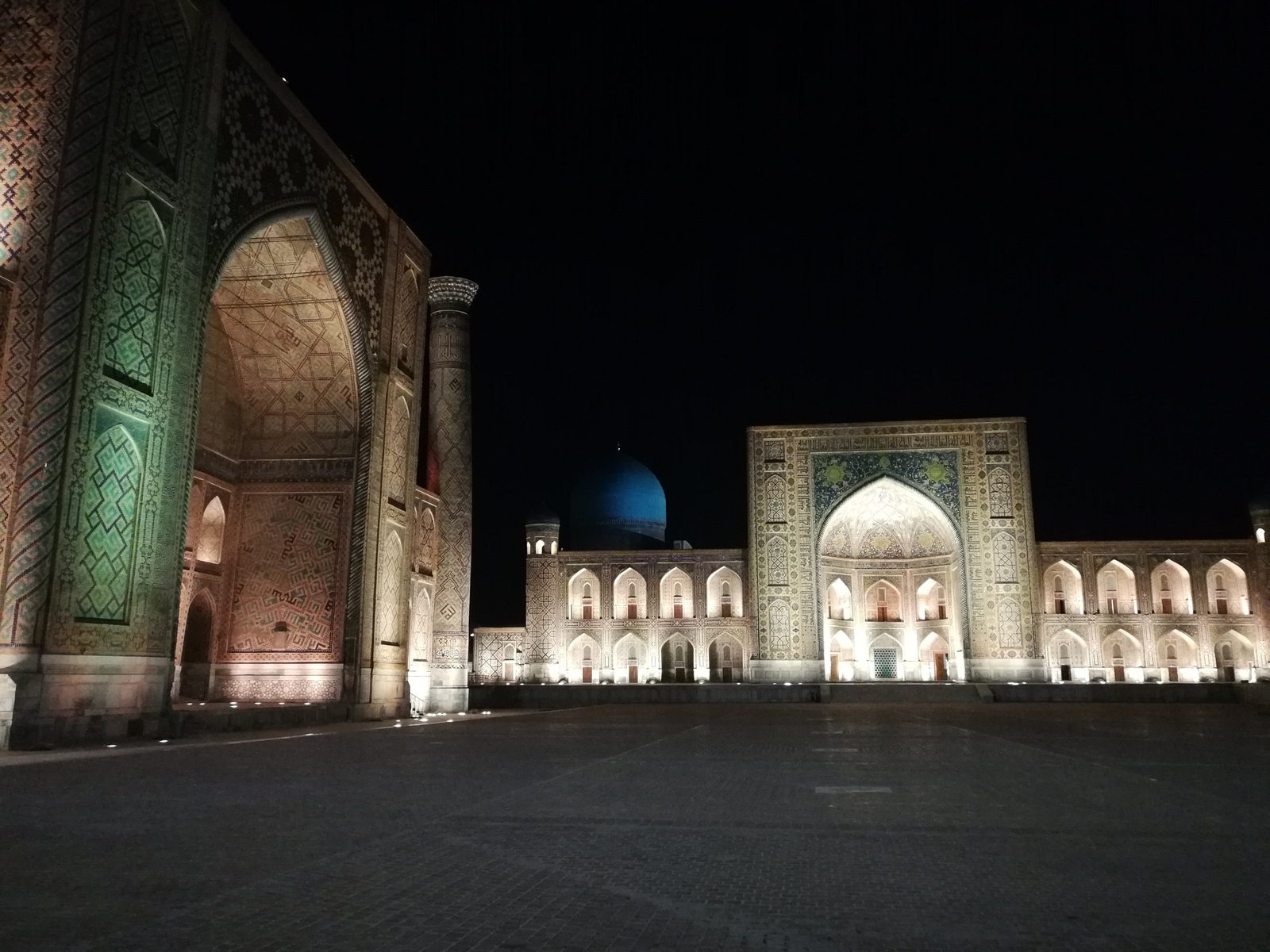
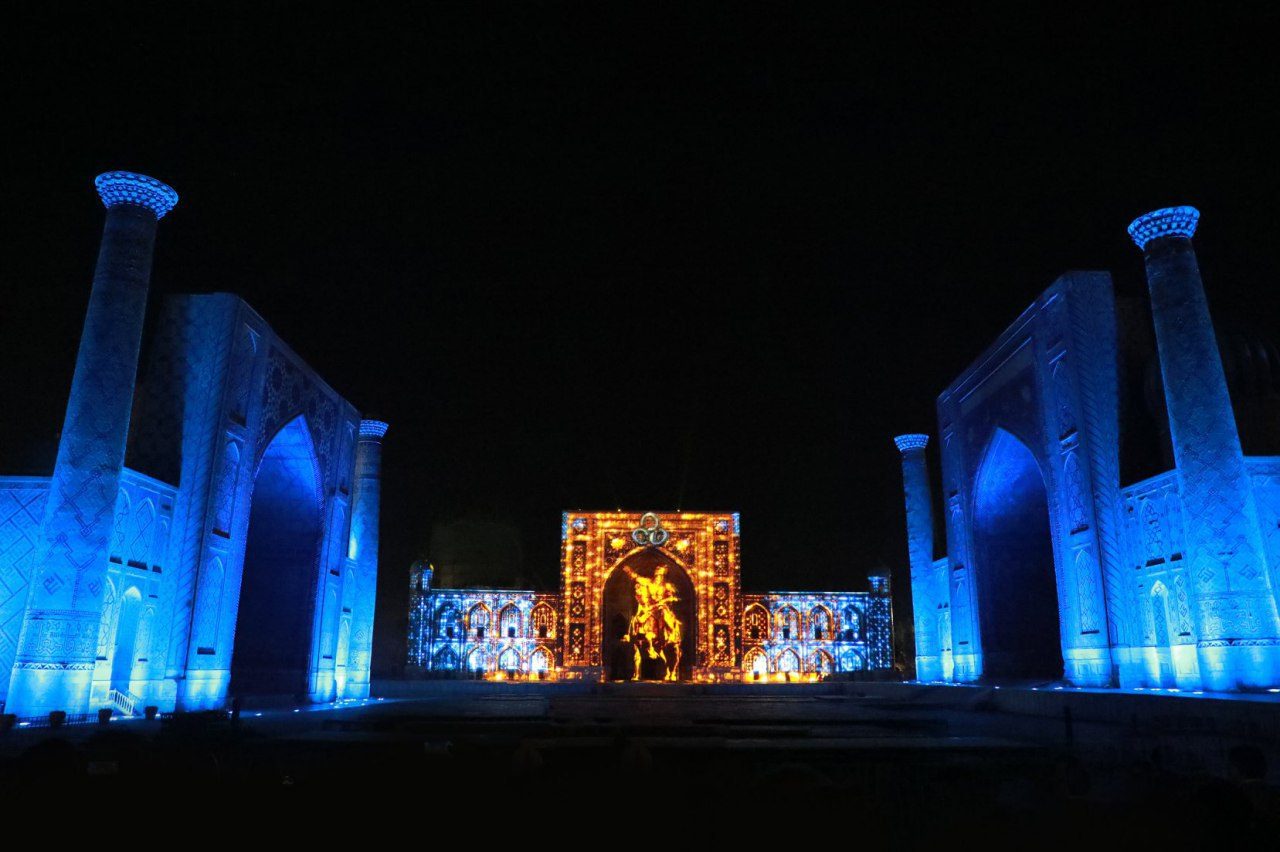
Photo moment: At night the Registan is illuminated: a great first encounter with the square before the guided visit.
Overnight in Samarkand · Meals: breakfast, lunch
Day 5 · Samarkand — The scale of an empire
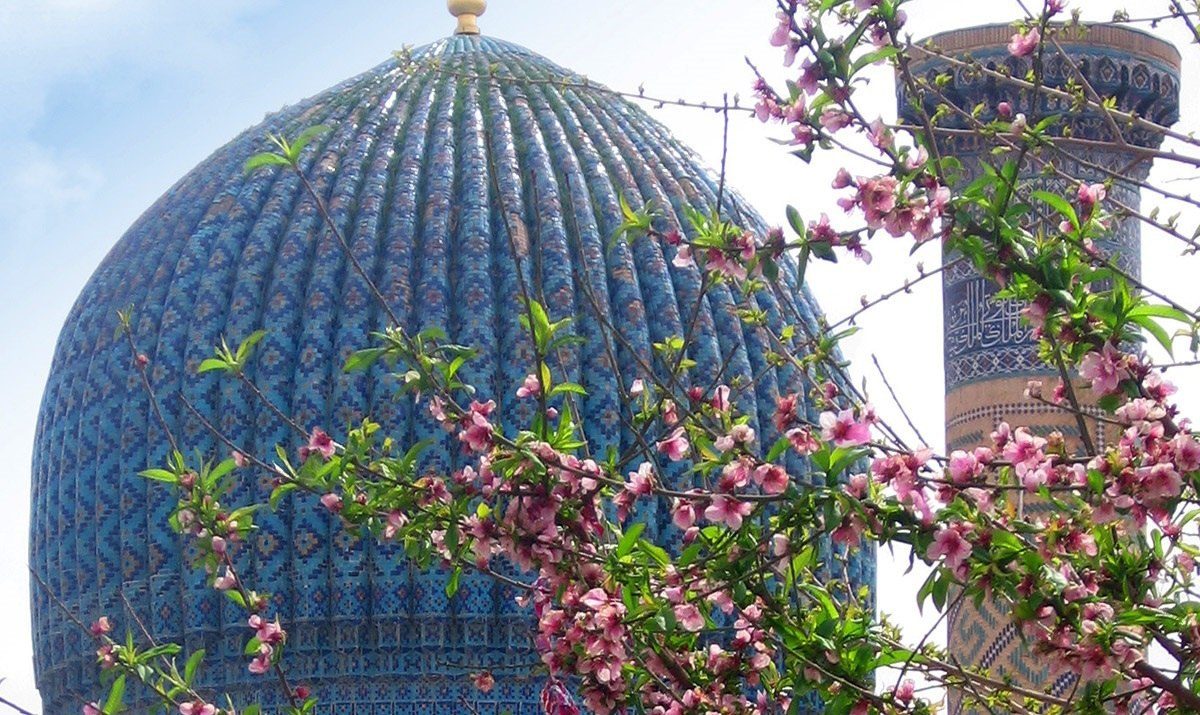
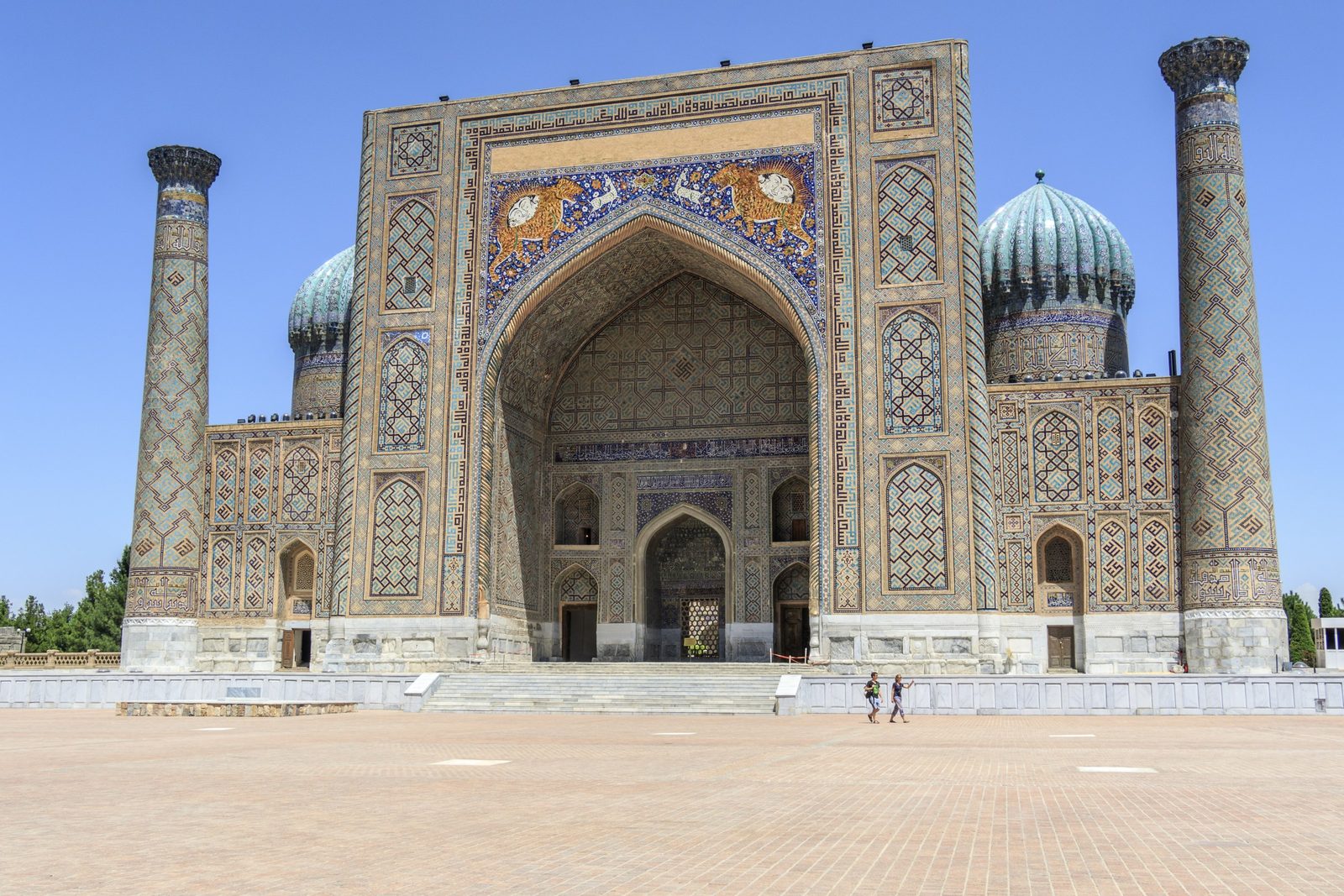
Registan Square — three madrasahs facing each other, ,Did you know? Ulugh Beg measured the year to within 25 seconds Working at his Samarkand observatory, Ulugh Beg put the tropical year at 365 days 5 h 49 min 15 s, about 25 seconds too long, closer than Copernicus a century later. Read more → Sher-Dor and ,Did you know? The 'gilded' mosque of the Registan Tilla-Kari, built in 1646–1660, means 'gilded'. With Bibi-Khanym in ruins, it served as Samarkand's main Friday mosque until the 1920s. Its prayer hall glows with kundal, relief painting finished in gold leaf, restored in 1979. Read more → covered in tilework and blue domes. Gur-e-Amir Mausoleum (“Tomb of the King”), where Amir Timur (Tamerlane, 1336–1405), founder of the Timurid empire, which had its capital in Samarkand. Born near Shahrisabz. Read more → ()Did you know? Why Europe calls Timur 'Tamerlane' Persian sources called him Timur-i Lang, 'Timur the Lame', after old wounds to his right leg and arm. When his tomb was studied in 1941, anthropologist Mikhail Gerasimov confirmed the injuries and modelled his face from the skull. Read more → and his descendants rest.
Lunch at a local restaurant.
Bibi-Khanym Mosque — the great mosque Tamerlane ordered after his campaign in India, named after his favourite wife.
Photo moment: Inside ,Did you know? Timur's tombstone went to Persia and came back The dark-green jade slab on Timur's grave in Gur-e-Amir was carried off by Nader Shah in 1740. It broke, and on his advisers' urging he sent it back to Samarkand. Read more → the gilded interior calls for a wide-angle lens and patience with the light.
Overnight in Samarkand · Meals: breakfast, lunch
Day 6 · Samarkand – Bukhara — Towards the holy city
High-speed train to Bukhara, for centuries one of the great centres of faith, trade and learning on the Silk Road. Lunch at a local restaurant, check-in and free time.
Overnight in Bukhara · Meals: breakfast, lunch
Day 7 · Bukhara — Life around the water
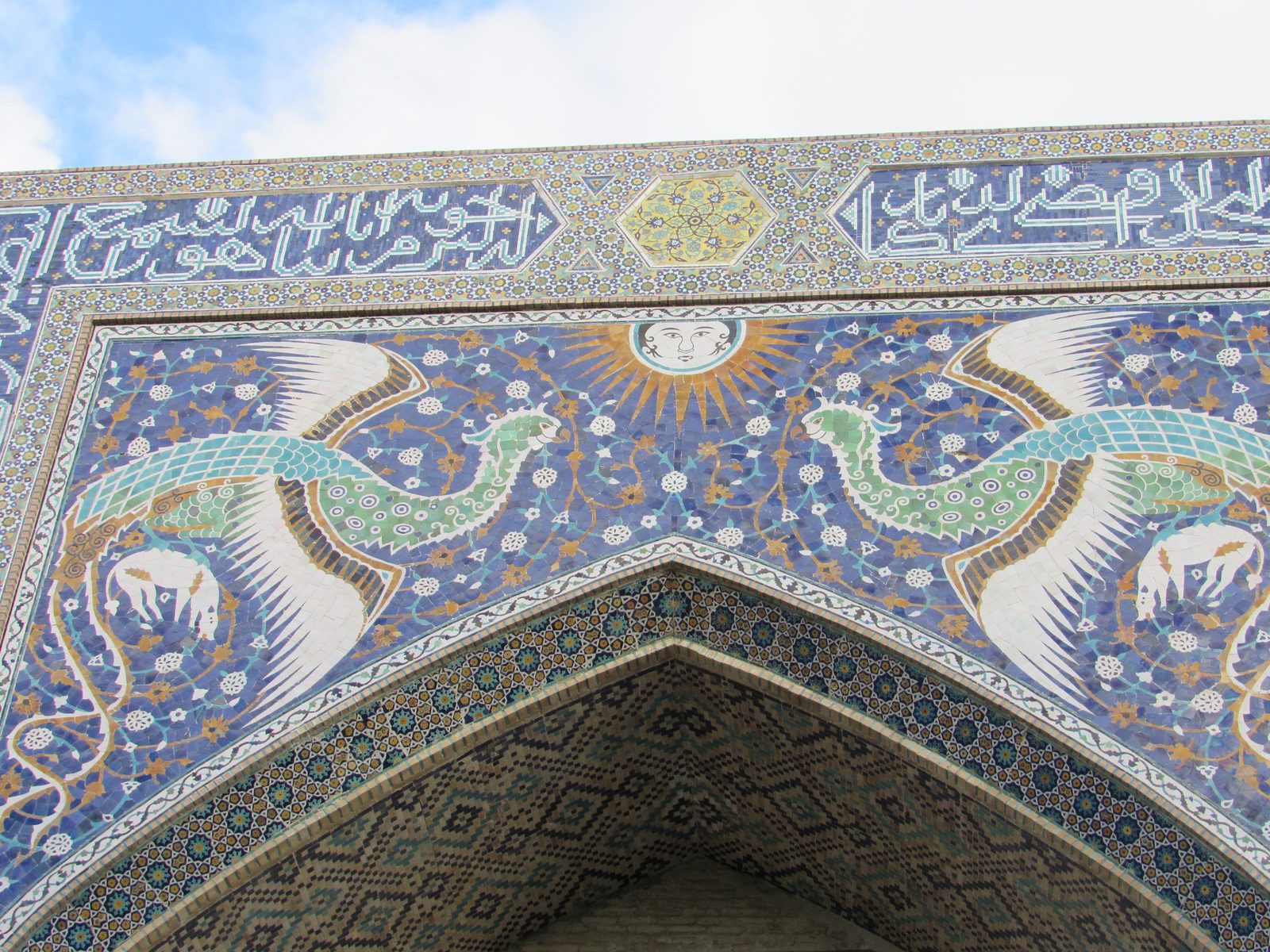
Lyabi-Hauz Ensemble (16th–17th centuries): the pond that under the khanate served as the city’s square, market and meeting place. Kukeldash Madrasah, one of the largest in Central Asia, and Did you know? A caravanserai that became a madrasah by a khan's word Nadir Divan-Begi built his 1622 building by Lyabi-Hauz as a caravanserai. At the opening Imam Quli Khan praised it as a fine madrasah, and a khan's word could not be taken back: a portal and cells were added, and a madrasah it became. Read more → (1622), with its portal of mythical birds and a sun with a human face.
Lunch at a local restaurant. Free afternoon.
Photo moment: At sunset Lyabi-Hauz fills with local life: a good moment for portraits and street scenes.
Overnight in Bukhara · Meals: breakfast, lunch
Day 8 · Bukhara — Emirs, brick and bazaars
Samanid Mausoleum (9th–10th centuries), a masterpiece of brickwork. Did you know? The famous columns of Bolo-Hauz are barely a century old The Bolo-Hauz mosque opposite the Ark was completed in 1712, but its best-known feature, the tall, slender carved columns along the front of the iwan, was added only in 1917, together with the small minaret of 1916–1917. Read more → Mosque (1712): its twenty wooden columns reflect in the pond and become forty. Did you know? Legend: the Ark was laid out with a bull's hide Legend credits the Ark to Siyavush, a prince of the Persian epic, who was offered as much land as a bull's hide would cover. He cut it into thin strips and circled a hill. In fact people built up the Ark's hill over more than 2,000 years. Read more →, the oldest structure in the city and residence of the Emirs of Bukhara.
Lunch at a local restaurant.
Trading domes (16th century): fur hats, embroidery, handmade carpets and ceramics.
Photo moment: At the Samanid Mausoleum the texture of the brick changes with every hour of the day.
Overnight in Bukhara · Meals: breakfast, lunch
Day 9 · Bukhara – Khiva — Along the edge of the Kyzylkum
Train to Khiva through the desert landscape of the .The Kyzylkum, or Red Sands: the desert between the Amu Darya and Syr Darya rivers that the road and the railway cross on the way to Khiva. Arrival in the afternoon or evening and check-in.
Overnight in Khiva · Meals: breakfast
Day 10 · Khiva — A whole city within its walls
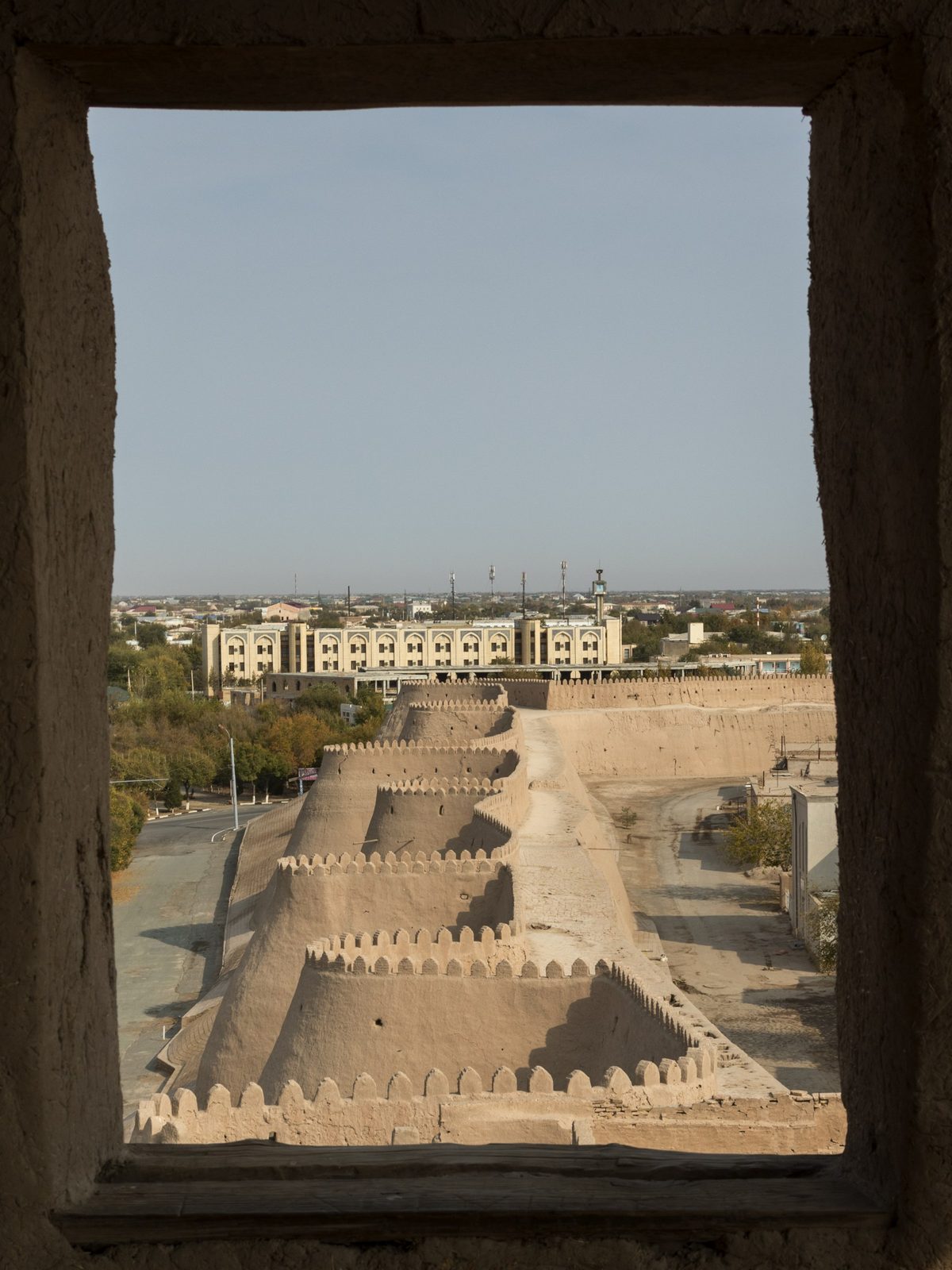
Itchan Kala, a UNESCO World Heritage Site since 1990: the Did you know? Legend: the khan wanted to see Bukhara from his minaret Legend says Muhammad Amin-Khan wanted the Kalta-Minor so tall that Bukhara, some 400 km away, could be seen from the top. In reality work began in the 1850s and stopped in 1855, when the khan died, at a height of about 29 m. Read more → with its turquoise tiles, the Did you know? In the khan’s courtyard a round platform waited for a yurt The Kunya-Ark, the khans’ citadel, had its own mint, arsenal and harem. In the courtyard of its reception hall of 1804–1806 stands a round platform: a yurt was set up on it, and there the khan received envoys of the steppe nomads. Read more → citadel, the Mohammed Rahim Khan Madrasah and the Did you know? Khiva's tallest minaret is barely a century old The Islam Khoja Minaret was begun in 1908, near the very end of the khans' era. At 56.6 m it is one of the tallest in Central Asia; a spiral stair of 175 steps leads up to its windowed top. Read more → ensemble, with the tallest minaret in Khiva.
Lunch at a local restaurant.
Afternoon: Did you know? In Tash-Hauli's harem each of four wives had her own loggia Allakuli Khan built the Tash-Hauli palace in 1830–1838 around three courtyards. In the harem four tall loggias belonged to the khan's four wives and a fifth, the largest, to the khan himself; behind each summer terrace lay a winter room. Read more → Palace and its harem (19th century), the Did you know? Legend: a wrestler freed captives with a single cowhide Legend says Pahlavan Mahmud won a bout in India and asked to free as many fellow Khorezmians as would fit in a cowhide. He cut it into one long thin strip and encircled them all. The real Mahmud, a poet and wrestler of around 1300, is Khiva's patron saint. Read more → Mausoleum, the Did you know? Khiva's Juma Mosque stands on 212 wooden columns Recorded as early as the 10th century and rebuilt in 1788, the Juma Mosque has no portal and no domes: its flat roof rests on 212 carved columns in 17 rows, and some of them are older than the building itself. Read more → with more than two hundred carved wooden columns, and the Mausoleum of Said Allauddin. Free time in the workshops and stalls of the old town.
Photo moment: Inside the Juma Mosque the light falls from above: the forest of columns reads best without flash.
Overnight in Khiva · Meals: breakfast, lunch
Day 11 · Khiva – Tashkent — The last light of the desert
Free morning in Khiva. Transfer to Urgench airport and flight to Tashkent (schedule to be confirmed). Arrival and transfer to the hotel.
Photo moment: Early in the morning, before the stalls open, Itchan Kala is almost empty.
Overnight in Tashkent · Meals: breakfast
Day 12 · Tashkent — See you soon, Uzbekistan
Transfer to the airport for your flight home. You leave with thousands of images — and, we hope, the wish to come back. End of services.
Meals: breakfast
Accommodation
Hotels
| City | Hotel (or similar) | Nights |
|---|---|---|
| Tashkent | Hyatt Regency | 4 nights + extra night for early arrival |
| Samarkand | Hilton | 2 nights |
| Bukhara | Wyndham | 3 nights |
| Khiva | Farovon | 2 nights |
Hotel check-in is at 14:00, check-out at 11:00.
Price
Price
The price is given on request: it depends on the dates and the size of the group.
Good to know
Conditions
- The tour operator reserves the right to change the itinerary and/or replace hotels with others of similar category if circumstances beyond our control make it necessary.
- Hotel check-in is at 14:00, check-out at 11:00. Early arrival and late departure not listed are not included.
- If a site is closed, it will be replaced with an equivalent alternative.
- Domestic flight schedules may change. If no seats are available on the Uzbekistan's high-speed train: Tashkent to Samarkand in about 2 hours 10 minutes, Tashkent to Bukhara in about 4 hours. Tickets are tied to your passport. Read more → high-speed train, it will be replaced by a regular train or a road transfer.
- Reservations are confirmed with passport copies only.
Cancellation policy
| Cancellation timing | Penalty |
|---|---|
| 21 days before the service | 20% |
| 20–7 days | 50% |
| 6–0 days | 100% |
Transportation
| Vehicle | Group size |
|---|---|
| Chevrolet Cobalt | 2 pax |
| Hyundai Starex | 3–4 pax |
| Toyota Hiace / King Long | 5–8 pax |
| Mercedes Sprinter | 9–14 pax |
| Bus | more than 14 pax |
Vehicles may differ in make and colour.
🌿 Responsible tourism: we allocate part of our profits to good causes and are preparing for GSTC certification.
Expert opinion
Pluses
- Three UNESCO sites: Did you know? People still live inside Khiva's museum city Itchan Kala packs more than 50 historic monuments and about 250 old houses inside clay walls 8–10 m high and 5–6 m thick, and families still live and work in its lanes. Read more → (1990), the Historic Centre of Bukhara (1993) and Samarkand – Crossroad of Cultures (2001) in 12 days.
- Paced for photography: Two days to acclimatise, free afternoons, a free morning in Khiva and a photo moment pointed out in every city.
- Transport is in the price: Trains between all four cities, the Urgench – Tashkent flight, 7 lunches and entrance fees are included.
Minuses
- Dinners not included: the price covers daily breakfasts and 7 lunches; dinners are paid separately.
- Photo fees extra: photo and video fees at monuments are not in the price.
- Flight time not fixed: the Urgench – Tashkent flight on day 11 is “to be confirmed”, and a train can be replaced by a regular train or a road transfer.
AroundCA numbers
How we counted
By the AroundCA programme: we count only what is written in the day-by-day programme of this tour. If the programme gives no figure, we show nothing.
- Hotel changes
- 4
- Walking
- Medium
Walking: Medium: full sightseeing days on foot (Tashkent on day 3, about eight sights in Khiva on day 10), balanced by free days and afternoons, with no trekking.
Best time
Mar–May, Sep–Nov
Spring and autumn: in April, daytime temperatures are 21–24 °C in all four cities.
Cool, fewer people: Jan–Feb, Dec
Better to avoid
Jun–Aug
June–August: daytime 33–37 °C.
A typical day
On day 10 in Khiva the morning goes to Itchan Kala: the Kalta-Minor minaret, the Kunya-Ark citadel and the Mohammed Rahim Khan and Islam Khoja ensembles. After lunch you see Tash-Hauli Palace, the Pahlavan Mahmud Mausoleum and the Juma Mosque, with free time in the workshops of the old town.
What the price includes
What is included
- Accommodation in double/twin rooms, including the extra night for early arrival
- Hotel tourist taxes
- Daily breakfasts and 7 lunches at local restaurants
- All transfers and air-conditioned transport
- Entrance fees to the monuments in the program
- Local guide during excursions
- Train tickets Tashkent – Samarkand – Bukhara – Khiva
- Domestic flight Urgench – Tashkent
- Mineral water throughout the tour
- Local guide during excursions, speaking your language
Not included
- International flights
- Visa and processing fees (if applicable)
- Dinners
- Alcoholic and soft drinks during meals
- Photo and video fees at monuments
- Early check-in and late check-out
- Tips for guides, drivers and porters
- Personal expenses and extra services
Extra cost on site
- Photo and video fees at monuments
- Dinners
- Drinks during meals
- Tips for guides, drivers and porters
Good for
- Photographers who want time and good light, not a rush between sights
- Architecture lovers: tilework, brick vaults and wooden columns
- First-time visitors to Central Asia who prefer trains and hotels arranged for them
Maybe not for you if
- Anyone who wants dinners included — only breakfasts and 7 lunches are in the price
- Travellers who plan to shoot at the monuments without extra cost — photo and video fees at sites are not included
Questions about this tour
How much does the tour cost?
The price is given on request: it depends on the dates and the size of the group. The single supplement is also on request.
What is included in the price?
Everything that is and isn’t included, and what you pay on site, is in one list: What the price includes
What is not included?
Everything that is and isn’t included, and what you pay on site, is in one list: What the price includes
Which hotels are used?
Hyatt Regency in Tashkent (4 nights plus an extra night for early arrival), Hilton in Samarkand (2 nights), Wyndham in Bukhara (3 nights) and Farovon in Khiva (2 nights), or similar.
How do we travel between the cities?
By high-speed train from Tashkent to Samarkand and on to Bukhara, by train from Bukhara to Khiva, and by flight from Urgench to Tashkent; the flight schedule is to be confirmed. If there are no seats on the Afrosiyob high-speed train, it is replaced by a regular train or a road transfer.
Is there time for photography on my own?
Yes. There are two days to acclimatise at the start, free afternoons in Samarkand and Bukhara, and a free morning in Khiva on day 11 to go out at first light.
What is the cancellation policy?
A 20% penalty if you cancel 21 days before the service, 50% for 20–7 days, and 100% for 6–0 days.
What is Arda Khiva, and can we spend an evening there?
Arda Khiva is a new tourist complex on the shore of Lake Govuk, a short drive from Itchan Kala, opened in May 2025: 17 hotels and guest houses, a 3,000-seat amphitheatre, restaurants, a bazaar and a canal with gondolas. We can add an evening or a stay there on request.
Didn’t find your answer? Ask about this tour →
Make it your trip
Tick what you’d like to add — it goes into your request, and the manager confirms the final price.
Add a few days
Arrival, departure, transfers
Arrive earlier or stay longer
Need extra nights before or after the tour?
Prices are indicative; we confirm the exact rate after your request.
© Photos
Wooden columns of the Juma Mosque, Khiva — Dan Lundberg / Wikimedia Commons · CC BY-SA 2.0