
 Deutsch
 English
 Español
 Français
 Italiano
 Polski
 Português
 Suomi
 Svenska
 Türkçe
 Русский
 עברית
 한국어
 中文
 日本語
Places in this article: Samarkand · Tashkent
Ancient Samarkand: a City Read in Layers, from Afrasiyab to the Registan
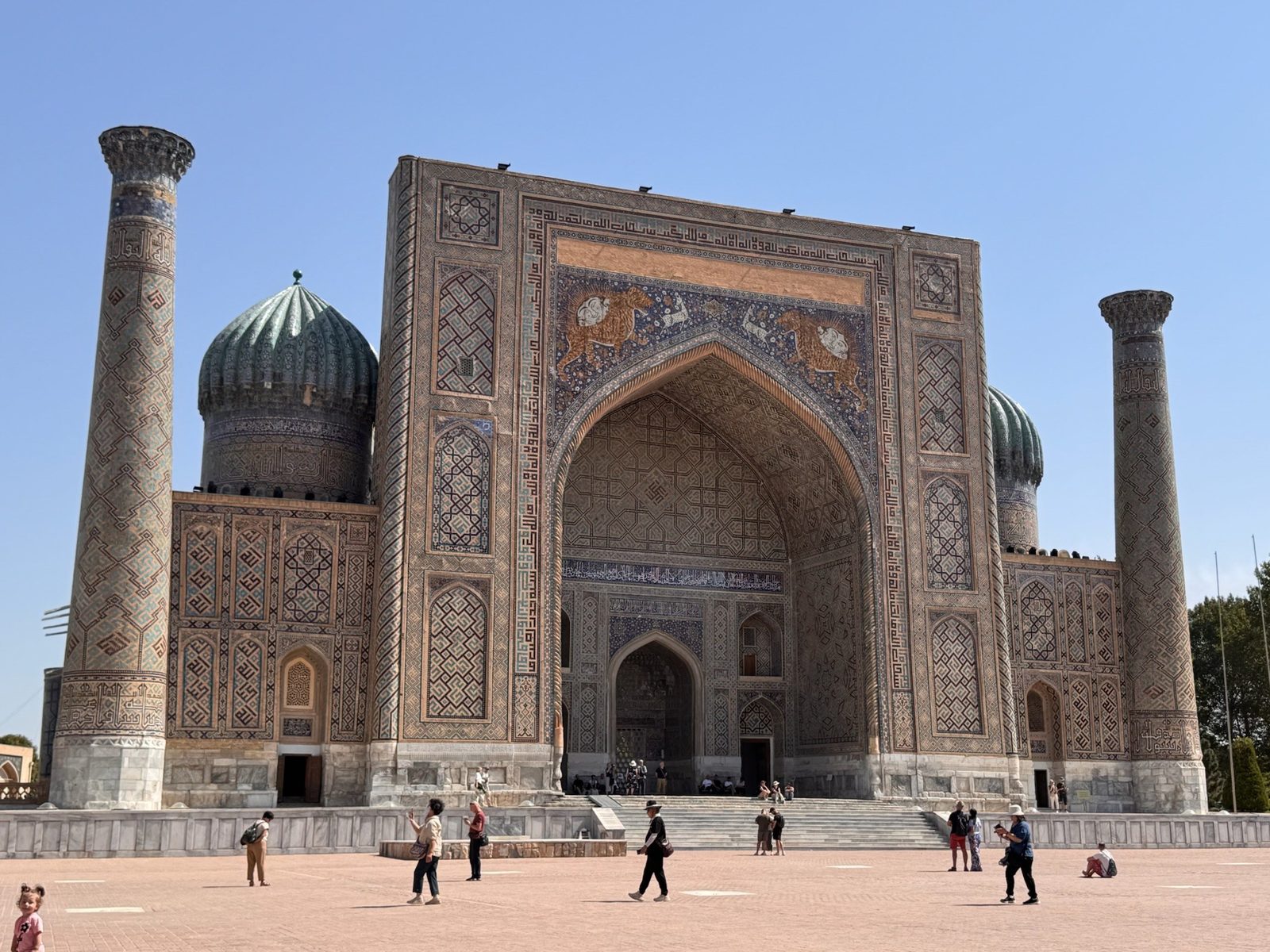
North-east of the ,Did you know? The Registan's sun-carrying lion went on a banknote The Sher-Dor Madrasah (1619–1636) is named for the big cats with the sun on their backs on its portal. The image appeared on the reverse of Uzbekistan's 200-som note of 1997. Read more → past ,Samarkand's main bazaar, right next to Bibi-Khanym: Samarkand bread, dried fruit, nuts and halva. Read more → the road climbs onto a long, bare hill of pale loess. There are no domes on it, only grass, dirt tracks and shallow pits left by archaeologists. This is ,Did you know? A 7th-century mural shows envoys from Korea Uncovered by road builders in 1965, the Ambassadors' Painting at Afrasiyab shows delegations bearing gifts, Chinese with silk among them, and two men in feathered hats thought to be envoys from Korea's Goguryeo. Read more → and for more than 1,700 years it was Samarkand. The blue city you came to see stands next to it, younger by many centuries.
We are a tour operator in Tashkent, and we bring guests to Samarkand every week. The best way we know to understand it is to read it like a cut through the earth: layer by layer, from the hill where the old city lived to the Russian boulevards of the 19th century. Here is that history in order, with the place where you can still see each layer.
Afrasiyab: the city before the domes
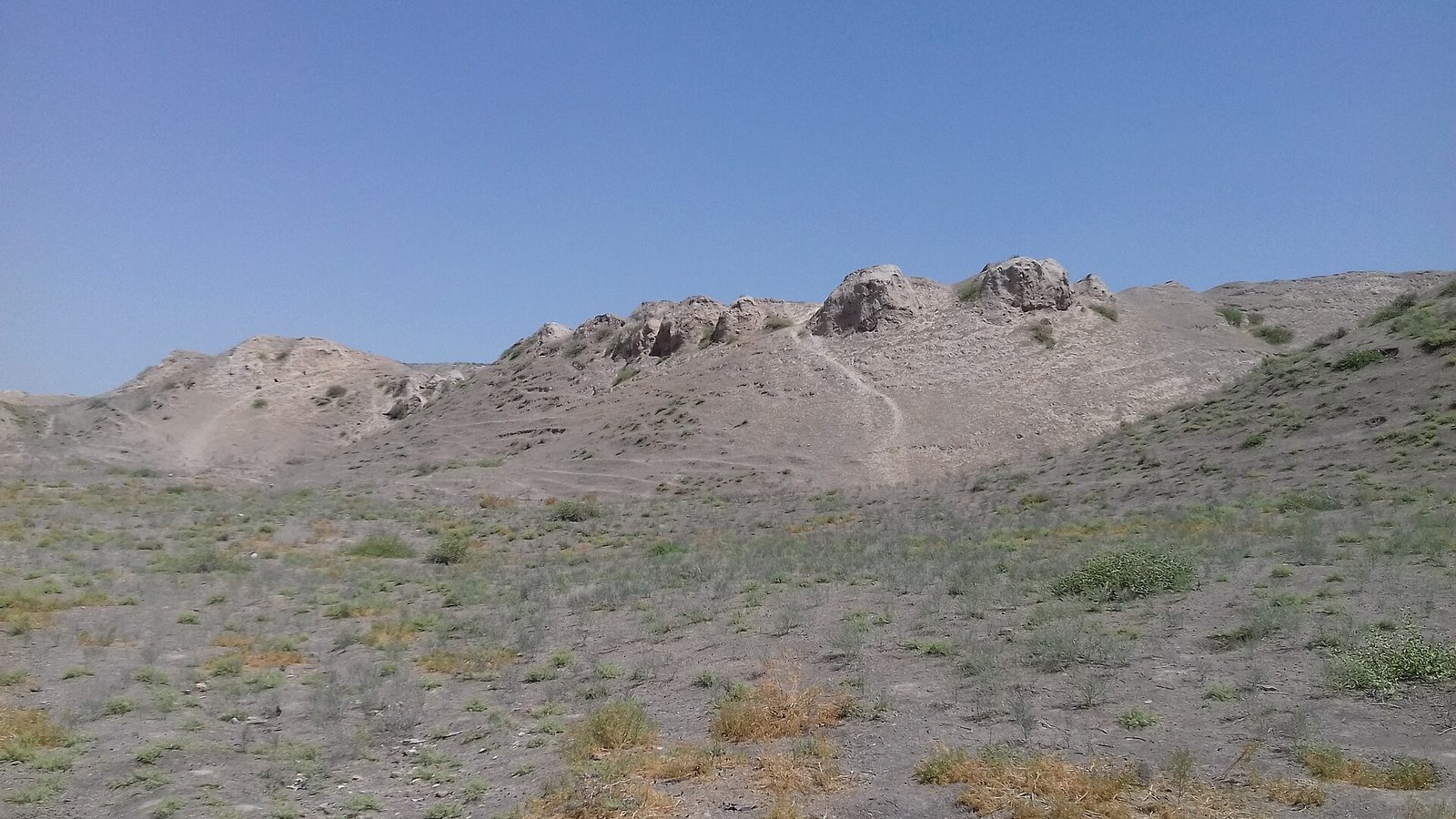
People lived on Afrasiyab from about 500 BC until 1220. This was ,Did you know? Legend: Alexander found Samarkand more beautiful than told Alexander the Great took Maracanda, ancient Samarkand, in 329 BC. Legend credits him with saying that all he had heard of the city was true, except that it was even more beautiful. No ancient author records the words. Read more → the city that Alexander the Great took in 329 BC, and later the capital of Sogdiana, the land of the merchants who carried goods, languages and religions between China, India and Persia.
The finds are in the Afrasiyab Museum on the hill. Its pride is the Ambassadors' Painting, wall paintings made in 648–651 for a palace hall and found in 1965: processions of envoys bringing gifts to a Sogdian king, among them figures that researchers identify as envoys from China and from Korea. It is the one place in Samarkand where you see the faces of the people who lived here before Islam. More on the museum and its halls is in our guide to the museums of Samarkand and Bukhara.
Paper, scholars and the Arab conquest
Early in the 8th century Arab armies took Samarkand, and the city slowly became part of the Islamic world. Under the Samanids, in the 9th and 10th centuries, it was one of the great cities of the region, famous for one product above all: paper. A well-known story says the secret came with Chinese captives after the battle of Talas in 751. It is a legend; Samarkand had paper earlier. But the fame was real, and Did you know? Legend says Chinese prisoners taught Samarkand paper A legend recorded in the 11th century says Chinese prisoners taken at the Battle of Talas in 751 taught Samarkand to make paper. In fact paper was used here earlier, and the craft most likely came gradually along the Silk Road. Read more → was prized across the Muslim world for centuries.
You can watch it made today. In the village of ,A village near Samarkand where paper is made by hand from mulberry bark, the old way, at a working mill on the stream. outside the city, a workshop has revived the old method with mulberry bark, a water wheel and polishing stones. Our article on Samarkand paper and the Konigil mill explains the process and how to fit it into a day.
Shah-i-Zinda and the year 1220
In 1220 the Mongol army of Genghis Khan took Samarkand and destroyed much of it. Life never returned to the hill. When the city recovered, it grew to the south, on the ground where the Registan and Did you know? Timur's tombstone went to Persia and came back The dark-green jade slab on Timur's grave in Gur-e-Amir was carried off by Nader Shah in 1740. It broke, and on his advisers' urging he sent it back to Samarkand. Read more → stand today, and Afrasiyab was left to the wind.
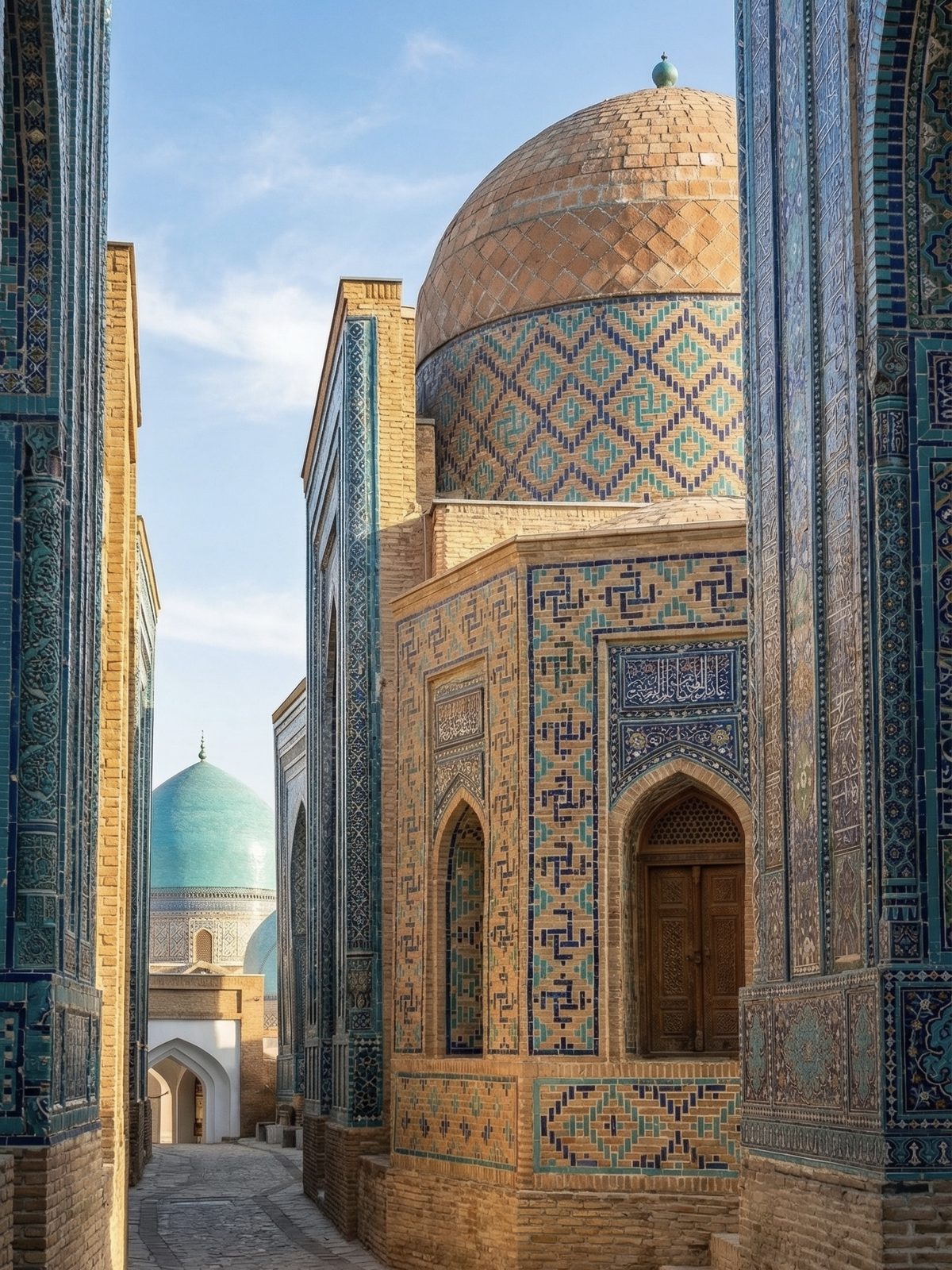
One place on the edge of the old city kept its life: ,Did you know? Why Shah-i-Zinda means 'the Living King' The necropolis grew around the shrine of Qutham ibn Abbas, a cousin of the Prophet Muhammad. Legend says he did not die in battle but went down a deep well to a garden of paradise, where he lives on. Read more → the necropolis on the southern slope of Afrasiyab. Its oldest core goes back to the 11th century and the tomb honoured as that of Kusam ibn Abbas, a cousin of the Prophet Muhammad. Most of the mausoleums along its narrow street were built in the 14th and 15th centuries, many for women and nobles of Amir Timur (Tamerlane, 1336–1405), founder of the Timurid empire, which had its capital in Samarkand. Born near Shahrisabz. Read more →'s family. It is an active necropolis, so we visit it with covered shoulders and knees and a lowered voice. The details are in our article on Shah-i-Zinda.
Gur-e-Amir and Bibi-Khanym: Timur's capital
In 1370 Timur, known in Europe as ,Did you know? Why Europe calls Timur 'Tamerlane' Persian sources called him Timur-i Lang, 'Timur the Lame', after old wounds to his right leg and arm. When his tomb was studied in 1941, anthropologist Mikhail Gerasimov confirmed the injuries and modelled his face from the skull. Read more → made Samarkand his capital. For 35 years the wealth of his campaigns flowed here, and with it craftsmen from the cities he took. He built on a scale meant to impress. The ,Did you know? 95 elephants hauled stone for Timur's great mosque Bibi-Khanym, begun in 1399 after Timur took Delhi, was the largest mosque of his empire. Some 200 stonecutters worked on site and 95 elephants brought from India hauled the loads; the courtyard was meant to hold 10,000 people. Read more → begun in 1399 after his Indian campaign, had a portal about 35 metres high; the building was so ambitious that parts of it began to fall within decades, and what you see today owes a great deal to restoration from 1974 onwards.
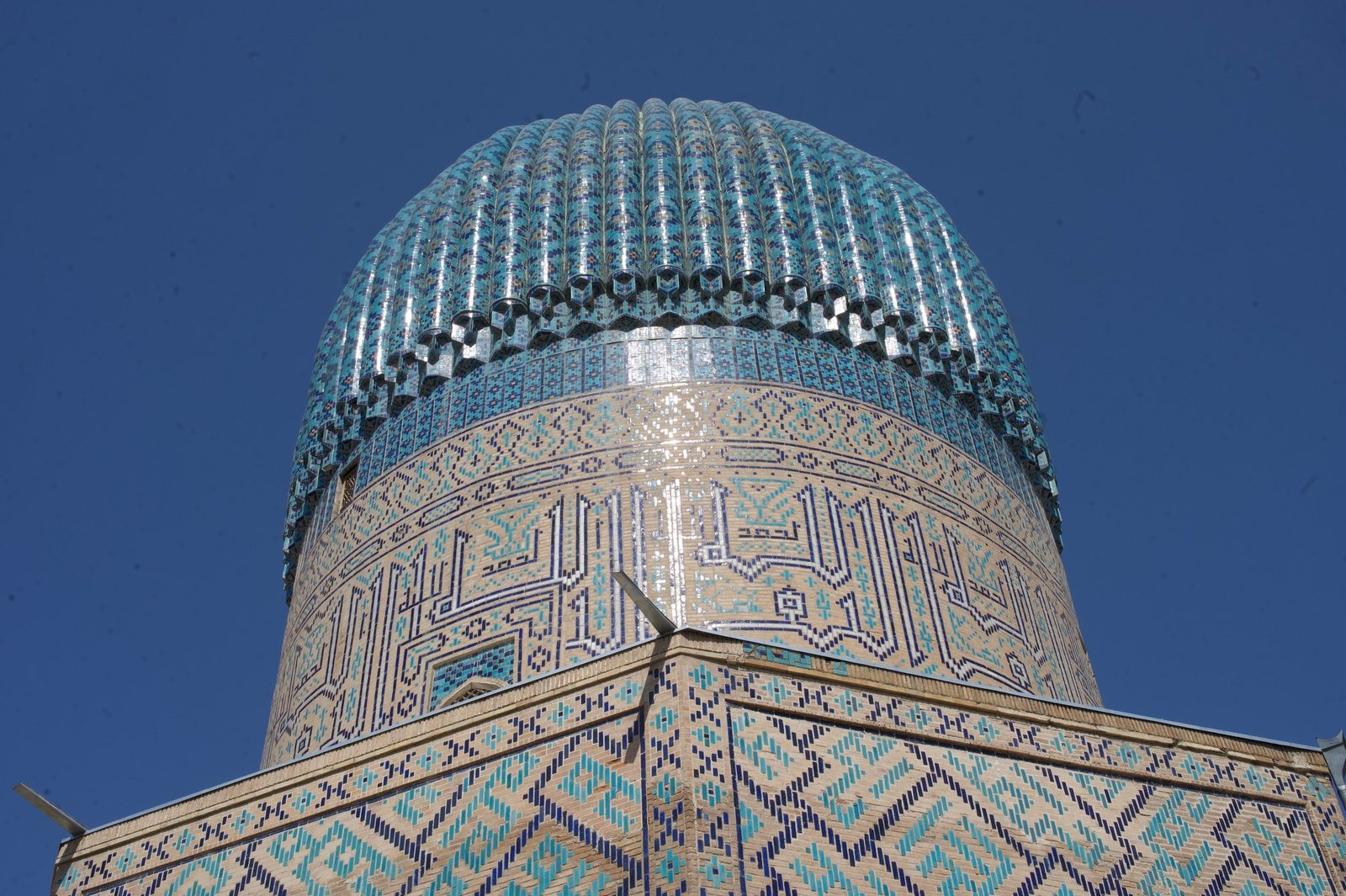
In 1404 Ruy González de Clavijo, the envoy of the King of Castile, reached Samarkand and described the gardens, the feasts and the building works. A few months later, in February 1405, Timur died on campaign. He lies in Gur-e-Amir, the mausoleum with the ribbed blue dome, completed in 1404 and first built for his grandson .Did you know? Timur's tomb was built for his grandson Gur-e-Amir was begun in 1404 for Muhammad Sultan, Timur's grandson and chosen heir. Timur had a crypt ready in his home town of Shahrisabz, but when he died in 1405 he was laid in Samarkand, in the tomb meant for the young prince. Read more → Under the dome a slab of dark green jade marks his grave; his grandson Did you know? Ulugh Beg measured the year to within 25 seconds Working at his Samarkand observatory, Ulugh Beg put the tropical year at 365 days 5 h 49 min 15 s, about 25 seconds too long, closer than Copernicus a century later. Read more → is buried nearby. Our article on Gur-e-Amir tells the story of the tomb, including the opening of the crypt in June 1941.
Ulugh Beg's observatory: the ruler who counted stars
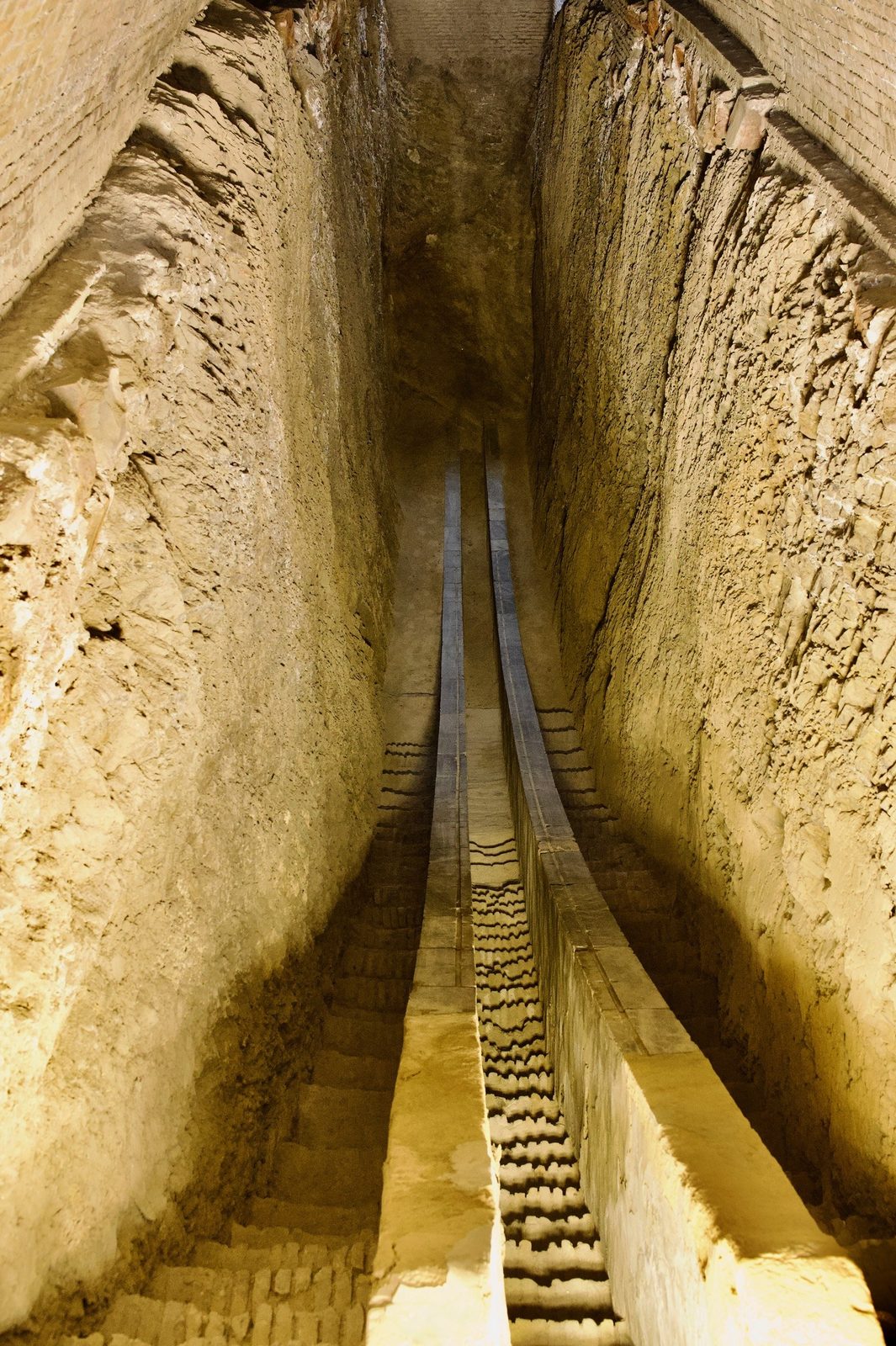
Timur's grandson Ulugh Beg ruled Samarkand from 1409 and turned his grandfather's capital into a city of scholars. In 1417–1420 he built a An Islamic college: student cells and classrooms around a courtyard behind a grand portal. In the old towns many now house museums and craft workshops. Read more → on the Registan where astronomy and mathematics were taught alongside theology. In the 1420s he built an observatory on a hill outside the city, with a sextant of about 40 metres radius set in a trench dug into the hill. With it his astronomers measured the length of the year and compiled a catalogue of 1,018 stars.
Ulugh Beg was killed in 1449, and the observatory was later dismantled and forgotten. In 1908 the archaeologist Vasily Did you know? A former teacher found the lost observatory in 1908 After Ulugh Beg's death his observatory was taken apart for its bricks and even its site was forgotten. Vasily Vyatkin, keeper of Samarkand's monuments, traced it through a 17th-century land deed and in 1908 dug up the great marble arc. Read more → found the underground arc of the sextant, and you can walk down the steps and see it today. Our article on the Ulugh Beg Observatory covers the instrument and the museum.
The Registan and Sher-Dor: the second act
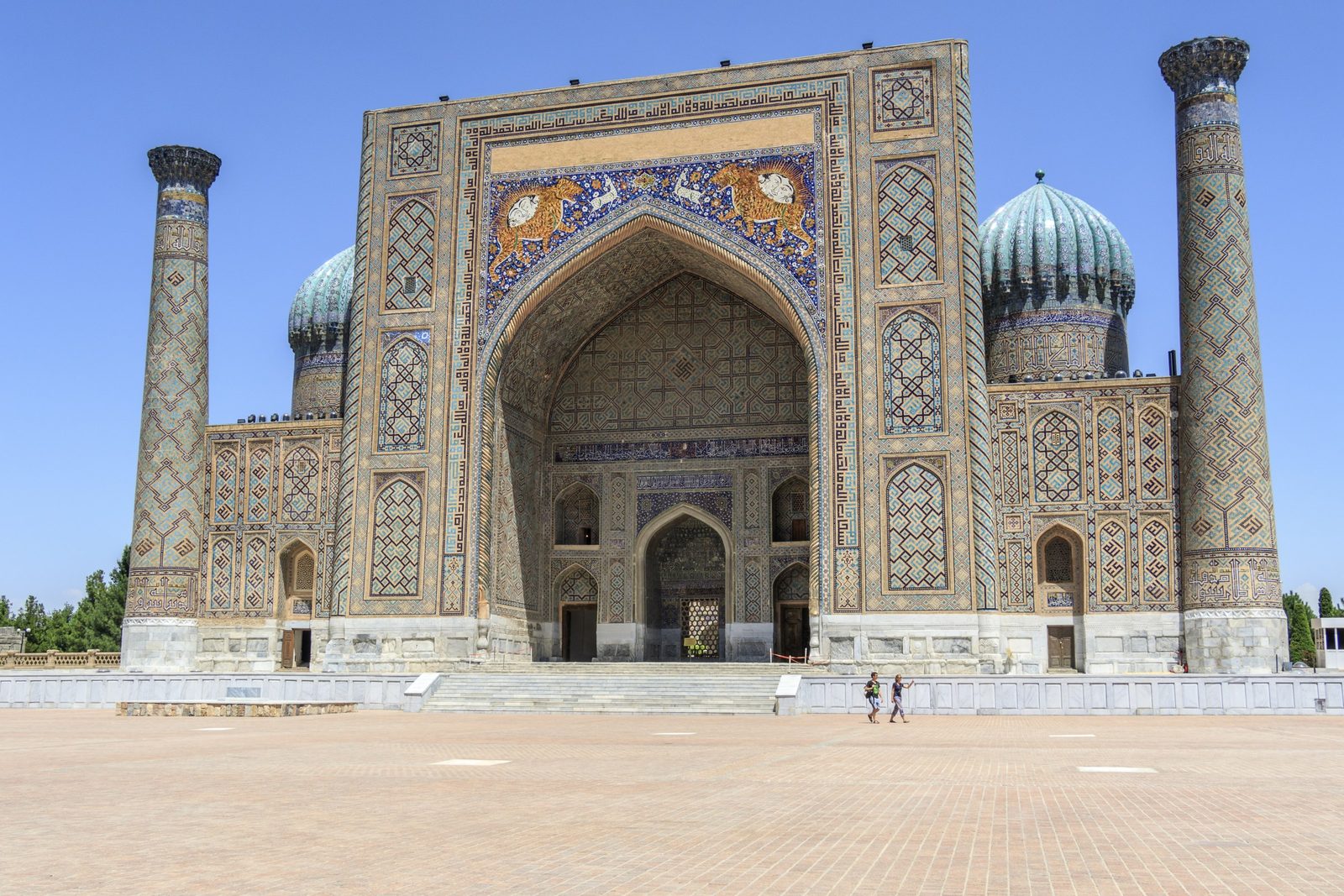
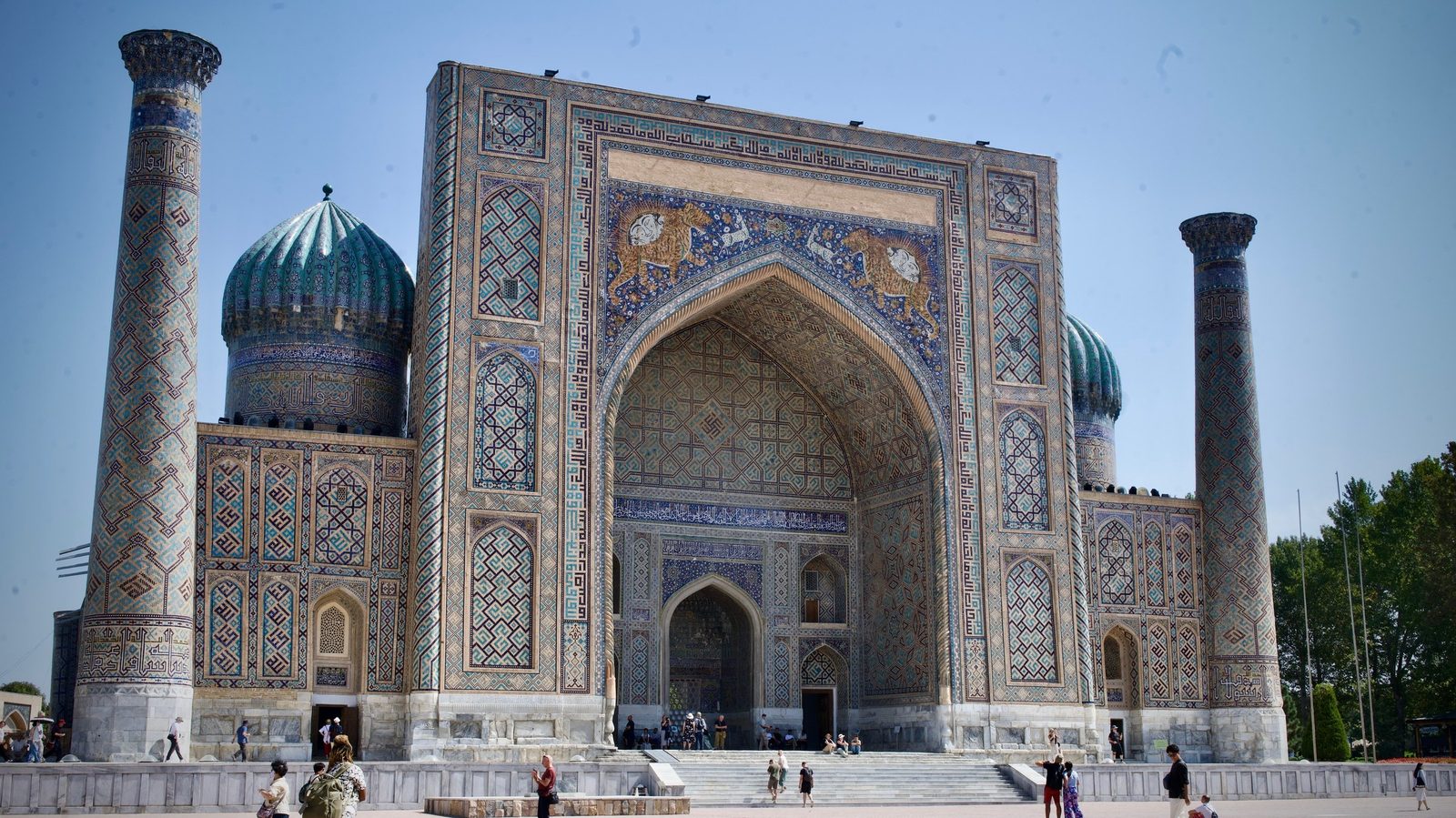
The Registan looks like one plan, but it took more than two centuries. Opposite Ulugh Beg's madrasah, the governor Yalangtush Bahadur built the Sher-Dor madrasah in 1619–1636, matching the older building in size, and then Did you know? The 'gilded' mosque of the Registan Tilla-Kari, built in 1646–1660, means 'gilded'. With Bibi-Khanym in ruins, it served as Samarkand's main Friday mosque until the 1920s. Its prayer hall glows with kundal, relief painting finished in gold leaf, restored in 1979. Read more → in 1646–1660, with a gilded mosque inside. Sher-Dor's portal carries the most famous mosaic in the city: two striped beasts chasing deer, with a sun with a human face rising behind each of them. Images of living creatures are rare on religious buildings, and that is why everyone stops here.
The square has its own guide on our site, the Registan in Samarkand, with the best hours for light and the evening illumination.
Siab Bazaar and the Russian city
In 1868 Samarkand became part of the Russian Empire, and a new town of straight, tree-lined streets grew to the west of the old one. In 1888 the railway arrived. From 1925 to 1930 Samarkand was the capital of Soviet Uzbekistan, before the capital moved to Tashkent. Walk west from the Registan and in ten minutes tilework gives way to 19th-century brick and shady avenues.
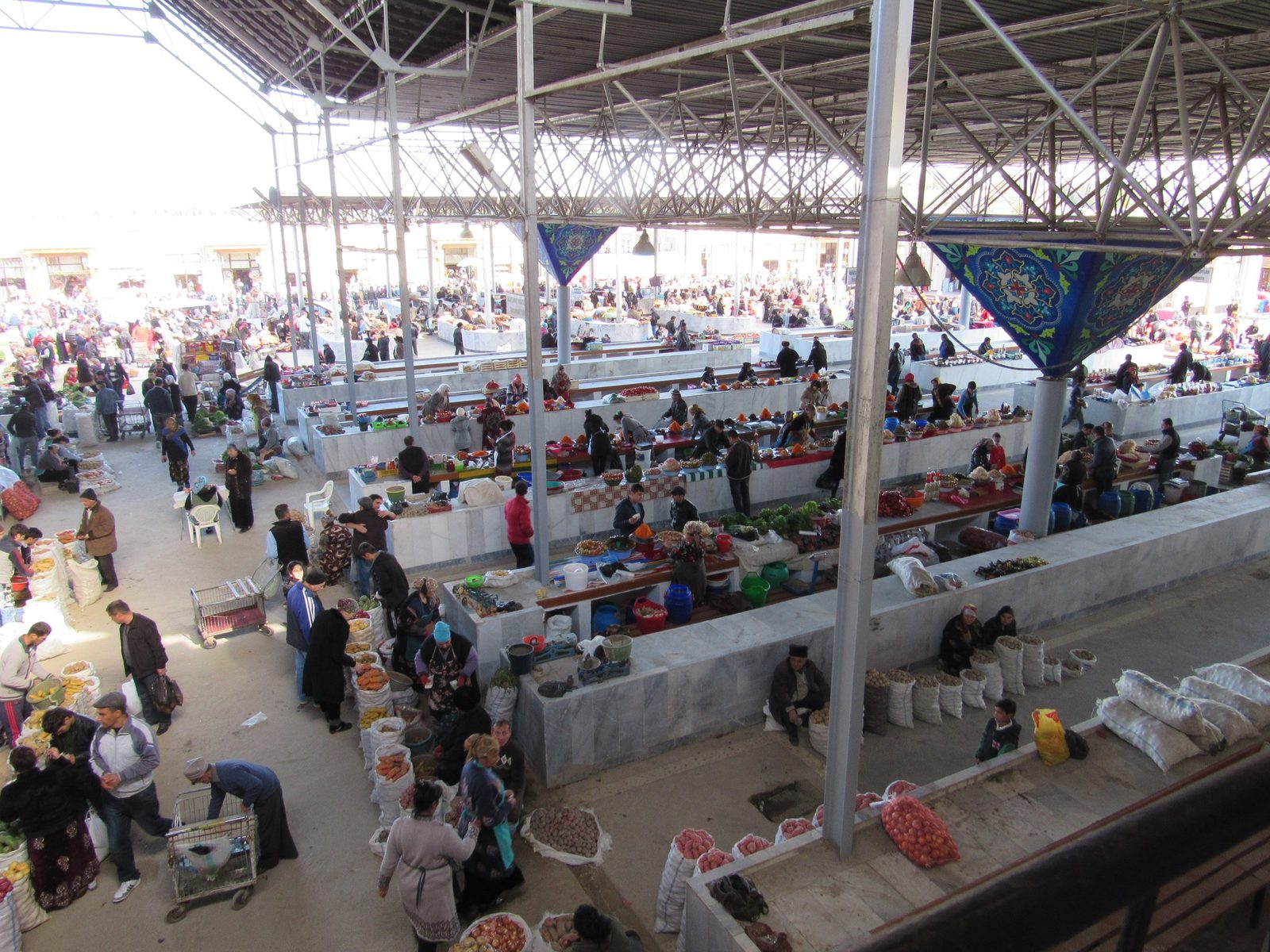
In 2001 UNESCO inscribed the city on the World Heritage List as Samarkand – Crossroads of Cultures, and the name fits: Afrasiyab, the Timurid city and the Russian town are all part of it. The layer that never stopped is the everyday one. Siab Bazaar, beside the Bibi-Khanym Mosque, still sells the dense Samarkand flatbread, dried apricots and nuts, as the city's markets have for centuries.
How to read Samarkand in one or two days
Follow the layers and the city makes sense. Start in the morning at the Registan, when the sun falls on Ulugh Beg's madrasah. Walk the pedestrian street to Did you know? Legend says the architect asked the queen for a kiss Legend says the architect of Bibi-Khanym would finish on time only for a kiss from Timur's wife, and Timur punished him. In fact the mosque was Timur's own project; his wife Saray Mulk Khanum built her madrasah across the road. Read more → and Siab Bazaar, then up to Shah-i-Zinda and on to Afrasiyab and its museum. Gur-e-Amir and the observatory fit into the afternoon, and the Registan is worth a second visit after dark. Our plan for Samarkand in 1, 2 and 3 days gives the timings, and Samarkand sights: tickets and opening hours covers the ticket desks.
The fast Uzbekistan's high-speed train: Tashkent to Samarkand in about 2 hours 10 minutes, Tashkent to Bukhara in about 4 hours. Tickets are tied to your passport. Read more → train covers Tashkent to Samarkand in about two hours and ten minutes; the details are in Tashkent to Samarkand. To see the whole sequence with a guide in your language, take the Samarkand highlights tour. If the oldest layers interest you most, the Sogdiana archaeology tour spends its days on Afrasiyab and the sites around Samarkand and Bukhara. The stories that guides tell at each stop are collected in legends of Samarkand.
In short
- Ancient Samarkand stood on the hill of Afrasiyab from about 500 BC until the Mongols took it in 1220; the city you visit grew up beside it afterwards.
- The Ambassadors' Painting of 648–651 in the Afrasiyab Museum is the best window into the Sogdian city.
- Timur made Samarkand his capital in 1370; Bibi-Khanym and Gur-e-Amir are his. His grandson Ulugh Beg added the Registan madrasah and the observatory.
- Sher-Dor and Tilla-Kari completed the Registan in the 17th century; the Russian town to the west dates from after 1868.
- Walk the layers in order: Registan, Bibi-Khanym, Siab, Shah-i-Zinda, Afrasiyab, and back to the Registan for the evening lights.
© Photos
- Afrasiyab ancient settlement, Samarkand — Akhemen / Wikimedia Commons · CC BY-SA 4.0