
Programme and details
Uzbekistan · 5 Days / 4 Nights · Private Astronomy Tour
Stars of Uzbekistan: Astronomy and Science
Tashkent – Parkent – Samarkand – Nurata – Aydarkul – Samarkand – Tashkent
In 1437 Ulugh Beg’s astronomers in Samarkand finished a catalogue of 1,018 stars, the second in seventeen centuries after Hipparchus. The rock-cut arc of the instrument they used is still on its hill. In five days you see where Uzbekistan has watched the sky for six hundred years: Ulugh Beg’s observatory and madrasah in Samarkand, the Solar Furnace in the foothills near Tashkent, where 62 mirrors follow the sun, and a night in a yurt camp in the The Kyzylkum, or Red Sands: the desert between the Amu Darya and Syr Darya rivers that the road and the railway cross on the way to Khiva. by Aydarkul, far from city lights.
| Duration | 5 days / 4 nights |
| Price | on request |
| Format | Private, or a small group on your dates |
| Where | Tashkent, the Solar Furnace near Parkent, Samarkand, Nurata and Aydarkul |
| Getting there | High-speed train Tashkent – Samarkand and back, about 2 h 30 min; by car with driver to Parkent and Aydarkul |
| Best time | April–May and September–October, with the desert night close to the new moon |
Ideal for amateur astronomers, engineers, science teachers and families with curious children.
Ulugh Beg Observatory — the marble-faced arc of a sextant with a radius of about 40 m, where one degree took up some 70 cm.
Aydarkul — a lake in the Kyzylkum desert, with fewer than two thousand people living along its shores: a dark sky over the yurts.
Itinerary
Day by Day
Day 1 · Tashkent — Space in the metro
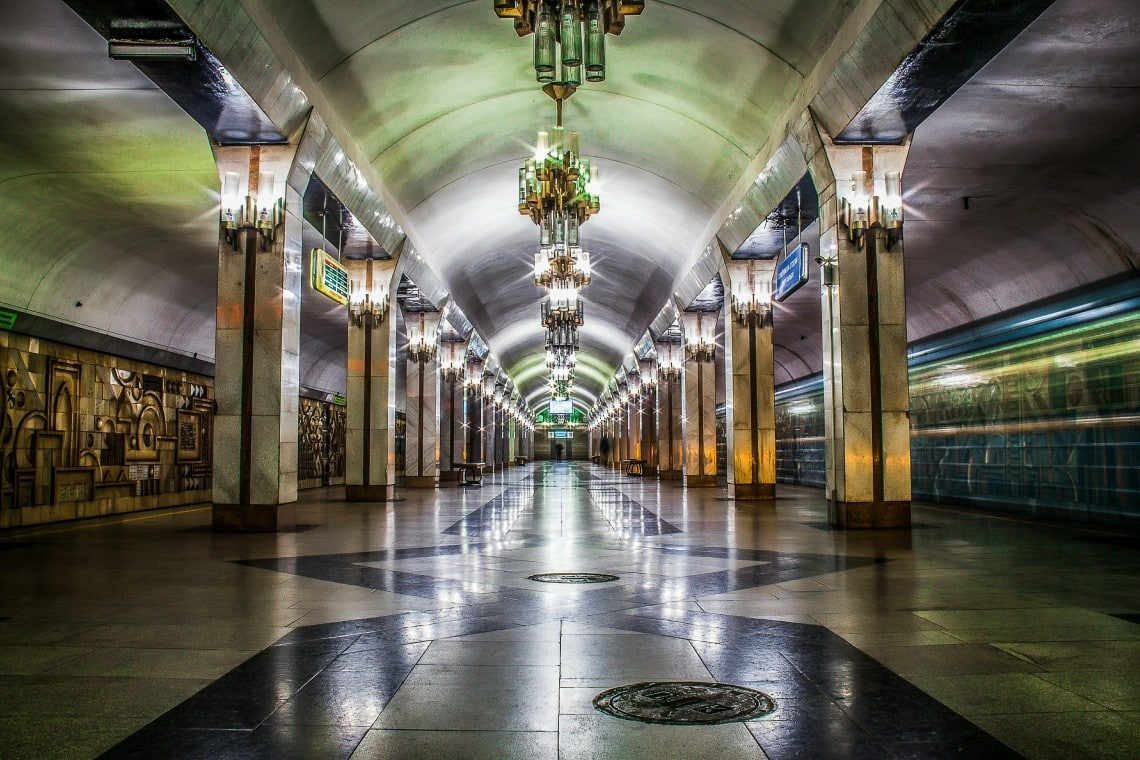
Our driver meets you at Tashkent airport or station and takes you to your hotel. In the afternoon, a walk with your guide through the centre and a ride on the Did you know? A metro designed to ride out a magnitude-9 earthquake The three original lines of the Tashkent Metro were built to withstand an earthquake of magnitude 9.0, and the tunnels lie unusually shallow, only 8–25 m below the street. Read more → to ,Did you know? A metro station where Ulugh Beg meets Gagarin Kosmonavtlar station, opened in 1984, has ceramic medallions of Ulugh Beg, Galileo, Icarus, Gagarin and Tereshkova, and glass stars in the ceiling that hint at the Milky Way. Read more → opened in 1984: walls that darken from turquoise to deep blue like the sky on the way to orbit, glass stars along the ceiling, and ceramic medallions of Yuri Gagarin, Valentina Tereshkova and Ulugh Beg, the astronomer-ruler of Samarkand you meet again on day 3.
In July 2026 Kosmonavtlar became part of the UNESCO World Heritage site “Tashkent Modernist Architecture”, the only metro station on the list.
Overnight in Tashkent
Day 2 · Parkent — 10,700 mirrors, then the high-speed train
In the morning we drive to the Solar Furnace of the Institute of the Sun, in the foothills of the Parkent district, about 45 km east of Tashkent and more than 1,000 m up. The site was chosen for its sunshine: about 270 sunny days a year.
Built in 1981–1987, the furnace works with mirrors alone. On the slope, 62 flat heliostats follow the sun and send its light to a curved concentrator 54 m wide and 42 m high, made of 10,700 mirrors. The concentrator focuses it onto a point in the tower, where the temperature reaches up to 3,000 °C, with a thermal power of 1 MW. Scientists use that heat to test materials. Your guide explains how it all works, from the mirrors on the slope to the tower.
Back in Tashkent for lunch, then the high-speed train to Samarkand, about 2 h 30 min. Our driver meets you at the station.
Good to know: The furnace runs on direct sunlight, so a clear day is the best day to see it. We keep a spare date in mind if the forecast is cloudy.
Overnight in Samarkand
Day 3 · Samarkand — Ulugh Beg’s observatory and madrasah
The morning belongs to the observatory on the Kuhak hill, built in the 1420s. Start in the small museum, with copies of pages from the star tables, then walk down into the trench cut into the rock, 2 m wide and 11 m deep. Its two marble-faced rails are the lower part of the Fakhri sextant, with a radius of about 40 m: one degree took up some 70 cm. Here Ulugh Beg’s team measured the year of the seasons to within 25 seconds and listed 1,018 stars in the ,Did you know? A former teacher found the lost observatory in 1908 After Ulugh Beg's death his observatory was taken apart for its bricks and even its site was forgotten. Vasily Vyatkin, keeper of Samarkand's monuments, traced it through a 17th-century land deed and in 1908 dug up the great marble arc. Read more → finished in 1437. The building was taken apart for its bricks and forgotten; Vasily Vyatkin found the arc in 1908.
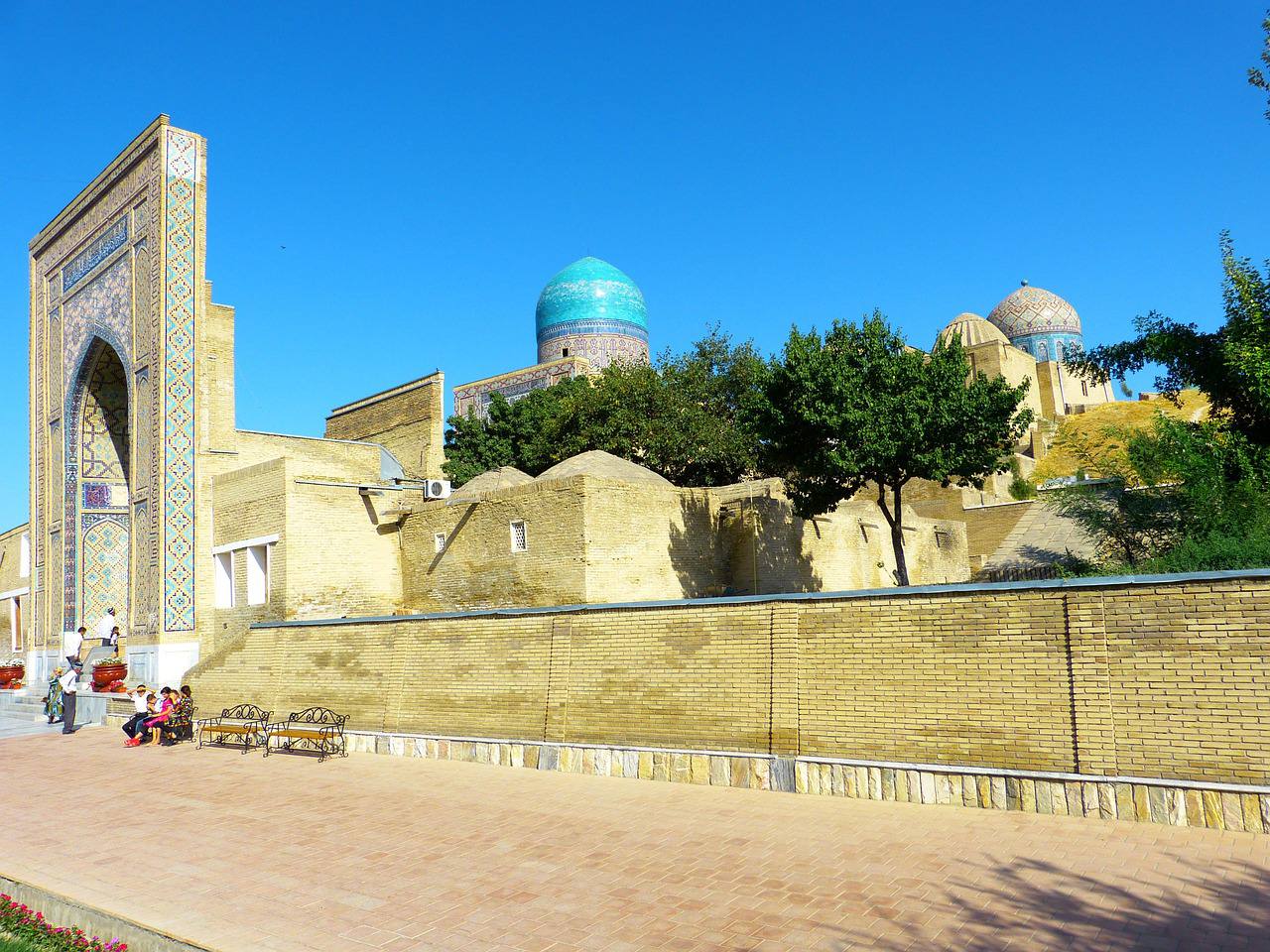
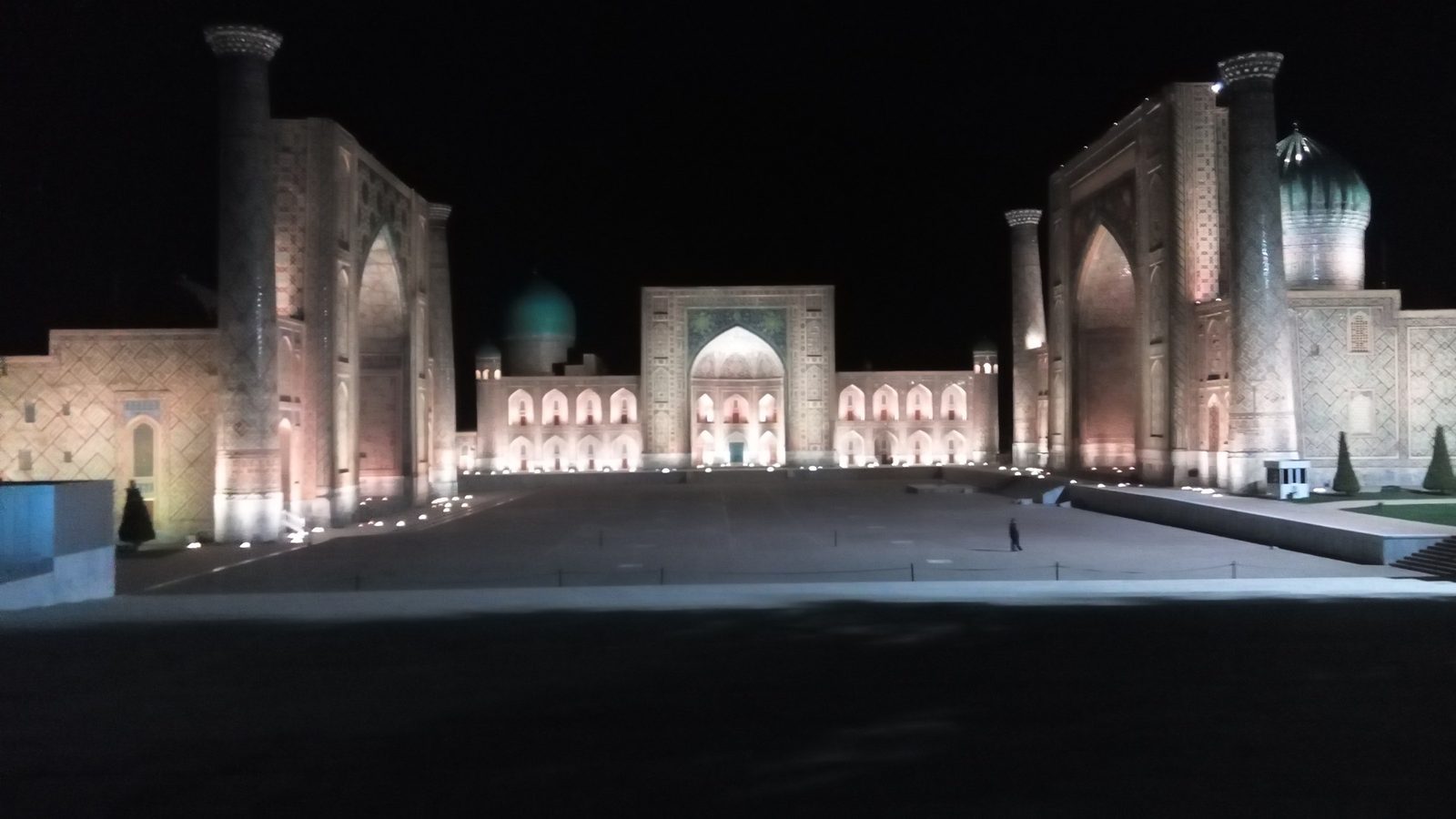
On the way, ,Did you know? Why Shah-i-Zinda means 'the Living King' The necropolis grew around the shrine of Qutham ibn Abbas, a cousin of the Prophet Muhammad. Legend says he did not die in battle but went down a deep well to a garden of paradise, where he lives on. Read more → the lane of tiled tombs on the slope of .Did you know? A 7th-century mural shows envoys from Korea Uncovered by road builders in 1965, the Ambassadors' Painting at Afrasiyab shows delegations bearing gifts, Chinese with silk among them, and two men in feathered hats thought to be envoys from Korea's Goguryeo. Read more → In the afternoon, the Registan, where Ulugh Beg built his madrasah in 1417–1420: astronomy was its most important subject, and the ruler lectured there in person. Then Gur-e-Amir, where he lies a few steps from his grandfather .Amir Timur (Tamerlane, 1336–1405), founder of the Timurid empire, which had its capital in Samarkand. Born near Shahrisabz.
Overnight in Samarkand
Day 4 · Samarkand – Nurata – Aydarkul — A night under the desert sky
By car about 180 km to Nurata. In the centre of the town, the Chashma complex around a holy spring that stays at about 20 °C all year, with the Juma mosque directly above the water. Then about 60 km more to a yurt camp in the Kyzylkum by Aydarkul, a lake that formed only in 1969.
In the afternoon, time to settle in; most camps offer a camel ride on the sand. After dinner, step away from the camp lights and let your eyes adjust for twenty minutes. Your guide helps you find the main constellations and the planets that are up that night. A crater on the Moon carries Ulugh Beg’s name.
Good to know: The desert cools quickly after sunset, even in autumn: bring a warm layer and a torch, and binoculars if you have them.
Overnight in a yurt camp by Aydarkul
Day 5 · Aydarkul — Morning by the lake and the train home
Morning on the shore of Aydarkul, with the Nuratau ridge to the south: pelicans, swans and white herons are seen over the water. Then about 240 km back to Samarkand, and the afternoon high-speed train to Tashkent, about 2 h 30 min. Our driver takes you to your hotel or the airport.
Going on to Bukhara instead? Aydarkul lies between the two cities, and we can end the tour there (on request).
Accommodation
Where you stay
| City | Stay |
|---|---|
| Tashkent | A hotel in Tashkent, 1 night |
| Samarkand | A hotel in Samarkand, 2 nights |
| Aydarkul | A yurt camp in the Kyzylkum by the lake, 1 night |
We confirm the hotels and the camp for your dates before booking. Facilities differ from camp to camp, and we tell you what yours has.
Price
Price
The price is given on request: it depends on the dates, the hotels, the size of your group and the language of the guide.
Good to know
Conditions
- The darkest nights are those close to the new moon: tell us your travel window, and we suggest the dates.
- The night sky depends on the weather: clouds can hide it on any date.
- The train timetable can change: we check it on eticket.railway.uz before we confirm the programme.
- Train tickets need the full name and passport number of every traveller.
- Reservations are confirmed with passport copies only.
Cancellation policy
| Cancellation timing | Penalty |
|---|---|
| 21 days before the service | 20% |
| 20–7 days | 50% |
| 6–0 days | 100% |
Transportation
| Vehicle | Group size |
|---|---|
| Chevrolet Cobalt | 2 pax |
| Hyundai Starex | 3–4 pax |
| Toyota Hiace / King Long | 5–8 pax |
| Mercedes Sprinter | 9–14 pax |
Vehicles may differ in make and colour.
🌿 Responsible tourism: we allocate part of our profits to good causes and are preparing for GSTC certification.
Expert opinion
Pluses
- Sun and stars: the Solar Furnace with its 10,700 mirrors, Did you know? Ulugh Beg measured the year to within 25 seconds Working at his Samarkand observatory, Ulugh Beg put the tropical year at 365 days 5 h 49 min 15 s, about 25 seconds too long, closer than Copernicus a century later. Read more →’s observatory and a night under the desert sky in five days.
- Ulugh Beg in full: his An Islamic college: student cells and classrooms around a courtyard behind a grand portal. In the old towns many now house museums and craft workshops. on the ,Did you know? The Registan's sun-carrying lion went on a banknote The Sher-Dor Madrasah (1619–1636) is named for the big cats with the sun on their backs on its portal. The image appeared on the reverse of Uzbekistan's 200-som note of 1997. Read more → the 40-metre sextant on the Kuhak hill and his grave in .Did you know? Timur's tombstone went to Persia and came back The dark-green jade slab on Timur's grave in Gur-e-Amir was carried off by Nader Shah in 1740. It broke, and on his advisers' urging he sent it back to Samarkand. Read more →
- A dark sky: a yurt camp by Aydarkul, where fewer than two thousand people live along the shores.
Minuses
- Long drives: Samarkand to the yurt camp is about 240 km each way, and day 5 ends with the train to Tashkent.
- Weather and Moon: clouds or a bright Moon can hide the faint stars, so we plan the dates around the new moon.
- A simple night: facilities in the yurt camp are simpler than in a hotel, and the desert is cold after sunset.
AroundCA numbers
How we counted
By the AroundCA programme: we count only what is written in the day-by-day programme of this tour. If the programme gives no figure, we show nothing.
- Hotel changes
- 2
Best time
Apr–May, Sep–Oct
April–May and September–October: afternoons around 23 °C in Navoi in April and October, while July is about 36 °C.
Better to avoid
Jul–Aug
July and August: about 36 °C in the afternoon, and the Kyzylkum stays hot from mid-May to mid-September.
A typical day
On day 3 you start at the observatory on the Kuhak hill: the museum first, then the trench in the rock with the marble rails of Ulugh Beg’s sextant. Shah-i-Zinda is on the way. In the afternoon, the Registan and the madrasah where astronomy was taught, then Gur-e-Amir, where Ulugh Beg is buried. The night is in a hotel in Samarkand.
What the price includes
What is included
- High-speed train tickets Tashkent – Samarkand – Tashkent
- Accommodation: 3 nights in hotels with breakfast and 1 night in a yurt camp
- A private car with driver on the programme
- A guide on all five days
- Entrance tickets on the programme
- A private car with driver on the programme, including the drive to the Solar Furnace and to Aydarkul
Not included
- Meals and drinks not on the programme
- Camel rides and other activities at the camp
- Photo and video fees at the sites
- International flights and visa fees (if applicable)
- Tips and personal expenses
Extra cost on site
- Camel rides and other activities at the camp
- Photo and video fees at the sites
- Tips and personal expenses
Good for
- Amateur astronomers and anyone who wants to see a sky without city lights
- Engineers, science teachers and students curious about how the Solar Furnace works
- Families with children who like space, maps of the sky and stories about scientists
Maybe not for you if
- Anyone who wants a hotel every night: one night is in a yurt camp, where facilities are simpler
- Travellers who mind long drives: Samarkand to Aydarkul is about 240 km each way
- Those who need a telescope session guaranteed: the night sky here is for the naked eye and binoculars
Questions about this tour
How much does the tour cost?
The price is given on request: it depends on the dates, the hotels, the size of your group and the language of the guide.
When is the sky darkest?
On the nights close to the new moon: a bright Moon washes out the faint stars and the Milky Way. Tell us your travel window, and we put the yurt night as close to the new moon as we can. Spring and autumn are the most comfortable seasons: in Navoi, the regional centre, the average afternoon is about 23 °C in April and October, but about 36 °C in July.
Will there be a telescope?
The programme is built around the naked-eye sky and binoculars, so bring a pair if you have one. If you would like a telescope session, tell us when you book, and we check what we can arrange for your dates.
What is the yurt camp like?
You sleep in a felt yurt on or near the shore of Aydarkul. Larger camps have electricity, showers and toilets; simpler ones have shared washrooms. We tell you what your camp has before you book.
What should I pack?
A warm layer for the night, even in autumn, because the desert cools quickly after sunset; a torch; closed shoes for the sand; a sun hat and sunscreen for the day. Binoculars help both with the sky and with the birds over the lake.
Can we continue to Bukhara instead of returning to Tashkent?
Yes. Aydarkul lies between Samarkand and Bukhara: Nurata is about 180 km from Samarkand and about 175 km from Bukhara. We can end the tour in Bukhara and plan the next days of your trip from there.
Didn’t find your answer? Ask about this tour →
Make it your trip
Tick what you’d like to add — it goes into your request, and the manager confirms the final price.
Add a few days
Arrival, departure, transfers
© Photos
Kosmonavtlar metro station, Tashkent — Oqsaqol / Wikimedia Commons · CC BY-SA 4.0; Aydarkul lake seen from the Nuratau ridge — Carpodacus / Wikimedia Commons · CC BY-SA 4.0