
 Deutsch
 English
 Español
 Français
 Italiano
 Polski
 Português
 Suomi
 Svenska
 Türkçe
 Ελληνικά
 Български
 Русский
 עברית
 한국어
 中文
 日本語
Places in this article: Samarkand · Khiva
Ancient Merv and Nisa: Turkmenistan’s Silk Road ruins on a trip from Uzbekistan
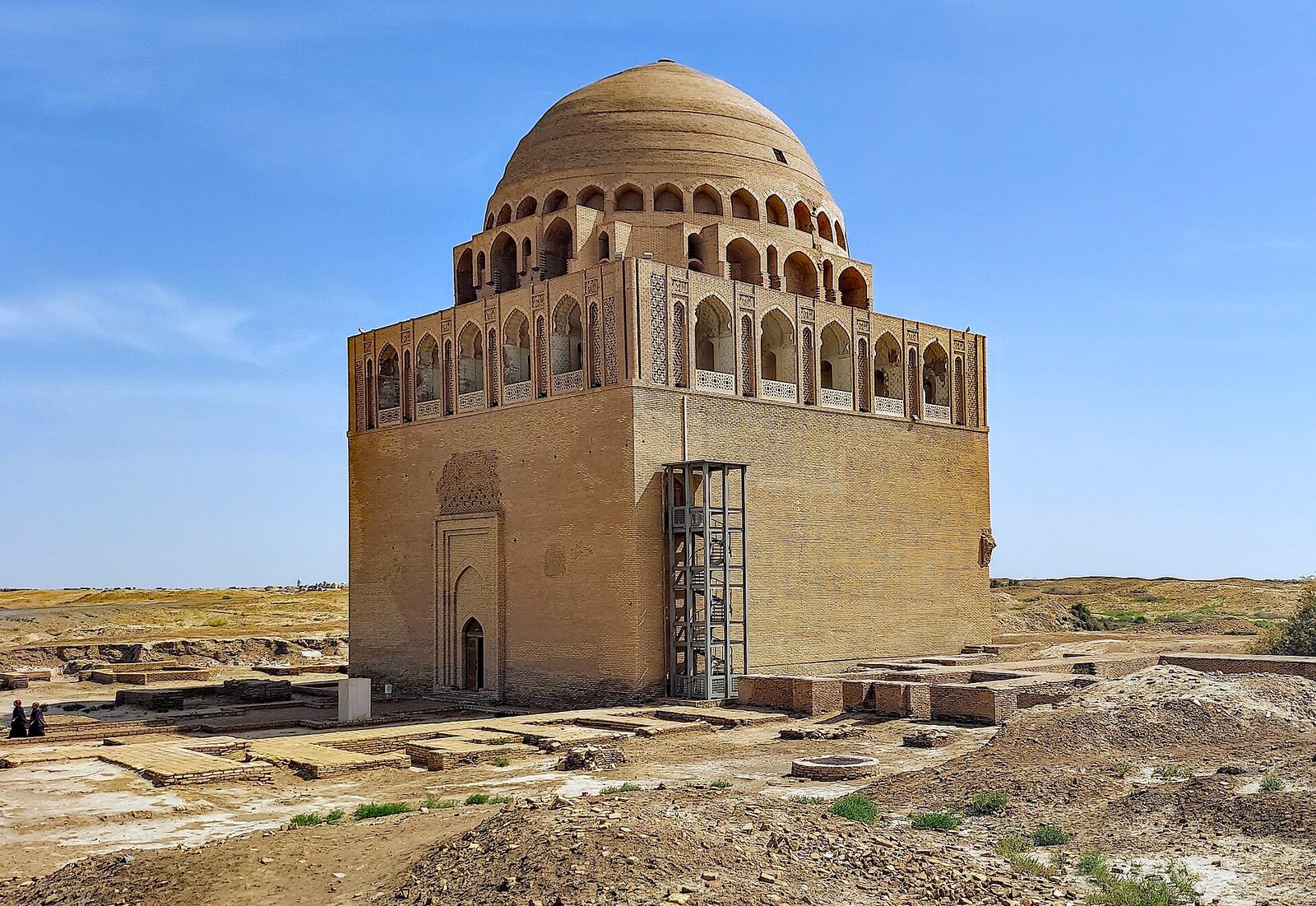
In 1157 a builder from Sarakhs put a dome 27 metres high over the tomb of Sultan Sanjar in Merv. Its double shell, an inner dome under an outer one, is the idea that the builders of Amir Timur (Tamerlane, 1336–1405), founder of the Timurid empire, which had its capital in Samarkand. Born near Shahrisabz. Read more → later carried to Samarkand. Today the mausoleum stands almost alone in open steppe outside the town of Mary, and the city that once surrounded it is a field of clay walls.
We are a tour operator in Tashkent, and Ancient Merv is the place our guests ask about once they have seen Samarkand and Bukhara. Here is what you see at Merv and at Nisa, the Parthian fortress outside Ashgabat, and how our Merv, Darvaza and Khiva tour joins Turkmenistan to Uzbekistan in one trip.
In short
- Ancient Merv is about 30 km east of Mary, some four hours by road from Ashgabat; it has been on the UNESCO World Heritage List since 1999.
- The site is four walled cities side by side, from Erk Kala, the oldest, to the Seljuk capital Sultan Kala and the later Timurid town.
- Do not miss the mausoleum of Sultan Sanjar (1157) and the corrugated clay walls of the Great Kyz Kala.
- Nisa, 18 km west of central Ashgabat, was a royal fortress of the Parthians; it has been on the UNESCO list since 2007.
- We file your Turkmen e-Visa application and plan the route on to Khiva across the land border.
Contents
Four cities in one field
People lived at Merv from the third millennium BC until the 18th century, and each new city was built beside the old one. That is why the site is so large. Erk Kala, the oldest, is a high ring of earth from the Achaemenid period. Around it lies ,Did you know? Shells from the Indian Ocean were found near Nukus Gyaur-Kala near Mizdakhan, a Khorezm fortress of the 4th century BC with walls about 10 m high, stood on a branch of the Silk Road. Finds there include coral beads, Indian Ocean shells and fabrics woven with gold thread. Read more → the city that the Seleucid king Antiochus I rebuilt as Antiochia Margiana, and that stayed in use under the Sasanians.
To the west is Sultan Kala, by far the largest of the walled cities. The Seljuks took Merv in 1037, and in the 11th and 12th centuries it was the capital of the Great Seljuk Empire. In the 12th and 13th centuries Merv may have been the largest city in the world. In 1221 it fell to the Mongols and never regained its size. A smaller town, Abdullah Khan Kala, was founded later a short distance to the south under the Timurids. Without a guide the walls all look alike; ours walks you from the oldest rampart to the newest, so you see the order in which the oasis grew.
The mausoleum of Sultan Sanjar
Sanjar ruled from Merv until his death in 1157, and his mausoleum is the building that holds the centre of Sultan Kala. It is a squat cube, 17 by 17 metres, under a dome 27 metres high. Its outer dome was once covered in turquoise tiles and could be seen from far across the plain. That outer layer is gone, but the double dome survived, and the same idea shaped the domes of the Timurid period that you see in Samarkand.
The Great Kyz Kala: walls like folds of cloth
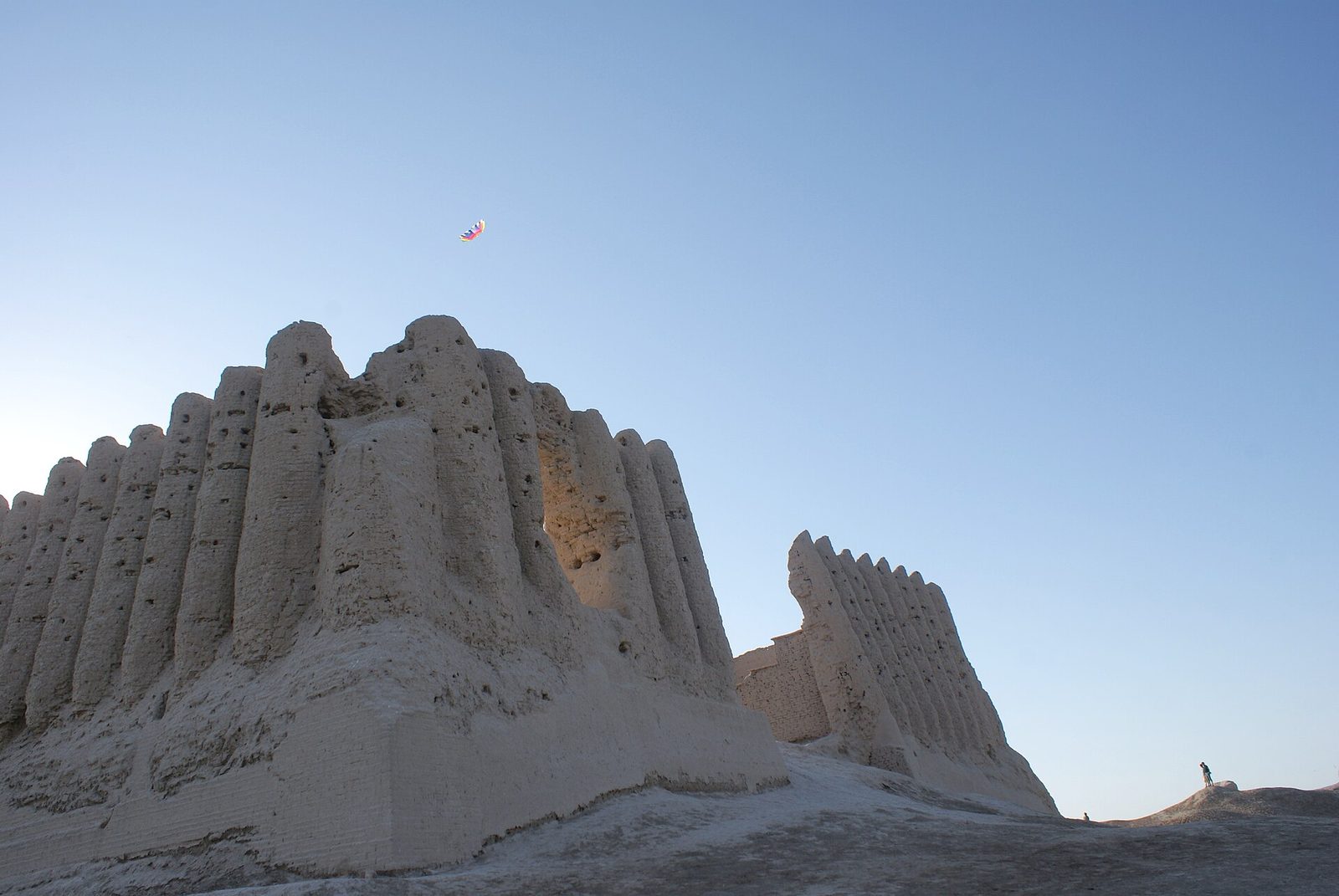
A short drive from the mausoleum stands the Great Kyz Kala, a clay building whose outer walls are made of tall half-columns set close together. From a distance they look like folds of heavy cloth. Scholars date it either to the 6th–7th century, under the Sasanians, or to the 8th–9th century, and it was probably an elite residence, perhaps for the governor of Merv. Come in the late afternoon, when the low sun throws the ribs into relief.
Nisa: the Parthian fortress outside Ashgabat
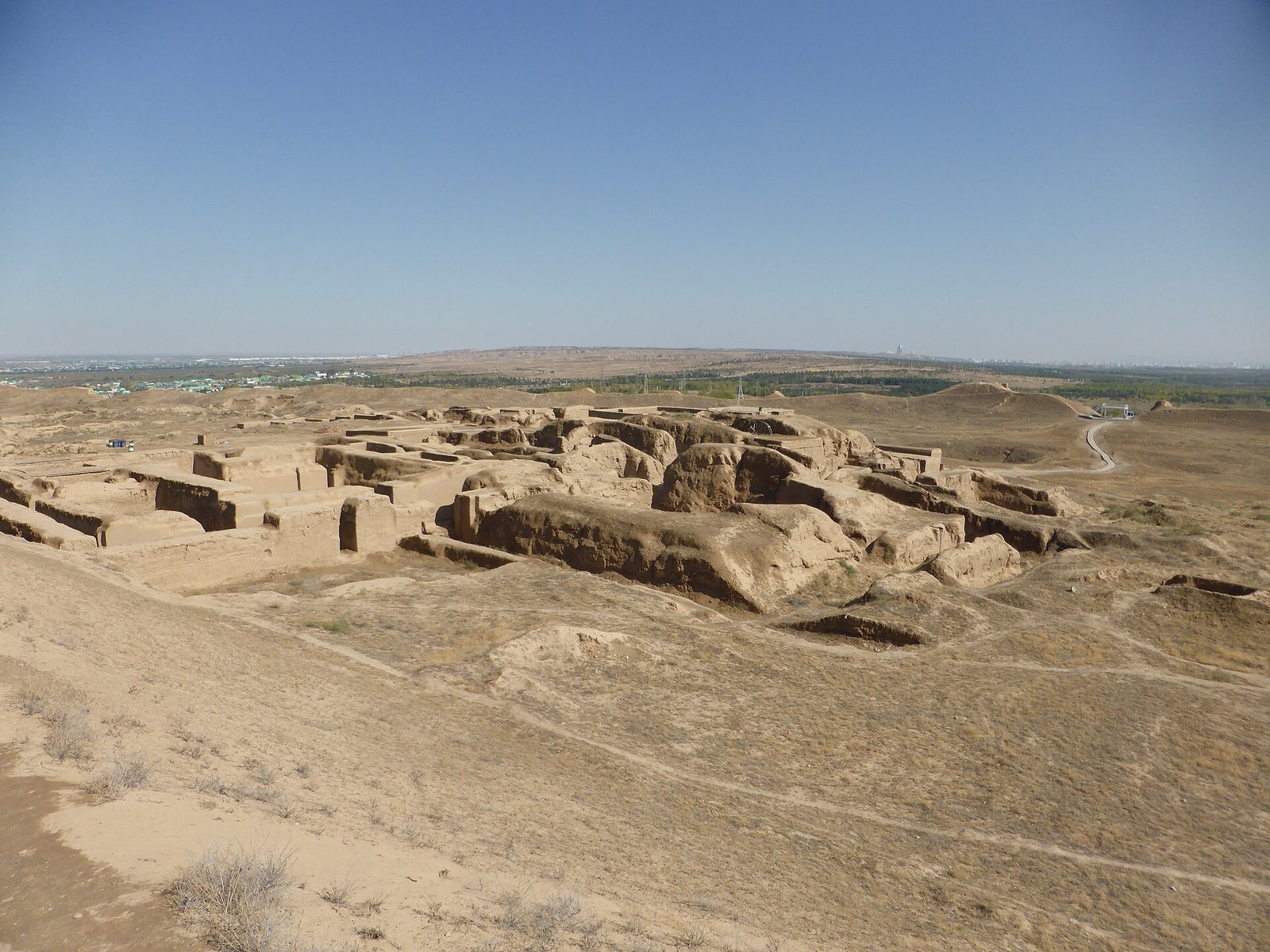
Nisa lies 18 km west of central Ashgabat, on two hills at the foot of the Kopet Dag. It was one of the first seats of the Parthians, the dynasty traditionally said to begin with Arsaces I in the 3rd century BC. Mithridates I later renamed it Mithradatkert. The excavations found a large number of ivory rhytons, carved drinking horns, and on our tour you see them in the National Museum of History in Ashgabat on the same day as the fortress. The Parthian fortresses of Nisa have been on the UNESCO World Heritage List since 2007.
How Merv and Nisa fit into a trip from Uzbekistan
Merv is a day trip from Ashgabat: about 355 km to Mary and some four hours each way with stops, so it is the longest day on the road of our tour. We carry bottled water, and there is shade only at the monuments, so bring a hat. Spring, from April to May, and autumn, from September to October, are the best months; summer in the Karakum is very hot.
Our ten-day Merv, Darvaza and Khiva tour starts in Ashgabat with Nisa and the museum, then Merv, then a night in a yurt camp by the Darvaza gas crater. From there the cars go on to the Dashoguz and Shavat border, and our team meets you on the Uzbek side and drives you to Khiva. High-speed trains then take you to Bukhara, Samarkand and Tashkent.
Merv with AroundCA
Turkmenistan issues visas only through its e-Visa portal. We file the application for you, check your scans against the requirements and tell you when the Entry rules depend on your passport. Once you are here, each stay must be registered within three days, and hotels do it for you; customs and registration rules are in our guide. Read more → is ready to show on your phone at the border. In Turkmenistan an English-speaking guide and a car with driver are with you every day, and 4×4 vehicles take you across the Karakum. The price is on request: it depends on your dates and the size of your group.
For the nights in Uzbekistan after the border, see our hotels in Khiva. Want Uzbekistan's own ruins too? The desert fortresses of Khorezm are close to Khiva: read Khorezm desert fortresses.
© Photos
- The mausoleum of Sultan Sanjar, Ancient Merv, Turkmenistan — P. Hughes / Wikimedia Commons · CC BY 4.0
- The ribbed clay walls of the Great Kyz Kala, Ancient Merv, Turkmenistan — Gai Jorayev / Wikimedia Commons · CC BY-SA 4.0
- The excavated halls of Old Nisa, the Parthian fortress near Ashgabat, Turkmenistan — Hans Birger Nilsen / Wikimedia Commons · CC BY-SA 2.0