Places in this article: Samarkand · Bukhara · Khiva · Tashkent
Samarkand, Bukhara or Khiva: which one to choose
,Did you know? People still live inside Khiva's museum city Itchan Kala packs more than 50 historic monuments and about 250 old houses inside clay walls 8–10 m high and 5–6 m thick, and families still live and work in its lanes. Read more → the walled old town of Khiva, measures about 650 by 400 metres: you cross it in twenty minutes. The old town of Bukhara takes half an hour on foot. In Samarkand the great monuments are strung out across a living city, and the last of them, the ,Did you know? Ulugh Beg measured the year to within 25 seconds Working at his Samarkand observatory, Ulugh Beg put the tropical year at 365 days 5 h 49 min 15 s, about 25 seconds too long, closer than Copernicus a century later. Read more → is 3.5 km from the .Did you know? The Registan's sun-carrying lion went on a banknote The Sher-Dor Madrasah (1619–1636) is named for the big cats with the sun on their backs on its portal. The image appeared on the reverse of Uzbekistan's 200-som note of 1997. Read more → That difference in size tells you a lot about how each city feels. If you are deciding between Samarkand, Bukhara and Khiva, or wondering whether to choose Samarkand or Bukhara when there is no time for both, here is how we, a team from Tashkent that takes guests to all three, compare them honestly.
The three cities side by side
| Samarkand | Bukhara | Khiva | |
|---|---|---|---|
| Character | Amir Timur (Tamerlane, 1336–1405), founder of the Timurid empire, which had its capital in Samarkand. Born near Shahrisabz.’s capital: huge portals and domes in a modern city | A lived-in old town of ponds, Did you know? Under Bukhara's domes merchants changed money and gold Four 16th-century trading domes still stand over old crossroads. Toki Sarrafon was the money changers' dome, where merchants from India and China swapped coins; Toki Zargaron held jewellers' workshops, Toki Telpak Furushon sold caps. Read more → and lanes | A whole walled town, kept in one piece |
| Main sights | Registan, ,Did you know? Timur's tombstone went to Persia and came back The dark-green jade slab on Timur's grave in Gur-e-Amir was carried off by Nader Shah in 1740. It broke, and on his advisers' urging he sent it back to Samarkand. Read more → ,Did you know? Legend says the architect asked the queen for a kiss Legend says the architect of Bibi-Khanym would finish on time only for a kiss from Timur's wife, and Timur punished him. In fact the mosque was Timur's own project; his wife Saray Mulk Khanum built her madrasah across the road. Read more → Did you know? Why Shah-i-Zinda means 'the Living King' The necropolis grew around the shrine of Qutham ibn Abbas, a cousin of the Prophet Muhammad. Legend says he did not die in battle but went down a deep well to a garden of paradise, where he lives on. Read more → | ,Did you know? Legend: the minaret's foundation was laid with camel milk Legend says master Bako laid the foundations of the Kalyan minaret with ganch plaster mixed with camel milk, then vanished for two years to let them harden, and only then built the tower. Locals still show a grave they say is his. Read more → ,The fortress-residence of the rulers of Bukhara on a high artificial hill: the oldest structure in the city. Read more → ,Did you know? Bukhara's ponds were once its water supply Pools like Lyabi-Hauz, dug around 1620 and 46 × 36 m, were the city's main source of water. Most were filled in during the 1920s–30s because they spread disease; Lyabi-Hauz survived. Read more → the Did you know? Buried in mud, this tomb escaped Genghis Khan The 10th-century Samanid Mausoleum, one of the oldest monuments of Islamic Central Asia, was covered by flood mud and sand before the Mongols came in 1220. Hidden for centuries, its brick lacework survived intact. Read more → | ,Did you know? A 14-metre-wide base for a tower that stopped at 29 m Kalta Minor was begun in 1852 and meant to reach 70–80 m, but work halted in 1855 at about 29 m when its khan died. It is said to be the only minaret covered entirely in glazed tiles. Read more → the ,Did you know? Khiva's Juma Mosque stands on 212 wooden columns Recorded as early as the 10th century and rebuilt in 1788, the Juma Mosque has no portal and no domes: its flat roof rests on 212 carved columns in 17 rows, and some of them are older than the building itself. Read more → ,Did you know? In the khan’s courtyard a round platform waited for a yurt The Kunya-Ark, the khans’ citadel, had its own mint, arsenal and harem. In the courtyard of its reception hall of 1804–1806 stands a round platform: a yurt was set up on it, and there the khan received envoys of the steppe nomads. Read more → Did you know? Khiva's tallest minaret is barely a century old The Islam Khoja Minaret was begun in 1908, near the very end of the khans' era. At 56.6 m it is one of the tallest in Central Asia; a spiral stair of 175 steps leads up to its windowed top. Read more → |
| On the UNESCO list | Since 2001 | Since 1993 | Since 1990, the first in Uzbekistan |
| On foot | Several kilometres; the observatory by car | Half an hour across the old town | Twenty minutes across Itchan Kala |
| How long | 2 days, 3 with a day trip | 2 days | 1 full day plus the evening you arrive |
| From Tashkent | ,Uzbekistan's high-speed train: Tashkent to Samarkand in about 2 hours 10 minutes, Tashkent to Bukhara in about 4 hours. Tickets are tied to your passport. Read more → about 2 h 10 min | Afrosiyob, about 4 hours | Fast train, 07:00 to 14:31, not on Sundays, or a flight to Urgench |
| Best for | A first trip and a short stay | Slow walks, evenings, food and crafts | Photography and a town to yourself at dawn |
Samarkand: the scale of an empire
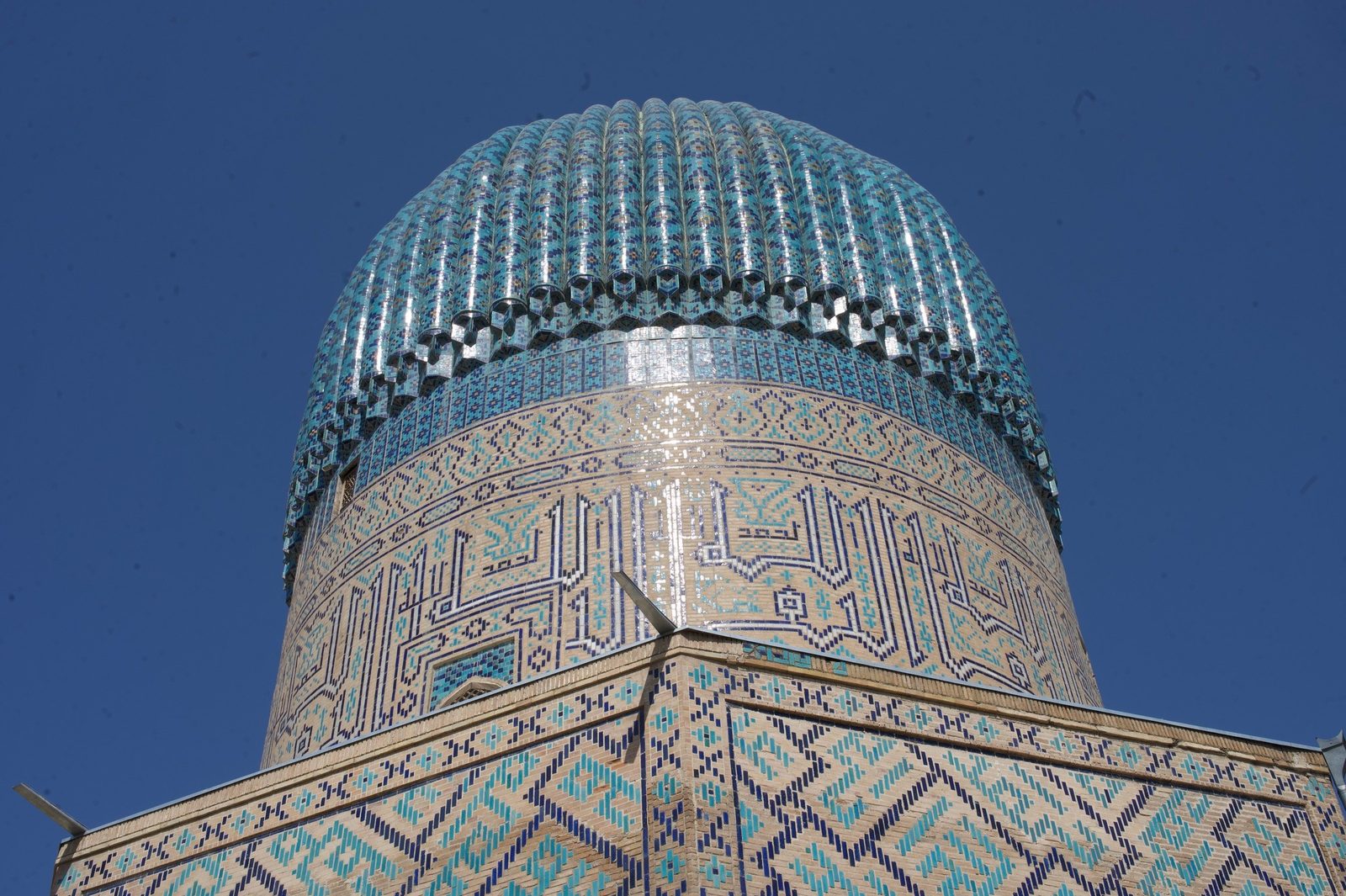
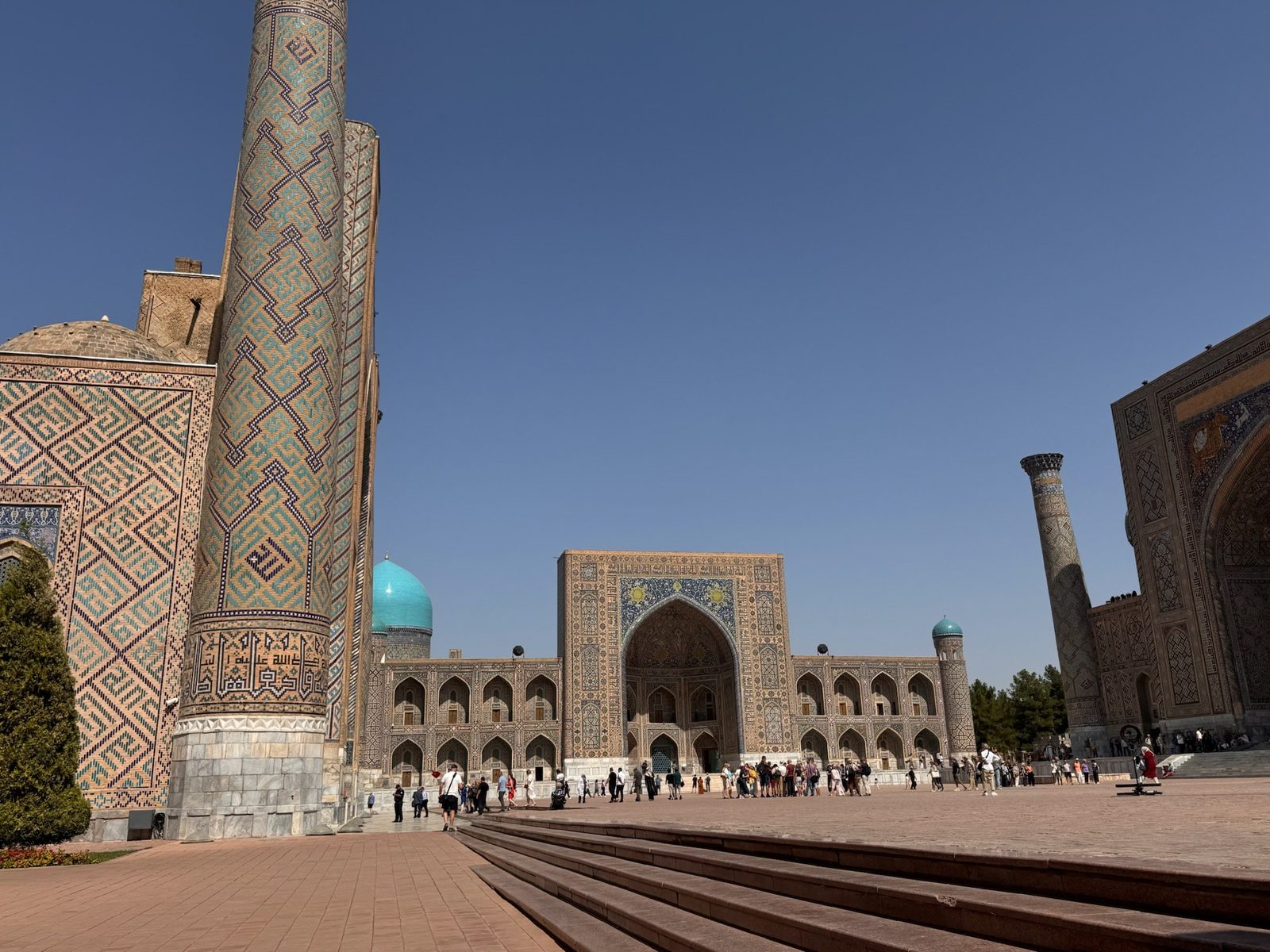
Samarkand is about size. The Registan is three madrasas around one square, and it took more than two centuries to finish: Ulugh Beg’s in 1417–1420, Sher-Dor in 1619–1636, Did you know? The 'gilded' mosque of the Registan Tilla-Kari, built in 1646–1660, means 'gilded'. With Bibi-Khanym in ruins, it served as Samarkand's main Friday mosque until the 1920s. Its prayer hall glows with kundal, relief painting finished in gold leaf, restored in 1979. Read more → in 1646–1660. Gur-e-Amir, the mausoleum of Timur, was completed in 1404, and his Did you know? 95 elephants hauled stone for Timur's great mosque Bibi-Khanym, begun in 1399 after Timur took Delhi, was the largest mosque of his empire. Some 200 stonecutters worked on site and 95 elephants brought from India hauled the loads; the courtyard was meant to hold 10,000 people. Read more → was built in 1399–1405. Shah-i-Zinda is the quieter counterpoint: a narrow lane of more than twenty tiled buildings from the 11th to the 15th and the 19th centuries.
Around the monuments is a modern city with avenues and traffic, so Samarkand feels less like a preserved old town and more like a capital that kept its great buildings. The sights lie roughly on one line and most are a walk apart, about 700 m to 1 km between stops, but the line is long. Two days cover it well; a third adds the Ulugh Beg Observatory, the A village near Samarkand where paper is made by hand from mulberry bark, the old way, at a working mill on the stream. Did you know? Paper polished with stone, made to last 400 years At the Meros mill in Konigil, founded in 1996 to revive a craft that had died out, a water wheel beats mulberry bark into pulp, and each sheet is polished for hours with agate, shell or horn. It is made to last some 400 years. Read more → or a day trip to Shahrisabz.
Samarkand is also the easiest to reach: about 2 h 10 min from Tashkent by Afrosiyob, so even a day trip works. Our plan for Samarkand in 1, 2 or 3 days gives the order, and the Registan, Gur-e-Amir and Shah-i-Zinda have their own guides. For the walk itself we can arrange a walking tour of Samarkand with a guide.
Bukhara: an old town that people still live in
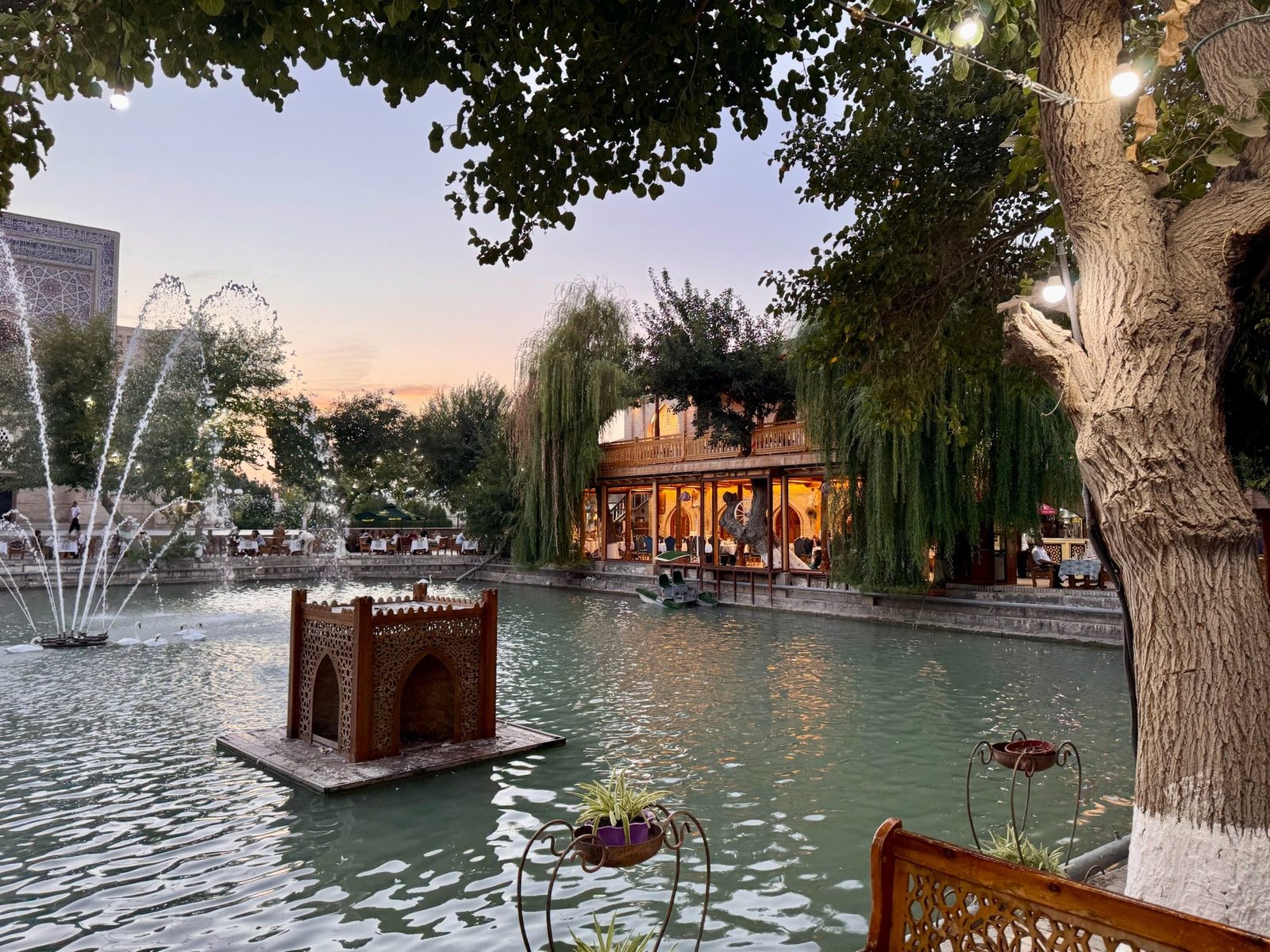
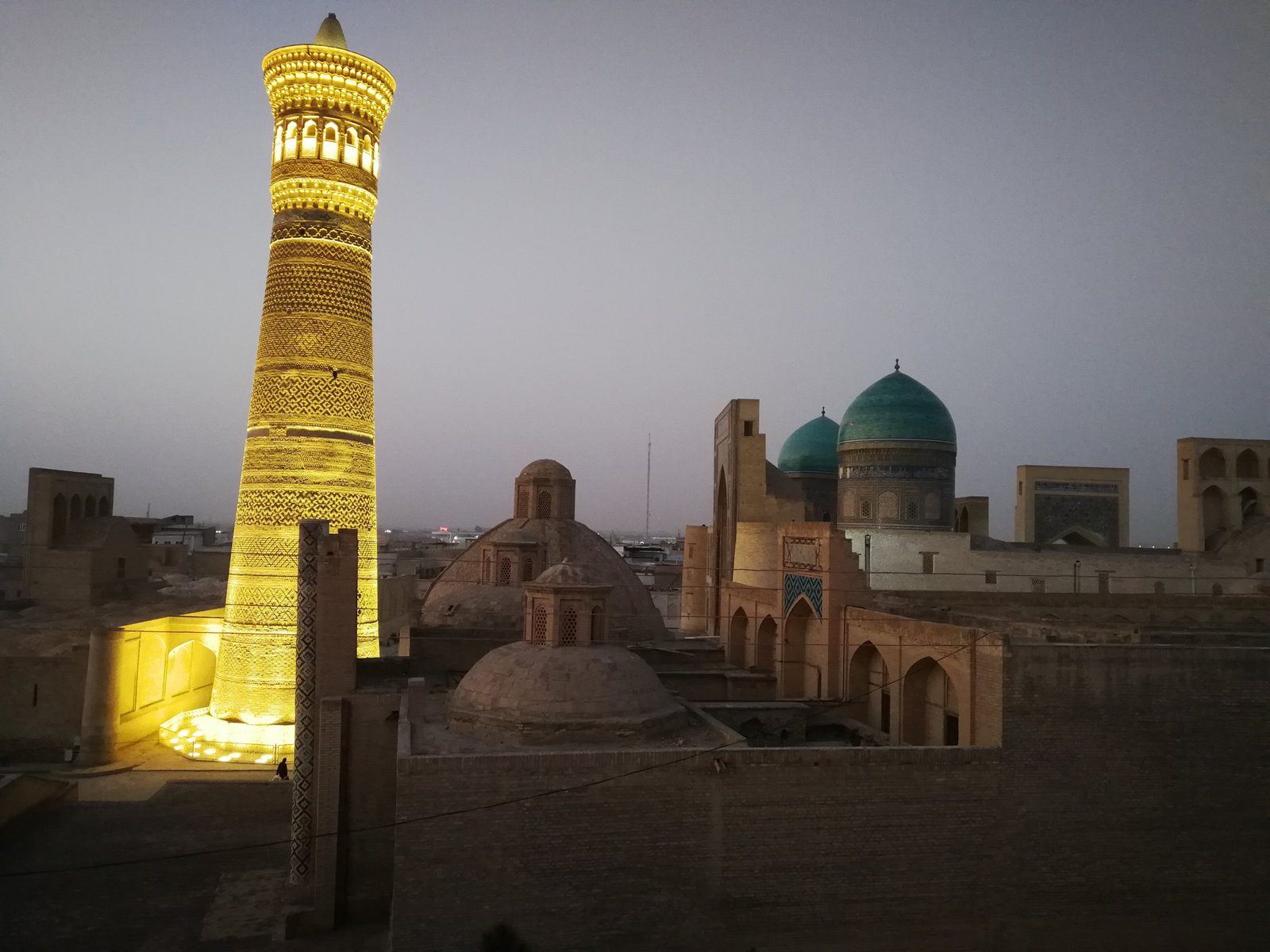
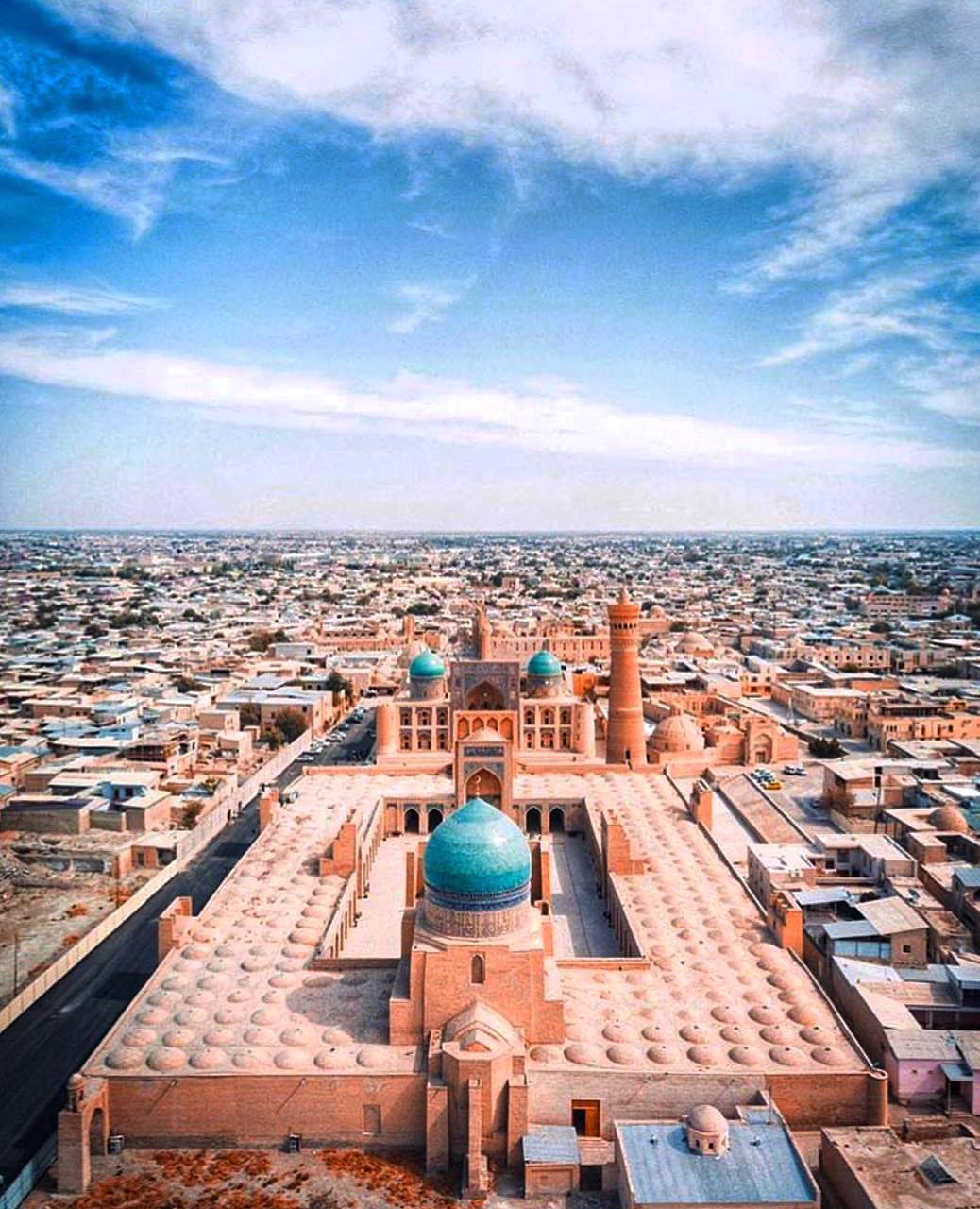
Bukhara is about texture. Its oldest buildings are older than Samarkand’s: the Samanid Mausoleum is a 10th-century cube of patterned brick, and the Did you know? Diggers went 13 m down and never found its base The Kalyan Minaret of 1127 rises about 46 m, and an excavation reached 13 m without finding the bottom of its foundations. Genghis Khan reportedly ordered it spared. Read more → of 1127 rises about 46 m over Poi Kalyan. Between them run the 16th-century trading domes, still full of stalls, and the lanes of houses where the old town carries on its ordinary life.
The centre of gravity is Lyabi-Hauz, a square around a pond of about 1620, framed by madrasahs and teahouses. Everything is close: from the pond to the Kalyan minaret is about 500 m. That makes Bukhara the city of evenings. When the day groups leave, you have tea by the water and walk back to Poi Kalyan to see it lit up. Two days are what we plan for most guests: the old town on foot on the first, the emir’s summer palace and the Did you know? A village renamed in honour of a Sufi master Bahauddin Naqshband (1318–1389), who gave his name to one of the largest Sufi orders, was born and buried near Bukhara in Qasr-i Hinduvan. The village was later renamed Qasr-i Arifan in his honour; the tomb over his grave dates from 1544. Read more → complex by car on the second.
The station is in Kagan, about 12 km away, under two hours from Samarkand by Afrosiyob. See Bukhara in 1, 2 or 3 days, Poi Kalyan, the Ark and Lyabi-Hauz and Chor Minor. One of the best evenings here is dinner with a local family, which we arrange.
Khiva: a walled town in one piece
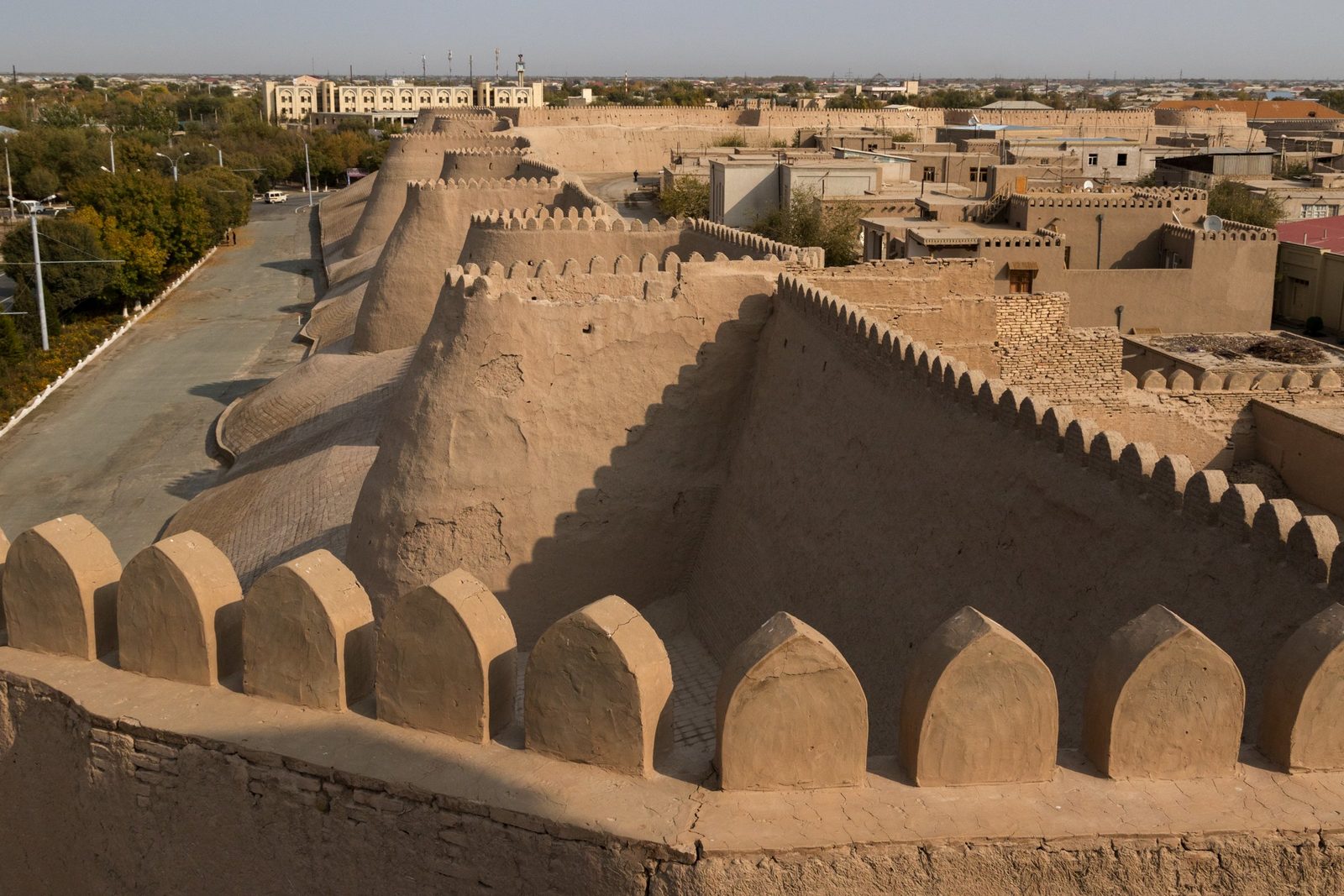
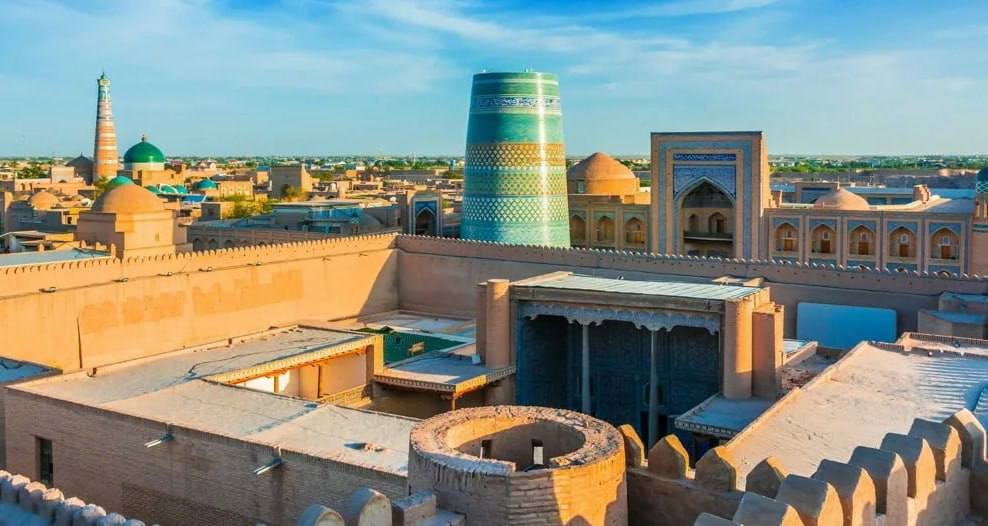
Khiva is about completeness. Itchan Kala, the inner town behind clay walls, was the first site in Uzbekistan on the UNESCO World Heritage List, in 1990. Inside, everything is a few minutes apart: the Kalta Minor, begun in 1852 and stopped at about 29 m, the only minaret covered entirely in glazed tiles; the Juma Mosque with 212 carved wooden columns; the khans’ citadel, Kunya Ark; and the 56.6 m minaret of Islam Khoja.
What Khiva has that the other two lack is the whole picture at once: walls, domes, minarets and flat clay roofs in one view from the watchtower of the Kunya Ark. The best hours are the first and the last, when the light is soft on the clay and the lanes are empty, so sleep inside the walls if you can. One full day plus the evening you arrive covers Itchan Kala properly; a second day adds the outer town and the desert fortresses.
The price is distance. Khiva lies beyond the The Kyzylkum, or Red Sands: the desert between the Amu Darya and Syr Darya rivers that the road and the railway cross on the way to Khiva. Desert. The fast train leaves Tashkent at 07:00 every day except Sunday and arrives at 14:31; from Bukhara the crossing takes about three and a half hours. The other way is a flight to Urgench, 30 km from Khiva. See Khiva in 1 or 2 days, Itchan Kala and Kalta Minor and Islam Khoja. For a day inside the walls we offer a private guide in Khiva.
Who each city suits
- A first trip to Uzbekistan: Samarkand. It has the images people come for, and it is the closest to Tashkent.
- Architecture and history: Samarkand for the Timurid buildings of around 1400, Bukhara for the 10th and 12th centuries.
- Slow travel and families: Bukhara. Short distances, shade under the domes at midday, evenings by the pond.
- Photography: Khiva at sunrise and sunset, and the Registan in Samarkand, where the sun moves from one facade to the other during the day.
- Crafts: the stalls under Bukhara’s trading domes, handmade paper at Konigil near Samarkand, Khorezm woodcarving in Khiva.
- Fewer people: Khiva before breakfast, or Bukhara after dark.
Samarkand or Bukhara: if you have 2, 3 or 5 days
Two days. Choose Samarkand. Take the morning Afrosiyob from Tashkent, spend one night, and you see the Registan in the evening lights and at 8 a.m., when it opens, plus Shah-i-Zinda in the morning. If you have already seen Samarkand, Bukhara with one night is the better second visit. Khiva in two days only works if you fly to Urgench and back.
Three days. Samarkand and Bukhara. Day one Tashkent to Samarkand, day two Samarkand in the morning and the train to Bukhara, day three Bukhara and an afternoon train back to Tashkent, about four hours. Fast, but both cities get an evening. If you would rather see one city properly, take Samarkand with a third day for Shahrisabz, or Khiva on its own with our Khiva in 3 days tour by night train from Tashkent.
Five days. Samarkand and Bukhara with two nights each, or all three cities if you fly to Urgench first and take the train back east. Both versions are laid out day by day in Uzbekistan in 5 days. With a week you no longer have to choose: see Uzbekistan in 7 days.
In short
- Samarkand is scale, Bukhara is texture, Khiva is a whole walled town in one view.
- Days: Samarkand 2 (3 with a day trip), Bukhara 2, Khiva 1 full day plus the arrival evening.
- From Tashkent: Samarkand about 2 h 10 min, Bukhara about 4 hours by Afrosiyob, Khiva by the fast train (not on Sundays) or a flight to Urgench.
- Only two days: Samarkand. Three days: Samarkand and Bukhara. Five: both with two nights each, or all three with a flight.
- Whichever you choose, give it the morning and the evening: that is when all three look their best.