
Places in this article: Khiva
Kunya-Ark and Tash-Hauli, Khiva: the khans’ citadel and palace in Itchan Kala
Khiva’s khans lived in two places, ten minutes’ walk apart. The ,Did you know? In the khan’s courtyard a round platform waited for a yurt The Kunya-Ark, the khans’ citadel, had its own mint, arsenal and harem. In the courtyard of its reception hall of 1804–1806 stands a round platform: a yurt was set up on it, and there the khan received envoys of the steppe nomads. Read more → the old citadel by the West Gate, was their fortress and seat of government from the end of the 17th century. In the 1830s Allakuli Khan built himself a new palace, ,Did you know? In Tash-Hauli's harem each of four wives had her own loggia Allakuli Khan built the Tash-Hauli palace in 1830–1838 around three courtyards. In the harem four tall loggias belonged to the khan's four wives and a fifth, the largest, to the khan himself; behind each summer terrace lay a winter room. Read more → on the other side of ,Did you know? People still live inside Khiva's museum city Itchan Kala packs more than 50 historic monuments and about 250 old houses inside clay walls 8–10 m high and 5–6 m thick, and families still live and work in its lanes. Read more → and his successors lived there for half a century before moving back. Visit both in one morning and you see how a Khivan court received envoys, judged, prayed, minted money and kept its harem.
Here is what to look for in each, room by room, and how to plan the visit, from the combined ticket to the climb up the Did you know? Legend: a White Sheikh lived at the top of the Kunya-Ark Legend says a holy man, Ak Sheikh Bobo, the White Sheikh, lived in a cell on the highest point of the hill long before the khans. What is known: the citadel was first built in 1686–1688, and his cell later served as a watchtower and powder store. Read more → lookout.
Kunya-Ark: a fortress inside the fortress
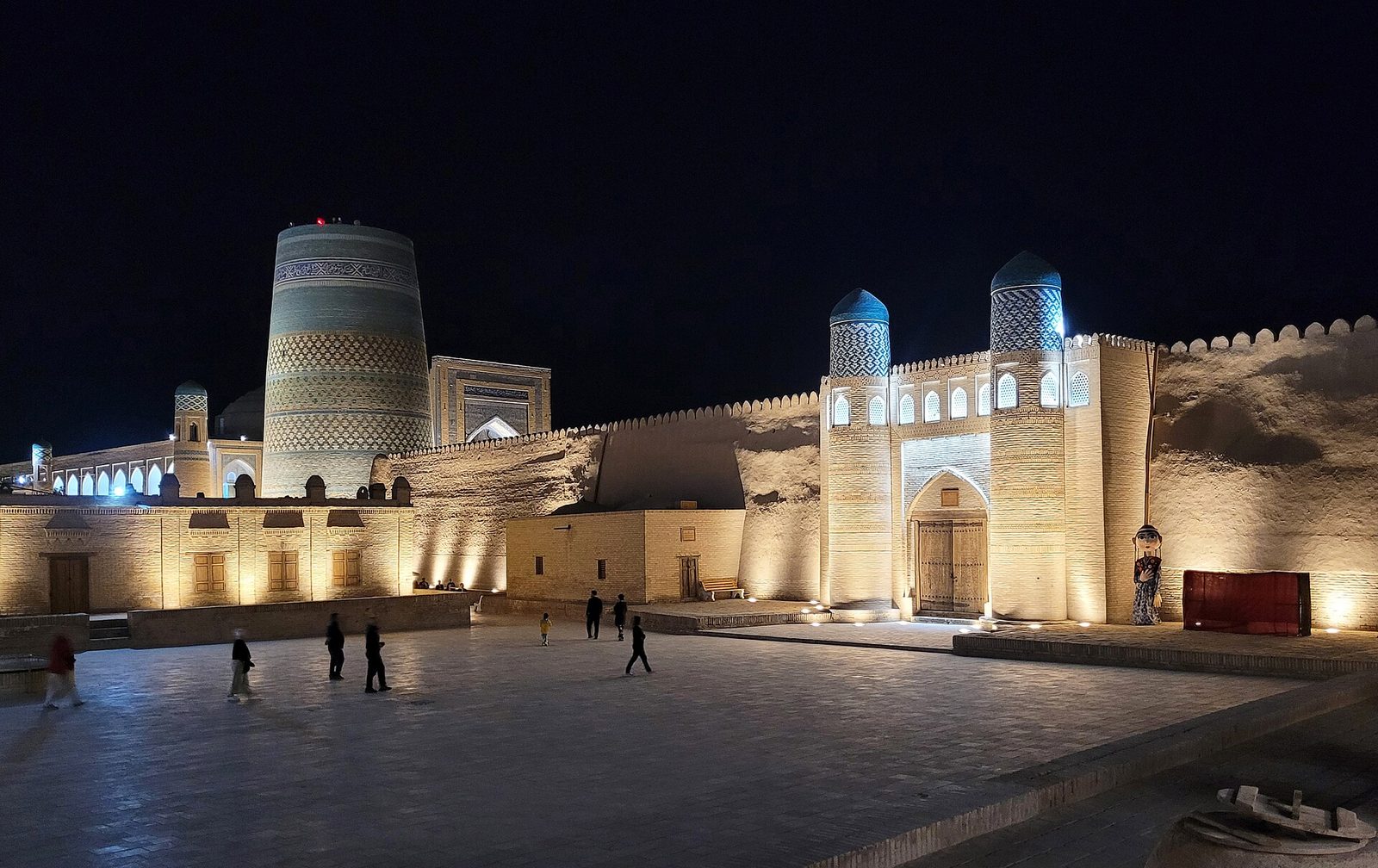
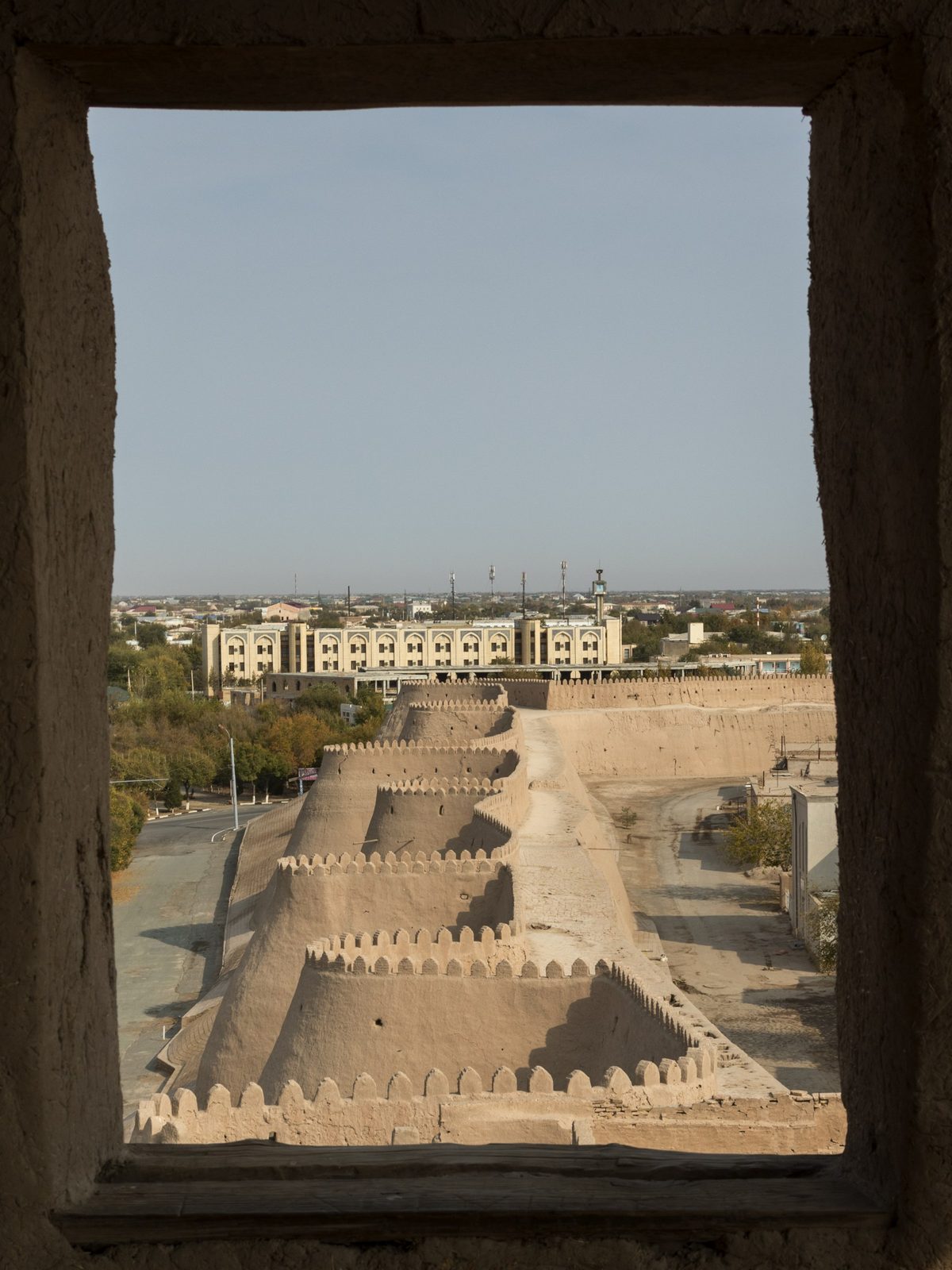
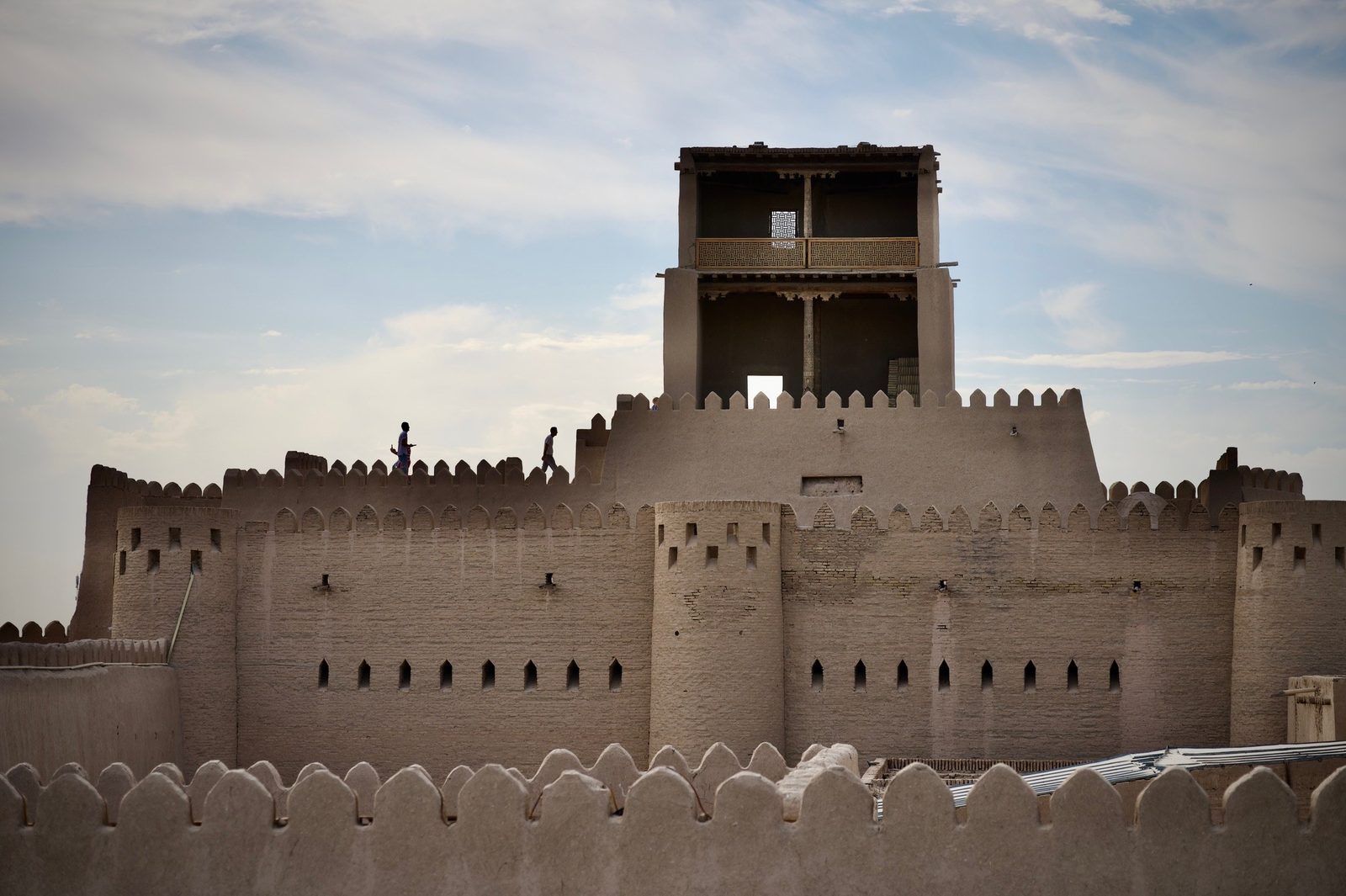
The Kunya-Ark stands just inside ,Did you know? Khiva’s four gates are the Father, Garden, Strongman and Stone Itchan Kala’s four gates face the points of the compass: Ota-Darvoza, the “Father Gate”, in the west; Bogcha-Darvoza, the “Garden Gate”, in the north; Polvon-Darvoza, the “Strongman’s Gate”, in the east; Tosh-Darvoza, the “Stone Gate”, in the south. Read more → the West Gate, against the town wall: a citadel of about 1.2 hectares with walls of its own. Arang Khan began it in 1686–1688, and over the next two centuries it filled with everything a court needed: a reception hall, mosques, a mint, an arsenal, a powder works, stables, kitchens, a court of justice and a harem. The prison stood by the eastern wall, next to the parade ground.
Not all of it survives. Today you walk through the east gate with its guard room into the courtyards of the reception hall, the summer and winter mosques, the mint and the harem, and up to the cell of Ak Sheikh Bobo. The whole of Itchan Kala has been a UNESCO World Heritage Site since 1990, and our Itchan Kala guide puts the citadel in its place among the other monuments.
The kurinish-khana: the throne hall and the yurt
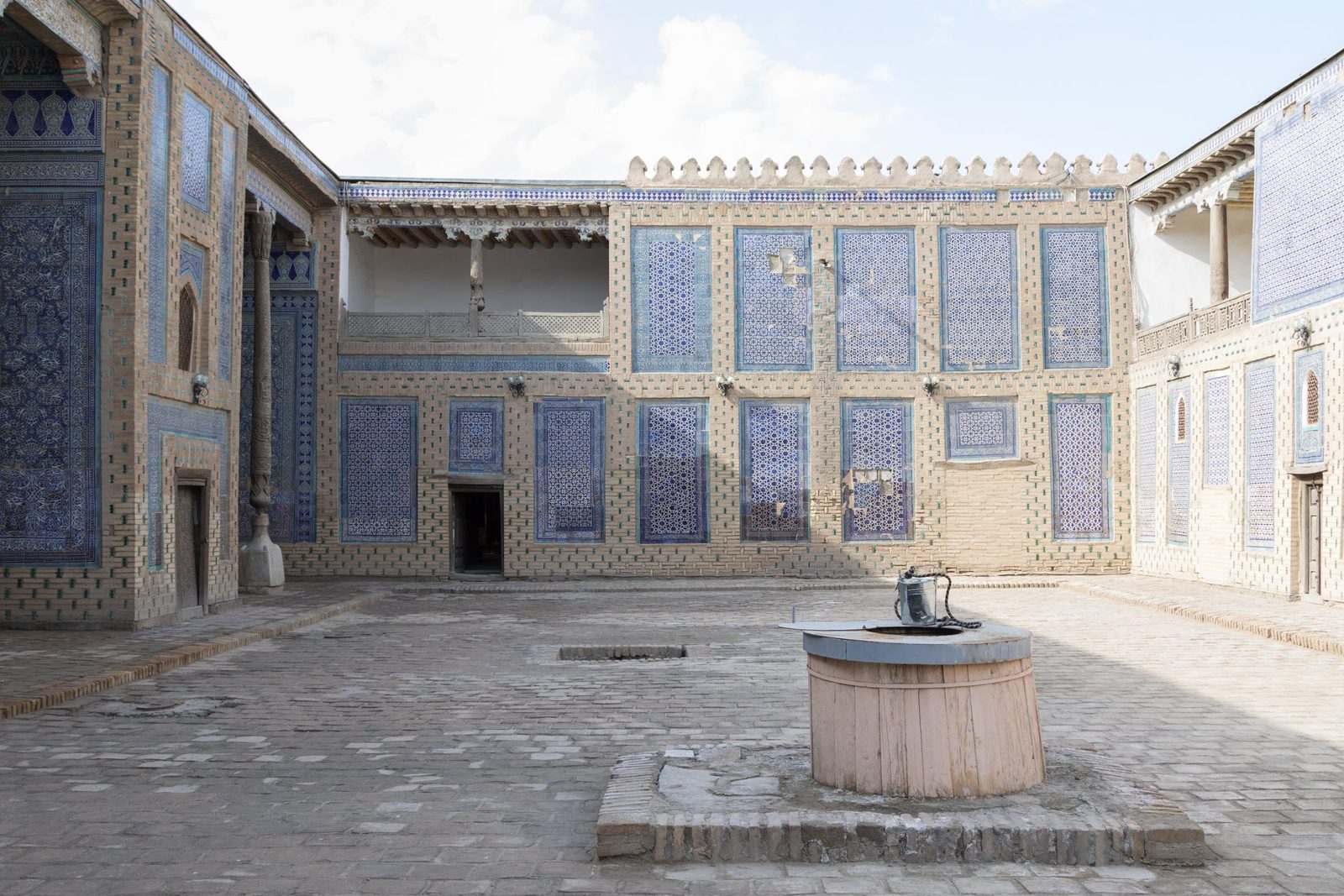
The kurinish-khana was where the khan held his receptions. The first hall of 1686–1688 was destroyed in the middle of the 18th century, and Eltuzar Khan rebuilt it in 1804–1806. Its iwan, the high open porch on carved columns, was faced with majolica under Allakuli Khan, and the throne room behind it has carved plaster and a red painted ceiling. The khan’s treasury and a store for manuscripts were kept here too.
The throne itself was made in 1816 by a master named Muhammad, of wood covered with stamped silver plates. In 1873 it was taken to Moscow, where it is kept in a museum. Look down into the courtyard: the round raised platform in the middle was for a yurt. In it the khan received the envoys of his nomadic neighbours, who were more at home under felt than under tiles.
The summer mosque and the mint
Under Muhammad Rahim Khan I, who ruled from 1806 to 1825, the citadel gained its mint and its mosques. The summer mosque is an open iwan with two rows of wooden columns on stone bases. Its walls are covered with blue and white majolica by the masters Abdulla Jin and Ibadulla, and its ceiling is painted with gold patterns on blue: stand in the middle and look up.
The mint struck the coins of the khanate. More than 300 Khivan coins are kept today in the Hermitage in St Petersburg.
The harem and the Ak Sheikh Bobo lookout
The harem in the northern part of the citadel was built later, under Muhammad Rahim Khan II, who ruled from 1863 to 1910: carved pillars, brightly coloured plaster walls. From it a narrow corridor leads to the stair up to the Ak Sheikh Bobo, the highest point of the citadel.
Khiva says a holy man, Ak Sheikh Bobo, the White Sheikh, lived in a cell on top of the hill long before the khans; the cell later served as the citadel’s lookout and as a store for gunpowder. Its two-tier iwan was an observation post, and from it you see the whole town at once: domes, minarets and flat clay roofs. The full story, with what is known and what is legend, is in the legends of Khiva.
Whether the lookout is open on a given day, and whether the climb is included in your ticket, is decided on the spot: ask at the ticket office by the West Gate in the morning. The stair is narrow and steep, so wear shoes with a good grip.
Tash-Hauli: Allakuli Khan’s stone house
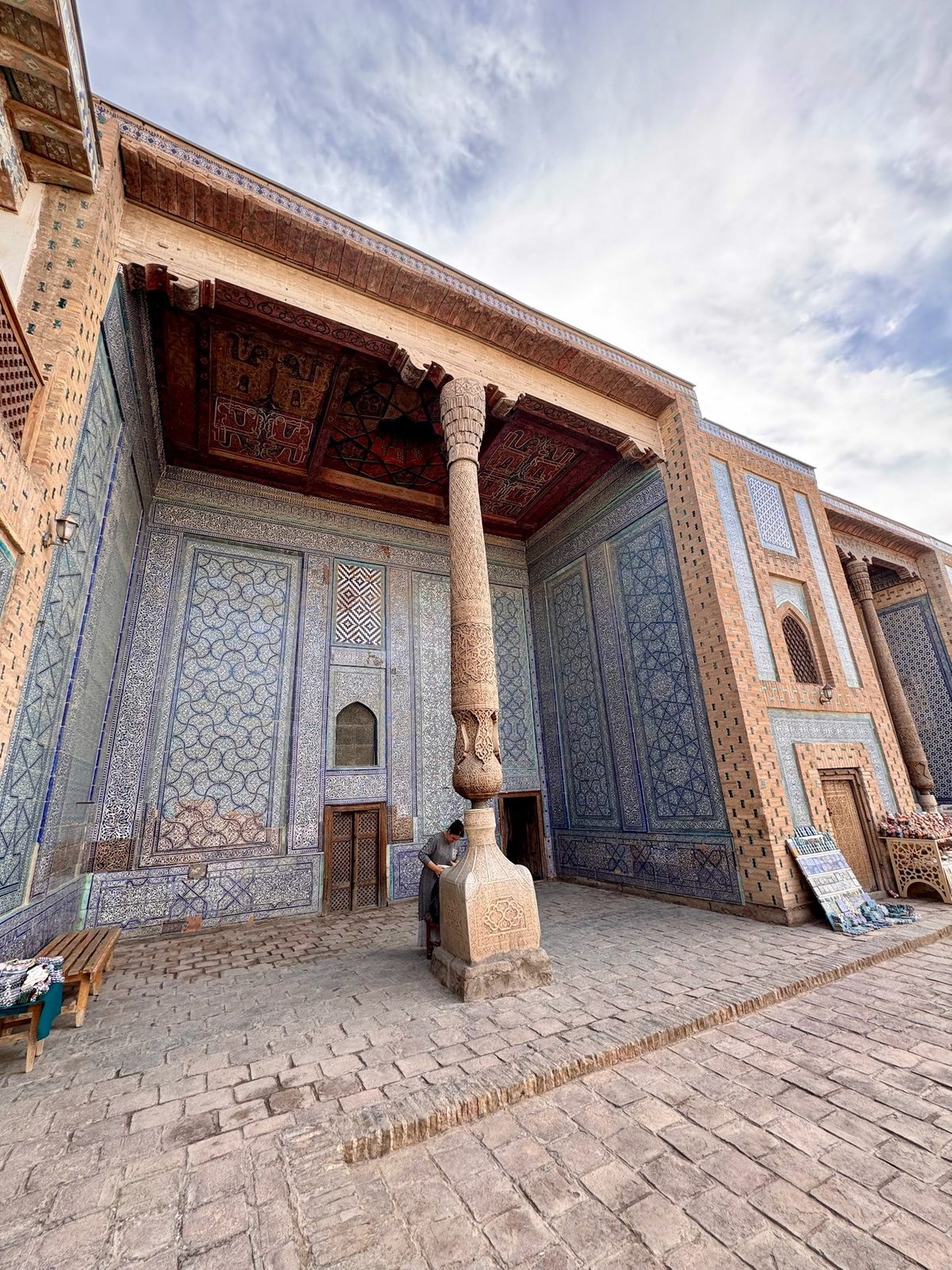
Allakuli Khan, who ruled from 1825 to 1842, did not want to live in the old citadel, and in 1830–1838 he built Tash-Hauli, the “stone house”, on the east side of the town, near the East Gate. Behind its high walls, about 80 by 80 metres, lie more than 260 rooms around three courtyards. The khans lived here until 1880, when Muhammad Rahim Khan II moved back into the Kunya-Ark.
Khiva tells a story about the builder. The khan wanted the palace in two years; the first master, Usta Nur Muhammad, said it could not be done, and was removed, in the harsher version of the tale, for good. His successor, Kalandar Khivagi, took about eight years.
The harem, the reception court and the court of justice
The harem was built first. Around its long courtyard stand five tall iwans, each on a carved wooden pillar: four for the khan’s four wives and the largest for the khan. Each wife’s apartment has a high open loggia for the summer and a winter room beside it. The walls are faced with blue and white majolica, partly the work of the master Abdullah Jin, and the wooden ceilings are painted red and yellow.
The Ishrat-hovli, the reception court of 1830–1832, was where the khan received guests and ambassadors, in a loggia on carved columns. Envoys could pitch their yurts in the courtyard on two round platforms, as at the Kunya-Ark.
The Arz-hovli, the court of justice of 1837–1838, is twice the size of the reception court. Two side stairs lead up to a raised iwan, and here too a platform for a yurt is aligned with the columns. Compare the carved pillars from courtyard to courtyard: they were carved at different times.
Visiting Kunya-Ark and Tash-Hauli: tickets, timing and our tips
Ticket: both are covered by the combined ticket for the museums and monuments of Itchan Kala, sold at the office by the West Gate. It is valid for one day; each further day is paid separately. Its price and what it includes are set there, so ask on the spot, together with the Ak Sheikh Bobo climb.
Timing: start at the Kunya-Ark at opening time, when the light is on the majolica of the summer mosque, then walk along the main street to Tash-Hauli while its courtyards are still cool. Allow about an hour for the citadel and 45 minutes for the palace. If the lookout is open, come back to it in the last hour of light.
With a guide: both are on our Khiva walking tour and our Khiva in 3 days from Tashkent. Already in Khiva? Book a private guide in Khiva for your group. A full plan of the town is in Khiva in one or two days.
In short
- The Kunya-Ark by the West Gate was the khans’ citadel from 1686; Tash-Hauli was Allakuli Khan’s palace of the 1830s.
- In the Kunya-Ark: the throne hall with its yurt platform, the majolica summer mosque, the mint and the harem.
- The Ak Sheikh Bobo lookout gives the view over the whole town; whether it is open is decided on the day.
- In Tash-Hauli: the harem with its five iwans, the reception court and the court of justice, more than 260 rooms in all.
- One combined ticket from the West Gate covers both; go in the morning, citadel first.