
 Deutsch
 English
 Español
 Français
 Italiano
 Polski
 Português
 Suomi
 Svenska
 Türkçe
 Ελληνικά
 Български
 Русский
 עברית
 한국어
 中文
 日本語
Programme and details
Private · 10 days
Uzbekistan Off-the-Beaten-Path — 10 Days
The classic four cities plus the Chimgan mountains, told through hands-on workshops, family dinners and a slower pace.
from $1,499 per person
Private tour
Samarkand · Bukhara · Khiva · Tashkent
Highlights
What’s inside
- Hands-on workshops with hereditary artisans — batik, blacksmithing, miniature painting, wood-carving
- A folklore dinner at the Meros silk-paper mill
- A mountain day at Chimgan — Gulkam Canyon trekking, a river swim (in summer only) and a picnic
- Authentic dinners in family homes — real plov and Khorezm cuisine
- Chorchinar Park and the «chilakhona» inside a hollow tree
Programme
Day by day
Day 1 · Arrival in Samarkand
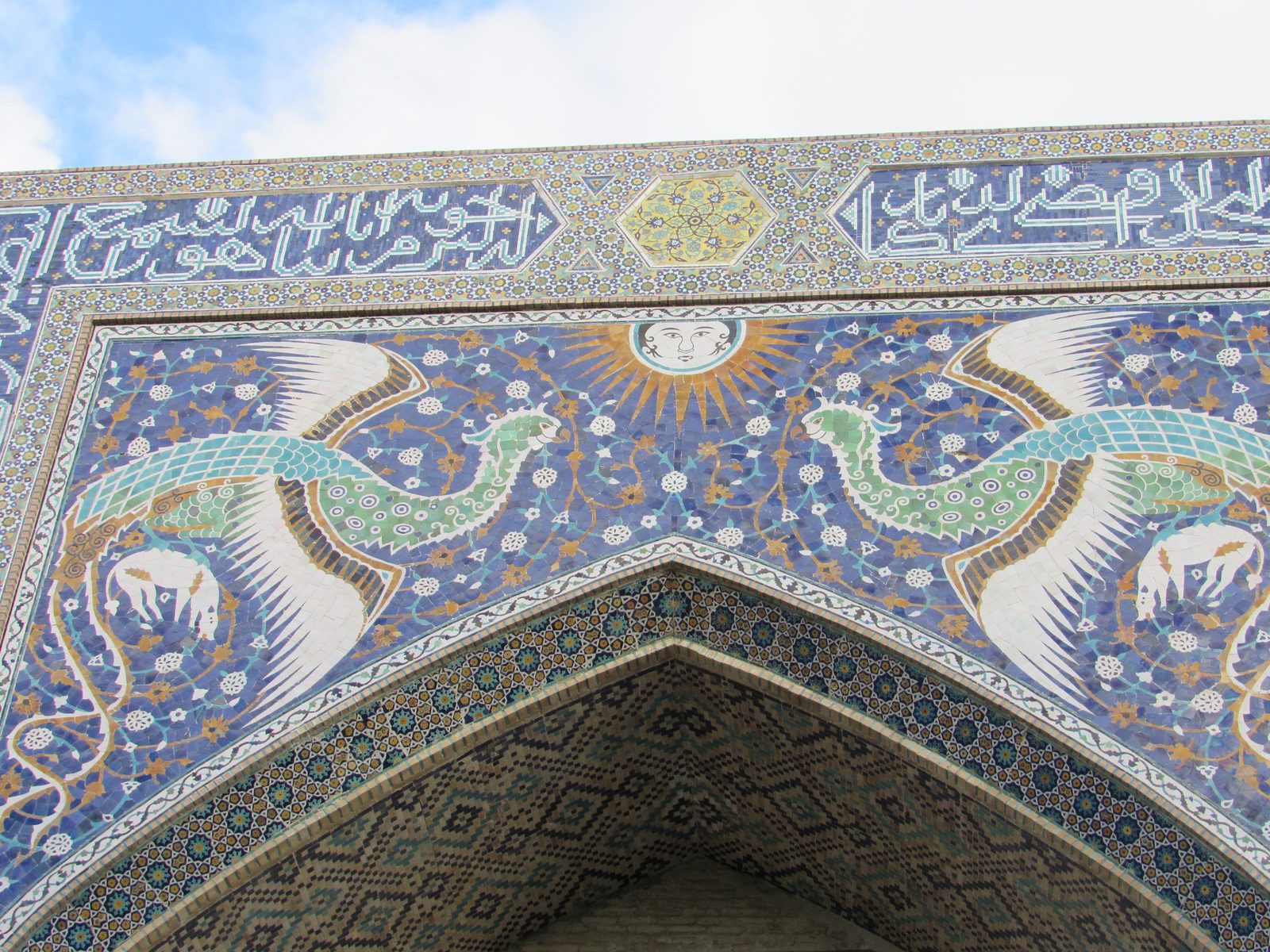
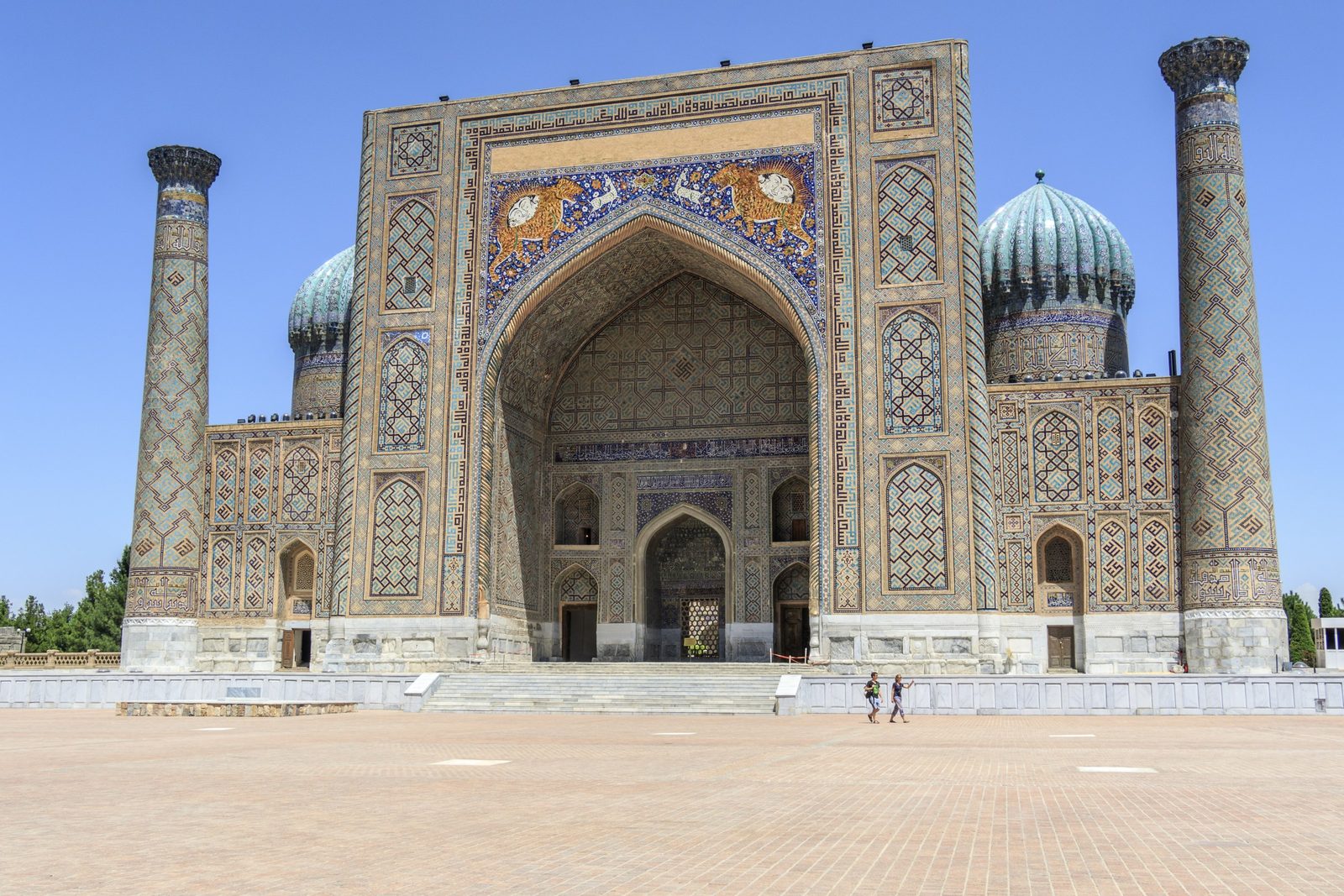
Meeting and transfer. The Did you know? The Registan's sun-carrying lion went on a banknote The Sher-Dor Madrasah (1619–1636) is named for the big cats with the sun on their backs on its portal. The image appeared on the reverse of Uzbekistan's 200-som note of 1997. Read more → with its three madrasahs, the ,Did you know? 95 elephants hauled stone for Timur's great mosque Bibi-Khanym, begun in 1399 after Timur took Delhi, was the largest mosque of his empire. Some 200 stonecutters worked on site and 95 elephants brought from India hauled the loads; the courtyard was meant to hold 10,000 people. Read more → the Samarkand's main bazaar, right next to Bibi-Khanym: Samarkand bread, dried fruit, nuts and halva. Read more → and the Meros silk-paper mill. Dinner with a folklore show at Meros.
Day 2 · Samarkand
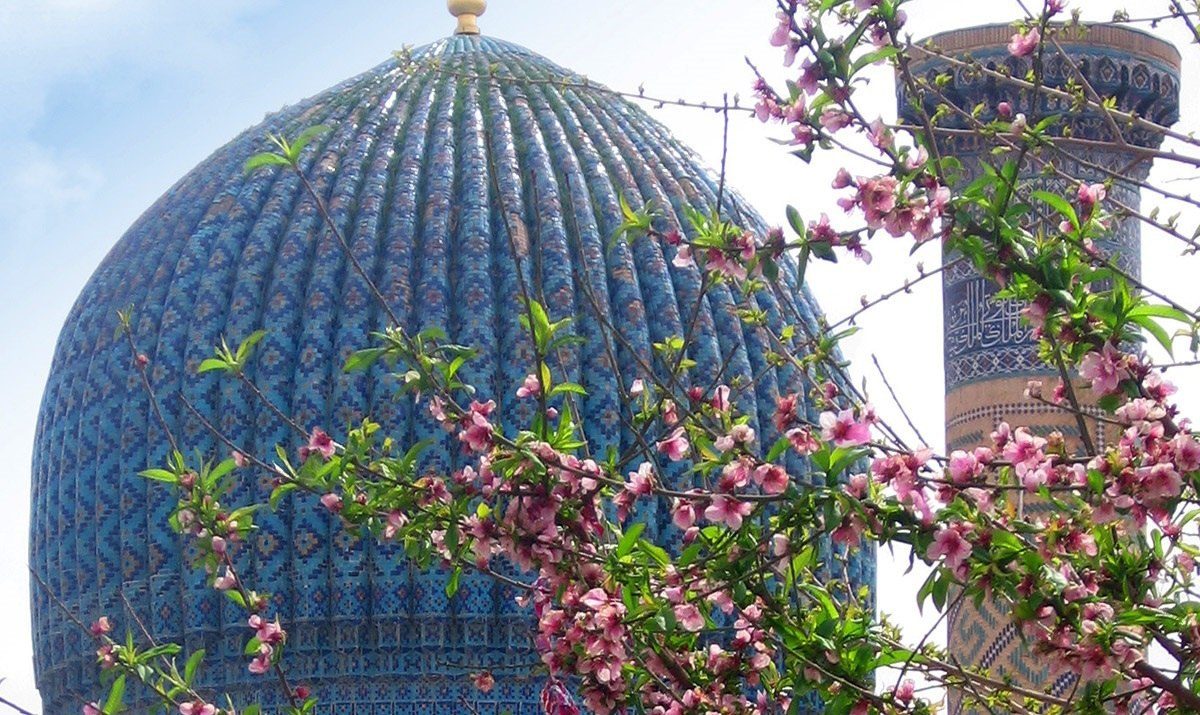
A morning drive to Chorchinar Park and its «chilakhona» hollow tree, then the ,Did you know? Timur's tomb was built for his grandson Gur-e-Amir was begun in 1404 for Muhammad Sultan, Timur's grandson and chosen heir. Timur had a crypt ready in his home town of Shahrisabz, but when he died in 1405 he was laid in Samarkand, in the tomb meant for the young prince. Read more → the Did you know? Why Shah-i-Zinda means 'the Living King' The necropolis grew around the shrine of Qutham ibn Abbas, a cousin of the Prophet Muhammad. Legend says he did not die in battle but went down a deep well to a garden of paradise, where he lives on. Read more → complex and a batik workshop in an artisan studio.
Day 3 · Samarkand → Bukhara
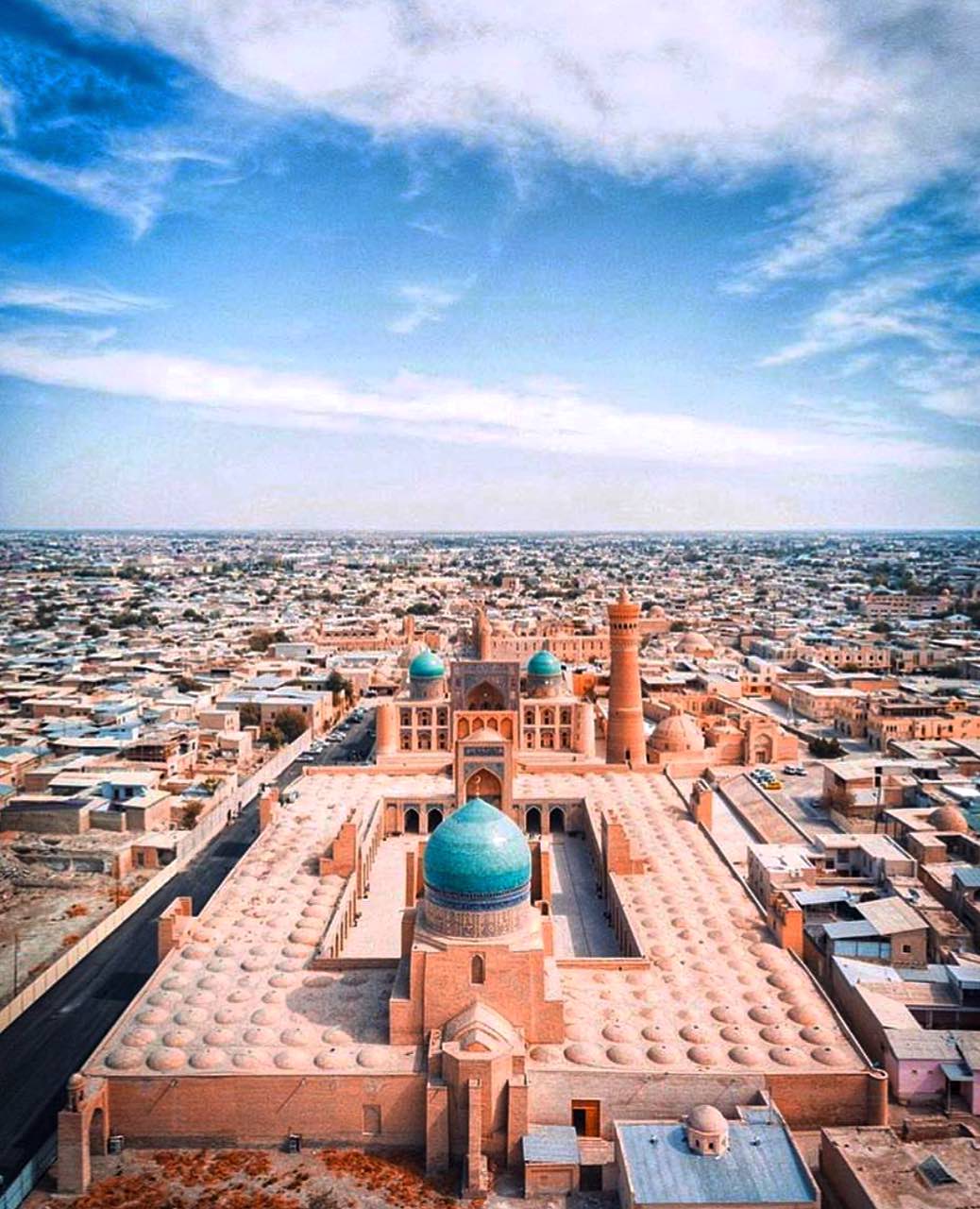
Train to Bukhara. On arrival: ,Did you know? Bukhara's ponds were once its water supply Pools like Lyabi-Hauz, dug around 1620 and 46 × 36 m, were the city's main source of water. Most were filled in during the 1920s–30s because they spread disease; Lyabi-Hauz survived. Read more → Kalyan Square with a blacksmith workshop (a fourth-generation master), The fortress-residence of the rulers of Bukhara on a high artificial hill: the oldest structure in the city. Read more → citadel and the .Did you know? Buried in mud, this tomb escaped Genghis Khan The 10th-century Samanid Mausoleum, one of the oldest monuments of Islamic Central Asia, was covered by flood mud and sand before the Mongols came in 1220. Hidden for centuries, its brick lacework survived intact. Read more →
Day 4 · Bukhara
The Did you know? Legend: the emir's palace site was chosen with meat Legend says that when Emir Nasrullah wanted a summer palace in the mid-19th century, sheep carcasses were hung in several places around Bukhara, and the spot where the meat spoiled last was chosen. Sitorai Mohi-Hosa there today dates from 1912–1918. Read more → summer palace, Did you know? Legend: four towers for four world religions? Chor Minor, a gatehouse of 1807, has four towers, each decorated differently. Guides say they stand for four world religions and look for a cross, a fish and a prayer wheel in the decor; others say four dynasties. All are interpretations. Read more → and the three ,Did you know? Under Bukhara's domes merchants changed money and gold Four 16th-century trading domes still stand over old crossroads. Toki Sarrafon was the money changers' dome, where merchants from India and China swapped coins; Toki Zargaron held jewellers' workshops, Toki Telpak Furushon sold caps. Read more → then a Bukhara miniature-painting masterclass.
Day 5 · Bukhara → Khiva
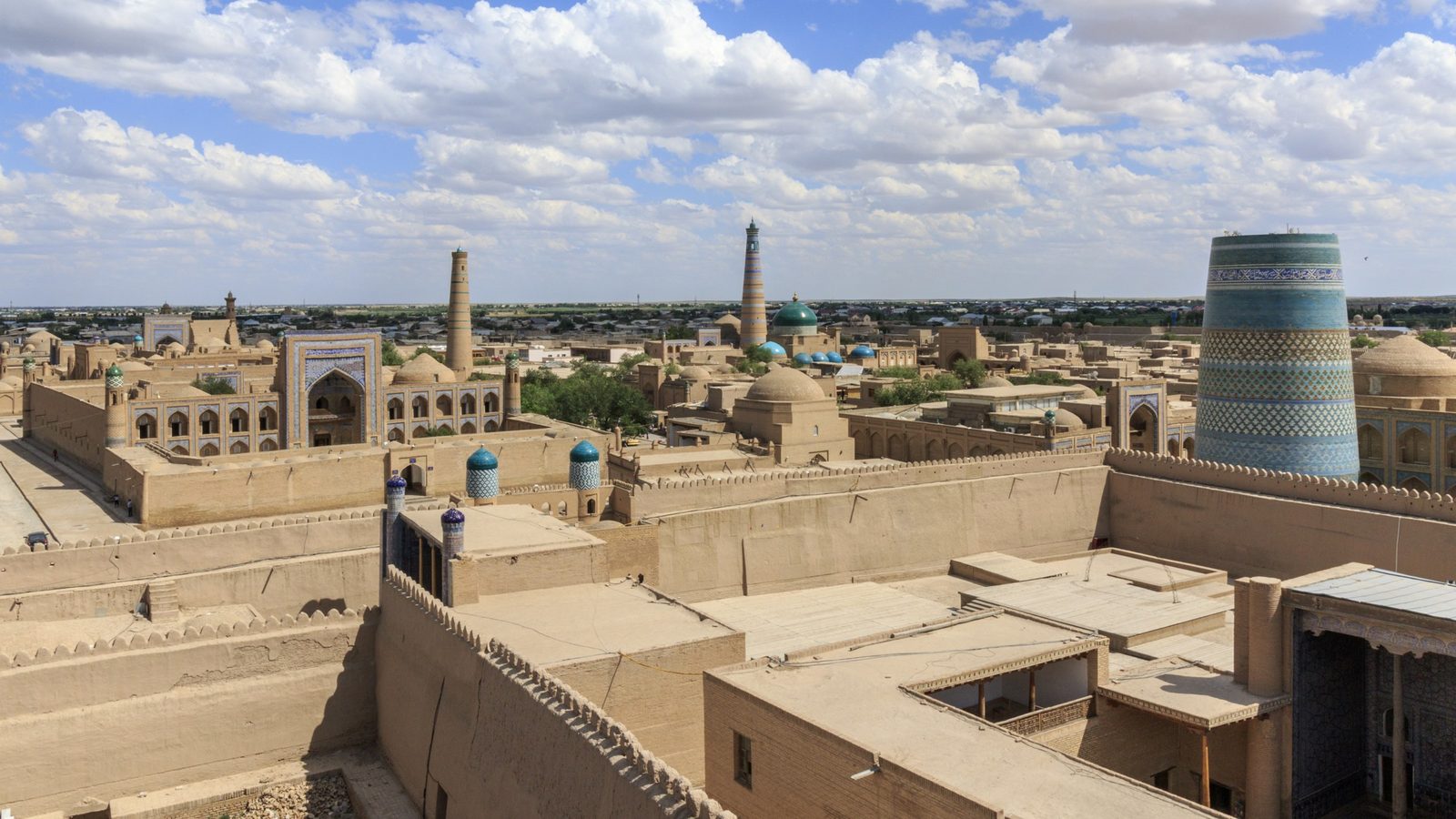
Early drive across the desert to Khiva and a first walk in .Did you know? People still live inside Khiva's museum city Itchan Kala packs more than 50 historic monuments and about 250 old houses inside clay walls 8–10 m high and 5–6 m thick, and families still live and work in its lanes. Read more →
Day 6 · Khiva
A full day in Itchan Kala: the ,Did you know? Legend: the khan wanted to see Bukhara from his minaret Legend says Muhammad Amin-Khan wanted the Kalta-Minor so tall that Bukhara, some 400 km away, could be seen from the top. In reality work began in the 1850s and stopped in 1855, when the khan died, at a height of about 29 m. Read more → the ,Did you know? Khiva's largest madrasah now welcomes hotel guests Muhammad Amin-Khan built his madrasah in 1852–1855 beside the Kalta-Minor. With about 130 rooms around a 38-metre courtyard it is the largest in Khiva and once taught some 260 students; today it houses a hotel. Read more → the Did you know? In the khan’s courtyard a round platform waited for a yurt The Kunya-Ark, the khans’ citadel, had its own mint, arsenal and harem. In the courtyard of its reception hall of 1804–1806 stands a round platform: a yurt was set up on it, and there the khan received envoys of the steppe nomads. Read more → citadel, the ,Did you know? Khiva's Juma Mosque stands on 212 wooden columns Recorded as early as the 10th century and rebuilt in 1788, the Juma Mosque has no portal and no domes: its flat roof rests on 212 carved columns in 17 rows, and some of them are older than the building itself. Read more → the Did you know? Legend: a wrestler freed captives with a single cowhide Legend says Pahlavan Mahmud won a bout in India and asked to free as many fellow Khorezmians as would fit in a cowhide. He cut it into one long thin strip and encircled them all. The real Mahmud, a poet and wrestler of around 1300, is Khiva's patron saint. Read more → Mausoleum and the Did you know? In Tash-Hauli's harem each of four wives had her own loggia Allakuli Khan built the Tash-Hauli palace in 1830–1838 around three courtyards. In the harem four tall loggias belonged to the khan's four wives and a fifth, the largest, to the khan himself; behind each summer terrace lay a winter room. Read more → palace, with a Shivit Oshi lunch. Optional sunset hour.
Day 7 · Khiva → Tashkent
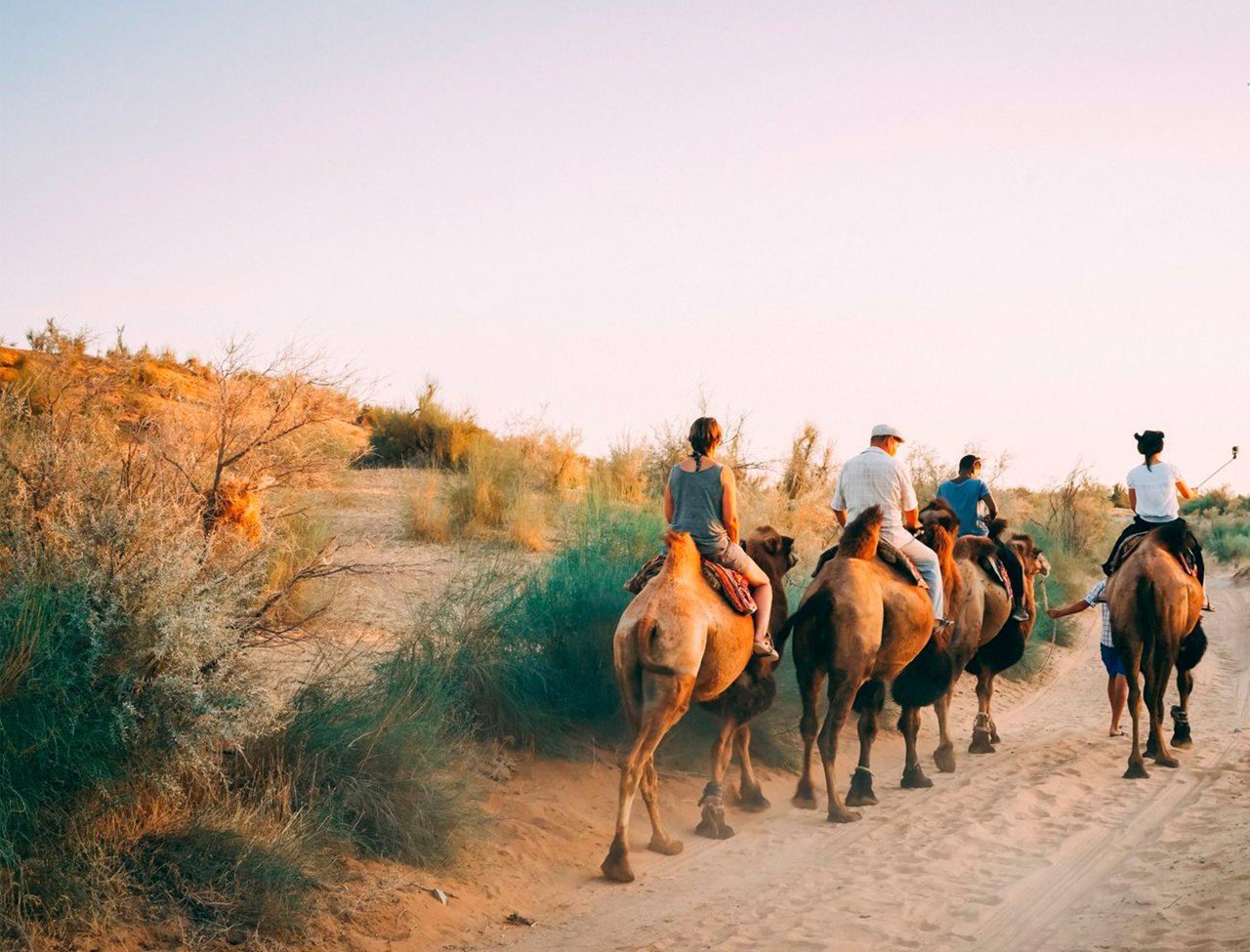
A wood-carving workshop and the ,Did you know? Khiva's tallest minaret is barely a century old The Islam Khoja Minaret was begun in 1908, near the very end of the khans' era. At 56.6 m it is one of the tallest in Central Asia; a spiral stair of 175 steps leads up to its windowed top. Read more → then the flight to Tashkent.
Day 8 · Tashkent — Chimgan
A day in the mountains: Gulkam Canyon trekking, a river swim (in summer only) and a picnic.
Day 9 · Tashkent
A city tour: the The religious heart of old Tashkent: madrasahs, a Friday mosque and mausoleums. Right next to it stands the new Center of Islamic Civilization, opened in 2026. Read more → complex, Independence Square, ,Did you know? Legend: “Strength lies in justice” were Timur's own words The equestrian statue of Amir Timur in central Tashkent, unveiled in 1994, bears the motto “Strength lies in justice” in four languages. Tradition attributes the words to Timur himself, but historians cannot confirm he said them. Read more → the Did you know? A metro station where Ulugh Beg meets Gagarin Kosmonavtlar station, opened in 1984, has ceramic medallions of Ulugh Beg, Galileo, Icarus, Gagarin and Tereshkova, and glass stars in the ceiling that hint at the Milky Way. Read more → Did you know? A metro designed to ride out a magnitude-9 earthquake The three original lines of the Tashkent Metro were built to withstand an earthquake of magnitude 9.0, and the tunnels lie unusually shallow, only 8–25 m below the street. Read more → station, the Did you know? A diplomat's house that became a museum of crafts In 1896 diplomat Alexander Polovtsov bought a merchant's house and had it rebuilt in the Central Asian style. Today it is the Museum of Applied Arts, with over 7,000 pieces of folk craft. Read more → and .Did you know? Tashkent’s Chorsu dome is younger than the city’s metro Trade at the old crossroads is centuries old, but the domed building opened only in 1990, thirteen years after the metro. Architects Vladimir Azimov and Sabir Adylov gave it a main dome of 86 m ringed by seven smaller ones. Read more →
Day 10 · Departure
Transfer to Tashkent airport.
Price
Price per person
| 2 travellers, twin/double room | $1,499 |
| Single supplement | +$245 |
| Urgench — Tashkent flight | +$110 |
| Samarkand — Bukhara train | +$25 |
Hotels (tourist category): Dilshoda B&B (Samarkand), Makon / Porso B&B (Bukhara), a guest house (Khiva), Baden-Baden 3★ (Tashkent), or similar. Airline: Uzbekistan Airways. Air and train ticket prices may vary.
Booking
How to book
- Send a request via the form on this page, by email hello@aroundca.com or on WhatsApp. Reply within 24 hours.
- Fixed weekly departures — send your dates and group size and we confirm availability.
Four A network of caravan routes between China and the Mediterranean. Samarkand, Bukhara and Khiva grew rich as stops along it. cities and a mountain day — slower, hands-on and lived rather than looked at.
Expert opinion
Pluses
- Hands-on workshops: masterclasses with hereditary artisans in batik, blacksmithing, miniature painting and wood-carving are included.
- A day in the mountains: day 8 at Mountains of the Western Tien Shan about 80 km from Tashkent: hiking in summer, skiing in winter, the Charvak reservoir nearby. Read more → has Gulkam Canyon trekking, a river swim (in summer only) and a picnic.
- Meals with locals: dinners in family homes with Rice cooked in a kazan with carrots, onions and meat: the dish of every Uzbek celebration. Each region cooks it its own way. and Khorezm cuisine, and a folklore dinner at the Did you know? Paper polished with stone, made to last 400 years At the Meros mill in Konigil, founded in 1996 to revive a craft that had died out, a water wheel beats mulberry bark into pulp, and each sheet is polished for hours with agate, shell or horn. It is made to last some 400 years. Read more → silk-paper mill on day 1.
Minuses
- Three hotel changes: you move on days 3, 5 and 7, by train to Bukhara, by road to Khiva and by air to Tashkent.
- Early desert drive: day 5 starts early with a long drive across the desert to Khiva, most of the day in the car; we send the exact timings for your dates when you book.
- Tickets and extras on top: air and train tickets, extra meals, the optional sunset hour in Khiva, photo and video fees and tips are not included.
AroundCA numbers
How we counted
By the AroundCA programme: we count only what is written in the day-by-day programme of this tour. If the programme gives no figure, we show nothing.
- Hotel changes
- 3
- Walking
- Medium
Walking: Medium: day 6 is a full day in Itchan Kala with six named sights, day 8 is Gulkam Canyon trekking and day 9 is a city tour of six places. Expect long hours on your feet on these days; the guide sets the pace for your group.
Best time
Mar–Jun, Sep–Nov
March and November are the start and end of the season: 11–17 °C by day, few crowds and lovely weather. Winters are getting milder, too: very few people, sunny days and pleasant prices.
Cool, fewer people: Jan–Feb, Dec
Better to avoid
Jul–Aug
July–August is outside the season and hot: 33–37 °C by day in all four cities.
A typical day
Day 6 in Khiva is a full day in Itchan Kala: the Kalta-Minor minaret, the Muhammad Amin-Khan Madrasah, the Kunya-Ark citadel, the Juma Mosque, the Pahlavan Mahmud Mausoleum and the Tash-Hauli palace, with a Shivit Oshi lunch. An optional sunset hour is available and is not included in the price.
What the price includes
What is included
- Accommodation in twin/double rooms with breakfast
- All transfers by Mercedes Sprinter
- The lunches, picnic and dinners listed in the programme
- A tea break in Bukhara
- Sightseeing programme with a guide in your language
- Entrance tickets to the monuments in the itinerary
- All masterclasses in the programme
- Mineral water throughout the tour
Not included
- Air and train tickets (supplements in the price table)
- Meals other than those included
- The optional sunset hour in Khiva
- Photo and video fees at the monuments
- Personal expenses and tips
Extra cost on site
- The optional sunset hour in Khiva
- Photo and video fees at the monuments
- Personal expenses and tips
- Meals other than those included
Good for
- Second-time visitors
- Travellers who want local life, not just monuments
Maybe not for you if
- Those who just want the main sights quickly
Questions about this tour
What is included?
Everything that is and isn’t included, and what you pay on site, is in one list: What the price includes
What is not included?
Air and train tickets (Urgench–Tashkent flight +$110, Samarkand–Bukhara train +$25), extra meals, the optional sunset hour in Khiva, photo fees at monuments and tips. What the price includes
Which hotels are used?
Tourist category: Dilshoda B&B in Samarkand, Makon or Porso B&B in Bukhara, a guest house in Khiva and Baden-Baden 3★ in Tashkent, or similar.
In what language is the guide?
The guide speaks your language.
Can I travel alone?
The price is per person for two travellers sharing a room; a single room is +$245.
What is Arda Khiva, and can we spend an evening there?
Arda Khiva is a new tourist complex on the shore of Lake Govuk, a short drive from Itchan Kala, opened in May 2025: 17 hotels and guest houses, a 3,000-seat amphitheatre, restaurants, a bazaar and a canal with gondolas. We can add an evening or a stay there on request.
Didn’t find your answer? Ask about this tour →
Make it your trip
Tick what you’d like to add — it goes into your request, and the manager confirms the final price.
Add a few days
Arrival, departure, transfers
Arrive earlier or stay longer
Need extra nights before or after the tour?
Prices are indicative; we confirm the exact rate after your request.