
Aisha Bibi mausoleum near Taraz: the legend and the terracotta tomb
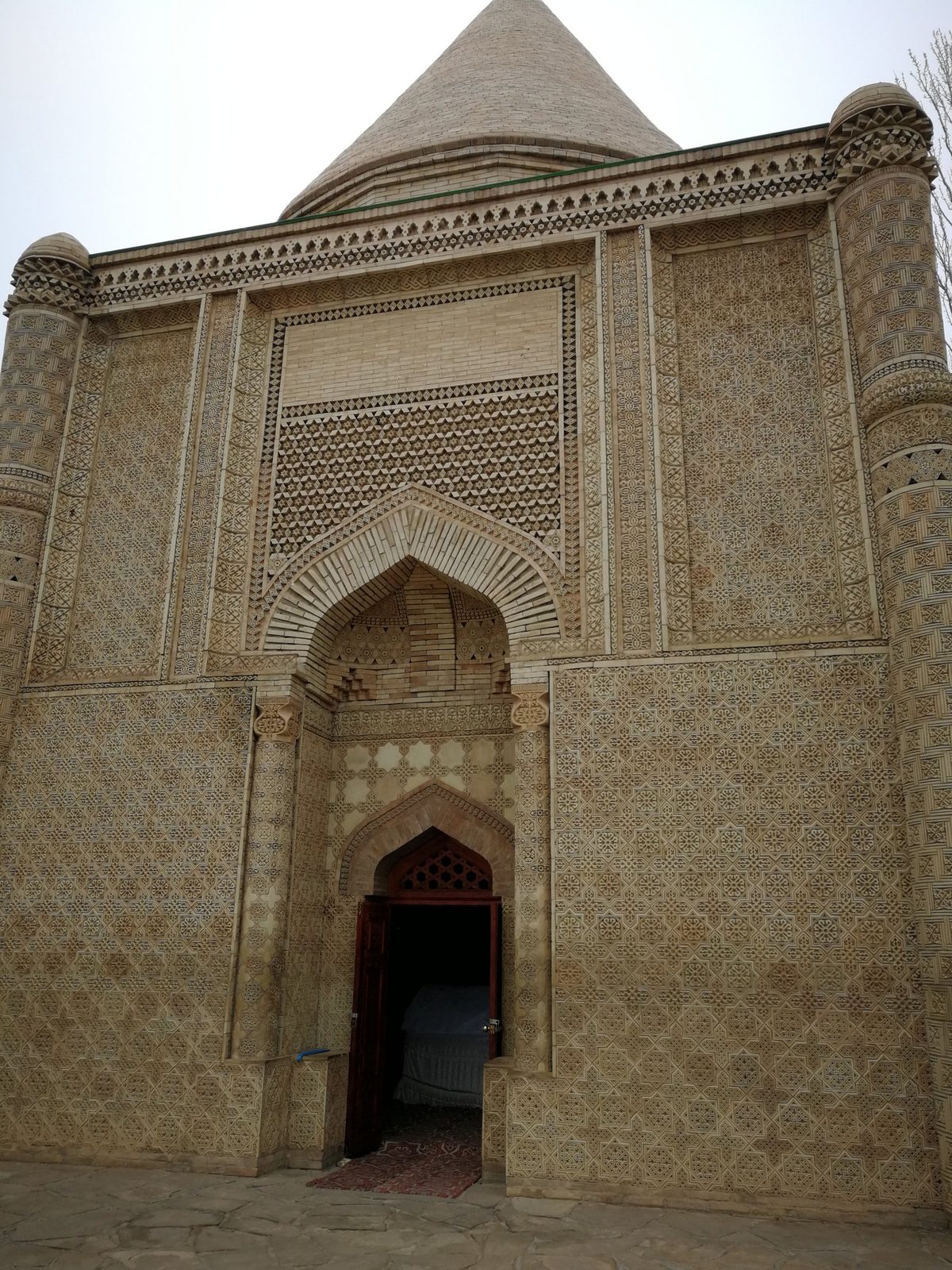
Put your palm against the wall of Aisha Bibi and you feel it before you see it: the surface is not flat. Every tile is carved, a cross here, a star there, a tiny lattice, and one small building carries more than sixty different patterns. Nine centuries on, the clay still throws a fine net of shadow over itself. No colour, no glaze. Just light.
The mausoleum stands in the village of Aisha Bibi, 18 km west of Taraz in southern Kazakhstan. We bring guests here on routes that cross from Uzbekistan into Kazakhstan and Kyrgyzstan, and we always tell the story first. The building makes more sense once you know whom it was for.
The legend of Aisha Bibi and Karakhan
Long ago, the story goes, Karakhan, the young ruler of Taraz, fell in love with Aisha, a girl of sixteen. Her father would not hear of the match. Aisha chose love anyway. She set out for Taraz in secret, with only her nanny, Babaji Khatun, at her side.
Her father did not chase her. He said something worse: she would cross six rivers, but not the seventh.
The seventh river was the Asa, almost at Taraz. Aisha stopped on its bank to bathe and dress before she met her groom. A snake was hiding in her headdress. It bit her.
Karakhan rode out with healers and mullahs, but nobody could save her. So he asked a mullah to marry them there and then, while she was still alive. When the words were said, he told her: “Aisha, you have now become bibi.” Bibi meant his wife. Soon after, she died.
Karakhan buried her on the hill where she died and raised a mausoleum over the grave. People in Taraz still call it a monument to love and faithfulness.
Other versions of the story
This is a legend, and legends travel: around 28 versions are known. In some, Aisha’s father is the Sufi poet Hakim Ata; in others, he is Zengi Baba. In one, the snake hides not in her headdress but in her clothes. Some tellings start her journey in Otrar, on the Syr Darya.
One historian links the story to a real death in 1034: a daughter of the ruler of Talas, as Taraz was then known, who died on the road to Ghazna, where her fiancé, a prince, was waiting. Almost every version keeps the same heart: a river, a snake and a ruler who came too late.
Babaji Khatun: the nanny who stayed
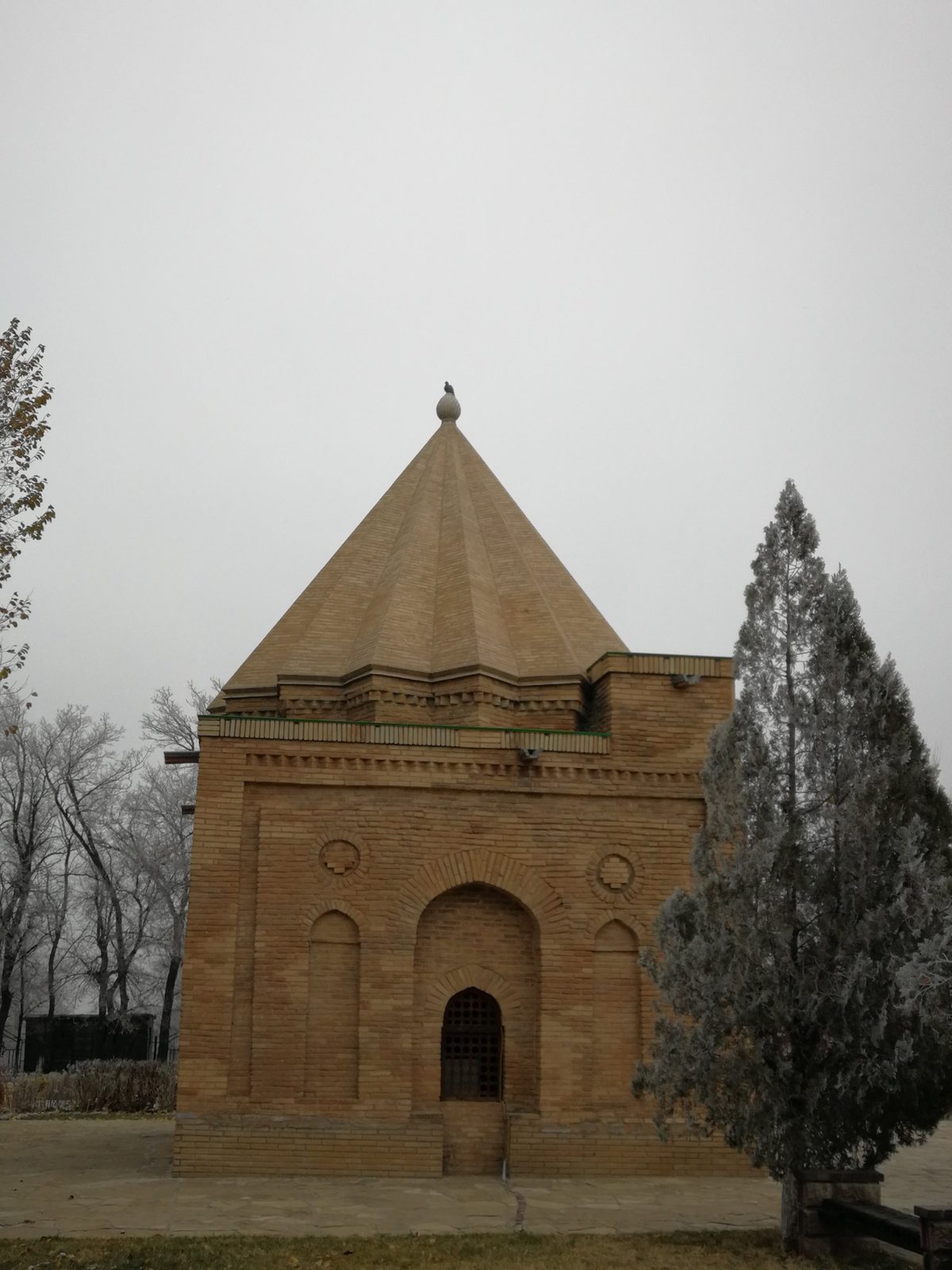
The legend has a second heroine. After Aisha died, Babaji Khatun did not go home. She stayed by the grave and looked after it. When she died, she was buried close to her girl, and a mausoleum went up over her too. In time she came to be honoured as a saint.
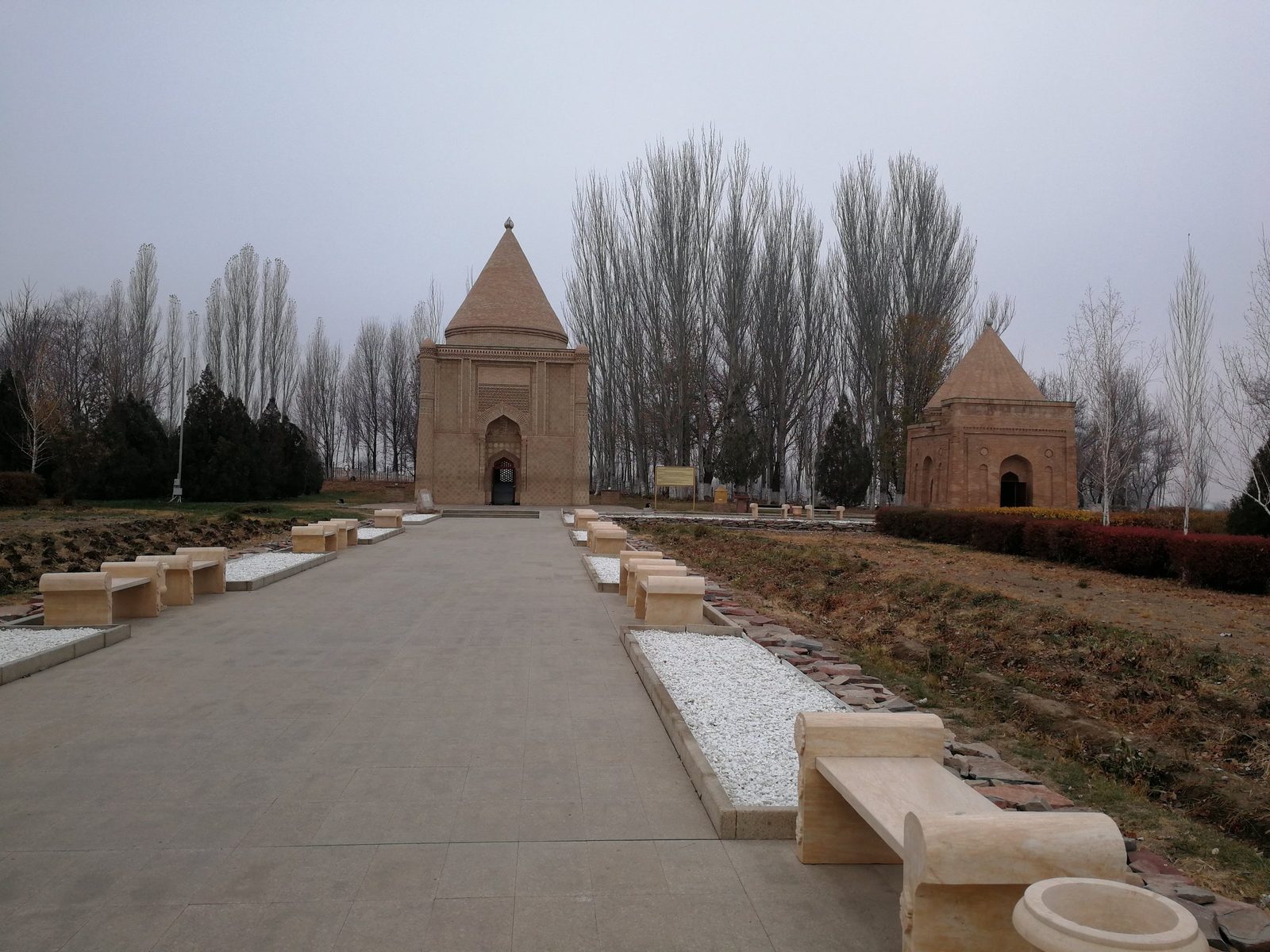
Her tomb stands a few steps from Aisha Bibi’s, at the end of the same alley. It is a plain square of fired brick with a ribbed, cone-shaped dome. Niches, medallions, carved frames and arched windows work its walls, and an Arabic inscription on the main front gives her name and the name of the builder.
An 11th–12th-century tomb carved in terracotta
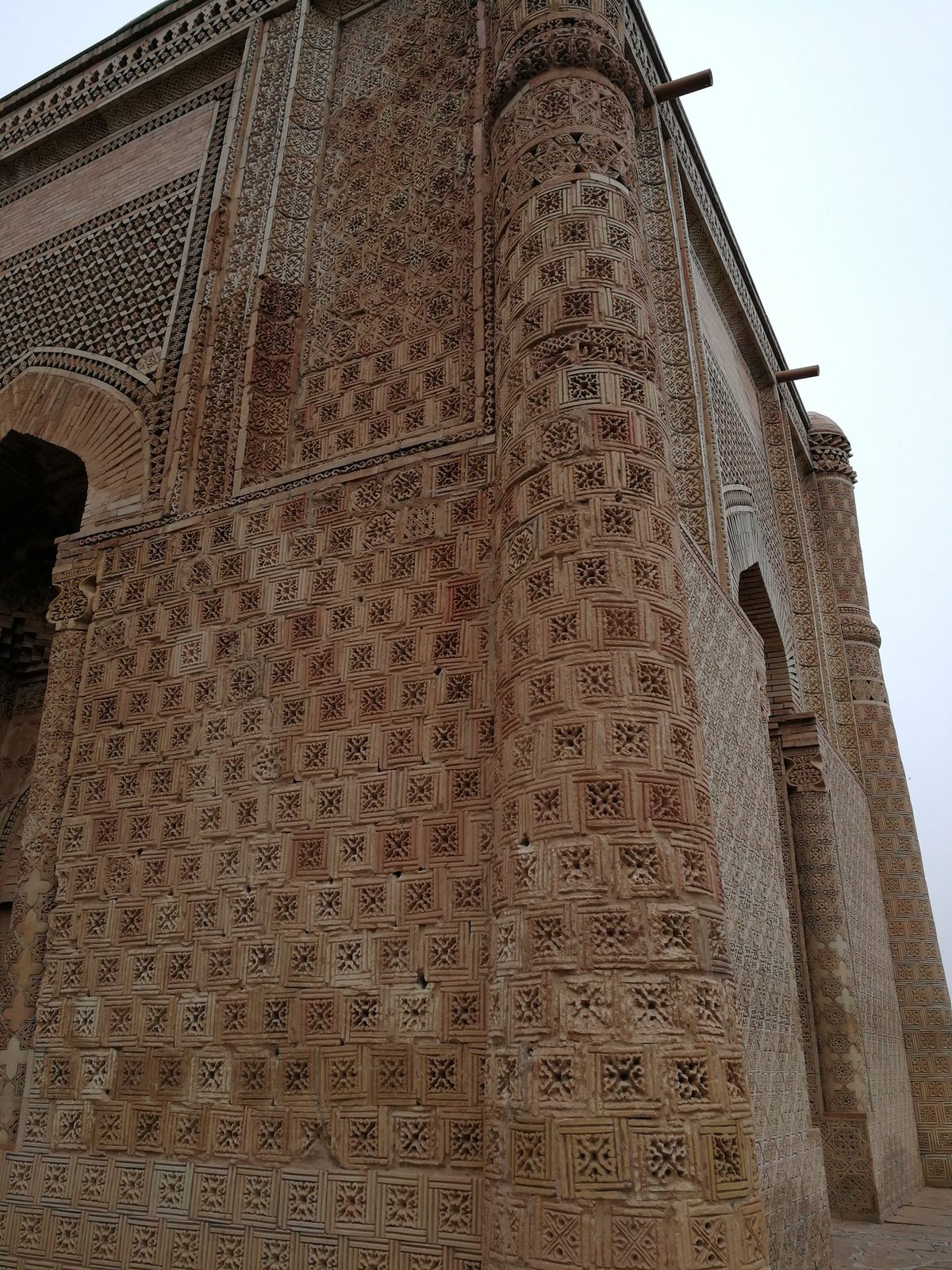
Aisha Bibi dates from the 11th–12th century, when Taraz was ruled by the Karakhanids and was at its height. It is a small square tomb with a tall portal and a pointed conical roof. It belongs to the same family of buildings as the A 9th–10th-century family tomb of the Samanid dynasty, one of the oldest surviving monuments of Islamic architecture in Central Asia, built entirely of patterned brick. Read more → in Bukhara, where the brick itself is the decoration.
What makes it rare is how that decoration is made. The walls are faced with carved terracotta tiles in more than 60 floral and geometric patterns. They are not glued on like a skin: the tiles are part of the wall and help hold it together. In strong sun the carving breaks the light into thousands of small shadows, so the walls never glare. That is the pre-Mongol way of decorating: with light and shadow, not with colour.
Look at the corners. The round corner columns copy the wooden columns of the older Sogdian houses, only here they are made of clay.
A line of Kufic verse
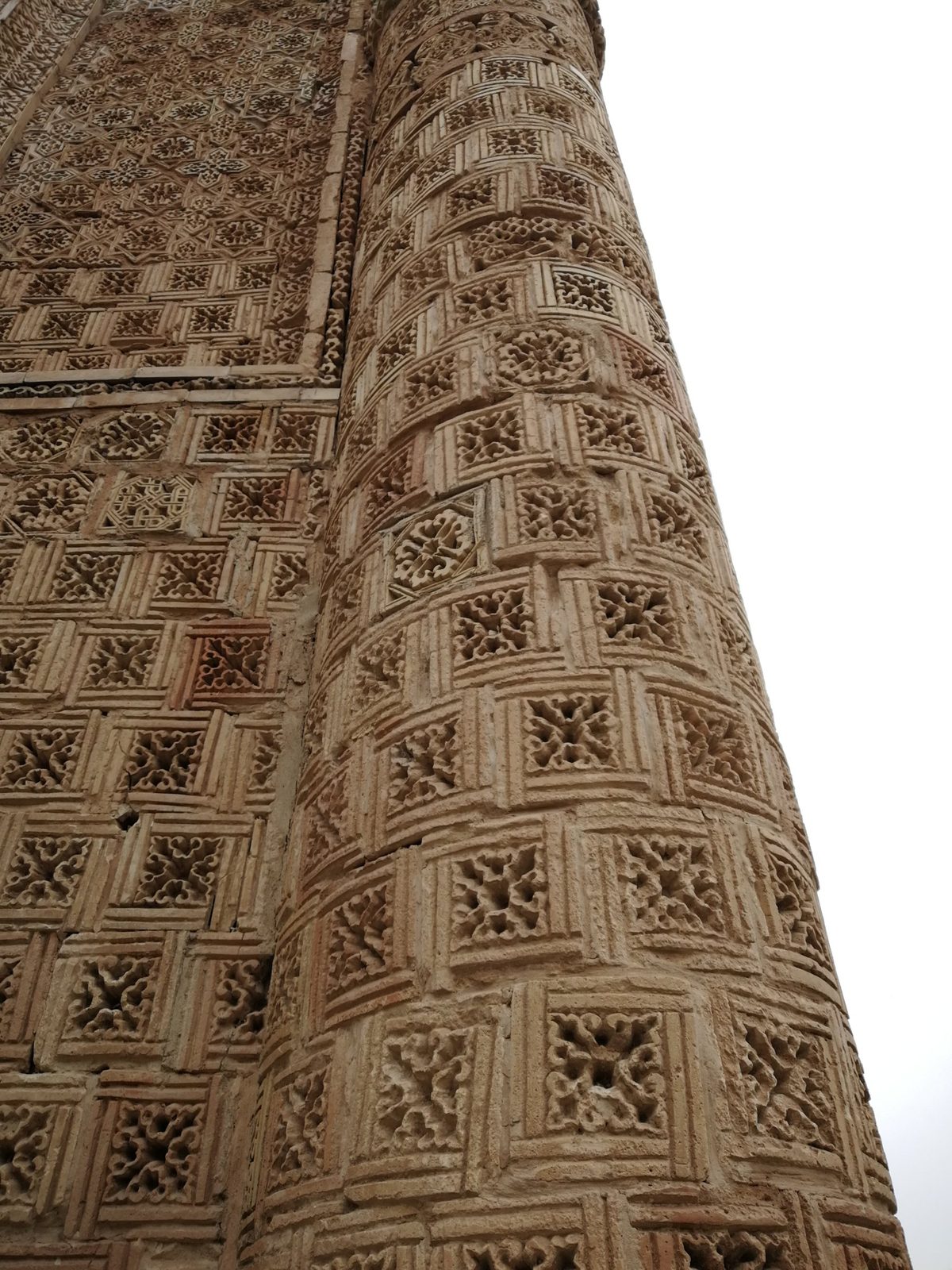
Each corner column has a band of calligraphy at its narrowest point. On one of them, in angular Kufic script, an unknown poet left a line that reads, in translation: “Autumn… Clouds… The Earth is beautiful…”. We took the photos for this article on a grey November morning, and the line fitted perfectly.
Restoration: is Aisha Bibi a UNESCO site?
The tomb you see today is part original, part careful rebuild. Shokan Valikhanov, the Kazakh scholar and traveller, painted the ruin in 1856, and the orientalist Vasily Bartold recorded it in 1893. In Soviet times what was left stood under a protective glass shell.
The restoration that gave the mausoleum its present look was carried out in 2002, together with the park around both tombs. Only about a third of the original building had survived. The new bricks were made of Sauran clay, the same clay as the old ones.
Aisha Bibi is a national monument under state protection, as the sign at the gate says. It is not part of the UNESCO Silk Roads World Heritage listing, although you will sometimes read that it is. That 2014 listing does include several ancient town sites in the same Jambyl region, and Balasagun with the Burana tower in Kyrgyzstan.
Why newlyweds come here
The legend is not only for visitors. Couples from across the Jambyl region come to Aisha Bibi on their wedding day: it is believed to bring a happy life together. In Taraz a wedding party may retrace Karakhan’s own journey, from his mausoleum in the city to Aisha Bibi, asking the lovers for their blessing along the way. Local women come here to pray for children and a happy family.
How to visit Aisha Bibi
Where. In the village of Aisha Bibi, 18 km west of Taraz, on a ridge above the Taraz oasis. From the gate a straight alley leads to Aisha Bibi, with Babaji Khatun beside it.
How long. An hour is enough for both tombs and the story. Add an hour for the Karakhan mausoleum in Taraz itself: it goes back to the 11th century and was rebuilt in 1906.
Manners. This is a place of pilgrimage. Dress modestly, keep your voice down near people praying, and ask before you photograph a wedding party.
Aisha Bibi on a Kazakhstan and Kyrgyzstan route
Taraz lies between Shymkent and Bishkek, so Aisha Bibi fits naturally into a trip that starts in Uzbekistan and continues into Kazakhstan, Kyrgyzstan or both. How we combine the countries is in our guide to Central Asia tours from Uzbekistan.
West: Shymkent and Turkestan
From Tashkent the road goes north across the border to Shymkent. From Shymkent it is 176 km east to Taraz. Turkestan, with the mausoleum of Khoja Ahmed Yasawi, lies the other way, northwest of Shymkent. One loop can take in both: Tashkent, Turkestan, Shymkent, Taraz. How to get to Turkestan is in our article Turkestan from Tashkent.
East: Bishkek, the Burana tower and the balbals
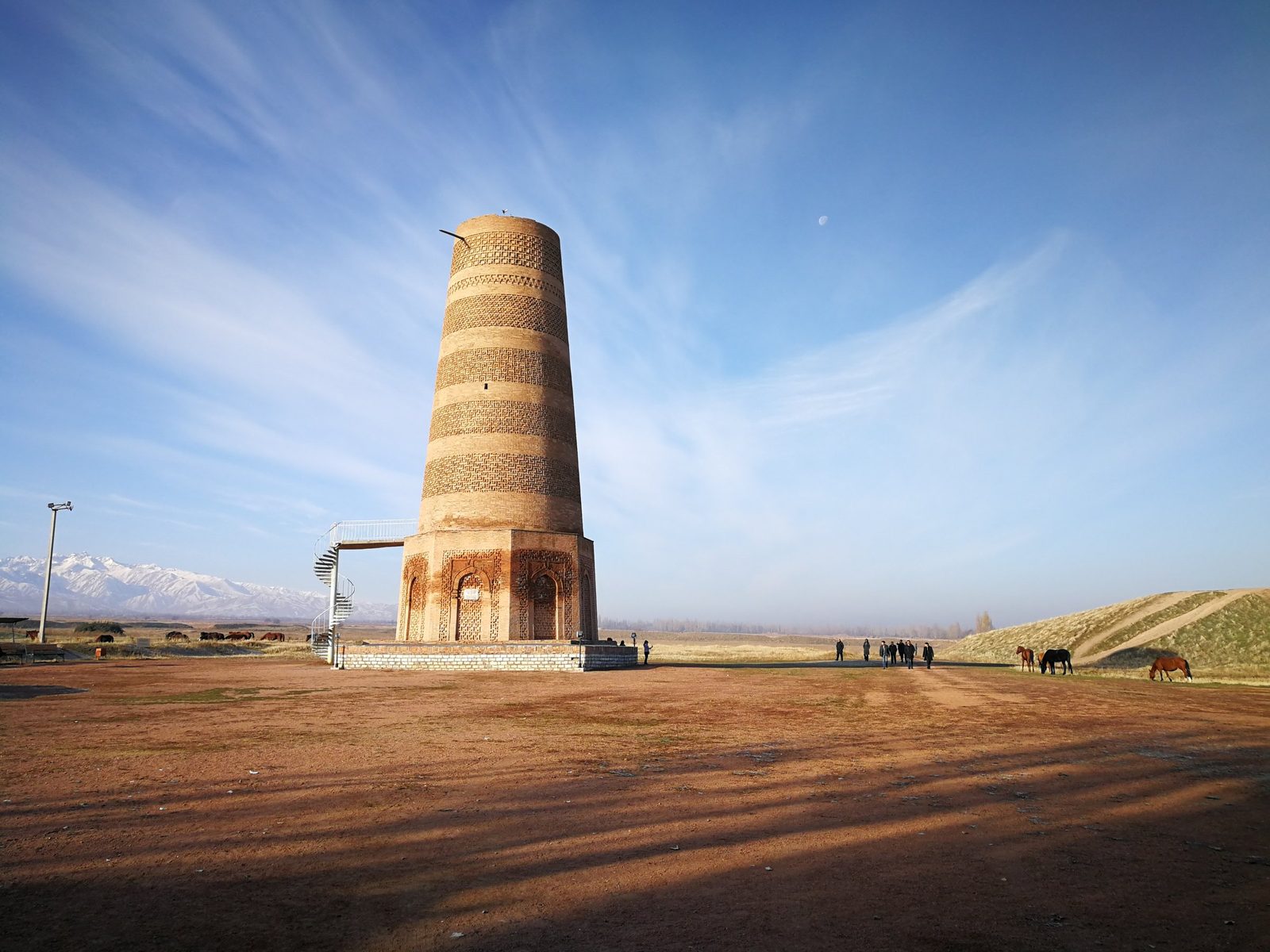
East of Taraz the road crosses into Kyrgyzstan and runs on to Bishkek. The Burana tower is not next to Aisha Bibi: it stands about 80 km beyond Bishkek, east of the capital and 10 km south of Tokmok, in the Chuy valley.
It is the 11th-century minaret of Balasagun, another Karakhanid city. It was once about 45 metres tall; an earthquake in the 15th century took the top half, and about 25 metres remain. In the field beside it stand balbals: stone figures with carved faces that Turkic nomads set up as grave markers between the 6th and 10th centuries. With the snowy Did you know? The tulip's family tree is said to begin in the Tian Shan Long before Ottoman gardens and Dutch bulb fields, wild tulips grew in Central Asia's mountains, and the Tian Shan is often named as their homeland. In April they flower on the slopes around Chimgan. Read more → behind them, they make a fine half-day from Bishkek.
Entry rules: check your passport
This route can cross three borders, and the rules depend on your passport. With a British passport, for example, Kazakhstan is Entry rules depend on your passport. Once you are here, each stay must be registered within three days, and hotels do it for you; customs and registration rules are in our guide. Read more →-free for up to 30 days per visit, and Kyrgyzstan for 30 days in each 60-day period. For Uzbekistan, see our guide do you need a visa for Uzbekistan. If you travel on an Uzbek e-visa and plan to come back, take a double- or multiple-entry one. Before we book anything, we check every passport in the group against the current rules of each country.
In short
- Aisha Bibi is an 11th–12th-century tomb 18 km west of Taraz, faced with carved terracotta in more than 60 patterns.
- The legend: Karakhan, ruler of Taraz, married Aisha as she lay dying from a snake bite at the seventh river; her nanny Babaji Khatun stayed to tend the grave and lies a few steps away.
- Newlyweds still come here to ask the lovers for a blessing.
- Pair it with Shymkent and Turkestan to the west, or with Bishkek and the Burana tower to the east.
- Check the entry rules of every country on the route for your passport.