
 Deutsch
 English
 Español
 Français
 Italiano
 Polski
 Português
 Suomi
 Svenska
 Türkçe
 Ελληνικά
 Български
 Русский
 עברית
 한국어
 中文
 日本語
Programme and details
Uzbekistan · 8 Days · Group Tour by Train
Essential Uzbekistan by Train
Tashkent – Samarkand – Bukhara – Khiva – Urgench
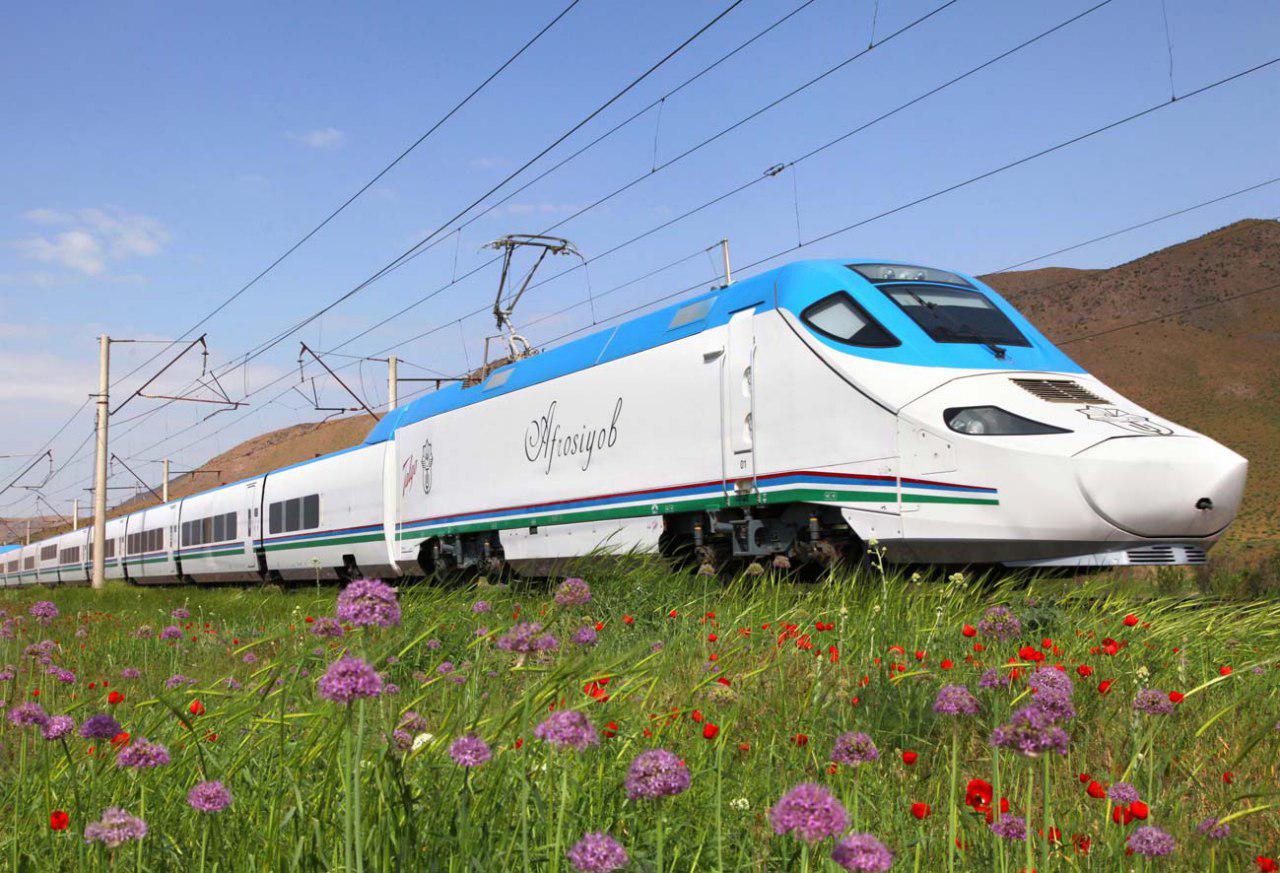
An 8-day group tour of Uzbekistan that leaves every Monday from March to November 2027 and covers Tashkent, Samarkand, Bukhara and Khiva by train. Day 1 is your flight to Tashkent; from day 2 you have six nights in hotels: one in Tashkent, one in Samarkand, two in Bukhara and two in Khiva. Between the cities you ride three trains, the last of them the high-speed Did you know? The fast train to Khiva bears the name of a 13th-century shah The Jaloliddin Manguberdi, a Hyundai Rotem high-speed train, made its first run on 5 May 2026: 1,220 km from Tashkent to Khiva via Samarkand, Bukhara and Urgench in about 7.5 hours. It is named after Jalal ad-Din, the last Khwarazmshah. Read more → across the The Kyzylkum, or Red Sands: the desert between the Amu Darya and Syr Darya rivers that the road and the railway cross on the way to Khiva. desert to Khiva. Breakfasts are included, an English-speaking guide leads every excursion, and the evenings are yours.
| Duration | 8 days: the flight to Tashkent on day 1, then 6 nights in hotels |
| Price | on request |
| Format | Group tour, fixed departures every Monday, March–November 2027; from 2 to 20 travellers |
| Where | Tashkent, Samarkand, Bukhara and Khiva; the tour ends at Urgench airport |
| Getting around | Economy-class seats on the Sharq trains Tashkent – Samarkand – Bukhara and the Jaloliddin Manguberdi Bukhara – Khiva; an air-conditioned vehicle for the transfers |
| Meals | Breakfasts only |
| Guide | An English-speaking guide on all excursions |
| Best time | March–June and September–November; July and August are hot |
Ideal for first-time travellers who want all four classic cities in one week, for anyone who prefers a ready date and a group to planning alone, and for those who would rather see the desert from a train window than from the road.
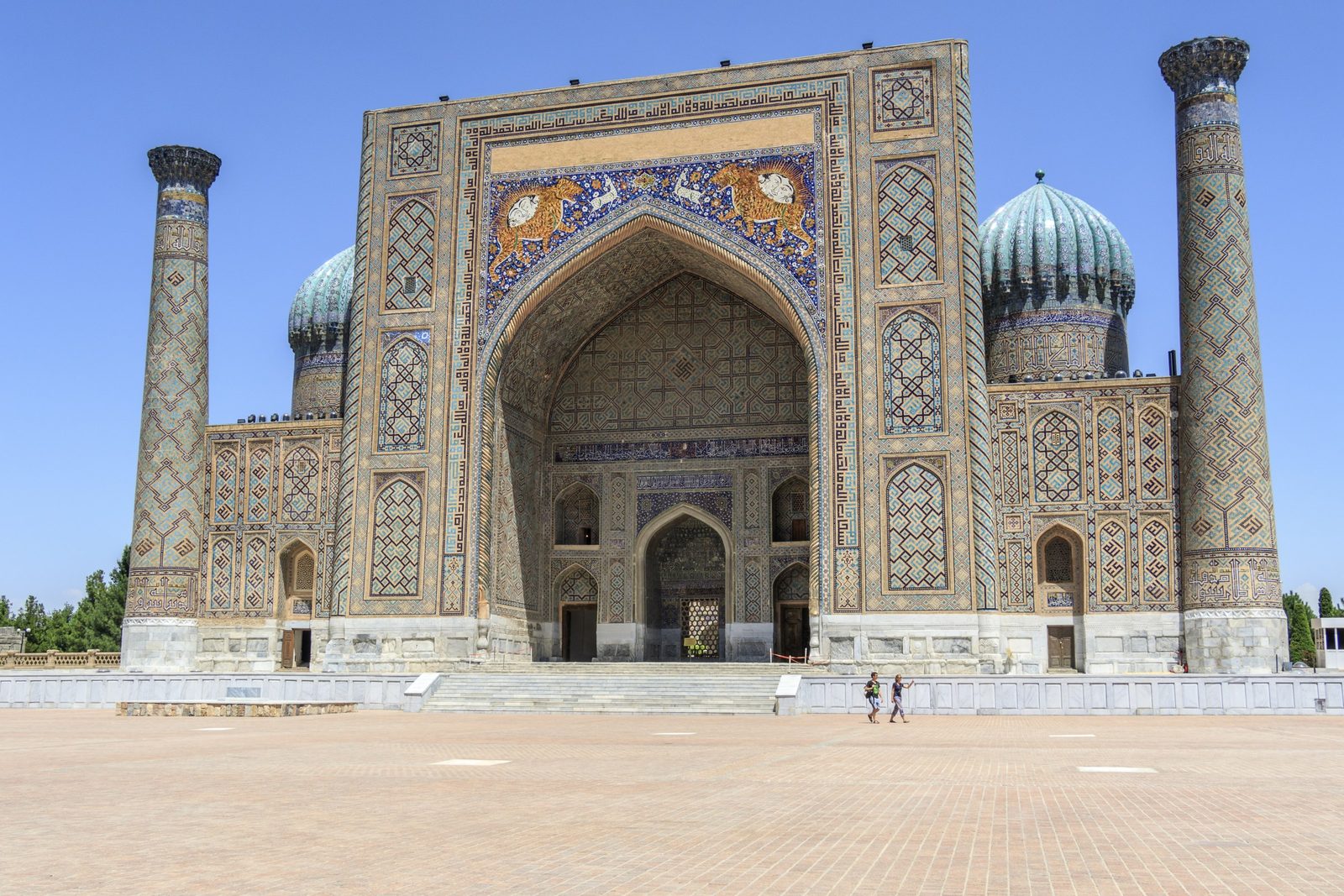
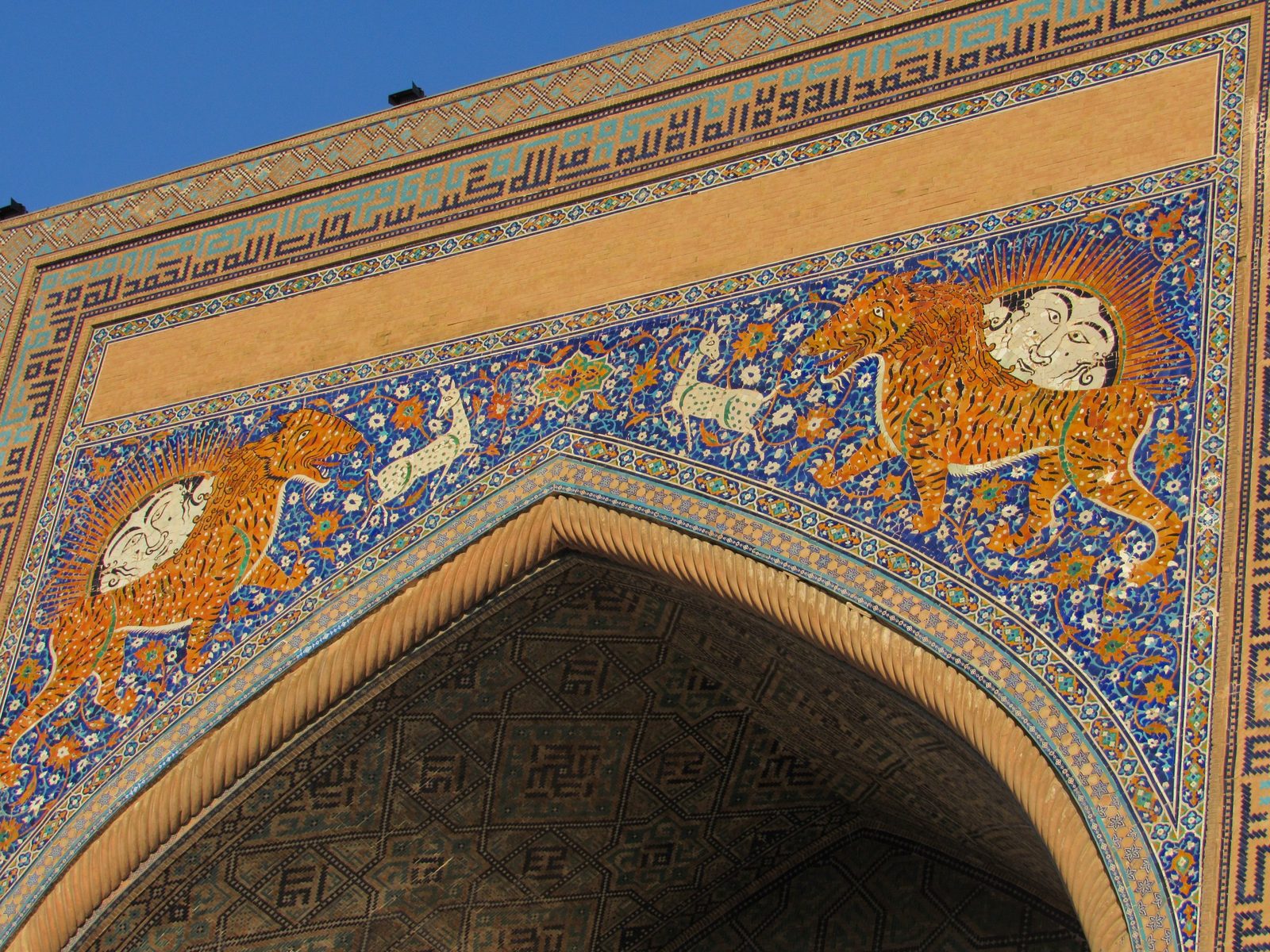
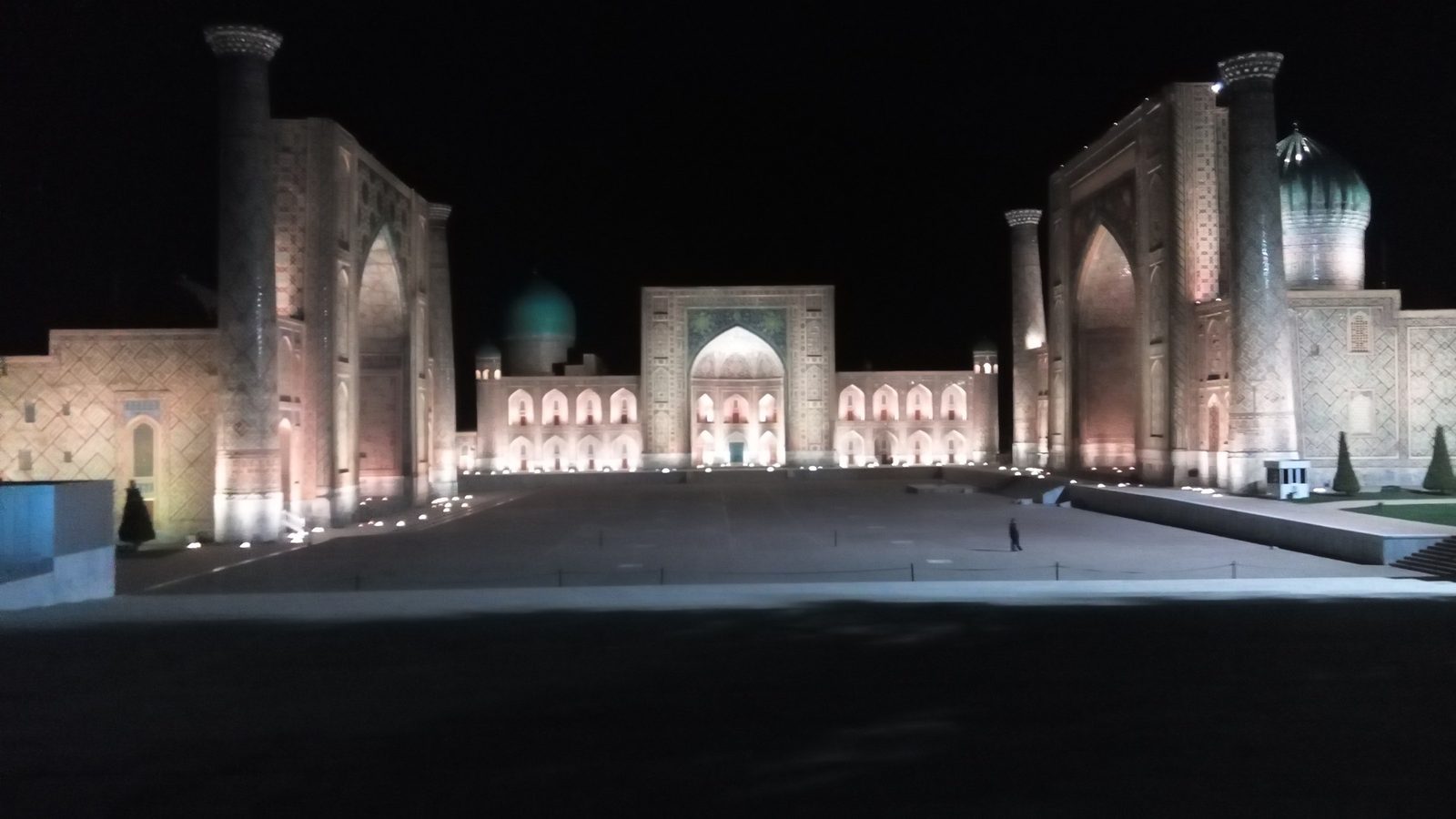
The Did you know? The Registan's sun-carrying lion went on a banknote The Sher-Dor Madrasah (1619–1636) is named for the big cats with the sun on their backs on its portal. The image appeared on the reverse of Uzbekistan's 200-som note of 1997. Read more → — three madrasahs around one square; the name means "sandy place".
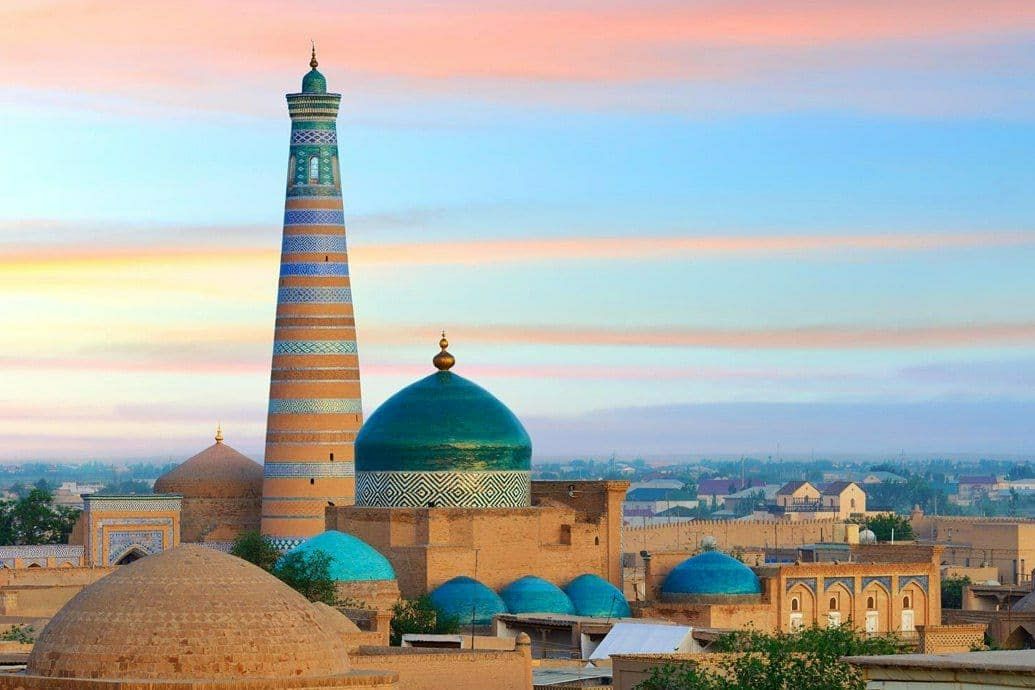
Did you know? People still live inside Khiva's museum city Itchan Kala packs more than 50 historic monuments and about 250 old houses inside clay walls 8–10 m high and 5–6 m thick, and families still live and work in its lanes. Read more → — the walled inner town of Khiva, where people still live among the madrasahs and palaces.
Departure dates — 2027
Every departure is a Monday: that is day 1, when you fly to Tashkent. The programme in Uzbekistan starts when you land on Tuesday and ends on the following Monday at Urgench airport.
Itinerary
Day by Day
Day 1 · Monday · Home – Tashkent — The flight to Uzbekistan
You fly to Tashkent, the capital of Uzbekistan. The night is spent on the way, so there is no hotel tonight.
Good to know: if your flight lands in Tashkent on Monday, we book an extra night in Tashkent on request. More in our Tashkent airport arrival guide.
Day 2 · Tuesday · Tashkent — Chorsu bazaar, the Khast Imam square and the modern centre
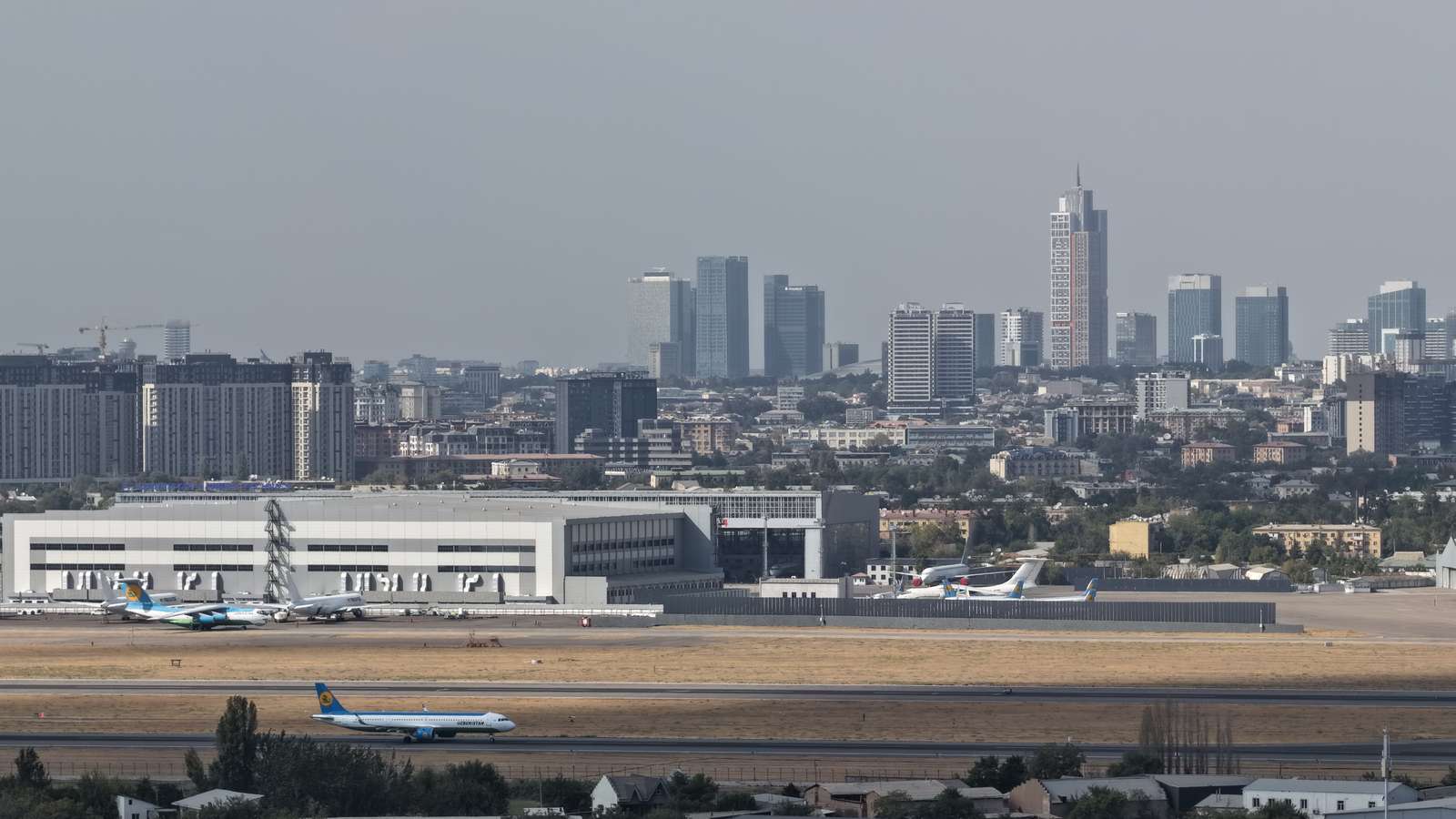
A driver meets you in the arrivals hall of Tashkent International Airport with a sign and takes you to the hotel; rooms are ready from 14:00.
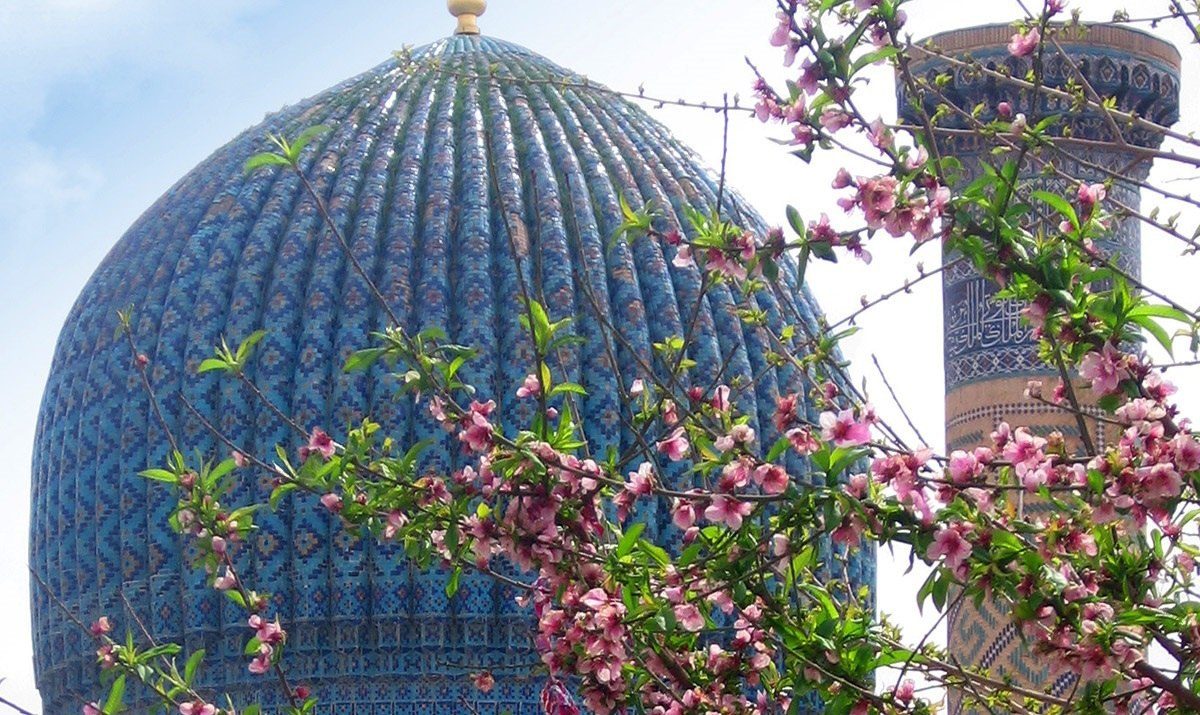
With your guide you start in the old town. Did you know? Tashkent’s Chorsu dome is younger than the city’s metro Trade at the old crossroads is centuries old, but the domed building opened only in 1990, thirteen years after the metro. Architects Vladimir Azimov and Sabir Adylov gave it a main dome of 86 m ringed by seven smaller ones. Read more → trades under a great blue dome: dried apricots by the sack, pyramids of spices and bread sellers who will want you to taste first. Nearby is the The religious heart of old Tashkent: madrasahs, a Friday mosque and mausoleums. Right next to it stands the new Center of Islamic Civilization, opened in 2026. Read more → square with the Did you know? A mausoleum built for a khan who was buried in another city Barak Khan Madrasah was built in 1531–32. One of its two mausoleums was meant for Barak Khan himself, but he was buried in Samarkand, so the tomb is still called the Nameless Mausoleum. Its cell doors were inlaid with ivory. Read more → ,An Islamic college: student cells and classrooms around a courtyard behind a grand portal. In the old towns many now house museums and craft workshops. Read more → the Tilla Sheikh mosque and the mausoleum of .Did you know? Tashkent's patron saint was nicknamed “the locksmith” Abu Bakr Kaffal Shashi, born in Shash, old Tashkent, in 903–904 and died in 976, was a jurist and poet and the son of a locksmith: “kaffal” means locksmith. His mausoleum at Hazrati Imam dates from 1541–1542. Read more →
Then the Tashkent of the last two centuries: Independence Square, once Lenin Square; the ,Did you know? A Romanov grand duke gave Tashkent its first cinema Grand Duke Nikolai Konstantinovich Romanov lived in Tashkent from the 1880s; his palace of 1891 is by Heinzelman and Benois. He opened the city's first cinema, “Khiva”, funded canals in the Hungry Steppe, and his paintings seeded the Museum of Arts. Read more → built in 1891 for Grand Duke Nikolai Konstantinovich, who had been exiled from St Petersburg, seen from outside; the Did you know? An opera house with a foyer for every region The Alisher Navoi Theatre, opened in 1947, has six halls carved in the styles of Tashkent, Fergana, Bukhara, Samarkand, Khiva and Termez, each led by a master of that school. Read more → of Opera and Ballet, designed by Alexey Shchusev, the architect of Lenin's Mausoleum, and opened in 1947; and .Did you know? Legend: “Strength lies in justice” were Timur's own words The equestrian statue of Amir Timur in central Tashkent, unveiled in 1994, bears the motto “Strength lies in justice” in four languages. Tradition attributes the words to Timur himself, but historians cannot confirm he said them. Read more → The evening is free.
Good to know: early check-in is not included; if you land at dawn and want the room at once, we book it on request. More in our article on Chorsu bazaar.
Overnight in Tashkent
Day 3 · Wednesday · Tashkent – Samarkand — The morning train, Gur-e-Amir, the Registan and Bibi-Khanym
After breakfast you take the morning Sharq train to Samarkand, a little over three hours. Your guide starts at ,Did you know? Timur's tombstone went to Persia and came back The dark-green jade slab on Timur's grave in Gur-e-Amir was carried off by Nader Shah in 1740. It broke, and on his advisers' urging he sent it back to Samarkand. Read more → where ,Amir Timur (Tamerlane, 1336–1405), founder of the Timurid empire, which had its capital in Samarkand. Born near Shahrisabz. Read more → known in Europe as ,Did you know? Why Europe calls Timur 'Tamerlane' Persian sources called him Timur-i Lang, 'Timur the Lame', after old wounds to his right leg and arm. When his tomb was studied in 1941, anthropologist Mikhail Gerasimov confirmed the injuries and modelled his face from the skull. Read more → lies under a slab of dark green jade.
Then the Registan, whose name means "sandy place": the madrasahs of ,Did you know? Ulugh Beg measured the year to within 25 seconds Working at his Samarkand observatory, Ulugh Beg put the tropical year at 365 days 5 h 49 min 15 s, about 25 seconds too long, closer than Copernicus a century later. Read more → Sher-Dor and Did you know? The 'gilded' mosque of the Registan Tilla-Kari, built in 1646–1660, means 'gilded'. With Bibi-Khanym in ruins, it served as Samarkand's main Friday mosque until the 1920s. Its prayer hall glows with kundal, relief painting finished in gold leaf, restored in 1979. Read more → around one square. A short walk away stands the ,Did you know? 95 elephants hauled stone for Timur's great mosque Bibi-Khanym, begun in 1399 after Timur took Delhi, was the largest mosque of his empire. Some 200 stonecutters worked on site and 95 elephants brought from India hauled the loads; the courtyard was meant to hold 10,000 people. Read more → which Timur began in 1399; it was built so fast that, as the story goes, it started to crumble soon after it was finished. Next to it is ,Samarkand's main bazaar, right next to Bibi-Khanym: Samarkand bread, dried fruit, nuts and halva. Read more → with ,Did you know? Legend: Samarkand bread can't be baked anywhere else Legend says a Bukhara ruler brought Samarkand's best baker to his court with his oven, flour and water, yet the bread came out different. The missing ingredient, the baker said, was the air of Samarkand. The round loaves keep for a long time. Read more → nuts and dried fruit. Check-in at the hotel from 14:00, and the evening is yours.
Good to know: train times follow the current railway timetable, which Uzbekistan Railways may change. Tickets are issued in each traveller's name, so we need your passport details about two months ahead. More in Tashkent to Samarkand.
Overnight in Samarkand
Day 4 · Thursday · Samarkand – Bukhara — A free morning and the Sharq train to Bukhara
The morning is yours until the transfer to the station. Shah-i-Zinda, the street of tiled mausoleums, is a short walk from Did you know? Legend says the architect asked the queen for a kiss Legend says the architect of Bibi-Khanym would finish on time only for a kiss from Timur's wife, and Timur punished him. In fact the mosque was Timur's own project; his wife Saray Mulk Khanum built her madrasah across the road. Read more → if you want one more site; its ticket is not included.
Around midday the Sharq takes you on to Bukhara in under three hours. Bukhara's station is in Kagan, about 12 km from the old town, and the transfer takes you to the hotel; rooms are ready from 14:00. The rest of the day is free, and the evening crowd around the Did you know? Bukhara's ponds were once its water supply Pools like Lyabi-Hauz, dug around 1620 and 46 × 36 m, were the city's main source of water. Most were filled in during the 1920s–30s because they spread disease; Lyabi-Hauz survived. Read more → pond is the easiest first walk.
Good to know: times per the current railway timetable. More in Samarkand to Bukhara.
Overnight in Bukhara
Day 5 · Friday · Bukhara — A whole day on foot, from Lyabi-Hauz to the Ark
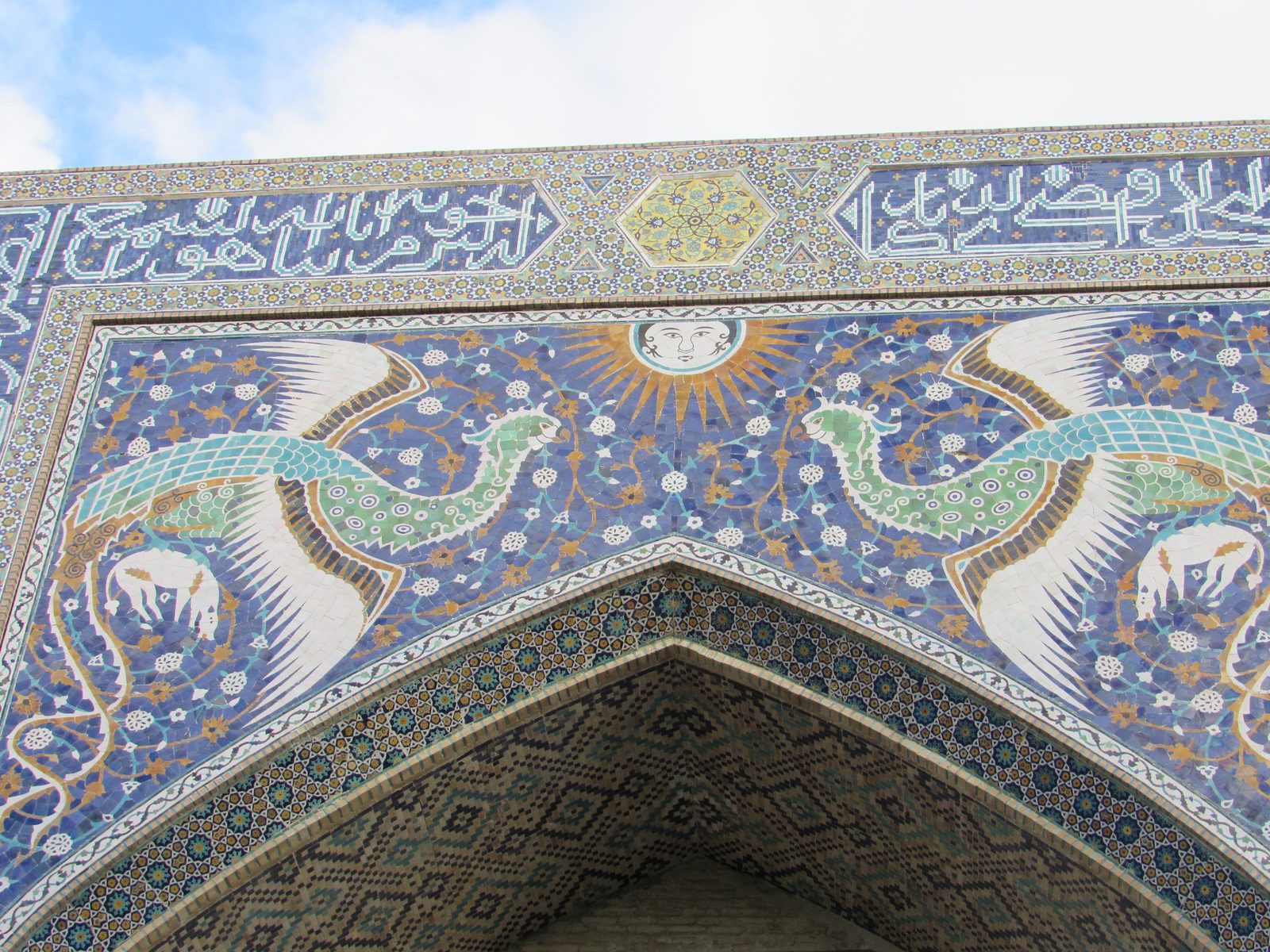
Bukhara is best on foot, and today is all walking. You start at Lyabi-Hauz, the square around a pond of about 1620, between the Did you know? A madrasah that was an inn, a fort and a museum Tashkent's Kukeldash Madrasah, built around 1570, became a caravanserai in the 18th century, later a fortress and then a museum, before returning to teaching in the 1990s. Read more → and the ,Did you know? A caravanserai that became a madrasah by a khan's word Nadir Divan-Begi built his 1622 building by Lyabi-Hauz as a caravanserai. At the opening Imam Quli Khan praised it as a fine madrasah, and a khan's word could not be taken back: a portal and cells were added, and a madrasah it became. Read more → whose portal shows two great birds and a sun with a human face. Then the Did you know? Magoki-Attori: a mosque 'in the pit' Magoki-Attori means roughly 'in the pit': even in the 10th century it lay below street level. Beneath it lie remains of a pre-Islamic temple. Read more → mosque, which stands several metres below today's street, and the three Did you know? Under Bukhara's domes merchants changed money and gold Four 16th-century trading domes still stand over old crossroads. Toki Sarrafon was the money changers' dome, where merchants from India and China swapped coins; Toki Zargaron held jewellers' workshops, Toki Telpak Furushon sold caps. Read more → of the 16th century: of the money changers, the hat sellers and the jewellers. Beyond them face each other the madrasahs of Ulugh Beg, from 1417, and Abdulaziz Khan, from the 1650s, seen from outside.
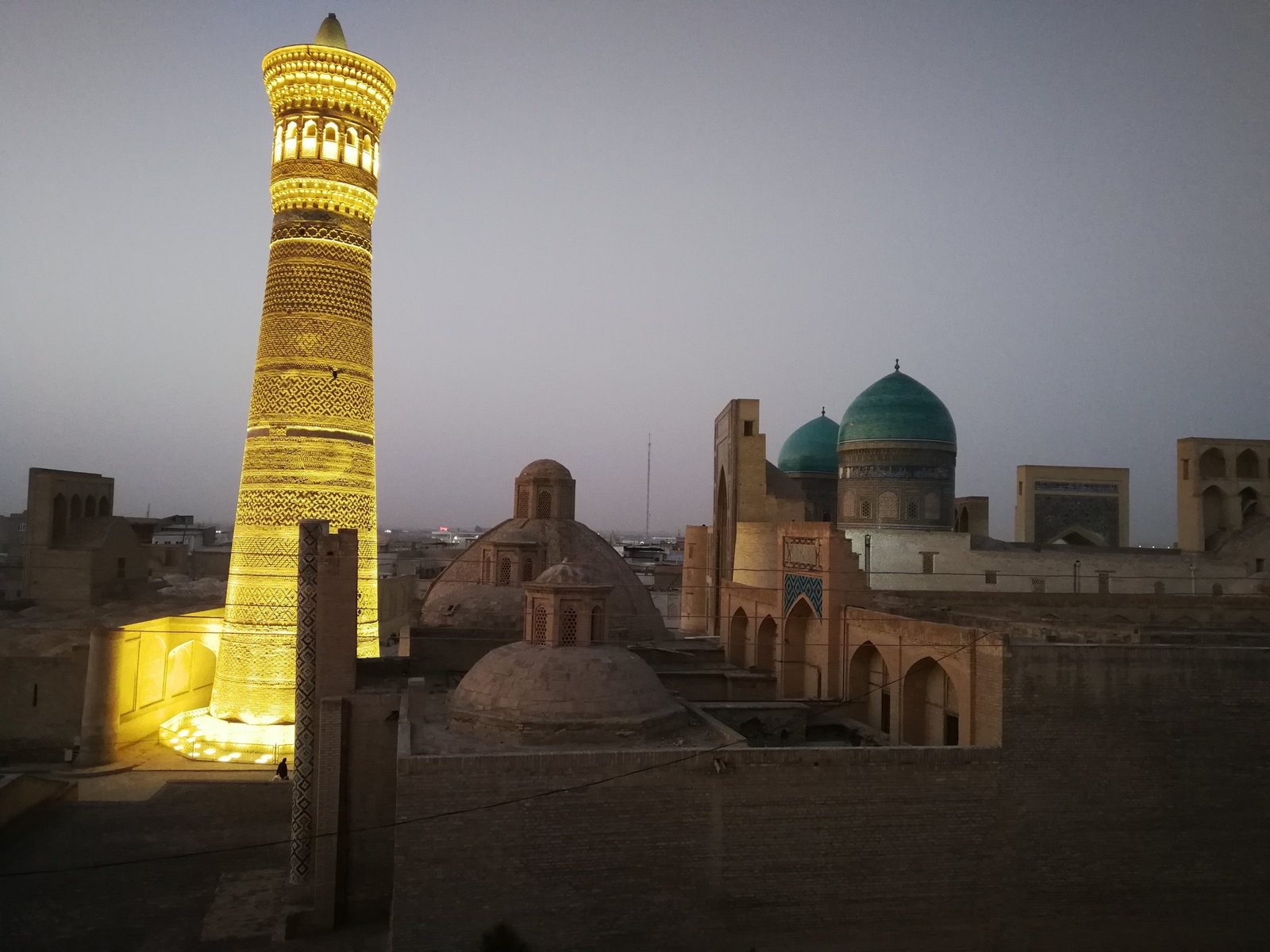
Next comes Poi Kalyan. The Kalyan minaret was raised in 1127, and the story goes that Genghis Khan ordered it to be spared. Beside it stand the Kalyan mosque and the Did you know? A madrasah still teaching after almost 500 years Mir-i-Arab, built in the 1530s opposite the Kalyan Mosque, was one of only three Islamic schools that kept working through the Soviet period, and it still trains students today. Read more → madrasah, still a working school, seen from outside. The walk ends at ,The fortress-residence of the rulers of Bukhara on a high artificial hill: the oldest structure in the city. Read more → the fortress of the emirs until 1920, and at the Did you know? The famous columns of Bolo-Hauz are barely a century old The Bolo-Hauz mosque opposite the Ark was completed in 1712, but its best-known feature, the tall, slender carved columns along the front of the iwan, was added only in 1917, together with the small minaret of 1916–1917. Read more → mosque across the road, built in 1712, whose twenty wooden columns, people say, become forty in the pond.
Good to know: Poi Kalyan and Bolo-Hauz are working religious places, so cover shoulders and knees. More in Bukhara in 1, 2 or 3 days.
Overnight in Bukhara
Day 6 · Saturday · Bukhara – Khiva — The high-speed train across the Kyzylkum
After breakfast the transfer takes you to Kagan for the Jaloliddin Manguberdi, the high-speed train that has run to Khiva since May 2026. It is named after the last Khwarazmshah, who fought the armies of Genghis Khan. The ride across the Kyzylkum, the "Red Sand", takes about three and a half hours, and for long stretches there is hardly a town in sight.
In Khiva you are met at the station and taken to the hotel; rooms are ready from 14:00. The afternoon and evening are free: the clay walls of Itchan Kala are at their best at sunset.
Good to know: this train runs on set days, not every day, and times follow the current railway timetable. If Uzbekistan Railways changes it, we adjust the programme and tell you before departure. More in Khiva and Bukhara by train.
Overnight in Khiva
Day 7 · Sunday · Khiva — Inside the walls of Itchan Kala
Khiva kept a whole walled town, not just an old quarter, and people still live inside it. On foot with your guide: the ,Did you know? A 14-metre-wide base for a tower that stopped at 29 m Kalta-Minor was begun in 1852 and meant to reach 70–80 m, but work halted in 1855 at about 29 m when its khan died. It is said to be the only minaret covered entirely in glazed tiles. Read more → the tiled minaret begun in 1852 and left unfinished at 29 metres in 1855, when Muhammad Amin Khan died; his madrasah beside it, now a hotel; the Muhammad Rahim Khan madrasah and the ,Did you know? In the khan’s courtyard a round platform waited for a yurt The Kunya-Ark, the khans’ citadel, had its own mint, arsenal and harem. In the courtyard of its reception hall of 1804–1806 stands a round platform: a yurt was set up on it, and there the khan received envoys of the steppe nomads. Read more → the khans' citadel begun in 1686.
Then the Juma mosque, whose roof rests on more than two hundred carved wooden columns, the oldest of them about a thousand years old; the ,Did you know? Khiva's tallest minaret is barely a century old The Islam Khoja Minaret was begun in 1908, near the very end of the khans' era. At 56.6 m it is one of the tallest in Central Asia; a spiral stair of 175 steps leads up to its windowed top. Read more → 56.6 m, the tallest in Khiva, seen from outside; the Allakuli Khan madrasah and caravanserai; and ,Did you know? In Tash-Hauli's harem each of four wives had her own loggia Allakuli Khan built the Tash-Hauli palace in 1830–1838 around three courtyards. In the harem four tall loggias belonged to the khan's four wives and a fifth, the largest, to the khan himself; behind each summer terrace lay a winter room. Read more → the palace of the 1830s with its tiled harem courtyard. The evening is free.
Good to know: cover shoulders and knees in the mosque. More in Khiva in 1 or 2 days.
Overnight in Khiva
Day 8 · Monday · Khiva – Urgench — The flight home
Breakfast comes as a box. A driver takes you to Urgench airport, about 30 km from Khiva, for your flight home. End of services.
Good to know: flights from Urgench are not part of the tour; tell us your flight time and we set the transfer by it. Want more time in Khiva? We add an extra night on request.
Other ways to see Uzbekistan by train
If you would rather travel on your own dates with a guide only for you, our private Uzbekistan by Train takes the Uzbekistan's high-speed train: Tashkent to Samarkand in about 2 hours 10 minutes, Tashkent to Bukhara in about 4 hours. Tickets are tied to your passport. Read more → and the Tashkent Did you know? Tashkent’s railway museum opened for a 100th birthday The Museum of Railway Techniques opened next to Tashkent’s main station on 4 August 1989, for the 100th anniversary of the first railways in Central Asia. Its oldest engine, an OV, dates from 1914, and most locomotives can be climbed, cabs included. Read more → into an 8-day route. The Samarkand, Bukhara and Khiva group tour leaves on Fridays and flies to Khiva instead of taking the desert train.
Good to know: the trains, classes and tickets are explained in our guide to trains in Uzbekistan.
Accommodation
Where you stay
| City | Stay |
|---|---|
| Tashkent | A tourist-class hotel, 1 night |
| Samarkand | A tourist-class hotel, 1 night |
| Bukhara | A tourist-class hotel, 2 nights |
| Khiva | A tourist-class hotel, 2 nights |
Hotels in Uzbekistan are often low-rise and many have no lift; most are privately run without an official star rating. If a planned hotel is not available, we confirm one of the same category.
Price
Price
The price is on request: it depends on the departure date and on whether you share a room or take a single.
Good to know
Conditions
- The group is from 2 to 20 travellers. Book at least two months before departure: train tickets are issued in each traveller's name and go on sale 60 days ahead, so we need full names and passport details before that. Later requests depend on the seats left.
- Train times follow the current timetable of Uzbekistan Railways, which may change the times or the running days; then we adjust the programme and tell you in advance.
- Citizens of the EU, the UK, Australia and the USA can currently visit Uzbekistan without a Entry rules depend on your passport. Once you are here, each stay must be registered within three days, and hotels do it for you; customs and registration rules are in our guide. Read more → for up to 30 days. Rules change, so we check them for your passport before booking. Hotels register you on arrival; keep the slips until you leave.
- Your guide speaks English on all excursions.
- At the mosques and mausoleums, cover shoulders and knees.
- Drink bottled water: it is sold everywhere.
- If your luggage is delayed, airlines in Uzbekistan do not deliver it to the hotel; it is collected at the airport, and that trip is not part of the tour.
- Read before you go: Trains in Uzbekistan and Uzbekistan in 7 days.
- Reservations are confirmed with passport copies only.
Cancellation policy
| Cancellation timing | Penalty |
|---|---|
| 14–8 days before departure | 20% |
| 7 days | 50% |
| 6–0 days | 100% |
🌿 Responsible tourism: we allocate part of our profits to good causes and are preparing for GSTC certification.
Expert opinion
Pluses
- All the way by train: three trains from Tashkent through Samarkand and Bukhara to Khiva, and the flight home from Urgench, about 30 km away.
- A date every Monday: departures from March to November 2027, and each one runs from 2 travellers, up to 20.
- Time in Bukhara and Khiva: two nights in each, with a whole day on foot in Bukhara and a whole day inside the walls of Khiva.
Minuses
- Breakfasts only: lunches, dinners and drinks are paid on site.
- Samarkand in brief: one afternoon with the guide and a free morning; Did you know? Why Shah-i-Zinda means 'the Living King' The necropolis grew around the shrine of Qutham ibn Abbas, a cousin of the Prophet Muhammad. Legend says he did not die in battle but went down a deep well to a garden of paradise, where he lives on. Read more → is not on the programme.
- Summer heat: departures in July and August mean 34–37 °C by day in Bukhara and Khiva.
AroundCA numbers
How we counted
By the AroundCA programme: we count only what is written in the day-by-day programme of this tour. If the programme gives no figure, we show nothing.
- Hotel changes
- 3
- Walking
- Medium
Walking: Medium: city walks in Tashkent and Samarkand, a whole day on foot in Bukhara and another inside the walls of Khiva; the train days are easy.
Best time
Mar–Jun, Sep–Nov
The season runs March–June and September–November; March and November, at its start and end, are the quietest, with 11–17 °C by day.
Better to avoid
Jul–Aug
July–August is outside the season and hot: 34–37 °C by day in Bukhara and Khiva.
A typical day
On day 5 you walk all day in Bukhara: Lyabi-Hauz and the Nadir Divan-Begi portal in the morning, then the trading domes, Poi Kalyan with its minaret of 1127, and the Ark and Bolo-Hauz at the end of the afternoon.
What the price includes
What is included
- Accommodation: 6 nights in double or twin rooms (Tashkent 1, Samarkand 1, Bukhara 2, Khiva 2)
- Tourist tax at the hotels
- Breakfasts, the last one as a box
- Economy-class train tickets Tashkent – Samarkand, Samarkand – Bukhara and Bukhara – Khiva
- Airport and station transfers in an air-conditioned vehicle
- An English-speaking guide on all excursions
- Entrance tickets to the museums and monuments on the programme
Not included
- International flights to Tashkent and from Urgench
- Lunches, dinners and drinks
- A single room (on request)
- Early check-in and late check-out
- Extra nights in Tashkent or Khiva (on request)
- Visa fees, if your passport needs a visa
- Photo and video fees at the sites
- Personal expenses
Extra cost on site
- Lunches, dinners and drinks
- Photo and video fees at the sites
- Personal expenses
Good for
- First-time travellers who want Tashkent, Samarkand, Bukhara and Khiva in one week
- Anyone who likes a ready Monday date and a group from 2 people
- Travellers who prefer trains to domestic flights and long desert drives
Maybe not for you if
- Those who want lunches and dinners arranged: only breakfasts are included
- Travellers who need their own dates or a private guide: see our private Uzbekistan by Train
- Anyone who wants a slow week: Samarkand gets one afternoon and a free morning
Questions about this tour
How much does the tour cost?
The price is given on request. It depends on the departure date and on whether you share a double or twin room or take a single. Send us your Monday date and the number of travellers, and we reply with a full quote, including any extra nights you want in Tashkent or Khiva.
How does a Monday departure work?
The Monday is day 1, when you fly to Tashkent. The programme starts when you land on Tuesday, with a driver waiting in the arrivals hall, and ends the next Monday with a transfer to Urgench airport. If your flight lands on Monday itself, we add a night in Tashkent on request.
How big is the group?
From 2 to 20 travellers. Each departure runs from two people, so you do not have to wait for a group to fill. Travellers share an English-speaking guide on all excursions and the transfers between the hotels, the stations and the airports. Lunches, dinners and the evenings are your own.
Which trains do we take?
Three trains, in economy class. The Sharq takes you from Tashkent to Samarkand and on to Bukhara. From Bukhara the high-speed Jaloliddin Manguberdi crosses the Kyzylkum to Khiva in about three and a half hours. Times follow the current railway timetable; if it changes, we adjust the programme.
Do we need a visa for Uzbekistan?
Citizens of the EU, the UK, Australia and the USA can currently visit Uzbekistan without a visa for up to 30 days. Rules change, so send us your citizenship and we check them before booking. For the train tickets we need your passport details about two months before departure.
How is this different from your other train and group tours?
It is our simplest group tour: fixed Mondays, breakfasts, economy-class trains and tourist-class hotels. The private Uzbekistan by Train runs on your dates, and the Samarkand, Bukhara and Khiva group tour leaves on Fridays and flies to Khiva. Choose this one for a ready Monday date and the train all the way.
Didn’t find your answer? Ask about this tour →
Make it your trip
Tick what you’d like to add — it goes into your request, and the manager confirms the final price.
Add a few days
Arrival, departure, transfers
Arrive earlier or stay longer
Need extra nights before or after the tour?
Prices are indicative; we confirm the exact rate after your request.