Places in this article: Samarkand · Bukhara · Khiva · Tashkent
Uzbekistan tours from Malaysia and Indonesia: the Kuala Lumpur flight, 30 days visa-free and the land of al-Bukhari
Three names explain a great deal. Al-Bukhari means “from Bukhara”, at-Tirmidhi “from Termez”, Did you know? The word “algorithm” comes from a scholar of Khorezm Muhammad al-Khwarizmi, born in Khorezm around 780, worked at the House of Wisdom in Baghdad. The Latin form of his name gave us “algorithm”, and “algebra” comes from al-jabr in the title of his book. A statue of him stands in Khiva. Read more → “from Khwarazm”, the oasis around Khiva. All three places are in Uzbekistan, about eight hours by air from Kuala Lumpur. We are a tour operator in Tashkent, and this is our guide to Uzbekistan tours from Malaysia and Indonesia: the flights, entry without a ,Entry rules depend on your passport. Once you are here, each stay must be registered within three days, and hotels do it for you; customs and registration rules are in our guide. Read more → the heritage of the great scholars, the holidays of 2027, halal food and prayer times on the road.
Flights: nonstop from Kuala Lumpur
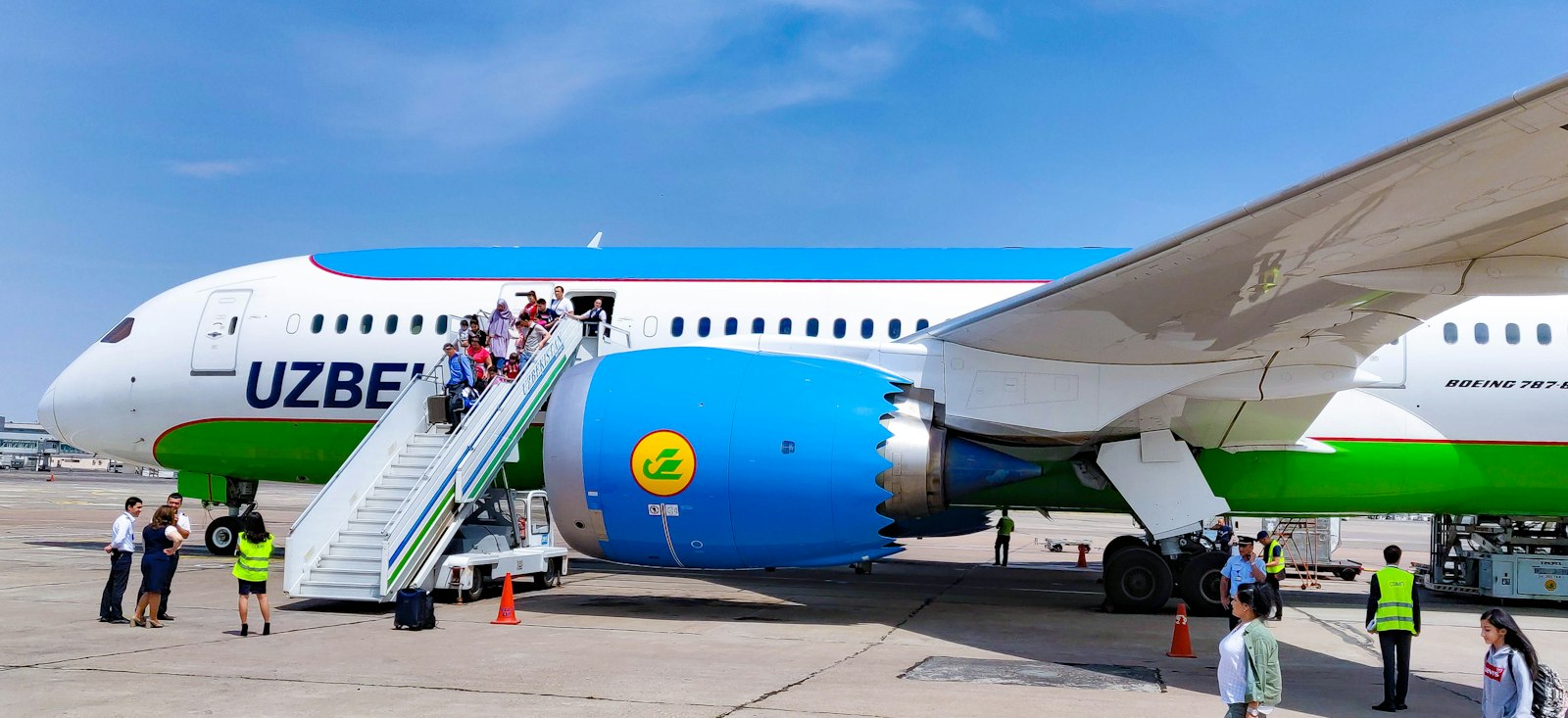
Uzbekistan Airways flies nonstop between Kuala Lumpur and Tashkent. From late October 2026 there are four flights a week, with morning, evening and night departures to choose from. The flight to Tashkent takes about 8 hours, the way back about 7 h 30 min. Batik Air Malaysia also flies the route on some days of the week.
On Uzbekistan Airways tickets for this route booked by 27 March 2027 you get one extra checked bag: up to 32 kg on the Comfort fare and up to 23 kg on Smart. Details are in our news story Tashkent–Kuala Lumpur: four flights a week and an extra bag. Malaysia is one of the markets growing fastest for Uzbekistan: from January to September 2026 the number of visitors from Malaysia grew 1.9 times.
From Jakarta there is no nonstop flight as of October 2026, so you fly with one connection, for example in Kuala Lumpur, onto the nonstop flight to Tashkent. Some flights land in Tashkent late at night; we meet you whatever the hour, with a car to your hotel and, if you wish, fast-track passport control. More routes are in our guide to flights to Uzbekistan.
Tashkent is on UTC+5 all year: three hours behind Kuala Lumpur and two hours behind Jakarta.
Entry: 30 days without a visa
Citizens of Malaysia and of Indonesia enter Uzbekistan without a visa and can stay up to 30 days, whatever the purpose of the trip. The rule has applied to both countries since 10 February 2018, and the 30 days count from the day you arrive. For a longer stay you need a visa before you travel.
Travel on a passport with at least three months of validity left from your date of arrival and a blank page: that is what Indonesia’s foreign ministry asks of its citizens, and we advise the same to guests from Malaysia. Your stay is registered: hotels do it at check-in, so on a tour you will hardly notice; keep the registration slips until you fly home. Details are in our articles on registration and customs and visas. These are the rules as of October 2026; they can change, so check them before you travel.
Al-Bukhari, at-Tirmidhi, al-Khwarizmi: the names on the map
Imam al-Bukhari. Muhammad ibn Ismail al-Bukhari was born in Bukhara in 810 and died in 870 in Khartang, a village 25 km from Samarkand, where he is buried. His Sahih, the collection of hadith he compiled over about sixteen years, carried the name of his home town far beyond Central Asia. The memorial complex over his grave was rebuilt and reopened in March 2026: four minarets of 75 metres, a mosque for 10,000 people and a museum of nine pavilions that tells his life and how hadith were collected and written down. Allow three to four hours.
At-Tirmidhi. Abu Isa at-Tirmidhi, born near Termez in about 824, was a pupil of al-Bukhari, and his Jami’ is one of the six canonical hadith collections of Sunni Islam. He died in 892 and lies in a mausoleum of the 11th–12th centuries on the outskirts of Sherobod, about 60 km north of Termez. Termez has a second great name, Al-Hakim at-Termezi, a 9th-century Sufi writer whose shrine stands by the ruins of Old Termez; our Termez guide tells the two apart.
Al-Khwarizmi. Muhammad ibn Musa al-Khwarizmi, who lived from about 780 to about 850, worked in Baghdad, where around 820 he wrote al-Jabr, the book that gave algebra its name. The Latin form of his own name, Algoritmi, gave the world the word algorithm. His name points to Khwarazm, and his statue stands outside the West Gate of the old town of Khiva. He also compiled a zij, a book of astronomical tables; six centuries later, in Samarkand, Did you know? Ulugh Beg measured the year to within 25 seconds Working at his Samarkand observatory, Ulugh Beg put the tropical year at 365 days 5 h 49 min 15 s, about 25 seconds too long, closer than Copernicus a century later. Read more →’s astronomers finished their own zij, with a catalogue of 1,018 stars, in 1437. See Ulugh Beg’s observatory.
.Did you know? A village renamed in honour of a Sufi master Bahauddin Naqshband (1318–1389), who gave his name to one of the largest Sufi orders, was born and buried near Bukhara in Qasr-i Hinduvan. The village was later renamed Qasr-i Arifan in his honour; the tomb over his grave dates from 1544. Read more → Born near Bukhara, Bahauddin Naqshband (1318–1389) gave his name to the Naqshbandi Sufi order. His complex, about 12 km from the city, grew around a tomb of 1544 and has been part of a UNESCO World Heritage property since 2023.
We have put these names into one private route: Heritage of the Great Scholars, seven days through Tashkent, Samarkand and Bukhara, with Termez as an option. We visit these places as history and heritage; for dress and etiquette at the shrines, read our guide to ziyarat in Uzbekistan.
Uzbekistan tours from Malaysia and Indonesia: routes for 7 to 10 days
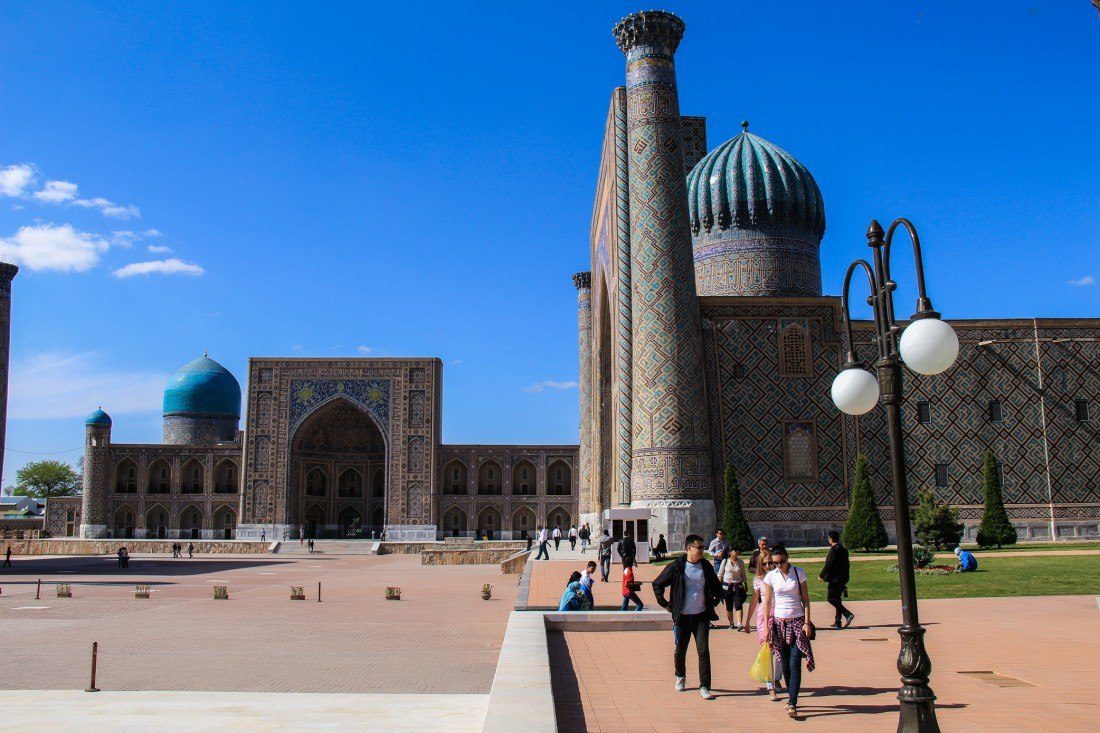
You book the flight, and we arrange everything on the ground: hotels, train tickets, guides and transfers. With flights from Kuala Lumpur on four days a week, we fit the route to the days you land and fly home.
The great scholars, 7 or 9 days. Heritage of the Great Scholars starts at The religious heart of old Tashkent: madrasahs, a Friday mosque and mausoleums. Right next to it stands the new Center of Islamic Civilization, opened in 2026. Read more → and the Center of Islamic Civilization in Tashkent, spends three nights in Samarkand, with the Imam al-Bukhari complex and Ulugh Beg’s observatory, and two in Bukhara, with Bahauddin Naqshband. Two more days add Termez and the mausoleum of at-Tirmidhi.
The classic route, 8 or 11 days. Tashkent, Samarkand, Bukhara and Khiva on the 8-day classic tour, or at an easier pace on the 11-day classic tour. How we lay out such trips is in Uzbekistan in 7 days and Uzbekistan in 10 days.
Bukhara in depth. The seven Sufi masters buried around the oasis take a full day by car; our two-day Seven Saints of Bukhara tour visits them without hurrying. In the evening, spend a few hours as the guests of a local family at dinner; tell us about your food requirements when you book.
Your guide speaks your language, and that is included in the price of our tours: tell us when you book which language you prefer. Not sure which route fits? Try our tour finder.
When to go: school holidays and Hari Raya in 2027
Malaysia. The school year 2027 has four breaks. The first, 5–13 March in Kedah, Kelantan and Terengganu and 6–14 March in the other states, takes in Hari Raya Aidilfitri on 10–11 March. Afternoons in Tashkent average 16 °C in March, and on 21 March Uzbekistan celebrates Navruz, the spring new year; see Navruz in Uzbekistan. The mid-year break, 21 May – 5 June or 22 May – 6 June, begins a few days after Hari Raya Aidiladha on 17 May and falls in one of our best seasons: May afternoons are 27–28 °C, though by June Bukhara reaches 36 °C, so we start the days early. The break of 27 August – 4 September or 28 August – 5 September is still hot, about 33–36 °C. The year-end break from early December is our winter: 8–9 °C in the afternoon in Samarkand and Bukhara, and frost at night.
Indonesia. The longest break of 2027 comes in March. Nyepi falls on Monday 8 March, Idulfitri on 10–11 March, and with the cuti bersama days of 9, 12 and 15 March you get ten days off in a row, from Saturday 6 to Monday 15 March. In May, Iduladha on Monday 17 May, the leave days of 18 and 19 May and Waisak on Thursday 20 May join into six days from 15 May; take Friday 21 May off, and you have nine. School holidays are set by each province, so check yours.
Ramadan and autumn. Ramadan 2027 is expected to begin around 8 February. Ramazon hayiti and Qurbon hayiti, Eid al-Fitr and Eid al-Adha, are public holidays in Uzbekistan too, and trains and hotels fill up, so we book early. September and October are among our best months, with afternoons in Tashkent around 22 °C in October. Month by month: March, May, December and when to go.
Halal food and prayer times on the road
Close to nine in ten Uzbeks are Muslim, and most dishes here are cooked with halal meat: lamb, beef or chicken. We do not promise a halal certificate in every restaurant; if you want to be sure, ask “halolmi?”, which means “is it halal?” in Uzbek, or ask your guide to check for you. Tell us about your food requirements when you book, and we take them into account when we plan the meals.
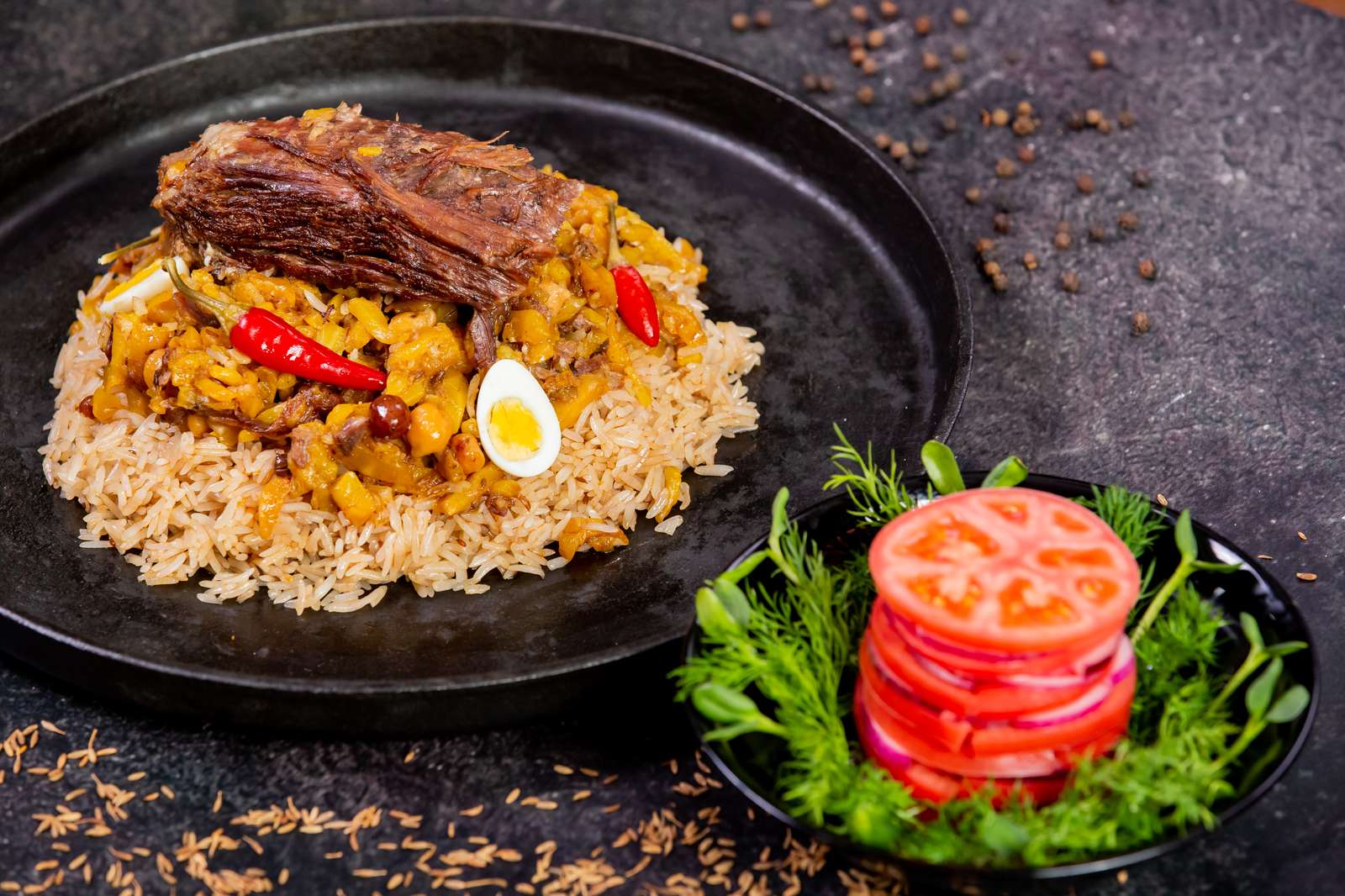
,Rice cooked in a kazan with carrots, onions and meat: the dish of every Uzbek celebration. Each region cooks it its own way. rice cooked in a cauldron with meat, carrots and onions, is a midday dish; shashlik is grilled on skewers, and lagman is hand-pulled noodles with meat and vegetables. Every meal comes with non, the round bread from the clay tandir oven, and green tea. Our guides to Uzbek cuisine and plov will help you order.
Your guide plans each day with prayer times in mind, and in the old towns of Samarkand and Bukhara a mosque is never far away. International airports and railway stations have prayer rooms with space for ablution. On Friday the midday prayer is the main one of the week; tell us if you want to pray Juma at a particular mosque, and we build the day around it. During Ramadan, cafés stay open in the daytime, and iftar in restaurants starts right after sunset.
Money, plugs and your phone
- Cards. Visa and Mastercard work at most card terminals in hotels, restaurants, shops and stations. Cash, in so’m, is for bazaars, street stalls and some taxis.
- Cash. Bring US dollars or euros: banks and exchange offices change them against your passport; keep the receipt. See where to exchange currency and cards, cash and tipping.
- Plugs. Sockets are types C and F at 230 V. Indonesian plugs fit; the Malaysian three-pin plug, type G, does not, so pack an adapter.
- Phone. Roaming works, and a local SIM card is sold against your passport. For a one- or two-week tour your phone needs no registration; the rules are in bringing a phone to Uzbekistan.
- At mosques and shrines. Cover shoulders and knees, men and women alike; women cover their hair, and shoes come off on the carpets. More in what to wear.
In short
- Uzbekistan Airways flies Kuala Lumpur – Tashkent nonstop four times a week from late October 2026, in about 8 hours; from Jakarta you fly with one connection.
- Citizens of Malaysia and Indonesia need no visa for up to 30 days; bring a passport with at least three months of validity left.
- Al-Bukhari rests near Samarkand, at-Tirmidhi near Termez, and al-Khwarizmi’s statue stands in Khiva: our Heritage of the Great Scholars tour links them in 7 or 9 days.
- Malaysia’s mid-year school break of late May and Indonesia’s long Idulfitri break of 6–15 March 2027 both fall in good weather.
- Most dishes are cooked with halal meat, your guide plans the day with prayer times in mind, and on Friday we build the day around Juma.