
 Deutsch
 English
 Español
 Français
 Italiano
 Polski
 Português
 Suomi
 Svenska
 Türkçe
 Ελληνικά
 Български
 Русский
 עברית
 한국어
 中文
 日本語
Places in this article: Samarkand · Bukhara · Khiva · Tashkent
Uzbekistan in 6 days: Tashkent, Khiva, Bukhara and Samarkand without night trains
Most first-time guests ask us for "about a week" in Uzbekistan. Take away the days of arrival and departure and that week becomes six days on the ground, which happens to be enough for Tashkent, Khiva, Bukhara and Samarkand without a single night train and with one afternoon off in the middle.
We are a tour operator in Tashkent. This is how we plan Uzbekistan in 6 days: a day in the capital, a morning flight west to Khiva, then three daytime trains back east through Bukhara and Samarkand.
In short
- Day 1 is Tashkent: the old city, Did you know? Tashkent’s Chorsu dome is younger than the city’s metro Trade at the old crossroads is centuries old, but the domed building opened only in 1990, thirteen years after the metro. Architects Vladimir Azimov and Sabir Adylov gave it a main dome of 86 m ringed by seven smaller ones. Read more → and a ride on the .Did you know? A metro designed to ride out a magnitude-9 earthquake The three original lines of the Tashkent Metro were built to withstand an earthquake of magnitude 9.0, and the tunnels lie unusually shallow, only 8–25 m below the street. Read more →
- Day 2: a morning flight to Urgench, about 1 h 30 min, and the rest of the day inside the walls of Khiva.
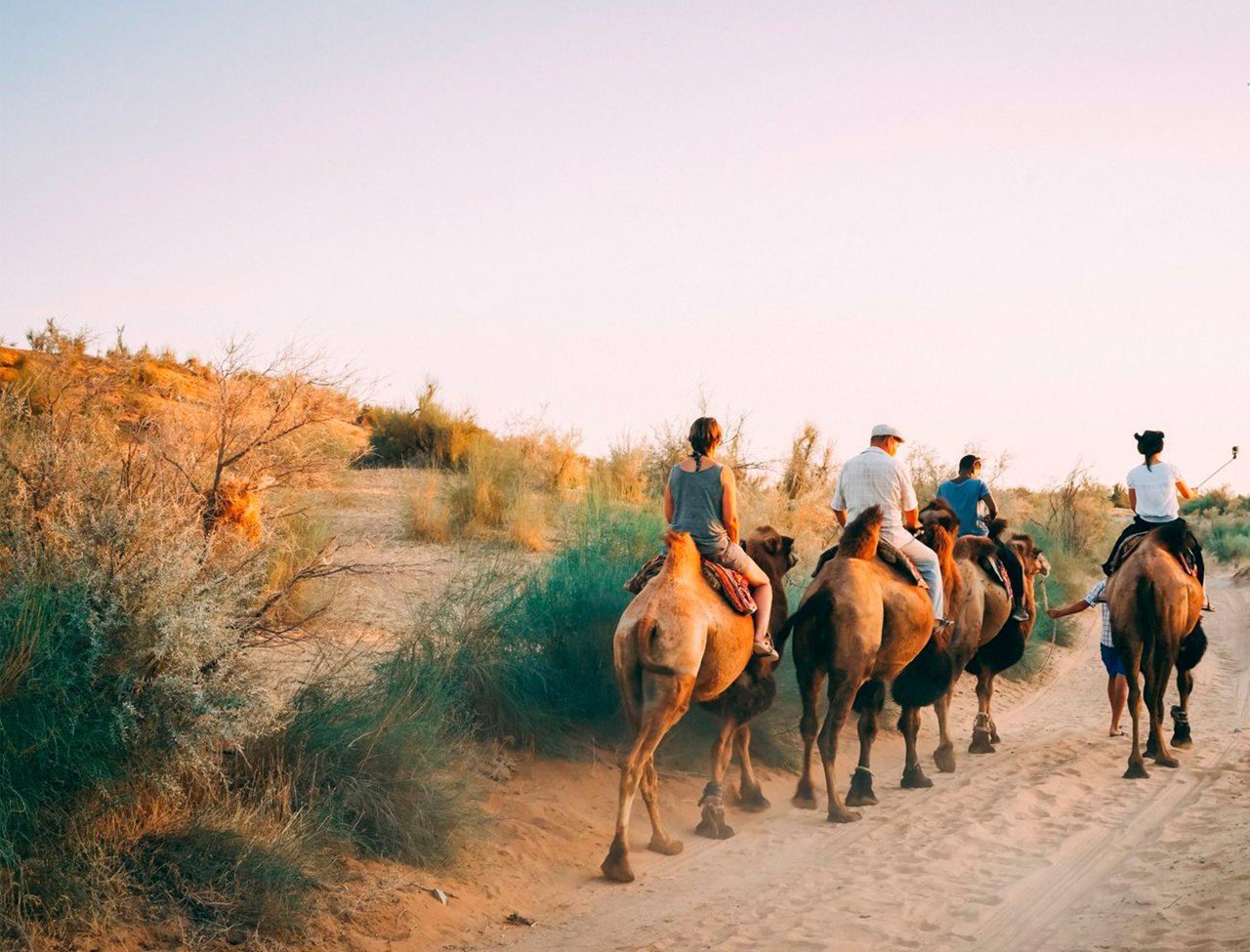
- Day 3: the 07:20 fast train across the The Kyzylkum, or Red Sands: the desert between the Amu Darya and Syr Darya rivers that the road and the railway cross on the way to Khiva. to Bukhara, about three and a half hours.
- Days 4 and 5: two nights in Bukhara, with a rest at midday, then the afternoon Uzbekistan's high-speed train: Tashkent to Samarkand in about 2 hours 10 minutes, Tashkent to Bukhara in about 4 hours. Tickets are tied to your passport. Read more → to Samarkand.
- Day 6: Samarkand all day and the evening train to Tashkent. We run this route as a private tour: Uzbekistan in 6 Days: Tashkent, Khiva, Bukhara and Samarkand, price on request.
Contents
The six days at a glance
| Day | Where | How the day goes |
|---|---|---|
| 1 | Tashkent | ,The religious heart of old Tashkent: madrasahs, a Friday mosque and mausoleums. Right next to it stands the new Center of Islamic Civilization, opened in 2026. Read more → Chorsu bazaar, the metro to Did you know? Legend: “Strength lies in justice” were Timur's own words The equestrian statue of Amir Timur in central Tashkent, unveiled in 1994, bears the motto “Strength lies in justice” in four languages. Tradition attributes the words to Timur himself, but historians cannot confirm he said them. Read more → |
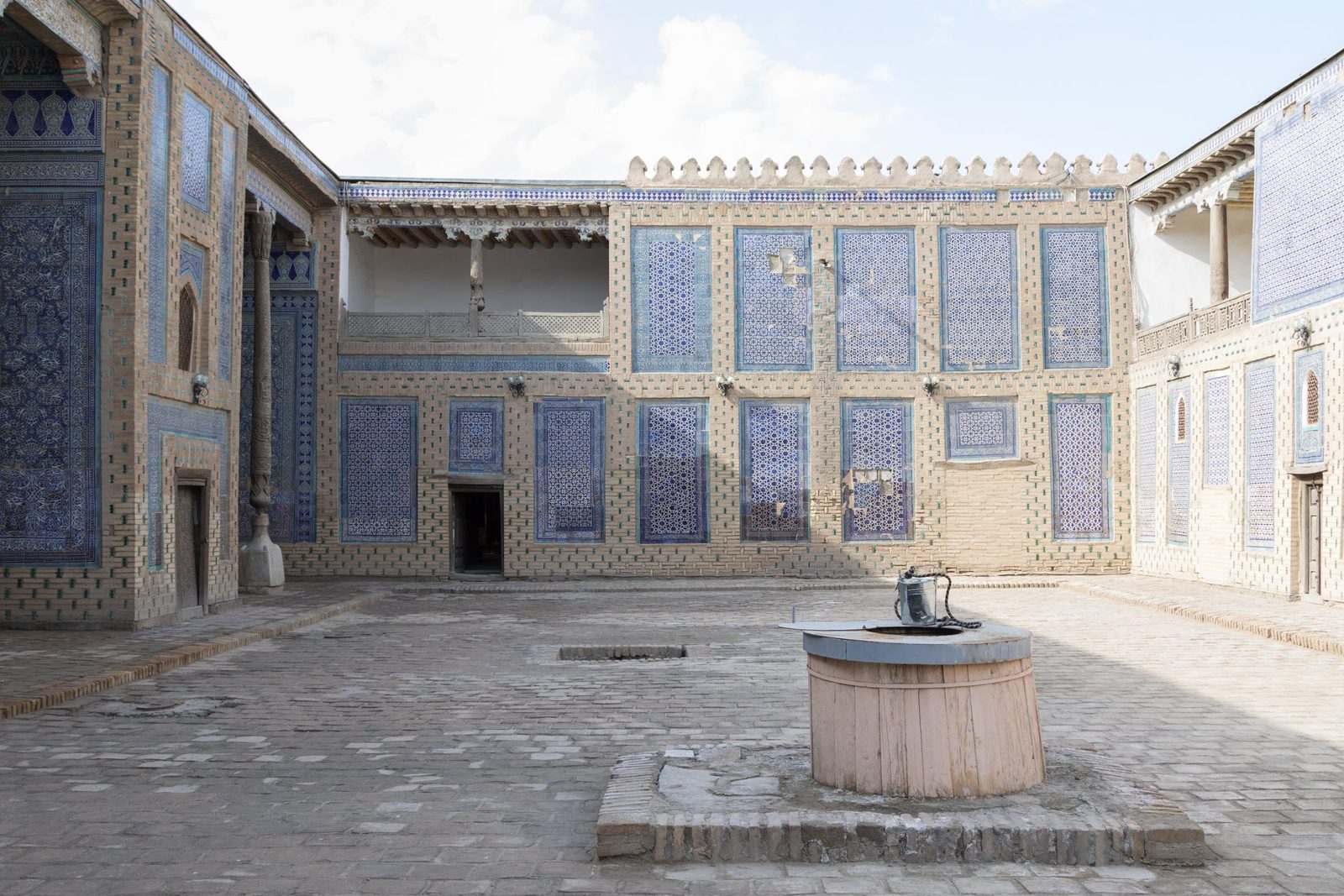
| 2 | Tashkent → Khiva | The morning flight to Urgench; ,Did you know? People still live inside Khiva's museum city Itchan Kala packs more than 50 historic monuments and about 250 old houses inside clay walls 8–10 m high and 5–6 m thick, and families still live and work in its lanes. Read more → the ,Did you know? A 14-metre-wide base for a tower that stopped at 29 m Kalta-Minor was begun in 1852 and meant to reach 70–80 m, but work halted in 1855 at about 29 m when its khan died. It is said to be the only minaret covered entirely in glazed tiles. Read more → ;Did you know? In the khan’s courtyard a round platform waited for a yurt The Kunya-Ark, the khans’ citadel, had its own mint, arsenal and harem. In the courtyard of its reception hall of 1804–1806 stands a round platform: a yurt was set up on it, and there the khan received envoys of the steppe nomads. Read more → sunset over the walls |
| 3 | Khiva → Bukhara | The 07:20 fast train; the ,Did you know? Under Bukhara's domes merchants changed money and gold Four 16th-century trading domes still stand over old crossroads. Toki Sarrafon was the money changers' dome, where merchants from India and China swapped coins; Toki Zargaron held jewellers' workshops, Toki Telpak Furushon sold caps. Read more → ,Did you know? Legend: the minaret's foundation was laid with camel milk Legend says master Bako laid the foundations of the Kalyan minaret with ganch plaster mixed with camel milk, then vanished for two years to let them harden, and only then built the tower. Locals still show a grave they say is his. Read more → Did you know? Bukhara's ponds were once its water supply Pools like Lyabi-Hauz, dug around 1620 and 46 × 36 m, were the city's main source of water. Most were filled in during the 1920s–30s because they spread disease; Lyabi-Hauz survived. Read more → |
| 4 | Bukhara | The Ark, ,Did you know? The famous columns of Bolo-Hauz are barely a century old The Bolo-Hauz mosque opposite the Ark was completed in 1712, but its best-known feature, the tall, slender carved columns along the front of the iwan, was added only in 1917, together with the small minaret of 1916–1917. Read more → the ;Did you know? Buried in mud, this tomb escaped Genghis Khan The 10th-century Samanid Mausoleum, one of the oldest monuments of Islamic Central Asia, was covered by flood mud and sand before the Mongols came in 1220. Hidden for centuries, its brick lacework survived intact. Read more → a rest at midday; Did you know? Legend: four towers for four world religions? Chor Minor, a gatehouse of 1807, has four towers, each decorated differently. Guides say they stand for four world religions and look for a cross, a fish and a prayer wheel in the decor; others say four dynasties. All are interpretations. Read more → in the evening |
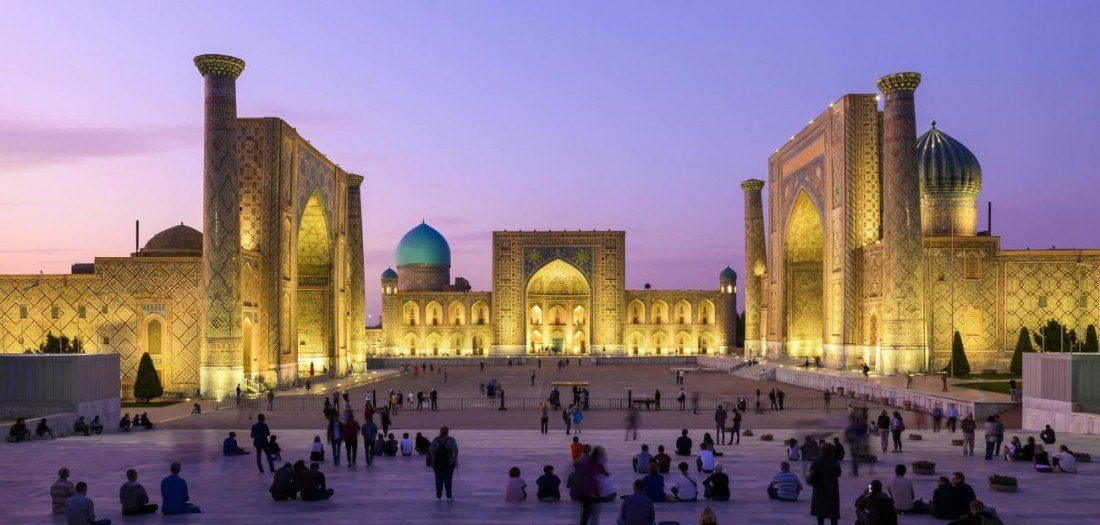
| 5 | Bukhara → Samarkand | A free morning under the trading domes; the afternoon Afrosiyob; the Did you know? The Registan's sun-carrying lion went on a banknote The Sher-Dor Madrasah (1619–1636) is named for the big cats with the sun on their backs on its portal. The image appeared on the reverse of Uzbekistan's 200-som note of 1997. Read more → lit up |
| 6 | Samarkand → Tashkent | ,Did you know? Timur's tombstone went to Persia and came back The dark-green jade slab on Timur's grave in Gur-e-Amir was carried off by Nader Shah in 1740. It broke, and on his advisers' urging he sent it back to Samarkand. Read more → the Registan, ,Did you know? Legend says the architect asked the queen for a kiss Legend says the architect of Bibi-Khanym would finish on time only for a kiss from Timur's wife, and Timur punished him. In fact the mosque was Timur's own project; his wife Saray Mulk Khanum built her madrasah across the road. Read more → ;Did you know? Why Shah-i-Zinda means 'the Living King' The necropolis grew around the shrine of Qutham ibn Abbas, a cousin of the Prophet Muhammad. Legend says he did not die in battle but went down a deep well to a garden of paradise, where he lives on. Read more → the evening train |
Why Tashkent first and Khiva second
Almost every international flight lands in Tashkent, often late in the evening or at night. A first day in the capital gives you time to sleep, change money and get used to the clock before the travelling starts. The flights to Urgench leave in the morning, so after a night in Tashkent you are in Khiva by lunchtime: about 1 h 30 min in the air and 30 km by car from the airport to the walls.
Khiva is the far end of the country. Go there first and every later leg brings you closer to Tashkent: about three and a half hours by train to Bukhara, 1 h 40 min to 2 hours to Samarkand, about 2 h 15 min back to the capital.
Day 1: Tashkent without a car
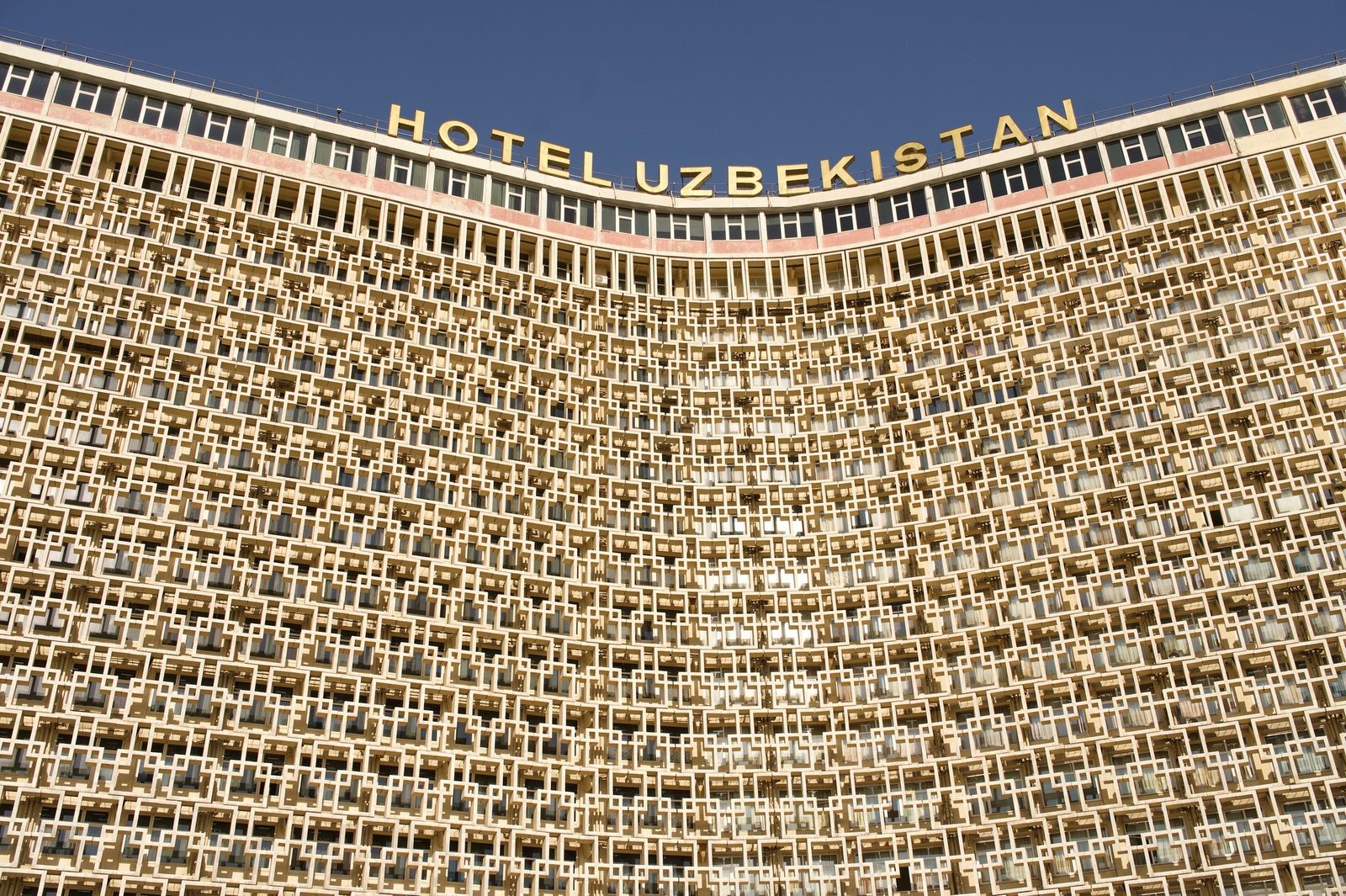
Our driver meets you at the airport. With your guide you start in the old city, on the Hazrati Imam square, then walk to Chorsu bazaar under its blue dome: spices, dried apricots, nuts and round bread. From Tashkent's old bazaar under a big blue-green dome, not far from Hazrati Imam. Bring cash in so'm. Read more → station the metro takes you to Alisher Navoi, with its turquoise ceramic reliefs, and on towards Amir Timur Square, where the curved block of Hotel Uzbekistan closes the view. If your flight lands late, we keep only the evening part of the walk. Our longer plan for the capital is in Tashkent in 1 or 2 days.
Days 2 and 3: Khiva and the train across the desert
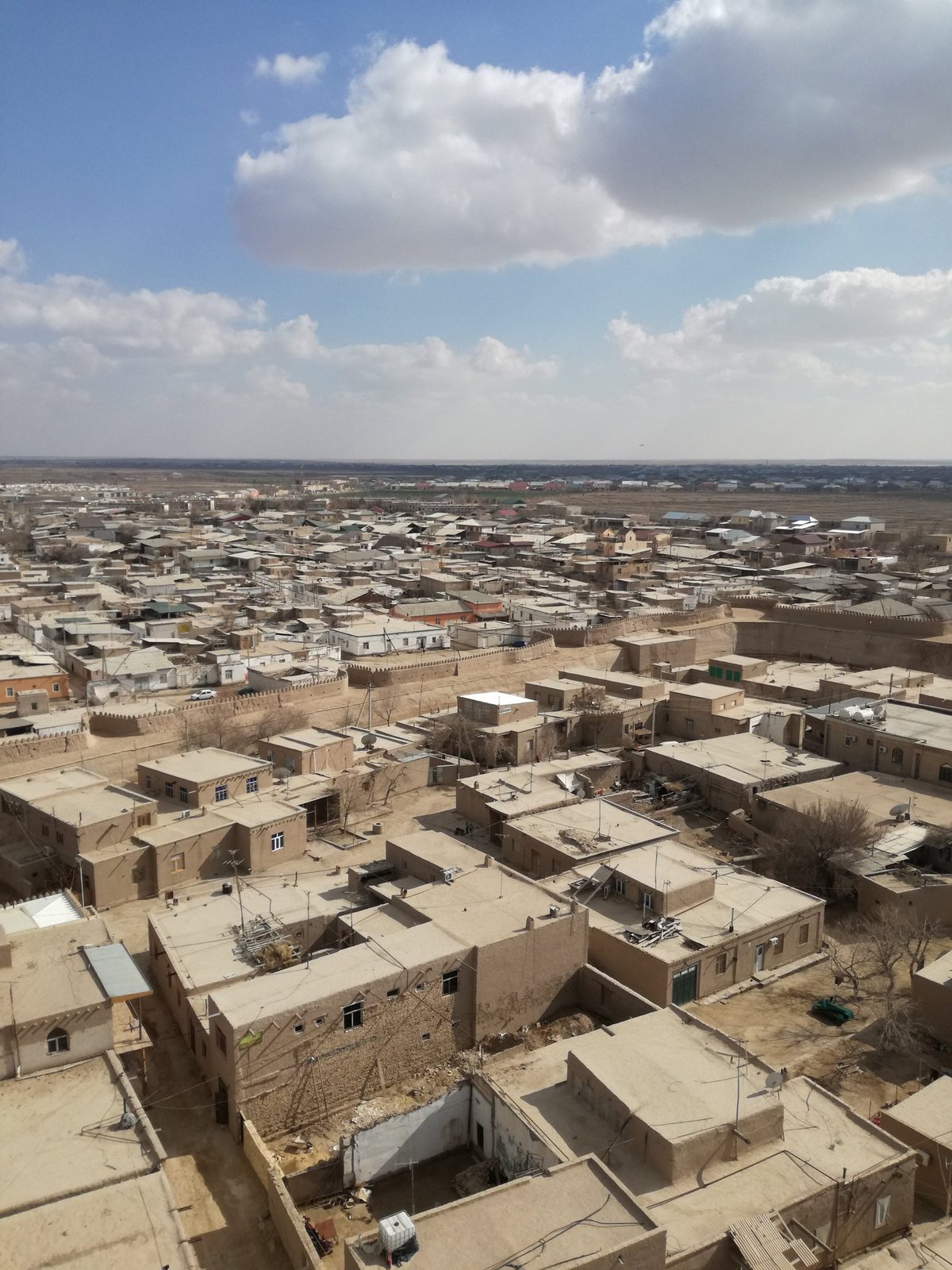
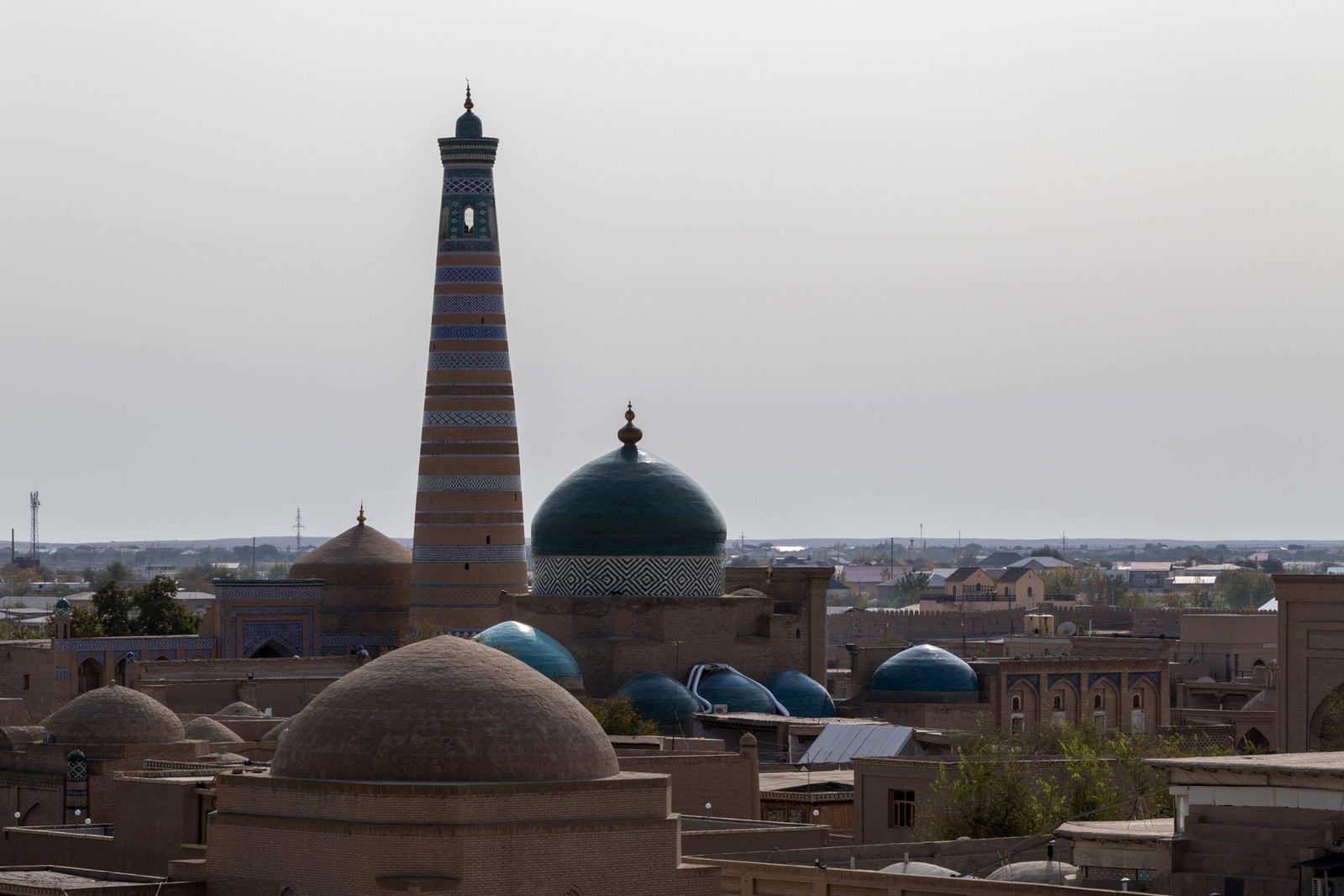
Itchan Kala, the walled inner town of Khiva, sits inside clay walls 8 to 10 metres high. Your guide starts at the West Gate with the Kalta-Minor, the tiled minaret stopped at 29 metres in 1855, then Kunya-Ark, Did you know? In Tash-Hauli's harem each of four wives had her own loggia Allakuli Khan built the Tash-Hauli palace in 1830–1838 around three courtyards. In the harem four tall loggias belonged to the khan's four wives and a fifth, the largest, to the khan himself; behind each summer terrace lay a winter room. Read more → and the .Did you know? Khiva's tallest minaret is barely a century old The Islam Khoja Minaret was begun in 1908, near the very end of the khans' era. At 56.6 m it is one of the tallest in Central Asia; a spiral stair of 175 steps leads up to its windowed top. Read more → We keep the end of the day for the walls at sunset.
Next morning the ,Did you know? The fast train to Khiva bears the name of a 13th-century shah The Jaloliddin Manguberdi, a Hyundai Rotem high-speed train, made its first run on 5 May 2026: 1,220 km from Tashkent to Khiva via Samarkand, Bukhara and Urgench in about 7.5 hours. It is named after Jalal ad-Din, the last Khwarazmshah. Read more → the high-speed train that reached Khiva in May 2026, leaves at 07:20 in the current timetable and calls at Bukhara at about 11:00. By car the same 450 km take 6 to 7 hours. Ticket sales open 60 days before departure and this train sells out first, so it is the first ticket we buy. More on this leg is in Khiva to Bukhara.
Days 4 and 5: Bukhara at a slower pace
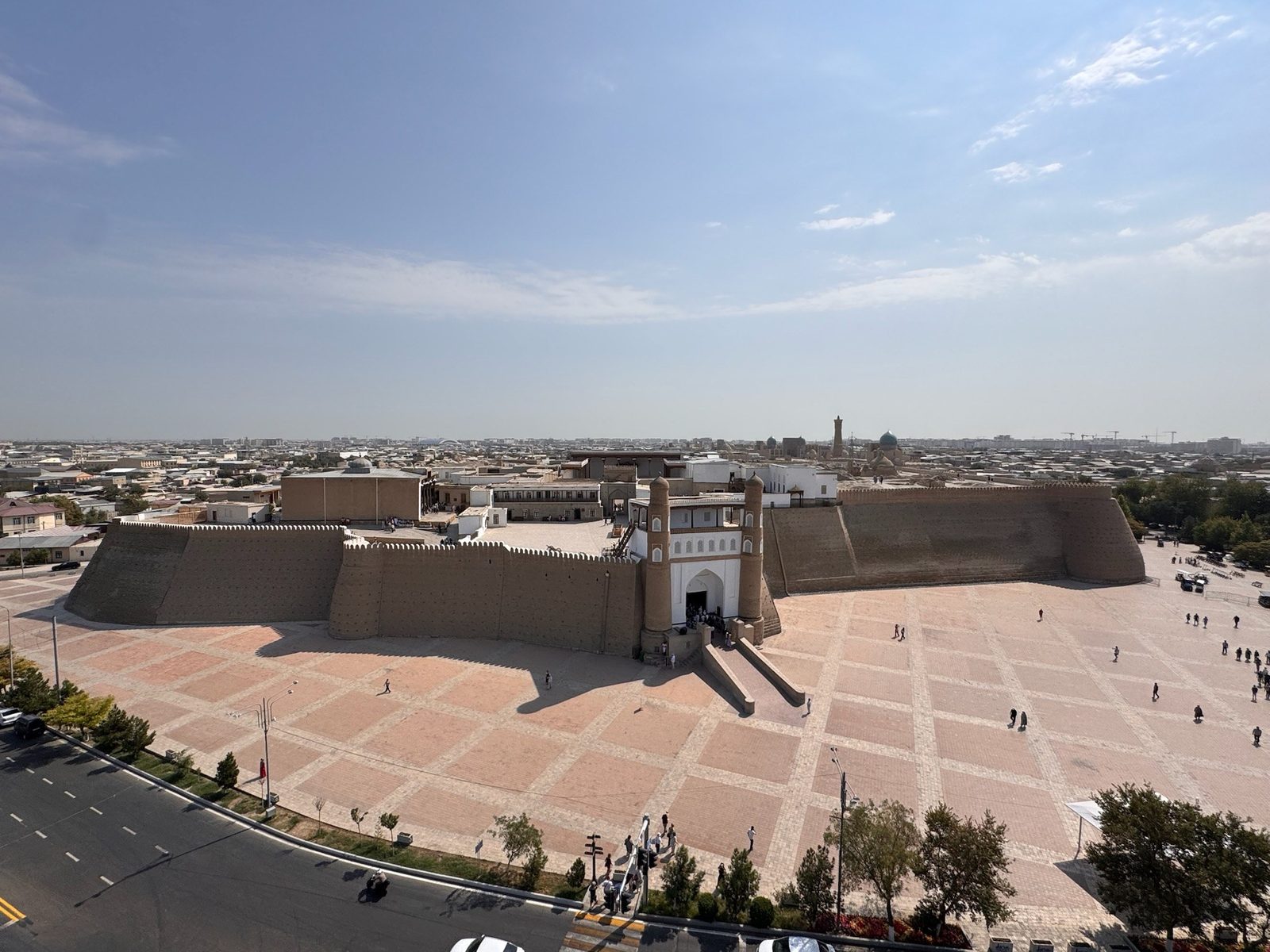
The second night in Bukhara, which the 4-day route does not have, puts you at The fortress-residence of the rulers of Bukhara on a high artificial hill: the oldest structure in the city. Read more → when it opens; its walls rise 16 to 20 metres. Then you cross to the Bolo-Hauz mosque of 1712 and walk on to the Samanid mausoleum in its park. After lunch the day stops: in summer the old town is hot by early afternoon, and in winter a rest before the evening walk is just as welcome. Late in the day your guide takes you through the lanes to Chor Minor, a gatehouse of 1807 with four blue-domed towers. Despite the name, "four minarets", no one ever called to prayer from them.
Day 5 starts slowly under the trading domes, where carpets, Did you know? One suzani was often stitched by several women at once A family member or a pattern drawer, the kalamkash, drew the design across strips of cotton. The strips went to different women of the family or neighbourhood, who embroidered them at the same time; sewn back together, they show slightly mismatched seams. Read more → and metalwork are sold and the workshops are open to look into. In the autumn 2026 timetable the afternoon Afrosiyob trains leave Bukhara at about 15:10 and 16:20, so you reach Samarkand in time for the Registan under its evening lights. Our two-day plan for the city is in Bukhara in 1, 2 or 3 days.
Day 6: Samarkand and the evening train
Gur-e-Amir, completed in 1404, comes first, then the Registan by day with the tigers on the portal of Sher-Dor, the ,Did you know? 95 elephants hauled stone for Timur's great mosque Bibi-Khanym, begun in 1399 after Timur took Delhi, was the largest mosque of his empire. Some 200 stonecutters worked on site and 95 elephants brought from India hauled the loads; the courtyard was meant to hold 10,000 people. Read more → Samarkand's main bazaar, right next to Bibi-Khanym: Samarkand bread, dried fruit, nuts and halva. Read more → beside it and Shah-i-Zinda after lunch. The last fast trains to Tashkent leave at about 7 to 8 p.m., so the day has no rush. If you fly home from Samarkand, we take you to the airport instead.
What can go wrong, and what we do about it
- The fast train from Khiva does not run on your date or is full. We check the days before we confirm the programme. If there is no seat, a driver takes you across the desert, and Bukhara starts in the late afternoon.
- December light. The sun sets early, so we start the walks earlier and keep the evenings for the lit-up squares.
- Tickets need passports. Train and flight tickets are issued to the full name and passport number of each traveller, so send them when you book.
Our private tour Uzbekistan in 6 Days: Tashkent, Khiva, Bukhara and Samarkand includes the airport transfer, the flight to Urgench, the three trains, five nights with breakfast, the car with driver and a guide who speaks your language in every city. If you would rather pick the hotels yourself, start from our hotels in each city. We quote the price for your dates.
Four, five, six or seven days?
With four days you can still see Khiva, Bukhara and Samarkand, but not Tashkent, and Bukhara gets one evening and a morning: that plan is in Uzbekistan in 4 days. Five days usually means leaving Khiva out, as in Uzbekistan in 5 days. With a seventh day, add a second day in Khiva for the desert fortresses or a day in the mountains near Tashkent; see Uzbekistan in 7 days. Six is the shortest trip that covers all four main cities and still leaves an afternoon to do nothing.