Places in this article: Samarkand · Bukhara
Imam al-Bukhari Memorial Complex near Samarkand: history and how to visit
A boy who began learning hadith at about ten, lost his father as a baby and spent most of his life on the road ended his days in a village 25 kilometres from Samarkand. That was in 870. Today the village of Khartang has a mosque for 10,000 people, four minarets about 75 metres high and a museum of nine pavilions, all built around one grave.
This is our guide to the Imam al-Bukhari complex: who the scholar was, how a small 16th-century mausoleum became the memorial of 1998 and then the complex that opened in March 2026, what to see there, how to dress, and how to fit the visit into a day in Samarkand. We bring guests here to meet the heritage of the country, whatever their faith.
Who was Imam al-Bukhari
Muhammad ibn Ismail al-Bukhari was born in Bukhara in July 810. His father, Ismail, was himself a scholar of hadith, the reports of the words and deeds of the Prophet Muhammad, and died when his son was an infant. The boy started studying hadith at about ten and soon set off to learn from others: Mecca and Medina, then Basra, Kufa, Baghdad, Syria and Egypt. He is said to have studied with about a thousand teachers.
His great work is the Sahih, “the authentic”, which he completed around 846. It holds 7,563 reports with repetitions, fewer than 3,000 without them, chosen from a far larger number that he examined and set aside. Sunni Muslims regard it as the most reliable collection of hadith, second in authority only to the Qur'an. He also wrote al-Adab al-Mufrad, a book of hadith on manners, and al-Tarikh al-Kabir, a great biographical dictionary of the people who passed hadith on.
In his last years he settled in Khartang, near Samarkand. He died there on 1 September 870 and was buried in the village.
Where the complex is
Khartang lies in Payariq district of the Samarkand region, about 25 km from Samarkand, among fields and orchards. The village is also known as Khoja Ismoil. You come by car, and from the city it is a short drive.
If you are planning several trips out of the city, our article on day trips from Samarkand puts Khartang next to ,A village near Samarkand where paper is made by hand from mulberry bark, the old way, at a working mill on the stream. Urgut and Shahrisabz.
From a small mausoleum to the memorial of 1998
For centuries the grave was marked modestly. In the 16th century a small mausoleum was raised over it, a mosque was built beside it and plane trees were planted around them. In the 20th century the site fell into neglect.
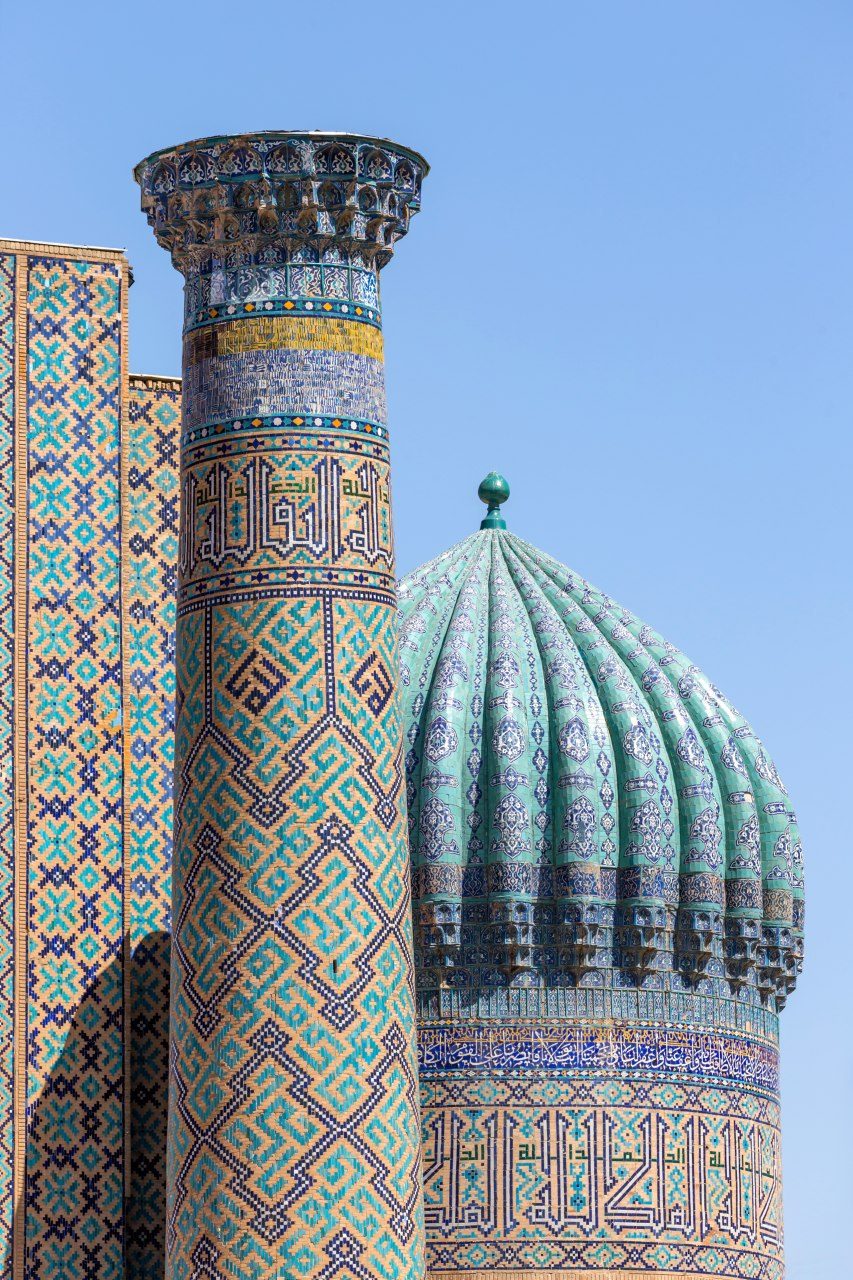
In 1997–1998 a memorial complex was built on the old site for the 1225th anniversary of the scholar's birth, counted by the Islamic lunar calendar. It covered about 10 hectares. The new mausoleum was a cube under a dome about 17 metres high, its walls faced with light green, blue and white glazed tiles, marble, onyx and granite, with carved plaster, ganch, inside. A mosque for 1,500 people stood on the courtyard.
The stone in the centre of the mausoleum is a cenotaph, a memorial. The grave itself lies in a crypt below.
The complex rebuilt: 2021–2026
New construction began in April 2021, and the rebuilt complex opened in March 2026. It now covers 45 hectares. Before, it could receive up to 12,000 visitors a day; now it is designed for up to 65,000.
- The mosque: for about 10,000 worshippers, 3,924 square metres and 54 metres high.
- Four minarets about 75 metres high.
- Fourteen blue domes and an aivan, a columned gallery in the national style, on 154 columns.
- The museum: nine pavilions over 1,300 square metres.
Next to the complex is a new 15-hectare visitor area: a four-star hotel, two three-star hotels, 22 family guesthouses with 176 beds, a restaurant for 300 run on halal principles, and a car park.
What to see at the complex of Imam Bukhari
The mausoleum. This is the heart of the place. Walk around the cenotaph slowly and quietly: people come here to pray.
The museum. Its nine pavilions tell the life of Imam al-Bukhari and his scholarship, the stories of the 25 prophets named in the Qur'an, the genealogy of the Prophet Muhammad and his life in Mecca and Medina, and how hadith were collected and written down. If you have only one hour, give it to the museum: it explains everything else you see.
The aivan and the courtyards. Stand under the gallery of 154 columns and look along it: the rhythm of the columns is the best photograph of the complex. Then look up at the minarets from the courtyard to feel the scale.
The old part. Around the mausoleum the old plane trees still stand. They are the link between the modest 16th-century shrine and the new complex around it.
Rules for visitors
The Imam al-Bukhari complex is a working place of prayer, so the rules are those of any mosque or mausoleum in Uzbekistan:
- Dress: shoulders and knees covered, for men and women alike; women cover their hair. Bring a scarf. Details are in our guide to what to wear in Uzbekistan.
- Shoes come off before you step onto the carpets of the mosque and the mausoleum.
- Quiet: speak softly, do not walk in front of people who are praying, and never photograph them.
- Friday: the midday prayer fills the mosque and the courtyards. If you want a calm visit, come on another day or in the morning.
How to get there from Samarkand and how long to stay
The complex is about 25 km from Samarkand, and the only practical way there is by road: a taxi, a car with a driver or a private tour. Plan three to four hours on site, with the museum, the mausoleum and a walk around the courtyards. Add the drive both ways and the visit takes half a day.
The easiest pattern is the complex in the morning and Samarkand in the afternoon. Back in the city, book a walking tour of Samarkand with a guide for the Did you know? The Registan's sun-carrying lion went on a banknote The Sher-Dor Madrasah (1619–1636) is named for the big cats with the sun on their backs on its portal. The image appeared on the reverse of Uzbekistan's 200-som note of 1997. Read more → and Gur-e-Amir. Our Samarkand in 1, 2 or 3 days shows where half a day out of town fits best.
The complex is part of our private Turkic Heritage of the Silk Road tour, nine days with your own guide through Tashkent, Samarkand, Bukhara and Khiva. The other great shrines of the country, from Did you know? Why Shah-i-Zinda means 'the Living King' The necropolis grew around the shrine of Qutham ibn Abbas, a cousin of the Prophet Muhammad. Legend says he did not die in battle but went down a deep well to a garden of paradise, where he lives on. Read more → to ,Did you know? A village renamed in honour of a Sufi master Bahauddin Naqshband (1318–1389), who gave his name to one of the largest Sufi orders, was born and buried near Bukhara in Qasr-i Hinduvan. The village was later renamed Qasr-i Arifan in his honour; the tomb over his grave dates from 1544. Read more → are in our article on ziyarat in Uzbekistan, and all our Samarkand tours are in the catalogue.
In short
- Imam al-Bukhari (810–870), born in Bukhara, compiled the Sahih, the collection of hadith Sunni Muslims hold most reliable.
- He is buried in Khartang, Payariq district, about 25 km from Samarkand.
- A 16th-century mausoleum, a memorial of 1998, and since March 2026 a complex of 45 hectares with a mosque for 10,000 and four minarets about 75 metres high.
- Give the museum of nine pavilions at least an hour; plan three to four hours on site.
- Cover shoulders and knees, scarves for women, shoes off, and avoid Friday midday if you want quiet.