Programme and details
Khorezm and Karakalpakstan · 5 Days / 4 Nights · Private Tour
Karakalpakstan and the Desert Fortresses of Khorezm
Urgench – Khiva – Toprak-Kala – Did you know? Legend says a tunnel links Kyzyl-Kala and Toprak-Kala Legend says the small, almost square fortress of Kyzyl-Kala, the “Red Fortress”, is joined to neighbouring Toprak-Kala by an underground passage. No tunnel has been found yet; the fort itself was discovered by S. P. Tolstov’s expedition in 1938. Read more → – Ayaz-Kala – Nukus – Did you know? Legend says Mizdakhan's little brick towers grant wishes Legend says that if you stack a column of seven bricks at the Mizdakhan necropolis near Nukus, your wish comes true; another tale says each column adds seven years to the life of the world. The hill site holds ruins from many centuries. Read more → – Tashkent
In 1938 archaeologists began to dig a clay mound east of the Amu Darya and found a palace of about 150 halls and rooms, with painted walls and household documents written on leather and wood. That was Toprak-Kala, a capital of ancient Khorezm. Its statues went to the Hermitage; thousands of finds from the same desert are kept in Nukus, in the museum Did you know? A 2010 film tells how Savitsky gathered his collection A 2010 documentary follows Igor Savitsky as he sought out avant-garde painters whose works were not shown in museums in those years, met their families and brought thousands of works to Nukus. Ben Kingsley voices Savitsky. Read more → built after years as the artist of that expedition. In five days you see both halves of the story: the walls standing above the ,The Kyzylkum, or Red Sands: the desert between the Amu Darya and Syr Darya rivers that the road and the railway cross on the way to Khiva. and the finds and paintings in Nukus. The tour starts with two days in Khiva, and on the way from the walls to the museum you spend a night in a yurt camp by Ayaz-Kala, with sunset and sunrise on the walls.
| Duration | 5 days / 4 nights |
| Price | on request |
| Format | Private, or a small group on your dates |
| Where | Khiva, the Ellikqala district of Karakalpakstan, Nukus |
| Getting around | A flight from Tashkent to Urgench, a car with driver from Khiva to Nukus, a flight from Nukus back to Tashkent |
| Best time | April–May and September–October |
Ideal for travellers who have seen Samarkand and Bukhara and want the far west of Uzbekistan, for lovers of archaeology and of 20th-century art, and for anyone who would like one night in the desert.
The desert fortresses — clay forts on the edge of the Kyzylkum, on Uzbekistan’s UNESCO tentative list since 2008.
The Savitsky Museum — about 100,000 objects in Nukus: the avant-garde, Did you know? Karakalpak means 'black hat' The Karakalpaks, who gave Karakalpakstan its name, call themselves Qaraqalpaq: qara means black and qalpaq a hat. About 770,000 of the world's 900,000 Karakalpaks live in the republic, whose capital is Nukus. Read more → applied art and the archaeology of Khorezm.
Itinerary
Day by Day
Day 1 · Urgench – Khiva — The Kalta-Minor in the low sun
A morning flight from Tashkent brings you to Urgench. Our driver meets you at the airport and drives you about 30 km to your hotel in Khiva. Sleep inside the walls if you can: you get the lanes to yourself before the groups arrive and after they leave.
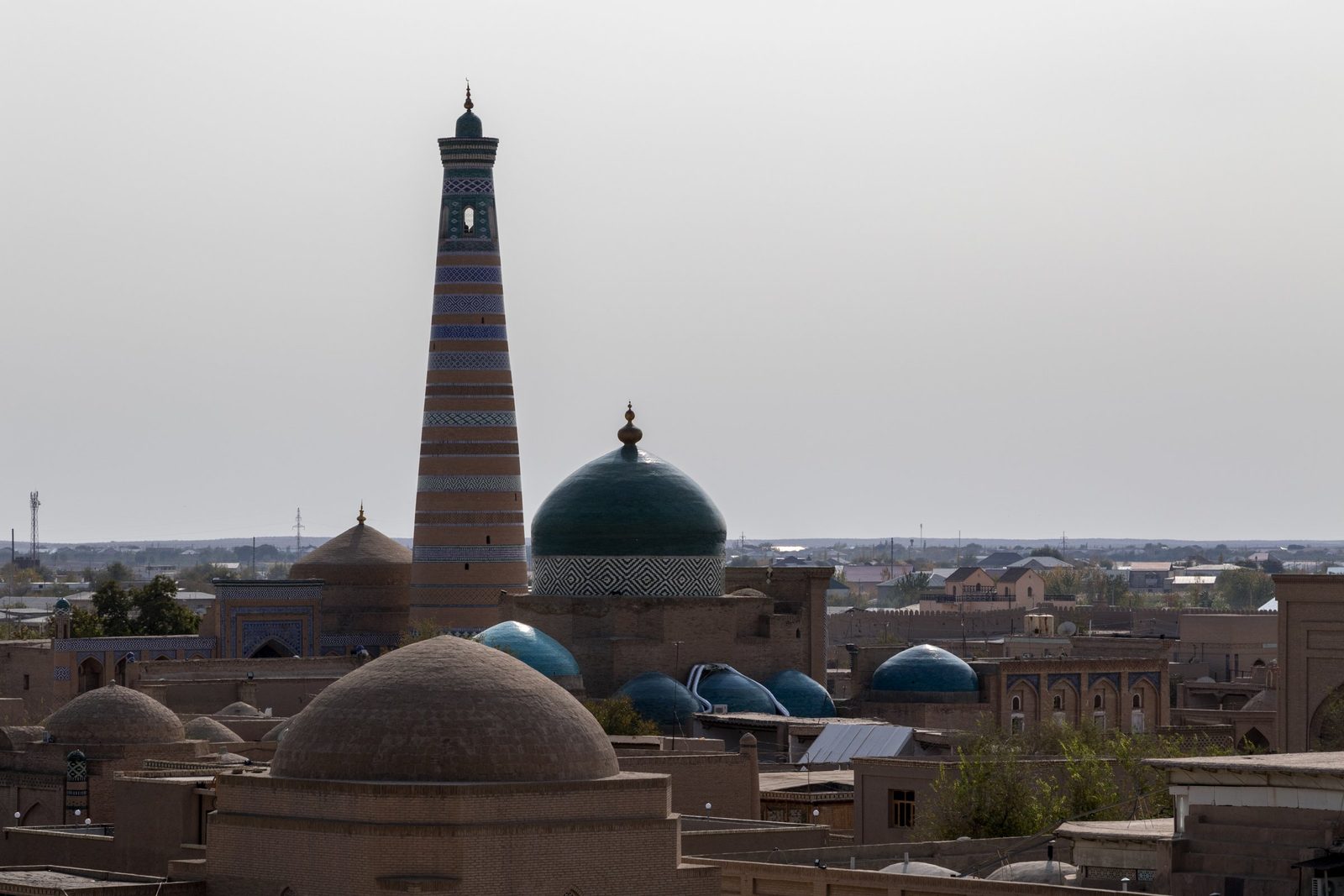
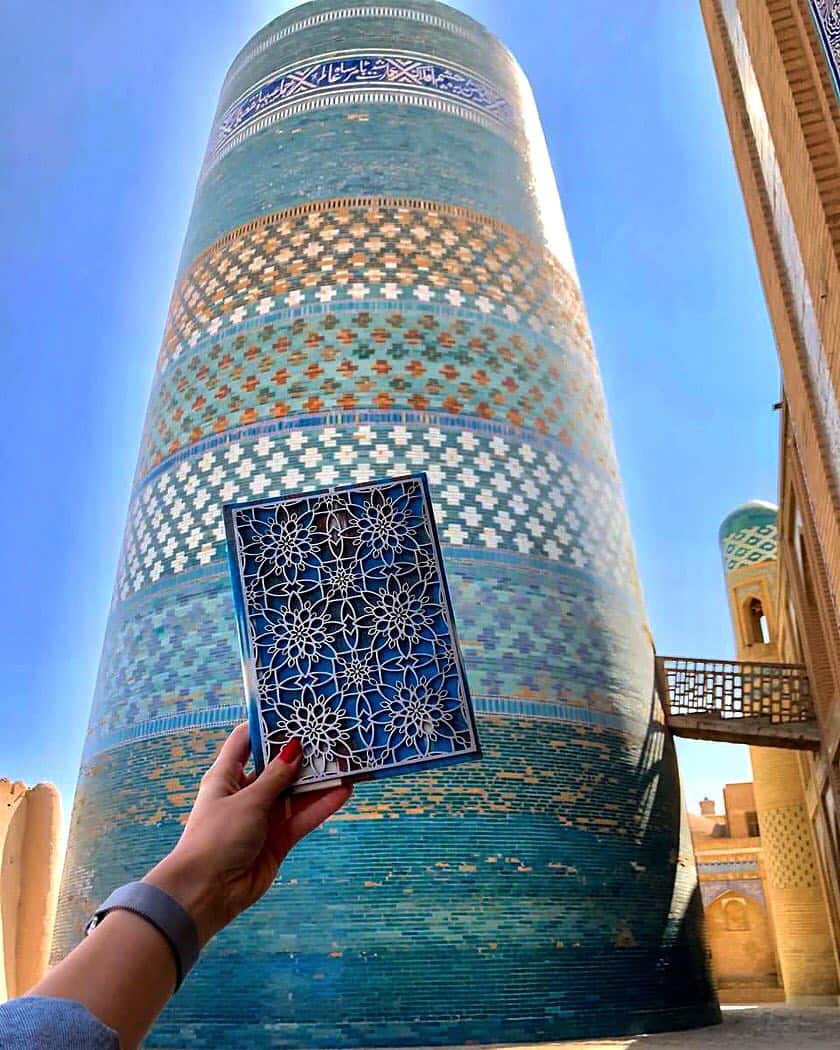
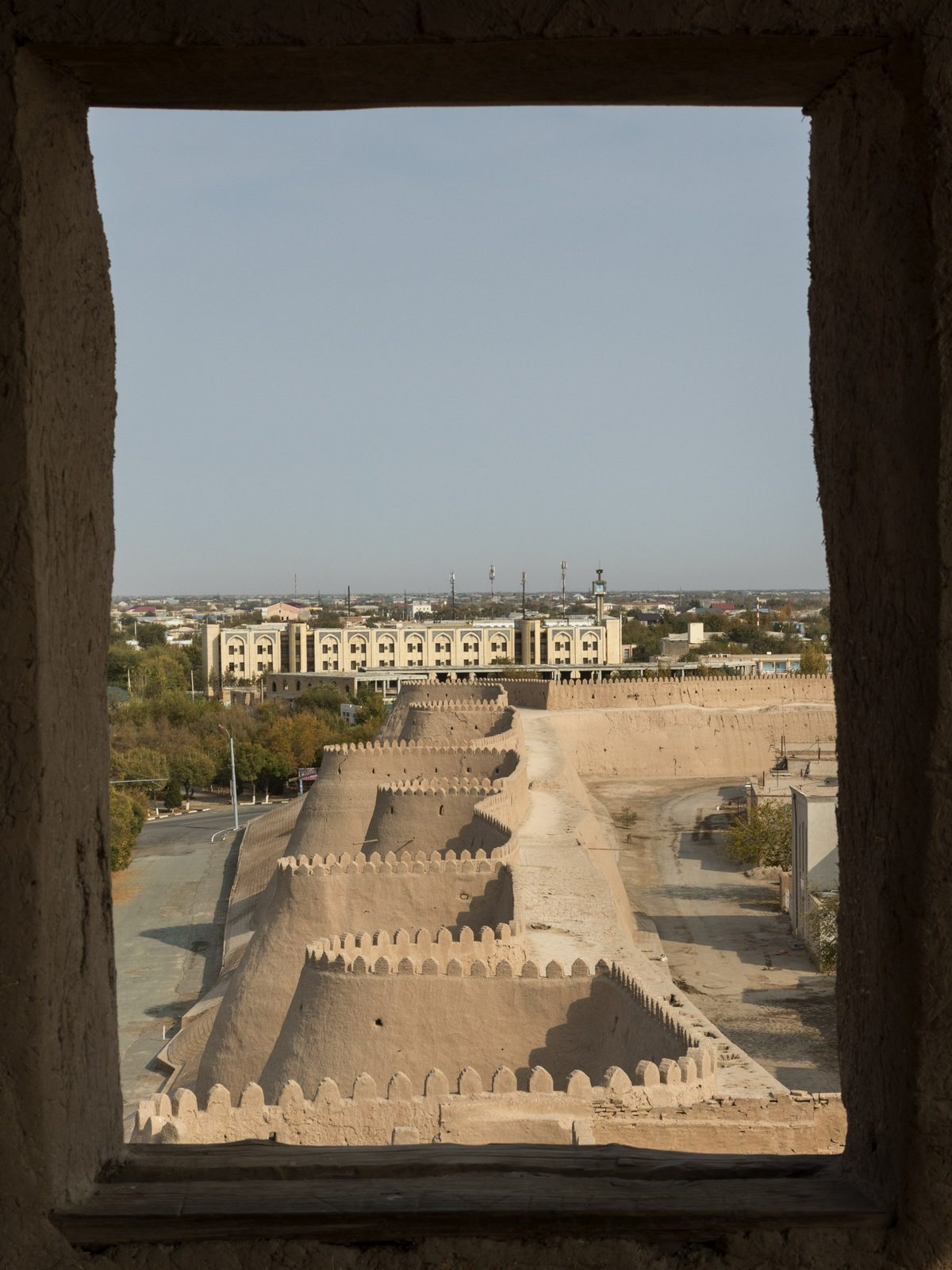
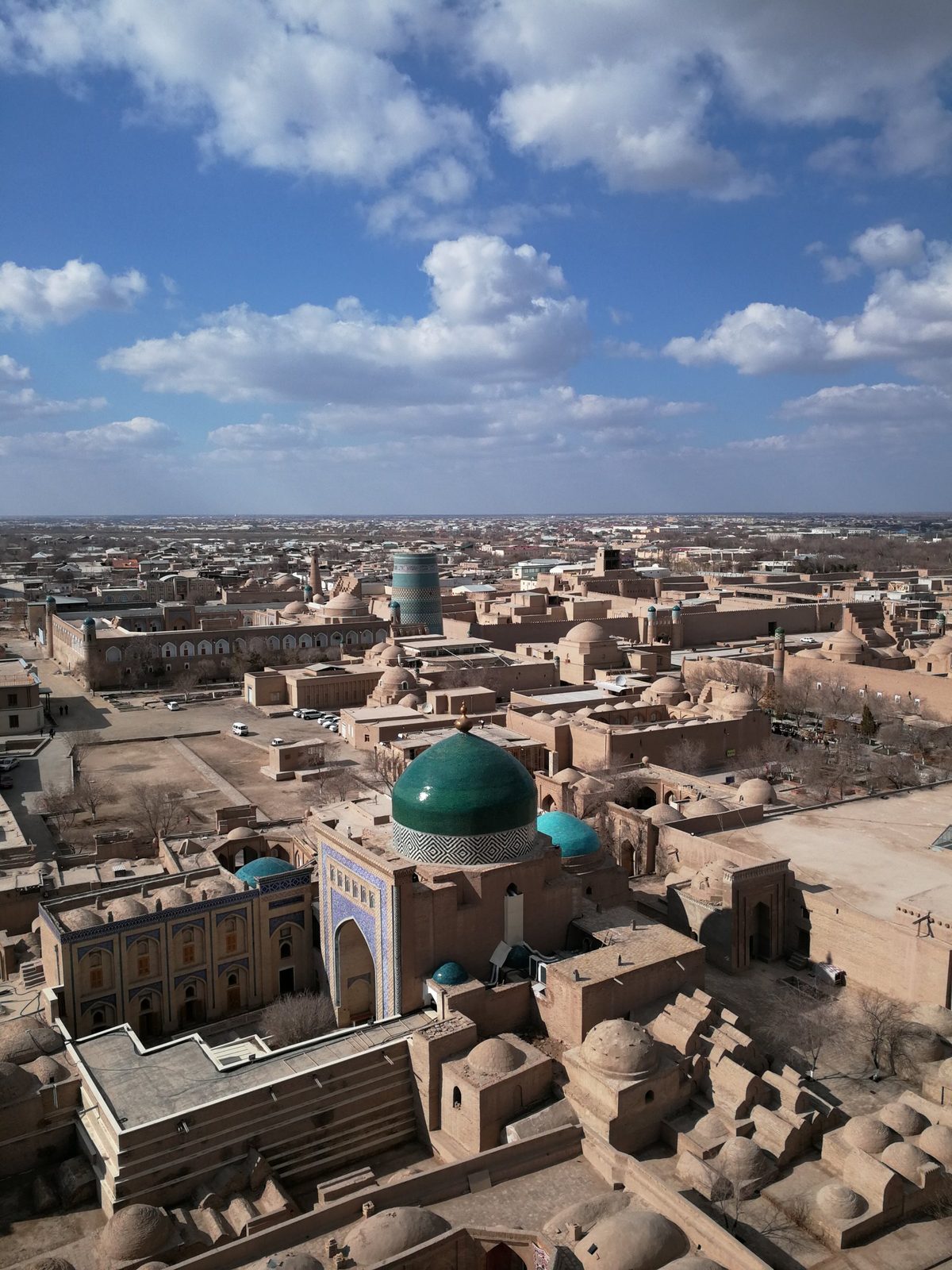
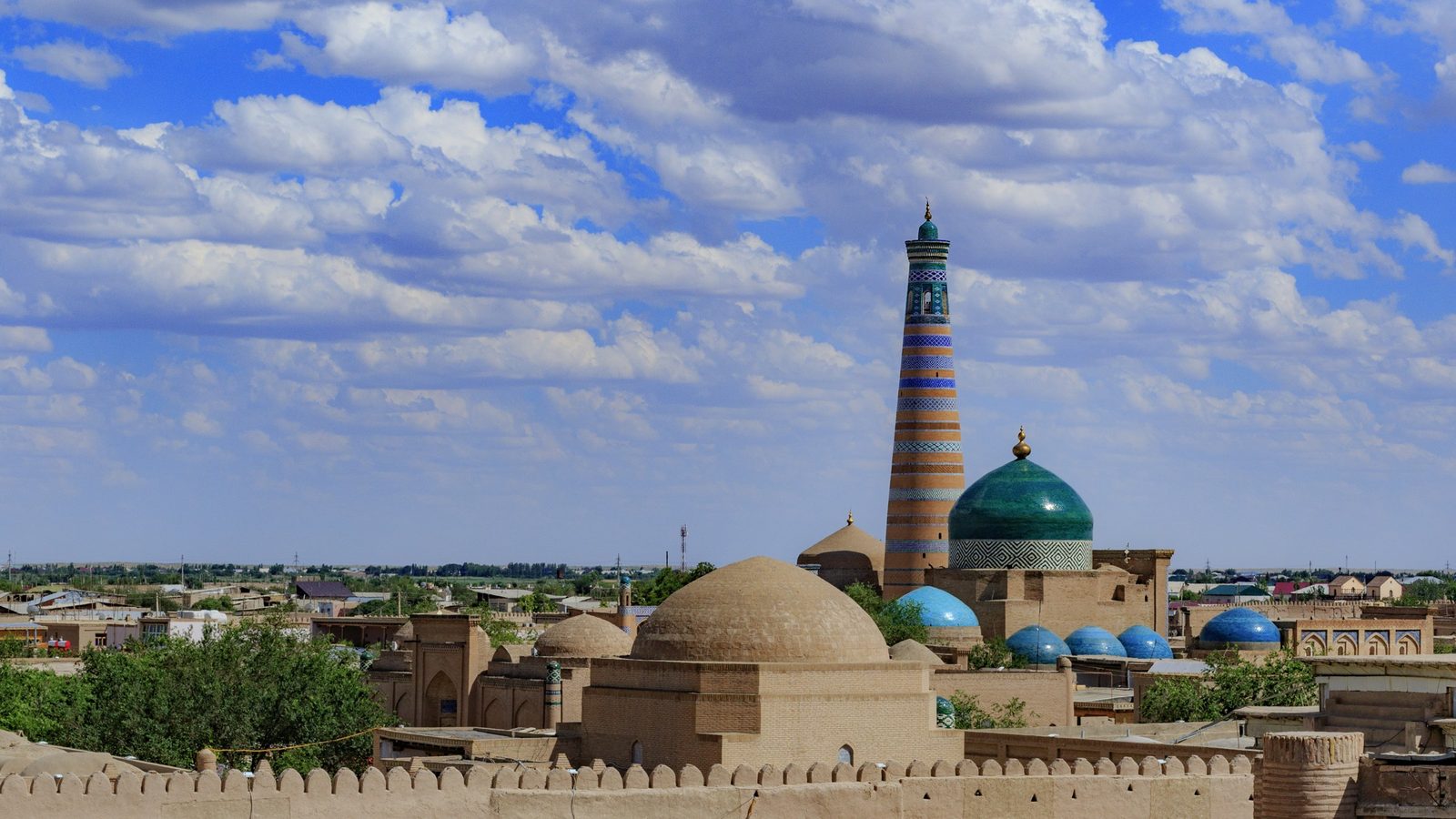
In the afternoon your guide walks you into Ichan-Kala through Ota-Darvoza, the West Gate. The low sun is on the ,Did you know? A 14-metre-wide base for a tower that stopped at 29 m Kalta Minor was begun in 1852 and meant to reach 70–80 m, but work halted in 1855 at about 29 m when its khan died. It is said to be the only minaret covered entirely in glazed tiles. Read more → begun in 1852 and stopped at 29 m in 1855, when its khan died: the only minaret covered entirely in glazed tiles. From there we wander the lanes towards the Did you know? Khiva's tallest minaret is barely a century old The Islam Khoja Minaret was begun in 1908, near the very end of the khans' era. At 56.6 m it is one of the tallest in Central Asia; a spiral stair of 175 steps leads up to its windowed top. Read more → and watch the sunset from a café terrace above the flat clay roofs.
Overnight in Khiva
Day 2 · Khiva — Ichan-Kala from gate to gate
In the morning, the The old fortress-residence of the khans of Khiva, inside the walls of Itchan Kala. beside the West Gate, the khans’ citadel, with its reception hall of 1804–1806 lined with blue and white tiles. Then across the old town to ,Did you know? In Tash-Hauli's harem each of four wives had her own loggia Allakuli Khan built the Tash-Hauli palace in 1830–1838 around three courtyards. In the harem four tall loggias belonged to the khan's four wives and a fifth, the largest, to the khan himself; behind each summer terrace lay a winter room. Read more → Allakuli Khan’s palace of the 1830s with more than 260 rooms; in the harem, four loggias belonged to the khan’s four wives and the fifth, the largest, to the khan.
Around noon we reach the ,Did you know? Khiva's Juma Mosque stands on 212 wooden columns Recorded as early as the 10th century and rebuilt in 1788, the Juma Mosque has no portal and no domes: its flat roof rests on 212 carved columns in 17 rows, and some of them are older than the building itself. Read more → when light falls through the openings in its roof onto 212 carved wooden columns, no two alike. Lunch is shivit oshi, Khiva’s green dill noodles. In the afternoon, the Did you know? Legend: a wrestler freed captives with a single cowhide Legend says Pahlavan Mahmud won a bout in India and asked to free as many fellow Khorezmians as would fit in a cowhide. He cut it into one long thin strip and encircled them all. The real Mahmud, a poet and wrestler of around 1300, is Khiva's patron saint. Read more → mausoleum under its turquoise dome, the shrine of the poet and wrestler who became the patron saint of Khiva, and the ,Did you know? A grand vizier brought Khiva a hospital and a telegraph Islam Khoja, grand vizier of Khiva from 1898, funded the khanate's first European-style school, a hospital, a pharmacy, a post office and a telegraph. In 1908–1910 he also built the small madrasah beside his famous minaret. Read more → home to the museum of applied arts. Its minaret, 56.6 m and built in 1908–1910, is the tallest in Khiva.
For the last hour of light we climb the Ak Sheikh Bobo watchtower of the Kunya-Ark: from the top, the domes, minarets and roofs come together into one picture.
Good to know: In the evening we can arrange dinner as guests of a local family in Khiva. Tell us about any food restrictions when you book.
Overnight in Khiva
Day 3 · Toprak-Kala – Kyzyl-Kala – Ayaz-Kala — The fortresses of the Kyzylkum
After breakfast we cross the Amu Darya into Karakalpakstan. This edge of the Kyzylkum is traditionally called Elliq Qala, “fifty fortresses”: the forts that guarded the farmland of ancient Khorezm from the desert. The district still carries the name, Ellikqala.
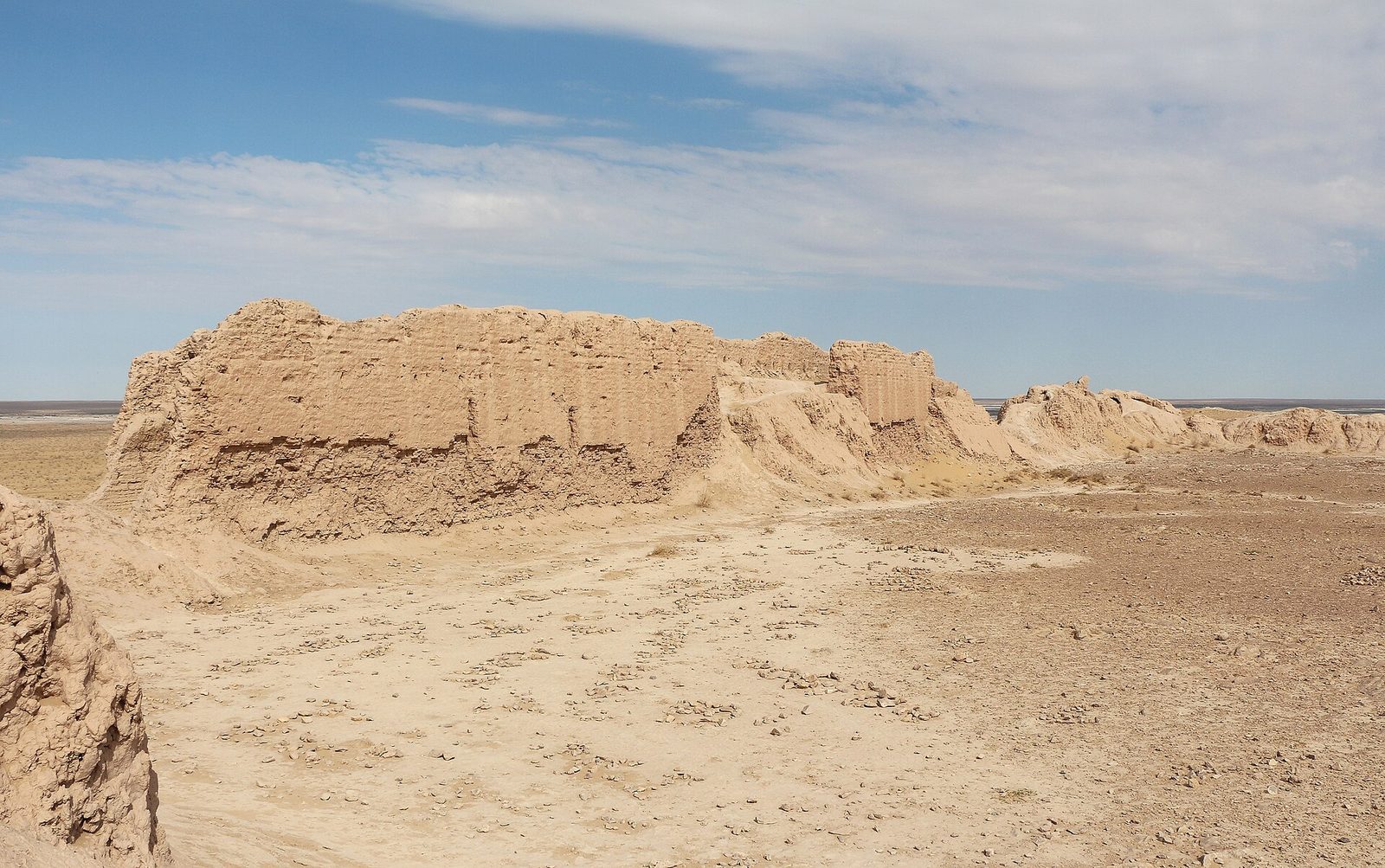
First Toprak-Kala, the capital of Khorezm in the 2nd–3rd century AD: a city of about 500 by 350 m with a fire temple in one corner and the palace in another. Archaeologists named its halls after what they found inside, the Hall of Kings, the Hall of Victories, the Hall of Dancing Masks. Today you read the plan rather than the paintings: long clay ridges and the palace mound above them. Just west stands Kyzyl-Kala, the Red Fortress, a square fort of the 1st–4th century AD, rebuilt in the 12th century, with walls up to 16 m high; it has been restored to show what a fortress of Khorezm looked like when whole.
In the afternoon we drive about 32 km to Ayaz-Kala. It is three fortresses, not one. The oldest, Ayaz-Kala 1, crowns a hill about 100 m high and dates from the end of the 4th or the start of the 3rd century BC: double walls up to 10 m, with a vaulted corridor inside them and 45 towers. From the top you see the other two fortresses, the salt lake Ayazkul and the desert to the horizon. Your guide tells the legend of the shepherd Ayaz, who built the fortress to win the hand of a princess, and we stay on the walls for sunset.
The night is in the yurt camp on a hill near the fortresses, with dinner in the camp.
Good to know: The paths up to the walls are loose sand and crumbling clay: wear shoes with a firm grip, and keep off the tops of the walls. In the camp, showers and toilets are shared.
Overnight in a yurt camp by Ayaz-Kala
Day 4 · Nukus — The Savitsky Museum
Get up for sunrise: the first light reaches the walls across the desert. After breakfast we drive to Nukus, the capital of Karakalpakstan, about 150 km away.
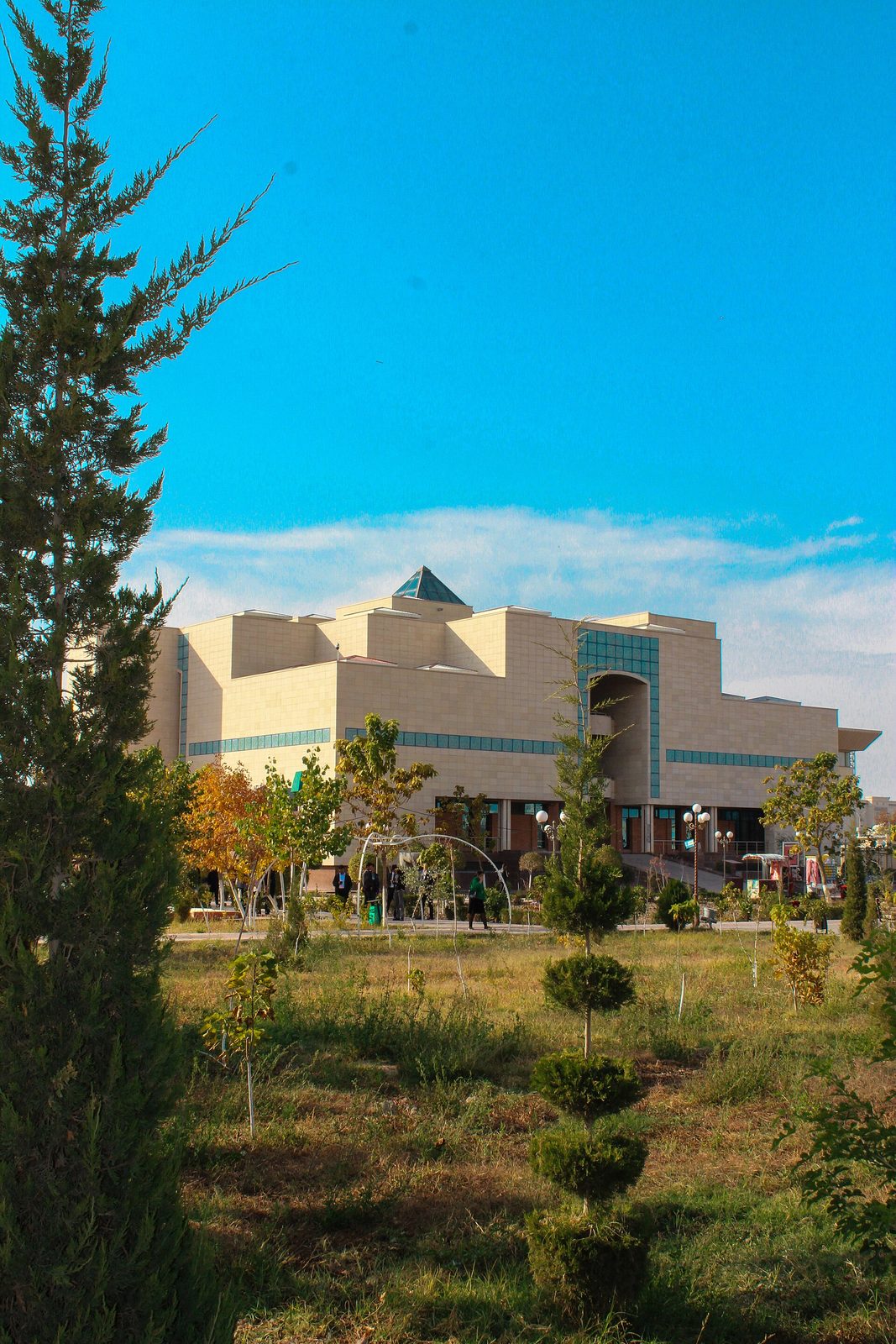
In the afternoon, the State Museum of Art named after Igor Savitsky. Savitsky came to Khorezm in 1950 as the artist of the archaeological expedition led by Sergey Tolstov, the expedition that excavated Toprak-Kala, and in 1956 moved to Nukus for good. He began by collecting Karakalpak jewellery, carpets and embroidered costume, then sought out painters of the 1920s and 1930s and their families and brought their canvases to Nukus. The museum opened in 1966; today it holds about 100,000 objects.
On the walls: the Russian avant-garde, and the art the museum calls Avanguardia Orientalis, painters who settled in Central Asia and painted its towns and people, among them Alexander Volkov, with about a hundred paintings here, and Usto Mumin. Do not hurry past the halls of Karakalpak applied art, almost 10,000 pieces, and the archaeology of ancient Khorezm, more than 15,000 items, including finds from the fortresses you walked yesterday.
Good to know: The museum is open Tuesday to Sunday, 9:00 to 18:00, and closed on Mondays: we set the start date so that this day does not fall on a Monday.
Overnight in Nukus
Day 5 · Nukus – Mizdakhan – Tashkent — The hills of Mizdakhan and the flight home
In the morning we drive about 20 km west of Nukus, near Khodjeyli, to Mizdakhan: three hills that hold one of the most revered burial grounds of the region. We walk the hills from outside, past the domes of the Did you know? At Mizdakhan, a princess’s mausoleum goes underground The Mazlum-Khan Sulu mausoleum is half underground: steps lead down into tiled halls, and little more than the dome shows above the hill. “Sulu” means “beauty” in Karakalpak; who the princess was, history does not say. Read more → and Khalifa Erejep mausoleums. The legend says time will end when the last brick of Khalifa Erejep falls, which is why it is called the “clock of the world”. Next to them stand the ruins of .Did you know? Shells from the Indian Ocean were found near Nukus Gyaur-Kala near Mizdakhan, a Khorezm fortress of the 4th century BC with walls about 10 m high, stood on a branch of the Silk Road. Finds there include coral beads, Indian Ocean shells and fabrics woven with gold thread. Read more →
Mizdakhan is still a place of pilgrimage, so we walk quietly, dress modestly and do not photograph the graves or people at prayer. Back in Nukus there is time for lunch, and if the museum held you yesterday, for a second look. Then our driver takes you to the airport for the flight to Tashkent.
Accommodation
Where you stay
| City | Stay |
|---|---|
| Khiva | A comfortable hotel in Khiva, 2 nights |
| Ayaz-Kala | A yurt camp by the fortresses, 1 night |
| Nukus | A comfortable hotel in Nukus, 1 night |
We confirm the hotels and the yurt camp for your dates before booking. If the camp is closed on your dates, we replace the night in the desert with a hotel.
Price
Price
The price is given on request: it depends on the dates, the hotels, the flights, the size of your group and the language of the guide.
Good to know
Conditions
- In July the average high in Urgench is about 36 °C and the fortresses have no shade: in summer we visit them early and late in the day. In January the average high is under 3 °C.
- Take a hat, sunscreen and more water than you think you need, and a warm layer for the evening in spring and autumn, when the desert cools fast.
- The Pahlavan Mahmud mausoleum, the Juma Mosque and Mizdakhan are places of prayer: shoulders and knees covered, and a scarf for women.
- Read before you go: our guides to the desert fortresses of Khorezm, the Savitsky Museum, Ichan-Kala and the legends of Khiva.
- Programme details, flight times, the hotels and the yurt camp are confirmed for your dates.
- Reservations are confirmed with passport copies only.
Cancellation policy
| Cancellation timing | Penalty |
|---|---|
| 21 days before the service | 20% |
| 20–7 days | 50% |
| 6–0 days | 100% |
Transportation
| Vehicle | Group size |
|---|---|
| Chevrolet Cobalt | 2 pax |
| Hyundai Starex | 3–4 pax |
| Toyota Hiace / King Long | 5–8 pax |
| Mercedes Sprinter | 9–14 pax |
Vehicles may differ in make and colour.
🌿 Responsible tourism: we allocate part of our profits to good causes and are preparing for GSTC certification.
Expert opinion
Pluses
- The walls, then the finds: the halls of Did you know? Toprak-Kala was the palace city of ancient Khorezm's kings In the 2nd–3rd century AD Toprak-Kala was the capital of Khorezm. From 1938 Sergey Tolstov's expedition uncovered its palace, with wall paintings, coins and archives; its sculptures are now in the Hermitage. Read more → on day 3, the archaeology of Khorezm in the The Karakalpakstan State Museum of Art in Nukus, named after Igor Savitsky, who gathered a large collection of Russian avant-garde art there in Soviet times. on day 4.
- A night by :Did you know? Legend says a shepherd named Ayaz built Ayaz-Kala for a bride Legend says a Khorezm king promised his daughter to whoever built an unassailable fortress; the shepherd Ayaz began, the king broke his word, and the walls stayed unfinished. In fact the oldest fort here dates to the 4th–3rd century BC. Read more → a yurt camp on a hill near the fortresses, with sunset and sunrise on the walls.
- No backtracking: you fly into Urgench and out of Nukus, so the road between them is the route itself.
Minuses
- Time on the road: the fortresses and Nukus mean long drives across the desert on days 3 and 4.
- Simple camp: in the yurt camp showers and toilets are shared.
- Hot in summer: in July the average high in Urgench is about 36 °C, and the fortresses have no shade.
AroundCA numbers
How we counted
By the AroundCA programme: we count only what is written in the day-by-day programme of this tour. If the programme gives no figure, we show nothing.
- Hotel changes
- 2
- Walking
- Medium
Walking: Moderate: a full day on foot in Ichan-Kala, and climbs up loose sand and clay to the walls of the fortresses.
Best time
Apr–May, Sep–Oct
April–May and September–October: warm days in the desert and mild evenings for the night in a yurt.
Better to avoid
Jul–Aug
July–August: the average high in Urgench is about 36 °C, and there is no shade at the fortresses.
A typical day
On day 3 you cross the Amu Darya into Karakalpakstan. In the morning you walk the halls of Toprak-Kala, the capital of ancient Khorezm, and the restored walls of Kyzyl-Kala next to it. In the afternoon you drive about 32 km to Ayaz-Kala, climb to the oldest of its three fortresses for the view over the lake Ayazkul and stay on the walls for sunset, then spend the night in the yurt camp nearby.
What the price includes
What is included
- Domestic flights Tashkent – Urgench and Nukus – Tashkent
- A private car with driver from Urgench airport to Nukus airport
- A guide speaking your language on all days
- Accommodation: 2 nights in Khiva and 1 night in Nukus with breakfast, 1 night in the yurt camp with dinner and breakfast
- Entrance tickets on the programme, including the Savitsky Museum
Not included
- Lunches, and dinners outside the yurt camp
- Photo and video fees at the sites and in the museum
- Camel rides at the yurt camp
- International flights
- Tips and personal expenses
Extra cost on site
- Lunches, and dinners outside the yurt camp
- Photo and video fees at the sites and in the museum
- Camel rides at the yurt camp
- Tips and personal expenses
Good for
- Travellers who have seen Samarkand and Bukhara and want the far west of the country
- Lovers of archaeology and of 20th-century art: the fortresses and the finds from them in one trip
- Anyone who would like one night in the desert, with sunset and sunrise on the walls of Ayaz-Kala
Maybe not for you if
- Travellers who want hotel comfort every night: in the yurt camp showers and toilets are shared
- Anyone who does not enjoy long drives: the fortresses and Nukus are a day and a half on the road
- Summer trips in the heat: in July the average high in Urgench is about 36 °C, and the fortresses have no shade
Questions about this tour
How much does the tour cost?
The price is given on request: it depends on the dates, the hotels, the flights, the size of your group and the language of the guide.
What is the night in the yurt camp like?
The camp stands on a hill near the Ayaz-Kala fortresses. You sleep in a yurt, dinner and breakfast are served in the camp, and showers and toilets are shared. It is simple, and the reward is sunset and sunrise on the walls. If the camp is closed on your dates, we replace the night with a hotel.
Why do we fly into Urgench and out of Nukus?
So that you never drive the same road twice. Urgench airport is about 30 km from Khiva; from Khiva the route runs across the Amu Darya to the fortresses and on to Nukus, about 150 km from Ayaz-Kala, where you take the flight back to Tashkent.
Is the Savitsky Museum open every day?
It is open Tuesday to Sunday, 9:00 to 18:00, and closed on Mondays. We set the start date so that the museum day does not fall on a Monday.
Can we add the Aral Sea?
Yes. Muynak and the Aral Sea shore lie north of Nukus, and our 2-day Aral Sea extension fits at the end of this tour. Tell us your dates and we plan the days together.
When is the best time to go?
April–May and September–October. In July the average high in Urgench is about 36 °C, so in summer we visit the fortresses early and late in the day; in January the average high is under 3 °C.
Didn’t find your answer? Ask about this tour →
Make it your trip
Tick what you’d like to add — it goes into your request, and the manager confirms the final price.
Add a few days
Arrival, departure, transfers
© Photos
Kyzyl-Kala fortress, Karakalpakstan — Prof. Mortel / Wikimedia Commons · CC BY 2.0