
Uzbekistan for older travellers: pace, trains, hotels
Places in this article: Samarkand · Bukhara · Khiva · Tashkent
Samarkand to Bukhara takes under two hours on the fast train. That one fact makes Uzbekistan easier for older travellers than the map suggests: you change cities in a morning, sitting down, with no airport queues. The tiring parts are elsewhere: summer heat, uneven paving in the old towns and the temptation to see everything in a week. Here is how we plan an unhurried trip.
A comfortable pace: how many nights in each city
Our rule for a relaxed trip is simple: one move every two or three days, never two train rides in one day, sightseeing in the morning, a rest after lunch and a short walk in the evening. For the classic route that gives about ten nights:
| City | Nights | Why |
|---|---|---|
| Tashkent | 2 | Rest after the flight; the capital at an easy pace |
| Samarkand | 3 | The sights are spread out; two half-days instead of one long day |
| Bukhara | 3 | A compact old town to enjoy slowly |
| Khiva | 2 | Evening and morning inside the walls, without rushing |
On a winter schedule, flights from London and Paris land in Tashkent before 6am. Book the room from the night before, so you can go straight to bed. The day-by-day plan is in Uzbekistan in 10 days. Among our ready-made routes, the 11-day classic private tour runs at an easy pace, and the tour finder with the answer “easy pace” shows the rest.
Trains: Afrosiyob business class and the Khiva train
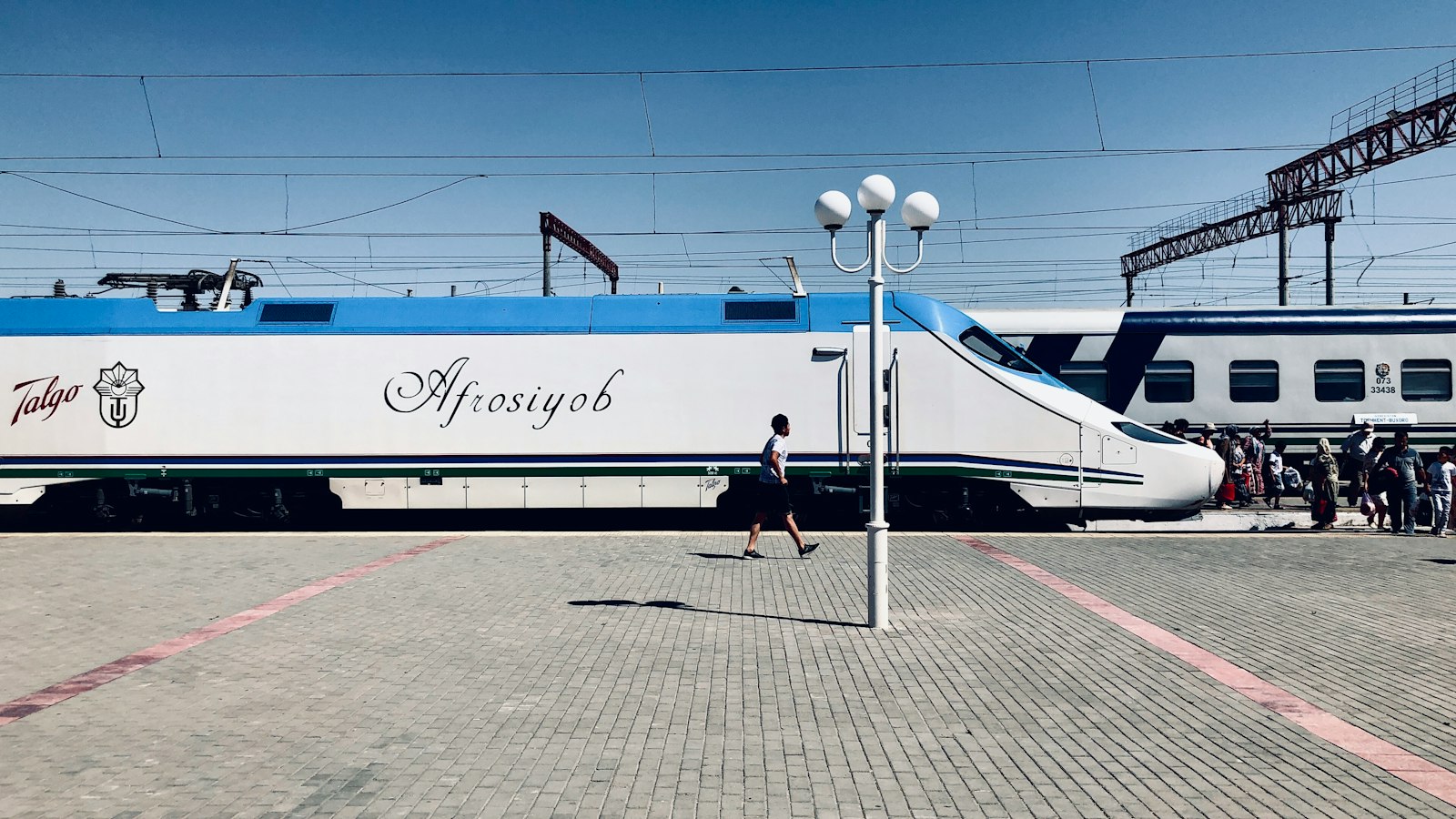
The Uzbekistan's high-speed train: Tashkent to Samarkand in 2 hours 30 minutes, Tashkent to Bukhara in about 4 hours. Tickets are tied to your passport. Read more → is a Spanish-built Talgo train with VIP, Business and Economy classes and a restaurant car. Tashkent to Samarkand takes 2 hours 30 minutes, Samarkand to Bukhara under 2 hours. For older guests we book Business class and a morning train, so you arrive with the whole afternoon to rest or explore.
What to know at the station: you show your ticket and passport to enter, bags are screened, and it is best to come at least half an hour early. Tickets are tied to your passport and go on sale 60 days ahead; Afrosiyob sells out, so book as soon as your dates are fixed. Stations are outside the old towns, more than 6 km from the Did you know? The Registan's sun-carrying lion went on a banknote The Sher-Dor Madrasah (1619–1636) is named for the big cats with the sun on their backs on its portal. The image appeared on the reverse of Uzbekistan's 200-som note of 1997. Read more → in Samarkand and about 12 km in Bukhara, so a car should meet you.
Khiva is the long leg: about 7.5 hours from Tashkent by the high-speed train, or about 3.5 hours from Bukhara. We often suggest the train one way and a flight back to Tashkent from Urgench, the airport for Khiva. If you use a wheelchair or find steps difficult, tell us when you book, and we will plan each station and carriage with you. More in our guide to trains in Uzbekistan.
How much walking: old towns, cobbles and minarets
Samarkand is a city of distances. The Registan, Did you know? Timur's tombstone went to Persia and came back The dark-green jade slab on Timur's grave in Gur-e-Amir was carried off by Nader Shah in 1740. It broke, and on his advisers' urging he sent it back to Samarkand. Read more →, The great mosque Amir Timur ordered after his Indian campaign of 1398–1399, one of the largest of its time. Read more → and Did you know? Why Shah-i-Zinda means 'the Living King' The necropolis grew around the shrine of Qutham ibn Abbas, a cousin of the Prophet Muhammad. Legend says he did not die in battle but went down a deep well to a garden of paradise, where he lives on. Read more → are not one walk, so we drive between them. Shah-i-Zinda begins with a steep stone staircase; take it slowly, and use the handrail.
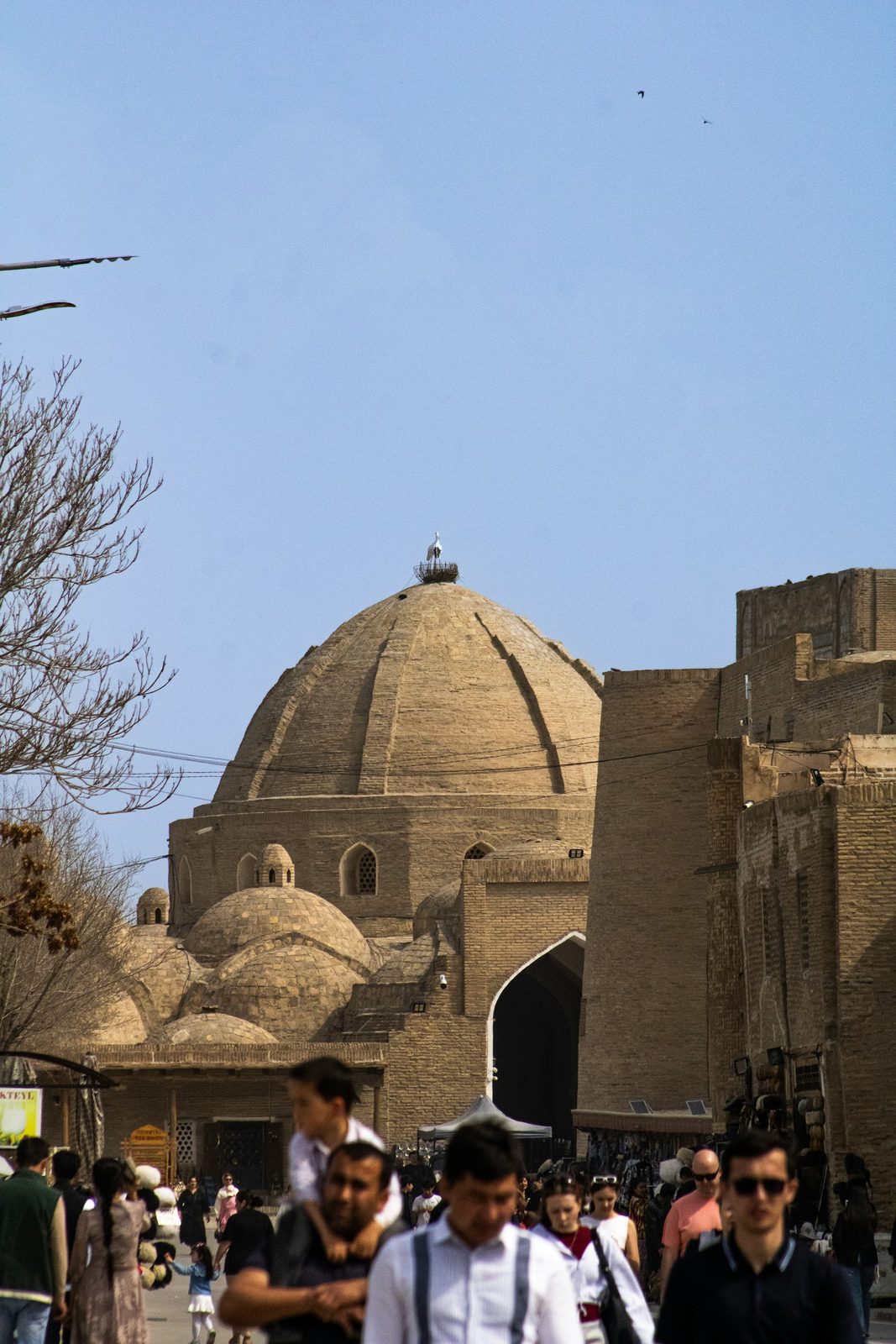
Bukhara is compact: everything worth seeing is within walking distance of Did you know? Bukhara's ponds were once its water supply Pools like Lyabi-Hauz, dug around 1620 and 46 × 36 m, were the city's main source of water. Most were filled in during the 1920s–30s because they spread disease; Lyabi-Hauz survived. Read more →. Khiva is smaller still, but not every lane inside the walls is open to cars, and the driver may stop a short walk from your hotel door.
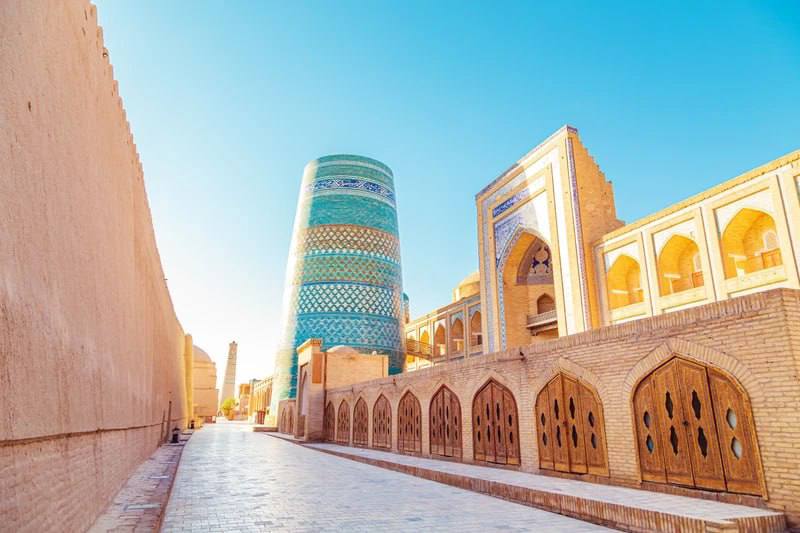
Paving in the old towns is uneven, so wear shoes with a good grip and bring a walking stick if you use one at home. Climbing a minaret, where it is allowed, means a narrow, dark spiral staircase. It is entirely optional, and you miss nothing essential by staying below.
Heat and the best months
For older travellers we strongly suggest April–May or September–October. The average high in Bukhara is about 24°C in April and 23°C in October: walking weather all day. In July it is 37.3°C in Bukhara and 35.9°C in Tashkent. If summer is your only window, see the sights before 11am and after 5pm and spend the middle of the day indoors.
Winter has its own catch. From November to February air pollution is at its worst in big cities such as Tashkent, and it may especially affect older people and anyone with a pre-existing condition.
Health, medicines and insurance
Official advice is plain: medical care in Uzbekistan is generally below Western standards, especially outside the big cities, and insurers usually send serious cases to hospitals in Europe or New Delhi. Take a policy that covers treatment, hospital stays and medical evacuation, and tell the insurer about any existing conditions. With a health condition, this cover matters most of all.
Bring all your regular medicines from home, with the prescription. Prescription medicines must be declared on the customs form, and some medicines containing codeine are restricted here. Check vaccines with your doctor at least eight weeks before you travel. For an English-speaking doctor, there are private clinics in Tashkent. The emergency number is 112. Everything else is in safety and health in Uzbekistan.
Hotels: lifts, ground floors and location
Choose the address first. In Bukhara and Khiva, a hotel in the old town saves you a drive every time you want to rest. Many of these are small boutique hotels in the local style: Devon Begi in Bukhara, for example, has 20 rooms on two floors. Not every small hotel has a lift, so when you book, ask for a ground-floor room or one near the lift. In Tashkent and Samarkand, large modern hotels are the simpler choice if stairs are a problem; still, confirm the lift when you book. More in where to stay in Uzbekistan.
Private tour or group tour?
A private tour is easier on the body. The car waits outside each sight, the guide adjusts the day to how you feel, and an afternoon can simply be cancelled. That is why we suggest it to older travellers first. Gentle one-day routes include the Samarkand Discovery tour and the Bukhara Discovery tour.
A group tour gives you company and a fixed plan, but the pace is the group's. If that suits you, our 4-day Samarkand group tour is unhurried.
At the airport: fast track and wheelchairs
After a night flight, the queue at passport control is the last thing you need. With our CIP Arrival service a staff member meets you at the aircraft exit or in the arrivals area, takes you through the fast-track passport lane, helps with your luggage and walks you to the meeting point. CIP Departure gives you separate check-in and passport counters, a lounge with food and drinks and a separate bus to the aircraft.
Since January 2026 Tashkent airport has 30 wheelchairs for passengers with reduced mobility, free of charge, in the international and domestic terminals. If you need help to and from the aircraft, ask your airline for assistance when you book the ticket.
In short
- Plan one move every two or three days: about ten nights for Tashkent, Samarkand, Bukhara and Khiva.
- Take the Afrosiyob in Business class; for Khiva, consider the train one way and a flight back from Urgench.
- Go in April–May or September–October; in summer, sights before 11am and after 5pm.
- Get insurance with medical evacuation and bring all your medicines with the prescription.
- Ask for a ground-floor room or a lift, and book fast track at Tashkent airport after a night flight.