
Places in this article: Khiva · Tashkent
The Mat in the Compartment
Yoga Retreat · Khiva
The Mat in the Compartment
How to leave for Khiva on Friday night, watch the sun rise over the fortress walls, and be back at your desk by Monday morning
At Tashkent-Yuzhny station, around nine on a Friday night, you can spot your people immediately: rolled-up yoga mats sticking out of their backpacks. That morning, these same people were sitting in meetings and answering emails marked «urgent.» By seven on Monday morning, they’ll be back on this same platform. There will be The Kyzylkum, or Red Sands: the desert between the Amu Darya and Syr Darya rivers that the road and the railway cross on the way to Khiva. sand in the soles of their sneakers. And there will be a strange feeling that a week has passed, not two days.
You don’t need a day off for this. You need a ticket on the night train.
Fourteen Hours When Nothing Is Expected of You
Usually a train is something to endure on the way to a vacation. Here, it is the vacation, part one. There’s no meeting room in the compartment, no one pokes their head in «for a second,» and it’s long been dark outside, so there’s nothing to look at either. What’s left is the rhythm of the wheels, tea in a glass, and the people you’ll be sitting on a sand dune with in complete silence two days from now.
The group brings its own dinner for the road — some buy it on the train, some pack it from home. That’s the only thing you need to think about before Saturday.
Saturday: A City You Can Cross Faster Than You’d Sit in Traffic
The train reaches Khiva around eleven. The group is met at the station, taken to the hotel, and by one o’clock they’re having lunch in the old town.
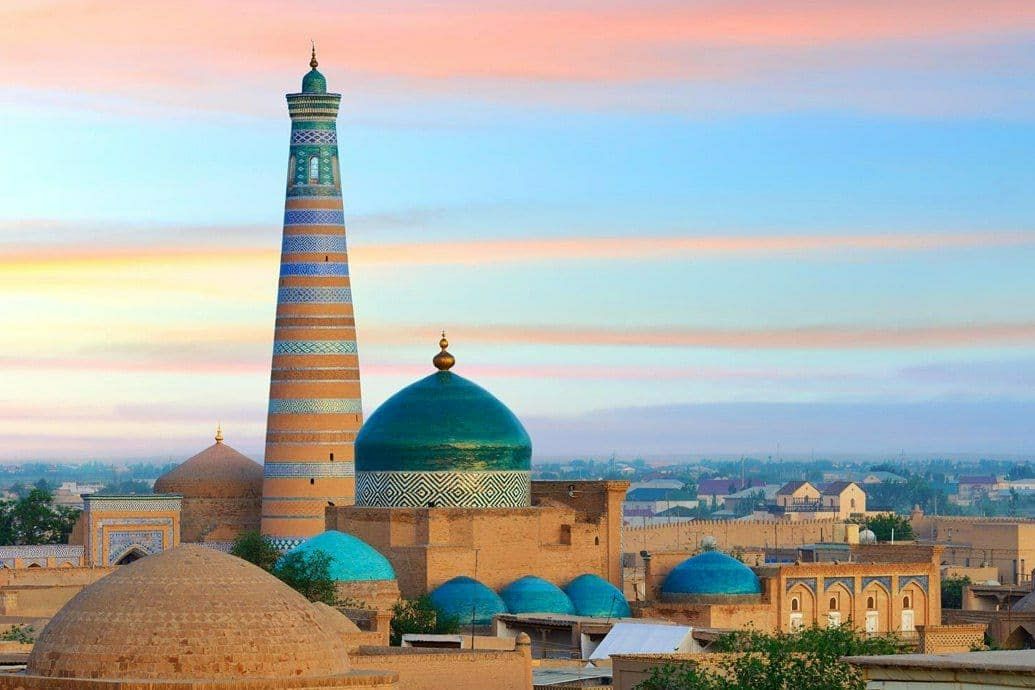
Did you know? People still live inside Khiva's museum city Itchan Kala packs more than 50 historic monuments and about 250 old houses inside clay walls 8–10 m high and 5–6 m thick, and families still live and work in its lanes. Read more → is usually described in dimensions and dates. But the first thing you actually notice is different: you don’t need transport here. Everything inside the fortress walls is close together. In three hours with a guide, the group walks to ,Did you know? A 14-metre-wide base for a tower that stopped at 29 m Kalta Minor was begun in 1852 and meant to reach 70–80 m, but work halted in 1855 at about 29 m when its khan died. It is said to be the only minaret covered entirely in glazed tiles. Read more → ,The old fortress-residence of the khans of Khiva, inside the walls of Itchan Kala. the Did you know? Khiva's tallest minaret is barely a century old The Islam Khoja Minaret was begun in 1908, near the very end of the khans' era. At 56.6 m it is one of the tallest in Central Asia; a spiral stair of 175 steps leads up to its windowed top. Read more → minaret, and the Muhammad Aminkhan An Islamic college: student cells and classrooms around a courtyard behind a grand portal. In the old towns many now house museums and craft workshops. — on foot, the whole way. On a typical weekend trip, this is usually the point where someone says «okay, back on the bus.» Here, that sentence never comes up.
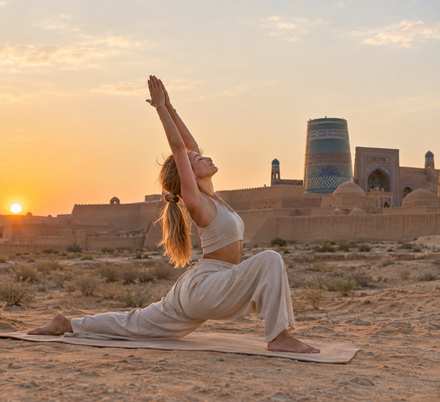
At half past five, the group heads out of the city. Twenty minutes later, the city ends and the desert begins. The evening practice is held right there, as the sun goes down. Then dinner back in Khiva, and free time — though most people spend it asleep.
Sunday: Practice Begins in the Dark
At six in the morning, the hotel terrace is still dark. In late October, the sun over Khorezm rises around quarter past seven. So the morning practice is timed to start before sunrise and end just as the light reaches the old city walls. Almost no tourist ever sees this particular sunrise — everyone else is still asleep at that hour.
After breakfast, the group drives into the Kyzylkum desert, about a hundred kilometers, to .Did you know? Legend says a shepherd named Ayaz built Ayaz-Kala for a bride Legend says a Khorezm king promised his daughter to whoever built an unassailable fortress; the shepherd Ayaz began, the king broke his word, and the walls stayed unfinished. In fact the oldest fort here dates to the 4th–3rd century BC. Read more → This fortress was built more than two thousand years ago on the border between the oasis and the desert. The best way to understand it is to climb the hill on foot and look at what it was actually defending against: sand in every direction. Lunch is at a yurt camp. Camel rides are available for an extra fee, but they’re entirely optional.
By four in the afternoon, the group is back at the station. The train leaves for Tashkent.
Monday, 07:00
The train arrives in Tashkent early enough that everyone makes it home before the workday starts. To be honest, this isn’t really «a weekend that ends on Sunday» — it’s «Friday evening to Monday morning.» The night trains, in both directions, give the weekend back the night it would otherwise have lost.
The Instructor Who Taught Herself Not to Rush
«You are the experiment. You are the experimenter, and you are the result of the experiment.»
Kamlesh Patel (Daaji), Heartfulness guide. Diana has this quote pinned to her Instagram.
Diana Samadinova’s own experiment began in August 2018, with Heartfulness meditation. By her own account, the practice changed her — and her life along with it. What started as a personal interest is now her profession. Diana is a certified Heartfulness meditation trainer and a yoga teacher. She trained at the Kanha Shanti Vanam ashram near Hyderabad, the movement’s main center, and has attended retreats in India. Her foundational certifications are the international RYT-200 (IHYTP) and the YTTC-100 teacher training course at Yogaschool.
But one certificate in particular says more about how Diana will actually lead the group in Khiva. The Yoga Federation issued her a certificate in prenatal yoga — teaching pregnant women. Most instructors are used to students who want to go further, deeper, harder. Diana also works with people who specifically can’t. In that kind of practice, pushing a stretch to its limit means nothing; what matters is knowing exactly where to stop. The people heading to Khiva aren’t seasoned yogis — they’re people coming off a work week with tight shoulders, and some of them will be unrolling a mat for the very first time. That’s exactly the kind of instructor they need.
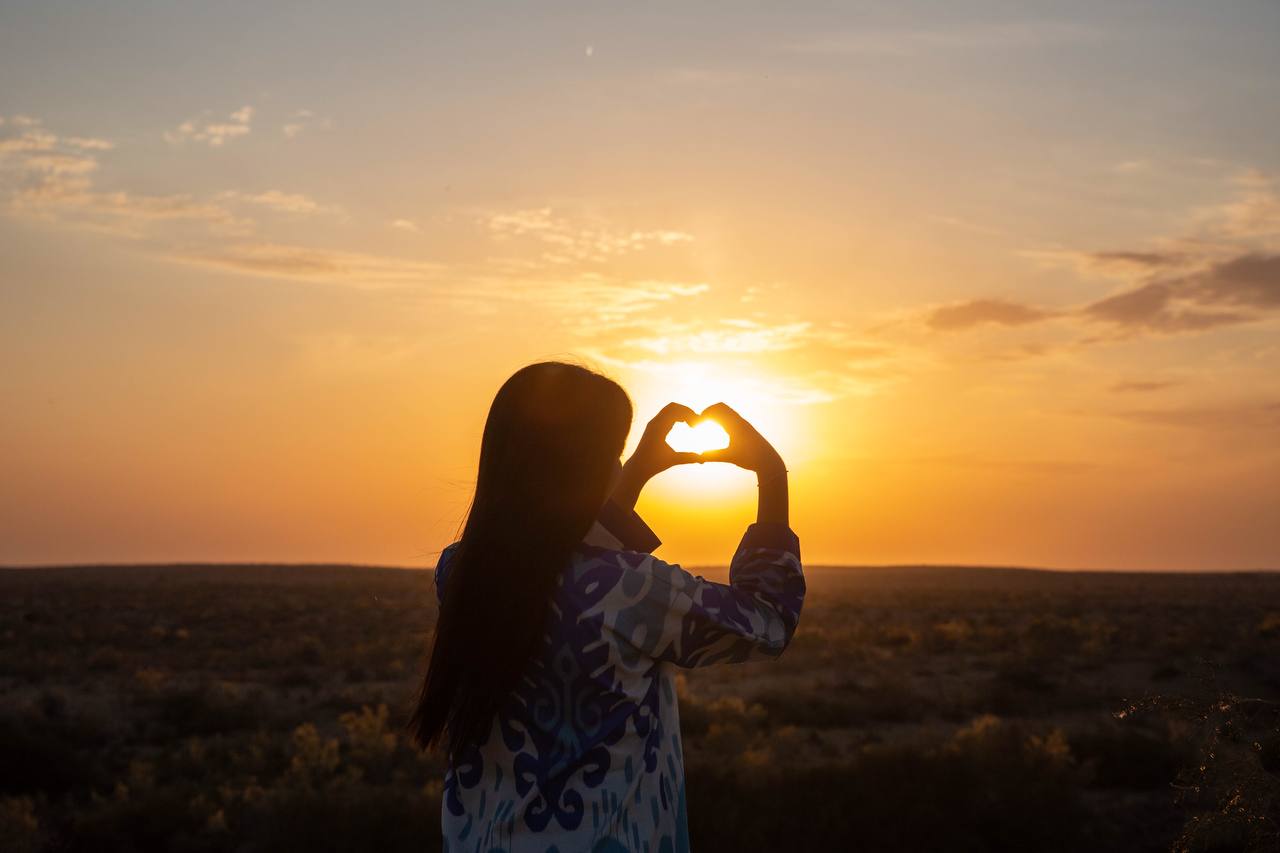
Sunset practice is familiar territory for her too. In September, Diana led an evening Yoga Sunset session on the terrace of the Riviera mall, with singing bowls. So many people showed up that she later thanked each one individually for «trusting the practice.» Khiva will be the same idea — just with the edge of the desert instead of a city terrace, and far fewer people around.
Old cities aren’t new to her either. This autumn she ran a retreat in Bukhara, and over the summer she took a group to .Did you know? Aydarkul is a wetland of international importance In 2008 the Aydar-Arnasay lake system, about 527,000 ha, became a Ramsar site. It lies where two great bird flyways cross and shelters Dalmatian pelicans and the rare white-headed duck. Read more → She also organizes corporate retreats away from the office — clients have included TBC Bank, the UENTER innovation center, OXYMED (Asklepiy), Rano Eco Village, the BI Media agency, and Safia. She knows exactly how to work with people who’ve come straight from a desk.
There’s a small irony in this particular trip. Diana says she spent her first two years in Crimea, and every summer until she was seven at her grandparents’ place on Did you know? Issyk-Kul means 'hot lake', and it rarely freezes At 1,607 m, with harsh winters all around, Issyk-Kul rarely freezes because its water is slightly salty. It is 182 km long and up to 668 m deep, the second-largest mountain lake in the world after Titicaca. Read more → — a childhood spent near large bodies of water. And in October, she’ll be taking a group to a place where the nearest sea is hundreds of kilometers of sand away. Maybe that’s exactly why she understands that the silence of the desert doesn’t need to be filled with anything.
Diana travels to Khiva with the group — same train, same sleeper car.
The Trip, in Short
- DatesOctober 23–26, 2026
- Price$320 per person, all-inclusive
- Group sizeup to 10 people
- Early booking−10% before October 2
Included: round-trip Tashkent–Khiva–Tashkent train tickets in a sleeper compartment; one night at a hotel in Khiva (double room, breakfast included); station-hotel transfers; transport to the desert; guide in Ichan-Kala and in the desert; Ichan-Kala entrance ticket; Saturday lunch and dinner, Sunday lunch in the desert; yoga sessions with the instructor; water; taxes.
Not included: dinner on the outbound train, camel rides, paid entry to the minaret or madrasah viewing platforms, insurance, personal expenses.
What to bring: a warm layer. October mornings in Khorezm are cool, and if the weather turns cold, practice moves to the terrace or indoors.
Next departure — October 23–26, 2026. Groups capped at 10 people.
On Monday, someone at the morning meeting will ask how your weekend was. You could answer honestly: «Two thousand years and one sunrise.» Or you could just stay quiet. Khiva teaches you that too.